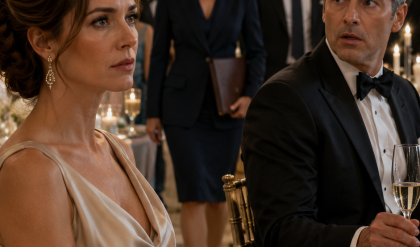
His mistress crossed my children’s names off their education trust and wrote her unborn baby’s name in gold ink. My husband signed the page, then expected me to cry quietly, protect the family name, and let his mother call me difficult. They did not know the trust had a trigger clause, or that the mansion where they planned to replace me was never truly his.
The paperwork arrived at 8:17 on a Thursday morning. It came through the Whitmore Family Office, printed on cream legal paper like it was a wedding invitation. My daughter Ava and my son Noah had been crossed out as beneficiaries. Above their names, in shiny gold ink, someone had written Baby Whitmore-Vale.
I sat at my kitchen island and stared at it while my children ate waffles in the next room. I did not scream. I did not call Graham. I set my coffee down, opened my contacts, and called Harold, the trustee.
Harold already knew why I was calling. His voice was careful, like he was handling glass. He told me the amendment was not valid. Then he told me Graham’s signature had triggered three mandatory provisions: custody review, fraud review, and a freeze on trust-related activity.
That was the moment I understood Sienna had not just insulted me. She had attacked my children. She thought I was the kind of wife who would fold because the family was wealthy, old, and used to women swallowing shame. She thought wrong.
Graham came home that afternoon furious. He stormed into the foyer in his expensive coat and asked what the hell I had done. I was trimming white roses, because steady hands matter when men are losing control. I told him I had answered a phone call.
He said Sienna had made a mistake. I said gold ink was rarely accidental. He said she was pregnant and needed security. I told him pregnancy was not a power of attorney.
His face changed when I said that. For a second, he looked less angry and more afraid. Then he asked where the children were. I told him they were at school, and that the court would decide what happened next.
The next morning, Sienna came to Ava’s school. She knelt in front of my daughter at dismissal, one hand on her stomach, and told her she was someone important to Daddy. I arrived before she could say another word. I told her not to approach my child again.
She smiled like I was being dramatic. So I told her she was violating a pending custody matter on school property. The smile disappeared. Security walked her out while Ava held my hand so tightly her fingers went cold.
By Monday, we were in court. Graham brought two attorneys, his parents, and Sienna in a cream maternity dress. She kept touching her stomach like it was a shield. Patricia Whitmore kissed her cheek in front of me, making sure everyone saw it.
I gave them nothing. No tears. No shaking hands. No speech about betrayal. I wore navy, pearls, and the face of a woman who had already read every document in the room.
Graham’s lawyer called the trust paperwork a misunderstanding. He said my husband was a loving father caught in an emotional transition. He said Sienna was just an expectant mother trying to secure a future. Then Lydia, my attorney, stood and placed the crossed-out trust amendment on the table.
The judge asked Graham if he had signed the page. His lawyer tried to answer for him. The judge stopped him. Graham stood, pale now, and said he signed several documents but did not fully review them.
Then Lydia read his email out loud. “If Evelyn refuses to make space, we will make it legally impossible for her to keep everything for those two.” The courtroom went so quiet I could hear Patricia inhale. Those two. Not our children.
The judge looked at Graham like she had just seen him clearly. Then she asked where Ava and Noah were living. Lydia answered that they were with me at Rose Harbor. The judge looked down at the file and asked one question that made Patricia sit up straight.
“Who owns Rose Harbor?”
PART 2:
Lydia did not rush. She opened another folder and slid a deed across the table. Her voice stayed calm. “Rose Harbor is owned by my client’s holding company.”
Patricia made a sharp sound behind Graham. She had sent Christmas cards from that mansion for twenty years. She had hosted dinners there, posed on the staircase, and treated me like a guest in my own home. Now she was learning the house had never belonged to her son.
Graham stared at the deed like the paper might change if he looked long enough. His lawyer leaned closer, read the first page, and went very still. The judge asked if there was any dispute over ownership. Graham’s lawyer said no.
That was the first time Sienna stopped touching her stomach. Her eyes moved from Graham to me, then back to the documents on the table. She had imagined walking through my front doors as the next Mrs. Whitmore. Instead, she was watching my attorney prove she could not even step onto the property.
The judge granted me temporary primary custody. Graham’s visits would be supervised pending review. Sienna was ordered not to contact my children. All trust accounts stayed frozen while the fraud review continued.
Outside the courtroom, Graham finally blocked my path. His voice was low and rough. He asked if I had planned this. I looked at him and said, “No, Graham. You signed it.”
He flinched at that. Not because I yelled. Because I did not. Men like him expect tears, screaming, begging, anything that lets them feel powerful again.
Sienna stood down the hallway pretending not to watch us. Her cream dress looked less like innocence now and more like costume. Graham glanced at her, and for the first time, I saw doubt on his face. It was small, but it was there.
Two weeks later, the Whitmore Foundation held its winter gala at the Plaza. Patricia refused to cancel it. She said canceling would look like guilt. I thought hosting it looked like denial.
I arrived in a silver dress and walked into that ballroom like I belonged there, because I did. Graham stood near the donor wall with Sienna beside him. She wore emerald velvet and smiled as if the room had already chosen her. I let her think that.
Then Graham went onstage. He spoke about legacy, family, and children. Every word felt like a slap, but I stayed seated. Then he invited Sienna to stand.
The room shifted. Cameras turned. Sienna rose with one hand on her stomach, smiling at me like she had finally won. That was when Lydia’s phone lit up beside me.
She looked at the screen, then looked at me. Her expression did not change, but her eyes did. She turned the phone so I could see the lab notification. At the top was one line: Court-authorized paternity result received.
PART 3: THE HEARING IN PEARLS
The courthouse in Stamford did not care about family names. That was one of the few things I liked about it. Marble halls, metal detectors, fluorescent lights, and benches polished by people waiting for life to divide itself into before and after. I wore navy. Not black, because I was not grieving. Not white, because I was not pretending to be innocent. Navy, pearls, low heels, my hair pulled back. Ava and Noah stayed home with my sister, Claire.
Graham arrived with two attorneys, his father, his mother, and the expression of a man used to private rooms suddenly finding himself in a public hallway. Sienna came too. That was brave or stupid. Often, the two wear the same perfume. She wore a soft cream maternity dress and placed one hand on her stomach whenever anyone looked in her direction. Patricia kissed her cheek. The gesture was small. The message was not. Graham watched me see it.
I gave them nothing. Inside the courtroom, Judge Marianne Keller read the emergency filings in silence. Her reading glasses sat low on her nose. Her face did not move. That made me like her. Graham’s lawyer stood first. He described the trust amendment as a “miscommunication.” He described Graham as a loving father. He described Sienna as an expectant mother caught in an “unfortunate and emotionally charged transition.”
He described me as “reactive.” Lydia rose slowly. “Your Honor, my client reacted by calling the trustee.” That was all she said at first. The judge looked at her. Lydia placed the original trust documents on the table. “The Rose Caldwell Education Trust was created exclusively for the benefit of Ava Grace Whitmore and Noah James Whitmore.” She placed the attempted amendment beside it. “The submitted document crosses out both minors and inserts an unborn child whose paternity has not been established.”
She placed Graham’s signed page beside that. “Mr. Whitmore’s authenticated signature is attached.” Graham whispered to his attorney. Sienna watched the judge. Her hand stayed on her stomach. Lydia continued. “The trust contains a mandatory reporting clause for attempted beneficiary substitution, a fraud review trigger for unauthorized spousal submissions, and an immediate custody risk assessment if a parent participates in diversion of protected assets.” The judge looked at Graham. “Mr. Whitmore, did you sign this page?”
His lawyer stood. “Your Honor, my client signed several documents at Ms. Vale’s request but did not fully review—” The judge raised one hand. “I asked Mr. Whitmore.” Graham stood. For the first time in years, no one could answer for him. “I signed a page,” he said. “Did you know it concerned your children’s trust?” “I knew it was related to family planning.” The judge’s eyebrows lifted slightly.
A quiet courtroom is louder than applause. “Family planning,” she repeated. Graham swallowed. “I did not understand that Ava and Noah’s names had been removed.” Lydia stepped forward. “Your Honor, we have an email from Mr. Whitmore to Ms. Vale sent six hours before submission.” Graham’s head turned. Sienna’s face changed. Just a flicker. But enough.
Lydia read the email without drama. “If Evelyn refuses to make space, we will make it legally impossible for her to keep everything for those two.” My entire body went cold. I had read it already. Still, hearing it in a courtroom landed differently. Those two. Not our children. Those two. The judge looked at Graham for a long time.
He did not look at me. Good. I did not want his remorse while it was still only fear in a suit. Graham’s lawyer objected. Lydia handed over the full chain, including metadata, timestamps, and the family office receipt. The objection died before it had legs. Then Lydia did something I had not expected. She played the voicemail. Graham’s voice filled the courtroom. “I never meant to hurt the children.”
It echoed once, soft and damning. Lydia stopped the recording. “Your Honor, Mr. Whitmore’s admission came after notice of the custody filing.” Judge Keller removed her glasses. “Where are the children currently residing?” “With me at Rose Harbor,” I said. She looked at me. “Is Mr. Whitmore residing there?” “No, Your Honor.” Graham shifted.
The judge glanced at the file. “Who owns Rose Harbor?” Lydia answered. “My client’s holding company.” Patricia made a sound. Small. Sharp. Like glass touched by a knife. The judge turned a page. “And the marital agreement?” Lydia handed up another document.
“The prenuptial agreement contains a child asset protection clause, a fraud-based custody review clause, and a morality provision tied to public reputational harm affecting minor children.” Graham’s father closed his eyes. He knew. Of course he knew. He had signed the guarantor acknowledgment twelve years ago when my mother required it before allowing his son into our family’s financial structure. Patricia had not known. That was clear from the way she stared at her husband like betrayal had finally changed tables. Judge Keller ordered temporary primary physical custody to me. Graham received supervised visitation pending review.
All trust-related accounts remained frozen. All communications with Sienna concerning Ava and Noah were to be preserved. Sienna was prohibited from contacting the children. The paternity issue was reserved. The corporate fraud review would proceed separately. Sienna’s face went pale at the word paternity. That was when I noticed Graham notice. Suspicion is an ugly seed. It does not need much water.
Outside the courtroom, reporters had not gathered because the case was sealed. But rich families have reporters of their own. Cousins. Assistants. Board members. Club wives. Sienna walked ahead of everyone, heels snapping against the marble, one hand clutching her phone. Graham followed her. Then stopped.
He turned back toward me. “Evelyn.” I kept walking. He stepped into my path. “Did you know about the paternity issue before today?” I looked at him. “Do not ask me questions you should have asked before signing away your children.” His face tightened. “Is the baby mine?” I almost felt sorry for him. Almost.
“That is between you, Sienna, and a laboratory.” He glanced down the hall. Sienna was watching us now. For the first time since the affair became public, she did not look victorious. She looked cornered. That afternoon, Graham called me fourteen times. I answered none. At 6:30, he sent a text. I made a mistake. At 6:42, he sent another.
Please do not do this to me. I read it twice. Then I walked into the kitchen where Ava and Noah were decorating cookies with Claire. Noah had frosting in his hair. Ava was laughing. The sound repaired something in me. Not completely. But enough. I deleted the texts. Not the screenshots. Just the texts.
PART 4: THE LAST SIGNATURE
Three months later, winter had surrendered to spring.
The roses at Rose Harbor had started blooming again.
For the first time in years, the house felt quiet—not empty, just peaceful. Ava practiced piano after school. Noah spent afternoons building impossible towers from blocks and insisting they were castles. Claire still came by every Sunday, usually carrying too many desserts and too much gossip.
And Graham kept losing things.
Not money. Not yet.
Respect.
Friends.
Board seats.
Trust.
The Whitmore Foundation had quietly removed him from two committees after anonymous donors began asking uncomfortable questions. The story never became public, but wealthy circles have their own newspapers: dinner tables.
Patricia stopped hosting charity luncheons.
People suddenly remembered they had other plans.
Meanwhile, the paternity results that had arrived during the gala sat inside a sealed envelope on Judge Keller’s desk.
Graham had begged for an expedited hearing.
He wanted answers.
So did Sienna.
The laboratory provided them.
The baby was not his.
Silence filled the courtroom after the report was read.
Sienna’s attorney closed his eyes.
Patricia nearly fell out of her chair.
And Graham…
He just stared.
No anger.
No shouting.
No denial.
Just a man realizing he had destroyed his family for a fantasy that had never belonged to him.
Judge Keller said nothing for several seconds.
Then she asked Sienna one question.
“Would you like to contest the findings?”
Sienna burst into tears.
Not elegant tears.
Not dramatic tears.
The ugly kind.
“No,” she whispered.
There was no point.
DNA did not care about gold ink.
Outside the courthouse, Graham sat alone on a marble bench.
I almost walked past him.
Almost.
He looked older.
Smaller.
Like someone had removed the armor he had worn his entire life.
“Evelyn,” he said quietly.
I stopped.
He didn’t ask me to come back.
He didn’t blame Sienna.
He didn’t mention money.
Instead, he asked the only question that mattered.
“Will Ava and Noah ever forgive me?”
For a moment, I thought about all the things he had done.
Calling them “those two.”
Signing away their trust.
Allowing another woman near them.
Destroying their sense of safety.
And then I thought about Noah, who still asked why Daddy needed supervision.
And Ava, who pretended not to cry when Father’s Day projects came home from school.
“They’re children,” I answered.
“The question isn’t whether they’ll forgive you.”
His eyes lifted.
“It’s whether you’ll become someone worthy of being forgiven.”
I left him there.
Summer arrived.
The fraud investigation concluded.
Several forged submissions from Sienna were discovered.
Criminal charges followed.
Patricia and Charles Whitmore reached a confidential settlement with the trust board.
And Graham voluntarily resigned from Whitmore Holdings.
Not because he was forced.
Because there was nothing left to fight for.
Supervised visits gradually became unsupervised after six months.
Not because I trusted him.
Because Judge Keller believed children deserved a father who was trying.
And for once in his life, Graham was trying.
He attended therapy.
He stopped missing weekends.
He learned how to braid Ava’s hair.
Noah taught him how to build block castles.
Slowly, painfully, he became less of a stranger.
Not my husband.
Never again.
But their father.
One year later, the Whitmore Foundation held another winter gala.
Patricia refused to attend.
Graham declined the invitation.
Instead, that evening he spent time making gingerbread houses with the children.
I attended alone.
Not because I needed anyone to see me.
But because I no longer needed to hide.
Halfway through the evening, Harold approached me holding a folder.
“The final transfer documents,” he smiled.
Everything was complete.
The trusts protected.
The reviews closed.
Rose Harbor secure.
I signed my name.
The same steady handwriting I had used the day everything began.
Then I looked around the ballroom and realized something.
For years, I had fought to protect my children.
I had fought to save my marriage.
I had fought to preserve the Whitmore name.
And somewhere in all that fighting, I forgot one person.
Myself.
“Mrs. Caldwell?”
I turned.
An elderly woman smiled and handed me a champagne flute.
“To new beginnings.”
I smiled.
“No.”
I raised the glass gently.
“To peaceful endings.”
And for the first time in a very long time…
I meant it.
EPILOGUE
Five years later, Ava stood onstage as valedictorian.
Noah sat beside me, pretending not to cry.
Graham sat three rows behind us.
Not next to me.
Not where husbands belong.
But where fathers who earned a second chance sit.
After the ceremony, Ava hugged me first.
Then she walked over to her father.
“Dad,” she said.
“I know you made mistakes.”
Graham’s eyes filled with tears.
“But thank you for staying long enough to become better.”
He couldn’t speak.
Neither could I.
Because forgiveness had never been the reward.
Growth was.
And as the evening sun lit the campus in gold, I realized something beautiful.
Sienna’s gold ink had tried to erase my children.
Instead…
It had written the beginning of a life none of us would ever trade. ✨