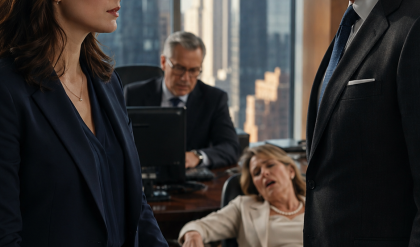
The Nurse Beside My Hospital Bed Asked If I Remembered Her—Then I Saw the Bracelet From the Crash
The first thing I heard after dying was a woman screaming my name.
I did not know I had been dead for forty-seven seconds on an operating table at St. Catherine’s Medical Center in Kansas City.
I did not know a trauma surgeon had opened my chest to stop the bleeding.
I did not know my sister, Claire, had collapsed in the hallway when a doctor told her, “We’re doing everything we can.”
All I knew was the sound of tires shrieking on hot asphalt.
Then metal folded around me like a fist.
One minute, I was driving west on Route 50 in my black pickup, one hand on the wheel, the radio playing an old Springsteen song I had not heard since college.
The late-afternoon sun made the highway shine like glass.
I remember thinking about a roast beef sandwich from a diner outside Warrensburg, a client call I needed to return, and whether I had paid the electric bill at my lake house.
Small thoughts.
Ordinary thoughts.
The kind a man has when he still believes tomorrow is guaranteed.
Then a white delivery truck swerved across the center line.
I saw the driver’s face for half a second.
Wide eyes.
Open mouth.
Both hands jerking the wheel too late.
The impact came before fear could finish forming.
Glass exploded.
The seat belt sliced into my ribs.
My head struck something hard, and my truck spun, rolled, screamed, then landed upside down in a ditch full of summer weeds.
Gasoline dripped somewhere close.
The radio kept playing for three strange seconds after the crash, the singer’s voice warped by static.
I tried to breathe.
Nothing happened.
Then a shadow appeared beyond the cracked windshield.
Someone was running toward me through the ditch.
“Stay with me!” a woman shouted. “Sir, can you hear me?”
I wanted to answer, but my mouth filled with blood.
Her hands reached through the broken window.
On her wrist was a silver bracelet, old and scratched, cheap enough that no rich woman would keep it.
It flashed once in the sun.
Then everything disappeared.
When I opened my eyes again, the ceiling above me was white.
Not heavenly white.
Hospital white.
Flat.
Fluorescent.
Unforgiving.
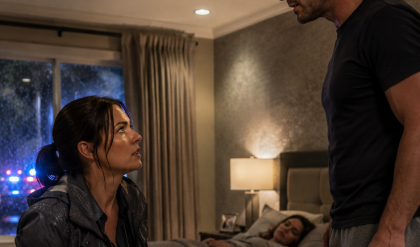
My throat burned like sandpaper. Machines clicked and breathed around me. Something heavy pressed on my chest. Tubes ran from my arms, and my left leg was trapped in a brace.
When I tried to move, pain dragged a sound from me that barely sounded human.
A woman stepped into view.
She wore navy-blue scrubs and a hospital badge clipped to her pocket.
Her dark blond hair was pinned back, but loose strands framed her face like she had been running her hands through it for hours.
Her eyes were red.
She looked at me like she had been waiting years for me to wake up.
“Mason,” she said softly.
My name sounded wrong in her mouth.
Too familiar.
Too careful.
I swallowed hard.
“Where am I?”
“St. Catherine’s,” she said. “Kansas City. You were in an accident.”
Fragments returned like knives.
The truck.
The ditch.
Gasoline.
Sunlight on a silver bracelet.
“How long?”
“Six days.”
My eyes dropped to her badge.
ELENA BROOKS, RN.
I did not know that name.
I was sure of it.
And yet something about her face bothered me, like a memory buried too deep under blood and pain.
Elena leaned closer.
For one second, the nurse disappeared, and a heartbroken woman stood in her place.
“Do you remember me?” she asked.
The question chilled me more than the hospital room.
I searched my mind and found only fog.
“Should I?” I whispered.
The hope in her eyes shattered so fast I almost wished I had lied.
She stepped back and smoothed her expression into professional calm.
“No. It’s okay. You had a serious concussion. Memory gaps are normal.”
But nothing about her voice sounded normal.
The bad news came in pieces after that.
Three fractured ribs.
A punctured lung.
A broken femur.
Internal bleeding.
A concussion severe enough to leave blank spaces in my memory.
They told me I was lucky.
I did not feel lucky.
Before the crash, I had built a billion-dollar construction empire on control.
Now a nurse had to help me sit upright.
My sister Claire visited every afternoon, carrying coffee she never drank.
One evening, she adjusted the flowers by my bed and glanced toward the hallway.
“That nurse has been asking about you again.”
“Elena?” I asked.
Claire’s face changed.
“You remember her name?”
Before I could answer, Elena walked in holding a sealed envelope.
And on her wrist was the same scratched silver bracelet I had seen through the broken windshield.
She looked at Claire.
Then at me.
“Mason,” she whispered, “the truck didn’t hit you by accident.”
Claire went very still.
For a moment, the only sound in the room was the faint hiss of oxygen and the steady beep of the heart monitor beside my bed.
“What did you just say?” Claire asked.
Elena’s fingers tightened around the envelope. The silver bracelet slid down her wrist and caught the light.
“I said the truck didn’t hit him by accident.”
Claire gave a short laugh, but there was no humor in it. “That’s a dangerous thing to say in a hospital room.”
“It’s a dangerous thing to ignore.”
I looked from one woman to the other. My ribs throbbed with every breath. My skull felt packed with broken glass.
“Elena,” I said. “Give me the envelope.”
Claire stepped toward her. “No. Whatever that is, you need to hand it to the police.”
Elena did not move.
“The police already have their version,” she said. “This is his.”
His.
Mine.
Something cold slipped into my stomach.
Elena crossed the room and placed the envelope on my blanket. My hands were weak, clumsy, shaking, but I tore it open anyway.
Inside were photographs.
The first showed my black pickup before the crash, parked outside my office building. The second showed the white delivery truck on Route 50, taken from a traffic camera. The third was a blurry image of a man standing beside the truck at a gas station.
I did not recognize his face.
But the next thing in the envelope made my blood run colder than the hospital sheets.
It was a folded note written in my own handwriting.
Five words.
If I forget, trust Elena.
My throat closed.
Claire snatched the note before I could stop her. She stared at it, then at Elena.
“This is disgusting,” she said. “You forged this.”
Elena’s face hardened. “You know I didn’t.”
“I know you showed up six days ago pretending to be a nurse who just happened to be on duty when my brother was brought in.”
“I work here.”
“And you just happened to be the first person at the crash?”
“I was following him.”
The monitor beside me started beeping faster.
Claire looked as if Elena had slapped her.
“You were what?”
Elena turned to me, and for the first time since I had awakened, I saw fear in her. Not grief. Not shock. Fear.
“You asked me to,” she said. “Two weeks before the crash, you came to my apartment at two in the morning. You were scared. I had never seen you scared before.”
I tried to pull the memory up.
Nothing came.
Only white fog and pain.
“You said someone had been inside your house,” Elena continued. “Someone had opened your safe. Someone had copied documents from your private files. You said the board was about to remove you from your own company.”
Claire crossed her arms. “That is insane.”
Elena ignored her.
“You told me there was a contract hidden inside the Warrensburg project. Payments routed through shell companies. Bribes. Land purchases. A demolition order signed under your name even though you swore you never authorized it.”
A sharp ache moved behind my eyes.
Warrensburg.
The word felt like a match struck in a dark room.
“Elena,” Claire said quietly, “stop.”
But Elena did not stop.
“You said you were going to expose it. You said if anything happened to you, I should look for the bracelet.”
My gaze fell to her wrist.
The scratched silver band.
Old. Cheap. Familiar.
“Why?” I asked.
Elena’s expression broke.
“Because you gave it to me.”
My heart monitor skipped into a frantic rhythm.
“No,” I whispered.
“Yes.”
“I don’t know you.”
“You did.”
The room tilted.
Claire came to my bedside, placing one hand over mine. Her palm was warm, but her fingers were stiff.
“Mason, listen to me,” she said. “You have a head injury. This woman is taking advantage of that. She knew you years ago, yes. She has been obsessed with you since college.”
Elena’s jaw tightened.
“Tell him the rest, Claire.”
Claire’s face changed again.
It was small. Almost nothing.
But I saw it.
The tiniest flicker of panic.
Elena stepped closer to the bed.
“We were engaged,” she said.
The words landed harder than the crash.
I stared at her.
Engaged.
Her face blurred in front of me. For a second, I saw rain on a windshield. A younger woman laughing in the passenger seat. A silver bracelet sliding over her hand as I whispered, “It’s not much, but it’s forever.”
Then the memory vanished.
I gasped.
Elena reached for me, then stopped herself.
“You remember something,” she said.
I could not answer.
Claire’s voice sharpened. “That was twenty years ago.”
“Elena,” I whispered. “What happened?”
She looked down.
“Your father happened.”
At that, even Claire went silent.
My father had been dead twelve years. Harold Voss. Founder of Voss Industrial Construction. A man people praised in public and feared in private. He built half of Kansas City’s commercial skyline and taught me that mercy was something weak men invented after losing.
Elena’s eyes lifted to mine.
“My father died on one of your construction sites.”
A pressure built in my chest that had nothing to do with broken ribs.
“The Northline collapse,” Claire said.
Elena nodded.
“Six men died. Mason was twenty-six. He didn’t own the company yet, but his signature was on the safety waiver.”
“I signed it?” I asked.
“You told me you didn’t read it. You told me your father put it in front of you with a dozen other forms.” Her voice trembled. “But my father was dead, Mason. And your name was on the paper that let them work under unsafe conditions.”
The hospital room seemed to shrink.
“I came to your house after the funeral,” Elena said. “You promised you would tell the truth. You promised you would stand against him.”
Claire looked away.
“And did I?” I asked.
Elena’s eyes filled.
“No.”
Silence.
Not empty silence.
A living thing.
“I waited for you outside the courthouse,” she said. “You walked past me in a black suit with your father’s lawyers. You wouldn’t even look at me. That was the last time I saw you until you came to my apartment two weeks ago.”
I closed my eyes.
Somewhere deep in my mind, something moved.
A courtroom hallway.
Elena crying.
My father’s hand on my shoulder.
His voice in my ear.
Family first, son. Always family first.
I opened my eyes again.
Claire was staring at me.
“You were young,” she said. “Dad forced you.”
“Did he?” I asked.
Her mouth tightened. “You don’t need this right now.”
“No,” Elena said. “He does.”
Claire turned on her. “You have no right.”
“I have every right. Someone tried to kill him.”
“You don’t know that.”
Elena pulled another photograph from the envelope and held it up.
The white truck.
Its front end crushed.
“The driver was identified as Daniel Price,” she said. “Former mechanic. Two felony charges. Three months ago, he got a wire transfer from a company called Lakefront Asset Recovery.”
Claire’s face went pale.
I saw it.
“Elena,” Claire warned.
“Lakefront Asset Recovery is owned by a trust controlled by Voss Holdings.”
The room went silent again.
This time, the heart monitor sounded too loud.
“Claire,” I said slowly, “is that true?”
She looked wounded. Perfectly wounded. The same expression she had worn when we were kids and she had broken my telescope, then cried so hard I apologized to her.
“I don’t handle every shell company attached to Voss,” she said. “You know that.”
“No,” I said. “Apparently, I don’t know much.”
Her eyes flashed.
Then she leaned close enough that only I could hear her.
“Mason, think very carefully before you decide she is the person to trust.”
Elena heard anyway.
“He already did,” she said.
Claire straightened. “I want her removed from his care.”
“You can request that,” Elena replied. “But it won’t change what’s in the envelope.”
Claire grabbed her purse.
At the door, she stopped and looked back at me.
For one second, the sister disappeared.
Something colder stood there.
“You always did choose pain when it wore a pretty face,” she said.
Then she left.
Elena and I stayed in the hospital room with the machines and the photographs and twenty years of ghosts between us.
I looked at the bracelet.
“Why did you keep it?” I asked.
Her hand moved over it protectively.
“For a long time, I thought I kept it because I hated you.”
“And now?”
She looked at me.
“Now I think I kept it because part of me knew you would come back bleeding.”
That night, I did not sleep.
Every time I closed my eyes, I saw pieces of lives I did not remember living.
Elena in a yellow dress under cottonwood trees.
My father’s mahogany desk.
Claire standing at the top of a staircase, whispering into a phone.
The delivery truck crossing the center line.
And the bracelet.
Always the bracelet.
Near midnight, a nurse I did not know came in to check my IV.
He was tall, masked, with kind eyes that did not match the rest of his face.
“You’re not Elena,” I said.
“No, sir. She’s on break.”
His gloved hand moved toward the port in my IV line.
Something inside me tightened.
“What are you giving me?”
“Just something for pain.”
“I didn’t ask for pain medication.”
He paused.
Only half a second.
But enough.
I turned my head toward the call button.
His hand shot out and clamped over my wrist.
Pain exploded through my ribs as I tried to pull away.
“Don’t,” he whispered.
I opened my mouth to shout.
He pressed something cold into my IV.
Before he could push the plunger, the door swung open.
Elena stood there.
For one heartbeat, no one moved.
Then she lunged.
The man shoved the syringe into his pocket and bolted. Elena slammed into him, catching his arm. They crashed into the tray table. Instruments clattered across the floor. He struck her hard enough to send her against the wall, then ran into the hallway.
Elena recovered faster than any nurse should have.
She chased him out.
I heard shouting.
Running feet.
A security alarm.
Then nothing.
I lay there sweating, shaking, useless in my own broken body.
Elena came back three minutes later with blood on her lip.
“He got away,” she said.
“What was in the syringe?”
She lifted the small plastic tube she had torn from his hand.
“I don’t know yet.”
But I knew from her face.
Whatever it was, it had not been for pain.
By morning, the hospital had become a fortress.
At least, that was what they wanted me to believe.
A security guard sat outside my door. My visitors were restricted. The hospital administrator came in with a tight smile and used words like “incident” and “internal review.”
Nobody said assassination.
Nobody said murder.
But Elena did.
She closed the blinds after the administrator left.
“Your sister called at six this morning,” she said. “She wanted you transferred to a private rehab facility owned by one of your company’s medical partners.”
“Convenient.”
“She said it was safer.”
“Would it be?”
Elena did not answer.
That was answer enough.
Later that afternoon, a detective arrived.
His name was Aaron Bell. He had tired eyes, a gray mustache, and the posture of a man who had seen too many people lie badly and too many people lie well.
He asked about the crash.
I told him what I remembered.
The Springsteen song.
The sunlight.
The truck crossing the center line.
The woman running toward me.
He looked at Elena when I said that.
“You were at the scene?” he asked her.
“Yes.”
“Following Mr. Voss?”
“Yes.”
He wrote something down.
“That’s unusual.”
“So is someone trying to murder a patient in your city,” she said.
Detective Bell looked back at me.
“Mr. Voss, do you know a man named Daniel Price?”
“No.”
“Do you know why he would have had your personal cell number written on a receipt in his pocket?”
I went cold.
“No.”
The detective took a clear evidence bag from his folder. Inside was a torn piece of paper.
My number.
And beneath it, two words.
Confirm delivery.
I stared at it until the ink blurred.
“That makes it look like I hired him.”
“Yes,” Bell said.
Elena stepped forward. “He didn’t.”
The detective’s eyes stayed on me.
“Your truck’s brake lines were cut, Mr. Voss.”
My mouth went dry.
“Then how did I drive all the way to Route 50?”
“They were cut partially. Slow leak. Professional job. Enough to fail when pressure built.”
The room seemed to sway.
“So the truck forced me into the crash, and my brakes were already compromised.”
“That is one possibility.”
“What is the other?”
Bell hesitated.
“That you were never meant to survive long enough for us to ask.”
After he left, Elena sat beside my bed.
Neither of us spoke for a long time.
Finally, she reached into her scrub pocket and took out a small black flash drive.
“I wasn’t sure when to give you this.”
I looked at it.
“You have more?”
“You gave it to me the night you came to my apartment.”
“Why didn’t you give it to the detective?”
“Because you told me not to trust the police until you remembered what Project Briar was.”
The name struck me like a physical blow.
Project Briar.
A flash of memory tore through me.
A file room.
Blue folders.
Claire’s voice behind a closed door.
A man saying, “If Mason signs it, the land clears by September.”
Then a child crying.
I grabbed the bedrail.
Elena leaned forward. “What did you see?”
“A child,” I whispered. “I heard a child.”
Her face went pale.
“There was a daycare near the Warrensburg site,” she said.
“No,” I said, though I did not know why. “Not near it.”
The memory came again.
Sharper this time.
A photograph on my desk.
A little girl with dark blond hair and gray eyes.
On the back, written in Elena’s handwriting:
Her name is Lily. She deserves the truth.
I looked at Elena.
My voice barely worked.
“Who is Lily?”
Elena’s lips parted, but no sound came out.
The door opened before she could answer.
Claire entered.
No coffee this time.
No flowers.
No sisterly smile.
Two men in dark suits stood behind her.
Elena rose slowly.
“You’re not supposed to be here.”
Claire ignored her and looked at me.
“Mason, I’m taking you home.”
“No,” I said.
The word surprised me with its strength.
Claire’s eyes hardened.
“You’re confused. You’re being manipulated. I have medical power of attorney.”
“I don’t remember signing that.”
“You did.”
“When?”
She did not answer.
One of the men stepped into the room.
Elena moved between him and my bed.
“Touch him,” she said, “and I scream loud enough to wake the dead.”
Claire smiled faintly.
“You always were dramatic.”
I reached for the flash drive hidden under my blanket.
Claire’s eyes dropped.
She saw.
Everything happened quickly.
She lunged for it. Elena caught her wrist. One of the men grabbed Elena from behind. I tried to sit up and nearly blacked out from pain.
The flash drive slipped from my fingers and fell to the floor.
Claire stepped on it.
There was a small crack.
Something inside me cracked with it.
Then a voice spoke from the doorway.
“I wouldn’t do that again.”
Detective Bell stood there with two uniformed officers.
Claire froze.
The man holding Elena let go.
Bell looked at Claire.
“Claire Voss, I need you to come with me.”
She laughed once. “For what?”
“Questioning.”
“For visiting my injured brother?”
“For obstruction, intimidation, and because we just traced last night’s hospital badge access to a card issued to your assistant.”
Claire’s face did not change.
Not at first.
Then she looked at me.
And smiled.
It was the same smile she had given me when we were children and she knew a secret I did not.
“You still don’t understand,” she said.
The officers moved toward her.
Claire did not resist.
At the doorway, she turned back.
“Elena didn’t come back into your life to save you, Mason.”
Elena went rigid beside me.
Claire’s smile widened.
“She came back because you finally found out what she did with your daughter.”
The world stopped.
My breath vanished.
Elena whispered, “Claire, don’t.”
Daughter.
The word split my skull open.
Lily.
The photograph.
The crying child.
Elena’s bracelet.
My handwriting.
If I forget, trust Elena.
I looked at Elena, but she was no longer the woman who had pulled me from the wreck.
She was a locked door.
And somewhere behind that door was a child with my eyes.
Claire was led away laughing softly down the hall.
Elena turned to me, tears spilling down her face.
“Mason,” she said, “there’s something I have to tell you before your memory comes back on its own.”
The broken flash drive lay on the floor between us.
From inside its cracked casing, a tiny red light began to blink.