# Part 3: The Night Everything Came Into the Light
The Whitaker Heart Institute Gala was exactly the kind of evening Nathan had always loved — chandeliers throwing warm gold across two hundred faces, the soft clink of crystal glasses, and a room full of people who believed that respectability was the same thing as decency.
I arrived alone, which was unusual enough to draw glances. I had told Nathan I would meet him there, that I needed time after my “flight.” He had texted back a heart emoji, which would have been funny if I had not been sitting across from a forensic documents examiner two hours earlier.
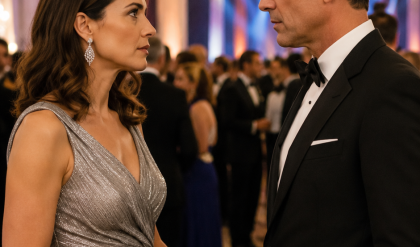
The silver dress I wore was one Nathan had never seen. I had bought it for myself on a Tuesday afternoon six months ago, the kind of purchase a woman makes when she has quietly accepted that no one else will. It fit the way confidence fits — not perfectly, but honestly.
Nathan was across the room when I entered, deep in conversation with a board member, a glass of bourbon held loosely in his surgeon’s hand. He spotted me and smiled, the particular smile he reserved for public settings, warm and proprietary and just slightly performative. He crossed the room and kissed my cheek.
“You look stunning,” he said, as if he had just remembered how.
“I know,” I said.
He laughed, assuming it was a joke.
—
The program began at eight. Dinner was served, speeches were made, and donors applauded the hospital’s record year. I ate quietly, smiled at the right moments, and watched Nathan work the room the way he always did — with his hands clasped behind his back, his head tilted forward as if every person he spoke to was the most important one in the world.
I had placed three things in my clutch that evening.
The first was a USB drive containing the airport video, along with two months of phone records my attorney had helped me obtain.
The second was a letter from a forensic document specialist, confirming that the signature on the Cole Legacy Foundation insurance amendment was not mine. The ink composition, pressure patterns, and letter spacing were consistent with forgery.
The third was a printed copy of an article I had found at 2 a.m., buried in a medical ethics archive from four years ago. It described an internal complaint filed against an unnamed cardiovascular surgeon at a Portland hospital in connection with an experimental cardiac implant trial. The complaint alleged that the surgeon had rushed a patient’s eligibility approval in exchange for early access to the technology — access that would have made him a named partner in the device’s commercialization. The patient had died. The complaint had been quietly resolved. The surgeon’s name had been redacted.
But the name of the medical technology company had not.
Hartwell Medical Systems.
Vanessa’s father had not simply died during a routine procedure. He had been one of the patients enrolled in that trial. And Vanessa had spent the last three years building a career inside the very company at the center of his death, getting closer and closer to the man her father had trusted.
I had spent a long night rearranging everything I thought I understood. Nathan had not simply taken a mistress. He had taken one who knew exactly who he was. The only question I could not yet answer was whether Vanessa was in love with him, or whether she had come for something else entirely.
—
At nine fifteen, the host invited Nathan to the stage.
The room rose to its feet before he even reached the podium. Nathan accepted the applause with practiced humility — a slight bow, a hand over his heart, the half-smile that photographed beautifully. A framed award was handed to him. A board member called him a man of integrity, which produced another round of applause.
I did not stand.
Nathan began his speech. He thanked the hospital. He thanked the donors. He thanked his colleagues. Then he looked out across the room and found me, and his voice softened in the way that made everyone around me lean in.
“And most of all,” he said, “I want to thank my wife, Claire. Fifteen years beside someone who makes every room more beautiful. I would not be standing here without her.”
The room turned to look at me with warm, approving smiles. Someone nearby touched my arm. Someone else whispered, “He adores you.”
I smiled back at every single one of them.
And then I stood, smoothed my silver dress, and walked toward the stage.
—
Nathan’s expression flickered only once. Just a half-second of confusion, because this was not part of the program.
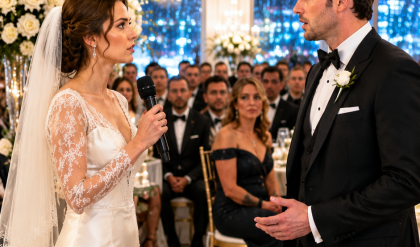
I climbed the three steps to the stage and leaned toward the host’s microphone before anyone had time to object. The room went very still, the way rooms do when they sense that something is no longer rehearsed.
“Thank you,” I said. “I have been coming to evenings like this one for fifteen years, standing beside my husband, smiling at all of you, and feeling deeply grateful for the life we had built.”
I paused. Nathan was three feet to my left, his jaw set, his eyes fixed on mine with an expression I recognized — it was the same calculation I had seen a hundred times when he was deciding how to manage a situation.
“Tonight I need to be honest with you all,” I continued, “because honesty is what this room deserves, and it is what I have deserved for a very long time.”
I reached into my clutch and placed the USB drive on the podium.
“Three days ago, I stood behind a pillar at Portland International Airport and watched my husband greet a woman named Vanessa Hart with ivory roses and a kiss that had nothing temporary about it.” I did not raise my voice. I had managed enough high-pressure rooms to know that stillness is more powerful than volume. “I recorded it, because I have spent fifteen years learning that in the absence of proof, pain is just a personality flaw.”
The silence in that ballroom was the most complete I had ever heard.
“I am also in possession of a forensic report confirming that my signature was forged on a life insurance document that routed a substantial benefit through the Cole Legacy Foundation — a foundation named after both of us, signed by neither of us equally.”
I looked at Nathan then, directly and without flinching. His face had gone the careful, neutral color of a man who was already deciding his next move.
“I am not here to destroy you,” I said quietly, and I meant it. “I am here because I refuse to be the last person in this room who knows the truth.”
I stepped back from the microphone.
—
The host did not know what to do, which meant no one else did either. Nathan reached for the microphone with steady hands — he always had steady hands — and said something about a misunderstanding, about stress, about private matters. He said it calmly and professionally, the way he said everything, and I could see some faces in the crowd beginning to recalibrate, the way faces do when they are deciding whose version of events is more comfortable.
That was the moment the ballroom doors opened.
Two people walked in. The first was my attorney, Margaret Yuen, carrying a leather folder. The second was a woman I had called the previous evening after reading the medical ethics archive — a journalist named Dana Park, who had spent two years trying to identify the redacted surgeon in that complaint and had never quite been able to close the story.
Dana had closed it that afternoon.
She was not there to make a scene. She was simply there, visible, in the room — which was enough. Nathan saw her and I watched something shift behind his eyes. Not guilt, exactly. More like the particular exhaustion of a man who has finally run out of distance.
—
I did not stay for what came next.
Margaret guided me out through a side exit, into a corridor that smelled like industrial carpet and cold air. Behind us, the sound of the ballroom rose and then fell into something chaotic and unbeautiful.
Outside, the November air was sharp and clean. I stood on the sidewalk and breathed it in.
My phone lit up once — Nathan’s name on the screen. I looked at it for a long moment, then declined the call and dropped the phone into my bag.
—
The months that followed were neither clean nor simple. Divorces never are, and this one had layers that took lawyers, accountants, and one very patient therapist to work through. The forged signature triggered a formal investigation. Nathan retained the best legal representation money could buy, which told me everything about the kind of man he had always been.
Dana Park’s story ran in a regional medical journal and was picked up nationally within a week. The redacted surgeon was no longer redacted.
Vanessa Hart, as it turned out, had not come to Portland for love. She had come for evidence. She had spent three years positioning herself close to Nathan, gathering documentation, building a case her father could no longer build himself. The affair had been real, she said later in an interview — or at least, something that had looked like it — but it had also been useful, and she had allowed it to be both.
I did not know how to feel about Vanessa for a long time. Then one afternoon I stopped trying to decide and simply let the complexity of it exist without requiring a verdict.
—
The following spring, I reopened my studio after six weeks away.
My business partner, Elena, had kept everything running in my absence. The morning I came back, she had placed a single stem of ivory ranunculus on my desk — not roses, not a bouquet, just one careful flower in a thin glass vase.
“I didn’t know what to get,” she said. “But you always say one well-chosen thing is worth more than a dozen careless ones.”
I sat down at my desk and looked at the ranunculus for a long time.
I had built a career on meaning, presentation, timing, and intention. I had spent fifteen years applying those principles to every client’s wedding, every donor’s gala, every farewell party for people I had never met — and almost none of them to my own life.
That was the thing about designing beauty for other people. You could get so good at making their moments feel complete that you forgot your own moments were also allowed to matter.
I pulled out my notebook and began writing the first proposal for a new event. A small one. Mine.
A dinner, for twelve women I loved, in a room full of flowers I would choose for no reason other than that they pleased me.
It was the most important event I had ever planned.