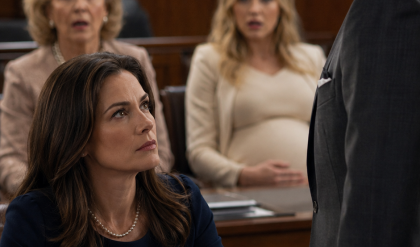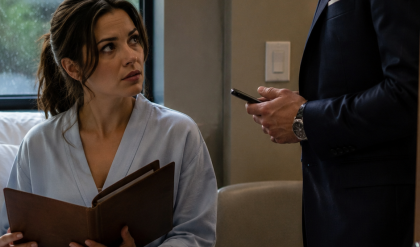
The Last Waitress — What the Mafia Boss Saw in Her Eyes Changed Everything
PART 1:
“You’re collateral now.”
Caleb Royce said it like it was nothing. Like he was commenting on the weather, or ordering another drink, or tossing a napkin onto the floor and expecting someone to pick it up.
Elena did not move. Did not pull away. She had learned — in the six weeks she had worked at Vesper, in the three months before that when she had first understood what Marco had gotten himself into, and in the twenty-six years before that when her father had taught her the same lesson in different rooms with different furniture — that the moment you showed them where the pain was, it never stopped.
So she held the tray. Or tried to. It slipped anyway.
Glass hit polished wood. Ice scattered. The sound cracked through the bass like a starting pistol, and for one impossible second, every pair of eyes in Vesper turned toward her.
Then they turned away.
That was the rule. You did not get involved. You looked, you catalogued, you filed it away for later use — but you did not step in. Not in Vesper. Not when Caleb Royce’s hand was wrapped around a woman’s wrist and his smile had that particular quality to it, the one that said he had already decided how this would end.
Elena’s palm was wet. She realized distantly that she had cut herself on the glass.
“Let go,” she said. Quietly. Not a plea. More like the tone you used when you were telling a child a fact they hadn’t learned yet.
Caleb’s smile widened slightly, which meant he had heard the composure in her voice and had decided to interpret it as a challenge rather than a warning. That was always the mistake men like him made. They confused stillness for weakness.
“You know what I find interesting?” he said, his gaze dropping — deliberately, intentionally — to her stomach. She was not showing yet. Not visibly. But she had touched that spot without thinking twice already tonight, that small reflexive gesture she had not yet trained out of herself. He had noticed. Of course he had noticed. Men like Caleb catalogued weakness the way other people catalogued exits.
He looked back up at her face, and what she saw in his eyes was not cruelty. It was something worse: amusement. The pleasure of someone who had found a new leverage point and was already mentally calculating its yield.
“Marco left quite a debt,” he continued. “And Marco left quite a lot of other things too, it seems.”
The grip tightened.
Elena made a decision.
Not the kind of decision that came with clarity or courage. The kind that came with no other options — when the animal brain stops calculating odds and simply acts because the alternative is to stand still while the world closes in.
She turned her head toward the far end of the room.
Not a dramatic turn. Not a plea. Just a slow, deliberate rotation of her gaze — away from Caleb’s face and toward the table that no one approached unless summoned. The table where the air was always a little quieter, a little heavier, as if the atmosphere itself understood the difference between power that was performed and power that simply existed.
She had never looked directly at him before.
She looked now.
He was already watching.
Dominic Voss had been running Vesper for eleven years, which meant he had watched exactly two thousand and seven hundred shifts of staff come and go, had overseen deals that made and unmade careers and occasionally lives, and had learned to read a room the way other men read balance sheets — not for what was on the surface, but for what the numbers underneath were actually saying.
He had watched Elena Vasquez for six weeks.
Not because she was beautiful, though she was. Not because she was competent, though she was that too, quietly and without seeking acknowledgment for it. He had watched her because of the way she moved through Vesper — like a woman who understood exactly where she was and had decided, deliberately, to be there anyway. There was a calculation behind her eyes that most of the staff never developed. A survival intelligence.
He had also watched the way her hand went to her stomach.
He was not supposed to notice things like that. His enforcer, Gideon, would have told him it was not relevant. His accountant, Mr. Fitch, would have told him it was a liability. The cold, efficient part of him that had built an organization on the understanding that sentiment was a currency too expensive to spend would have agreed with both of them.
But Dominic Voss had a particular weakness that he had spent eleven years disguising as something else: he did not like watching people be destroyed for other people’s debts.
He noticed the tray hit the floor. He noticed Caleb’s hand on her wrist, which was not unusual. He noticed the way she did not flinch, which was unusual. And then he noticed the moment she turned her head and looked directly at him — calm, precise, and completely without expectation.
She was not begging.
She was informing him. The way you informed someone of a fact they needed to make a decision.
Dominic set down his glass.
Gideon, seated three feet to his left, went very still in the particular way that meant he was preparing to move.
“Not yet,” Dominic said quietly.
He stood. “The everything you asked for.”
The shift in the room was not dramatic. It never was, with him. Dominic Voss did not need to raise his voice or knock over a table or even increase his pace. He simply moved through the space and the space adjusted. Conversations that had been in progress finished themselves faster. Staff found reasons to be elsewhere. Even the music seemed to lower itself one half-degree.
Caleb registered it. Elena could see the exact moment the awareness crossed his face — the slight recalibration behind his eyes as his confidence renegotiated with whatever instinct had kept him alive this long.
He did not let go of her wrist.
“Caleb.” Dominic’s voice was not loud. It did not need to be.
“Dom.” Caleb smiled — the performer’s reflex of a man who had learned to keep smiling even when his legs were uncertain. “I’m in the middle of a collection matter. The girl’s boyfriend owes—”
“I know what Marco Reyes owes.” Dominic stopped at a distance that was just close enough to be meaningful. His eyes moved to Caleb’s hand on Elena’s wrist, then back to Caleb’s face. “Let her go.”
“She’s collateral.”
“She’s my staff.”
The two statements sat in the air between them for a moment. Caleb’s jaw tightened almost imperceptibly.
“The debt’s legitimate,” he said.
“The debt is under review.” Dominic’s tone did not change. It was not a bluff — Elena somehow knew that, in the way you knew certain things about certain people within seconds of being near them. “And even if it weren’t, she isn’t Marco. Release her wrist.”
Caleb looked at her one more time. That assessing, inventory-taking look. Then he let go.
Elena did not rub her wrist. She would not give either of them that. She picked up the broken glass with her free hand, set the pieces back on the tray with the slow deliberate movements of a woman who had always been the one to clean up other people’s messes, and looked at Caleb with the specific expression she had perfected over years of practice — the look that said I see exactly what you are, and you don’t frighten me as much as you think.
“Thank you,” she said to Dominic. Evenly. Without debt in her voice.
He looked at her for a moment — not the way Caleb had looked at her, but the way someone looked when they were trying to understand a thing they had not expected to find.
“Finish your shift,” he said. “Then come to my office.”
It was not a question. Elena nodded once, turned, and walked away.
Behind her, she heard Caleb say something low and cold. She heard Dominic’s response even lower, even colder.
She did not look back.
PART TWO: THE ARCHITECTURE OF DEBT
She had three hours left.
Elena moved through them the way she had learned to move through every difficult thing — by staying in the present moment. Not the past, where Marco’s voice on the phone three months ago still replayed in her head (It’s nothing, Lena, I handled it, I always handle it). Not the future, where the complications of the next several months extended out in a direction she couldn’t fully see yet. Just this table. This order. This tray.
The cut on her palm had stopped bleeding. She had wrapped it with a bandage from the staff kit in the back, ignored the question in the eyes of Petra, the other waitress on her section, and returned to work.
Petra was twenty-two and had worked at Vesper for six months and had learned exactly how much curiosity to suppress. She handed Elena a fresh cloth and said nothing. Elena was grateful for that.
At eleven, during the brief lull before the late crowd arrived, Petra leaned against the bar and said, almost casually, “You know most people don’t look at him.”
“I know.”
“Like directly look at him. Most people look at the table next to him. Or the floor.”
“I know.”
“What did you — I mean.” Petra stopped herself. “Never mind.”
“I needed him to make a decision,” Elena said simply. “People like that don’t act unless they’ve made a choice. You can’t beg them into it. You have to give them information and let them decide.”
Petra was quiet for a moment. “That’s either very smart or very—”
“It’s what I had.”
She carried the rest of her shift in her chest, in that compressed way she’d learned to carry difficult things — not suppressed, just set aside until there was space to examine them properly.
By the time she knocked on the office door at the end of the hall, the club had moved into its late-night rhythm and the door to the main floor felt very far away.
“Come in.”
The office was not what she’d expected. She wasn’t sure what she’d expected — something more overt in its power, maybe. Flags of wealth arranged for maximum intimidation. Instead it was spare. A desk. Two chairs. A single lamp. One window that faced the alley, not the street. Books on a shelf, real ones with cracked spines, and a half-empty glass of water that someone had forgotten to finish.
Dominic Voss stood at the window with his back to her.
“Sit down.”
She did.
He turned. In the office light he was different from the figure at the far table — less mythological, more specific. She could see the tiredness around his eyes, the slight tension in his jaw. He looked like a man who had been carrying something heavy for a long time and had stopped noticing the weight because it had become structural.
“How long have you been pregnant?”
The directness was deliberate. Elena recognized it as a test — not of the information itself, but of how she handled being caught off guard.
“Fourteen weeks,” she said.
“Does Marco know?”
“Marco is gone.”
A pause. “Gone as in—”
“As in I haven’t heard from him in six weeks, and the last time I did, he told me not to try to find him.” She held his gaze. “So. He may know. I told him before he left. He didn’t say very much about it.”
Something moved in Dominic’s expression. Something she couldn’t quite read — not pity, she would have left immediately for pity — but something that was adjacent to recognition.
“Caleb Royce works in collections,” he said. “He’s effective at it. He’s also creative in ways that go beyond what I’ve authorized.” He said it with the flat precision of someone reading out a report. “The debt Marco owes is real. Two hundred and forty thousand, accumulated over eight months.”
Elena absorbed this. The number was larger than she’d expected, which meant her estimate of Marco’s capacity for self-destruction had still been optimistic.
“I can’t pay it,” she said.
“I’m not asking you to.”
“Then why am I here?”
He sat down on the edge of the desk — not behind it, she noticed; a deliberate choice that reduced the distance between them to something more conversational. He looked at her in that same appraising, non-threatening way he’d used on the floor, and she had the unsettling sense that he was not looking at her body or her face but at something she couldn’t see clearly herself.
“Because I’ve been watching you work for six weeks,” he said, “and I have a problem you might be able to solve.”
The problem was this: for the past three months, someone had been skimming from Vesper’s accounts. Not large amounts. Nothing that would immediately trigger an audit. But consistent — the kind of consistent that required access, knowledge, and enough proximity to understand the rhythm of what looked normal.
Dominic laid it out for her without preamble. He had discovered it eight days ago. He had not yet told Gideon, not because he didn’t trust Gideon, but because the amounts and timing suggested it was someone close — someone who knew when the books were reviewed, what the review process looked like, and how to hide within the noise of legitimate transactions.
“It could be Caleb,” Elena said.
“He crossed my mind.”
“But you don’t think it is.”
“Caleb skims in obvious ways. He adds to his expense reports. He takes a percentage off collections he doesn’t fully declare. He does it because he believes he’s untouchable and can’t be bothered to be clever.” Dominic’s voice was not contemptuous. Just analytical. “This is clever. This is someone who understands accounting.”
“I was a bookkeeper,” Elena said. “Before.”
“I know.”
She looked at him. “You looked into me.”
“When you were hired. Basic background.” He paused. “You worked for a regional shipping company for four years. Before that you did freelance accounting work. You’re good at finding where money isn’t where it should be.”
Elena was quiet for a moment. “You want me to look at your books.”
“I want you to look at my books and tell me where the problem is.” He reached into the desk drawer and slid a folder toward her. “Not who. Just where. I can find who once I know the structure of it.”
“And in exchange?”
“Marco’s debt disappears. Caleb stops seeing you as collateral.” He held her gaze steadily. “And you keep your job until you decide you don’t want it anymore.”
Elena looked at the folder. Then at the window. Then at the half-empty glass of water that someone had forgotten to finish.
“This is dangerous,” she said. “If whoever’s doing this realizes I’m looking—”
“I know.”
“You’re asking me to take a risk on behalf of an organization that I have no loyalty to, that my boyfriend borrowed a quarter million dollars from, while I’m—” She stopped. Started again. “While I’m in a situation that significantly limits my options.”
“Yes.”
She looked at him. “Why not just hire someone outside? An external auditor?”
“Because whoever this is knows my operation. An outside auditor would see the what but not the why. You’ve been watching how this place runs for six weeks. You already know the rhythm.” He paused. “You know who goes where and when. You’ve been watching. I’ve seen you.”
That landed differently than she’d expected. Not as a surveillance warning. More like an acknowledgment.
You see things. I see that you see things. That’s useful.
Elena picked up the folder.
PART THREE: THE SHAPE OF THINGS HIDDEN
She spent a week with the numbers.
She worked her shifts at night and looked at the accounts during the day, at the kitchen table of the one-bedroom apartment that she had been silently calculating how long she could continue to afford. The folder contained three months of transaction records, staff schedules, inventory orders, and supplier invoices.
She built the picture slowly, the way she always had — not by looking for anomalies first, but by establishing what normal looked like so thoroughly that anything else became visible by contrast.
The skimming was elegant. She would give whoever was doing this that much.
It came through the supplier invoices. Three vendors — a linen service, a spirits distributor, and a cleaning supply company — were being paid at margins fractionally above contract. Not by much. Not enough to flag. But consistent, and timed to coincide with the first week of each month, when the summary figures were compiled but before the line-item review.
Elena sat back and stared at the ceiling for a long time.
Then she pulled the staff schedule and cross-referenced it against the approval timestamps on the invoices.
There were four people with access to approve that tier of payment: Dominic, Gideon, Mr. Fitch the accountant, and the operations manager, a man named Soren Hale who had run Vesper’s back-end for seven years and who Elena had exchanged maybe twelve words with in six weeks, all of them logistical.
The timestamps were always on Thursday evenings.
Soren Hale did inventory on Thursday evenings.
Elena stared at this fact for a while longer.
Then she called the number Dominic had given her.
“It’s Hale,” she said.
A pause on the line. She heard something shift, something she couldn’t identify — not shock, exactly, but the particular quality of someone recalibrating.
“You’re certain?”
“The invoice approvals, the timing, and the fact that he has a personal account with one of the three vendors — it’s in the public business registry, it was set up fourteen months ago.” She paused. “Which means he started setting this up two months before the skimming began. He planned it.”
Another pause. “Come to Vesper.”
“Tonight?”
“Now.”
The meeting was not what she expected.
She had expected Dominic alone. She found Dominic, Gideon — who turned out to be a quiet, compact man who looked more like a librarian than anything else — and Soren Hale himself, who was seated in a chair in the middle of the office with the expression of a man who had already understood what was happening.
He looked at Elena when she came in, and what she saw in his face was not guilt. It was something older than guilt. Something that had been living in him long enough that it had become architecture.
“You had someone look at the books,” he said to Dominic. Not accusation. Just fact.
“Tell me why,” Dominic said.
Hale was quiet for a long time. Then: “My daughter has a condition. Degenerative. The treatment is experimental and not covered.” He looked at his hands. “I didn’t ask because I knew what you’d say.”
“What would I have said?”
“You would have said no.” Hale looked up. “You don’t do exceptions. You don’t do personal considerations. You built this organization on the principle that favoritism is a vulnerability. I’ve watched you run it that way for seven years. I knew the answer before I asked.”
The room was very quiet.
Elena watched Dominic’s face. Watched him absorb this — not the explanation as an excuse, but as information. The way you received information about a structural problem.
“You could have asked,” Dominic said.
“I told you. I knew—”
“You assumed.” Something moved in Dominic’s voice. Not anger. Something more controlled than anger. “You assumed what I would say, acted on the assumption, and stole from me for fourteen months.” He held Hale’s gaze steadily. “You were right about a lot of things, Soren. You were wrong about that one.”
Hale said nothing.
“The amount will be recovered,” Dominic said. “You’re done here. But—” He stopped. Looked at the desk. Looked back up. “Give me her name. The doctor running the trial. And the facility.”
Hale blinked. The first crack in his composure. “Why.”
“Because you were right that I don’t do exceptions as a policy. You were wrong that I don’t do them at all.” Dominic’s voice was still completely level. “Give me the name.”
Elena stood in the hallway outside the office while Gideon handled the details, and tried to understand what she had just witnessed.
She had expected punishment. Clean, decisive, delivered without ceremony. She had not expected what she’d seen — something that defied the architecture of the place she’d been working in for seven weeks, something that refused to fit the model she’d built of who Dominic Voss was.
She was still standing there when he came out.
“You did good work,” he said.
“He had a reason,” she said.
“Yes.”
“Does that matter to you?”
He looked at her for a moment. “Does it surprise you that it does?”
She considered this honestly. “A little.”
“Why?”
She looked at the wall, at the framed license that all establishments were required to display, at the number beside the door. “Because reasons are usually how people explain why the wrong thing was actually right. Reasons are what my father called them. Reasons are what Marco called them.”
“Hale’s reason doesn’t make what he did right,” Dominic said. “It makes it understandable. Those aren’t the same thing.”
Elena looked at him. “And the distinction matters to you.”
“It’s the only distinction that matters.” He paused. “Come back tomorrow. There’s more I need looked at.”
She should have said no. She knew, in the calculus of self-preservation that she had been running constantly since Marco’s phone call three months ago, that she should have taken the cleared debt and stepped away from anything that kept her proximity to Dominic Voss.
“All right,” she said instead.
PART FOUR: WHAT CALEB ROYCE KNEW
The problem with Caleb Royce was not that he was malicious. Elena had known malicious men, men who destroyed things because they enjoyed the specific texture of destruction. Caleb was something more dangerous: he was practical. He had identified Elena as leverage before she’d been aware of it herself, and he did not abandon leverage simply because someone told him to.
She noticed it in small ways at first.
A car she didn’t recognize on her street. A table in her section that requested her specifically, a group of men she’d never seen before who asked questions that seemed conversational but had a particular structure to them — the kind of questions designed to establish what you knew and who you’d told it to.
She told Dominic on a Thursday, two weeks after the Hale situation.
He listened without interrupting. Then: “He’s building a case.”
“For what?”
“For why taking you would be profitable rather than costly.” Dominic’s jaw was tight. “He’s looking for something he can use to justify it to the people above him.”
“What does he have above him?”
“Institutional partners.” He paused on the phrase like it tasted bad. “People who supply certain things I’ve declined to supply. Caleb has been developing those relationships independently. He wants the territory that comes with them, and he believes he can take it if he can demonstrate that I’m — vulnerable.”
“And I’m the vulnerability.”
“You’re what he’s decided to use.”
Elena was quiet for a moment. “Is he right? About the vulnerability?”
Dominic looked at her. The question hung in the air between them for a moment longer than was strictly neutral.
“He’s right that I’ve made decisions recently that I wouldn’t have made six months ago,” he said. “Whether that’s a vulnerability depends on how you define the word.”
Elena nodded slowly. She understood more than he’d said, and they both knew it, and neither of them did anything with that understanding yet.
“What do we do about him?” she asked.
“You don’t do anything about him,” Dominic said. “He becomes my problem.”
“He’s already my problem.”
“Elena—”
“I’m not asking for protection,” she said, and she heard her own voice — steady, precise, the voice she’d developed over years of practice at refusing to be an object in someone else’s story. “I’m asking what the options are. I’d like to be part of deciding which one we use.”
He looked at her for a long moment.
Then he said, “All right.”
PART FIVE: THE CHOICE AT THE CENTER OF IT
Three things happened in the same week.
The first: Elena found the second set of accounts. Not Hale’s — those were cleaned up and closed. Something else, something that predated Hale by years, something that was threaded so deeply into the structure of Vesper’s finances that removing it would mean dismantling part of the foundation. Something that had Dominic’s initials on the original authorization.
The second: Caleb made his move. Not subtly, not with the patience she’d expected. Directly. He came to her apartment — she opened the door to find him there with two men she didn’t know and the particular expression of a man who’d stopped being careful — and told her that she was going to come with him voluntarily, or the discussion about options would end.
The third: she called Dominic. He picked up on the first ring.
She could have left. That was the thing she kept coming back to. She had the accounting data. She had Dominic’s personal cell number. She had the evidence of what she’d found in the old accounts — the contracts, the supplier relationships, the money that had moved a long time ago toward purposes that were not, strictly speaking, legitimate.
She could have taken all of that to someone outside the situation entirely. She could have used it as a kind of insurance, and disappeared into whatever life she could construct from the pieces of the one Marco had dismantled.
She could have protected herself the way she’d always protected herself: by leaving before it got worse.
She stood in her kitchen at two in the morning with Caleb Royce’s offer still hanging in the air and Dominic Voss’s voice in her ear saying stay where you are, I’m coming and tried to identify what she actually wanted.
Not what was safe. Not what was strategically sound. What she wanted.
She wanted the life that was currently fourteen weeks along and growing. She wanted to stop waking up at three a.m. running calculations about what was possible alone. She wanted to stop being the kind of person who left before it got worse, because leaving before it got worse had also meant leaving before it got better, and she had been doing that her entire adult life.
She wanted to stop treating other people the way she’d always been treated — as variables in an equation rather than as people who were capable of surprising her.
Caleb Royce had given her a deadline. Thirty minutes.
She had twenty-two left.
She made a choice.
The choice was this: she texted Dominic the location of the secondary accounts. All of it. The authorization history, the contract structures, the names of the suppliers.
She sent it without explanation.
Then she sent a second message: I found this two days ago. I didn’t know what to do with it. I’m not using it as leverage. I’m giving it to you because you should have it.
Then she put her phone down on the counter and went to the door.
Caleb Royce was waiting in the hallway.
“Time’s up,” he said.
“I know,” Elena said. “I’m not coming with you.”
He processed this. The men with him shifted slightly. “You don’t understand what I—”
“You want Dominic’s territory,” she said. “You’ve been positioning for it for eight months. The institutional partners, the accounts you’ve been developing separately, the collections approach you use that goes beyond what he’s authorized — all of it points toward the same conclusion.” She held his gaze steadily. “The problem is that you need a justification. You need to demonstrate that he’s compromised. And you’ve decided that I’m the way to do that.”
Caleb looked at her with something she recognized, finally, as genuine uncertainty. He hadn’t expected her to understand the structure of it.
“Here’s what you’re missing,” Elena said. “You’re not wrong about him being different. You’re not wrong that he’s made decisions recently that create exposure. You’re just wrong about why that means he’s weak.” She paused. “People don’t become weaker because they start caring about things. They become harder to predict. That’s not the same.”
“That’s a very pretty speech,” Caleb said. “Doesn’t change your situation.”
“It changes his.” She looked past Caleb to the stairwell. “He’s here.”
He was.
Dominic came up the stairs the way he always moved — without announcing himself, without theater, without any of the signals that men who were performing power used to signal their arrival. He simply appeared at the end of the hallway and the hallway became a different place.
He looked at Elena first. A single, assessing look that she now recognized as his specific version of are you all right — not asked, just checked.
She nodded slightly.
Then he looked at Caleb.
“You’re in front of her apartment at two in the morning,” Dominic said. “After I told you specifically to leave her alone.”
“She’s collateral for a—”
“You don’t do collections here. You don’t come near her building. You don’t use her as a route to anything.”
Caleb’s jaw tightened. “You’re compromised. You know it and I know it and the people I work with know it. This woman is—”
“She works for me,” Dominic said. “That’s all she is, as far as you’re concerned.”
“She’s more than that,” Caleb said. “That’s exactly my point. You’ve let her be more than that. You’ve let—”
“Yes,” Dominic said.
The simple directness of it stopped Caleb mid-sentence.
“Yes,” Dominic repeated. “I have. And you can make whatever argument you want to your institutional contacts about what that means. But hear me clearly: whatever consequences you’re calculating about this situation, double them. Because if you come near her again, those consequences stop being hypothetical.”
Caleb looked at Elena. Then at Dominic. Then at the men with him, who had the particular quality of men who were reconsidering how visible they wanted to be in this moment.
“You’re making a mistake,” Caleb said.
“I make them sometimes,” Dominic said. “So do you. The difference is I’ve known about your mistakes for longer than you’ve known about mine.”
A pause. Something moved through Caleb’s face — not defeat, but a recalculation. The look of a man who had come to extract something and understood, suddenly, that the math had changed.
He left.
Elena and Dominic stood in the hallway after the sound of footsteps receded down the stairs.
“The accounts I sent you,” Elena said.
“I saw them.”
“You knew?”
“Not all of it. Not the full structure.” He paused. “The original authorization was mine. Eight years ago. A decision I made when I was building something that I would make differently now.” He looked at her directly. “I was going to have you find it.”
She processed this. “You wanted to see if I’d use it.”
“I wanted to see what you’d do with it.”
“And?”
“You gave it to me without conditions.” He paused again. “Nobody does that.”
Elena looked down at her hands. The cut from Caleb’s grip six weeks ago had healed into a faint line across her palm. She’d stopped noticing it until just now.
“I’m not good at the version of things where you hold onto information as insurance,” she said. “I tried it for a while. It made me into someone I didn’t want to be.”
“What version do you prefer?”
She looked up at him. “The one where you give people what they need to make real decisions, and trust them to make them. Or don’t. And live with the outcome either way.”
He was quiet for a long moment. Something in his face was doing the thing it did sometimes — the thing where the managed, careful expression he wore like a professional obligation loosened slightly at the edges, and whatever was underneath it was briefly visible.
“That’s a dangerous way to live,” he said.
“I know,” she said. “But the other way is worse.”
PART SIX: AFTERMATH
Three months later.
Caleb Royce was no longer at Vesper. The institutional contacts he’d been developing had, upon further investigation, turned out to have several significant legal complications that made their partnership with any Voss operation untenable. This had been a development that came from information provided to certain parties by certain documents. Elena didn’t ask who had made the calls. She had a reasonable hypothesis.
Soren Hale’s daughter was in a trial at a facility in Geneva. The treatment was showing results. Soren himself was gone from Vesper but was not, as far as Elena could determine, otherwise penalized. She’d asked Dominic about this once.
“He stole from me for fourteen months,” Dominic had said.
“I know. What happened to him?”
“He’s working at a logistics company in the suburbs. I own it.”
Elena had looked at him for a long moment. “You’re keeping an eye on him.”
“He’s good at his job. It would be wasteful.”
She’d understood then something she hadn’t fully understood before: the distinction Dominic lived inside, between what was done and why it was done, was not a simple philosophy. It was the specific kind of understanding that came from having been on the wrong side of it yourself, somewhere along the way.
She hadn’t asked about that yet.
She was learning to leave some questions for later.
The apartment was a different one. Larger. Not because Dominic had suggested it — he had not, and she would not have accepted if he had. She’d found it herself, had run the numbers until they worked, had painted the second bedroom the particular green that she’d always meant to use when she had a wall to put it on.
She was five months along now. Visibly, unmistakably. She had stopped touching her stomach defensively and had started doing it differently — the way you touched something that was simply there, that you were simply and quietly glad about.
Petra from Vesper had come over twice to help assemble furniture. She’d asked no questions and had strong opinions about shelving configurations, and Elena was starting to understand that this might be what friendship looked like when you weren’t performing it.
Dominic came on a Tuesday evening.
This was not unusual. He came on Tuesday evenings, mostly, which she had initially assumed was a logistical convenience until she realized it was a pattern he had created deliberately because she had once mentioned she cooked on Tuesdays. He brought wine he did not drink and sat at her kitchen table and talked about things that had nothing to do with Vesper — a book he’d read, a neighborhood she mentioned, a question about accounting theory that he didn’t actually need an answer to.
She’d started cooking enough for two without thinking about it. She’d noticed this when she noticed the second bowl was always empty at the end of the evening, and the first bowl that had been sitting cold and untouched in a specific apartment two years before Marco was gone forever from the equation she was running.
That Tuesday he sat down and looked at the green wall of the second bedroom through the open door.
“It’s good,” he said.
“I know,” she said.
They ate. At some point he said, “Caleb will try again eventually.”
“I know.”
“Not immediately. But eventually.”
“I know that too.” She looked at him across the table. “Do you want to talk about what we do about it, or is this the part where you tell me it’s handled?”
He looked back at her. “Which would you prefer?”
“The first one.”
A small pause. Something in his expression that she’d gotten better at reading — something that looked, to her eyes, like relief.
“The first one,” he agreed.
EPILOGUE
The night Elena Vasquez looked across a room full of dangerous people and met the gaze of the most dangerous one — the night she made a signal that was not a plea but an offer of information, a request to be treated as a variable worth calculating rather than a problem worth ignoring — she had not expected it to become the beginning of anything.
She had expected one night to be slightly safer than the night before it. She had expected a debt to be forgiven and an arm not to be broken and a shift to finish without incident. She had been practicing low expectations for a long time because high ones had always cost her more than she could pay.
What she had not expected was that she would spend the following months learning what it looked like when someone made choices that were hard and got them wrong and kept choosing anyway. When someone understood that understanding why wasn’t the same as excusing it and lived inside that distinction consistently, even when it was costly.
She had not expected to stop keeping everything she found as insurance, because she had found someone worth the risk of giving it away.
On a Tuesday in late autumn, Dominic Voss sat at her kitchen table with his hands wrapped around a coffee cup and said, “I’d like to stay.”
Not move in. Not be here for you with the particular hollow quality of promises she’d heard before. Just: stay.
Elena looked at the second bedroom through the open door. At the green wall. At the shelf she’d assembled herself on a Saturday afternoon while Petra criticized her technique.
She looked at the man at her table who had never once, in four months, told her what she should want.
“All right,” she said.
Outside, the city made its constant noise — the particular sound of a place that ran on secrets and calculations and the management of risk. A place where what you said and what you meant were always two separate conversations happening simultaneously, and the skill was in learning to hear both.
Inside, someone set down a cup. Someone else picked up two bowls.
The second one did not go cold.
Some things you do not choose because they are safe. You choose them because the alternative is to go on being the person who already left — and you are tired of her. You are ready, finally, to meet the one who stayed.
END