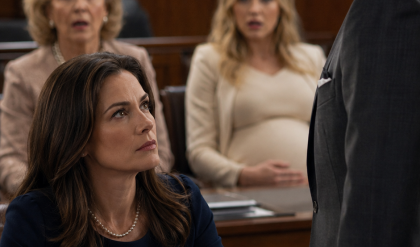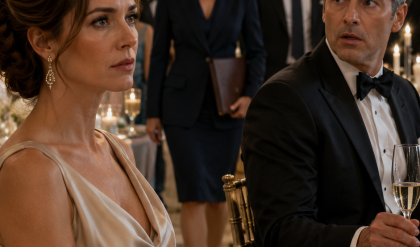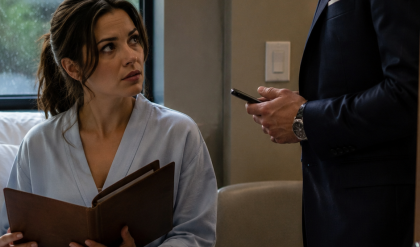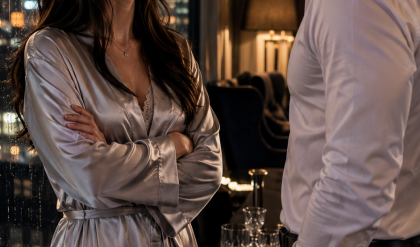
## **Part One: The Message He Chose Not to Answer**
**The night Mela Donovan sent her husband one desperate word, she was not begging to be loved — she was trying not to die alone.**
The Viscari mansion stood on the edge of Lake Forest like a monument to silence, all limestone walls, black iron gates, and windows tall enough to reflect the moon without revealing a single soul inside. In daylight, people called it magnificent. At night, when the halls stretched dark and polished beneath chandeliers that glowed like trapped stars, it felt less like a home and more like a place built to hide secrets.
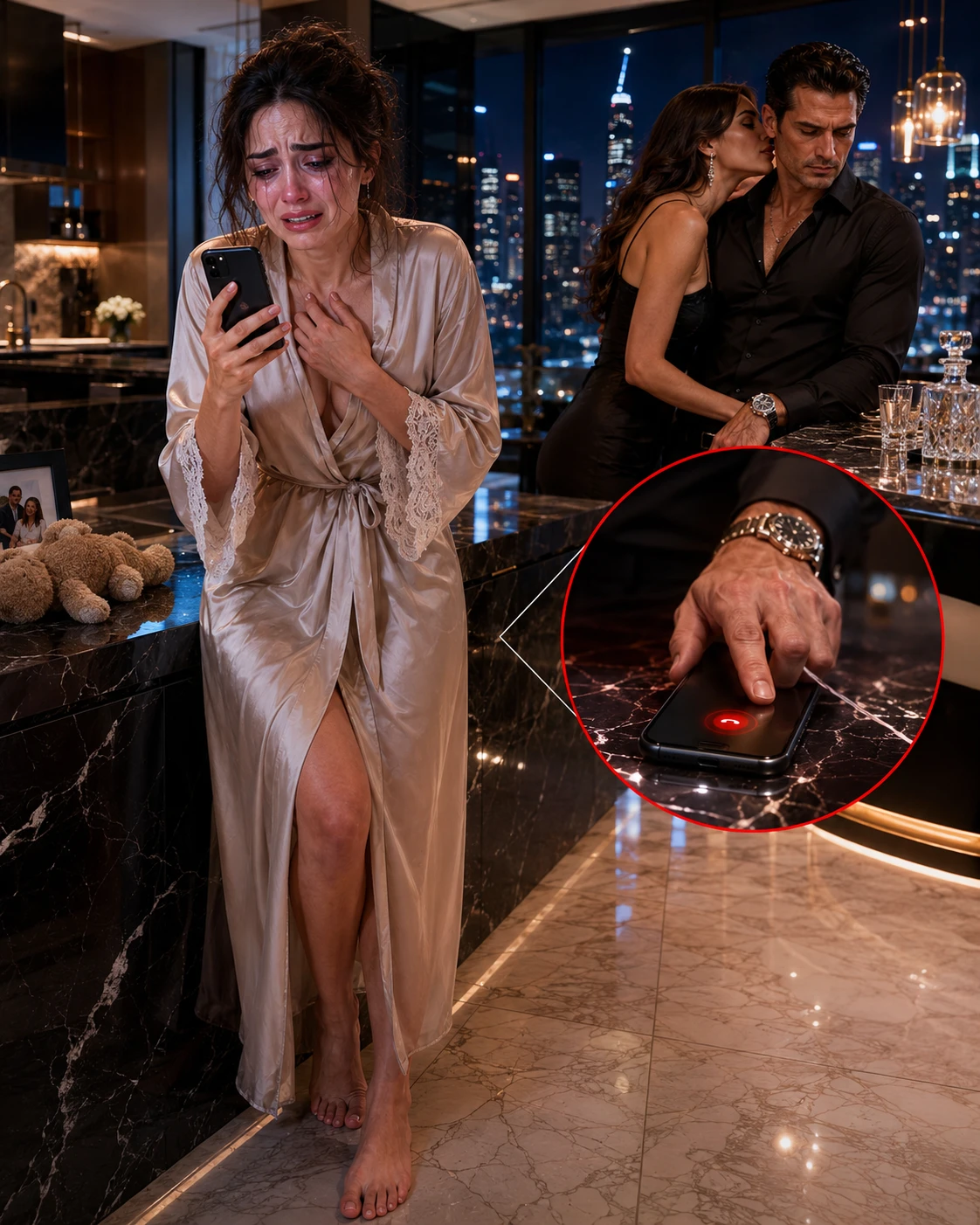
Mela stood barefoot in the kitchen, one hand clamped against the black marble counter, the other pressed to her chest.
Her lungs would not obey her.
The air was there. She knew it was there. The heating vents whispered. The refrigerator hummed. Somewhere upstairs, little Sophia made a soft sleeping sound through the baby monitor. But Mela’s body had turned against her with a cruelty that felt almost personal. Her ribs tightened. Her throat closed. The floor seemed to tilt beneath her feet.
“Breathe,” she whispered.
But the word came out thin and broken.
She was fifty-six pounds lighter than she had been after Sophia’s birth, though no one in Lorenzo’s world called it grief. They called it discipline. They called it getting her figure back. They called it lucky.
Mela knew better.
Loneliness had been eating her from the inside for years.
Upstairs, five-year-old Marco slept under his dinosaur blanket with one arm thrown over his stuffed whale. Two-year-old Sophia slept in her crib, her hair damp with the sweet sweat of children who trusted the world because no one had taught them not to.
Their mother could not fall apart. Mothers did not get that luxury.
Still, her fingers trembled so badly she nearly dropped the phone.
She opened Lorenzo’s name.
For one second, she stared at the old photo attached to his contact — Lorenzo at thirty-one, laughing on a windy beach in Michigan, his white shirt rolled at the sleeves, his arm around her waist, his eyes fixed on her as if the rest of creation had been an interruption.
That man had once driven six hours through a snowstorm because she had a fever and had whispered into her hair, “You will never have to be alone again.”
Mela almost laughed.
Then she typed three letters.
**SOS.**
Delivered.
Read.
The word sat on the screen like a tiny flare shot into endless dark.
Across Chicago, forty minutes away and thirty-seven floors above the river, Lorenzo Viscari saw it.
He was standing in the Monroe Club penthouse, where the windows were so clean the city looked imaginary beyond them. Chicago glittered below — bridges, headlights, winter water black as oil. In that room, with his jacket thrown across a chair and his cufflinks resting beside two half-finished glasses of Scotch, Lorenzo looked exactly like what powerful men were supposed to look like when they forgot they were mortal.
Dark hair. Sharp jaw. Tailored shirt. Expensive watch. The calm menace of a man who had inherited both money and enemies.
His phone lit up.
Mela.
SOS.
For one human second, his face changed.
Something in him knew.
Not business. Not drama. Not inconvenience.
Need.
Then Serena Hale stepped out from the bedroom wearing his shirt and nothing else, her blond hair loose over one shoulder, her smile soft with the lazy confidence of a woman who had never had to fold laundry outside a child’s room while wondering where her husband had gone.
“Is it business?” she asked.
Lorenzo stared at the screen.
His thumb hovered over Mela’s name.
He imagined her pale and anxious. He imagined another panic attack, another night of explanations, another conversation that would begin with “I can’t do this alone anymore” and end with him feeling accused by the life he had chosen.
Then he imagined Serena’s mouth on his neck.
“Nothing urgent,” he said.
**He turned the phone face down.**
Serena smiled and came to him.
In the mansion kitchen, Mela waited.
One minute.
Two.
Three.
No call.
No text.
Nothing.
The silence was not absence. **It was an answer.**
Her knees buckled, and she slid down the cabinet until she sat on the cold floor. She did what her therapist had once taught her before Lorenzo decided therapy was “making her weak.”
Name five things you can see.
The marble counter. The silver faucet. A green apple in a ceramic bowl. Sophia’s pink cup drying beside the sink. Her own wedding ring flashing under the kitchen lights like evidence.
Four things you can touch.
The floor. Her nightgown. The edge of the rug. Her own wrist, where her pulse beat like a trapped bird.
Three things you can hear.
The refrigerator. The baby monitor. Her own breath fighting its way back.
When the attack finally loosened its fist, Mela stayed on the floor for a long time.
Then she did something she had not done in years.
She stopped waiting for someone to save her.
By morning, she had washed her face, braided Sophia’s hair, packed Marco’s lunch, and stood at the stove flipping pancakes while her heart felt like a burned room.
“Mommy,” Marco said, peering at her over his orange juice, “why are your eyes red?”
Mela turned toward him with a smile so practiced it hurt.
“Because onions are mean,” she said.
“There’s no onions.”
“No,” she said softly. “I suppose there aren’t.”
Her phone lit up on the table.
Lorenzo.
Finally.
The screen vibrated and vibrated, his name flashing like a man knocking at a door after the house had already burned down.
Mela watched it ring.
Then, with hands that no longer shook, she typed one final message.
**Do not come home unless you are ready to tell the truth.**
She hit send.
And for the first time in their marriage, she did not care how angry he would be.
## **Part Two: The Husband Who Came Home Too Late**
Lorenzo arrived at the mansion at 8:17 that morning, which was early enough to look concerned and late enough to be unforgivable.
His black car swept through the gates, tires whispering over the long drive. Mela saw him from the dining room window, standing straight-backed beside the table while Sophia patted syrup into her hair and Marco made dinosaur noises into his oatmeal.
The sight of Lorenzo stepping out of the car used to quicken something in her. Not always happiness, but at least expectation. He had that effect on people. He entered the world as if every room had been waiting for permission to arrange itself around him.
That morning, he looked smaller.
Not physically. He was still tall, broad-shouldered, handsome in a hard, expensive way. But Mela saw something she had not allowed herself to see before: **Lorenzo Viscari did not look powerful because he was fearless. He looked powerful because everyone around him had agreed to be afraid.**
He came through the kitchen entrance, not the front door. Guilty men often chose side doors.
“Mela.”
His voice was low. Controlled. Already irritated.
Marco slid out of his chair. “Daddy!”
Lorenzo’s face softened, and for a moment Mela hated him for it. Not because he loved his children — he did — but because he knew how to become tender when tenderness cost him nothing.
He lifted Marco, kissed Sophia’s sticky cheek, and asked them about breakfast. Then he looked at Mela.
“What happened last night?”
She laughed once. It surprised them both.
“What happened?”
“You sent SOS.”
“Yes.”
“You didn’t answer when I called this morning.”
“No.”
His jaw tightened. “Mela, I was in a meeting.”
She looked at his collar.
There was a faint smear of lipstick near the edge.
Not red. Not dramatic. A pale rose color, expensive and subtle.
Just like Serena Hale.
Mela picked up a napkin, walked across the kitchen, and wiped it from his shirt.
Lorenzo froze.
The children were still watching.
“Marco,” Mela said gently, “take your sister to the playroom. You can show her the big train.”
“But Daddy just got home.”
“And Daddy is going to have a grown-up conversation with Mommy.”
Marco looked disappointed, but he obeyed. That was one of the great crimes of unhappy homes — children learned obedience before they learned joy.
When the playroom door closed, Lorenzo exhaled sharply.
“You are making this into something it isn’t.”
Mela leaned back against the counter. The same counter she had gripped the night before as if it were the edge of the earth.
“Where were you?”
“At the Monroe Club.”
“With whom?”
“Clients.”
“Do your clients wear your shirt?”
His eyes hardened.
There he was. The real Lorenzo. Not the beach photograph. Not the man who had held her through miscarriage at thirty-nine. Not the father who could make Sophia squeal by pretending to eat her toes.
The heir.
The boss.
The man trained from birth to treat exposure as an attack.
“Mela,” he said carefully, “you are tired.”
“No. I am awake.”
“You had another panic episode, didn’t you?”
“I had a panic attack while our children slept upstairs. I texted my husband because I was afraid I might collapse before I could call 911.”
“Why didn’t you call 911?”
“Because I was foolish enough to call you first.”
He looked away.
That tiny movement almost broke her.
An apology would have changed the morning. Not the marriage, perhaps, but the morning. A single honest sentence — I failed you — might have left one plank across the flood.
Instead, Lorenzo said, “You know my life is complicated.”
Mela nodded slowly.
“Yes. That must be very difficult for you.”
“You married into this family knowing—”
“I married a man,” she said. “Not a family. Not an empire. Not a locked gate with my name written on the inside.”
He took a step closer. “Lower your voice.”
“No.”
His eyebrows lifted.
It was such a small word. No. But in that kitchen, after years of swallowed questions and rearranged dinners and birthdays attended by bodyguards instead of fathers, it sounded like furniture being dragged from a burning house.
Mela removed her wedding ring.
Lorenzo stared at it.
“Don’t be dramatic.”
“I am not being dramatic. I am being precise.”
She set the ring on the marble counter between them.
The little circle clicked once.
“I want the children. I want access to my accounts. I want the house in Michigan that my mother left me and your lawyers somehow folded into Viscari holdings. I want a divorce without threats, without surveillance, and without your mother calling me unstable.”
Lorenzo’s mouth tightened at the mention of his mother.
“You think you can walk away from this family?”
“I think I already have.”
He laughed quietly. Not because anything was funny, but because men like Lorenzo often mistook disbelief for strength.
“You have no idea how the world works.”
“No,” Mela said. “But I am learning very quickly how yours does.”
For the first time, something like uncertainty moved across his face.
“What does that mean?”
Before she could answer, a car pulled into the drive.
Not one of Lorenzo’s.
An older blue Subaru with rust near the wheel well.
Lorenzo turned toward the window. “Who is that?”
Mela picked up Sophia’s cup and rinsed it carefully.
“My aunt.”
“You called Ruth?”
“She called me.”
“That woman hates me.”
“She has excellent instincts.”
A moment later, Ruth Donovan entered without waiting to be announced. She was seventy-two, silver-haired, broad-hipped, and dressed in a red wool coat that looked like it had survived three husbands and a tornado. She carried a canvas tote bag and the expression of a woman who had reached the age where politeness was optional.
“Lorenzo,” she said. “You look expensive and unwell.”
His eyes narrowed. “This is family business.”
Ruth walked to Mela, kissed her cheek, and placed the tote bag on the counter.
“No,” Ruth said. “This is Donovan business now.”
Inside the bag were two burner phones, a folder of bank statements, a small digital recorder, and a photograph.
Lorenzo saw the photograph first.
His face went still.
It showed him outside the Monroe Club at 2:13 a.m., Serena Hale pressed against his side, both of them smiling in the snow.
Mela looked from the photograph to her husband.
“I told you,” she said. “I am learning.”
## **Part Three: The Woman He Thought Was Alone**
For twelve years, Lorenzo had believed Mela’s softness was the same as weakness.
It was an easy mistake. Many men made it, especially men raised by women who had survived through obedience and called it loyalty.
Mela cried at movies. She remembered birthdays. She wrote thank-you cards by hand. She kept a drawer full of batteries, Band-Aids, birthday candles, and emergency sewing kits because someone always needed something. She apologized when people bumped into her. She made soup for sick neighbors who later forgot to return the container.
Lorenzo had mistaken all of that for surrender.
But tenderness, when betrayed long enough, does not always die.
Sometimes it sharpens.
The first person Mela called after the panic attack was not Ruth. It was Dr. Elise Warren, the therapist Lorenzo had forced her to stop seeing.
At 3:06 a.m., sitting on the kitchen floor with a blanket around her shoulders, Mela had found Elise’s old number and typed: I need help. I think I am in danger of disappearing inside my own life.
The answer came eight minutes later.
You are not disappearing. You are reaching the door.
By dawn, Elise had called Ruth. Ruth had called a lawyer in Evanston who had once defended a woman from a husband with political connections and a temper. The lawyer had called a forensic accountant. The accountant had said something that chilled everyone.
“Mrs. Viscari’s name appears on more than household accounts.”
Mela learned that afternoon, in Ruth’s small apartment above a closed flower shop, that Lorenzo had placed three shell companies partly under her signature.
Not directly. Never crudely. The Viscari family did not survive by being crude.
But her name was there, woven into documents she did not remember signing during the fog after Sophia’s difficult birth. Consent forms. Trust adjustments. Charitable foundation papers. Hospitality group expansions. A dozen elegant lies printed on cream paper.
“If federal investigators ever close in,” the accountant said over speakerphone, “your husband can make it look as if you handled the books.”
Mela sat very still.
Ruth swore so loudly the accountant paused.
Mela looked down at her hands. They were the hands that had held Marco through croup, braided Sophia’s hair, cooked meals Lorenzo did not come home to eat. Hands that had signed school forms, sympathy cards, grocery lists.
Apparently, they had also signed the mouth of a trap.
That evening, Lorenzo called twenty-two times.
Mela answered the twenty-third.
“Where are my children?” he demanded.
“With me.”
“Where?”
“Safe.”
“You do not take Viscari children out of a Viscari house.”
Mela looked across Ruth’s living room. Marco was asleep on the couch beneath an old quilt, Sophia curled against him like a comma. The lamp beside them cast a soft yellow pool over their faces.
“They are also Donovan children.”
A silence.
Then Lorenzo lowered his voice.
“Mela, come home. We will talk.”
“You mean you will explain what I am allowed to feel.”
“You’re angry. Fine. Be angry. But don’t start a war.”
She closed her eyes.
“I didn’t start one, Lorenzo. I just stopped pretending there wasn’t one.”
“Mela.”
There it was again. Her name in that old voice. The voice from the beach, the hospital, the kitchen on the night their first pregnancy ended and he held her while she bled and wept and blamed herself.
For one terrible moment, she wanted to crawl back into that memory and live there.
Then she remembered the phone face down.
“I need to ask you something,” she said.
“Anything.”
“Who is Serena Hale?”
His breath changed.
That was all.
A fractional shift. But marriage teaches a person to read weather in silence.
“A consultant,” he said.
“Does she consult from your bed?”
“Mela—”
“Do not insult me with half a confession.”
His voice hardened. “You had me followed.”
“You left me alone long enough to learn hobbies.”
“That woman means nothing.”
Mela smiled sadly.
“How generous of you. To ruin our marriage with someone meaningless.”
“She is not our problem.”
“No. You are.”
He said nothing.
So she continued.
“You had one chance. Last night. Not to be faithful. Not to be perfect. Not to repair every crack. Just one chance to answer three letters.”
Her voice began to tremble, but she did not stop.
“I could have forgiven more than I should. Women do that. We call it patience. We call it keeping a family together. We call it understanding a man under pressure. But when I reached for you because I was afraid, you chose not to reach back.”
“Mela, I didn’t know it was that serious.”
“You didn’t ask.”
The silence after that was different.
Not empty.
Wounded.
At last, Lorenzo whispered, “What do you want?”
“The truth. All of it.”
“You think truth will make you safer?”
“No,” she said. “But lies have made me sick.”
The next afternoon, Serena Hale came to Ruth’s apartment.
Mela opened the door and nearly closed it again.
Serena looked different in daylight. Less polished. Older than Mela expected, perhaps forty-five, with faint lines around her mouth and eyes that had learned to measure exits. She wore a camel coat, no jewelry, and carried a manila envelope.
Ruth appeared behind Mela with a cast-iron skillet.
Serena looked at the skillet. “I probably deserve that.”
“You deserve worse,” Ruth said.
“I know.”
Mela’s fingers tightened on the door.
“Why are you here?”
Serena swallowed.
“Because Lorenzo is not the only Viscari who lies.”
Mela did not move.
Serena held out the envelope.
“His mother knows everything. The accounts. The shell companies. Your forged signatures. And if Lorenzo tries to protect you, she will destroy him too.”
Mela stared at her.
“Why would you tell me this?”
Serena’s eyes filled, but no tear fell.
“Because twenty years ago, Valentina Viscari did the same thing to my sister.”
The apartment seemed to shrink around them.
Serena’s voice dropped.
“My sister was Lorenzo’s first wife.”
## **Part Four: The House Built on Buried Women**
For three days, Mela learned the history of her marriage as if reading the autopsy of a stranger.
Lorenzo had been married at twenty-three to a woman named Claire Hale. Serena’s younger sister. The marriage had lasted eleven months and had been erased from every public record money could reach. Claire died in a boating accident on Lake Como during a family trip. No charges. No scandal. No funeral in Chicago.
The official story was tragic.
The private story was uglier.
Claire had wanted out.
She had discovered that Valentina Viscari, Lorenzo’s mother, had been using family wives as soft places to hide hard crimes. Bank accounts. Property transfers. Charitable donations. Documents signed at kitchen tables while babies cried and husbands said, “Just here, sweetheart.”
Claire threatened to speak.
Two weeks later, she was dead.
Serena had spent years trying to prove it. She had come to Lorenzo not for love at first, but for revenge. She planned to get close, gather evidence, and expose the woman who had buried her sister under respectability.
“And then?” Mela asked.
They sat at Ruth’s kitchen table late at night. The children were asleep. Rain tapped the window. Serena’s envelope lay open between them, spilling photographs, copies, names, dates.
Serena looked ashamed.
“Then I hated him less than I expected.”
Mela said nothing.
“He is not innocent,” Serena continued. “But he was young when Claire died. He was told she was unstable. He believed what his mother needed him to believe.”
“And you slept with him to learn that?”
Serena flinched.
“Yes.”
It was not enough. It would never be enough. But the truth had weight, and Mela had asked for it.
“What changed?” Mela said.
Serena reached into the envelope and pulled out one last photograph.
It showed Valentina Viscari standing beside Mela at a charity gala two years earlier, one gloved hand resting on Mela’s shoulder.
On the back, in Valentina’s elegant handwriting, were three words.
**Next if necessary.**
Mela’s stomach turned cold.
Ruth whispered, “Dear God.”
Serena’s voice shook.
“I found that in Valentina’s private office. I think she’s preparing to use you the way she used Claire. Maybe worse.”
Mela remembered every time Valentina had called her fragile. Emotional. Overwhelmed. Every time Lorenzo’s mother had recommended rest, special vitamins, private doctors, quiet solutions.
She remembered the panic attacks beginning after Sophia’s birth.
She remembered a small amber bottle Valentina’s physician had prescribed for “nerves.”
Mela stood so quickly the chair scraped the floor.
“What was in them?”
Serena closed her eyes.
“We’re testing that now.”
The results came back the next morning.
Not poison in the theatrical sense. Nothing that would kill her quickly. Nothing obvious.
A compound that could worsen anxiety, dizziness, confusion, and heart palpitations when taken regularly.
A medication prescribed under a false diagnosis.
A slow undoing.
Mela sat in the lawyer’s office while the words rearranged her life.
She had not been weak.
She had been drugged.
The panic attacks. The trembling. The fog. The shame. The way Lorenzo looked at her sometimes as if she were becoming a burden he had not ordered but was obligated to store somewhere beautiful.
**They had made her symptoms, then blamed her for having them.**
For the first time in days, Mela cried.
Not delicately. Not quietly.
She bent forward with her hands over her face, and the sound that came out of her seemed too old for her body. Ruth held her. Serena stood at the window, pale and silent. The lawyer pretended to study papers because decent people know when privacy matters more than professionalism.
That evening, Lorenzo came to Ruth’s apartment alone.
No driver.
No guards.
No expensive coat.
He stood in the hallway looking like a man who had finally found the bill for his life.
Mela met him outside the door. She would not let him in where the children slept.
“You knew about Claire,” she said.
His face collapsed slightly.
“I knew I had been married. I knew she died. I did not know what my mother did.”
“That is not an answer.”
“It is the only one I have.”
“Did you know about the companies in my name?”
He looked away.
Mela felt her heart drop.
“How much?”
“I knew some documents were structured through family trusts.”
“My name, Lorenzo.”
“I did not think they would ever use them against you.”
She almost struck him.
Not because he lied, but because he had told the truth too late.
“You didn’t think.”
He stepped closer. “I was raised inside this. You think I understood normal? You think I knew where business ended and crime began? My father taught me loyalty before he taught me long division.”
“Do not make your childhood the knife and my body the place you store it.”
He stopped.
That sentence reached him. She saw it.
“I loved you,” he said.
Mela’s eyes burned.
“Yes. In the ways that were convenient.”
“No.”
“You loved coming home to warmth. You loved my forgiveness. You loved that I made your children feel safe, that I made your house look like a home, that I softened your name in rooms where people feared it.”
Her voice broke.
“But when I needed you to choose me, not as an idea, not as the mother of your children, not as the woman waiting under your roof — me, Lorenzo — you turned your phone over.”
He closed his eyes.
A tear slipped down his face.
She had seen Lorenzo angry, amused, aroused, exhausted, proud.
She had almost never seen him humbled.
“I cannot undo that,” he whispered.
“No.”
“What can I do?”
Mela took a long breath.
“Tell the truth publicly.”
His eyes opened.
“You know what that means.”
“Yes.”
“My mother will retaliate.”
“Yes.”
“The organization will fracture. Men will die.”
“Then perhaps they should have chosen better gods.”
Lorenzo stared at her with something like awe.
“You sound different.”
“I am not medicated anymore.”
He flinched.
Good, she thought. Let the truth have teeth.
The plan formed over the next week with terrible speed.
Lorenzo would meet Valentina at the old family house in Winnetka. Serena would provide the documents. Mela would remain with Ruth and the children under protection arranged by the lawyer through a retired federal judge.
Lorenzo would record his mother confessing enough to bring down the structure that had protected her for decades.
But Valentina Viscari had not survived seventy-nine years by underestimating betrayal.
On Friday night, she invited Mela to tea.
The note arrived by courier on thick ivory paper.
Mela read it once.
Then again.
Mrs. Viscari requests the pleasure of a private conversation. Come alone if you wish your children to remain outside adult consequences.
Ruth said, “Absolutely not.”
Serena said, “It’s a trap.”
The lawyer said, “This is exactly how women disappear.”
Mela looked at the note for a long time.
Then she said, “Not this one.”
## **Part Five: The Woman in the Photograph**
Valentina Viscari received Mela in the winter garden of the old family house, a glass room filled with citrus trees that had no business blooming in Illinois.
She sat beneath a lemon tree in a cream suit, her silver hair pinned perfectly, her face composed in that aristocratic way old money borrowed from old violence. A tea service gleamed on the table between two chairs.
“Mela,” she said. “You look rested.”
“I stopped taking your doctor’s medication.”
Valentina smiled.
“Then perhaps you look defiant.”
Mela sat across from her.
The room smelled of lemon leaves and rain.
“I know about Claire,” Mela said.
“Poor Claire.”
“Do not perform grief for me.”
Valentina lifted the teapot.
“Tea?”
“No.”
“Still afraid of what women offer you?”
Mela’s mouth went dry, but she held Valentina’s gaze.
“You drugged me.”
“I helped you remain manageable during a difficult season.”
“I was postpartum.”
“You were inconvenient.”
There it was.
No thunder. No music. No villain’s confession spoken in rage.
Just truth, placed gently on porcelain.
Mela’s pulse thudded in her throat.
Valentina stirred her tea.
“You married into a family older than your little moral vocabulary. Men like Lorenzo carry burdens. Women like us preserve the house around them.”
“Women like us?”
“Yes, my dear. Do not imagine you are the first wife to discover that comfort has a price.”
“Claire discovered it.”
Valentina’s smile faded by one degree.
“Claire lacked discipline.”
“She was murdered.”
“She fell.”
“Did you push her?”
Valentina sipped her tea.
Mela waited.
Outside the glass walls, rain slid down the panes in crooked lines.
“Young women are often careless near water,” Valentina said.
Mela felt the recorder beneath the brooch on her coat. The tiny device had been Serena’s. Ruth had pinned it on with trembling hands and whispered, “Come back, or I will haunt everyone involved.”
Mela needed more.
“What about me?” she asked. “Was I next?”
Valentina leaned back.
“You were never important enough to hate. That is what sentimental women never understand. You think cruelty requires passion. Most cruelty is administrative.”
The sentence chilled Mela more than any threat.
Valentina continued, “You were useful. Then unstable. Soon, if necessary, you would become legally compromised. A tragic mother overwhelmed by anxiety and financial irregularities. Lorenzo would mourn. The children would be protected. The family would continue.”
Mela’s fingers curled around the edge of her chair.
“My children are not yours.”
Valentina’s eyes sharpened.
“Everything born into this family is mine.”
The door opened behind them.
Lorenzo entered.
Mela had not expected him.
Neither, from the flicker in her eyes, had Valentina.
“Mother,” he said.
Valentina set down her cup.
“Lorenzo. How theatrical.”
He looked at Mela first. There was fear in his face. Fear for her, perhaps. Or fear of what he had allowed his life to become.
Then he looked at his mother.
“It’s over.”
Valentina laughed softly.
“My son. You have been saying that since you were sixteen.”
“I know about Claire.”
“You know stories.”
“I know about the accounts.”
“You know signatures.”
“I know what you did to my wife.”
Valentina’s expression hardened.
“Your wife ran to strangers with family matters.”
“My wife sent me SOS, and I ignored it.”
The room went silent.
Mela looked at him.
He had said it plainly. Without excuse. Without polishing it into something easier to hold.
Valentina’s mouth tightened.
“Do not humiliate yourself.”
“No,” Lorenzo said. “I think humiliation may be the first honest thing I have done in years.”
For one fragile second, Mela saw the man from the beach again. Older. Broken. But perhaps real.
Then the glass door at the far end of the winter garden shattered.
A gunshot cracked through the room.
Mela screamed as Lorenzo jerked backward, blood blooming across his white shirt.
He fell against the table, sending porcelain crashing to the floor.
Valentina did not scream.
That was how Mela knew.
Two men entered through the broken door, dressed in black, faces hidden, moving with the awful calm of people paid not to feel. Mela dropped beside Lorenzo, pressing both hands to his wound.
“Lorenzo! Look at me!”
His eyes found hers.
“I’m sorry,” he gasped.
“No. No, do not do that now.”
“I should have answered.”
“Yes,” she sobbed. “You should have.”
He gave a broken laugh that became a cough.
Valentina rose slowly.
“You see?” she said. “This is what comes of disobedience.”
Mela looked up at her.
Something inside her went quiet.
Not numb.
Clear.
The men stepped closer.
Then a voice behind them said, “Federal agents! Weapons down!”
The room exploded into motion.
Glass. Shouts. Boots. Rain. One of the masked men ran and was tackled against a lemon tree. The other raised his gun and was shot in the shoulder before he could fire. Agents poured through every entrance.
Serena Hale appeared behind them, face white, eyes fixed on Valentina.
Valentina did not move.
Even then, she looked less arrested than inconvenienced.
An agent took her arm.
She looked down at his hand with contempt.
“You have no idea what you are touching.”
Serena stepped forward.
“I know exactly what she is.”
For the first time, Valentina’s mask cracked.
Not because of Lorenzo bleeding on the floor. Not because of federal agents. Not because her empire had finally opened its rotten heart to daylight.
Because Serena held up a photograph.
Claire Hale on her wedding day, young and bright-eyed, standing beside Lorenzo.
And behind Claire, half-hidden in a mirror, Valentina watching her with the same expression she had worn in the winter garden.
Serena’s voice trembled.
“This time, the woman in the photograph gets to speak.”
Mela looked down at Lorenzo.
Blood slicked her hands. His breathing was shallow.
“Stay,” she whispered.
“I don’t deserve—”
“Don’t you dare decide what I get to say goodbye to.”
His eyes filled.
The ambulance arrived within minutes, though time had become strange. The agents carried Valentina away. Serena stood in the rain, crying without sound. Ruth arrived wrapped in fury and a purple scarf, pushing past everyone until she reached Mela.
“Where are the children?” Mela asked.
“Safe,” Ruth said. “Watching cartoons with a U.S. marshal who looks terrified of Sophia.”
Mela laughed once, then broke.
Lorenzo survived.
That was not the twist.
He spent three weeks in the hospital, two months under federal protection, and the next year giving testimony that dismantled what generations of Viscari men had built and Viscari women had preserved with bloodless hands.
Valentina died in custody before trial, still refusing to confess to murder, though the recording from the winter garden gave prosecutors more than enough to bury the living.
Serena became the public face of Claire’s case. Ruth became briefly famous after telling a reporter, “Never trust a family that has more lawyers than photo albums.”
Mela filed for divorce.
Lorenzo did not fight it.
On the day the papers were signed, he met her at a small park near Lake Michigan. He looked thinner. Older. Not ruined exactly, but emptied of the arrogance that had once entered rooms before him.
Marco and Sophia chased gulls near the water with Ruth supervising from a bench like a general.
Lorenzo stood beside Mela.
“I sold the Monroe Club interest,” he said.
“Good.”
“And the house.”
“Good.”
“The Michigan property is yours again.”
“It always was.”
He nodded.
Wind moved through Mela’s hair. For the first time in years, she had let it grow loose.
“I am sorry,” he said.
She looked at him.
“I know.”
“Do you forgive me?”
The old Mela might have rushed to comfort him. The old Mela might have mistaken his pain for her responsibility.
The woman beside the lake took her time.
“Some days,” she said. “Not all.”
He accepted that as if it were more mercy than he deserved.
Then Marco shouted, “Daddy, look!”
Lorenzo turned, smiling through tears, and watched his son hold up a gray feather as if he had discovered treasure.
Mela watched them together and felt grief move through her — not the sharp grief of betrayal, but the deeper grief of accepting that love can be real and still not be safe to live inside.
Three months later, Mela moved with the children into a modest house in Evanston with blue shutters, creaky floors, and a maple tree in the yard. There were no gates. No guards at the door. No marble counters cold enough to hold a woman upright while she waited for a call that would not come.
She began therapy again.
She planted rosemary.
She learned to sleep.
And then, on the first anniversary of the night she sent SOS, Mela received a package with no return address.
Inside was a small black phone.
The burner phone she had used during those first terrible days.
Wrapped around it was a note in Lorenzo’s handwriting.
I found this in evidence release. Thought you should have it. You saved yourself with this.
Mela turned the phone over in her palm.
The battery was dead. She almost dropped it in a drawer and forgot it.
But something — instinct, perhaps, or the hard-earned suspicion of a woman who had survived administrative cruelty — made her charge it.
When the screen lit up, there was one unsent draft message.
Not from Mela.
From the night of the panic attack.
The timestamp was 2:21 a.m.
Eight minutes after Lorenzo had read her SOS.
The draft had never been sent because the phone had died.
Mela opened it.
Three words appeared.
**I’m coming, Mom.**
Mela stopped breathing.
Not Lorenzo.
Not Ruth.
Not Serena.
Mom.
Her hands began to shake as a memory surfaced — not from that night, but from seventeen years earlier. A hospital room. A thunderstorm. A nurse with kind eyes. A baby girl Mela had held for eleven minutes before signing papers she had never forgiven herself for signing.
At nineteen, long before Lorenzo, long before the mansion, long before the life that nearly swallowed her, Mela had given birth to a daughter.
A closed adoption.
A secret she had buried so deeply that even Lorenzo never knew.
Only one person had known.
Dr. Elise Warren.
Her therapist.
Mela stared at the phone, heart pounding.
Then the front doorbell rang.
Slowly, she walked to the door.
Through the glass, she saw a young woman standing on the porch in the golden afternoon light. She was thirty-seven, maybe thirty-eight, with dark hair, familiar eyes, and a face Mela knew before memory could explain it.
Beside her stood Dr. Elise Warren, holding a folder against her chest.
Mela opened the door.
The young woman’s eyes filled instantly.
“My name is Anna,” she said. “But I think once, for eleven minutes, you called me Grace.”
Mela gripped the doorframe.
Elise spoke gently. “She found me six months before your SOS. She wanted to meet you. I was helping her prepare. That night, when you reached out to Lorenzo, she was already outside the mansion.”
Mela could not speak.
Anna wiped her cheek.
“I lost my nerve,” she said. “I saw the gates. The cameras. That huge house. I thought you wouldn’t want me. Then I saw you through the kitchen window.”
Mela’s world narrowed to the woman on the porch.
“You saw me?”
Anna nodded.
“You were on the floor. I called 911, but before they answered, you stood up. I didn’t know what to do. So I texted the only word I could think of.”
Mela looked back at the phone in her hand.
I’m coming, Mom.
“But it didn’t send,” Anna whispered. “My phone died. I thought I had failed you.”
Mela made a sound that was half laugh, half sob.
“No,” she said. “No, sweetheart.”
Sweetheart.
The word broke them both.
Anna stepped forward, and Mela pulled her into her arms with a force that seemed to gather every lost year, every birthday uncelebrated, every question unanswered, every lullaby swallowed before it became sound.
**The SOS had not saved her marriage. It had not summoned her husband. It had opened the door to the daughter she thought life had taken from her forever.**
Over Anna’s shoulder, Mela saw Marco and Sophia running in the yard, Ruth watching from the porch swing, the maple leaves turning gold above them.
For years, Mela had believed that night was the night she was abandoned.
But the truth was stranger, kinder, and more astonishing than pain had allowed her to imagine.
**That was the night one life ended.**
**And another, the one meant for her all along, finally found its way home.**