I Never Wanted This House — The Day I Had to Take It Back
PART 1:
“You don’t raise your voice at my mother in her own house.”
Those were the words he said. Her own house. And I remember thinking, even in the first blinding second after his palm connected with my face, that those three words were the most expensive lie Daniel Cross had ever told.
The chandelier above us was from Italy. I knew because I had wired the payment — six figures for twelve hundred pounds of Venetian crystal that Evelyn Cross wanted and Daniel had been too proud to admit we couldn’t afford. The marble beneath my feet had been selected from a quarry in Carrara during the one trip abroad Daniel and I took together before everything between us quietly calcified. The staircase, the oil portrait above the fireplace, the imported rugs that Evelyn told guests cost more than most people’s cars — I had touched every invoice. I had signed every wire transfer. I had done it all while pretending, for three years, that Daniel was the one holding everything up.
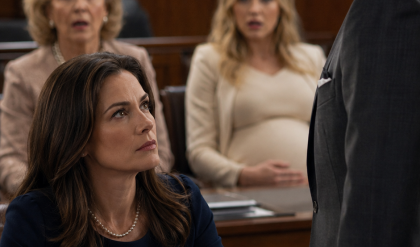
My cheek burned. My palm was bleeding where my wedding ring had bitten into the skin when my fist clenched — a reflex, not a threat. Around us, six relatives stood in the sudden, ringing silence. A cousin by the staircase. Two aunts with their teacups frozen halfway to their mouths. Evelyn behind Daniel with a silk handkerchief pressed to eyes that were dry as chalk.
Nobody moved. Nobody spoke.
Then Evelyn lowered her handkerchief and smiled. Not wide. Not theatrical. Just a small, private curve of the lips, the kind a woman wears when she has been patient for a very long time and has finally been proven right.
I looked at my husband. He was still breathing hard, his hand still raised slightly, as though he might need it again. His jaw was tight. His eyes were certain.
And I made a decision that had been building for three years, quietly, the way a river builds behind a dam before the dam simply gives.
I did not cry.
I did not apologize.
I looked at the room — at the chandelier, the marble, the staircase — and I made sure I would remember exactly how it looked in this moment, so that later, when I sat across from my attorney with a pen in my hand, the memory would hold.
It had begun, as most disasters do, not with a single catastrophic choice but with a long series of small surrenders.
When Daniel and I married, his import business was hemorrhaging money in ways he had not told me and I had not asked enough questions to discover on my own. I found out three weeks after the wedding, going through the shared filing system I had set up for us, because I was optimistic about things like shared filing systems. I found the overdraft notices. The unpaid vendor invoices. The quiet, humiliating reality beneath the confident exterior of a man whose family had always had money and who had never been taught what to do when it ran out.
I could have said something. I nearly did, a dozen times. I sat at the kitchen table in our first apartment with the papers arranged in front of me and rehearsed the conversation. Daniel, I found the accounts. Daniel, I think we need to talk about the business. Daniel, I can help.
But he would come home looking tired in a specific way — the way of someone carrying something they will not put down because putting it down means admitting it is too heavy — and the rehearsed words would dissolve. I loved him. More than that: I understood something about pride that I had learned from my own father, who had worked himself to illness rather than accept help and called it dignity. I recognized the architecture of that kind of suffering. And I thought, foolishly, lovingly, that I could save him without making him feel saved.
So I did it quietly.
My grandmother had left me a property portfolio that I had grown, slowly and carefully, over years before I met Daniel. Three apartment complexes, a commercial building, and a majority stake in a holding company that managed the whole structure. Daniel knew I had some inheritance. He had never asked for specifics. I had not offered them, partly because the relationship moved fast and I had been careful with my assets before him, and partly because, by the time I understood the scope of his financial trouble, offering the specifics felt like it would humiliate him in a way we could not recover from.
Instead, I restructured quietly. I moved money through legitimate channels — loans, consulting fees, a silent partnership arrangement — into Daniel’s company, in amounts large enough to matter but spaced carefully enough not to alarm anyone. I put the mansion, when they decided they needed a mansion, inside one of my holding companies rather than in Daniel’s name. I told him it was for tax purposes. He nodded in the way of a man who is grateful not to have to understand something.
He never read the documents. I had underestimated how completely he trusted that nothing in his life could belong to anyone but him.
For two years, it worked. The company stabilized. Daniel became confident again — the version of confidence that comes from not knowing which floor you’re standing on. We moved into the mansion. Evelyn came with us, or rather moved herself in so gradually that by the time it was complete, objecting felt like evicting someone who had already unpacked.
Then the small erosions began.
Evelyn called my dresses cheap before charity dinners where my donation check was always the largest in the room, though no one but me knew that. She asked, in front of guests, when I would “give Daniel a real family,” and Daniel’s gaze would slide sideways to the middle distance. She told people I had married up. She said it softly, conversationally, with a tone so practiced it sounded like affection. She said it so often that some of Daniel’s family began to say it too, not maliciously but reflexively, the way we repeat things we hear until they settle into fact.
I swallowed it. I smiled. I told myself that his mother’s opinion of me was not the measure of my life.
Then last month, Evelyn called my body a failure in her son’s house, in front of his family, and called me a parasite who had forgotten her place.
So I laughed. Once. A short, quiet, involuntary sound, the way you might laugh when you realize you have been told the same lie so many times that the truth sounds absurd by comparison. It was not a kind laugh. It was not designed to wound. It was simply the only honest response left in my body.
Evelyn had stood up from her chair, trembling with indignation, clutching her pearls like a woman who had rehearsed this exact scene. “She disrespected me in my own home,” she said to Daniel, and Daniel had crossed the room like a loyal soldier and raised his hand.
Now I stood in the foyer of a house that belonged to my holding company, with blood on my palm and a swelling cheek, and I watched Evelyn reach for her victory.
“Pack whatever cheap clothes you came with,” she said, her voice sharpening now that she’d gotten what she wanted. “Leave the jewelry. Leave the car keys. Leave everything my son paid for.”
I looked at her designer handbag on the console table. Ten thousand dollars, she had told her friends. She had bought it with her monthly allowance. The allowance that passed through Daniel’s company account but originated, like everything else in this house, from mine.
“Because,” I said, when Daniel asked why I was still standing there, “I wanted to remember this moment clearly.”
I picked up my purse. I looked around the room at every face that had watched without speaking.
“For court,” I said.
I walked to the door. Behind me, Evelyn called my name. Her voice no longer sounded like authority. It sounded like a woman who has just realized the ground beneath her is not what she thought it was.
Daniel called after me once. His voice had shifted — not quite fear yet, but something adjacent to it, a new and unfamiliar uncertainty.
I drove away without music. Without looking back. My hands were steady on the wheel, and that steadiness frightened me more than the pain in my face, because I recognized it. It was the calm of someone who has finally run out of something they had been spending for too long.… FULL STORY IN THE FIRST COMMENT 👇👇👇
Margaret Vale had been my attorney for four years, long before Daniel, long before the mansion. She was sixty-one years old and had the demeanor of someone who had seen every version of every disaster and was no longer surprised but remained, always, appropriately alarmed.
She took one look at my face when I walked through the door of her office and her expression went still.
“He hit you.”
“Yes. In front of six witnesses and on camera.”
She asked one more question — were there security cameras inside the house? — and when I said yes, her jaw tightened in the way of someone running calculations.
I sat across from her in the chair I had sat in four months ago, the first time I had admitted out loud that the marriage was ending. I had cried then. I had apologized for crying, which Margaret had waved off impatiently. Today I did not cry. I watched her open the file we had been building since that conversation — the file I had told her, for months, to keep closed unless there was no other path.
“Walk me through the assets,” she said, not because she needed reminding but because she needed to hear that I was ready to say it.
So I walked through it. The mansion: held inside Halcyon Property Group LLC, registered in my name prior to the marriage, with Daniel listed as a residential occupant but not an owner. The operating capital that had saved Daniel’s company: documented as a series of business loans from a consulting entity I controlled, with signed agreements Daniel had never read past the first page. Evelyn’s allowance: ten thousand dollars per month, originated from my holding company through Daniel’s business accounts in a structure that, on paper, looked like a family expense but was traceable, with the right subpoenas, directly back to me.
Margaret listened without interrupting. When I finished, she was quiet for a long moment.
“He doesn’t know any of this.”
“He never asked.”
“And Evelyn?”
“She knows he has money. She doesn’t know where it comes from.” I paused. “Or she didn’t. Until recently.”
Margaret’s pen stopped moving. “What do you mean?”
This was the part I had been afraid to say out loud, even to her. The part that had been sitting in the back of my mind since last month, shaping itself slowly into something I was not yet ready to name.
Three weeks ago, I had been looking for a household file in Evelyn’s private sitting room — a maintenance receipt for the HVAC system that had been misfiled during a renovation. Evelyn was out. I had a key because the house was mine, though I never said so.
I found the receipt. I also found a manila envelope tucked behind a stack of decorating magazines, the kind of envelope that does not belong in a sitting room, the kind that someone slides out of sight rather than puts away properly. I opened it because I recognized my own name on the tab.
Inside were medical records.
Mine.
Fertility consultations from two years into the marriage, when Evelyn’s comments about grandchildren had finally worn me down and I had gone, alone, to discuss what options existed. Hospital notes from the miscarriage I had suffered fourteen months ago — a pregnancy I had lost at eight weeks that Daniel knew about, that I had grieved in the specific muted way of a woman who has learned not to need too much from the people around her. Records from a follow-up appointment six weeks later that I had attended by myself because Daniel had a business trip and I had said it was fine, it was a routine appointment, I’d tell him about it later.
I had never told him about it. Not because there was anything alarming in the results. Because by then I had stopped telling Daniel things that mattered, and I had not yet admitted to myself that this was what I was doing.
Evelyn had no legal right to any of those documents. She was not my physician. She was not my healthcare proxy. She was not, in any formal or informal sense, anyone who should have had access to a single page of my medical history.
And yet she had them. Organized. Filed. Labeled with my name.
I had put the envelope back exactly as I found it. I had gone home and sat at my desk for a long time without moving.
Three weeks later, Daniel’s hand landed on my face.
“Someone gave her those records,” Margaret said. Her voice was controlled in the way of someone actively keeping it that way.
“Yes.”
“The question is who.”
“And how long ago. And what she’s been doing with the information.” I looked at my hands in my lap. “She knew about the miscarriage before I told Daniel. She made a comment — oblique, deniable, something about how the body sometimes knows better than doctors what it can carry. I thought it was her usual cruelty. But she said it three days after the follow-up appointment I hadn’t told anyone about.”
Margaret set down her pen.
“She knew,” I said. “She’s been watching my medical history. And I think she’s been steering Daniel’s responses — the adoption conversation, the specialist referral he suddenly didn’t want to pursue. She knows things she used on him.” My voice was steady, which still surprised me. “I don’t know yet whether the doctor shared records voluntarily or whether someone accessed them without authorization. But I know that Evelyn Cross has been building a case against my body for two years, and I think she used it on my husband.”
The wind hit the window. Outside, the street looked ordinary — a florist, a bakery, people walking past with their coffee cups and their uncomplicated afternoons.
“Claire,” Margaret said, “this divorce may be more complicated than we thought.”
“I know.”
“If she accessed those records unlawfully—”
“Then this isn’t just a divorce. I know that too.”
Margaret looked at me for a long moment. Then she opened a second folder, one I hadn’t seen before, and pushed it across the desk.
“I had a conversation last week,” she said, “with a medical records attorney. I hadn’t told you because I was hoping to be wrong.” She paused. “I wasn’t wrong.”
I looked at the folder without opening it.
“Someone requested copies of your fertility records eighteen months ago,” Margaret said. “The request came through a form signed by Daniel. Except Daniel was in Singapore when the request was submitted, and the signature—” She stopped. “The signature doesn’t match his.”
The room was very quiet.
“Evelyn forged his signature,” I said.
“That appears to be what happened, yes.”
I sat with that for a moment. Not just the violation of it — though the violation was enormous, a thing I would need to process in pieces for a long time — but the intention behind it. Evelyn had not stumbled across my records. She had gone looking for them. She had forged her son’s signature to obtain them. She had spent eighteen months using them, quietly, the way she used everything: as tools in a project I had not known I was the subject of.
I opened the folder.
PART THREE: THE ARCHITECTURE OF A PLAN
Daniel’s messages arrived in clusters throughout the afternoon, the rhythm of them charting the stages of a man who has done something he cannot quite reckon with.
First: Where are you? Call me.
Then: I’m sorry I slapped you. But you have to understand, you pushed me to it.
Then, after a gap of forty minutes: My mother is very upset. You need to come back and apologize so we can fix this.
Then: Claire. This isn’t a joke. Call me.
I read them in Margaret’s office while she made phone calls in the adjoining room. I did not answer. I watched each message arrive and felt, with increasing clarity, the strangeness of having been married to someone who thought I’m sorry I slapped you and you pushed me to it belonged in the same sentence.
Evelyn’s message came last: You have always been dramatic. Come home, apologize to Daniel before he makes a decision that can’t be undone, and we will speak no more about today.
I almost laughed again. She still thought I was parked somewhere down the road, waiting to be called back in. She still thought I was the woman she had assessed when Daniel first brought me to that house — someone who could be made small enough, through sustained pressure and accumulated humiliations, to fit the space she had designed for me.
She had never accounted for the possibility that the house itself belonged to me.
Margaret came back into the room. She had the particular energy of someone who has been making efficient use of a terrible situation.
“I’ve filed the emergency residence order,” she said. “The cameras inside the house document the assault, which means we have grounds for immediate injunctive relief. Daniel’s access to the Halcyon accounts is frozen pending the divorce proceedings.” She paused. “Evelyn’s allowance has been terminated.”
I nodded.
“There’s something else.” Margaret sat down. “I spoke with Dr. Patricia Ellison.”
The name landed with the weight of something I had been half-expecting. Dr. Ellison had been my fertility specialist. She had been professional, warm, careful. She had called me once, about a year ago, to follow up on some bloodwork — an unexpectedly proactive call that I had thought, at the time, was simply good medicine.
“She’s been notified that her records were accessed fraudulently,” Margaret continued. “She’s — she’s very disturbed. She says she received a call, approximately eighteen months ago, from a woman identifying herself as a medical administrator from a different practice, requesting a records transfer under HIPAA’s coordination-of-care provisions. She believed it was a legitimate request.” Margaret paused. “The phone number traced back to a burner.”
“Evelyn hired someone,” I said.
“It appears so. Or did it herself. We don’t know yet.” Margaret folded her hands. “Claire, this is a criminal matter. The forgery, the fraudulent records access, potentially the medical identity issue — this is beyond divorce.”
“I know.”
“The question is what you want to do with it.”
This was the question I had been sitting with since the moment I put the envelope back on Evelyn’s shelf three weeks ago and driven home with my hands shaking on the wheel, which was the only time in this whole long process that my hands had shaken. I had known then that whatever I decided would not be a small decision. That it would set something in motion that I could not easily stop once started.
Daniel’s face came back to me. Not the face from this afternoon — the face from the beginning, the early years, before the mansion and the status and the slow installation of Evelyn into the architecture of our lives. The man who had brought me coffee without being asked. Who had learned my grandmother’s name and used it naturally. Who had held my hand in the car when we drove past the cemetery where she was buried, not saying anything, just holding on.
I had loved that man. I believed he still existed somewhere beneath the layers of his mother’s influence and his own unchecked ego. But I had also sat for three years watching him choose her, again and again, in small ways and then in a very large one, and I understood now that love for a person and grief for a person can occupy the same space simultaneously.
“I want everything,” I said. “But I want to do it correctly.”
Margaret nodded. “Then we need to talk about strategy.”
The strategy was this: We would proceed with the divorce on the grounds of assault, documented and witnessed. The mansion, the accounts, the holdings — we would let the lawyers and the courts work through the disclosures. What we would not do, not immediately, was file criminal charges against Evelyn for the medical record theft. Not because I was protecting her. But because the moment we filed, everything became public and moved at the speed of institutions. What I needed first was information.
I needed to know who else knew. I needed to know whether Daniel had understood what his mother was doing or whether she had built her architecture without his knowledge. I needed to know whether the version of my husband I had married still existed, or whether she had remade him so completely that there was nothing left to recognize.
This was not mercy. This was precision.
Margaret arranged for me to stay at a colleague’s apartment — a spare bedroom with neutral furniture and a window that looked out over a different part of the city, a view with no familiar landmarks. I sat in that room the first night with my laptop open and went through every financial document I had ever managed for this family, reading them differently now. Not as evidence of what I had built but as evidence of what I had been building toward without knowing it — a paper trail so complete it was almost a confession of its own.
Somewhere in the third hour, I found something I had not expected.
A wire transfer, eighteen months ago, from Daniel’s business account — not to a vendor, not to a creditor, but to an individual account I didn’t recognize. The amount was forty thousand dollars. I went back further. There was another one, eight months before that. Thirty thousand. Both described in the ledger as “professional consultation fees.”
Neither matched any consultant I had ever paid.
I traced the account number through the documents I had available. It took me two days, a conversation with a financial investigator Margaret trusted, and a significant portion of my ability to believe in the best version of Daniel Cross. The account belonged to a private investigator in the city. Someone had been paying him steadily for the past two years.
The investigator’s name was Vincent Hale.
PART FOUR: WHAT DANIEL KNEW
I called Daniel on the fourth day. Margaret had advised against it. I did it anyway, from a number he wouldn’t recognize, because I needed to hear his voice and I needed to ask him one question directly.
He answered on the second ring, which told me he had been waiting.
“Daniel.”
A pause. “Claire.” His voice was different from the messages — the certainty was gone. “Where are you? I’ve been—”
“I know about Vincent Hale.”
The silence that followed was not the silence of a man who doesn’t recognize the name. It was the specific silence of a man who has been caught somewhere he cannot explain his way out of.
“Claire—”
“I’m not asking for an explanation right now. I’m asking one question, and I need an honest answer. Did you know what your mother was doing with my medical records?”
Another silence. Longer.
“I didn’t — I didn’t know she had them,” he said finally, and his voice had a quality I had not heard in it before. Something stripped down to a layer he usually kept covered. “I swear to you. I hired Hale because she asked me to. She said she was worried about you. About your — about whether you were being honest with me about your finances.” He stopped. “I know how that sounds.”
“It sounds like you hired someone to investigate your own wife because your mother was worried.”
“I know.”
“And you never told me.”
“No.”
“Did you find anything?”
He was quiet. “I don’t want to have this conversation on the phone.”
“That’s not an answer.”
“Claire.” His voice cracked, slightly, at the edges. “He found the holding companies. He found the Halcyon accounts. He found—” He stopped. “He found out that the house wasn’t mine. That it had never been mine.” A pause. “I’ve known for six months.”
The room was very still.
“You’ve known for six months,” I said slowly, “that I owned the house. That the money I moved through your company was mine. That everything your mother called her was something I had built.”
“Yes.”
“And you didn’t say anything.”
“I didn’t know what to say.” His voice was raw now, the self-possession he kept carefully maintained dissolving in the particular way of someone who has been holding something heavy and has finally set it down. “I felt — I didn’t know what to feel. Grateful. Angry. Like an idiot. Like everything I thought was real had been—” He stopped. “She said you were manipulating me. She said you had done it all to have power over me. She said when the time came, you’d use it.”
“And you believed her.”
Silence.
“You believed her,” I said again, not as an accusation but as a fact I was settling into, “and you still hit me.”
“I know.” His voice broke on those two words. Not the sharp break of performance but the slow break of something genuinely collapsing. “I know. Claire, I know. There is no — I can’t explain it. I can’t make it right. I just — she was crying and you were laughing and I stopped thinking.”
“You stopped thinking,” I said, “and you chose her.”
He didn’t answer. Which was the most honest thing he’d done in six months.
“I need you to understand something,” I said. “Your mother obtained my medical records illegally. She forged your signature to get them. She used them — I don’t know yet in what ways, but I know she used them — to influence your decisions about our marriage and our family. Whatever she told you about my fertility, about the miscarriage, about what the doctors said — that information was stolen. She built her case against me out of things she had no right to possess.”
The silence was different now. Denser.
“She told me,” he said, very quietly, “that your doctor had concerns. That the records showed things you hadn’t told me.”
“What things?”
“That the miscarriage had been — that there had been complications. That another pregnancy would be dangerous.” He paused. “That you might have chosen not to tell me because you thought I’d leave.”
I pressed my fingers against my eyes. In the dark behind them, I saw Evelyn’s face as clearly as if she were in the room — the handkerchief, the pearls, the smile she wore when Daniel’s hand came down.
“There were no complications,” I said. “I was cleared. I have the records. My body is not what your mother told you it was.” I kept my voice level. “She lied to you, Daniel. She used stolen documents to tell you a lie about my body, and you believed her, and that belief changed what you chose.”
He said nothing for a very long time.
“I’m sorry,” he said finally. The words were too small for what they were trying to carry, and he seemed to know it. “I’m sorry doesn’t — I know that. I know it doesn’t fix what I did.”
“No,” I said. “It doesn’t.”
“What happens now?”
“Now,” I said, “you decide what kind of person you want to be. Not for me. I’m clear on what the rest of my life looks like.” I looked at the neutral walls, the unfamiliar window. “But you have a mother who has been controlling you so completely that you hired a private investigator rather than ask your own wife a question. You have a mother who forged your name. You have a choice about what you do with that.”
I ended the call.
I sat with the quiet for a long time. Outside, the city went about its business. A bus passed. Someone laughed on the sidewalk below. The sound floated up and dissolved.
I had told the truth, all of it, to a man who had chosen his mother’s version of reality over mine for long enough that choosing mine would require him to dismantle something he had been building his entire life. I did not know if he could do that. I was not certain I would ever know.
What I was certain of: it was no longer mine to carry.
PART FIVE: THE WOMAN IN THE PHOTOGRAPH
Evelyn Cross had been born Eleanor Margaret Briggs in a small town sixty miles from the city, the eldest daughter of a man who owned two hardware stores and believed that the only thing protecting a family from disaster was the appearance of being unassailable. She had married Robert Cross at twenty-two because he was ambitious and because he came from a name she wanted to carry. She had spent forty years maintaining a performance so polished that even her son, who lived inside it, had never seen the seams.
I learned this from Vincent Hale.
He called me on the sixth day — from his own number, which surprised me. His voice was careful, professional, and underneath those things, something else. Something that might have been guilt.
“I want you to know,” he said, “that I ended the engagement with Mr. Cross four months ago. When I understood what the information was being used for, I stopped providing it.”
“What changed four months ago?”
“Mrs. Cross Senior contacted me directly. She wanted me to find evidence that you had been unfaithful. She wanted me to — she used the phrase manufacture context if the evidence wasn’t available.” A pause. “I don’t do that. I told her the engagement was terminated. She told me I would regret it.”
“Did you?”
“Not yet.” He paused again. “Mrs. Reeve, I think you should know that Mrs. Cross has been running this operation for longer than you know. The records access, the PI work — that was the visible part. There’s a woman. A woman your mother-in-law has been in contact with for the past three years.”
The hair on my arms rose. “Who?”
“Her name is Patricia Sorel. She’s a fertility specialist — not your doctor, a different one. She and Mrs. Cross Senior go back fifteen years, to when Mrs. Cross’s other son and his wife were trying to conceive. Mrs. Sorel is not someone I’d call ethical.” He paused. “I think Mrs. Cross consulted her before you ever met Daniel. I think she had a plan for whoever her son married.”
I sat very still. “She was screening potential daughters-in-law for — what? Fertility?”
“Among other things. What I know for certain: she had a conversation with Dr. Sorel approximately one month before Daniel proposed to you. I have a phone record. What was said, I don’t know. But the timing — given everything else — I think you should have your lawyer subpoena Sorel’s records.”
I thought about the afternoon of the slap. Evelyn’s handkerchief. The dry eyes. The smile.
I thought about the three years I had spent swallowing her cruelty, believing it was personal, believing it was about me specifically — my clothes, my background, my insufficiency as a Cross wife. I had made it about my own inadequacy. I had absorbed it as evidence of my own wrongness.
But what if it wasn’t about me at all?
What if Evelyn Cross had never seen me as a person? What if I had simply been an asset she was assessing for acquisition — and when the asset proved more difficult to control than expected, she had begun looking for grounds to return it?
The portrait above the fireplace came back to me. Robert Cross in his study. A man who had built things and protected them because he believed protection was love. And Evelyn, who had learned that lesson so completely that she had applied it to her son’s life the way a developer might apply it to a property: acquire, assess, manage the risk, dispose of what doesn’t serve the investment.
“Mr. Hale,” I said, “I’m going to ask my attorney to be in touch with you.”
“I expected you would,” he said. “I’ll cooperate fully.” A pause. “For what it’s worth — I don’t think he knew what she was. I think he believed he was protecting you by hiring me. Or he wanted to believe that.”
“Thank you,” I said. I was not sure I believed him, but I appreciated the charity of it.
The subpoena of Patricia Sorel’s records took three weeks and a court order. What came back confirmed what Hale had suggested and then went further.
Evelyn had consulted Dr. Sorel twice before the proposal: once to discuss “parameters for a suitable match” for her son — a phrase that appeared in Sorel’s clinical notes verbatim, clinical notes that should never have existed for a consultation that was not about a patient — and once to review my fertility records, which Sorel had obtained through a back-channel network of private data brokers that Margaret’s investigator described as “almost certainly illegal and definitely operating for years.”
There was more. There was a document — handwritten, which was the detail that made it real in a way typed records are not — in which Evelyn had listed, in her neat, unhurried hand, the qualities she required in Daniel’s future wife: family background, financial independence, physical health indicators, psychological profile notes derived from a brief social acquaintance before Daniel and I were introduced. She had not accidentally met me at that gallery opening. She had arranged it.
And at the bottom of the list, underlined: Must be manageable.
I read that word three times. Then I set the document down on Margaret’s desk and looked out the window and let myself feel, for the first time, the full weight of what had been done to me.
Not the slap. The slap was almost simple. The slap was a human losing control in a moment of rage, an unforgivable thing but a comprehensible one.
This was different. This was a blueprint. I had been a blueprint — a candidate evaluated, selected, monitored, and when I proved unmanageable, systematically undermined in the most intimate terms available.
My body. My fertility. My medical history. The things I had carried alone because I thought privacy was dignity.
Evelyn had taken all of it and turned it into intelligence.
“She’s going to claim she was protecting her son,” Margaret said, from the other side of the desk. “That’s what her lawyer will argue. Maternal concern. Concern about the health of a future grandchild.”
“Can they make that case?”
“They’ll try. The forgery charge is the hardest to argue away — that’s criminal, not civil, and the evidence is clean.” Margaret paused. “But yes. They’ll make the case that everything she did was out of love for Daniel.”
I thought about love as Evelyn practiced it — as acquisition and management, as the cultivation of dependency and the elimination of risk. I thought about what love had meant to her: something to be protected so fiercely that it required the destruction of anyone who might loosen its grip.
“She’s not wrong,” I said.
Margaret blinked. “Sorry?”
“She loves him. In her way. That’s real.” I looked at the handwritten list. Must be manageable. “She loves him the way someone loves a thing they own. She built him that way because her husband built her that way, and she has never once imagined that there was a different kind of love available.” I paused. “That doesn’t make what she did acceptable. It makes it — I don’t know. Tragic. In the original sense. Someone destroyed by what they believe most sincerely.”
Margaret looked at me carefully. “You’re being very generous to a woman who committed fraud and criminal records theft against you.”
“I know.” I picked up my pen. “I still want the full criminal referral. I just want to understand what I’m filing against.”
PART SIX: WHAT REMAINS
The court proceedings took four months. I am condensing them here because the machinery of law is relentless and slow and specific in ways that do not translate well to narrative. What matters is the shape of what came out of it.
The divorce was granted without contest. Daniel did not fight the asset disclosures. He sat across a conference table from me once, in the presence of our respective attorneys, and he looked like a man who has been walking a familiar path and suddenly understood that it was not going where he thought. He signed what was in front of him. He did not make speeches or accusations. When the meeting was over, he looked at me and said, quietly, “I’m sorry. Not for the paperwork. I’m sorry I didn’t ask you what was real.”
I nodded. That was all I had left for him.
Evelyn was charged with criminal forgery, fraudulent medical records access, and conspiracy to commit identity fraud. Dr. Sorel lost her license pending an investigation by the state medical board. The case moved into territory that was no longer mine to direct — it belonged to prosecutors and regulators and systems larger than my particular grief, which was, I found, an enormous relief.
Vincent Hale testified for the prosecution. His testimony was precise and damning. He told the truth in the way of someone who has decided that the only currency worth anything is accuracy.
Evelyn’s attorney made the argument Margaret had predicted: maternal love, maternal concern, a mother doing what mothers do when they fear their children are in danger. The judge, a woman in her fifties who listened without expression and then expressed herself clearly in writing, was not persuaded. The sentence was not the longest it could have been — Evelyn was seventy-one, and this was her first criminal conviction, and the system accounts for these things. But the conviction stood. The things she had done were named, formally and publicly, for what they were.
Daniel, I learned later, was not in the courtroom when the verdict was read. A mutual acquaintance told me he had left the city — moved to a smaller place, was rebuilding the business on smaller terms. I do not know if he is different now. I suspect he is working on it. That is, perhaps, the most honest thing I can say.
The morning after the divorce was finalized, I drove to the mansion.
Not to reclaim it — I had already decided what I was going to do with it. But I wanted to stand in it one more time, alone, before it changed again. The security code still worked. I let myself in through the front door.
The foyer was unchanged. The Venetian chandelier caught the morning light. The marble floor was clean. The portrait above the fireplace looked down with the equanimity of oil paint, unbothered by the events that had passed beneath it.
I stood in the exact spot where Daniel’s hand had found my face.
I could have stood there and felt diminished. I had been diminished here. That was real and would remain real, written into the record of my body the way certain things always are.
Instead, I felt something else. The particular clarity of a woman who knows exactly what she owns.
Not the house. The house I had already donated to a foundation for survivors of domestic violence — a legal transfer completed quietly, without announcement, because I did not need the story of my generosity to validate the act. The holding company would manage it. The women who needed it would live in it. The chandelier would light rooms I would never see.
What I owned was simpler than marble and crystal.
I owned the knowledge that I had built something real in silence, not to deceive but to protect, and that the protection had held even when I had not known I was going to need it. I owned the four months in a borrowed apartment where I had learned what I looked like when there was no one to perform stability for. I owned the grief of a marriage that had been, at its beginning, something true — and the grief was mine, wholly mine, untranslatable into anyone else’s terms.
I owned the laugh. The one small, involuntary laugh that had cut through Evelyn’s performance like a knife through silk. I was glad I had laughed. I think it was the most honest sound I had made in three years.
I sold the apartment complex on the east side of the city and used the proceeds to seed a fund for legal services in medical privacy cases. Margaret told me I was making an unusual financial decision. I told her that unusual was probably the right speed for me now.
I started working with Dr. Ellison again — not as a patient pursuing a particular outcome, but as a woman deciding, with full information, what she wanted from the years ahead. That decision is still in progress. I am in no hurry. The urgency I had been living under for three years — the urgency of managing someone else’s pride, someone else’s image, someone else’s mother’s vision of what I should be — had dissolved like sugar in water. What was left beneath it was time. Ordinary, uncrowded time.
My grandmother’s photograph sits on my desk in the new apartment — an old one, her in her garden, squinting against the sun with the particular satisfaction of someone who has grown something from seed. She built the property portfolio in forty years of patient, deliberate work, and she left it to me without instructions because she trusted me to know what to do with it.
I think about her often. I think she would have recognized Evelyn Cross — would have recognized the fear underneath the control, the wound underneath the strategy. I think she might even have felt sorry for her, in the long-running, no-nonsense way she had of extending sympathy to people who had made themselves into their own tragedy.
I think she would have been glad, the way she was glad about anything that grew correctly in difficult soil, that I had laughed when I needed to. And that afterward, I had walked toward the door.
The day I signed the foundation transfer for the mansion, I found, in the box of things I had brought from the house, the pearl earrings I had worn to our first charity dinner together. Evelyn had said, that night, that they were adequate. Adequate — her word, delivered with the tone of someone grading a performance they expected to improve.
I put them on. Not for any reason except that they were mine and I liked them.
Then I went to meet Margaret for coffee, in the ordinary morning of an ordinary day, in a city that had nothing to prove to anyone.
The earrings caught the light as I walked. Small and adequate and entirely sufficient.
End