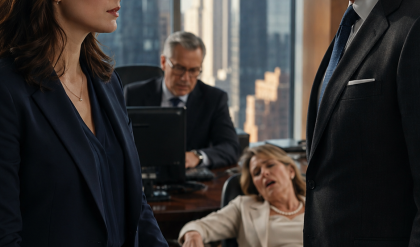
Preston Marchetti had never touched me, never promised me anything, and never once said my name like it belonged in his mouth. But that morning, while another woman stood in his office trying to remind me how invisible I was, I realized silence could hurt worse than betrayal. Veronica Ashford smiled at me like she already owned him, like my six months beside him had only made me a better shadow. And I stood there with contracts in my trembling hands, wondering if the most dangerous man in Manhattan had ever truly seen me at all.
The coffee on my tongue was bitter, cold, and cheap, but I swallowed it anyway as I straightened the stack of papers on Preston’s mahogany desk for the third time. My lower back ached from another endless week of bending over files, schedules, and legal notes no one else bothered to understand. Forty-two floors above the city, Marchetti Industries glittered like a palace built from glass, money, and secrets. Everything smelled of leather, expensive cologne, and danger—the kind of danger that followed Preston wherever he went.
I smoothed my gray pencil skirt and tried not to look at my reflection in the dark window beside his desk. Compared to the women on that floor, I looked plain, careful, forgettable. They wore silk and diamonds; I wore sensible shoes, a neat bun, and the kind of calm that came from learning how not to cry in public. Then I heard Veronica’s heels clicking down the hallway, and every sound felt like a warning.
“Paige,” she said from the doorway, her voice sweet enough to poison. “Still playing dress-up as a professional. How adorable.” I turned and found her leaning against Preston’s office door in a crimson dress that looked made for attention. Her dark hair fell in perfect waves, her lips curved with practiced cruelty, and her perfume filled the room before she even stepped inside. I lifted my chin and said, “Good morning, Veronica.”
She laughed like I had told a joke. “Preston will be with the Benedetti family all afternoon,” she said, walking closer as if the office belonged to her. “Important business. The kind that requires sophisticated company.” Her eyes traveled over my plain blouse, my tired face, my hands still resting on his contracts. “But I suppose someone has to keep the paper clips organized.”
“I’m aware of his schedule,” I said quietly. “I manage it.” That should have ended it, but Veronica had never come into a room unless she meant to leave someone bleeding. She leaned close enough for me to see the tiny diamonds at her ears. “Darling, you manage his paperwork. I manage so much more.”
The words struck exactly where she wanted them to. I had heard rumors about Preston Marchetti since my first day—CEO, billionaire, import-export king, and something much darker behind closed doors. People whispered about East Coast families, deals that never appeared on paper, and men who stopped answering their phones after private meetings. But I had never seen him break the law. I had only seen him work until midnight, speak with terrifying control, and sometimes look at me as if he could read every secret I tried to hide.
“Look at yourself, Paige,” Veronica whispered. “Those shoes. That hair. That bare face. Do you honestly think Preston Marchetti would ever want a woman like you?” My throat tightened, but I kept my hands steady on the desk. I had survived debt, loneliness, and six months of loving a man I knew I had no right to love. “I’m just here to do my job,” I said.
“And thank God for that,” she replied. “Because he would never kiss you, never touch you, never choose you. You’re the little mouse who files his papers and fetches his coffee.” She smiled wider, enjoying every second of my silence. “You’re invisible to him, sweetheart. You always will be.”
Then the private elevator chimed. The sound cut through the room like a gunshot, and Veronica’s face changed instantly. Preston Marchetti stepped out in a dark tailored suit, broad-shouldered, controlled, and devastatingly calm. The air itself seemed to shift around him, as if even the walls knew better than to challenge his presence. His black eyes moved from Veronica to me, and my heart forgot how to beat.
“Mr. Marchetti,” Veronica purred, straightening her posture and softening her voice. “I was just reviewing the Benedetti meeting details with Paige.” Preston looked at her the way a king might look at a fly on his glass. “Were you?” he asked, his voice low and cold. Then his gaze landed on me, and for one dangerous second, something in his expression changed.
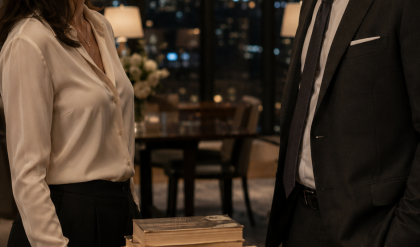
“Miss Hayes,” he said. “The contracts.” I motioned to the stack on his desk, forcing my voice not to shake. “Ready for your signature, sir. I flagged the urgent sections and cross-referenced them with legal’s notes.” His eyes flickered over the tabs, the markings, the careful work I had done while everyone else underestimated me. “Efficient as always,” he said.
Veronica’s smile cracked. Preston moved past her without another glance and reached for the first contract. “Clear my schedule for the next hour,” he said. “I need to review these without interruption.” I nodded and reached for my phone, but before I could move, his voice sharpened. “That includes you, Miss Ashford.”
Veronica froze. “But I thought—” “Now,” Preston said, still not looking at her. The word was quiet, but it carried enough force to empty a room. Her face burned red as she turned toward the door, and for the first time, I saw fear beneath her beauty. But before she left, Preston picked up one marked contract, paused on a hidden clause, and said my name in a tone I had never heard before.
Because buried inside that file was something I was never supposed to find.
PART 2:
For several seconds, I could not understand what Veronica had said. My mind rejected the words because accepting them would mean my entire life had been built on a lie. I looked at Preston, waiting for him to deny it, but the regret in his eyes told me the truth before his mouth did.
“I’m divorced,” I whispered, though my voice had already begun to break. Preston stepped toward me, but I lifted my hand to stop him. “Don’t,” I said, because I knew whatever came next would destroy something inside me forever.
Veronica smiled like she had finally found the knife she wanted. “Your husband, Martin Hayes, was never just a runaway coward,” she said. “He worked for the Benedetti family.” The room seemed to tilt beneath my feet.
Preston’s voice was low, controlled, and mercilessly honest. Martin had been an accountant for offshore transfers, a quiet man trusted with secrets powerful men killed to protect. Before he vanished, he stole a ledger containing names, routes, shell companies, judges, officials, and enough evidence to bury half the East Coast.
I stared at Preston as if I had never seen him before. “And you knew this when you hired me?” I asked. He did not answer quickly enough, and that silence was worse than any confession.
“Yes,” he finally said. “I hired you because of Martin.” The words cut through six months of late nights, careful glances, and foolish hope. I had not been chosen because I was capable; I had been placed because I might be useful.
Veronica laughed softly. “Invisible, but convenient,” she said. Something inside me snapped, not loudly, but completely. I turned to her and said, “Be quiet,” and for the first time that morning, she did.
I demanded the rest, and Preston gave it to me standing. Martin had tried to sell the stolen ledger to him but disappeared before the exchange. Preston believed I might know where it was hidden, so he brought me close, watched me, studied me, and kept me near his office like a key that might one day open a locked door.
Then came the deepest betrayal. Veronica revealed that Preston had monitored my apartment, my calls, my lunches, even my quiet trips home. My private life had not been private at all, and the man I had trusted in silence had turned my loneliness into surveillance.
Preston said he had done it because I was in danger. I asked if he had protected me for my sake or for the ledger, and his answer came like a wound. “At first, the ledger,” he said.
Those three words changed everything. But then he said “at first,” and the room filled with something neither of us was brave enough to name. Veronica saw it too and sneered that the wolf had developed feelings for the bait.
Before I could answer, Preston’s phone buzzed. His face hardened as he listened, and suddenly the air turned deadly. Benedetti’s men were downstairs, and the trap was no longer hidden inside a contract.
Preston opened a secret compartment and removed a coat and a gun. He said the forged clause had been designed to make me look guilty if he died, while Benedetti took control and Martin’s ledger stayed buried. Then he said the one thing that froze my blood completely.
Martin’s body had never been found. They had believed he was dead, but belief was not proof. Somewhere in the city, the truth about my husband was still breathing.
I looked at Preston, at Veronica, and at the contract with my forged name waiting like a death sentence. I was tired of being used, watched, pitied, and underestimated. So when Preston said we had to find the ledger before they found me, I did not run from the truth—I stepped straight into it.
# The Ledger and the Truth
Preston grabbed my wrist before I could reach the door. “You’re not going alone,” he said, and for once, I believed him — not because I had to, but because the fear in his eyes was real.
Veronica moved toward the exit, but Preston’s voice stopped her cold. “You’re staying here,” he said. “If Benedetti’s men come up, you’ll tell them I left an hour ago.” She opened her mouth to protest. He looked at her the way men look at something they no longer need. She sat down.
—
We took the service elevator down forty-two floors in silence. The city swallowed us the moment we stepped onto the street — gray skies, yellow cabs, the anonymous noise of ten million people who didn’t know or care that my life had just come apart at the seams.
“Where would Martin hide something he didn’t want found?” Preston asked.
I almost said *I don’t know*. That had been my answer to everything for six months — to questions about my marriage, my past, the strange hollow feeling I carried into every room. But standing there on the sidewalk, with Benedetti’s men somewhere behind us and the truth finally out in the open, I did know.
“The storage unit in Queens,” I said. “He paid two years in advance the month before he disappeared. I thought it was just old furniture.”
Preston didn’t ask why I’d never looked inside. Maybe he already knew. Some doors, you leave closed because you’re not yet ready to survive what’s behind them.
—
The unit was padlocked, number 114, in a facility that smelled of rust and forgotten things. I still had the key on my ring — had carried it for eighteen months without ever admitting why.
Inside was almost nothing. A folding chair, a broken lamp, three cardboard boxes. And taped beneath the seat of the chair, wrapped in two layers of plastic and a rubber band that had begun to decay: a black notebook no larger than my palm.
Preston reached for it. I got there first.
“I need to look at it,” I said. Not a question.
He stepped back and let me.
The handwriting was Martin’s — neat, slanted, obsessive. Columns of names, account numbers, routing codes, initials I didn’t recognize and some I did. Judges. A city councilman. Two names I had seen in newspapers above headlines about charitable foundations. And near the back, a single line in red ink that made my hands go still.
*P. Marchetti — approached 3/14. Refused. Trust him if everything falls apart.*
I looked up at Preston. He was watching me the way he always had — careful, unreadable, and somehow sorry.
“He trusted you,” I said.
“He was right to,” Preston said quietly. “I turned him away because I wanted no part of Benedetti’s world. Two weeks later, Martin was gone.” He paused. “I have been trying to find him ever since.”
The silence between us had a different texture now. Not the silence of secrets. Something older and more honest.
“You said his body was never found,” I said.
“It wasn’t.”
“Then we find him,” I said. “Before they do.”
—
We found Martin four days later — a man living under a different name in a rented room in Newark, thin and gray-haired and terrified of his own reflection. He had staged his disappearance to protect me. He had been too afraid to come back. He had carried his guilt through eighteen months of lonely survival and convinced himself I was better off believing he was dead.
He wept when he saw me. I stood in the doorway of his rented room and felt every complicated thing a person can feel at once — relief, fury, grief, and something that had no name.
“I’m so sorry, Paige,” he said.
“I know,” I said. And I meant it and didn’t forgive him, not that day, and maybe not for a long time. But I was done letting other people’s choices make me invisible.
—
The ledger went to a federal prosecutor Preston had trusted for years. The names inside it unraveled quietly over the following months — no dramatic headlines at first, only quiet arrests, resigned appointments, withdrawn foundations. Benedetti’s network didn’t collapse all at once. It dissolved, the way things do when the truth finally has enough room to breathe.
Veronica disappeared from the forty-second floor without ceremony. I didn’t ask where she went.
Martin faced the consequences of what he had done — the theft, the hiding, the long silence. I filed for divorce on a Tuesday morning in November, signed the papers with a steady hand, and walked back out into the cold air feeling lighter than I had in years.
—
Preston found me on the roof of Marchetti Industries three weeks later, where I sometimes came at lunch because the city looked less overwhelming from above.
“I owe you an honest answer,” he said, standing beside me at the railing.
“You owe me several,” I said.
He almost smiled. “I hired you because of Martin. That’s true.” He looked out at the city. “But I kept you close because of you. Because you were the only person in that building who did the work without needing anyone to notice. Because you flagged clauses three lawyers had missed. Because you said *good morning* to the security guards by name.” He paused. “Because when Veronica tried to make you small, you lifted your chin.”
I looked at him. The most dangerous man in Manhattan, standing in the wind, telling me the truth without being asked.
“That’s not an apology,” I said.
“No,” he agreed. “It’s a beginning. If you want one.”
I thought about the six months of careful, quiet love I had carried like something contraband. I thought about the forged contract, the surveillance, the three words — *at first, the ledger*. I thought about what it meant that he had come up here, to the roof, on a cold Tuesday, just to be honest with me.
“I’m not invisible,” I said.
“No,” he said. “You never were. I was just afraid of what that meant.”
The city hummed forty-two floors below us. Somewhere across the river, the wheels of justice were turning slowly, the way they always do. Martin was alive. The ledger was safe. And I was standing in the wind above Manhattan, no longer someone’s shadow, no longer someone’s useful secret.
“Ask me properly,” I said. “And don’t make me wait.”
He turned to look at me, and for the first time in six months, Preston Marchetti looked like a man who had finally run out of armor.
“Dinner,” he said. “Tonight. As equals.”
I picked up my coffee cup — fresh, hot, and finally mine.
“I’ll check your schedule,” I said. “And send you a reminder.”
He laughed — a real one, low and surprised — and I decided that sound was worth every paper clip, every cold cup of coffee, every morning I had spent learning how not to disappear.
I was done being invisible. It was time to be seen.