My husband let his mistress speak at my mother’s funeral reception.
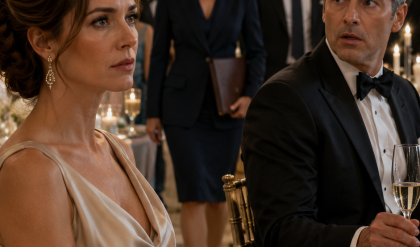
She stood beneath the crystal chandelier at the Aster House in Newport, wearing champagne silk to a room dressed in black, her diamond bracelet catching the candlelight like it had been invited to shine. In one hand, she held a glass of white wine. In the other, she held the attention of every person who had come to mourn Vivian Westbrook, my mother, the woman who had taught half of New England how to enter a room and the other half how to leave one with dignity.
Sloane Mercer smiled softly, as if grief were a stage she had rented for the evening.
“Vivian would have wanted everyone to be happy,” she said.
The room froze.
Not quieted. Not paused.
Froze.
Forks hovered above untouched plates. A senator’s wife stopped mid-breath. My mother’s oldest friend, Mrs. Ellery, lowered her handkerchief from her eyes and stared as though a serpent had slithered across the Persian rug.
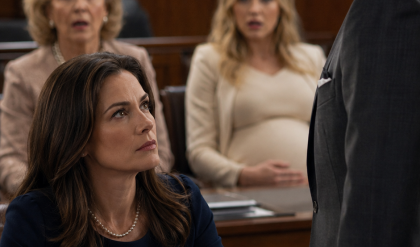
I stood beside the fireplace in my black dress, my mother’s pearls around my throat, my fingers cold around a glass of water I had not drunk. My husband, Grant Whitaker, stood six feet away from me.
He looked at the floor.
That was the part that cut deepest.
Not Sloane’s voice. Not her smile. Not the fact that she had come to my mother’s funeral reception dressed like a second bride.
It was Grant’s silence.
For nine years, I had protected him in rooms like this. I had smiled while he charmed donors with stories he had borrowed from my childhood. I had stood at his side while he climbed the marble staircase of my family’s name and called it ambition.
And now, as his mistress lifted her glass at my mother’s memorial and turned my grief into a toast, he simply stared down at his shoes and let her continue.
“I didn’t know Vivian as long as many of you,” Sloane said, her voice trembling with a performance of emotion so polished it almost gleamed. “But I know she believed in love. In forgiveness. In new beginnings.”
A sound moved through the room. Not quite a gasp. Not quite a warning.
My mother’s attorney, Nathaniel Price, rose from his chair near the back wall.
He was tall, silver at the temples, and so controlled that even his grief wore a suit. In his hand was a cream envelope sealed with red wax.
“Miss Mercer,” he said, his voice quiet enough to make the room lean in. “I suggest you sit down.”
Sloane blinked.
Grant finally looked up.
Nathaniel stepped forward.
“Mrs. Westbrook left one final letter,” he said. “It was to be read if, and only if, Mr. Whitaker brought Miss Mercer into this room today.”
My heart stopped.
Grant’s face drained of color.
Sloane’s glass trembled.
Nathaniel broke the seal.
And my dead mother began to speak.
Chapter 1: The Toast That Shattered the Marble
The Aster House had hosted governors, billionaires, heiresses, and widows who knew the exact value of silence. It was the kind of place where scandal did not explode. It condensed.
Whispers became frost on the windows. Side glances became headlines by morning.
My mother had chosen it herself.
“Never let people mourn you in a room with bad lighting,” she had told me three months before she died, sitting in her sunroom with a cashmere blanket over her knees and a cup of tea cooling beside her. Cancer had thinned her body, but not her presence. Vivian Westbrook had still looked like a woman who could make death wait in the hallway until she finished her correspondence.
I had thought she was joking.
She had not been joking.
Now every candle, every arrangement of white roses, every silver-framed photograph of her life felt deliberate. My mother had staged her own exit with the precision of a woman who expected enemies to attend.
Nathaniel unfolded the letter.
His eyes moved once across the first line, and something in his expression softened before turning to steel.
“My darling Claire,” he read.
At the sound of my name, I closed my eyes.
“If you are hearing this, then Grant has done what I suspected he would do. He has mistaken your kindness for weakness and my death for opportunity.”
Someone in the room whispered, “Oh my God.”
Grant took one step forward. “Nathaniel, this is inappropriate.”
Nathaniel did not even look at him.
My mother’s words continued.
“I know about the affair. I know about the penthouse on West Fifty-Seventh Street, the trips to Palm Beach listed as investor meetings, the sapphire bracelet purchased from Langley & Co. with money routed through a consulting account, and the woman currently pretending to respect me while standing in the room my daughter paid for with tears.”
Sloane’s face went white beneath her makeup.
Grant’s jaw locked.
The room had stopped being a funeral reception. It had become a courtroom with better flowers.
I stared at Nathaniel, trying to understand how my mother had known. How she had carried this truth in the same body that had held my hand through chemo. How she had watched me kiss Grant goodbye in hospital corridors and said nothing.
But then, maybe she had not said nothing.
Maybe she had simply waited.
Nathaniel turned the page.
“Claire, do not cry for what you are about to lose. You are not losing a husband. You are losing a liability.”
A sharp, involuntary laugh escaped someone near the bar. It disappeared just as quickly.
Grant’s mother, Eleanor Whitaker, pressed her fingers to her pearls. She had never liked me, but she had loved my family’s money with a devotion that bordered on religious.
“My will has been amended,” Nathaniel read. “All Westbrook family assets, including but not limited to the Newport estate, the Beacon Hill residence, the Westbrook Foundation endowment, and controlling interests in Marigold Holdings, have been transferred into the Hartwell Trust, of which Claire is sole trustee.”
Grant looked at me.
Not like a husband.
Like a man watching a door lock from the wrong side.
My mother’s letter went on.
“Grant, if you are present, let me be clear. You were offered my daughter’s heart, her loyalty, and more second chances than you deserved. You will receive from my estate exactly what your vows were worth.”
Nathaniel paused.
“One dollar.”
The room inhaled.
Sloane slowly lowered her glass.
Grant’s eyes narrowed. “This won’t hold.”
Nathaniel looked at him then. “It already has.”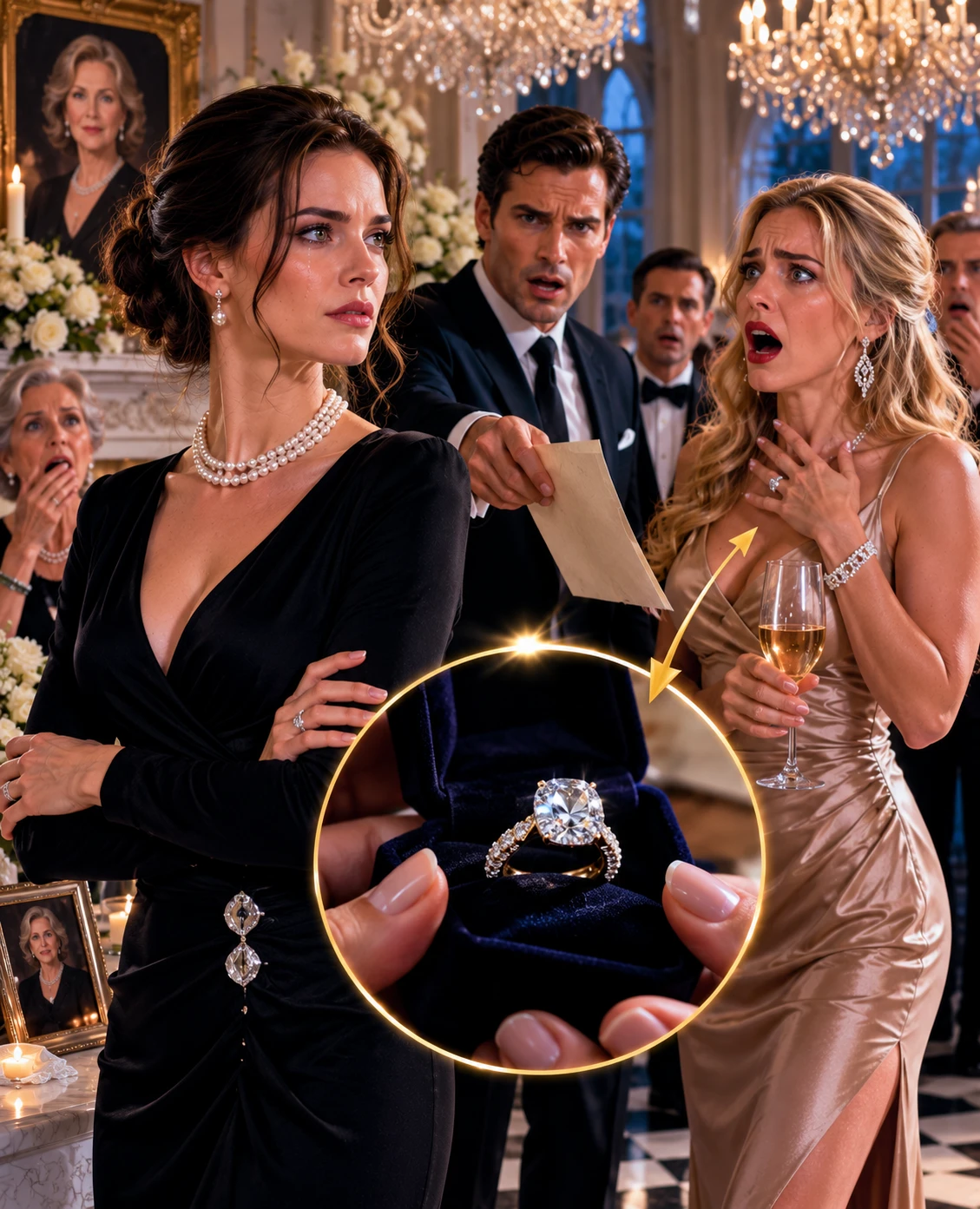
I felt the room tilt, though my feet stayed planted. My grief had been a dark ocean all day, pulling me under. But now something else rose beneath it.
Not joy.
Not revenge.
Power.
A quiet, cold current.
Nathaniel read the final paragraph.
“Claire, my precious girl, you were raised to be gracious. I am asking you, for once, to be dangerous. Not loud. Not cruel. Dangerous. The world forgives men who burn houses down and condemns women who change the locks. Change the locks anyway.”
My lips parted.
I could almost hear her voice. Smooth. Warm. Unshakable.
“P.S. The pearls are not just pearls.”
Nathaniel folded the letter.
For a moment, no one moved.
Then Sloane whispered, “I didn’t mean—”
“You did,” I said.
It was the first thing I had spoken since she stood.
My voice surprised even me. It did not tremble. It did not break.
It sounded like my mother’s.
Grant turned toward me. “Claire, we need to talk privately.”
I looked at the man I had married under hydrangeas in August, the man who had cried when my father died, the man who had slept beside me while my mother was dying and lied with the calmness of a practiced thief.
“No,” I said. “We don’t.”
He reached for my arm.
Nathaniel stepped between us before Grant’s fingers touched me.
“Mr. Whitaker,” he said, “your car is waiting.”
Grant’s smile was small and ugly. “You think a letter embarrasses me?”
“No,” Nathaniel said. “I think discovery will.”
The word landed like a blade.
Discovery.
Legal proof.
Documents. Emails. Bank records. Hotel receipts. Everything men like Grant believed could be hidden if the lighting was dim enough and the mistress was obedient enough.
Sloane’s eyes filled with tears, but they were not tears of shame. They were tears of calculation.
She turned to the room. “This is grief talking. Claire is hurt. We all loved Vivian.”
I laughed.
Softly.
That was what made everyone look at me again.
“You did not love my mother,” I said. “You loved the idea that her death would make me easier to replace.”
Sloane flinched.
Grant hissed my name.
I took off my wedding ring.
It was a five-carat emerald cut diamond Grant had chosen because he liked how it looked in photographs. I placed it on the marble mantel beside my mother’s portrait.
Then I lifted my water glass.
“To Vivian Westbrook,” I said. “Who always knew where the bodies were buried, and apparently left a map.”
No one laughed that time.
They raised their glasses.
All except Grant and Sloane.
Chapter 2: The Woman Who Inherited Silence
Three days after the funeral, I woke up alone in my mother’s house.
Not my house.
Not yet, though legally it had become mine the moment Vivian Westbrook took her last breath in a private hospital suite overlooking the harbor.
The Newport estate was called Windmere, because old money enjoyed naming houses as if they were people. It sat on twelve acres above the Atlantic, all gray stone and ivy, with windows that caught the morning light like gold coins.
As a child, I thought it was a castle.
As a wife, I treated it like a museum.
As a widow of a marriage that had not yet legally died, I walked through it barefoot at dawn and realized it was a fortress.
Grant had not come home.
He had gone to the Manhattan apartment, the one I had once decorated in warm neutrals because he said the city made him feel sharp around the edges. I wondered if Sloane was there now, wrapped in my cashmere throw, pouring coffee into my porcelain cups, convincing him that my mother’s letter was merely an emotional ambush.
Let them.
My phone had been vibrating for seventy-two hours.
Grant: We need to discuss this like adults.
Grant: Your mother poisoned you against me.
Grant: Do not make this public.
Grant: Claire, I still love you.
That last one arrived at 2:13 a.m.
I stared at it while standing in my mother’s dressing room, surrounded by cedar drawers and the faint scent of Chanel No. 5. Then I deleted it.
Love, I had learned, did not ask you to protect its reputation after it humiliated you in public.
On the vanity sat my mother’s pearl necklace.
The pearls are not just pearls.
I lifted them carefully. They were heavy, luminous, and cool. My father had given them to her on their twentieth anniversary. I had worn them at the funeral because she had requested it in a note left with the dress.
Now, under the softer dressing-room light, I noticed what grief had hidden from me.
The clasp was wrong.
Not wrong exactly. Too large. Too ornate. A small diamond flower with a center stone that pressed inward when my thumb brushed it.
A click.
The clasp opened.
Inside was a flash drive the size of my thumbnail.
For a long time, I simply stared.
Then I laughed so hard I cried.
“My God, Mom,” I whispered. “You were impossible.”
Nathaniel arrived at noon with two associates, a security consultant, and a woman named Mara Vance, whose handshake felt like signing an NDA.
“Mara specializes in forensic accounting,” Nathaniel explained as we sat in my mother’s library beneath shelves of leather-bound books no one had opened in decades.
Mara was in her early forties, with blunt black hair and the unbothered expression of a woman who had seen rich men try to hide money in very stupid ways.
She accepted the flash drive without surprise.
“You knew about this?” I asked Nathaniel.
“I knew your mother had evidence,” he said. “I did not know where she hid it.”
“Because she didn’t trust you?”
He smiled faintly. “Because she trusted herself more.”
That sounded like her.
Mara plugged the drive into an encrypted laptop. Within seconds, folders appeared.
WHITAKER — HOTEL
WHITAKER — BANKING
MERCER — PAYMENTS
SIGNATURES
MEDICAL TIMELINE
My stomach turned.
“Medical timeline?” I asked.
Mara opened the file.
Emails.
Texts.
Voicemails.
Notes from my mother’s private nurse.
Grant had visited my mother alone six weeks before she died. He had brought papers. He had told her they were routine estate documents to “make things easier for Claire.” He had asked her to sign over temporary voting authority in a real estate holding company connected to my trust.
She had refused.
Then she had told her nurse to keep the pen.
My mother had photographed the documents after he left.
The signature line showed my name.
Forged.
Grant had not merely betrayed me.
He had attempted to steal from me while my mother was dying.
Something inside me went very still.
Nathaniel watched me with careful eyes. “Claire.”
“I’m fine.”
“You don’t have to be.”
“No,” I said, looking at the screen. “But I am.”
Mara opened another folder. Sloane Mercer’s name appeared across wire transfers from a consulting entity connected to Grant’s firm. The payments were labeled brand strategy, art advisory, lifestyle marketing. Tens of thousands. Then hundreds.
There were hotel invoices in Palm Beach, Aspen, Miami Beach, Napa.
There were photos.
I did not look at those for long.
A woman can survive many things, but she does not need to memorize the wallpaper of the room where her marriage died.
“What happens now?” I asked.
Nathaniel placed a folder in front of me.
“First, we file for divorce on grounds permitted under the prenuptial agreement. Infidelity activates the penalty clause Grant personally negotiated when he thought it would only protect him.”
Despite everything, I almost smiled.
“Of course he did.”
“Second, we notify the board of Whitaker Meridian that voting documents submitted last quarter are under forensic review. Third, we freeze all transfers involving marital assets. Fourth, we pursue civil claims for fraud, conversion, and breach of fiduciary duty where applicable.”
“And Sloane?”
Mara turned the laptop toward me.
On the screen was a scanned contract bearing Sloane’s signature.
“She accepted payments from a shell entity created with funds connected to your family trust,” Mara said. “She also signed an image licensing agreement for a luxury development campaign that used Westbrook Foundation donor lists without authorization.”
I blinked.
“She stole from a charity?”
“Not elegantly,” Mara said.
Nathaniel slid another envelope toward me.
“This was also from your mother.”
My name was written across it in her handwriting.
Claire, for when you want to scream.
I opened it with shaking hands.
Inside was a short note.
My darling,
Rage is a room. Enter it if you must, but do not decorate it. You have work to do.
Grant believes power is volume. Sloane believes power is beauty. They are both wrong.
Power is ownership.
Ask Nathaniel about Marigold.
I looked up.
“What is Marigold Holdings?”
Nathaniel’s expression changed.
“Your mother’s final acquisition.”
“Of what?”
He hesitated, and for the first time since I had known him, Nathaniel Price looked almost pleased.
“Grant’s future.”
Chapter 3: Marigold Was Never a Flower
Grant Whitaker had spent two years building his masterpiece.
Whitaker Meridian was supposed to be his empire: a luxury resort and private residences project on the coast of South Carolina, all glass balconies, golf carts, and false promises of legacy. He had called it “the next American sanctuary.” Magazines had called him visionary.
He had never corrected them.
The truth was less glamorous.
Whitaker Meridian was overleveraged, underfunded, and dependent on one private debt package arranged quietly through Marigold Holdings.
Marigold Holdings, as it turned out, belonged to my mother.
And now it belonged to me.
I learned this in the library while rain tapped against the windows and Mara drew boxes and arrows on a legal pad.
“Your mother acquired the debt after Grant’s first lender got nervous,” she said. “She did it anonymously through counsel and intermediaries.”
“Why?”
Nathaniel answered. “Because she wanted leverage if he ever hurt you.”
I looked down at the diagram. Lines connected Grant’s company to Marigold, Marigold to the Hartwell Trust, the Hartwell Trust to me.
My mother had built me a throne out of paperwork.
“What does this mean?” I asked.
“It means,” Mara said, “Grant cannot close his next funding round, refinance the existing debt, sell major assets, or dilute investors without your consent.”
My phone buzzed.
Grant again.
I turned it face down.
For the next six weeks, I became a woman my husband did not recognize.
That was easy. He had never known me well.
He had known the dinner-party version of me. The woman who remembered birthdays, wrote condolence notes, donated quietly, and forgave quickly because anger seemed expensive. He had known the daughter of Vivian Westbrook, but not the woman Vivian had raised in private.
My mother had taught me table manners, yes.
She had also taught me where to stand in a negotiation so sunlight would make the other person squint.
I hired a divorce attorney named Beatrice Sloan, which was unfortunate for Sloane Mercer and delightful for everyone else. Beatrice was seventy-one, wore red lipstick to court, and had once made a hedge fund manager cry during mediation.
“Men like Grant do not fear losing love,” Beatrice told me. “They fear losing access.”
So we removed access.
Credit lines connected to my trust were frozen.
The Manhattan apartment, purchased before my marriage through a Westbrook entity and “generously made available” to Grant, received notice of occupancy review.
The Range Rover he had given Sloane, titled through a company tied to his firm and paid with misdirected marital funds, was repossessed from outside a private Pilates studio in Tribeca.
There was a video.
It went quietly viral.
Sloane wore oversized sunglasses and a camel coat while insisting to the tow driver, “This is my car.”
The tow driver, unmoved, said, “Not according to the paperwork.”
America loves justice most when it arrives with a flatbed truck.
Grant called me seventeen times that day.
I answered on the eighteenth.
“Have you lost your mind?” he snapped.
I was sitting in my mother’s garden, cutting dead roses from a trellis.
“No,” I said. “I found my paperwork.”
“You’re embarrassing yourself.”
I clipped a stem.
“Interesting. I thought that was Sloane’s department.”
Silence.
Then, lower, “This is beneath you, Claire.”
“No. You were beneath me. I just didn’t look down.”
He exhaled sharply. I could hear the city behind him, traffic and horns and the distant pulse of a life he thought he owned.
“I made a mistake.”
“You made hotel reservations.”
“I’m serious.”
“So am I.”
“She meant nothing.”
That was the moment I finally hated him.
Not when he cheated. Not when he let her speak at my mother’s funeral. Not when I saw the records, the gifts, the forged signature.
It was then.
She meant nothing.
He had destroyed me for nothing. Risked my mother’s legacy for nothing. Humiliated me in a room full of mourners for nothing.
I looked at the roses in my lap.
“My mother meant something,” I said. “My marriage meant something. My name means something. That is why you will not be allowed to keep using any of them.”
He laughed, but it was thin.
“You think you can ruin me?”
“No, Grant. I think you ruined yourself in writing.”
I hung up.
That evening, Sloane posted a photograph on Instagram.
She stood on a balcony at sunset in a black slip dress, looking mournful and expensive. The caption read:
Some women inherit money. Others earn love.
By midnight, the comments had turned.
By morning, someone had found the tow-truck video.
By lunch, the internet had renamed her “Funeral Toast Barbie.”
I did not like the nickname.
My mother would have said Barbie had better manners.
Still, I did not stop it.
I did not post. I did not leak. I did not cry on camera. I did not give interviews.
I attended board meetings.
I learned the architecture of Grant’s desperation. Debt maturities. Investor covenants. Personal guarantees. Bad signatures. Worse emails.
I discovered that Sloane’s “gallery” in SoHo had sold three paintings to a Whitaker entity at five times market value. I discovered Grant’s assistant had been instructed to label vacations as site visits. I discovered Eleanor Whitaker had received monthly transfers from an account Grant claimed was dormant.
At night, I dreamed of my mother.
Not sick. Not pale.
She appeared as she had when I was twelve, standing on the back lawn in white linen, holding garden shears and telling me not to be afraid of thorns.
One Friday in late October, Nathaniel arrived with another envelope.
I was in the ballroom at Windmere, overseeing the removal of my wedding portraits from storage. The largest one showed Grant kissing my hand beneath an arch of roses. I stared at it for a moment, then told the staff to donate the frame and burn the photograph.
Nathaniel handed me the envelope.
“This was to be opened after the preliminary injunction was granted.”
“Was it?”
“This morning.”
I took the envelope.
Inside was a key.
A brass key, old and small, tied with a marigold ribbon.
Beneath it was my mother’s handwriting.
My darling,
There is one thing I did not put on the flash drive.
A woman should always keep one secret for the finale.
Go to the boathouse.
I looked at Nathaniel.
He said, “I have no idea.”
The boathouse sat at the edge of Windmere’s private dock, gray with salt and age. My father had kept sailing trophies there. My mother had kept old wicker chairs, storm lanterns, and boxes of things too sentimental to throw away.
At least, that was what I had believed.
The key opened a cabinet behind a wall of faded oars.
Inside was a safe.
Nathaniel called Mara. Mara called a locksmith. The locksmith opened the safe and wisely pretended not to notice that my hands were shaking.
Inside were three things.
A velvet jewelry case.
A stack of notarized documents.
And a small silver recorder.
I opened the jewelry case first.
Empty.
No, not empty.
Indented velvet, shaped for a necklace.
A necklace I had seen before.
Around Sloane Mercer’s throat at my mother’s funeral.
A diamond collar with a pear-shaped emerald at the center.
Grant had told me it was costume.
My mother’s documents said otherwise.
The necklace was the Westbrook Emerald Collar, missing from the family vault since May.
Two weeks before Grant had taken Sloane to Palm Beach.
My breath left me.
Nathaniel picked up the recorder and pressed play.
Static.
Then Grant’s voice.
“She’ll sign if we push after the morphine.”
My mother’s voice followed, calm and very weak.
“Grant, you disappoint me.”
A chair scraped.
“Vivian, I’m trying to protect Claire.”
“No,” my mother said. “You’re trying to rob her before she realizes she’s alone.”
Sloane’s voice came next, soft and impatient.
“You said she was too fragile to fight.”
Grant muttered, “She is.”
My mother laughed.
Even through the tiny speaker, even through illness, even from beyond the grave, Vivian Westbrook laughed like a woman watching children play with matches beside a lake.
“You have no idea what my daughter is,” she said.
The recording ended.
No one spoke.
Outside, waves broke against the rocks with a sound like applause.
Chapter 4: The Gala Where the Knives Wore Diamonds
Grant made his final mistake on a Thursday night in Manhattan.
He invited me.
Not personally. He was too proud for that. The invitation came through a public relations firm, embossed in black and gold.
THE WHITAKER MERIDIAN FOUNDATION
INAUGURAL WINTER GALA
THE PLAZA HOTEL
BENEFITING COASTAL PRESERVATION AND ARCHITECTURAL HERITAGE
My mother’s foundation had funded coastal preservation for thirty years.
Grant’s new foundation had been created six days after her death.
The audacity was almost architectural.
Beatrice advised against attending.
Mara advised attending with federal marshals.
Nathaniel said nothing for a long moment, then asked, “What would your mother do?”
I looked at the invitation.
“She would wear black.”
The Plaza ballroom glittered like a jewelry box designed by someone with something to hide. Gold ceilings, white roses, champagne towers, a string quartet playing near the staircase. Women in couture drifted past men in tuxedos whose fortunes depended on appearing calm.
Grant stood near the stage, handsome as ever, smiling like the world had not begun to burn beneath his feet.
Sloane stood beside him.
She wore white.
Not bridal white. Worse. Widow white. A sleek column gown with long sleeves and a low back, her blond hair pinned in a soft knot. Around her throat sat the Westbrook Emerald Collar.
My mother’s necklace.
For one second, my vision narrowed.
Then I felt my mother’s pearls against my skin and remembered.
Dangerous. Not loud.
I entered the ballroom at exactly 8:17 p.m.
The room noticed in stages.
First the women.
Then the men.
Then the photographers.
Then Grant.
His smile faltered so slightly that only a wife would have seen it.
I wore black velvet, long-sleeved and high-necked, with my mother’s pearls and no wedding ring. My hair was swept back. My lipstick was deep red. I had not come dressed as a woman seeking closure.
I had come dressed as the period at the end of a sentence.
Nathaniel walked at my left. Beatrice at my right. Mara followed behind us with a black leather folder and the expression of a woman about to ruin several tax strategies.
Sloane recovered first.
She smiled.
That was her talent. Beauty as camouflage.
“Claire,” she said, loud enough for nearby guests to hear. “How brave of you to come.”
I looked at the emerald at her throat.
“How brave of you to wear evidence.”
Her hand flew to the necklace.
Grant stepped in. “Enough.”
I smiled at him.
There are smiles that forgive.
There are smiles that flirt.
There are smiles that say the elevator cable has already snapped and you are simply waiting for the impact.
Mine was the third.
The program began at eight-thirty.
Grant took the stage beneath a canopy of white roses and thanked everyone for believing in vision, legacy, and responsible development. He spoke about preserving history while building the future. He mentioned my mother once, calling her “a dear family mentor.”
Family mentor.
Not mother-in-law. Not founder. Not woman whose money had kept his empire breathing.
Mentor.
A waiter near me winced.
Then Grant lifted his glass.
“To those who came before us,” he said, “and to those brave enough to begin again.”
Sloane looked at me when he said it.
I looked at my watch.
8:42.
On cue, Beatrice rose.
“Mr. Whitaker,” she said.
The room turned.
Grant’s eyes hardened. “This is a private event.”
“No,” Beatrice said. “This is a fundraising event conducted by a registered charitable entity using donor materials currently under injunction.”
A murmur rippled outward.
Grant laughed once. “Ladies and gentlemen, please forgive the interruption. My wife is grieving.”
“Your wife,” Beatrice said, “filed for divorce six weeks ago. Your response was due Tuesday.”
Someone dropped a champagne flute.
It shattered beautifully.
Two uniformed officers entered through the side doors. Behind them came a process server in a charcoal suit who looked almost bored.
Nathaniel stepped forward.
“Grant Whitaker, you are being served with a temporary restraining order prohibiting the use of Westbrook Foundation donor lists, marks, historical materials, or charitable assets in connection with Whitaker Meridian Foundation.”
The process server handed Grant the documents.
Grant did not take them.
They were placed on the podium.
Cameras flashed.
Sloane whispered, “Grant?”
Mara opened the black folder.
“And Sloane Mercer,” Nathaniel continued, “you are being served notice regarding possession of stolen property belonging to the Hartwell Trust.”
Sloane’s face twisted.
“This necklace was a gift.”
“From whom?” I asked.
She looked at Grant.
Grant looked at the floor.
Again.
The same floor, different room.
That was the thing about cowards. Give them marble, give them money, give them a microphone, and eventually they still look down.
Beatrice’s voice cut through the whispers.
“The Westbrook Emerald Collar disappeared from a secured family vault in May. We have photographs of Miss Mercer wearing it in Palm Beach three days later, insurance documentation, vault logs, and a recording relevant to its removal.”
Sloane touched the emerald as if it might protect her.
A security officer approached gently.
“Ma’am,” he said. “The necklace.”
“You cannot be serious,” she whispered.
I stepped close enough that only she, Grant, and the nearest dozen donors could hear.
“You wanted to stand in my mother’s room and talk about happiness,” I said. “Now stand in this one and talk about chain of custody.”
Her eyes filled with tears.
Real ones this time.
She unclasped the necklace with shaking hands.
The emerald slid from her throat and into a velvet evidence pouch.
Without it, she looked suddenly unfinished.
Grant grabbed my arm.
This time, I let him.
For one second.
Long enough for the photographers to catch it.
Then Nathaniel said, “Remove your hand.”
Grant did.
The room was no longer whispering. It was humming.
Grant leaned toward me, his voice low and vicious. “You think you’ve won because you embarrassed me?”
“No,” I said. “I think I’ve won because you signed personal guarantees on debt you didn’t know I owned.”
His face changed.
There it was.
Not grief. Not regret. Not love.
Fear.
Pure, naked, expensive fear.
“You don’t own—”
“Marigold Holdings,” I said softly.
The name broke him.
I saw it happen in his eyes. The recalculation. The memory of contracts. The debt covenants. The maturity dates. The investor calls. The entire shining tower of Whitaker Meridian balanced on a foundation my mother had quietly purchased while he was busy buying bracelets for another woman.
“You can’t,” he whispered.
“I can.”
“You wouldn’t.”
I leaned closer.
“You let your mistress speak at my mother’s funeral.”
Behind him, on the stage screen, the gala slideshow froze.
Then changed.
Not to photographs of coastal renderings.
To a legal notice.
By order of the board and controlling creditor, Whitaker Meridian Holdings was entering emergency review pending allegations of fraud, asset misappropriation, and breach of fiduciary responsibility.
Mara had arranged it.
Mara, I was learning, enjoyed timing.
Gasps rose across the ballroom.
Phones came out.
Donors stood.
Reporters moved toward the stage like sharks scenting blood in champagne.
Grant turned in slow motion toward the screen. His face was gray.
Sloane backed away from him.
That, more than anything, made me almost pity him.
Almost.
He had thought she loved him. Perhaps she had thought the same. But love built on stolen jewelry and redirected funds has a short shelf life when subpoenas arrive.
“Grant,” Sloane said, her voice breaking, “you told me she had nothing.”
I smiled then.
I couldn’t help it.
He had told her I had nothing.
My mother had left me everything.
Chapter 5: The Letter Beneath the Rosebush
The fall of Grant Whitaker did not happen in one night.
That was only the part people watched on their phones.
Real ruin is slower.
It arrives as certified mail. As frozen accounts. As partners who stop returning calls. As board members who develop sudden family emergencies. As lawyers who begin sentences with “for the purposes of settlement.”
The gala video went everywhere.
A woman in black taking back a stolen emerald.
A husband served beneath gold ceilings.
A mistress in white losing her necklace, her composure, and eventually her sponsorships.
For two weeks, strangers sent me messages calling me queen, icon, savage, goddess.
They were wrong.
I was tired.
Revenge, when done properly, is administrative.
There were depositions. Appraisals. Forensic reports. Court filings. Insurance claims. Meetings in conference rooms where the water came in glass bottles and everyone pretended not to enjoy watching Grant’s attorneys sweat.
The divorce settled before trial.
Grant kept his clothes, a vintage watch his father had given him, and the one dollar from my mother’s estate, framed by Beatrice as a professional courtesy.
I kept my name.
Not Whitaker.
Westbrook.
Claire Westbrook.
Sloane avoided criminal charges by cooperating fully, returning assets, surrendering records, and signing a sworn statement that Grant had represented multiple transfers as authorized by me. Her gallery closed before Christmas. She moved to Scottsdale, where, according to one unfortunate headline, she began teaching “authentic feminine resilience” to divorced women online.
I wished them luck.
Truly.
Not because I forgave her.
Because women who sell reinvention usually need it most.
Grant was not so lucky.
His investors sued. His board removed him. Whitaker Meridian was restructured under new leadership, with Marigold Holdings converting debt into control. The project was not destroyed. My mother would not have approved of waste.
Instead, it was renamed.
Westmere.
A portion of its profits was directed permanently to the Vivian Westbrook Fund for Women Rebuilding After Financial Betrayal.
Beatrice called that poetic.
Mara called it tax efficient.
Nathaniel called it justice.
I called it breathing.
On the first day of spring, I returned to Windmere alone.
The house had changed over the winter. Or maybe I had.
The staff no longer looked at me with pity. The rooms no longer echoed with the ghost of my marriage. My mother’s portrait had been moved from the formal reception hall to the library, where she looked less like an ancestor and more like a woman still waiting for me to sit up straight.
I wore jeans, a cream sweater, and muddy boots.
No pearls.
No velvet.
No armor.
In the rose garden, the bushes looked brutalized by the cold, all thorns and dark stems. My mother had loved them best in this state.
“Anyone can love a rose in June,” she used to say. “The trick is believing in it in March.”
I knelt beside the oldest bush, the one my father had planted after I was born. The soil beneath it had sunk oddly near the brick border, and for weeks I had meant to ask the gardener about it.
Instead, I dug with my hands.
Six inches down, I found a copper box.
Of course I did.
By then, I no longer wondered how my mother had managed these things. Vivian Westbrook had treated mortality like an estate-planning inconvenience.
Inside the box was a final envelope.
Not cream this time.
Blue.
The color of my childhood bedroom.
Claire, for after.
I sat back on my heels, dirt on my hands, sun warm on my face, and opened it.
My darling girl,
If you found this, then the storm has passed enough for you to notice the ground again.
I am sorry I did not tell you everything while I was alive. Mothers like to believe we can spare our daughters pain by standing between them and the weather. We cannot. We can only teach them how to build better houses.
I knew about Grant before you did. I watched him mistake your gentleness for blindness. I watched that girl mistake access for love. I wanted to tear the world apart for you.
Instead, I did paperwork.
I hope that makes you laugh.
It did.
A small, broken laugh that turned into tears before I could stop it.
My mother continued.
I did not save you because you were weak. I protected the battlefield because I knew, when the time came, you would win your own war.
Do not let betrayal become your biography.
Fall in love again, if you wish. Or do not. Build something. Break something. Dance badly in the kitchen. Buy the shoes. Sell the apartment. Keep the house. Fill it with friends who bring soup without asking for gossip.
And when people tell this story, because they will, let them say this:
Vivian Westbrook did not raise a woman who needed rescuing.
She raised a woman who could read the fine print.
I pressed the letter to my chest and cried for my mother in a way I had not been able to cry at the funeral.
At the funeral, grief had been watched.
Here, grief was mine.
The garden smelled of wet earth and salt air. Somewhere beyond the hedges, waves struck the rocks and withdrew, struck and withdrew, patient as law, faithful as memory.
A month later, Windmere opened its west wing for the first retreat funded by the Vivian Westbrook Fund. Twelve women arrived from different states with different accents and the same exhausted eyes. Some had lost houses. Some had lost businesses. Some had lost years to men who called control protection.
We gave them rooms with ocean views.
We gave them lawyers.
We gave them financial advisors.
We gave them dinner at a long table beneath candlelight, where no one had to explain why she flinched when a phone buzzed.
On the last night, I stood at the head of the table and raised a glass.
Not champagne.
Tea.
My mother would have called that dramatic, then approved.
“I thought revenge would be the moment he lost everything,” I told them. “But it wasn’t. Revenge was the first morning I woke up and realized I had not lost myself.”
The women looked back at me, some crying, some smiling, all listening.
Outside, the garden was beginning to bloom.
Inside, the house was warm.
For the first time in months, I felt my mother not as an absence but as architecture. In the trust documents. In the roses. In the women laughing softly over dessert. In the pearls resting upstairs in their velvet box, no longer armor, simply inheritance.
Later that night, Nathaniel found me on the terrace.
He had come to deliver final documents and stayed for dinner after Mrs. Ellery bullied him into accepting soup. He stood beside me now, looking out over the black water, his tie loosened, his expression softer than I had ever seen it.
“You built something good,” he said.
“No,” I said. “She did.”
He shook his head.
“She left you tools. You built.”
The compliment settled quietly between us.
Once, I would have rushed to fill that silence. Once, I would have made myself smaller to make a man comfortable.
Now I let the silence breathe.
Nathaniel looked at me.
Not with pity. Not with hunger. Not with the greedy admiration men sometimes give women after they survive something publicly.
He looked at me as if I were a house with the lights on.
“Claire,” he said, “your mother would be proud.”
I turned back toward the ocean before he could see my eyes fill again.
“She’d say I was overdressed for emotional growth.”
“She would be right.”
I laughed.
It was not the sharp laugh from the funeral. Not the cold one from the gala. This one came from somewhere warmer. Somewhere healing.
Above us, the stars came out one by one over Newport, clear and distant and bright. Behind us, Windmere glowed with lamplight. Ahead, the Atlantic kept its own counsel.
I thought of Grant, somewhere far from this house, reduced at last to the size of his character.
I thought of Sloane, who had stood with a wineglass and tried to rewrite grief.
And I thought of my mother, who had known exactly when to let a foolish woman speak.
The mistress spoke first. My mother spoke last.