My husband played his mistress’s favorite song during our anniversary dance.
I knew because she had posted it three days earlier from the back seat of a black Escalade, her champagne glass tilted toward the Manhattan skyline, her lips shining like she had just bitten into a secret.
The caption said, “He said this is ours.”
That was how I learned that the song Callum Whitaker had chosen for our tenth wedding anniversary—the song the string quartet now played beneath the crystal chandeliers of the Aurelia Grand Hotel—did not belong to us at all.
It belonged to her.
Scarlett Lane.
Twenty-six years old. Diamond blonde. Social media darling. Former intern at my husband’s luxury development firm. The kind of woman who never entered a room quietly because she believed the room had been waiting for her.
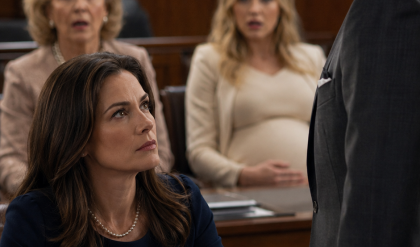
And tonight, every person in that ballroom was watching me sway in Callum’s arms while he avoided my eyes.
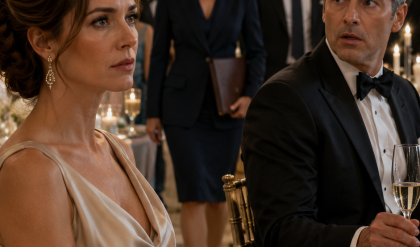
Two hundred guests. Senators. CEOs. Real estate heirs. Women in gowns that cost more than a car. Men with smiles sharpened by money. Reporters tucked neatly near the champagne tower, invited to photograph the perfect marriage of Callum and Vivienne Whitaker, Manhattan’s most polished power couple.
The violins rose. The melody turned soft and intimate.
The same melody Scarlett had called “ours.”
Callum’s hand tightened at my waist.
I looked up at him and smiled.
Not because I was happy.
Because I finally understood the cruelty of his gift.
Halfway through the song, I stepped back.
His arms stayed in the air for a second, still shaped around the ghost of me. The quartet faltered. Glasses stopped halfway to mouths. Conversations died in the gold-lit room like candles blown out one by one.
Callum whispered, “Vivienne.”
I lifted my chin.
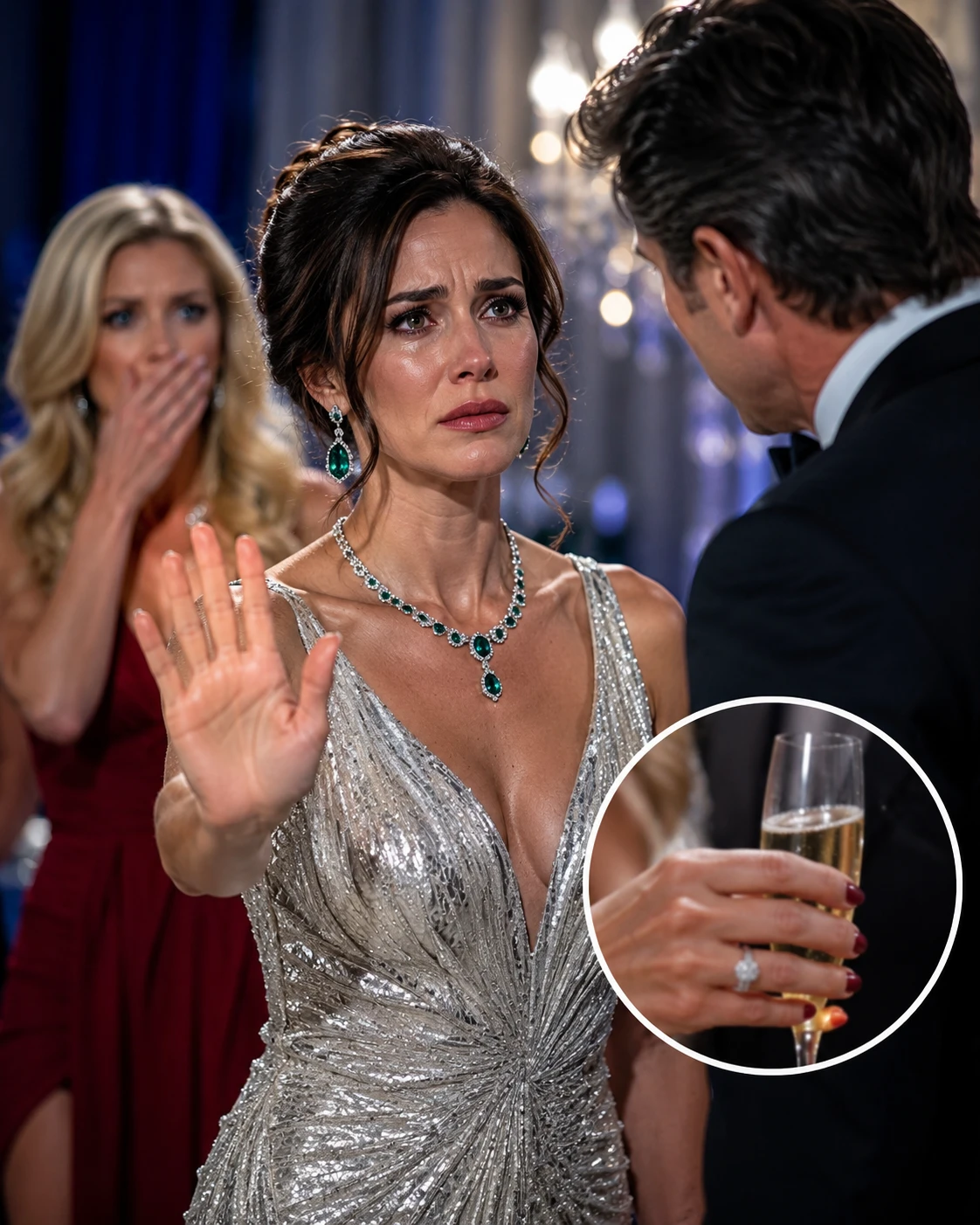
“If it’s hers,” I said, clearly enough for the front tables to hear, “go find her.”
Then I turned away from my husband, my marriage, and the beautiful lie everyone had paid to applaud.
CHAPTER 1: THE BALLROOM WHERE LOVE WENT TO DIE
The Aurelia Grand had been built for people who wanted to pretend money could make them immortal.
Its ceiling was painted with clouds so soft they looked stolen from heaven. Its marble floors reflected every chandelier twice, as if luxury itself needed an echo. The ballroom smelled of gardenias, amber perfume, and expensive secrets.
I had chosen the flowers myself.
White orchids for endurance. Black calla lilies for elegance. Silver roses because Callum once told me silver suited me better than gold. He said gold begged for attention, but silver held moonlight quietly.
That was ten years ago, when he still knew how to look at me as if I were a woman and not an accessory.
Tonight, I wore a silver gown with a low back and a train that moved like water. My hair was pinned high. My grandmother’s emeralds rested at my throat, glowing dark and old against my skin. I had dressed like a queen for the man who planned to make me a fool.
Callum stood in the center of the ballroom after I left him there, his handsome face frozen between panic and rage.
He had always been beautiful in a way that made forgiveness easier. Dark hair, gray eyes, the jawline of a man born for magazine covers and courtroom denials. The world had loved him before he earned it. That was the first danger.
The second was that I had loved him after I knew better.
My heels clicked across the marble.
No one stopped me.
They only watched.
That is what people do when a woman is humiliated in public. They watch first. They decide later whether she deserved it.
I felt the heat of their curiosity against my back. I heard the whispers begin to travel.
“Did she just—”
“What song is this?”
“Where’s Scarlett?”
“Isn’t she the one from Callum’s office?”
My mother-in-law, Eleanor Whitaker, sat rigid at Table One, her pearls arranged like a noose. She had never liked me. Not truly. To her, I was the quiet girl Callum married before he understood his own value.
She had smiled through our vows and cried into a linen handkerchief for the cameras. Later, in the powder room, she told me, “You are very lucky, Vivienne. Men like my son usually marry women with names people recognize.”
I was twenty-four then. I had smiled politely, because I had spent my entire childhood being trained never to reveal the blade until the room had leaned close enough.
Callum had recognized my name.
He simply did not know it was mine.
At the edge of the ballroom, Scarlett Lane stood beside the bar in a crimson satin dress that clung to her like sin. She was not listed on the guest sheet. Of course she wasn’t. Women like Scarlett did not need invitations when men like Callum left doors unlocked.
She had one hand over her mouth, but her eyes were bright. Not shocked. Thrilled.
She wanted this moment.
She wanted me to see her.
She wanted everyone to know she had taken something from me.
The quartet had stopped playing now. Silence stretched above the tables, delicate and dangerous.
Callum followed me, his shoes hard against the floor.
“Vivienne,” he said under his breath, “don’t do this.”
I stopped near the champagne tower and turned just enough to look at him.
“Don’t do what?”
His smile appeared, polished for the room. “Make a scene.”
That almost made me laugh.
A man could set a wife on fire in front of two hundred people and still accuse her of smoke.
“You chose the scene,” I said. “I’m only refusing the role.”
His jaw flexed.
Behind him, Scarlett began moving through the crowd. She walked slowly, as if the room itself had become a red carpet. Her eyes never left mine.
I remembered the first time I saw her.
It had been at Callum’s office holiday party eleven months earlier. She was wearing winter white and standing too close to his desk. When I entered, she looked me over in one quick glance and dismissed me. Not because I looked weak. Because Callum had taught her I was harmless.
That was his mistake.
“Vivienne,” Callum said, voice lower now, “we can talk upstairs.”
“Why?” I asked. “So you can lie in a better room?”
A few people heard that. I saw it land. A senator’s wife lifted her brows. One of Callum’s partners looked down at his plate as if the roasted sea bass might save him.
Scarlett reached us, her perfume arriving first.
It was too sweet.
“Vivienne,” she said softly, performing concern, “are you all right?”
I turned to her.
She was younger than me by eight years and had the confidence of a woman who mistook youth for victory. Around her neck was a thin diamond pendant I recognized immediately.
I had bought it.
Not for her. For Callum’s assistant, back when I thought he was simply bad at remembering birthdays. I had asked his office manager for a list of staff gifts and approved the jewelry myself.
The pendant rested now on Scarlett’s collarbone like a receipt.
“I’m wonderful,” I said.
Her mouth trembled, but not from fear. From the effort not to smile.
“I don’t want there to be any misunderstanding,” she said.
“How considerate.”
Callum snapped, “Scarlett.”
Too late.
The room leaned in.
Scarlett’s eyes flicked toward the reporters. She wanted a headline. She wanted the public wife wounded, the private woman chosen. She wanted what every mistress with a camera wants: proof that she mattered.
She took a breath.
“Callum and I are in love,” she said.
The ballroom inhaled.
There it was.
The sentence that should have shattered me.
Instead, something inside me went very still.
Not numb. Not broken.
Still.
Like a lake before a body rises.
Callum closed his eyes. “God, Scarlett.”
I looked at him then. Really looked.
He wasn’t ashamed because he had hurt me.
He was ashamed because she had ruined his timing.
That was when the last living part of my marriage died.
Eleanor stood from Table One. “This is inappropriate.”
“Yes,” I said, without looking away from Callum. “It is.”
Scarlett reached for Callum’s sleeve. He did not pull away fast enough.
That tiny delay was worth ten years of therapy.
A camera flashed.
Then another.
Callum saw the reporters and finally understood that humiliation had changed direction.
He stepped toward me. “Vivienne, listen to me.”
“No,” I said. “For ten years, I listened.”
His face hardened.
The mask cracked just enough for me to see the man beneath it—the man who had smiled through charity galas while moving assets, calling me fragile, making me feel grateful for crumbs of affection he had already fed to another woman.
“You don’t want to do this here,” he warned.
I smiled.
It was a small smile. Almost gentle.
That frightened him more than shouting would have.
“You’re right,” I said. “I don’t.”
Then I lifted one hand.
Across the ballroom, Nolan Vale stepped out of the shadows near the side entrance.
He wore a black tuxedo without a boutonniere and the calm expression of a man who had expected blood and brought silk gloves. His hair was dark, threaded with the faintest silver at the temples. He had the kind of presence that made powerful men check their posture.
Callum saw him and went pale.
Good.
He remembered Nolan.
Everyone who had ever underestimated me remembered Nolan eventually.
CHAPTER 2: THE MAN WHO KEPT MY SECRETS
Nolan Vale had been my father’s attorney, my guardian for exactly fourteen months when I was seventeen, and the first person who taught me that silence was not weakness if you knew when to spend it.
He was also the only man in Manhattan who had seen me cry without trying to use it as leverage.
We had known each other since I was a girl with scraped knees running barefoot through the marble halls of Montgomery House in Newport. Back then, my father owned half the hotels on the East Coast and hid from cameras like they were loaded guns. He believed wealth was safest when it moved quietly.
“Loud money gets robbed,” he used to say. “Quiet money buys the bank.”
When I married Callum, I married as Vivienne Hart, an event planner with a modest apartment and no living parents worth mentioning.
That was not a lie.
It was editing.
My full name was Vivienne Hart Montgomery.
My father was August Montgomery, founder of the Montgomery Group, a private investment empire that owned hotels, shipping interests, luxury residences, and enough shares in enough companies to make arrogant men suddenly respectful.
After my father died, I kept my inheritance behind trusts and holding companies. I wanted one thing that money could not easily buy.
I wanted to be loved without being counted.
Then I met Callum at a rain-soaked gallery opening in SoHo, where he was charming and broke in the expensive way ambitious men are broke. He wore a tailored suit he could not afford and spoke about architecture like buildings were living creatures.
He said he wanted to build places where lonely people felt less alone.
That was the sentence that ruined me.
For years, I believed him.
I believed him when he proposed on a rooftop in Brooklyn with a ring too small for my family and too large for his bank account. I believed him when he said he wanted to succeed without my help. I believed him when he told me late nights at the office were the price of becoming worthy of me.
He never knew I was the reason his investors stopped laughing.
He never knew Montgomery Group bought his firm’s debt through three layers of shell companies after his first major project almost collapsed.
He never knew I protected him from bankruptcy, lawsuits, and his own reckless hunger.
He thought luck loved him.
Luck was me.
And tonight, luck had left the ballroom.
Nolan approached with a slim black folder in one hand. His gaze touched my face first, searching for damage. I gave the smallest shake of my head.
Not now.
He understood.
Callum tried to recover. “Nolan. This is a private matter.”
Nolan smiled without warmth. “You held it in a ballroom with press present. That makes it ambitious, not private.”
A murmur moved through the guests.
Scarlett looked between them, confused. “Who is this?”
“No one,” Callum said too quickly.
Nolan’s eyes moved to him. “Careful.”
One word.
Callum shut his mouth.
I had forgotten how satisfying it was to watch a bully recognize a larger shadow.
Eleanor moved toward us, pearls trembling. “Mr. Vale, whatever involvement you think you have—”
“My involvement,” Nolan said, “began long before your son learned how to pronounce escrow.”
A few guests actually gasped.
I almost smiled again.
Nolan turned to me. “Mrs. Whitaker, would you like to proceed?”
The title sounded wrong now. Too heavy. Too borrowed.
“Yes,” I said. “But not with everything.”
Callum’s eyes narrowed. “Everything?”
“There are layers,” I told him. “You taught me that.”
Scarlett crossed her arms. “This is insane. Callum, why is she acting like she owns the place?”
The silence after that question was beautiful.
I looked at her.
Then I looked up.
At the Aurelia’s painted ceiling. At the chandeliers my father imported from Venice. At the gold leaf restored under my approval. At the ballroom I had opened for this anniversary because Callum wanted “something unforgettable.”
“Oh, Scarlett,” I said softly. “I do.”
For a moment, no one moved.
Then whispers erupted.
Callum stared at me as if I had spoken in another language.
“What did you say?”
I took the black folder from Nolan.
“The Aurelia Grand is owned by Morrow & Bell Hospitality,” I said. “Morrow & Bell is owned by a private trust. The trust is managed by Montgomery Group.”
Eleanor’s lips parted.
Callum’s face drained of color.
I opened the folder.
“And I am Montgomery Group.”
The ballroom changed.
I felt it happen.
The pity that had been crawling toward me from every table stopped midair and reversed. People sat straighter. Men who had ignored me at dinners suddenly searched their memories for every careless thing they had said. Women who had called me sweet with that thin social cruelty now looked at my emeralds differently.
Not jewelry.
Evidence.
Scarlett laughed once. “That’s not possible.”
I tilted my head. “No?”
“You’re Callum’s wife.”
“That was never my job title.”
A phone slipped from someone’s hand and clattered under a chair.
Callum took a step toward me, voice barely audible. “Vivienne.”
There it was again. My name in his mouth. Softer now. Reverent with fear.
He knew enough about Montgomery Group to understand the size of the cliff beneath him. His firm, Whitaker Urban Development, had three major projects underway. Two financed through banks influenced by Montgomery holdings. One insured through a company we quietly controlled. His newest luxury tower in Miami depended on a land acquisition he thought had been handled by a friendly investor.
The investor was me.
Or rather, had been.
“I was going to tell you,” he said.
That lie was so small I almost felt sorry for it.
“When?” I asked. “Before or after you played her song?”
His eyes flicked toward Scarlett.
She noticed.
For the first time that night, her confidence cracked.
“Callum,” she whispered, “what is she talking about?”
He didn’t answer.
So I did.
“Three days ago, you posted a video,” I said. “This song. Your caption said, ‘He said this is ours.’”
Scarlett lifted her chin. “Because it is.”
“No,” I said. “It isn’t.”
The quartet conductor, still frozen near the stage, stared at me over his violin.
I looked at him kindly. “You played beautifully.”
He blinked, then nodded like I had released him from a spell.
Then I turned back to Scarlett.
“That composition is called ‘Marina at Dusk.’ It was written by Elias Hart in 1998 for his wife. My mother. It was never commercially released. The only legal copy sits in the Montgomery family archive.”
Scarlett’s mouth opened.
Callum whispered, “Vivienne, please.”
I looked at him.
“You gave your mistress my mother’s song.”
The room went silent again.
But this silence was different.
Before, it had been gossip.
Now it was judgment.
The song had not simply been an affair’s soundtrack. It had been a theft from a dead woman, from a daughter’s private grief, from the one part of my past I had kept sacred.
Callum knew what that song meant. He had heard it once, years ago, when I played it on an old piano in our first apartment after too much wine and too many memories. I told him my father used to hum it on the anniversary of my mother’s death.
Callum had kissed my temple then and said, “Thank you for trusting me with it.”
Trust.
What a strange little knife.
Scarlett looked at Callum, anger rising to cover embarrassment. “You told me you found it in Paris.”
Callum said nothing.
“You told me no one else had it.”
Still nothing.
Her eyes flashed. “You said it was ours.”
He finally looked at her. “Not now.”
That was the most honest thing he had said all evening.
Not I love you.
Not I’m sorry.
Not I made a mistake.
Not now.
Because Scarlett, like me, had misunderstood her place in his life. She thought she was the chosen woman.
But Callum had never chosen women.
He chose mirrors.
And when a mirror cracked, he replaced it.
CHAPTER 3: THE PRICE OF A PERFECT IMAGE
I did not destroy Callum that night.
Not completely.
That would have been vulgar.
My father taught me that revenge, when done properly, should not look like rage. It should look like paperwork.
Nolan handed me a second folder.
Callum stared at it as if it contained a live snake.
“In the interest of preventing speculation,” I said to the room, “I’ll be brief.”
“Vivienne,” Eleanor hissed, “think of the family.”
“I am.”
The words struck harder than I expected.
Because once, I had tried to be part of their family. I memorized Eleanor’s preferences. Peonies, not roses. Dry martinis, not champagne. She liked handwritten thank-you notes on ivory stationery and despised open-toed shoes before June.
I had spent years making myself acceptable to people who were living in rooms paid for by my silence.
“Callum,” I said, “our prenuptial agreement contains a fidelity clause.”
He swallowed.
Scarlett looked sharply at him. “You told me you didn’t have a prenup.”
I smiled faintly. “He tells women what makes them easiest to keep.”
Several guests turned away to hide their reactions.
“Vivienne,” Callum said, “you don’t want this public.”
“That’s the second time you’ve told me what I want tonight.”
His face tightened.
I continued. “The clause is simple. Infidelity with documented evidence forfeits any claim to spousal assets, shared investment distributions, and discretionary trust benefits extended during the marriage.”
Eleanor’s hand flew to her throat.
She knew.
Of course she knew.
The Whitakers had not been rich in the way people assumed. They were socially established, yes. Old photographs. Club memberships. Names on university buildings from generations when buildings were cheaper. But liquidity? No.
Callum’s lifestyle came from deals.
The deals came from me.
“Additionally,” Nolan said, stepping beside me, “Whitaker Urban Development is in breach of several financing covenants triggered by reputational risk, misrepresentation of collateral, and unauthorized diversion of company funds.”
Callum went still.
That was the bullet he hadn’t seen.
I had not needed to spy on him.
Men like Callum always believe betrayal is only romantic. They forget money leaves footprints.
Scarlett’s apartment in Tribeca. Her leased car. Her “consulting fees.” Jewelry. Travel. A weekend in Aspen charged through an entity created for a housing project in Queens.
He had dressed his affair in corporate expense reports and expected no one to read them.
Unfortunately for him, I read everything.
A man near the back muttered, “Jesus.”
Callum’s mask finally fell.
“You had me investigated?” he demanded.
“No,” I said. “I had my investments audited.”
“That’s my company.”
“Not entirely.”
He stared at me.
I let him understand it one piece at a time.
“Who do you think saved the Harbor West project?” I asked. “Who do you think bought the debt when Pacific Union pulled out? Who do you think convinced Ridgemont Bank to extend terms after you overleveraged the Miami acquisition?”
His mouth opened, but no sound came.
“It was never luck, Callum.”
A softness passed through his face then. Not love. Memory.
Maybe he saw the woman who made him coffee at midnight while he complained about investors. The wife who proofread his speeches. The quiet presence beside him in photographs. The hand at his back when his confidence slipped.
Maybe for one second, he understood the scale of what he had mistaken for weakness.
But shame in men like Callum curdles quickly into anger.
“You lied to me,” he said.
I almost laughed.
“I hid my money,” I replied. “You hid another woman.”
Scarlett flinched.
Good.
“You built your entire marriage on a lie,” Callum said, louder now, trying to regain the room. “You manipulated me.”
That was when the reporters’ cameras rose again.
He saw them and committed to the performance.
“Everyone here should know,” he said, voice carrying, “my wife pretended to be someone else for ten years. She sat in judgment while lying about who she was. This is not dignity. This is control.”
For a moment, I saw the old Callum—the rain-soaked dreamer from SoHo—buried under the glittering ruin of ambition.
Then I remembered every night he came home smelling like another woman’s perfume and kissed me like I should be grateful.
“No,” I said. “Control is playing my dead mother’s song to humiliate me at our anniversary.”
His face flickered.
“Control is telling your mistress enough about me to make her feel superior, but not enough to understand the ground she was standing on.”
Scarlett looked like she might be sick.
“Control is spending marital and corporate funds on an affair while letting your employees think layoffs were necessary because markets were tightening.”
That landed.
Hard.
Several of Callum’s executives exchanged looks.
One woman at Table Nine, his head of acquisitions, slowly set down her wineglass. I knew her name. Denise Walker. Brilliant. Overworked. Passed over twice because Callum preferred men who laughed at his jokes.
She looked at him with disgust.
Callum saw her and snapped, “That’s not true.”
Nolan opened the folder and removed a single page.
“Then you won’t mind the forensic audit being delivered to the board tomorrow morning.”
Tomorrow was generous.
It had already been delivered ten minutes earlier.
I checked my watch.
Actually, twelve.
Callum’s phone began vibrating in his pocket.
Then another phone at his table.
Then another.
The room filled with the low, insect hum of consequences arriving in real time.
A board member stood abruptly and walked toward the exit, already answering a call.
Callum did not move.
He looked at me with something close to hatred.
“You planned this.”
“No,” I said. “You planned this. I prepared.”
Scarlett grabbed his arm. “Callum, tell me she’s lying.”
He pulled away from her.
This time, fast.
That was the moment she understood.
She had not been a great love. She had been evidence.
Her humiliation arrived differently than mine. Mine had been served in music and chandeliers. Hers came in the sudden knowledge that she had risked her reputation for a man who would abandon her the second she became inconvenient.
She looked at me then, and for the first time there was no smirk.
Only fear.
I could have crushed her.
Part of me wanted to.
Not because she loved my husband. Love makes fools of better women than Scarlett Lane. But because she had enjoyed my pain before she understood it was borrowed from a deeper account.
Still, I had learned something from grief.
Not every person who wounds you is worth becoming cruel for.
“Scarlett,” I said.
She stiffened.
“You should leave.”
Her eyes widened, suspicious of mercy.
“Now,” I added.
She looked at Callum.
He did not defend her.
He was too busy watching his empire bleed through his phone.
Scarlett gathered what remained of her pride and walked out through the side doors, crimson satin flashing once before disappearing into the hall.
The ballroom exhaled.
Callum stood alone.
As I had left him during the dance.
Only now there was no music to make it beautiful.
CHAPTER 4: THE WOMAN BEHIND THE NAME
The elevator to the Aurelia’s penthouse was lined in smoked mirrors.
Callum and I stood on opposite sides of it like strangers in a jewelry box.
Nolan remained downstairs to manage the fallout. That was the word he used. Manage. As if the end of my marriage were a flood in a basement.
Maybe it was.
Maybe I had been drowning quietly for years, and tonight someone finally opened the door.
Callum had insisted on talking privately. I agreed for one reason only: some endings deserve witnesses, and some deserve graves.
The elevator climbed.
Fifty-one floors.
Neither of us spoke until the doors opened into the penthouse suite.
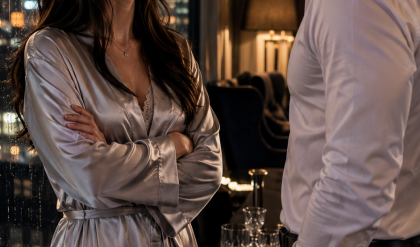
It was absurdly beautiful. Floor-to-ceiling windows framed Manhattan in glittering black. The Hudson reflected pieces of moonlight. A fire burned in a marble fireplace no one needed. On the dining table sat a silver bucket with champagne we would never drink.
Callum walked to the window and put both hands in his pockets.
For a long time, he stared at the city.
When he finally spoke, his voice was quiet.
“Was any of it real?”
I laughed once, softly.
That question. From him.
“I was,” I said.
He turned.
Something in his face broke then. Not enough to save him. Just enough to remind me why I had stayed so long.
“I loved you,” he said.
I wanted those words to cut me.
They didn’t.
They arrived too late, dressed badly.
“You loved being loved by me.”
He flinched.
“You loved the version of yourself you saw in my eyes,” I continued. “The brilliant husband. The builder. The man who started with nothing and earned everything.”
“I did earn it.”
“No,” I said gently. “You worked. There’s a difference.”
His eyes flashed.
“You don’t get to erase me,” he said. “I built Whitaker Urban.”
“And I protected it every time your ego outgrew your math.”
He looked away.
The fire crackled.
For the first time all night, without the room watching, I felt tired. Not weak. Not uncertain. Just tired in the marrow-deep way that comes after carrying a marriage alone.
Callum moved toward the bar and poured whiskey with an unsteady hand.
“You should have told me,” he said.
“I wanted to.”
“Then why didn’t you?”
I looked at the skyline.
Because I was afraid.
Because every man who knew my last name changed the way he touched me.
Because my father’s friends never saw a girl after they saw an inheritance.
Because I wanted one person to choose me before they knew what I could give them.
Because you did choose me once, and I ruined myself believing that meant you always would.
I said none of that.
Instead, I said, “Because I loved you.”
He drank, then laughed bitterly. “That makes no sense.”
“It does to people who know how to love without acquisition.”
He slammed the glass down.
“There it is. The judgment. Saint Vivienne. Quiet, perfect, suffering Vivienne.”
“No,” I said. “Imperfect Vivienne. Lonely Vivienne. Foolish Vivienne. The woman who stayed after the first hotel receipt from Chicago. The woman who believed you when you said Scarlett was just ambitious. The woman who let you call her insecure until she apologized for noticing your betrayal.”
His face changed.
He hadn’t known I knew that far back.
“I ended it then,” he said.
“You paused it.”
He dragged a hand through his hair.
“And Nolan?” he asked suddenly.
I went still.
The way he said Nolan’s name told me this was not jealousy. It was strategy.
He needed me guilty.
He needed balance.
If I had a sin, his would feel smaller.
“Nolan is my attorney,” I said.
“He looks at you like you belong to him.”
“No,” I said. “He looks at me like I belong to myself. That’s why you hate him.”
Callum smiled cruelly. “Did you sleep with him?”
“No.”
“Did you want to?”
There it was. The question with teeth.
I thought of Nolan standing in my father’s study after the funeral, his black suit dusted with rain, telling me, “You do not have to be brave with me.” I thought of the way he stepped back when I married Callum, never once making my choice harder. I thought of every birthday card he sent without signing more than his initials, every boardroom where he said “Ms. Montgomery” with immaculate distance.
Desire had existed somewhere, perhaps. Buried deep under loyalty, time, grief, and restraint.
But wanting is not betrayal.
Acting is.
“No,” I said, because Callum did not deserve the delicate truth.
He studied me, then nodded as if he had won something. “You’re lying.”
“I learned from you.”
Silence.
Then his phone rang.
He looked down. The screen showed his board chair.
He didn’t answer.
A second call came in.
Then a third.
His empire was collapsing in the palm of his hand.
For a few seconds, I saw the fear behind his anger. It was naked. Almost childlike.
“What happens now?” he asked.
I opened my clutch and removed an envelope.
His eyes fixed on it.
“Divorce papers,” I said. “A settlement offer. More generous than the prenup requires.”
He laughed sharply. “Generous?”
“Yes.”
“After that performance downstairs?”
“That performance saved you from handcuffs tonight.”
His face went white.
I let him absorb that.
“The corporate charges are separate from our marriage,” I said. “I won’t interfere with the audit. But I could have let the board discover everything through federal filings and subpoenas. Instead, I gave you one clean exit.”
“What do you want?”
The question was almost a whisper.
“For the first time,” I said, “nothing from you.”
That hurt him more than rage would have.
Callum took the envelope but did not open it.
“You’ll ruin me,” he said.
“No, Callum. I’m returning you to what you built without me.”
He stared at me with wet eyes.
The old me would have crossed the room.
The old me would have touched his face, softened my voice, made space for his pain even while mine bled through my dress.
But the old me had died downstairs during a song that was never his to give away.
“I was going to leave her,” he said.
“No, you weren’t.”
“I swear—”
“You were going to keep her until she became expensive. Then you were going to find someone quieter.”
His mouth closed.
Truth has a sound when it enters a room.
Not loud.
Final.
I walked to the door.
Behind me, Callum said, “Did you ever think maybe I cheated because you were always somewhere else? Always calm. Always untouchable. Like a museum piece.”
I stopped.
There it was.
The last gift of a selfish man: a wound shaped like blame.
I turned around.
“You did not cheat because I was untouchable,” I said. “You cheated because she clapped when you entered the room, and I knew what it cost to keep the lights on.”
His face twisted.
I opened the door.
“Goodbye, Callum.”
This time, he did not say my name.
CHAPTER 5: THE REVENUE OF SILENCE
By morning, the video had gone everywhere.
Not the whole scene. Just twenty-seven seconds.
Me stepping away from Callum in the ballroom.
The music faltering.
My silver dress catching the chandelier light.
My voice, calm and clear: “If it’s hers, go find her.”
By noon, it had eight million views.
By dinner, it had become a sentence women wrote over their own stories.
If it’s hers, go find her.
Under breakup posts.
Under divorce announcements.
Under videos of women packing boxes, changing locks, deleting photos, laughing with friends over margaritas, crying in cars, walking into courthouses wearing sunglasses.
The internet named me things.
Ice Queen.
Silver Wife.
The Aurelia Widow.
My favorite was one I saw beneath a clip of Callum standing alone after I left him on the dance floor.
“Men will turn a queen into a ghost, then panic when she starts haunting.”
That one made me smile.
I did not release a statement immediately.
Callum did.
That was his second mistake.
The first had been underestimating me.
The statement came from Whitaker Urban Development at 9:04 a.m., full of phrases like private marital matter, malicious distortion, and commitment to transparency.
At 9:17 a.m., three board members resigned.
At 9:31 a.m., the audit leak hit.
Not from me.
That mattered.
It came from someone inside his own company. Later, I learned it was Denise Walker. She had kept copies of everything after Callum blamed her department for budget irregularities caused by his personal spending.
Women remember where men hide knives.
By evening, every financial outlet in the country was discussing Whitaker Urban’s liquidity crisis. By the next morning, Ridgemont Bank froze a credit line. By Friday, Callum stepped down as CEO “to focus on family and legal matters.”
He had no family left to focus on.
Scarlett posted once.
A black screen. White letters.
“I was lied to, too.”
The comments were not kind.
I did not add to them.
Revenge should not become a hobby. It should be a door you walk through once, then close behind you.
On Saturday, I returned to the Aurelia.
Not for drama.
For work.
The hotel staff had been whispering all week, but when I entered through the private lobby, every spine straightened. I knew that look. Fear disguised as respect.
I hated it.
So I stopped near the front desk where a young concierge named Maya was pretending not to stare.
“Maya, right?”
Her eyes widened. “Yes, Ms. Montgomery.”
“Mrs. Hart is fine,” I said, then paused. “Actually, Vivienne is fine.”
She blinked.
I smiled. “Has the ballroom been reset?”
“Yes. The charity luncheon is at one.”
“Good. And the quartet?”
Her face panicked. “We can replace them if—”
“No,” I said quickly. “They did nothing wrong.”
Relief softened her shoulders.
Luxury runs on invisible people. The ones pouring champagne, steaming dresses, carrying trays, memorizing names. I had spent ten years watching Callum charm billionaires while ignoring the woman refilling his water.
My father never did that.
He knew every doorman’s birthday.
So would I.
I spent the morning walking the hotel. Kitchens. Laundry. Security. Event offices. The places guests never saw because beauty depends on labor hidden behind swinging doors.
Everywhere I went, people tried to become smaller.
I told them not to.
By noon, Nolan found me in the rooftop garden.
The Aurelia’s roof was my favorite place in the city. Olive trees grew in enormous stone planters. White roses climbed black iron trellises. Beyond the glass railing, Manhattan glittered with its usual arrogance.
Nolan stood beside me without speaking.
He had always understood that my silence had different meanings.
Today, it meant I was breathing.
Finally.
“You’re trending again,” he said.
“Do I want to know why?”
“Someone found the old charity interview where Callum said his success came from ‘choosing the right woman to stand behind him.’”
I closed my eyes. “Of course he said that.”
“The comments are inventive.”
“I’m sure.”
A soft wind lifted a strand of hair from my cheek. Nolan reached toward it, then stopped before touching me.
That restraint undid me more than contact would have.
“You can,” I said.
His eyes met mine.
Slowly, gently, he tucked the strand behind my ear.
The gesture was nothing.
It was everything.
For ten years, touch had become negotiation. Callum touched me when cameras were near, when apologies were needed, when he wanted reassurance that he was still adored.
Nolan touched me like I was not something to be taken.
“You should go somewhere quiet,” he said. “Newport. Lake Tahoe. Anywhere with fewer cameras.”
“I was thinking of staying.”
His brow lifted. “Here?”
“Yes.”
“The press will be unbearable.”
“Let them be.”
A faint smile. “That doesn’t sound like you.”
“No,” I said. “It sounds like who I’m becoming.”
He looked at me for a long moment.
In daylight, Nolan Vale seemed less like a shadow and more like a man who had spent too many years waiting outside locked rooms. He was not soft. Life had not made him that way. But there was a steadiness in him that I trusted more than charm.
Charm had ruined me.
Steadiness might save me.
“I owe you an apology,” I said.
His expression changed. “For what?”
“For making you watch me choose someone who didn’t deserve me.”
Pain crossed his face so quickly another person might have missed it.
“I never wanted you to choose me out of grief,” he said.
“I know.”
“Or gratitude.”
“I know that, too.”
The city moved below us. Sirens. Horns. Lives colliding and continuing.
He leaned one hip against the railing. “Then what do you want, Vivienne?”
For the first time in years, the question did not feel like a trap.
I looked down at my left hand.
My wedding ring was gone.
There was a pale mark where it had been, a small circle of skin protected too long from the sun.
“I want to learn what my own life sounds like,” I said. “Without his voice over it.”
Nolan nodded.
No pressure. No claim.
Just understanding.
“That’s a good beginning,” he said.
Later that afternoon, I held a press conference in the Aurelia ballroom.
The same ballroom.
People advised against it. My publicist, my board, even Nolan.
“Too symbolic,” they said.
They were right.
That was why I did it.
I wore black this time. No emeralds. No silver train. Just a tailored dress, red lipstick, and my mother’s wedding band on a chain beneath the fabric where no camera could steal it.
The room was full of reporters.
Flashes burst like tiny storms.
I stepped to the podium and looked at the place where Callum had stood alone.
Then I began.
“My name is Vivienne Hart Montgomery,” I said. “For the last ten years, many people have known me as Mrs. Callum Whitaker. That chapter of my life is ending.”
Pens moved. Cameras zoomed.
“I will not be discussing the private pain of my marriage beyond what is already public. I will not be performing heartbreak for entertainment. I will not be insulting another woman for believing a man who made a habit of lying.”
That line traveled fast.
I continued.
“What I will say is this: silence is not consent. Grace is not weakness. A woman can stand beside a man without standing beneath him.”
The room went still.
“Effective immediately, Montgomery Group will be launching the Marina Fund, named in honor of my mother. It will support women rebuilding their lives after financial betrayal, coercive control, and divorce-related economic abuse. The first grant will go toward legal services, emergency housing, and career placement.”
I saw a female reporter lower her camera.
Her eyes were wet.
I swallowed carefully.
“The song played at my anniversary was private. It belonged to my family. But since it has now become part of a public story, I have decided to release the original recording of ‘Marina at Dusk.’ All proceeds will go to the fund.”
By evening, it was number one.
Not because it was catchy. It wasn’t.
It was haunting.
A piano moving slowly through grief. A violin entering halfway, tender as a hand reaching through fog. My father had written it for a woman he loved beyond language, and somehow, after all the ugliness, the world heard that love.
People used it over videos of mothers, daughters, old photographs, empty chairs, wedding dresses packed away, first apartments after divorce, sunrise walks after terrible nights.
Scarlett’s caption disappeared beneath something larger.
He said this is ours.
No.
It had never been theirs.
It had been love before betrayal touched it.
And now it belonged to every woman who needed to remember that stolen things can be reclaimed.
CONCLUSION: WHERE THE MUSIC BEGAN AGAIN
Six months later, I returned to Newport.
Not for escape.
For spring.
Montgomery House stood above the Atlantic with its gray stone walls and widowed windows, watching waves break themselves against the cliffs. As a child, I thought the house was too large to ever feel lonely. As an adult, I knew size had nothing to do with emptiness.
I opened every curtain.
I had the staff bring fresh flowers into rooms that had been closed for years. I walked barefoot through the library. I sat at my mother’s piano and played badly until I cried, then laughed because crying no longer frightened me.
The divorce finalized quietly in April.
Callum fought at first. Then the evidence multiplied, the board turned, and his attorneys convinced him that silence would be the most affordable dignity left to him. He moved to Miami, then somewhere outside Austin. I did not follow the details.
People expected me to enjoy his downfall more.
I didn’t.
There is a difference between justice and nourishment. Justice cleared the room. It did not fill the table.
So I filled it myself.
I worked. I funded shelters. I rebuilt the Aurelia’s employee benefits program. I promoted Denise Walker to lead the restructured development division after Montgomery Group acquired what remained of Whitaker Urban’s best projects. She sent me an email with only one sentence.
“Thank you for seeing what he tried to bury.”
I printed it and kept it in my desk.
Scarlett vanished from social media for a while. When she returned, she was quieter. Less polished. She posted about starting over, about therapy, about learning the difference between being chosen and being used.
I did not forgive her publicly.
I did not destroy her privately.
Some endings need no audience.
Nolan came to Newport in May.
He arrived without calling first, because I had finally told him he did not always need permission to knock. I found him in the garden at dusk, his coat open, sea wind moving through his hair.
He held a small paper bag from a bakery in town.
“Peace offering,” he said.
“For what crime?”
“Thinking about you too much.”
I should have had a clever answer.
I didn’t.
The sunset turned the ocean copper. Somewhere below the cliffs, waves struck rock with patient force.
Nolan stepped closer.
“Tell me to leave if this is too soon,” he said.
I looked at him, this man who had waited through my grief without trying to own it, who had protected my secrets without mistaking them for invitations, who had seen me at my most humiliated and never once looked at me as if I were less.
“It’s too soon for promises,” I said.
He nodded, accepting it immediately.
“But not for this.”
I kissed him first.
It was not dramatic. No thunder. No violins. No ballroom full of witnesses.
Just the ocean, the garden, and a quiet man’s hand trembling once at my waist before he steadied himself.
For the first time in years, music did not feel stolen.
It felt like something beginning.
Later, we ate croissants on the terrace and watched the last light disappear. Nolan asked what I wanted to do with Montgomery House.
“Open it,” I said.
“To whom?”
I thought about that.
“To women who need a place to remember they are not finished.”
He smiled. “Your father would like that.”
“My mother would, too.”
Below us, the sea kept moving.
A year ago, I had stood in a ballroom while my husband played another woman’s favorite song and expected me to keep dancing.
Now, the world knew my name.
But more importantly, so did I.
I was not the abandoned wife.
I was not the quiet woman at the table.
I was not the ghost in someone else’s love story.
I was Vivienne Hart Montgomery.
Daughter of August and Marina. Owner of the Aurelia. Founder of the Marina Fund. A woman who had mistaken silence for safety until betrayal taught her how powerful a voice could be.
Sometimes people still stopped me in airports or hotel lobbies.
They never knew what to say at first.
Then, almost always, they whispered the line back to me.
“If it’s hers…”
And I would smile.
Not coldly anymore.
Warmly.
Because I had learned the truth.
The song was never the point.
The dance was.
And the moment a woman steps away from the wrong partner, the whole room finally sees she was never alone.
She was only waiting for the music to change.