NOT GUILTY OF LOVING HIM — THE DAY I BECAME THE EVIDENCE
The first thing I did after discovering the bug inside my husband’s anniversary pendant was not call the police.
I wrapped it in black velvet, tied it with gold ribbon, forged his initials on a love note, and sent it straight to the woman he thought I didn’t know existed.
That was the moment my marriage stopped being a marriage and became a crime scene.
Three nights earlier, Grant Hawthorne had stood behind me in our walk-in closet, smiling at my reflection as if he had not been quietly dismantling my life for months. The closet lights glowed soft and amber over rows of designer suits, ivory shelves, and glass cases filled with jewelry I rarely wore anymore. Outside, downtown Chicago glittered beneath our penthouse windows — all silver towers and black water, beautiful in the cold way expensive things are beautiful.
Grant opened a black velvet box.
Inside rested a pendant made of deep green stone, polished smooth, almost luminous under the lights.
“Malachite,” he said, brushing my hair aside to fasten the clasp. “Private Arizona source. One of a kind.”
The stone touched my collarbone like a warning.
I met his eyes in the mirror.
My husband was handsome in a way that made strangers trust him too quickly. Tall, blond, sharp-jawed, with pale blue eyes and the practiced warmth of a man who had spent forty years learning that charm opened doors faster than honesty ever could. To the board of Hawthorne Global, he was a visionary CEO. To charity committees, he was a devoted husband with excellent taste. To the society pages, he was proof that old Chicago money could still look vital and young.
To me, he was a man who smiled most sweetly when he was setting a trap.
“It’s beautiful,” I said.
His fingers lingered at the clasp half a beat too long. “You deserve beautiful things, Madison.”
The words should have landed like tenderness. Instead, they landed like a verdict.
Three months earlier, he had asked me to sign a revised marital agreement — “for tax efficiency,” he said, sliding the papers across the breakfast table with his reading glasses still on, as though it were the most ordinary request in the world. Two months ago, he had suggested, gently and then not so gently, that I consider stepping back from my law career because “the stress was changing you, sweetheart.” Last month, the questions had started.
Where did you have lunch?
Why were you near the financial district?
Who called you at 4:18?
A wife who loved blindly might have found those questions protective. I found them procedural. The questions of a man not worried about losing his wife — but worried about being caught by her.
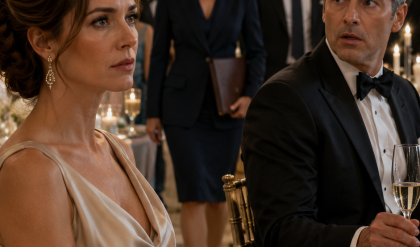
At the charity gala that night, every woman in the room noticed the pendant.
Grant made sure of it.
He kept one hand on the small of my back as he guided me through donors, banking heirs, two aldermen, and men who laughed at his jokes before he finished them. When Mrs. Hollis — wife of a diamond wholesaler on Oak Street — leaned close to examine the stone, something crossed her face in the space between one expression and the next.
Not admiration.
Recognition.
Then fear, covered quickly with a practiced smile.
“That’s… unusual,” she murmured.
“Rare,” Grant said smoothly. “Madison has rare taste.”
I smiled. I drank champagne. I let people admire the green stone cooling against my skin while Grant described its provenance to anyone who would listen — Arizona, private source, authenticated, one of a kind — and I thought: he announced its value publicly before I’d worn it once.
That was the tell.
A man who gives a gift to love does not need witnesses.
A man who gives a gift to establish a narrative needs a room full of them.
By midnight, I already knew I would not sleep with that necklace in the house.
The following morning, I drove to a private gemology lab on Wabash Avenue. I wore jeans, sunglasses, and an old navy coat — the way women dress when they don’t want anyone to remember seeing them. Alden Pierce had testified for my father’s firm four times over twenty years. No composite stone had ever fooled him for longer than three minutes.
He placed the pendant beneath his microscope.
His face moved through professional curiosity, then mild concern, then something much colder that he was too disciplined to name.
“Madison,” he said quietly. “Where did you get this?”
“My husband gave it to me.”
His mouth tightened. “It’s fake. Composite stone. Treated, dyed, polished to a high grade. Worth five thousand dollars if someone is generous.”
I laughed once, softly, the way you laugh when a thing you already suspected turns out to be even worse than you’d suspected.
Grant had announced at the gala that it was priceless.
Of course he had.
“Keep looking,” I said.
Pierce glanced at me. “Madison —”
“Please.”
He examined the setting, the chain, the clasp, moving methodically and without hurry, the way people who know what they’re looking for always do. Ten minutes passed. Then his hand stopped moving completely. He adjusted the microscope, leaned in, and went still.
When he looked up, the color had left his face.
“There is a device embedded behind the stone.”
The room became a different room.
“What kind of device?”
“A tracker. Possibly audio-capable.” He paused. “This is sophisticated. This was not assembled by someone who did this once.”
I sat with that for a moment.
My husband hadn’t given me jewelry.
He’d given me a leash.
I thought of every place I’d worn it. The coffee meeting with my father’s former law partner. The quiet lunch with the forensic accountant I’d hired under a different name three weeks ago. The afternoon I’d spent at the Cook County Recorder’s office pulling deeds. I thought of every conversation I’d believed was private.
“Can it be traced?”
Pierce hesitated. “To the account monitoring it, yes. If you have the device ID—”
He wrote something down and pushed the paper across the table.
“You didn’t get that from me.”
I folded the paper and placed it in my purse along with everything else I was carrying that he couldn’t see: six weeks of bank records, two sets of hotel invoices, three photographs, and the business card of a divorce attorney who had already reviewed the marital agreement Grant wanted me to sign.
When I walked out of the lab, the October wind hit my face hard enough to sting.
I stood on the sidewalk holding the velvet box and thought about the exact angle of Grant’s smile when he fastened the clasp.
Then I thought about Elise Warren.
Twenty-six years old. Executive assistant, officially. Blonde, photographed frequently, expensive in a way her salary couldn’t explain. Cartier bracelet. Weekend hotel stays. Orange shopping bags with captions: Blessed to have a boss who values me. Posts that had been deleted in the last two weeks — but not before I’d saved them.
I had discovered her six weeks ago.
I had said nothing.
A woman who moves too early gives her enemy time to clean the room.
I had spent those six weeks building. Quietly. Carefully. The way my father had taught me to build a case: start with what you know is true, then trace backward until you find what they hoped you’d never find.
What I’d found was not just an affair.
What I’d found was a liquidation plan.
The revised marital agreement — I’d had two attorneys review it independently — would have stripped me of any claim to Hawthorne Global assets accumulated during the marriage, reframed in language clever enough to survive a challenge if you didn’t know what you were reading. The questions about my schedule. The gentle pressure to leave my career. The monitoring device on my body. Taken separately, each was explainable. Together, they were architecture.
Grant was not just cheating on me.
He was building a version of events in which I had no claim and no credibility by the time he was done.
The pendant was the last piece. A gift given publicly, announced as priceless, worn at a charity gala with two hundred witnesses. If it later disappeared under strange circumstances — if I claimed it was a fake, if I made accusations — I would look like the paranoid, ungrateful wife.
He had thought of everything.
Almost everything.
That afternoon, I drove to a stationery store on Michigan Avenue and bought cream envelopes and a small roll of gold ribbon. In Grant’s private study, behind the first-edition Hemingway he had never opened, I found his personal embosser — a silver H surrounded by a laurel wreath. I had known it was there for eleven years. He had never thought to ask whether I’d noticed it.
On the card, I wrote, in careful, neutral block letters:
To my little secret — wear this close to your heart. —G
Then I called Owen.
Owen had driven for Grant for nine years. He was sixty-three, quiet, and meticulous, the kind of man who saw everything that happened in the back seat and stored it without comment. Last year, when his son had been two weeks away from losing his apartment to gambling debt, I had paid the amount owed and told no one — not Grant, not Owen’s son, not a person on earth. Owen had shown up at my office door one morning to thank me.
“You don’t owe me anything,” I’d told him.
“No,” he’d said. “But if you ever need me, Mrs. Hawthorne.”
Now I slid the velvet box across a quiet café table and looked at him steadily.
“Deliver this to Elise Warren at Hawthorne Global,” I said. “Tell her Mr. Hawthorne wanted it to be a surprise.”
Owen looked at the box.
Then at me.
His face said he understood exactly what kind of war had begun. His face also said he had been waiting for this, in the quiet way people who love someone wait for them to finally see clearly.
“Yes, Mrs. Hawthorne,” he said.
He picked up the box and didn’t ask a single question.
At 3:42 that afternoon, my phone showed the tracker moving.
Hawthorne Global headquarters, Wacker Drive.
Michigan Avenue, northbound.
St. Aurelia Hotel.
I sat in my car in a parking garage and watched the red dot settle into place like a period at the end of a sentence I had written myself. Suite 2104. The suite Grant had charged to a consulting LLC for the past four months, the invoices buried three layers deep in a subsidiary account that he didn’t know I’d found.
The tracker was now resting against Elise Warren’s throat.
And every word spoken in her vicinity was now going somewhere.
I spent the next two hours at my kitchen table, building what I needed.
The anonymous email account took eleven minutes. The message I sent to Grant at midnight was six words and one attachment:
Your woman is in 2104 waiting.
Attached: a screenshot of the tracker’s current location, timestamped.
I did not explain how I had the tracker data. Let him wonder. Let it eat at him. Control was Grant’s theology — the idea that someone, somewhere, was three moves ahead of him would work on him faster than any evidence.
The message I sent to Elise the following day took longer to craft. I built a persona over three days, a fictional junior assistant named Kayla who loved secrets the way some people love sugar: compulsively, without understanding the cost.
Mr. Hawthorne planned something special tonight. St. Aurelia. Suite 2104. Wear the green pendant. Trust me.
Her reply came in twelve seconds.
OMG are you serious?
Yes.
Is he finally going to talk about leaving Madison?
I looked at that sentence for a long time.
Then I typed: Tonight changes everything.
That part, at least, was completely true.
At 7:50 p.m., I sat in the far corner of the St. Aurelia lobby wearing black slacks, a black cashmere sweater, a baseball cap, and glasses that weren’t mine. The lobby looked like a cathedral commissioned by people who confused wealth with permanence — marble floors, crystal chandeliers, gold elevator doors that opened and closed like something from a myth about judgment.
I ordered a coffee I didn’t drink and opened a book I didn’t read.
At 7:56, Elise arrived.
She wore a red dress designed to be noticed and the green pendant resting at the hollow of her throat. She looked nervous and happy and entirely certain she was walking toward something that would finally resolve in her favor. She checked her phone twice. She touched the pendant once, absently, the way people touch things they believe belong to them.
At 8:02, Grant walked in.
He was not the man from the gala. The practiced ease, the curated warmth — all of it was gone. What was left underneath was harder and colder than most people who had only seen him in public would have believed possible.
Elise lit up. “Grant!”
She moved toward him, reaching for his arm.
He stepped back.
She stopped.
His gaze dropped to the pendant at her throat, and in the two seconds he stared at it, I watched him understand that something had gone very wrong in a way he hadn’t anticipated — and that whatever had gone wrong, he hadn’t caused it.
That was new for Grant Hawthorne.
“Where did you get that?” His voice was low and careful.
Elise blinked. “You sent it.”
“No, I didn’t.”
“Owen delivered it. There was a card—” She was reaching into her clutch, still trying to smile, still trying to locate the version of this evening she’d been expecting. “Here—”
Grant took the card from her hand with a speed that made her flinch.
He read it once.
He read it again.
I watched his jaw set. Watched him recognize the embossed H. Watched him understand that someone had been inside his private study, holding his personal embosser, writing in his name.
Then he showed her his phone.
The anonymous email. The tracker screenshot. The timestamped location data.
Elise’s face went white in stages, like a light being turned down slowly.
“What is this?” she whispered.
“That’s what I’m asking you.”
“I came here for you.”
“Who else were you meeting?”
“No one—”
“Don’t.”
The word was quiet, but it hit like something thrown. The lobby had gone the specific kind of silent that expensive public spaces go when something privately catastrophic surfaces in them. A bellman stood motionless near the luggage rack. The desk clerk’s voice dropped mid-sentence. Two women at the bar discovered reasons to look at their phones.
“The pendant has a tracker in it,” Grant said.
Elise touched it involuntarily. “What?”
“Someone put it on your neck and they have been watching you move through this building all evening.” He paused. “And I don’t know who.”
“You gave it to me—”
“I never touched that box.” His voice was the quietest it had been. That was when I recognized it — not anger. Fear. “Elise. Think very carefully. Who knew you were coming here tonight?”
She stared at him.
“Kayla,” she said slowly. “Someone named Kayla from your office told me—”
“There is no Kayla in my office.”
The silence that followed had a texture to it.
I picked up my coffee cup and held it with both hands and did not look at them directly, because I was thinking about what I was feeling, and what I was feeling was not triumph. It was something quieter and colder. It was the feeling of standing in the middle of an ending that you yourself built, and recognizing that the building of it had cost you something you would only fully understand later.
I had loved Grant Hawthorne once.
Not blindly. Not the way people love when they are young and careless. But genuinely, in the way you love someone you have chosen with your whole intelligence and then spent a decade learning was not what you chose at all.
That was the thing about being married to a man like Grant. The loss was not just him.
The loss was the eleven years I had spent wondering what was wrong with me.
I left the hotel lobby at 8:19.
The tracker data would be subpoenaed. My attorney had been in possession of a sealed copy of the device ID and the monitoring account information since that morning. By the following afternoon, the account would be linked to a subsidiary of Hawthorne Global, which would raise the question — before a judge, before the board, before the two journalists my attorney had quietly briefed — of why a CEO was monitoring his wife’s location and conversations using company resources.
That question would lead to the consulting LLC.
The LLC would lead to the hotel invoices.
The invoices would lead to the offshore account, which my forensic accountant had been tracing for three weeks through shell structures in the Cayman Islands and Luxembourg.
The offshore account would lead to everything else.
It would not happen overnight. Cases built carefully do not collapse overnight. But Grant had structured his entire plan on one foundational assumption: that I was decorative. That I was the kind of woman who received a pendant, wore it to a gala, and went to sleep grateful.
He had been wrong about that for eleven years.
He would spend a considerable amount of time understanding how wrong.
When I got home that night, the penthouse was quiet. I made tea, which I drank standing at the window watching the city below. After a while, I took the device ID from my purse and set it on the counter next to a copy of the marital agreement and a photograph of Grant at the gala, his hand on my back, smiling for the camera.
Then I went to my bedroom — not ours; I had been sleeping in the guest room for three weeks — and I called my father.
He answered on the second ring, because he always answered on the second ring.
“Dad,” I said.
“Madison.” A pause. The sound of him setting something down. “Is it time?”
“It’s time.”
Another pause. Then: “Are you all right?”
I looked at the ceiling.
“I will be,” I said. “I need to be not all right for a while first.”
He was quiet for a moment in the way he was quiet when he was thinking about how to say something carefully.
“Your mother went through something like this once,” he said. “Before you were born. I didn’t know until it was over.” He paused again. “She was the most frightening person I’ve ever known, when it was necessary.”
“What did she do?”
“She built the case,” he said simply. “And then she walked through it.”
I thought of my mother, who had died when I was seventeen and who I had spent the following years slowly discovering was a considerably more complicated person than I’d understood while she was alive. I thought of the embossed H in Grant’s private study and the fact that I had known it was there for eleven years and never mentioned it.
Some things you hold because you might need them.
She had told me that once.
I hadn’t understood it at the time.
Grant came home at eleven.
I heard him in the kitchen. The sound of the refrigerator. The sound of ice. The specific silence of a man who is composing himself before entering a room.
He appeared in the doorway of the guest room.
“You’re awake,” he said.
“I am.”
He looked at me for a long moment. His face was tired in a way that went below the surface. “How was your evening?”
“Quiet,” I said. “Yours?”
“Long.” He leaned against the doorframe. “Madison — the pendant. I had someone check it. The setting was loose.”
“I know,” I said. “I had it checked too.”
Something moved behind his eyes.
“And?” he said carefully.
“And I found what you put inside it,” I said.
The word what sat between us.
He didn’t move. Didn’t speak. He was very good at not reacting, Grant — he’d had practice. But I had eleven years of watching his face, and I saw the exact moment he understood that careful was no longer an option.
“Madison—”
“I’m not angry,” I said.
That stopped him.
“I was,” I continued. “For about twenty minutes in a parking garage on Michigan Avenue. And then I stopped being angry because I realized something.” I looked at him steadily. “You needed me not to know things. You needed me small. You needed the woman you kept constructing me to be — decorative, distracted, grateful.” I paused. “That’s not a marriage. That’s a housing arrangement with legal consequences.”
Grant crossed his arms slowly. When he spoke, his voice was quiet and controlled. “You want to talk about consequences?”
“My attorney does,” I said. “Her name is Patricia Vance. She’s been practicing family law for thirty-one years and she’s reviewed everything. She’ll be reaching out to your legal team Monday morning.”
He stared at me.
“I found the offshore account,” I said. “The LLC. The hotel invoices. The tracker data. The draft of the marital agreement you were going to ask me to sign right before you filed.” I paused. “You built a very complete system, Grant. I spent three years as a corporate litigator. Incomplete systems were always what I looked for.”
He was quiet for a long time.
Then he said something I hadn’t expected.
“You would have been miserable with all of it anyway,” he said quietly. “The money. The account. The whole thing.” He looked at me with something that might, in another context, have been honest. “You never wanted what I was building. You never even looked at it.”
“You’re right,” I said. “I didn’t want it.”
“Then what are you—”
“I wanted you to have asked me.” The words came out quieter than I intended. “I wanted you to have looked at what you were doing and decided it wasn’t worth it. I wanted —” I stopped. “I wanted a different husband.”
He had nothing to say to that.
Which was its own kind of answer.
“The pendant is in the possession of my attorney,” I said. “Along with everything else. You should get some sleep, Grant. You have board prep in the morning.” I pulled the blanket up. “Close the door on your way out.”
He stood in the doorway for another moment.
Then he did.
The months that followed were not a clean story.
My father’s law firm took the financial fraud elements. Patricia Vance handled the dissolution. The forensic accountant’s findings were referred to the SEC. The board of Hawthorne Global launched an internal investigation eight days after my attorney’s call, and Grant placed himself on administrative leave six days after that — which was, as two separate journalists noted, not the behavior of an innocent man.
Elise Warren retained her own attorney and cooperated with investigators. She was twenty-six and had made catastrophically poor decisions in the company of a man who had known exactly which vulnerabilities to press. I did not forgive her for her role in it. I also did not consider her the architect.
Owen retired with a pension funded entirely by a settlement payment he had never asked for and never publicly acknowledged.
Mr. Pierce sent me a card.
The malachite pendant — fake stone, real tracker, $5,000 of composite rock announced to two hundred witnesses as priceless — sat in an evidence bag in Patricia Vance’s office for eleven months. After the proceedings concluded, her paralegal asked what I wanted done with it.
“Throw it away,” I said.
She wrote it down.
“Actually,” I said.
She looked up.
“Keep it.” I thought for a moment. “If I ever start to wonder whether I made the right call — just send it to me.”
She smiled at that.
I went home to a smaller apartment in Lincoln Park, four rooms and good light and no signature scent selected by a designer from New York. I made coffee in a kitchen with chipped tile that I had not gotten around to fixing yet and stood at a window that looked out on a courtyard instead of a skyline.
My phone rang.
My father.
“The board vote is final,” he said. “This morning.”
“I know.”
A pause. “How do you feel?”
I looked at the courtyard. A woman was walking a dog with a specific kind of patience — letting the dog stop at every interesting thing, not pulling, just waiting. The dog was old. The woman was not young. They moved together slowly, the way things move when neither party is in a hurry.
“Like I can start,” I said.
“Start what?”
“I don’t know yet.” I drank my coffee. “That’s the first honest answer I’ve given to that question in eleven years.”
My father was quiet for a moment.
“Your mother would say that’s the correct place to start from,” he said finally.
“I know,” I said. “I think I finally understand what she meant.”
The dog in the courtyard found something extraordinary in the base of a bare tree and sat down to examine it with total, unhurried attention.
I watched it until it was done.
Then I picked up my pen, opened the yellow legal pad I’d had since law school — still half full, because I’d always saved it for things that mattered — and wrote a single line at the top of a clean page:
What I actually want.
Not what I was offered.
Not what I was told to be grateful for.
Not the life constructed for me in a room I wasn’t allowed to see.
What I actually wanted.
I didn’t know all of it yet.
But for the first time in eleven years, not knowing felt like a beginning rather than a failure.
Outside, the city carried on in its ordinary way — the elevated train, the wind off the lake, someone three floors up playing piano badly and with great enthusiasm.
I began to write.