RECYCLED LOYALTY — A WIFE RETURNS HER VOWS WITH INTEREST
PART ONE:
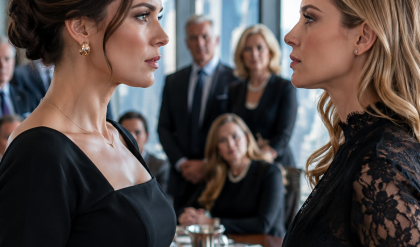
“Your color is very on theme,” I said to the woman wearing my mother’s diamonds.
Sloane Mercer’s smile flickered — just for a half-second, just enough. She covered it the way women like her always do: a small laugh, a tilt of the head, a practiced redirect toward someone standing slightly behind me. I did not turn to look. I already knew who was there.
Adrian’s hand found the small of my back.
It was not affection. It was instruction.
Behave. Smile. Make me look powerful in front of these people.
I smiled. I was very good at smiling.
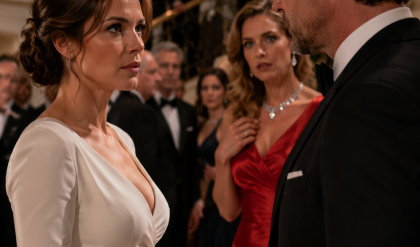
The Meridian Club smelled of old money and fresh flowers — gardenias, which I had once mentioned to the event coordinator were my least favorite. The walls were paneled in dark walnut. The candles were tall and ivory. Forty-three guests had been seated at tables draped in cream linen, each one a calculated arrangement: investors beside board members, the magazine editor beside the congressman’s wife, and Sloane Mercer placed two tables away from me with a perfect sightline to Adrian.
Three nights ago, I had found the letter.
I had not slept since. Not because I was devastated — though I was — but because I had been too busy.
The coat had been hanging in our shared closet for eleven months.
Charcoal cashmere, slim-cut, the kind of coat that costs more than most people’s rent. Adrian wore it to board meetings, charity galas, and, I would later understand, expensive lies. I had always liked the way he looked in it. I had once pressed my face against the lapel and told him he smelled like a man who had figured out the world.
He had laughed and said, “You always know exactly what to say.”
I found the letter on a Tuesday. I was looking for his fountain pen — the one his father had given him, the one he misplaced constantly and then blamed the household staff for moving. I checked every coat pocket methodically, the way I had done a hundred times before.
The paper was thick, cream-colored, and monogrammed with his initials in navy.
A.W.
My hands almost softened. I thought — for one idiotic moment — that he had written something for me. An anniversary note, perhaps. Something tender and private, something the public version of Adrian Whitmore never allowed himself to be.
Then I saw the name at the top.
Sloane.
I read the first line. Then the second. Then the third, and somewhere in the third line I understood that my stomach was not dropping so much as it was recognizing something it had long suspected but refused to name.
My vows.
Word for word.
The line I had written at two in the morning in our tiny apartment on 84th Street, the line I had crossed out three times and rewritten because nothing else felt true enough:
Wherever the world becomes loud, I will build you a quiet room.
He had given it to her.
Not as a gift. Not as an homage. He had handed her my most private self and let her wear it like a piece of jewelry she hadn’t paid for.
I sat in the living room for a long time after that. Our penthouse overlooked Central Park, and the city glittered below in the way it always did, indifferent and beautiful. I poured one finger of his best bourbon — a 1964 Pappy Van Winkle he was saving for some occasion I apparently was not — and stared at our wedding portrait above the mantel.
In that photograph, taken on the lawn at Larkspur House in Newport, Adrian looked at me like I was holy.
Now I understood he had only been studying the language of devotion.
He had always been good at that. At learning the texture of a thing without caring about its substance.
I drank the bourbon slowly.
Then I called Grace Halpern.
Grace had been my attorney since before I was Adrian’s wife. She had drawn up the terms of my grandmother’s trust, administered the Newport estate, and once, years ago, sat across from me at a corner table in a dim restaurant and said, “Isabella, if you ever decide to protect yourself, call me first.”
I had filed that away the way you file emergency numbers — hoping never to need them, recognizing you probably will.
She answered on the second ring.
“Tell me you’re not calling because something happened,” she said.
“I’m calling because something has already been happening,” I said. “And I need three days.”
There was a pause. “For what?”
“To be ready.”
Another pause. “How bad?”
I looked at the letter in my hand. “He gave her my vows, Grace.”
She was quiet for a long moment. Then: “What else?”
“He’s planning to announce the Newport deal at the anniversary dinner. He thinks Larkspur House is already his.”
Her voice shifted — not louder, but denser, the way stone becomes denser under pressure. “We need to talk about something your grandmother left in the trust documents.”
“I know about the preservation clause.”
“There’s more,” she said. “Come to my office tomorrow. And Isabella — don’t tell him you know. Not yet.”
I set the letter on the coffee table.
I picked up his fountain pen — I had found it, tucked into the coat’s breast pocket, beneath the letter — and turned it over in my fingers.
You always know exactly what to say.
Then I picked up the letter, took it to the best framer on Madison Avenue the following morning, and had it mounted behind museum glass in a black lacquer frame. Beneath it, I added a small brass plate engraved with five words I chose very carefully.
RECYCLED LOYALTY. Adrian Whitmore. Ink on paper, cowardice on display.
I wrapped it in ivory silk ribbon.
I carried it into our seventh anniversary dinner like a widow bringing flowers to a funeral.
The first toast was Adrian’s.
He was good at toasts. He was good at standing at the center of a room and making every person in it feel like they had been chosen. This was the skill that had built Whitmore Hotels into what it was — not financial genius, not operational excellence, but a particular talent for making people feel seen long enough to sign something.
He stood, and the room quieted the way rooms do when they have been trained to.
“Seven years ago,” he said, “I married the woman who taught me what it means to build something that lasts.”
He looked at me.
I smiled.
“Isabella has always understood that a home is more than a structure. It’s a promise.” He raised his glass. “To promises. And to what we’re building together.”
The room drank.
Two tables away, Sloane Mercer raised her glass and let her eyes settle on me for just a moment. The diamond pendant at her throat caught the candlelight. I had seen the receipt for that pendant eighteen months ago, filed under “client gifts” in the household account I was not supposed to access but had been accessing for three years out of a habit I had convinced myself was just organization.
Marchetti Jewelers. One custom pendant. Pear-cut diamond. Platinum setting. $24,000.
Client: S. Mercer.
Beside me, Adrian’s mother, Catherine Whitmore, leaned close and said, “You’re glowing tonight, darling.”
“Thank you,” I said. “I feel very clear.”
She patted my hand. She had never particularly liked me — I was Newport money turned social worker turned nonprofit director, and she had wanted Adrian to marry someone with a hedge fund connection — but she respected self-possession. She had raised a son who mistook it for softness and she would spend the rest of her life not understanding where she went wrong.
My phone buzzed inside my clutch.
A single line from Grace: Do not let him announce the Newport deal until you see the second signature.
Adrian began the announcement between the entrée and the dessert course — the precise moment he had calculated for maximum attention and minimum interruption.
“Many of you know that Whitmore Hotels has been developing a new concept,” he said, standing again, buttoning his jacket, performing certainty the way he had been performing it our entire marriage. “A luxury wedding destination unlike anything on the East Coast. We’re calling it The Vow House.”
Appreciative murmurs.
“The centerpiece of this property will be Larkspur House — a historic coastal estate in Newport, Rhode Island. A property with one hundred and thirty years of family history.” He paused. “And as of last month, a property that is fully, legally, and finally part of the Whitmore portfolio.”
He reached into his jacket pocket and produced a document — folded, cream-colored, official-looking.
I stood up.
The room noticed. Forty-three pairs of eyes turned toward me. Adrian’s expression shifted through three emotions in half a second: surprise, irritation, and the forced smoothing of both into something that looked like invitation.
“Bella,” he said warmly. “Did you want to say something?”
“I’d like to see the transfer document,” I said.
A small silence.
“This isn’t really the moment —”
“You’re announcing it to investors,” I said. “I think this is exactly the moment.”
He brought the document to me. He had no choice — refusing would have drawn more attention than complying. I took it from his hand and looked at the second signature line.
Eleanor Lark. February 14, 2024.
My grandmother had been dead since 2018.
I looked up at Adrian.
He knew. From the way my expression didn’t change, from the way I was very still and very quiet, he knew that I knew.
“This signature,” I said, not raising my voice, not performing emotion, just stating a fact into the attentive silence of the room, “belongs to a woman who died six years ago.”
The room went first still, then loud.
Not shouting — this was not that kind of crowd. It was the sound forty-three wealthy people make when they realize that fraud has walked into the room wearing a tuxedo and a seven-year marriage as its alibi.
Adrian tried to take the document back.
I stepped away.
For the first time in our marriage, he reached for me and found nothing.
“This is a private matter,” he said, and I could hear the strain beneath the smoothness, the machinery beginning to grind. “Isabella is understandably emotional —”
“I’m very calm,” I said.
“We can discuss this at home —”
“We won’t,” I said.
Then Grace Halpern walked through the entrance of the Meridian Club.
She was fifty-one years old, five feet four inches tall, and she walked into that room with the particular authority of someone who had never once needed anyone to open a door for her. She carried sealed documents and wore the expression she reserved for courtrooms and catastrophes.
She crossed to where Adrian was standing. She looked at the forged transfer. She read it once, unhurried, thorough.
Then she looked at my husband and said: “This stopped being private when you used it to raise investor money.”
The temperature of the room changed.
Investors stopped looking at me like a humiliated wife. They started looking at Adrian like a liability.
Across the room, Sloane stood.
“Please stay,” I said.
She stopped.
I had not raised my voice. I had not moved toward her. But something in my stillness held her in place the way a closed door holds even when it is not locked. She sat back down, and the diamond pendant settled against her collarbone, and I thought about my mother, and I let the thought go.
This part was not about Sloane.
This part was about documents.
PART TWO: WHAT THE QUIET ROOMS HOLD
Adrian followed me to the elevator afterward.
He had dismissed everyone with the practiced grace of a man who had always been able to end rooms — a few quiet words to the maître d’, a hand signal to the investors, a brief reassuring murmur to his mother. By the time the elevator doors closed behind us, he had already reconstructed his composure into something that looked like controlled anger rather than panic.
I watched him in the mirrored walls of the elevator.
He was still beautiful. That had never been the issue.
“You want to tell me what that was?” he said.
“You forged my grandmother’s signature.”
“Isabella —”
“You presented fraudulent documents to investors in front of forty witnesses.”
“It was a procedural issue. The attorney —”
“There is no attorney,” I said. “There’s a notary you paid four thousand dollars to look the other way, and a document that was backdated to a date when Eleanor Lark had been in the ground for six years.” I looked at him in the mirror. “Did you think I wouldn’t find out? Or did you think it wouldn’t matter by the time I did?”
He was quiet for a moment. The elevator descended.
“The resort needs Larkspur,” he said finally. “The whole concept is built around that property.”
“I know.”
“We have investors —”
“I know.”
“Loans tied to this, Isabella. Real loans. People with real exposure.” His voice shifted — not quite pleading, not quite threatening, something occupying the uncomfortable space between. “If this falls apart, it’s not just me. There are employees. Partners. My parents have money in this.”
“Your parents,” I said, “have always had money in things that weren’t theirs to begin with.”
The elevator opened. I walked out. He followed.
“What do you want?” he said. “Say it plainly. What do you want me to do?”
I turned to look at him in the lobby of the Meridian Club, under the chandelier that cost more than our first apartment.
“Nothing,” I said. “You’re done, Adrian. The decision about what happens next isn’t yours to make.”
Grace drove me to the apartment.
It was a small place on the Upper West Side, two rooms and a decent kitchen, leased under my maiden name — Isabella Lark — seven months ago when I had started to notice the gap between what Adrian said and what Adrian did widening into something I could no longer step across.
I had not told him about it. I had told no one.
Even Grace had not known until I called her about the letter.
We sat at the kitchen table with tea neither of us drank, and she opened the folder she had brought from her office, and she showed me what Adrian Whitmore had never bothered to read.
My grandmother, Eleanor Lark, had been a woman of extraordinary practicality dressed in the appearance of sentiment. She had built Larkspur House with her first husband, named it for the flowers that grew along the coastal path in June, and spent the following sixty years collecting the kind of quiet power that does not announce itself.
The Quiet Room Covenant was her masterwork.
It had been drawn up in 1987 and amended three times, most recently in 2016, two years before she died. The covenant established a preservation trust for Larkspur House and its surrounding forty-seven acres. The terms were clear: the property could not be sold, mortgaged, transferred, or commercially developed without approval from the trust protector.
The trust protector was me.
Adrian had known this. Or he had known a version of it — the version his own attorneys had summarized in a briefing document two years ago that said significant restrictions apply and which he had apparently not read past the first page.
He had decided that my grandmother’s signature, forged on a backdated transfer document, would be sufficient to circumvent those restrictions.
He had decided this because he had decided, at some point in our marriage, that I was sentimental and loyal and too soft to understand contracts.
He was wrong about one of those things.
“There’s more,” Grace said.
She turned to a different section of the folder. A page dated 1998, formal legal letterhead, signatures I recognized.
In 1998, Whitmore Hotels had been in serious financial difficulty. Malcolm Whitmore — Adrian’s grandfather — had approached Eleanor Lark for a private loan. Eleanor had agreed, for reasons Grace speculated were partly business and partly something more complicated that we might never fully understand.
The collateral was a dormant voting interest in Whitmore Hotels Group — five percent of voting shares, held in trust, not exercised, not publicly disclosed, structured in a way that had made it invisible to every audit and due diligence review for twenty-six years.
The terms of that collateral included a trigger clause.
If any member of the Whitmore family attempted to acquire Larkspur House through fraud, coercion, or marital pressure, the dormant interest could be activated. And upon activation, it would expand — through a compounding mechanism tied to unpaid interest on the original loan, which had never been formally discharged — to a controlling stake.
“How much?” I said.
Grace looked at the calculation sheet she had spent two days verifying.
“Fifty-one point three percent,” she said.
I sat with that for a moment.
The tea had gone cold.
“She planned this,” I said.
“I don’t know if she planned it exactly,” Grace said carefully. “But she built a house that could not be taken. And she made sure that if someone tried, the person who tried would lose more than the house.”
I thought about my grandmother. About the way she had stood on the Larkspur lawn at my wedding, watching Adrian say his vows — or my vows, as I now understood — with an expression I had interpreted at the time as approval.
Now I wondered if it had been assessment.
“Drive me to Newport,” I said.
Grace looked at me across the kitchen table. “Now? It’s two in the morning.”
“Drive me to Newport,” I said again.
PART THREE: LARKSPUR
We arrived at dawn.
The coastal path was silver in the early light, the ocean flat and pewter, the air cold with the particular coldness of a New England June morning that has not yet decided to become warm. Larkspur House rose at the end of the drive with the unhurried authority of things that have been standing longer than the people arguing about them.
Thomas, the caretaker, met us at the door.
He was seventy-three years old, had worked the property since before I was born, and had a particular talent for asking no questions at unusual hours. He led us through the entrance hall — past the portrait of Eleanor at forty, past the case of navigational instruments that had belonged to her first husband, past the hallway where the floorboards sang a specific note if you stepped on the third plank from the left — and into the library at the rear of the house.
Behind the library’s east wall hung a tapestry of white roses.
I had assumed, my entire life, that it was decorative.
Thomas moved it aside without ceremony to reveal a door.
The door opened into a room the size of a large closet — low-ceilinged, stone-walled, lit by a single overhead fixture Thomas switched on as we entered. There was a wooden chair, a small table, and on the table, a black tin box.
I had asked Grace what we were looking for. She had said: Your grandmother mentioned a room in a letter she wrote to me in 2015. She called it the quiet room. She said if you ever came to Newport asking the right questions, I should tell you to find it.
I opened the box.
Inside: a photograph, a velvet pouch, and a folded letter addressed to no one in particular, in Eleanor’s handwriting.
The photograph showed my mother — Margaret Lark, age approximately twenty-five, taken sometime in the late 1970s — standing beside a man I recognized from board portraits and family mythology.
Malcolm Whitmore.
They were standing in the garden at Larkspur. My mother was laughing. Malcolm Whitmore was not looking at the camera. He was looking at her.
The velvet pouch was empty except for a single torn jewelry clasp — gold, delicate, the kind that might have belonged to a necklace.
I set it down.
I picked up Eleanor’s letter.
My darling,
If you’ve found this room, you already understand that I built this house to hold more than furniture. I built it to hold what I could not say aloud.
Your mother was not simply our tenant’s daughter. Malcolm Whitmore was not simply our creditor’s grandson. Some things are more complicated than the stories families agree to tell.
The necklace I left in the pouch was Margaret’s. She left it here the last summer she visited, before you were born. I kept it because I couldn’t give it back and I couldn’t throw it away.
I don’t know what Adrian Whitmore is. I know what his grandfather was. I know what blood carries and what money corrupts and what houses remember when people forget.
The Covenant protects Larkspur. But Larkspur protects you. Do not sell it. Do not sign it. Do not let them take the quiet room.
I love you beyond language.
Eleanor.
I folded the letter.
I looked at the empty velvet pouch.
Then my phone rang.
The number was Sloane’s.
I stared at it for a moment.
Then I answered.
She was whispering, which meant Adrian was somewhere nearby. “I need to tell you something,” she said. “About the necklace.”
“Tell me.”
“He gave it to me six months ago. He said — he told me it was a gift. Something he’d had made.” A pause. “But last night, when you said my color was on theme, I looked it up. The clasp style, the cut. It’s not custom. It’s antique.”
I waited.
“He told me it came from your house,” she said. “From Larkspur. He said he’d found it in a storage room and had it repaired.”
My eyes dropped to the empty velvet pouch on the table. The torn clasp.
“Sloane,” I said carefully. “Were you in love with him?”
A silence that lasted long enough to be an answer.
“I thought what we had was real,” she said finally. “He talked about you like a business arrangement. He talked about me like —” She stopped. “He talked about me like I was the real one.”
“He talked about me the same way,” I said. “To you.”
Another silence.
“The letter he wrote me,” she said. “The beautiful letter. I’ve been thinking about it all night.” Her voice was very small. “He didn’t write it for me, did he.”
“No,” I said. “He didn’t write it for anyone. He just learned how it was supposed to sound.”
I heard her breathe.
“What are you going to do?” she asked.
“Finish what my grandmother started,” I said. “What about you?”
A long pause. Then, quietly: “I’m going to need a different kind of attorney than Adrian’s.”
“I know someone,” I said. “I’ll have her call you.”
PART FOUR: THE WEIGHT OF WHAT WAS BUILT
I drove back to the city that afternoon.
Adrian was waiting in the penthouse.
He had spent the morning, I later learned, calling investors, calling lawyers, calling board members, and calling his father. He had constructed a narrative in which the forged signature was an administrative error, the letter was a private marital document being weaponized by an emotional wife, and the entire situation was recoverable with enough meetings and enough money.
He was still constructing it when I walked through the door.
“We need to talk,” he said.
“We do,” I agreed.
I set my bag down. I sat in the chair by the window that overlooked the park — my chair, the one he always described to guests as the reading chair, as if reading were a charming eccentricity rather than the thing I had done every morning for seven years to build the mind he had borrowed from.
He remained standing. He always remained standing in difficult conversations. He had once told me it was a dominance strategy he’d learned in a negotiation seminar, and he had said it with the particular pride of a man who did not realize he had just explained why his wife never felt safe.
“I know I handled this wrong,” he said.
I waited.
“The signature — I know how it looks. But I need you to understand the pressure I’m under. The resort is not optional. We have forty million dollars in committed loans, investors who have already moved other positions, architects, a construction timeline —”
“Adrian.”
“— and Larkspur is the only property that fits the concept. It’s the whole brand. The name, the story, the —”
“Adrian.”
He stopped.
“Do you know why my grandmother named the trust the Quiet Room Covenant?”
He blinked. “What?”
“The quiet room. The one she built behind the tapestry in the library at Larkspur.” I watched his face. “Did you know it existed?”
“I —” He stopped. “No.”
“She built it because she understood that the loudest people in a room are usually the ones protecting nothing worth protecting,” I said. “She built it so that the thing worth protecting would always have somewhere to be quiet.”
He looked at me for a long moment with an expression I had not seen before — not anger, not calculation, not the practiced warmth he deployed like a tool. Something closer to discomfort. The specific discomfort of a man who has just realized he may have underestimated the foundation he was standing on.
“What did you find?” he said.
“What your grandfather buried,” I said. “And what my grandmother chose not to.”
I leaned forward in the chair.
“Here is what’s going to happen,” I said. “Grace will be in contact with your attorney tomorrow morning about the Whitmore Hotels voting interest. The terms of your grandfather’s debt were never discharged. That triggers the clause. I now hold a controlling stake in Whitmore Hotels Group.”
His face went through colors I had not known faces could go.
“That’s not —”
“It’s documented and verified and will hold up in any court you choose to bring it to.” I met his eyes. “Larkspur will be protected under the covenant. The resort project at that location is over. You will need to find a different property, and you will need to tell your investors the truth about why.”
“Isabella, you can’t —”
“You will also need to inform your investors,” I continued, “that the transfer document was fraudulent, because if you don’t, I will, and my version will come with the documentation that Grace has already prepared.”
Silence.
“The controlling stake,” he said carefully. “What are you going to do with it?”
“That,” I said, “is not your concern.”
He sat down then. For the first time in the conversation, for perhaps the first time in our marriage, he sat down and was still and quiet and something that was not quite defeated but was the thing that lives just before defeat — the moment of understanding that the game has changed and the old moves no longer apply.
“I was going to tell you,” he said. “About Sloane. After the deal closed. I was going to —”
“No,” I said gently. “You weren’t.”
He didn’t argue.
Because some things, once said plainly, cannot be argued with.
“She’s not what you think,” he said. “It wasn’t — it wasn’t love, Isabella. It was —”
“I know what it was,” I said. “That’s not the wound.”
He looked at me.
“The wound,” I said, “is the letter. The wound is that you read the most private thing I ever built, and you decided it was useful, and you used it. Not because you loved her. Because you needed the language of love and you had run out of your own.”
He was quiet for a long time.
Then, in a voice I had not heard from him since the early years, stripped of polish and strategy and performance: “I’m sorry.”
“I know,” I said.
“That’s not enough.”
“No,” I agreed. “It isn’t.”
There is a particular kind of grief that has no name in English. The grief not for what was lost but for what was never there — the discovery that the thing you thought you were protecting was a reflection in a window, not a room you could enter.
I had built my marriage the way Eleanor had built Larkspur: with intention, with care, with the belief that what you build carefully will last.
What I had not understood was that a house requires two builders.
I had been building alone.
I had been building alone and calling it partnership.
I stayed in the penthouse that night. I had earned the right to choose where I slept, and I chose my chair by the window. Adrian took the guest room without being asked. It was the most honest thing he had done in seven years.
In the morning, I called the office of the Newport Historic Properties Commission and arranged a meeting about Larkspur’s designation status.
Then I called the Whitmore Hotels board administrator and arranged a different kind of meeting.
Then I made coffee and sat by the window and watched the park come alive in the early light, the way it always did, indifferent and beautiful, going on without asking anyone’s permission.
PART FIVE: WHAT THE HOUSE REMEMBERS
Sloane Mercer met with Grace three days later.
She came in without the pendant. She came in with documentation — emails, bank transfers, a photograph of the letter Adrian had written her, and a detailed account of the past two years that she had clearly been preparing for some time, perhaps longer than she had admitted to herself.
She was not who I had made her in my mind during the worst nights.
She was a woman who had been told a story and had believed it because she wanted to and because it was told with skill.
She was also a woman who had, at some point, stopped quite believing it and had not known what to do.
I did not forgive her because forgiveness was not mine to hand out on her behalf. What she had participated in, she would have to account for herself. But I understood her in the way you understand a pattern once you can see the whole of it — the shape of what Adrian did, over and over, to the people who trusted him: he learned their language, their vows, their values, and he used those things like keys to rooms he had no right to enter.
Sloane returned the pendant to me in a small box, unasked.
I looked at the clasp.
It matched the torn clasp from the velvet pouch at Larkspur.
I had a jeweler reattach it.
Then I put it back in the tin box, in the quiet room, where it had always belonged.
The Whitmore Hotels board meeting was held two weeks later.
I presented the documentation of the dormant voting interest with Grace beside me and a table of twelve board members who were, to their credit, uniformly professional about their collective shock. The company had grown significantly since 1998. The stake, calculated with compounding, was not the kind of thing anyone had anticipated.
Adrian was present. He sat at the far end of the table and did not speak.
His father, Richard Whitmore, asked three questions, all of them precise and relevant and completely devoid of the emotional landscape of the situation. I answered all three. He nodded once and said, “Eleanor Lark was a formidable woman.”
“Yes,” I said. “She was.”
I did not immediately exercise the controlling stake in ways that dismantled the company. That had never been the point. Eleanor had not built the clause as a weapon. She had built it as a deterrent — the same way she had built the preservation covenant, the same way she had built the quiet room. Not to attack. To protect.
What I exercised it for, in the weeks that followed, was to require a full independent audit of the company’s financial practices, to mandate the repayment of the fraudulent investment funds with interest, and to require a new governance structure that included an independent ethics committee.
Was it the end of Whitmore Hotels? No.
Was it the end of the way Whitmore Hotels had been run for forty years? Yes.
The Newport resort project found a different property in Connecticut — a gracious colonial house with no historic trust, no preservation covenant, and no grandmother watching from the quiet room. The investors were made whole. The construction timeline shifted by a year. The brand evolved.
Adrian and I signed the divorce papers on a Tuesday in September.
He looked older than he had at the anniversary dinner. He had always been beautiful in the specific way of men who know they are beautiful, which tends to wear badly under real pressure. What was left was something harder and, I thought, more honest — the actual face of a man who had run out of mirrors to stand in front of.
“I want you to know,” he said, setting down the pen, “that I did love you.”
I looked at him.
“I believe that you believed that,” I said.
He held my gaze for a moment. Then he nodded, slowly, the way people nod when they have arrived somewhere they did not expect and do not entirely know what to do with.
“Will you sell the penthouse?” he asked.
“No,” I said. “I’ll keep it.”
I had reframed the question, months ago, from What am I losing? to What was mine all along? The answer, it turned out, was more than I had understood.
The penthouse. The business acumen I had quietly developed while appearing to only do charity work. The inheritance, protected. The language of devotion I had written at two in the morning in a tiny apartment, which was mine again, which had always been mine, which no amount of recycling could actually transfer because language returns to its author eventually.
The marriage was over.
I was not.
EPILOGUE: THE QUIET ROOM
October in Newport.
The larkspur along the coastal path had gone to seed, brown stalks swaying in the Atlantic wind, storing themselves for spring. The house stood at the end of the drive, warm with late-afternoon light, looking the way it had always looked: like something that had survived every storm it had been asked to survive and was not particularly surprised by this.
I walked the property with Thomas, who asked no questions and noticed everything.
“The east parlor needs the floor refinished,” he said. “And the gatehouse chimney is cracked.”
“Get it done before December,” I said.
“And the tapestry room?” He looked at me sideways. “The room behind the wall.”
“The quiet room stays,” I said. “Leave everything as it is.”
He nodded. He had always known it was there. Of course he had.
I went in alone, as the last of the light came through the small window and laid itself on the stone floor. The tin box was on the table. The photograph of my mother and Malcolm Whitmore. The velvet pouch with its repaired clasp. Eleanor’s letter, refolded, returned to where it had been waiting.
And one new thing.
Before I had left the city, I had sat in the chair by the window that overlooked the park — my chair — and I had taken out a piece of paper and a pen. Not a fountain pen. An ordinary pen, the kind I used for grocery lists and thank-you notes and the unremarkable keeping-track of an ordinary life.
I had written one line.
Not for anyone. Not as a vow. Not as a letter or a performance or a gift for a room full of people who needed to be impressed.
Just for myself. Just because it was true.
Wherever the world becomes loud, I will still know how to build the quiet room.
I set it in the tin box, beside Eleanor’s letter.
Then I closed the lid.
Outside, the Atlantic moved the way it always had — patient, immense, carrying everything toward shore and returning it changed. The larkspur seeds were in the ground. In June, the flowers would come back. They always did.
I had a meeting with the Newport Historic Properties Commission in the morning. I had a board call in the afternoon. I had a half-dozen people counting on decisions I was learning, day by day, to make with clarity rather than habit.
I had a life that was mine.
Not perfect. Not finished. Not the story anyone had told me I was supposed to live.
Mine.
That was enough.
That was, it turned out, everything.
End.