PART 2:
By sunset, the story online was not the truth.
It was worse.
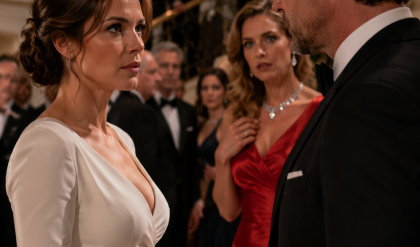
Someone from that conference room had taken a photo at the exact moment Brielle looked fragile and I looked cold. The bracelet was hidden. Preston’s hand was not visible. My nameplate, my chair, and her Chanel bag on my folder were all cropped out.
The caption said a Winthrop heiress had humiliated a grieving guest at a will reading.
Brielle posted minutes later.
A glass of champagne. A city window. A bare wrist. One line that made strangers feel sorry for her before they knew she was wearing stolen diamonds.
“Some women inherit everything except grace.”
By morning, women who had kissed my cheek at charity luncheons were sending me careful messages. They said they were thinking of me during this complicated time. Complicated was the word polite people used when they wanted to call something ugly without risking a side.
Preston did not come home that night.
He texted me at 1:17 a.m.
“We need to be careful now.”
Not “I’m sorry.”
Not “I betrayed you.”
Not “She should never have been there.”
Just strategy.
The next morning, my uncle Malcolm came to Whitethorn with my aunt Lydia. He kissed the air beside my cheek and told me I looked tired. When I said I was grieving, he nodded as if grief were proof that I should not be trusted.
Then he slid a folder across Catherine’s breakfast table.
It was a temporary authorization proposal. If I signed it, Malcolm would be allowed to advise and manage certain Winthrop assets for ninety days, just until I was “steady again.” It sounded harmless in the way a locked door sounds harmless before you realize you are on the wrong side of it.
Lydia cried softly and begged me not to make the family look worse.
That was when I understood the second humiliation.
The first had been Brielle in my chair.
The second was my own family explaining that my reaction to being humiliated was the real problem.
I closed Malcolm’s folder and said, “No.”
His face barely moved, but his eyes hardened.
“Avery,” he said, “you are in no condition to make enemies.”
“Then people should stop volunteering,” I replied.
After they left, I went upstairs to my dressing room. The drawer where the bracelet had been kept was still locked. The key was still in the porcelain dish beside my perfume. There were no scratches, no broken wood, no sign of force.
The bracelet tray was simply empty.
Then I noticed two other pieces missing.
My mother’s diamond earrings.
Catherine’s sapphire pin from my college graduation.
Not the most expensive pieces.
The most personal ones.
That was not random theft. That was selection.
Rebecca Shaw called that afternoon, and I told her I needed to see the Blue Room. The office had been Catherine’s private world at Whitethorn, a locked room I had only entered twice as a child and never as an adult.
Rebecca arrived with two document boxes and a warning.
“Your grandmother did not leave you a rescue,” she said. “She left you a system.”
Inside the Blue Room, I found a note in Catherine’s handwriting.
“If you are reading this because you are heartbroken, I am sorry. If you are reading this because you are angry, wait. If someone has taken something from you and dared you to prove it, begin with the inventory.”
That night, Preston came home.
He found me in Catherine’s public study, not the Blue Room. I had already learned one rule: never show the room where you are becoming dangerous.
When I asked for the bracelet back, he gave me a pitying look and said, “Avery, you’ve been under strain.”
There it was.
Under strain would become unstable.
Unstable would become unreasonable.
Unreasonable would become unsafe.
And unsafe would become a reason for men like Preston and Malcolm to step in and take control.
At 2:03 a.m., my phone lit up with Brielle’s newest post.
She was standing in my greenhouse at Whitethorn.
Behind her were Catherine’s white orchids.
On her wrist was my bracelet.
And in the glass reflection behind her, someone was holding the greenhouse door open.
Preston had sworn she had never been inside my house before the will reading.
So why had my husband’s mistress been photographed inside Whitethorn while my grandmother was still alive?
PART 3:
I learned that houses remember.
Not in a poetic way.
In a mechanical way.
Whitethorn remembered door codes, service entrances, motion sensors, security overrides, delivery logs, old invoices, contractor names, and the small technical details arrogant people forget when they believe a woman is too heartbroken to check.
For two days, I did nothing visible.
That was harder than rage.
Preston watched me at breakfast as if he were waiting for me to crack. I buttered toast. I read the paper. I asked whether he would be home for dinner in the same calm voice I used before our marriage became evidence.
He relaxed.
That was his mistake.
Men like Preston mistake silence for surrender because surrender is what they would do if silence cost that much.
In the Blue Room, I started with Catherine’s inventory. Every piece of Winthrop jewelry had a file: photographs, appraisals, insurance riders, repair history, and handwritten notes. Catherine had documented beauty like a prosecutor.
The bracelet’s file was labeled THORN BRACELET — AVERY.
There were close-up photographs of the hidden clasp. Years earlier, I had caught the bracelet on a garden gate, and the repair had left a tiny scar near the hinge. No replica would have that mark.
Rebecca connected me with a forensic jeweler named Daniel Reyes. He studied the photos Brielle had posted and said the bracelet looked almost certainly like mine. Almost was not enough, but it was a beginning.
Then I went to Marisol, the house manager who had worked for Catherine since I was a teenager.
When I asked what she had seen, she looked at the laundry room door before she looked at me. That told me enough.
She admitted Malcolm had made the staff sign new confidentiality papers while Catherine was in the hospital. He claimed it was to protect the family from the press, but the threat was clear. Anyone who spoke could lose more than a job.
Marisol had seen a blonde woman near the east hallway.
She had been with Preston.
It was the day before Catherine died.
When I asked whether the woman had gone into my bedroom, Marisol’s hands shook. She said she could not swear to it. Then she whispered, “I heard the jewelry drawer.”
That sentence should have made me furious.
Instead, it made me cold.
Cold was better.
Cold could keep records.
Preston’s next move came through court. He filed for temporary marital access to Whitethorn and claimed I was trying to exclude him from a shared residence during a period of grief-related emotional instability. He attached receipts for electrical work, greenhouse repairs, and security upgrades, all meant to suggest he had a financial stake in the estate.
He did not demand ownership outright.
That would have looked too greedy.
He demanded concern.
Concern is a blade with a gentle voice.
Rebecca warned me that if we made the fight about adultery, Preston would win. If we made it about my pain, he would win. If we accused him without a sequence, he would win.
So we sequenced him.
But the pressure got worse before it got better. Brielle went on a podcast and cried about loving a man trapped in a cold marriage. She said some wives had the ring but not the heart. The clip spread fast, and strangers started calling me cruel, jealous, spoiled, and unstable.
Then I found lipstick on my bedroom mirror.
No message.
No threat.
Just a faint mark in the corner, placed where only I would notice.
Someone had been in my room again.
For three minutes, I sat on the floor and shook. Not cried. Shook. There is a difference. Crying asks for comfort, but shaking is what happens when your body realizes comfort is not coming.
Then I saw an old photograph of Catherine and me in the greenhouse. On the back, she had written one sentence.
“Inventory is memory with teeth.”
I opened every file in the Blue Room.
House repairs.
Security upgrades.
Vendor contracts.
Insurance records.
Printed emails Catherine had saved because she never trusted clouds.
That was when I saw it.
Some of Preston’s receipts were not entirely fake. That was what made them dangerous. Some work had been done, some signatures were real, and some money had moved.
But the dates were wrong.
One contractor had been paid by Catherine’s trust eighteen months earlier, yet Preston’s records claimed an emergency repair six weeks ago. Another invoice used a real company logo with a false invoice number. The security account had been transferred to Preston’s administrative email after Catherine entered hospice.
This was not just an affair.
This was not just stolen jewelry.
This was a machine made out of grief, access, paperwork, and timing.
And I had been standing inside it for months.
PART 4:
My first counterattack failed.
That mattered.
In stories, the betrayed wife often opens one folder and destroys everyone before dessert. In real life, power is slower. Power has deadlines, motions, affidavits, and people who lie beautifully under fluorescent lights.
Rebecca filed a demand for the return and inspection of the Thorn Bracelet. We did not mention the affair. We did not mention humiliation. We described it as an insured family asset held by an unauthorized third party.
Brielle answered with tears.
She posted a video from a hotel room saying she never wanted to be dragged into a billionaire family war. She claimed Preston had given her the bracelet because he loved her. By morning, strangers were calling me a bully for wanting my own diamonds back.
Then Preston’s lawyers produced a receipt.
A platinum diamond bracelet.
Private sale.
Paid by Preston Whitlock two days before the will reading.
For six hours, it worked.
Then Daniel Reyes called.
“The receipt is real,” he said. “But not for your bracelet.”
Preston had bought a similar bracelet to create confusion. The one Brielle wore had the repaired thorn clasp from Catherine’s archive. He did not need the lie to be perfect. He only needed it expensive enough to delay the truth.
That was when I made my first mistake.
I called him.
I accused him of buying a fake paper trail for stolen jewelry. He laughed softly and said I had always turned grief into accusation. Then he said, “Avery, you are not Catherine.”
That hit harder than it should have.
Not because I wanted to be Catherine.
Because some weak part of me still wanted Preston to admit reality.
After that, I stopped speaking to him directly. Everything went through counsel. Everything was in writing. Everything was time-stamped.
Then I made the choice that changed the case.
I stopped chasing Brielle for the bracelet.
I let her keep wearing it.
Rebecca hated the idea until she understood. Brielle loved being seen. Preston loved controlling narratives. Malcolm loved looking calm in rooms where he thought everyone else was weaker. Their vanity was not random. It was predictable.
Brielle posted brunch.
The bracelet appeared in a mirror.
Brielle posted a charity fitting.
The clasp was visible under perfect light.
Brielle posted a photo of Preston holding her hand, captioned as if she had been chosen before the truth became public. But behind them was the west hallway of Whitethorn, with my mother’s portrait still on the wall.
That portrait had been removed before the will reading.
Which meant Brielle had been inside my home earlier than Preston admitted.
The old security company resisted giving records until Rebecca filed a preservation notice. Suddenly, archived logs appeared. A guest code labeled B.H. had opened the east entrance, the greenhouse, and the private residential wing.
The last use was the night I found lipstick on my mirror.
Then came the contractor.
He admitted Preston had asked him to reconstruct old paperwork for insurance purposes. Preston had used Catherine’s name to make it sound legitimate. But Catherine had been unconscious in hospice that week.
The more we found, the clearer it became.
Preston needed money.
Brielle needed a ladder.
Malcolm needed control.
And I had been mistaken for a grieving woman who would be too embarrassed to look beneath the affair.
We held a family meeting at Whitethorn before the final legal conference. Malcolm spoke about unity. Preston spoke about a painful marriage. Brielle cried about being treated like a criminal because she had loved the wrong man.
I let them finish.
Then I placed Brielle’s greenhouse photo on the table and asked Preston when she first came to Whitethorn.
He said, “After the will reading.”
I placed down the west hallway photo.
Then the access logs.
For one moment, his charm faltered.
But Preston recovered quickly. He looked around the room and said I was turning heartbreak into surveillance. He said I could not accept that he had fallen in love with someone else.
For one dangerous second, the room softened toward him.
That was his gift.
He could make betrayal sound like weather.
Sad, natural, and no one’s fault.
I gathered the papers and said, “Maybe you’re right. Maybe this is only a painful marriage.”
He smiled.
That smile gave him away.
Within forty-eight hours, he tried to replace the entire Whitethorn security company and delete old access records.
Rebecca filed an emergency preservation motion before his request even landed.
Because we had expected it.
Because I had baited him.
And when the final meeting returned us to the forty-third floor, Preston walked in thinking he was there to negotiate money.
He did not know the room was already mine.
PART 5:
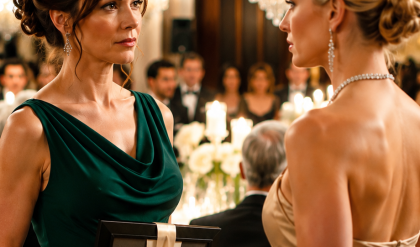
The final meeting happened in the same Manhattan conference room where Brielle had taken my chair.
This time, my nameplate was correct.
AVERY CATHERINE WINTHROP.
Not Whitlock.
Preston noticed immediately. Brielle noticed the empty chair beside him. A junior attorney brought her another seat and placed it against the wall, not at the table.
She was no longer a guest.
She was evidence wearing cream.
Rebecca began with the marital agreement. Preston had signed away all claims to inherited Winthrop property before the wedding. He had no right to Whitethorn, no right to its contents, no right to its appreciation, and no right to use my grief as a bridge into Catherine’s estate.
Preston’s attorney tried to say Whitethorn had functioned as a marital residence.
Rebecca looked at him and said, “Access is not ownership.”
Catherine’s words filled the room.
Then we began with the bracelet.
Brielle was still wearing it.
I looked at her and said, “That bracelet belongs to me.”
She gave a small laugh. “Preston gave it to me.”
“No,” I said. “Preston gave you a receipt.”
Daniel Reyes’s report went onto the table: the repair scar, the trust registration, the insurance rider, the no-transfer clause, the photographs Catherine had saved. The bracelet on Brielle’s wrist was the Thorn Bracelet. It had never been sold, loaned, gifted, or transferred.
Brielle looked at Preston.
For the first time, he did not look back.
That was when she began to understand she had not been chosen.
She had been used.
Next came the access logs.
Guest code B.H.
East entrance.
Greenhouse.
Residential wing.
Dates and times.
Then came Brielle’s own photos: the greenhouse, the west hallway, the reflection in the glass, and the man’s hand holding the door open. On his wrist was the anniversary watch I had once given Preston when I still believed time meant something to us.
Preston said inviting someone into the house was not illegal.
“No,” I said. “Not by itself.”
Then came the invoices.
False repair dates.
Recreated contractor paperwork.
A security transfer requested after Catherine entered hospice.
Payments connected to Preston’s debts.
Records showing that Malcolm had pressured staff into silence under the excuse of protecting the family from scandal.
Malcolm tried to stop it by calling the entire thing an overreach. He said I was turning a failed marriage into a public spectacle because my husband had embarrassed me.
“No,” I said. “My husband embarrassed himself. You treated that embarrassment as an opening.”
Then Rebecca opened Catherine’s affidavit.
My grandmother had signed it twelve days before her final hospitalization. In it, she documented concern that certain family members might try to create grounds for temporary interference with my control of inherited assets after her death. She noted Malcolm’s questions about what would happen if I were “emotionally compromised.” She noted Preston’s questions about marital access and residence classification.
Catherine had not guessed everything.
She had seen enough.
The final reveal was simple and devastating.
Brielle had been brought to the will reading to provoke me.
The bracelet was not just stolen for vanity. It was bait. The chair, the whisper, the public humiliation, the photo, the gossip post, the podcast, the court filing—every piece was designed to make me react like an unstable grieving wife.
If I had screamed, grabbed Brielle, slapped Preston, or made a public scene, they would have used that moment to argue I was emotionally unfit to control Catherine’s estate.
That was the trap.
And I had ruined it by staying calm.
Preston stood and said, “Avery, don’t do this.”
After everything, that was what he had left.
Not love.
Not remorse.
A request for mercy from the woman he had tried to erase in front of witnesses.
Brielle unclasped the bracelet with shaking hands and placed it on the table. The sound was tiny, platinum against mahogany, but everyone heard it. Preston looked at it as if the diamonds had betrayed him.
Rebecca explained what happened next.
Preston’s conduct triggered the forfeiture and bad-faith provisions of the marital agreement. He would receive no claim, no settlement leverage, no occupancy advantage, and no value connected to Winthrop inherited property. The unauthorized access, fabricated records, and possession of trust property would move into civil action, with possible criminal review.
Then I opened Catherine’s final blue folder.
Malcolm’s advisory seat had already been removed under an emergency governance amendment Catherine had left me, but I had needed evidence to activate it.
Now I had it.
Malcolm looked at me and said, “She made you hard.”
“No,” I told him. “She made sure I survived soft people with hard intentions.”
Six months later, Whitethorn bloomed in winter.
Preston left the marriage with his clothes, his watches, and none of the Winthrop property he had tried to approach sideways. Brielle returned the bracelet and two other pieces through counsel. Malcolm lost the power he had spent years waiting to claim.
I did not wear the bracelet for a long time.
Then one evening, I opened Catherine’s safe and clasped it around my own wrist. The diamonds were cold at first, the way good jewelry always is before it warms to the body.
That was when I finally understood what Catherine had given me.
Not the house.
Not the money.
Not even the revenge.
She had given me the strength to let thieves mistake silence for weakness, then make the ending legally impossible to steal.
I walked through Whitethorn that night without hurrying.
Every door recognized me.
Every room was mine.
And no one in the room could take my chair again.