NOT YOURS TO GIVE AWAY
A Story of What Men Mistake for Permission
PART ONE:
“He printed Better Without on the napkins.”
That was how Grace Albright opened the conversation — not with hello, not with are you all right, but with those four words delivered through the phone at eleven in the morning while I was standing in my kitchen watching coffee go cold.
I already knew about the napkins. I had known for two days.
What I had not known was that Grace had a source inside the catering company.
“The party’s tonight,” she said. “Seven o’clock. He’s calling it A Toast to New Beginnings.”
“I know.”
“Amelia—”
“I know, Grace.”
There was a silence between us that we had been building for twelve years. Grace Albright was the kind of attorney who never said I told you so, which was the only reason I had not fired her six times during my marriage. She had the patience of a woman who understood that sometimes a client had to walk through the fire herself before she would let anyone help pull her out.
“The filing is ready,” Grace said finally. “All I need is your word.”
I watched the coffee. The surface had gone perfectly still.
“Tonight,” I said. “Give it to me tonight.”
She exhaled. Not relief. Something closer to the sound a person makes when they realize the plan they built in the abstract is now about to become very, very real.
“Wear something they’ll remember,” she said.
I hung up and poured the coffee down the drain.
The dress was white.
Not the white of weddings — not the white that asks you to believe in things. The white of expensive grief. The white of a woman who has decided to stop pretending her mourning is something she should hide.
My mother called it funeral white when I pulled it from the garment bag. She was standing in the doorway of my childhood bedroom, which I had returned to three weeks ago when Blake changed the access codes on Whitmore House’s security panel.
He’d changed the codes on a Tuesday. I had discovered it on a Wednesday when I returned from a meeting with Grace and my key fob stopped working at the gate. Blake had texted me the new code within the hour, along with a note that read:
Needed to update the system. Love.
No period. Just Love hanging there like a door left slightly open.
He’d always done that — left small humiliations dressed as affection. Twelve years had trained me to hear the music under the words.
“You look like you’re going to a funeral,” my mother said.
“I am,” I said. “Just not mine.”
She pressed her lips together and went to make tea. My mother was a woman who had loved my father longer than I had been alive, who had watched him lie to her face for twenty-three of those years, and who had still kept his name after he died because — as she once told me — some things you carry even after they stop deserving it.
I did not want to be my mother.
That was perhaps the truest thing I could say about myself.
I sat at the vanity and looked at my reflection. Thirty-nine. Green eyes that Grace once told me were the color of the ocean right before a storm. Hair the shade of dark wood, pulled back tonight in a way that was elegant without trying to hide what I was.
From the black velvet box on the dressing table, I lifted a single piece: a key, attached to a small silver tag.
I had engraved the tag myself, three days ago, standing at the counter of a jewelry shop whose owner had the good sense not to ask questions.
Five words.
Not yours to give away.
I tucked the key into the box, retied the silver ribbon, and stood.
In the mirror, I looked like a woman who had already won. I did not feel like a woman who had already won. I felt the way you feel standing at the edge of a high board — not afraid of the fall, but acutely, electrically aware of the exact moment before it.
That was all right.
The fall was the point.
Whitmore House sat at the end of Belle Haven’s longest private drive, behind iron gates that I had chosen and limestone walls that I had approved and gardens I had planted with a woman named Rosa who came every Tuesday and called me señora with a warmth that made me feel, sometimes, that the house actually belonged to me.
Tonight, cars lined the drive three deep.
Valets moved in coordinated efficiency. Lights blazed from every window. The jazz quartet I recognized from the charity gala we’d hosted two springs ago was playing something bright and careless. I could hear it before I reached the door.
I paid the car service driver and walked in alone.
This was deliberate.
Blake had expected me to come with someone — a friend, a lawyer, a shield. He had expected me to arrive defended. The image of me walking in alone, in white, carrying nothing but a box, was not the image he had prepared for.
The jazz quartet missed a note when I stepped through the door.
I had not planned that. The universe offered it as a gift.
The foyer was full of people I had fed, celebrated, consoled, and smiled beside for a decade. They turned toward me with the particular expression of people watching something they know they should not enjoy. Margo Ellison — whose daughter I had written a college recommendation letter for — opened her mouth and closed it. Richard Tate — who had eaten Thanksgiving dinner at my table four years in a row — took a half-step backward as though distance might insulate him from what he was about to witness.
I did not look at any of them.
I was looking at Blake.
He stood halfway up the grand staircase in a black tuxedo that fit him the way expensive clothes fit men who have never had to earn anything, which is to say: perfectly. He was forty-four and he looked it in the way that magazines call distinguished and vital and that I had once, foolishly, called safe.
Madison Vale stood beside him.
Twenty-seven. Red silk. A body that existed in that specific register of beauty that makes older women invisible in rooms that prize visibility above all else. She was smiling the smile of a woman who believes she has already arrived at the destination she was racing toward, which is the most dangerous kind of smile.
Around her throat: my diamonds.
The collar. Eighteen platinum links. Twenty-three oval diamonds of exceptional clarity. Blake had given it to me on our tenth anniversary in this very room, in a box just like the one in my hands, and he had said — I remembered this precisely — This belongs on a woman no one could replace.
Madison touched it when she saw me looking.
Not in shame.
In pride.
And in that gesture, I understood something I had been turning over for weeks. She was not the villain of this story. She was a girl who had been handed a stolen crown and told it was hers by conquest. The theft was Blake’s. The arrogance was Blake’s. Madison was simply the woman willing to wear what he’d taken.
That did not make her innocent. But it made her comprehensible.
Blake raised his champagne glass.
“My almost-ex-wife has joined us.” He paused for laughter. Got it. “Amelia, sweetheart — you’re a little late to stop me.”
I looked at him across thirty feet of marble floor and crystal light.
“I’m not here to stop anything,” I said.
The smile on his face did what smiles do when they encounter something they weren’t prepared for. It held — too long, by about half a second — and then he recovered, because Blake Whitmore had never in twelve years of marriage met a version of me he could not eventually manage.
He turned to the crowd and spread his arms.
“Shall we have a toast?”
The speech lasted nine minutes.
I know because I counted. I stood near the piano with my champagne untouched and I counted every minute of it — the part where he called our marriage a beautiful, expensive, lifeless museum; the part where he said Madison had reminded him what it meant to be truly seen; the part where he actually looked at me across the room and said, Some people are meant to be preserved behind glass, Amelia, not lived with, and people laughed, and some of them looked at the floor while they did it.
That was the part that almost broke me.
Not the cruelty. The complicity.
The people who had kissed my cheek at a hundred parties, who had watched me hold Blake’s failures with both hands so they never became public scandals, who had eaten from my table and drunk from my cellar — they were laughing. Not all of them. But enough.
There is a specific loneliness in watching people choose the spectacle over the person they know.
I stood in it. I did not let it move me.
When Blake finished, I lifted my glass.
“To being alive,” I said.
The room went quiet the way a room goes quiet when the wrong person speaks. Not silence out of respect. Silence out of sudden, uncomfortable attention.
I walked toward the staircase.
“If you wanted a public ending, Blake,” I said, “I’m happy to give you one.”
Madison laughed — low, dismissive, the laugh of a woman who has practiced it.
“You’re embarrassing yourself.”
I looked at her.
“For whom?”
The laugh died.
Blake descended three steps. He was smiling again. He had the smile of a man who mistakes a woman’s calm for an absence of capability — who looks at stillness and sees surrender.
“Amelia,” he said softly, almost gently, the voice he used when he wanted witnesses to see him as reasonable. “Don’t make this sadder than it already is.”
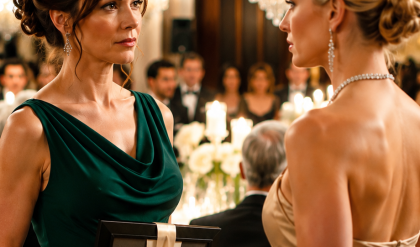
I held up the black velvet box.
“This is for Madison.”
The room rearranged itself without anyone moving. Collective attention shifted. Phones rose. A reporter from the lifestyle section of the Belle Haven Ledger — a woman named Diane who had profiled me twice and Blake three times and who I had always suspected found Blake more interesting — leaned infinitesimally forward.
Madison looked at the box with the expression of a woman who has been told a war is over and cannot quite stop bracing for artillery.
Then greed moved across her face.
She descended the stairs.
Blake said, “Maybe it’s a peace offering,” and people laughed, and Madison smiled, and for one moment the entire room believed they were watching a humiliation play out in its final act — the discarded wife bringing tribute to the woman who replaced her.
Madison took the box from my hands.
Her fingers brushed the silver ribbon.
The diamond collar caught the light.
She untied the ribbon. Lifted the lid.
Inside, on black velvet, lay a single house key on a silver tag.
Madison’s smile spread. Blake’s did too. The crowd leaned in.
Then Madison lifted the key and read the tag.
Her face changed.
It changed before Blake’s did, because she was closer, and because she was the one holding the evidence.
Blake saw her face change, and then he saw mine, and then he looked at the key, and I watched the understanding move through him — slowly, the way a tide comes in, and then all at once.
The five words on the tag.
Not yours to give away.
The front doors opened.
Grace Albright walked in with two deputies and a folder thick enough to mean something.
PART TWO:
Grace had been my attorney for four years before she became something else.
Not a friend — Grace Albright did not do friendships the way other people did. She did alliances, and she was faithful to them with a precision that could easily be mistaken for warmth if you were not paying close attention.
She had come to me eighteen months ago with a question.
We had been in her office, going over the standard documents Blake wanted me to sign — the kind of documents that men like Blake called simplifications and attorneys like Grace called transfers of liability. I had just finished reading a clause about the management rights to a subsidiary company called Vale Property Consulting when Grace had looked up from her own copy and asked, very quietly:
“Amelia. Has Blake ever mentioned someone named Madison Vale to you?”
The room had been very still.
“No,” I had said.
Grace nodded once. Set down her pen. Folded her hands.
“He hasn’t mentioned her in the context of business,” she said. “What about otherwise?”
The silence that followed was the kind where two women look at each other and both understand exactly what the question means.
“No,” I said again.
“All right.” Grace picked her pen back up. “Then let me ask you a different question. If I told you that Blake is making transfers — small, documented, entirely legal transfers — into a holding company that has a connection to the Vale family, how would you feel about the current structure of your assets?”
I looked at her steadily.
“I would feel,” I said, “like I had been very patient for a very long time.”
Grace almost smiled.
“Good,” she said. “Then let’s start from the beginning.”
What I knew about Madison Vale at the start: she was twenty-seven, she had a background in property development, and she had been introduced to Blake at a conference in Scottsdale eighteen months ago. She had excellent taste and an excellent instinct for identifying what belonged to other people and labeling it as underutilized.
What I learned in the months that followed: that Madison Vale was not precisely who she claimed to be, and that the introduction in Scottsdale had not been accidental, and that the relationship between Blake Whitmore and the Vale family was not new.
It was old.
It was older than my marriage.
That was the thing I did not know yet — the thing sitting in the east wall of the library, waiting for me like a letter that had already been opened and resealed.
But tonight, in the ballroom, I did not know any of that.
Tonight, I only knew what Grace had gathered over sixteen months: the financial transfers, the property filings, the shell company with Madison’s mother as a silent partner, and the piece of documentation that was the keystone of everything Grace had built — the title to Whitmore House, which Blake had assumed he had always controlled, because he had paid for it, and because men like Blake confuse paying for something with owning it.
The title had been structured as a joint asset on the advice of the attorney who handled our prenuptial agreement. That attorney was a woman named Harriet Soo who was seventy-two years old and profoundly methodical and who had sat across a table from a twenty-seven-year-old version of me and said: You are entering a marriage, not a dissolution. But we are going to document this as though we are already on the other side.
Blake had signed every document his attorney placed in front of him on the day of our wedding. He had not read them. He trusted his attorney to have read them. His attorney had trusted a paralegal. The paralegal had been thorough.
Whitmore House had two owners.
Only one of us had been changing the access codes.
“Blake Whitmore,” Grace said, from the center of my ballroom, in the voice she used in courtrooms, “I have here an emergency possession order signed this evening by Judge Cahill, confirming that Amelia Whitmore’s co-ownership rights to this property are inviolable pending the completion of divorce proceedings. I also have a report from Belle Haven Police Department documenting the theft of a diamond collar necklace from the private safe of Amelia Whitmore on or around the fourteenth of this month.”
She paused.
The room was the kind of silent that happens when people who have been watching a performance realize they are inside it.
Blake laughed.
It was the laugh of a man who had never in his life been publicly wrong and could not yet comprehend that this was what that felt like.
“Grace,” he said pleasantly, “I don’t know what she’s told you, but—”
“I also have,” Grace continued, without inflection, “a petition filed today in probate court under your signature, Mr. Whitmore, asserting that your wife lacks the mental capacity to manage her own financial interests.”
The room twitched.
“That is a standard protective—”
“Signed by Dr. Franklin Marsh.”
Blake’s smile stayed. His eyes changed.
“The issue,” Grace said, opening the folder, “is that Dr. Franklin Marsh passed away in December. He has been deceased for six months. I’m confident you can explain how he signed a legal document last Tuesday.”
A sound moved through the crowd. Not quite a gasp. Something between a gasp and a recalibration — the noise of people revising their understanding of what they were witnessing.
Madison turned to Blake.
Not with love.
With the expression of a woman who has just realized she has been handed a problem she did not consent to carry.
One of the deputies approached her.
“Ma’am, we’re going to need to ask you to remove the necklace.”
She unclasped it with shaking hands.
The sound the diamonds made dropping into the evidence bag was very small. But in the silence of that room it traveled.
Blake was still looking at Grace. He was trying to locate the angle. He was a man who always found the angle. But Grace was not a woman who left angles.
“You’re going to want to call your attorney,” Grace said. “Not this building’s attorney. A criminal attorney.”
Blake said nothing.
He walked down the remaining steps. He walked across the marble floor. He walked out the side entrance with his personal aide and a deputy at each elbow, and the suitcase that someone had apparently packed for him was already by the door.
I watched him go.
He did not look back.
That was the thing about Blake. He never looked back. He always assumed that whatever he was leaving would simply recede, the way a landscape recedes from a moving car. He did not understand that sometimes the landscape follows.
By eleven, the party was over.
The caterers packed up glasses and leftover canapés. The jazz quartet disassembled their stands. The reporter from the Ledger — Diane — asked me for a comment and I looked at her and said: “You can quote me as saying I hope people enjoyed the napkins.”
She wrote it down.
The last guests filtered out in small, quiet clusters, the way people leave after witnessing something they know they will be talking about for years but are not yet sure how to contextualize. Margo Ellison found me near the conservatory — the one with the neon sign that still read FREE AT LAST in pink light — and took my hand.
“I should have called you,” she said. “When I heard about the party, I should have—”
“You were here,” I said. “That’s enough.”
It was not entirely true. But it was the most generous thing I could offer, and tonight I was not interested in burning every bridge. Just the right ones.
Grace found me when the room was empty, the chandeliers still lit, the white roses beginning to wilt in their arrangements — flowers I had chosen, for a table I had owned, at a party designed to erase me from both.
She handed me a glass of water and then set a sealed envelope on the table beside me.
My father’s handwriting.
I have my father’s handwriting memorized the way you memorize the weather in a country where you once lived. He wrote in a dark, deliberate print — each letter separated slightly, as though he believed words needed room to breathe.
Amelia.
Open this when Blake mistakes performance for power.
I sat down.
Grace stood a short distance away, giving me the precise amount of space a good attorney gives her client at the exact moment the case becomes personal.
I broke the seal.
PART THREE: THE ARCHIVE
My father, James Holloway, had been dead for four years.
He had died in the way that men of his generation often die — suddenly, from something the body hides until it cannot, in a hospital room that smelled of industrial cleaner and too-sweet coffee, with my mother holding one hand and me holding the other and Blake in the hallway taking a call.
In the weeks after, people told me he had been a great man.
I had complicated feelings about this.
My father had been many things. He had been brilliant, and meticulous, and capable of a loyalty that went so deep it occasionally became indistinguishable from complicity. He had loved me in the specific, distanced way of a man who believes love is proved through provision rather than presence. He had taught me to read a contract before I was eight years old and had told me, when I was twenty-two and newly engaged, that Blake Whitmore was an excellent match, which I now understood was the language he used when he meant this benefits the arrangement I’m managing.
I had forgiven him for most of it.
The envelope suggested I should revisit whether I had forgiven him enough.
The key was old. Brass. The kind that belongs to something that predates combination locks and digital panels — a physical space, built for permanence, in a world that still believed in it.
The note in my father’s handwriting said: East wall, library. Third shelf, left bracket. There is a panel. This key opens it.
Under that: I am sorry. I thought I was protecting you. I am not sure now that protection and deception are as different as I believed.
I read it twice.
Then I stood up, and Grace followed me across the empty ballroom and down the corridor that led to the library — the room Blake had always called decorative, meaning he never used it, meaning it was one of the few rooms in Whitmore House that had remained entirely mine.
The third shelf. The left bracket. I felt along the seam of the built-in and pressed, and a panel the size of a small door swung inward with the particular smoothness of something that has been prepared and maintained.
Behind it was a steel panel. And the key opened it.
Inside was a gray archive box.
On the lid, in my father’s handwriting, one word.
VALE.
My hands were cold.
I set the box on the library table and opened it and stood in the light of the Tiffany lamp — another choice I had made, another thing I had brought into a house I was told was mine — and went through it page by page.
Checks. Old ones. Some going back fifteen years, the dates preceding my marriage.
Settlement documents.
Photographs. My father. A woman I did not recognize but whose eyes I would later identify, because I would see them in a face I already knew.
Support records. Monthly. Consistent. Running for nine years.
And a name, repeated across document after document, on letterhead and in notations and in the neat print of a father keeping records he never intended to be found too soon.
Madison Vale.
Daughter of Caroline Vale, née Morrison.
Formerly Caroline Morrison Holloway.
Formerly — for two years, before I was born, before my father met my mother, in a marriage that lasted twenty-four months and produced one child and ended in a dissolution so quiet that no one in my family had ever mentioned it — my father’s first wife.
Madison Vale was my father’s daughter.
She was my half-sister.
And Blake had known.
My phone buzzed on the table.
A text from Charlotte.
Charlotte Whitmore was twenty-three years old, Blake’s daughter from his first marriage, and the person in my life I had most completely believed in during the entire course of my time at Whitmore House. I had not given birth to her. I had fed her, driven her, held her when her mother died, argued with her about curfews, watched her graduate, and called her mine in every way that mattered.
The text said: I’m sorry.
I stared at it.
A second one arrived before I could find my breath.
I gave Madison the safe code.
The room did not spin. That is the thing about the very worst revelations — they do not spin the room. They slow it. Everything becomes extraordinarily detailed. I noticed the pattern on the library rug. I noticed the slight draft from the panel I had left open. I noticed that the Tiffany lamp cast a red shadow along the left side of my father’s handwriting.
Then I sat down, and I let myself feel what there was to feel, which was enormous and layered and not entirely one thing.
Charlotte had given Madison the code.
Charlotte, who had eaten dinner at my table three nights a week for nine years. Charlotte, who had called me Amelia and not Mom but who had said it with a softness that was its own word. Charlotte, who had cried at my father’s funeral with her head on my shoulder and whose grief I had held as though it were my own.
Charlotte, who had known Madison — how long? Since when?
And underneath that question: the worse one. Had Charlotte known what Madison was? Had she known about the archive box, the support records, the half-sibling my father had paid to disappear?
Had Blake told her?
Or had he kept her, too, as a piece in a game she could not see the whole board of?
Grace found me twenty minutes later, sitting in the library chair with the archive box open on the table and my phone face-down beside it.
She looked at the box. Then at me.
“How bad?” she asked.
“Complicated,” I said.
I showed her the photographs. The settlement records. The name.
Grace sat across from me and read for a long time. When she finished, she set the last document down and looked at the ceiling for a moment, the way she did when she was reorganizing her understanding of a situation.
“Madison knew,” Grace said finally. It was not a question.
“I think she’s known for a while,” I said.
“Did she tell Blake, or did he tell her?”
This was the question.
Because the answer defined what Blake had done. If Madison had come to Blake with this information — with the knowledge of who her father was, who I was, what the connection meant — then Blake was a man who had used a complicated piece of family wreckage for leverage and personal advantage. That was monstrous, but it was the kind of monstrous that had a shape.
If Blake had found it himself, had found Madison himself, had engineered the connection from the beginning—
That was a different shape entirely.
“I need to talk to Charlotte,” I said.
Grace nodded.
“Tonight?”
“Tomorrow.” I closed the archive box. “Tonight I need to figure out what I’m going to do with this.”
PART FOUR: THE CHOICE
Charlotte met me at nine the next morning at the café on Meridian Street that she had always liked better than anywhere Blake had ever taken her. Small place. Good light. The kind of establishment that does not perform itself.
She was already there when I arrived. She had ordered coffee she was not drinking. She looked like someone who had been awake all night, which she probably had, because Charlotte Whitmore was not someone who did careless things without knowing they were careless.
She looked up when I came in.
“I’m sorry,” she said immediately.
“I know,” I said. “Tell me everything.”
She told me.
It came out in the particular way that long-held secrets come out — not in a smooth narrative but in fragments that she had to keep reaching back to correct. Six months ago, she said. Madison had reached out. Said she knew who Charlotte was, said she knew Blake, said she needed help — just this one thing, just the safe, just once, she only wanted what should have been hers.
“She said my father was in love with her,” Charlotte said. “She said you were keeping them apart.”
I looked at her.
“Did you believe that?”
The answer took a long time to come.
“Part of me wanted to,” she said finally. “Because if that was true, then what I did made sense. And I needed it to make sense.” She wrapped her hands around her coffee mug. “I think I knew it wasn’t true. I think I knew Madison was telling me a version. But I wanted to be — useful. To someone. My dad has always made me feel like I’m a fact he has to manage. Like I exist in a category he’s already planned for. You were the only person who ever just—” she stopped.
“Just what?”
“Asked what I actually wanted.”
The café was warm. Outside, a Tuesday morning moved past the windows without us.
“I have to tell you something,” I said.
I told her about the archive box. About my father. About the name written on fifteen years of support records.
Charlotte went very still.
“Madison is my—”
“Half-sister,” I said. “Mine. By my father.”
Charlotte looked at me for a long time.
“Does she know?”
“She’s always known.”
“Does Blake—”
“I don’t know yet.” I reached across the table and rested my hand near hers — not on it. An offer. “But I need you to understand something. What you did was harmful. You gave someone access to my private property and my personal belongings, and the damage that caused has consequences I’m still working through.”
Charlotte’s jaw tightened. Her eyes went bright.
“I know.”
“And,” I said, “you are not the villain of this story. Madison handed you a narrative designed specifically to make you useful to her. Blake has spent your entire life making you feel like a piece of a plan rather than a person who matters. Both of those things are true and both of them explain the choice you made without excusing it.”
She exhaled. A shaking, careful sound.
“What do I do?”
“You make a statement to Grace. Everything you know about your contact with Madison. Everything she told you about the safe, about me, about your father. You do it on record.”
“That will hurt my dad.”
“Yes.”
She looked out the window. A woman walked past with a yellow dog and a coffee cup and the unhurried expression of someone who had nowhere urgent to be.
“He never actually sees me,” Charlotte said quietly. “My dad. He looks at me and he sees — a daughter-shaped thing that he did right once. An accomplishment. But not—” she pressed her lips together. “Not a person.”
“I know.”
“You always did,” she said. “That was the thing.”
She turned back to me.
“Okay,” she said. “I’ll give Grace the statement.”
PART FIVE: WHAT REMAINS
The divorce took seven months.
Not because it was contested — Blake’s attorney, once the full scope of the documentation became clear, strongly advised his client to settle. It was contested because Blake Whitmore did not know how to be someone who had lost, and he spent three months trying to locate a version of events in which he hadn’t.
He did not find it.
The diamond collar was returned to me. It sits in a drawer now. I look at it sometimes and I am aware that it is just an object — platinum and stone — and that the story I had attached to it (a woman no one could replace) was a story he was telling himself, not me. He replaced me quite easily. It was the house that was harder.
Whitmore House remained mine, per the terms of the original asset structure and the emergency order Grace had filed. I gave Blake six weeks to arrange alternative accommodations. He moved into the apartment on the east side of the city that he had apparently been maintaining for two years, which told me something I had already suspected about the timeline of Madison.
Madison and I did not speak for three months after the party.
When we finally did, it was at my request, in a meeting that Grace advised against and that I arranged anyway. We sat in the library of Whitmore House — my library, my Tiffany lamp, my choice — and we looked at each other across the table where I had opened my father’s archive box.
She was not what I had expected, in the aftermath.
She was frightened.
Not of me — or not only of me. But of the knowledge itself, of the way the knowledge had been used, of the way she had allowed herself to be positioned inside someone else’s plan while believing she was the one doing the positioning.
“He told me about your father,” she said. “About what was in the box. He found it three years ago, when your father was sick. He photographed everything before the funeral.”
I let that settle.
“He found out you were my father’s daughter,” I said.
“Yes.”
“And his strategy was to bring you into this house.”
“He called it—” she stopped. Started again. “He said I deserved what was mine. What your father had never given me because he’d chosen your mother instead. He said the house, the money, the name — it was all owed to me. That you were just holding it.”
She looked at the table.
“He said I was the real Holloway heir. He said that if he divorced you and married me, we’d have access to the Holloway trust through the family provision.”
I sat with that.
The Holloway trust. My grandfather’s money. The provision that extended to lineal descendants of James Holloway.
Including, as it turned out, daughters.
Including the one my father had paid to stay invisible.
“He was going to marry you,” I said, “for the inheritance he thought you could access.”
“Yes.”
“Did you know that was the reason?”
A long pause.
“I knew he wanted the money,” she said. “I thought I wanted him too. I told myself those two things weren’t — incompatible.” She looked up. “I don’t think that anymore.”
I looked at my half-sister.
She had my father’s jaw. I had not noticed it the night of the party. Now I could not un-see it. The particular set of the chin, the way the lower lip pulled slightly when she was trying not to show what she was feeling.
I had that too.
“What do you want?” I asked her. “Not what Blake told you to want. Not what my father owed you or didn’t. What do you actually want?”
She was quiet for a long time.
“To not be a piece in someone else’s plan,” she said.
I understood that so completely it almost hurt.
“There’s a family law matter to sort out,” I said. “About the Holloway trust. Whether you have a claim, legally, and what that means.”
“I don’t want to fight you for it.”
“I’m not asking you to.” I rested my hands flat on the table. “My father made choices I cannot undo and I have spent my adult life in relationships defined by men who thought I was a thing to be managed rather than a person to be known. I am done letting other people’s choices become my prison.” I paused. “My father owed you acknowledgment. He owed your mother something I can’t fully calculate. What he left behind is something we can figure out without adding it to the pile of damage.”
She looked at me steadily.
“Why would you do that?”
“Because I’m tired of inheriting wars,” I said. “And because—” I stopped. Decided to say the true thing, even though it was strange and new and had no precedent in the family I thought I had. “Because you’re mine too. In whatever sideways, complicated way. You’re family.”
Madison Vale — my father’s daughter, Blake’s discarded strategy, the woman who had stood in my ballroom wearing my diamonds with the confidence of someone who believed the story she’d been given — pressed her hand to her mouth and looked away.
For a moment I saw her very clearly: not as threat or rival or complication but as someone who had been handed a version of herself that wasn’t true, and had worn it because no one had offered her anything else.
“Okay,” she said finally, her voice unsteady.
“Okay,” I said.
Charlotte came for dinner on the first Friday of the month after the divorce was finalized.
She brought wine and a plant — a small potted olive tree, which she set on the kitchen table and said was a housewarming gift, which made us both laugh because I had lived in this house for nine years.
Rosa came on Tuesday mornings still. She brought me cuttings from the garden and called me señora with the same warmth and brought her daughter sometimes, a seven-year-old named Lucia who ran through the hallways with a ferocity that made the house sound like something different than it had been.
Grace filed the final paperwork in October.
On the day the divorce was complete, she sent me a single text.
It’s done. The house is yours. So is everything else.
I was standing in the library when I read it. At the table. Under the Tiffany lamp. The panel in the east wall was closed and locked and I had not opened it since the night I found my father’s box. I had not thrown it away, either. Some things you carry even after they stop being wounds — you carry them because they are part of the map of how you got here.
I looked around the library.
Mine. In whatever way things are truly mine — not because I paid for it, not because someone gave it to me, not because a document said so, but because I had chosen it, over and over, in every small act of staying and improving and refusing to let someone else’s story about what this house was become the story I believed.
I put the phone in my pocket and went to put the kettle on.
On the last Saturday of October, I hosted a dinner.
Not a party. A dinner. Eight people around the library table, with the Tiffany lamp and good wine and food I had cooked myself. Charlotte was there. Grace was there. Margo Ellison came, because she had called me twice to apologize properly and I had decided to accept it, because life is too long to maintain every grudge and too short to pretend cruelty didn’t happen. Rosa came with her daughter Lucia, who fell asleep on the library sofa at eight-thirty and had to be carried to a guest room.
Madison did not come. She was not ready for that, and I was not ready for it either. We were somewhere in the early stages of a thing that did not have a name yet — tentative, careful, occasionally strange. She had sent flowers.
I put them in the conservatory.
Not under the neon sign, which I had taken down and replaced with a fern. Just in the conservatory, in afternoon light, in a blue vase I had bought with my own money before I had ever heard the name Blake Whitmore.
After dinner, after Charlotte had gone home and Grace had gone home and Margo had gone home and Rosa had loaded Lucia into the car and driven away, I stood at the kitchen window with a glass of wine and looked at the dark garden.
The house was quiet.
Not empty. There is a difference — and I had spent twelve years forgetting it, confusing the noise and the lights and the guests and the events for fullness, and mistaking solitude for lack.
Quiet is what it sounds like when the right people have left for the night and you are in a space that is actually yours.
I finished the wine.
I washed the glass myself.
I turned off the kitchen light.
And I walked through my house — my house, mine, not because of any document or any ring or any man’s willingness to allow it, but because I had been the one who made it worth living in — and I went to bed.
Outside, on the drive, a car passed and its headlights moved across the ceiling in a long, slow arc.
I watched it go.
Then it was gone, and the dark was ordinary again, and I closed my eyes.
Some doors only open for the wife he tried to erase.
She had been right about that.
He just hadn’t understood that she was the one holding the key.
END