He Invited His Ex barren Wife to Humiliate Her at His Wedding—But She came With Three Heirs.
He called her barren and sent her into the night with one trunk.
Years later, she walked into his wedding with three sons holding her hands.
By the time the orchestra stopped playing, every lie he had built his pride upon had begun to fall.
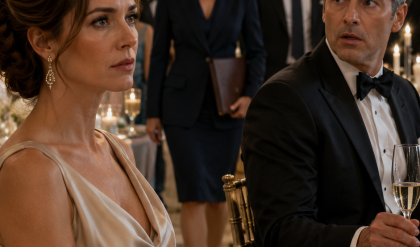
The grand hall fell into a silence so sharp it felt as if the air itself had forgotten how to move.
Every head turned toward the entrance at once. Silk sleeves brushed against velvet chairs. A fan stopped mid-flutter. Somewhere near the front, a crystal glass trembled in an elderly duchess’s hand, the champagne inside rippling as if even the drink understood that something irreversible had entered the room.
The doors had opened.
And standing beneath the carved archway, calm, luminous, and utterly still, was the one woman no one had expected to see.
Lady Seraphina Rowan.
Not broken.
Not ashamed.
Not alone.
Three young boys stood beside her, each holding one of her hands or the soft fold of her pale blue gown. They were dressed neatly in dark little coats, their hair brushed, their faces solemn with the effort of behaving in a room full of strangers. The eldest, perhaps five, had his chin lifted in stubborn courage. The middle boy stared openly at the chandeliers. The youngest leaned closer into Seraphina’s side, one small hand clutching the lace at her sleeve.
A whisper moved through the hall like flame crossing dry grass.
“Those are her children.”
At the altar, Lord Alistair Pembroke stepped backward as if the polished marble beneath his boots had shifted. His face, arranged moments earlier into the composed satisfaction of a man about to secure his second marriage before half of England’s most important families, went colorless.
His bride, Lady Verity Ashborne, turned slowly from him to the entrance. Her smile faded first. Then her eyes sharpened.
The orchestra faltered. One violin drifted out of tune before falling silent. Even the chandeliers overhead seemed to dim under the weight of recognition spreading from guest to guest, from row to row, from one carefully trained face to another.
Because the woman Alistair had once cast out as barren had returned with three living answers beside her.
And in that instant, everything he had built on pride began to collapse.
Years earlier, Pembroke Hall had stood against the gray English sky like an announcement that some families were not merely wealthy, but permanent. Its stone walls rose from acres of wet green land, its chimneys smoking in winter, its tall windows reflecting gardens clipped into obedience. Inside, polished floors carried the sound of servants’ footsteps so softly they seemed to belong to the house rather than the people who made it run. Portraits of Pembroke men stared down from every corridor with the same long noses, same narrow eyes, same inherited certainty that the world had been arranged for their convenience.
Alistair moved through those halls as if he owned not only the estate, but the air within it.
He had been raised for that belief.
His father had taught him that emotion was disorder. His mother had taught him that reputation was the final religion. His tutors had taught him history, estate law, Latin, and the correct way to lose money quietly without ever appearing diminished. By the time he inherited the title, he had become a man admired in every drawing room and known intimately by no one.
Seraphina had loved him before she understood that admiration and love were not the same thing.
She married him at twenty-three, wearing ivory satin, orange blossoms, and the kind of hope young women carry when they have been told patience can soften any man. She had not been born into the same old power as the Pembrokes, though her family was respectable, educated, and warmly regarded. Her father had been a physician with gentle hands and tired eyes. Her mother had taught music. Seraphina came into marriage with grace, intelligence, and the quiet instinct to make a room warmer than she found it.
For a while, even Alistair seemed grateful for that warmth.
In the early years, he would linger in the morning room while she arranged flowers, asking what she thought of the color. He would stand behind her at the pianoforte and rest one hand on the back of her chair. Once, after a dinner where an older lord mocked his plans to modernize estate management, Seraphina found Alistair alone in the library, rigid with humiliation. She had crossed the room and taken his hand without speaking.
He had looked at her then with something almost vulnerable.
“You believe in me?” he asked.
“Yes,” she said. “But more than that, I see you.”
He kissed her fingers.
That man vanished slowly.
At first, society adored them. The handsome young lord and his gentle wife. The promising pair. The future of Pembroke. But as the years passed and no child came, admiration changed texture. It became curiosity, then pity, then something more poisonous.
At dinner parties, the question arrived disguised as concern.
“No nursery sounds yet, Pembroke?”
“Seven years is quite a stretch.”
“Perhaps Lady Seraphina is too delicate.”
Women said less, but looked more. A glance at her waist. A softened voice. A pause when someone mentioned christenings. Seraphina learned that being pitied by women trained not to pity openly was worse than being insulted by men.
She prayed. She waited. She brewed teas suggested by old aunts. She swallowed tonics from physicians who spoke to Alistair more than to her. She marked calendars. She folded tiny linen shirts she had embroidered before anyone told her to stop preparing for a child that would not come.
Alistair did not attend examinations.
“There is no need,” he said whenever she suggested they both consult a specialist. “The Pembroke line has never lacked sons.”
The implication settled between them before he said it directly.
The fault was hers.
It entered the marriage like damp entering stone.
Gradually, Alistair’s hand stopped finding hers beneath dinner tables. His chair at breakfast remained empty more often. When he returned late from London, he smelled of cold air, cigar smoke, and places where men congratulated one another for cruelty disguised as practical sense. He spoke less to Seraphina and more about her. She became a problem to be managed. A gentle disappointment. A beautiful room in a house without an heir.
Still, she stayed.
Not because she was foolish.
Because loyalty, once built into the bones, does not leave easily.
The night he ended their marriage, rain tapped against the bedchamber windows with the dull persistence of fingers on glass. The room was lit by candles, their flames throwing shadows over the carved wardrobe, the silver brush set on her dressing table, the embroidery hoop she had left unfinished beside the chair.
Seraphina sat at the edge of the bed with her hands folded in her lap.
Alistair entered without greeting.
“Seven years,” he said.
She looked up.
“Yes.”
“Seven years, and still nothing.”
His voice was not loud. That made it worse. Anger can be argued with. Certainty leaves no door.
“We have tried,” Seraphina said carefully. “Perhaps we should consult another physician. Together.”
“There is no need.”
“Alistair—”
“I know where the problem lies.”
She absorbed the words without moving.
“We cannot know that without certainty.”
His expression hardened. “I will not subject myself to humiliation because you cannot accept what is obvious.”
The candlelight wavered.
Seraphina rose slowly. “Do not speak of me as though I am nothing more than this.”
He looked at her then, truly looked, but not with tenderness. With assessment.
“What else remains?”
The question did not seek an answer.
It ended something.
He crossed to the desk, pulled out paper, and began writing with calm, beautiful penmanship.
“You are writing now?” she asked, barely above a whisper.
“To my solicitor.”
Her breath caught.
“There is no reason to delay what is already clear,” he said. “This marriage is finished.”
No shouting followed. No broken glass. No dramatic collapse.
Just the scratch of his pen.
There are cruelties too orderly to look like violence.
By morning, arrangements had been made. She would leave Pembroke Hall quietly. She would receive a modest settlement. The official wording would be incompatibility. Society would understand the rest without being told. A woman without children had failed in the one duty old families considered sacred.
Seraphina packed in silence.
Each gown folded into the trunk carried a memory: dinners where she smiled through humiliation, mornings when she still believed his coldness was temporary, the pale green dress she wore the day she thought she might be expecting, only to bleed before dawn and hide the sheets herself because she could not bear the household knowing before she had stopped hoping.
Her hands trembled only once.
Then they steadied.
At the front entrance, no one stopped her. A footman looked away. The housekeeper cried silently but did not dare embrace her. Portraits watched from the walls as the former mistress of Pembroke Hall passed beneath them carrying one small case and what dignity she could save.
Outside, the night air cut through her cloak.
She did not look back.
The carriage that brought Seraphina to London did not announce her arrival with grandeur. It stopped on a narrow street where brick houses leaned close together, softened by ivy, soot, and the warmth of ordinary lives. There were no gates. No servants arranged in formation. Only the faint smell of bread from a nearby bakery, the clatter of carriage wheels, and the distant laughter of children running somewhere out of sight.
Miss Elowen Hartwell opened the door before Seraphina could knock a second time.
Elowen had been her closest friend since childhood, though marriage had pulled them into different worlds. She was unmarried by choice, practical, sharp-eyed, and possessed of a moral steadiness that intimidated people who confused kindness with weakness. She wrote letters in dark ink, wore simple gowns, and had a talent for making soup that healed more than hunger.
At first, surprise crossed her face.
Then concern.
Then recognition.
“Seraphina,” she said softly.
That was all.
The strength Seraphina had carried through the journey loosened. Not into collapse. Into surrender.
Elowen took her case from her hand and pulled her inside.
The house was modest, but it held what Pembroke Hall had not: warmth without performance. A fire burned in the hearth. A small table near the window was set with bread, tea, and strawberry preserves. Curtains were drawn for comfort, not display. The floor creaked. The kitchen smelled faintly of cinnamon. Nothing in the room existed to impress anyone.
For the first time in years, Seraphina sat without arranging her face for observation.
She did not cry immediately.
Grief, when too deep, sometimes cannot find the door.
For days, she spoke little. She ate when Elowen pressed food into her hands. She slept in a small upstairs room beneath a sloped ceiling, waking before dawn from dreams of long corridors and Alistair’s voice saying, What else remains? London felt too large and too close at once. Whispers seemed capable of slipping under doors. Every bell, every carriage, every woman’s laugh from the street made her imagine the word moving through society like smoke.
Barren.
One afternoon, Elowen found her sitting by the fire, untouched tea beside her.
“You have accepted something no one proved,” Elowen said.
Seraphina did not look up.
“There is nothing to prove.”
“There is everything to prove.”
“He knows.”
“No,” Elowen replied, sitting across from her. “He concluded. That is not the same as knowing.”
The next morning, Seraphina sat in a physician’s consulting room that smelled of antiseptic, old paper, and coal smoke from the grate. Shelves of medical texts lined the wall. The physician, Dr. Merritt, was older, careful, and spoke to her directly instead of above her head.
The examination was thorough.
Humiliating in the quiet way women were often expected to endure without complaint.
Through every question, every waiting pause, one thought repeated inside her.
What if Alistair was right?
When Dr. Merritt returned with the results, he folded his hands on the desk.
“Lady Seraphina,” he said gently, “you are in good health. There is no evidence of deficiency. If there has been difficulty conceiving, it would be wise to examine the other party.”
The room went still.
For a second, Seraphina could not understand him because the truth he offered had no place to land. She had carried the blame for so long that setting it down felt almost like losing a part of her body.
Then tears filled her eyes.
Not restrained.
Not hidden.
They came with force, hot and endless, carrying seven years of prayer, shame, quiet accusations, and nights spent apologizing to God for a failure that had never been hers.
Elowen took her hand.
Not to steady her.
To witness the return of truth.
“You did not fail,” Elowen said.
Seraphina covered her mouth and wept harder.
After that, life did not become easy.
But it became possible.
Elowen baked for neighboring households — bread, buns, small cakes flavored with lemon and spice — and Seraphina began helping at first because work was better than sitting with thoughts that had sharp edges. There was comfort in flour. In kneading dough until her wrists ached. In watching something rise because warmth and patience had been applied at the right time. In making food that asked nothing of her except attention.
Customers came.
Then returned.
The little front room filled with the smell of butter, sugar, and yeast. Women stopped by for loaves and stayed for conversation. A solicitor’s clerk came every Friday for currant buns. A widow from two streets over ordered seed cake for her grandchildren. People began to know Seraphina not as the discarded Pembroke wife, but as the woman whose hands made beautiful things.
Her name changed in their mouths.
Not pity.
Respect.
It was during a gray afternoon, while she arranged warm loaves near the window, that Thaddeus Rowan first stepped inside.
He was not handsome in the fashionable, careless way Alistair had been. Thaddeus was quieter than that. Tall, composed, with dark hair touched by early silver at the temples and eyes that seemed trained by loss to observe gently. His coat was well made but not showy. His gloves were practical. When he removed his hat, he did so with real courtesy rather than performance.
“You have built something of care here,” he said.
The remark startled her because it did not flatter. It noticed.
“It is only a bakery table,” Seraphina replied.
“No,” he said, looking at the shelves, the careful labels, the clean cloth, the warm window, the customers who lingered because they felt welcome. “It is a beginning.”
He bought a loaf of bread and a packet of sugared buns.
Then he returned the next day.
And the day after.
He never pressed. Never asked for the story society had already mangled. He spoke of ordinary things: books, weather, street repairs, trade routes, a nephew who hated Latin, the ridiculous stubbornness of a horse he owned and loved. His presence did not demand that she explain her wounds before being treated kindly.
Trust returned to Seraphina slowly.
Not in declarations.
In moments.
The way Thaddeus waited when she paused, instead of filling silence to soothe himself. The way he never complimented her beauty when her mind had done the work. The way he moved aside if the room grew crowded, placing himself near enough for safety but never close enough to claim.
One evening, walking home through a narrow London street after delivering an order, Seraphina stumbled on uneven stone. Thaddeus offered his arm.
She hesitated.
Then took it.
Neither of them spoke for several steps.
“You do not have to carry everything alone,” he said.
She looked ahead at the lamps appearing one by one through the dusk.
“I am learning that.”
He nodded.
No triumph.
No rescue.
Only understanding.
When he asked for her hand, months later, it was in Elowen’s sitting room with rain ticking against the windows and a half-finished tray of almond biscuits cooling on the table.
“I would like to build a life with you,” he said.
Seraphina studied him carefully.
“And you understand what I have been through?”
“I understand enough to know it does not measure you,” he said. “And enough to spend my life making sure I never add to it.”
That was enough.
Their wedding was small. A quiet chapel. Elowen crying openly. Bread and soup after. No orchestra. No long list of guests measuring lineage. No display meant to repair reputation. Just vows spoken with care and a ring placed on her finger by a man whose hands did not shake because he was certain.
Life after marriage did not erase the past.
It made a new room beside it.
The bakery expanded into a proper shop. Thaddeus helped with accounts without taking them over. He carried flour sacks when needed, listened to her ideas, and never once introduced the business as his. Customers called it Lady Rowan’s bakery before she finally surrendered and painted the name on the window.
Rowan House Bakes.
There was dignity in it.
Peace.
Then came the morning when the smell of warm pastry made her turn away suddenly, one hand at her mouth.
At first, she dismissed it as fatigue. The shop had been busy. Orders had increased. London dampness made the body slow. But when the nausea returned, and then the heaviness, and then the strange tenderness that made her hand rest over her abdomen before she knew why, something old and frightened woke inside her.
Thaddeus noticed.
“You should see Dr. Merritt,” he said gently.
She went with a calm face and a heart full of echoes.
This time, the consulting room felt different. The shelves were the same. The smell of paper and antiseptic. The ordered desk. The soft scratch of the physician’s pen. But Seraphina was not the same woman who had come there once carrying another man’s accusation in her bones.
Still, fear sat beside her.
When Dr. Merritt returned, his expression had softened.
“Mrs. Rowan,” he said, “you are with child.”
The words entered the room like light breaking through storm cloud.
Seraphina did not speak.
Her hand rose to her chest.
Thaddeus reached for her other hand, warm and steady.
“I was never what they said I was,” she whispered.
“No,” he said. “You were never what they said.”
Dr. Merritt cleared his throat gently.
“There is more.”
Seraphina looked up.
“More?”
“You are expecting three children.”
The room shifted again, but this time not with grief.
With wonder.
Three.
Not proof, exactly. Children should not have to exist as evidence in anyone’s trial. But the truth carried meaning all the same. Not because motherhood restored her value — she had fought hard to know she was whole before it — but because every cruel certainty spoken over her had been answered by life itself.
The pregnancy was difficult.
Triplets are not gentle guests.
Her body ached. Her breath shortened. Her ankles swelled. Some nights she woke afraid the blessing might vanish because blessings had once felt unsafe to trust. Thaddeus sat with her through it all, reading aloud when she could not sleep, helping her stand, rubbing her back without being asked, pressing cool cloths to her forehead, never once turning her vulnerability into power over her.
The birth came on a wet spring morning.
Rain softened the windows. Elowen paced until a maid threatened to make her sit. Dr. Merritt came and went with grave focus. Hours blurred into pain, sweat, whispered prayers, and the animal courage of the body doing what fear had once told her it never could.
Then came a cry.
Then another.
Then another.
Three sons.
Thomas, Edmund, and Felix Rowan.
Tiny. Fierce. Alive.
Seraphina held them against her, exhausted beyond language. Thaddeus stood beside the bed, his composure broken by tears he made no attempt to hide.
“They are here,” he whispered.
Seraphina looked down at their small faces and felt no desire to send word to Pembroke Hall.
The truth did not need to be delivered to a man who had thrown it away.
It would reach him when it was ready.
For years, Seraphina built a life so full that the past no longer sat at the head of the table.
The boys grew in a home that smelled of bread, ink, soap, and garden soil. Thomas was serious and observant, forever arranging toy soldiers into careful formations. Edmund laughed easily and climbed everything. Felix, the smallest at birth, became the loudest, trailing after his brothers with fearless devotion. Thaddeus loved them with practical tenderness: scraped knees washed, bedtime stories read, boots tied, questions answered honestly even when the answers were inconvenient.
Seraphina returned to the bakery gradually. She taught apprentices. Opened a second shop. Funded a small clinic for women who could not afford medical consultations and were tired of being told their suffering was imaginary. She never named it after herself. Elowen insisted on placing a discreet plaque near the entrance anyway.
For women who deserve certainty.
Meanwhile, Alistair Pembroke continued through the motions of grandeur.
The estate remained magnificent. The windows still caught the gray sky. The servants still bowed. His name still opened doors.
But something essential had hollowed.
He married no one. Then courted briefly. Then withdrew. Attempts to secure an heir through suitable matches dissolved politely. Whispers returned, altered now.
No heir yet, Pembroke?
Curious.
Perhaps the issue was never…
People did not finish the sentence in front of him.
They did not need to.
Eventually, he announced his engagement to Lady Verity Ashborne, a woman of sharp intelligence, excellent breeding, and a fortune large enough to make even Pembroke advisers pleased. The wedding was arranged as a public correction. It would prove he had moved forward. It would prove his first marriage had been the unfortunate failure of the wrong woman.
Among the invitations, one name was written with deliberate care.
Lady Seraphina Rowan.
When the invitation arrived at Rowan House, Seraphina found it beside the morning post while Felix was trying to feed toast to the cat.
Thaddeus read her face.
“You need not go.”
“I know.”
“Do you want to?”
Seraphina watched her sons arguing over jam.
“No,” she said. “But I think I should.”
The day of the wedding, she dressed without anger.
A pale blue gown. Simple pearls. Her hair pinned low. The boys dressed in dark coats, scrubbed and shining and unusually solemn after being told they were attending an important event where there would be cake if they behaved.
Thaddeus stood in the doorway watching her.
“I can come with you,” he said.
She smiled.
“I know. But this is not a battle.”
“What is it, then?”
She looked at her sons.
“An answer.”
And so she entered the grand hall at the precise moment Alistair Pembroke was waiting to be seen as triumphant.
Instead, he saw the life he had discarded.
Seraphina walked forward with measured steps, her sons beside her. She did not hurry. Did not look left or right for approval. Society parted before her not because anyone instructed it to, but because truth has its own authority when it enters a room unafraid.
Lady Verity looked from the children to Alistair.
“Who is she?” she asked, though realization was already dawning.
“My former wife,” he said.
“And those children?”
He swallowed.
No answer came.
Verity’s face changed. Not into embarrassment. Into clarity.
“You told me she was incapable of bearing children.”
“I believed—”
“You believed what suited your pride.”
The sentence crossed the hall without effort.
Seraphina had reached her place among the guests. She did not sit.
Verity turned toward her.
“Madam,” she said formally, “are these your children?”
Seraphina met her gaze.
“Yes.”
“No further explanation is needed,” Verity said.
Then she turned back to Alistair.
“You built this union on an unproven cruelty and expected me to stand upon it.”
“This is not the time.”
“There is no better time.”
Verity removed her gloves slowly.
“I will not proceed.”
The wedding dissolved without shouting.
That made it worse.
Guests did not gasp dramatically or rush toward exits. They watched with the controlled hunger of people witnessing reputation collapse inside its own architecture. Alistair stood at the altar in formal dress, surrounded by flowers, music, silver, and silence, and for once none of it obeyed him.
Seraphina did not stay to savor it.
She had not come for revenge.
She took her sons’ hands and walked back toward the doors. At the threshold, Thomas looked up.
“Mother, was that the man?”
She paused.
“Yes.”
“The one who was unkind?”
“Yes.”
Felix frowned. “He looked sad.”
Seraphina touched his hair.
“Sometimes people meet the truth later than they should.”
They went home.
Consequences unfolded quietly, as they often do in old society. Verity’s family withdrew. Invitations to Pembroke Hall slowed. Conversations changed tone. Men who once slapped Alistair’s shoulder with admiration now spoke with careful distance. Women who had pitied Seraphina years earlier sent notes, some sincere, some ashamed, some merely curious. She answered very few.
Alistair finally consulted a physician.
The appointment was clinical. Brief. Merciless in its neutrality.
The difficulty had almost certainly been his.
He sat alone afterward in his carriage, staring at his gloved hands, and understood that he had not merely lost a wife. He had built years of cruelty on a false conclusion because the alternative had wounded his pride.
Two weeks later, he came to Rowan House.
Seraphina received him in the sitting room while the boys played in the garden and Thaddeus remained nearby without intruding. The room smelled of lemon cake and rain. It was smaller than any formal room at Pembroke Hall, but warmer than all of them combined.
Alistair looked around and saw peace.
It hurt him more than anger would have.
“I was wrong,” he said.
The words sounded unused.
Seraphina sat across from him, hands folded loosely in her lap.
“Yes.”
“I believed what I chose to believe. I let society speak through me. I let pride make a coward of me.”
She did not rescue him from the sentence.
He continued.
“I do not ask you to return.”
“You cannot.”
“I know.”
Silence sat between them, not hostile, but complete.
“I have no right to forgiveness,” he said.
“No,” Seraphina replied gently. “You do not.”
His face tightened.
Then she added, “But I forgive you.”
He looked up.
The words did not restore anything. They did not rebuild the marriage, erase the night, return her years, or make him noble. They simply released the chain she no longer wished to carry.
“When I left Pembroke Hall,” she said, “I thought you had taken my future. But you only removed me from a life that would have buried me. I found myself afterward. I found my work. My husband. My children. I will not hate you forever for a door that led me to them.”
Alistair bowed his head.
For the first time, he looked less like a lord and more like a man.
When he left, he carried nothing but the truth.
Seraphina returned to the garden.
Her sons were chasing each other beneath a gray sky brightening after rain. Thaddeus stood near the gate, watching them with quiet joy. Elowen had arrived with a basket of buns and was pretending not to cry after hearing Alistair had come and gone without damage.
Thomas ran to Seraphina first, then Edmund, then Felix, each crashing into her skirts with the total faith of children who have never had to question whether love will make room for them.
She held them close.
Thaddeus came to stand beside her.
“Are you all right?”
Seraphina looked toward the street where Alistair’s carriage had disappeared.
Then she looked back at her life.
The bakery. The clinic. The garden. The boys. Elowen at the door. Thaddeus beside her. The smell of bread from the kitchen and rain lifting from the earth.
“Yes,” she said.
And she meant it.
Pembroke Hall still stood in the distance, grand and cold beneath its gray sky. Its windows reflected power, lineage, and all the empty rooms pride had preserved. But Rowan House held laughter, flour on aprons, children’s boots by the door, a husband who listened, and a woman who had learned that worth did not require anyone’s permission.
Years ago, Seraphina had walked into darkness carrying one small case and a truth she had not yet discovered.
Now she stood in the light with three sons calling her name.
The world had once reduced her to a single word.
Barren.
Life had answered with three.
But the greater answer was not motherhood.
It was not the stunned faces in the hall or the abandoned wedding at the altar.
It was this: she had been whole before anyone believed her, whole before the doctor spoke, whole before Thaddeus loved her, whole before her children were born.
The truth did not make her worthy.
It only revealed the worth that had been there all along.