PART 2:
I was twenty-six, desperate, and in love with a married man who offered me forty-two thousand dollars to carry his wife’s embryo as a surrogate. He said she had agreed. He said it was all legal. He said everything with the calm certainty of a man who had rehearsed every lie until it sounded like truth. I believed him — until I found his iPad unlocked and read one word that changed everything. Buyers.*
—
### Chapter Five: The Weight of Wrong Choices
I need to tell you what I did before I tell you what I did right.
I did not go to Madison immediately.
I sat with my knowledge for three days and thought about what it would cost me.
The forty-two thousand dollars was spent. My father was recovering. My sister was back in classes.
If I went to Madison, Ryan would deny everything. I had no legal standing. I had signed documents that were forged — but from the outside, from my signature, they looked voluntary. A lawyer could argue I had participated knowingly. Ryan would turn me into the villain, and the resources to fight him were his, not mine.
I was also afraid.
The message from M had not read like a man who handled setbacks philosophically.
*We handle it differently.*
I called Ryan.
I told him I had seen the messages.
He was very calm.
That was the scariest part.
Men who panic are predictable. Men who go calm when cornered are doing math you can’t see.
He told me the messages were misread. He told me M was a private adoption attorney. He told me the *”buyers”* were a vetted couple who had been through proper channels. He told me Madison had agreed to open adoption and then changed her mind, and now the situation was *”complicated.”*
I said: *”Ryan, I carried this baby. I know what complicated means.”*
He said: *”Chelsea, you need to trust me.”*
I had trusted him for fourteen months. I had trusted him enough to let a doctor implant an embryo into my body on his word.
*”Tell Madison,”* I said. *”Call her right now and tell her.”*
Silence.
Then: *”It’s not the right time.”*
*”When is the right time? When the buyers take her?”*
*”Nobody is taking anyone.”*
*”Then tell your wife!”*
He hung up.
The next morning, I had a voicemail from a number I did not recognize. A man’s voice, very smooth, very measured, explaining that *”the arrangement”* would proceed as planned and that *”continued cooperation”* was in everyone’s best interest.
I played it twice.
Then I did not sleep for two days.
I thought about what would happen if I did nothing.
Ryan would find a story to tell Madison. He would present Lily as a gift or a surprise or the beginning of a fresh chapter. Or he would not tell her at all. He would sell Lily to strangers in Ohio and come home that evening and eat dinner and complain about traffic and no one would know.
No one except me.
I thought about Lily’s face.
The crease above her nose. One fist raised at the world. Dark eyes that searched for light without knowing that was what they were doing.
She was six weeks old and already the subject of business negotiations she had no voice in.
And I was the only person in the world who knew what was being done to her who had the ability — barely, and with significant personal risk — to stop it.
On the third day, I made a decision.
It was not a brave decision, not exactly. Bravery implies you are not afraid. I was terrified.
It was a decision made in the particular clarity that arrives when you have exhausted every other option and the only path left is the right one.
I would take Lily to Madison.
Not through channels. Not through Ryan. Not through attorneys or phone calls that could be denied or intercepted.
I would put Lily in my arms and walk up to the door and knock.
I had Ryan’s address because I had driven past the house in Lincoln Park once, in a way I am not proud of, in the early months of the affair, with the particular stupidity of a woman who wanted to see the shape of the life she was adjacent to.
I packed a diaper bag.
I packed the folder — all of it. Every document Ryan had given me. Every ultrasound photo. Every consent form with Madison’s forged name at the top.
I put on a baseball cap. My good cardigan.
No lipstick, because lipstick felt obscene for this.
I sent Ryan a text from a new SIM card: *I’m going to Madison. If you want to stop me, call the police. At least then she’ll find out from them.*
Then I stopped reading messages.
And I drove to Lincoln Park.
—
### Chapter Six: The Porch
I almost turned around three times.
Once when I merged onto Lake Shore Drive and the city opened up ahead of me, enormous and indifferent, and I thought: *who am I in this city? What right do I have to walk into this woman’s life with any more damage?*
Once in the parking structure three blocks from the house, where I sat with Lily in her car seat and rehearsed every possible opening sentence and discarded all of them.
Once on the sidewalk outside the house itself, which was beautiful and Lincoln Park and looked like a life that had been very carefully built and was currently, without its owner fully knowing, on fire.
I stood there for four minutes.
Then I walked up the steps.
The bruise on my cheek was from a door — I had walked into it at two in the morning while carrying Lily, not sleeping, not seeing straight. But standing on that porch in a baseball cap, holding a six-week-old, I imagine I looked like a woman running from something.
I was.
I rang the bell.
I could see the Ring camera above the door. I looked directly into it.
Then I held Lily a little higher, so whoever was watching could see her clearly.
The door opened.
Madison stood behind the chain lock.
She looked — I will not pretend I can describe this without some cost to her privacy — she looked like someone who had been holding herself together by force of will for a very long time. Perfect posture. Controlled face. Red lipstick at five in the afternoon.
Behind the eyes, something that recognized immediately that I was not here on ordinary business.
*”What the hell are you doing here?”* she said.
Her voice did not shake.
I was shaking enough for both of us.
*”Please,”* I said. *”I know you hate me. You should. But I need to come in.”*
She looked at Lily.
And something happened in Madison Kline’s face that I do not have the right to fully describe, because it did not belong to me. It was hers — a recognition so private and so violent it looked like a physical wound opening.
She knew.
Not the details. Not the whole story.
But some part of her already knew.
She unchained the door.
—
### Chapter Seven: Inside the House
She did not make me tea.
That was fair.
I locked the door behind me the way Ryan had always locked doors. Twice. The reflex of a man who lived in fear of consequence catching up with him.
She noticed. She noticed everything.
I said: *”He told me to do that.”*
She looked at me with an expression I had no name for.
I told her.
Not everything at once. In pieces, because some truths are too large to arrive all at once without breaking the container they land in.
I told her about the affair first.
She did not flinch. She already knew.
I told her about the proposal. The dinner. The wine. The number on the napkin.
Her face went very still.
I told her about the documents. Her name on the forms. The fertility clinic. Dr. Voss. The private facility. The nine months I had spent carrying a child while she lived two miles away, grieving a family that was secretly already being built in my body without her knowledge.
I said: *”He told me you had agreed. He said you couldn’t emotionally handle the updates. He said you asked not to know the carrier’s identity.”*
Madison looked at me.
Then she said, very quietly: *”I had a drawer full of baby socks for three years.”*
I closed my eyes.
I thought of Ryan at that dinner, telling me Madison had *”abandoned the dream of family.”* I thought of how easily I had accepted it. How convenient that version was. How neatly it allowed me to feel like I was helping rather than participating in something monstrous.
*”I know,”* I said.
She did not respond.
She opened the folder.
She looked at her name — her full legal name — in black ink on clinic letterhead. Her forged signature. Her forged initials. Her forged life arranged on white paper.
Her face went completely still.
Stillness like that is not calm. Stillness like that is a person holding themselves very carefully so they do not fracture in front of you.
Lily started to fuss.
I reached for her automatically — six weeks of midnight feeds had made the motion reflexive — and Madison said:
*”Don’t rock her like that in my house.”*
I stopped.
Lily’s lower lip trembled.
The silence was enormous.
I reached into the bag and passed Madison the bottle.
She took it without a word. She knelt on the kitchen floor — still in her coat, still holding her keys — and put the nipple to Lily’s mouth.
The crying stopped.
Just like that.
Madison stayed very still, crouched on that tile, feeding her daughter for the first time. The daughter who had existed for six weeks without her knowledge. The daughter who had been growing in someone else’s body while she folded her husband’s shirts and pretended not to smell another woman’s perfume on his collar.
I sat across the room with my hands flat on my thighs.
And I understood, sitting there, watching Madison hold that bottle, that there was a particular grief I had no right to feel — the grief of handing over something you were never supposed to have. The grief of six weeks of midnight feeds and memorized faces and love that arrived before you could stop it.
She was not mine.
She had never been mine.
But I had loved her anyway, in the helpless, unauthorized way of someone who was only supposed to be a vessel and became something more complicated without permission.
I did not say that.
I sat on the couch and I let Madison have the silence and I held my hands very still.
—
### Chapter Eight: The Men at the Door
The doorbell rang.
Madison stood up immediately.
She checked her phone — the Ring camera app. She turned it toward me so I could see the screen.
Two men in dark jackets. No badges. No packages. Standing on the porch with the particular stillness of people who are paid to be patient.
One of them looked directly into the camera.
He smiled.
Not a friendly smile. The smile of a man who was communicating that he knew we were watching and did not care.
Madison’s phone rang.
Unknown number.
She answered without speaking.
A man’s voice came through, smooth and measured: *”Mrs. Kline. We need to collect the child.”*
I grabbed Lily.
Collect.
Like a parcel. Like a debt. Like a six-week-old girl was an item on a pickup manifest.
Madison said, very clearly: *”Leave my property.”*
*”This can be handled quietly.”*
*”Quietly is over,”* she said.
She hung up and called 911.
I want you to understand something about Madison Kline that I did not understand until that moment.
She had learned in the span of one afternoon that her husband had forged her name, violated her medical privacy, used her frozen embryos without consent, conducted an eleven-month affair beneath her roof, and was in active negotiation to sell the biological child who had been grown in the body of the woman he was sleeping with.
She had found a broken front door, her husband’s phone on the floor, and two men who smiled at cameras.
She did not freeze.
She called 911, grabbed a marble candle off the entry table, pulled me up the stairs by her presence alone, and dragged a dresser in front of the bedroom door.
I sat on the floor of the master bathroom with Lily against my chest and my hands shaking so badly I could not get the bottle to her mouth.
Madison said: *”Give it to me.”*
I looked up.
*”I can—”*
*”Give me the bottle.”*
I passed it over.
She knelt on the tile and fed Lily for the second time.
Her hands were perfectly steady.
The bedroom door took a hit.
Then another.
Then sirens — close, getting closer.
Then, from downstairs: *”Chicago Police! Hands where I can see them!”*
Then a voice I did not know, sharp and certain, cutting through everything: *”Madison!”*
The footsteps outside the door stopped.
A man cursed.
Boots on glass.
More shouting.
And Madison did not move from the bathroom floor until the woman called Angela appeared in the bedroom doorway with two officers behind her and said: *”Is that the baby?”*
Madison looked up.
Lily’s tiny fingers had curled around hers while she was holding the bottle.
*”I think she’s mine,”* Madison said.
—
### Chapter Nine: The Statement
The next twelve hours dissolved into police, numbered evidence markers, a child protective services worker named Denise who wore sneakers and carried a portable bassinet in her car as if she had learned long ago that the world would keep requiring one.
I gave my statement at the kitchen table.
All of it.
The affair. The proposal. The documents. The clinic. The nine months. The delivery. The messages from M on Ryan’s iPad. The voicemail from the man who said cooperation was in my best interest.
I did not soften any of it.
Including the parts that made me look naive — which is the polite word. Including the parts that made me look complicit — which is the more accurate word.
An officer typed while I talked. Denise wrote in a notebook. Angela sat at the far end of the table and listened to everything with the expression of someone building a case in real time.
Madison sat across from me.
She did not look at me the way I deserved. She did not scream. She did not perform her grief.
She just listened, and every time I said something that confirmed another dimension of Ryan’s lie, her jaw tightened once and then went still.
When I said *”He told me you asked not to know the carrier’s identity,”* she looked down at her hands.
When I said *”He told me you had abandoned the dream of family,”* she laughed once — short and airless and mean — and then stopped.
When I said *”He told me this would be a surprise. That you would understand when you saw her,”* she looked up and said, with an evenness that cost her something:
*”He thought I would pay anything to keep her.”*
She said it to no one in particular.
Or to herself.
Or to the room, which had once been a house where she trusted someone.
I said: *”Yes.”*
Because that was the truth Ryan had spoken out loud, in a holding cell, on a recorded phone call.
*Once she saw her, she would pay anything.*
He had not just stolen her embryo.
He had studied the shape of her grief and priced it.
I had been part of the machinery that made that possible.
I said: *”I’m sorry.”*
Madison looked at me across that table.
She did not say: *it’s okay.*
She did not say: *I forgive you.*
She said: *”Keep going.”*
And I did.
I was Ryan Kline’s mistress — and, for nine months, the unwitting surrogate for his wife Madison’s stolen embryo. When I discovered from his unlocked iPad that men were coming to collect the baby and hand her to buyers, I had three days to make a choice. I packed a diaper bag, drove to Lincoln Park, and knocked on the door of the woman whose life I had helped destroy. By nightfall, two men were on her porch, police were in her living room, and Madison was feeding her daughter for the first time on a bathroom floor while the world outside fell apart.*
### Chapter Ten: Where Ryan Was
They arrested him outside Indianapolis.
He had shaved his beard badly. Dyed his hair an ugly brown. Paid cash at a motel and bought a burner phone from a gas station and a hoodie that said Notre Dame on the front, which was funny because Ryan had spent years telling anyone who would listen that he could have gone Ivy League if he had *”applied himself.”*
His mugshot appeared online before noon.
He looked smaller than I remembered.
I had spent eleven months believing this man was large — large in the way of someone who fills a room, fills a conversation, fills the negative space of your life until you stop noticing how much of yourself you have moved to accommodate him.
In the mugshot, he was just a man with bad hair and a pale blue collar and the expression of someone who had not yet decided which version of the story he was going to tell.
He called Madison from holding.
She answered — which surprised me, later, when she told me. Angela had told her not to.
But some conversations need witnesses, she said.
Even if the only witness is the part of you that finally stopped begging.
He said he was not selling Lily.
He said it got complicated.
He said he was cornered.
And Madison said: *”You thought I would empty my trust to save the baby you stole from me.”*
He did not deny it.
That was his confession.
Not the legal one. The real one.
The one that required no forged documents to understand.
—
### Chapter Eleven: The Full Shape of It
When the details of the case came out publicly — the forged notarization, the phantom consent verification call routed through a number Ryan controlled, the private adoption network, the messages about buyers — I had to sit with the complete architecture of what had been done.
Not just to Madison.
To me.
Ryan had not seduced me into an affair and separately, in an unrelated moment of calculation, decided to involve me in a surrogacy fraud. The two things were the same plan. He had watched me accumulate debt and desperation and family crisis for months before he made his move. He had built the affair first, established trust, learned my specific pressure points — my father, my sister, the student loans that arrived as a monthly reminder of my exact financial ceiling — and then made the offer when I was most likely to accept it.
I was not a mistress who became useful.
I was the instrument he selected and then prepared.
I understood this alone in my apartment, weeks after the arrest, at two in the morning with the particular clarity of a person who has nothing left to protect herself from.
He had been patient.
He had been thorough.
He had used every weakness I handed him and every weakness I did not know I was handing him, and he had turned them into a mechanism to steal his wife’s embryo, carry it to term in a body he had leverage over, and then liquidate the result before anyone could stop him.
I thought I had loved Ryan Kline.
What I had actually done was trust a man who was, at the precise moment I trusted him most, cataloguing the cost of my trust.
—
### Chapter Twelve: The Trial
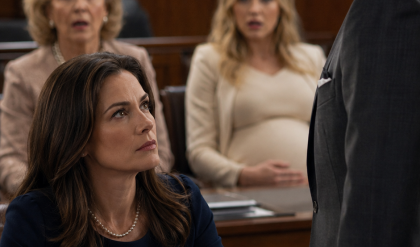
I testified for two days.
Ryan’s attorney tried every available angle.
He was a compact man in a good suit who had likely spent his career turning complicated women into simple ones before a jury.
*”Ms. Reed, you were sleeping with a married man.”*
*”Yes.”*
*”You accepted money.”*
*”Yes.”*
*”You lied to Mrs. Kline’s face.”*
*”Yes.”*
He leaned forward like a man who had timed this pause.
*”You expect this court to believe you suddenly discovered morals?”*
I looked at him.
I had thought about this question — not his version of it, but the real one. The version I asked myself at two in the morning with Lily in my memory and Chicago receding through a car window.
Had I suddenly discovered morals?
No.
I had always known, somewhere under the money and the wanting and the man who remembered my coffee order, that what I was doing was wrong. I had chosen not to look at it directly. I had kept my eyes slightly to the left of the truth for fourteen months, because looking directly at it would have required stopping.
That was not a sudden discovery of morals.
That was the slow, exhausting collapse of every reason I had given myself not to see clearly.
I said: *”I discovered the baby was in danger.”*
He pressed: *”And that makes everything else disappear?”*
*”No,”* I said. *”It means when the last door opened, I chose the one that led to her mother.”*
The courtroom was quiet.
I did not look at Ryan. I had made that decision before I walked into the room. Looking at him would have required acknowledging that I had loved him, or believed I had, and that the man I loved had been performing love the way a contractor performs an inspection — identifying structural weaknesses and filing them away for later use.
I did not want to give him even that.
I did not look at Madison much either.
But once, near the end of my second day, I glanced over.
She was looking at her hands.
Then she looked up and our eyes met for exactly one second.
I do not know what was in her face.
I know what I hoped for and did not expect: not forgiveness. Not warmth. Just the acknowledgment that I was a human being who had done wrong things and then done one right one.
She looked back down.
I finished my answer.
Ryan was convicted on multiple counts — fraud, forgery, reproductive coercion, conspiracy related to child trafficking, financial crimes, obstruction. The sentencing was not light. The judge had seen the messages. The judge had heard the word *buyers* read into the record.
Dr. Voss lost his medical license and took a plea deal.
Three other babies were found through the same network.
Two other women came forward.
A family in Wisconsin learned the child they had adopted through *”private channels”* was connected to a missing embryo case in another state.
The network cracked open wider than anyone expected, which meant Ryan’s particular crime was not an invention but a system — one that had been operating in the soft places where money and medicine and oversight did not quite overlap. One that required men like Dr. Voss, who had learned to ask only the questions he was paid to answer. One that required women like me, who were desperate enough to sign documents they should have had reviewed.
I do not find comfort in understanding the system.
I find it more terrifying.
It did not require monsters.
It required ordinary people with ordinary weaknesses making ordinary choices to look the other way.
—
### Chapter Thirteen: The Letter
After the verdict, there was one thing I needed to do.
Not for absolution. Absolution was not available to me and I had stopped wanting it — or rather, I had stopped believing I deserved to want it. What I needed was to leave something that told the truth without asking for anything in return.
I wrote Lily a letter.
I sat at the kitchen table in my apartment the night before I drove to the airport for the last time, and I tried to write it cleanly. Without defense. Without justification. Without the particular cowardice of someone who softens their wrongs by burying them in context.
I wrote:
*Dear Lily,*
*I carried you before I understood the size of the lie around us. When I learned enough to be afraid, I brought you to the woman who should have held you first. I made choices I cannot defend. I also made one choice I hope protected you. You were loved before you knew what love was. Not perfectly. Not cleanly. But truly.*
I folded it.
I gave it to Angela.
She looked at me for a moment over her glasses.
Then she took it without comment, which was the most I could have asked for.
I went to Arizona.
—
### Chapter Fourteen: Afterward
I did not ask for visits.
I did not ask for updates.
I did not contact Madison or Lily or send things through holidays and birthdays the way a person might who wanted to maintain a thread of connection without admitting that is what they were doing.
I left.
Not because I was running. Not because the guilt was too heavy, though it was. But because the most honest thing I could offer Madison was the absence of my continued presence in a life she was rebuilding from the rubble of what Ryan had done — and what I had, in my way, contributed to.
Lily did not need Chelsea Reed to be part of her story.
She needed a mother who had fought for her.
She had one.
My father recovered fully. My sister finished her degree and got a job that paid enough that she stopped sending me updates about hours worked like they were evidence in a case I needed to evaluate. The dental office where I work knows me as the woman who is always slightly too warm with patients who look scared. Nobody there knows my full name appears occasionally in articles about reproductive rights legislation and consent verification reform in Illinois.
I read those articles sometimes.
In the strange, dissociated way of reading about a character in a book who shares your face and your choices but exists at enough distance that you can analyze her without entirely becoming her again.
The articles call what happened to Madison Kline a landmark case.
They talk about the legal gaps that allowed it. The reforms that followed. The other women who came forward.
They mention Chelsea Reed as a key witness.
They do not say: she was also the person who signed the documents. She was also the person who did not ask enough questions. She was also the person who sat on a kitchen floor for three days while a woman two miles away did not know her daughter existed.
That part stays with me.
Not the articles. The floor. The three days. The decision I should have made on day one.
—
### Chapter Fifteen: What Madison Was
I have thought often about the woman at the holiday party who shook my hand and said, *”Ryan talks about you all the time.”*
I thought she was cold.
She was not cold.
She was managing a man she had begun to suspect and could not yet prove. She was performing normality in a marriage that was already a crime scene with furniture rearranged to look ordinary. She was carrying grief she had been carrying alone since the miscarriage — alone, as it turned out, because the man who wept beside her in the parking lot had filed the intelligence away and decided it was useful.
She was careful.
And I mistook careful for cold because Ryan had told me to, and because it was easier to believe his version of her than to see her clearly and keep doing what I was doing.
She was not cold.
She was a woman who had a drawer full of baby socks for three years and a husband who had decided her love for a child she hadn’t met yet was an asset he could monetize.
She was also — and this took me longer to understand — a woman capable of something I did not expect.
Not forgiveness. I am not claiming that.
But something close to justice, which is not the same thing.
When I gave the letter to Angela, Angela said: *”I’ll see that she gets it.”*
I said: *”She doesn’t have to read it.”*
Angela said: *”I know.”*
Six months after I left Chicago, a message arrived through Angela. Three words. Written by Madison or on her behalf, I did not ask.
*She is safe.*
I was standing in a parking lot outside a Safeway at seven in the morning when I read it. The Arizona light was doing something particular to the mountains in the middle distance. Sharp. Definitive. The kind of light that does not make allowances.
I sat down on a bench.
I read the three words again.
*She is safe.*
I had done one right thing.
I had done it late, and badly, and with years of wrong things stacked behind it.
But when the last door opened, I had chosen the one that led to her mother.
That was the only part of this I had the right to keep.
—
### Epilogue: The Distance Between Two Things
I was twenty-six and desperate and not wicked.
I was also not innocent.
The distance between those two things is where I live.
It is not a comfortable address. It does not simplify into a lesson or a redemption arc or the kind of ending that resolves cleanly in a single paragraph. I made choices that hurt a woman who did not deserve to be hurt. I made those choices with enough information to have made different ones if I had been willing to look directly at what I was doing instead of slightly to the left of it.
I was not a villain.
I was something harder to categorize: a person who was used and who allowed herself to be used because it was convenient, and who did not fully reckon with what that made her until a baby on an iPad screen was described as something men were coming to collect.
I think about Lily.
More than I should, maybe. Less than I could allow myself to.
She will be four now. Or five. I do not let myself calculate exactly. She is in Evanston, in a house Madison chose for its good light and its old hardwood floors and its distance from the rooms where men had come through glass. She is probably throwing something at a wall. She is probably saying *mama* in the direction of a woman who waited four years to hear it and then got it while standing in a parking lot in the rain or over a bowl of cereal or in the ordinary, unannounced way that joy arrives when you have stopped expecting it.
I was part of how Lily came to exist in the world.
I am not her mother.
I am not her anything.
I am the woman who, at the last possible moment, drove to Lincoln Park with a diaper bag and a folder of forged documents and knocked on a door I had no right to knock on, and handed back something that should never have required returning.
After the trial, Angela found me in the courthouse parking lot.
She had no particular reason to say anything kind to me. She knew that. I knew that.
She stood with her keys in her hand and said: *”For whatever it’s worth. She doesn’t hate you.”*
I said: *”She should.”*
Angela said: *”She knows the difference between someone who made wrong choices and someone whose wrong choices were her husband.”*
I got in the car.
I drove south on the interstate until the city thinned and the flat gray landscape opened up and the mountains resolved in the distance into something specific and permanent.
I cried somewhere in the middle of that.
Not dramatically. Not the way grief performs itself when people are watching. The quiet kind that comes when you have finally, fully, stopped lying to yourself about what you did and what you knew and when you chose not to know it.
I cried for Lily.
I cried for Madison.
I cried for myself — not with self-pity, which is the luxury of people who still believe they were primarily victims, but with the specific exhaustion of a woman who has looked at herself clearly for the first time in a very long time and found someone more complicated than the story she had been telling.
Then I drove south.
The mountains stayed where they were.
Entirely indifferent to the story I had been part of.
I found that comforting.
The mountains do not need the story to mean anything in particular.
They are just there.
And Lily Walker is just there too, in Evanston, in a house with good light, with a mother who fought for her from a bathroom floor with a marble candle in her hand.
That is enough.
It is more than enough.
It is the only thing, in all of this, that I am allowed to keep.