I INHERITED $3 MILLION, THEN SAW MY HUSBAND CUTTING MY BRAKES AT 3 A.M.
So I handed his sister the keys, and three hours later his whole family learned who he really was.
PART ONE: THE VIDEO UNDER THE CAR
At 3:07 a.m., Madison Whitaker watched her husband murder her on camera.
Not with a knife.
Not with a gun.
Not with his hands around her throat.
With a pair of silver bolt cutters beneath her brand-new pearl-white Range Rover, while the garage light flickered over his face like a confession.
Madison sat upright in bed, frozen under the Egyptian cotton sheets, her phone trembling so violently in her hand that the video shook.
Her husband, Grant Whitaker—the man who kissed her forehead every morning, the man who called her “Maddie-girl” in front of his friends, the man who had cried during their wedding vows at a vineyard outside Nashville—was lying flat on the concrete beneath her SUV.
He wore navy pajama pants, leather driving gloves, and an expression so calm it made her stomach turn.
The dash camera app had opened by accident.
Madison had meant to check the living-room camera because their rescue cat, Jasper, liked knocking over lamps at night.
Instead, her thumb had tapped the app connected to the Range Rover she had bought only eight days earlier after inheriting three million dollars from her late aunt Celeste in Denver.
Three million dollars.
The number had changed everything.
It had changed Grant’s smile.
It had changed the way his mother looked at Madison across Sunday dinner.
It had changed the way Grant’s younger sister, Savannah, suddenly wanted to “borrow” things.
Jewelry.
Credit cards.
Shoes.
Cars.
And now, apparently, it had changed the value of Madison’s life.
On the screen, Grant braced one elbow against the garage floor, lifted the bolt cutters, and squeezed.
A thin black line under the car snapped.
Madison’s breath died in her chest.
“No,” she whispered, but no sound came out.
Grant shifted position and reached for another line.
He moved slowly, carefully, like a man who had practiced the motion in his head a hundred times.
Madison stared, unable to blink, as the husband she had loved for four years severed the brakes of the vehicle she was supposed to drive the next morning through the steep, winding roads toward Gatlinburg to visit her parents.
She had told him at dinner she wanted to ask her father what to do with the inheritance.
Grant had smiled and squeezed her hand.
“Smart,” he had said. “Take the mountain route. It’ll clear your head.”
Now she knew why.
Madison was twenty-four, young enough that people still called her lucky before they called her capable.
She was French-American on her mother’s side, with dark honey-blonde hair, clear green eyes, red lipstick that made Grant’s mother call her “flashy,” and a polished, feminine confidence she had built after years of being underestimated by older, richer people.
She looked glamorous in rooms where people expected her to feel grateful.
Grant had loved that about her at first.
Or maybe he had only loved that other men noticed.
Her phone’s audio crackled.
Grant’s phone rang on the garage floor.
He cursed softly, wiped sweat from his jaw with the back of his gloved hand, and answered on speaker.
A woman’s voice purred through the tiny speaker.
“Baby, is it done?”
Madison stopped breathing.
The voice was young, silky, and familiar enough to make bile rise in her throat.
She had heard it months ago at Grant’s office Christmas party.
Paige Monroe.
Grant’s former marketing assistant.
Blonde, ambitious, always touching Grant’s arm when she laughed.
Grant chuckled under Madison’s car.
“Almost,” he said. “Quit calling me.”
“I’m scared,” Paige whispered. “My brother keeps asking when the money’s coming. And I’m showing now, Grant. Your son is not waiting forever.”
Your son.
Madison clamped a hand over her mouth.
Paige continued, her voice turning sharp.
“You promised. Once your wife is gone, the inheritance becomes yours. Then we can finally stop hiding.”
Grant laughed softly.
“Relax. By tomorrow afternoon, Madison will be at the bottom of some Smoky Mountain ravine. Everyone will call it a tragic accident. Brand-new car, bad brakes, rich wife driving too fast. Happens all the time.”
Madison’s phone slipped from her fingers onto the duvet.
For a few seconds, the world turned silent.
Then the bedroom door creaked downstairs.
Grant was coming back.
Madison moved on instinct.
She grabbed the phone, locked it, shoved it under her pillow, and lay down facing away from the door.
Her whole body shook, but she forced her breathing to slow.
She heard Grant enter the bedroom.
Heard him pause beside the bed.
Heard the faint rustle of him removing his gloves.
Then his hand touched her shoulder.
Madison wanted to scream.
Instead, she let out a sleepy murmur.
“You okay?” Grant whispered.
She swallowed blood from where she had bitten the inside of her cheek.
“Bathroom?” she mumbled.
Grant leaned down and kissed her temple.
His lips were warm.
His betrayal was colder than death.
“Go back to sleep, Maddie-girl,” he whispered. “Big drive tomorrow.”
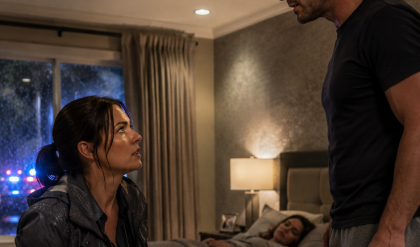
When he turned away, Madison opened her eyes in the darkness.
The woman who had gone to sleep trusting her husband was gone.
The woman lying there now had only one thought.
If Grant wanted a funeral, she would give him one.
Just not hers.
She did not sleep again.
At 3:19 a.m., when Grant’s breathing settled into the deep, selfish rhythm of a man certain he had won, Madison slid silently out of bed.
She took her phone into the walk-in closet, locked the door, and replayed the footage with the volume low.
Every second of it felt like a hand squeezing her throat.
Then she did what Grant had forgotten she knew how to do.
She thought.
Aunt Celeste had not left Madison three million dollars because she was sweet.
Celeste Moreau had been a divorced hotel investor from Denver who wore diamond cuffs, smoked thin cigars on balconies, and told Madison at sixteen, “Never confuse being loved with being safe.”
She had outlived two husbands, three lawsuits, and one brother who tried to steal from her trust.
Madison had adored her.
Celeste had taught her to read contracts before love letters.
Madison sent the garage video to two places: her private cloud and her attorney, Elise Donovan.
Elise had represented Aunt Celeste’s estate and had warned Madison that sudden money had a way of turning ordinary relatives into hungry ones.
Madison had smiled then.
She was not smiling now.
She typed one line beneath the video.
If anything happens to me this morning, Grant did this.
Then she paused.
Her thumb hovered over the emergency call button.
She could call police right now.
She should call police right now.
But a voice inside her, cold and clear, reminded her of the obvious problem: Grant would deny everything, claim the footage was hacked, say she was hysterical, say she was unstable from grief after Celeste’s death.
And if the police came before anyone else knew, Grant’s family would protect him.
His mother would cry.
His sister would lie.
Paige would disappear.
The Whitakers were very good at polishing rot until it looked like tradition.
Madison looked toward the bedroom door.
Then toward the garage camera feed.
Then she noticed something she had missed.
Grant had placed the bolt cutters inside the locked tool cabinet before returning upstairs.
He had wiped the floor where he worked.
But he had forgotten one thing.
The leather driving gloves were still on the washer beside the garage door.
Madison took a screenshot.
Then another.
Then she called Elise.
Her attorney answered on the fourth ring, voice thick with sleep.
“Madison?”
“Elise,” Madison whispered. “Grant cut my brakes.”
Silence.
Then Elise became fully awake.
“Are you safe?”
“For the moment.”
“Do not confront him.”
“I’m not going to.”
“Good. Listen carefully. Save everything. Do not drive that vehicle. Do not let anyone drive it.”
Madison looked through the closet glass toward the bed where Grant slept like a man without a conscience.
Then, downstairs, a new sound echoed softly through the house.
The front keypad chirped.
Someone was entering.
Madison froze.
Elise heard the silence.
“Madison?”
The front door opened.
A familiar voice called brightly from the foyer.
“Grant? Maddie? I know it’s early, but I need a favor!”
Savannah.
Madison closed her eyes.
Because at 6:04 a.m., Grant’s spoiled younger sister had just walked into the trap meant for Madison.
PART TWO: THE KEYS IN SAVANNAH’S HAND
Morning arrived with cruel brightness.
Sunlight spilled across the kitchen of the Whitakers’ white-columned home in Franklin, Tennessee, turning everything golden: the marble countertops, the copper pans hanging above the island, the framed wedding photo where Grant looked at Madison as if she were the whole world.
Grant stood at the espresso machine in a crisp white shirt, humming.
“Morning, gorgeous,” he said, as if he had not spent the night turning her car into a coffin.
Madison walked in wearing cream slacks, a fitted silk blouse, gold earrings, and a smile she had built in the bathroom mirror piece by piece.
Her hair fell in smooth waves over one shoulder.
Her red lipstick was perfect because she had needed something on her face that did not tremble.
“Morning.”
“You look tired.”
“I didn’t sleep great.”
His eyes flickered.
There it was.
The first crack.
“Stressed about the drive?” he asked.
“A little,” she said, pouring coffee with a steady hand. “Did you check the Range Rover? You know how nervous I get on mountain roads.”
Grant came up behind her and kissed her shoulder.
Madison’s skin crawled.
“Baby, I checked everything. Tires, fluids, brakes. That car is safer than a bank vault.”
Madison almost laughed.
Instead, she looked out the window toward the driveway.
That was when the front door burst open.
Savannah Whitaker swept in wearing oversized sunglasses, a pink designer tracksuit, acrylic nails, and entitlement like perfume.
Behind her came Tyler Briggs, her tattooed boyfriend, carrying nothing but a vape pen and a grin.
Savannah was twenty-three, pretty in a careless way, with glossy brown hair and the exhausting confidence of a woman who had never been told no long enough to believe it.
“Perfect,” Savannah announced. “You’re both here.”
Grant stiffened.
Madison lifted her coffee.
Savannah dropped her purse on the counter.
“I need the Range Rover.”
Grant’s face changed so fast Madison almost missed it.
Color drained from his cheeks.
“What?” he said.
“My Jeep’s making that noise again,” Savannah said. “Tyler and I are going to the lake with friends. I’m not pulling up in some embarrassing rental.”
Tyler grinned.
“It’s a celebration weekend.”
“For what?” Madison asked.
Savannah gave her a look.
“For being alive, Madison. Try it sometime.”
Grant’s mother, Eileen Whitaker, entered from the hallway in a silk robe, already frowning at Madison as if Madison had caused the problem by existing.
“Let her take it,” Eileen said. “Madison has three million dollars now. Surely she can share a car with family.”
Family.
That word had become a bill Grant’s relatives kept presenting to her.
Savannah rolled her eyes.
“Come on, Madison. Don’t act like some greedy rich girl. You married into this family.”
Madison looked at Grant.
He looked trapped.
His sister wanted the car.
His mother demanded it.
His ego could not admit the truth.
And his murder weapon sat gleaming in the driveway, waiting for the wrong victim.
Madison set down her coffee.
“I was supposed to drive it to Gatlinburg,” she said softly.
Savannah snorted.
“So take your old Mercedes.”
Eileen crossed her arms.
“Honestly, Madison. After everything this family has done for you?”
Madison almost asked what exactly they had done besides criticize her clothes, borrow money, and remind her that Grant could have married someone from “better people.”
But she did not.
She watched Grant instead.
His jaw clenched.
“Maybe,” he said slowly, “just let Savannah use it.”
Madison turned toward him.
“Oh?” she asked. “You think it’s safe?”
Grant blinked.
His eyes begged her not to push.
But Madison smiled.
“All right,” she said.
She walked to the hallway table, picked up the key fob, and placed it in Savannah’s hand.
The metal clicked against Savannah’s acrylic nails.
“Drive carefully,” Madison said. “The mountain roads can be dangerous.”
Savannah laughed, kissed Grant on the cheek, and swept out the door.
Tyler followed, whistling.
Grant watched through the window as his sister climbed into the Range Rover.
Madison stood beside him.
The engine roared.
Savannah waved.
The gates opened.
The SUV disappeared down the long driveway.
Grant’s lips parted.
But no words came.
Madison knew what he was thinking.
If he stopped Savannah, he exposed himself.
If he let Savannah go, he risked killing his own sister.
If he warned her after the fact, he would have to explain why he knew there was anything wrong with the car.
For the first time in their marriage, Grant Whitaker had no charming option.
Madison walked back to the counter.
Eileen poured herself coffee.
“See? Was that so hard?”
Madison looked at her mother-in-law.
“No,” she said. “Not at all.”
Grant turned sharply.
She smiled at him.
Then she picked up her phone and walked into the powder room.
The moment the door closed, her hand shook so badly she nearly dropped it.
She called Elise.
“They took the car,” Madison whispered.
“Who?”
“Savannah.”
“Madison—”
“I tried to stall. Eileen pressured. Grant said yes. I need Tennessee Highway Patrol now. Plate number, location tracking, everything. I am sending you the Range Rover app access.”
Elise cursed softly, then said, “Stay calm. I’m calling Detective Pruitt and Highway Patrol. Do not let Grant know you have evidence. Do not be alone with him.”
Madison sent the vehicle location link.
Then she sent the garage video again.
Then she opened the Range Rover app and watched the little dot move east.
Too fast.
Savannah was not going to the lake.
Madison whispered, “She changed route.”
Elise asked, “Where?”
Madison enlarged the map.
Her heart dropped.
“She’s heading toward the mountains.”
Elise’s voice tightened.
“I’ll call you back.”
Madison returned to the kitchen.
Grant stood exactly where she had left him, his face pale beneath his summer tan.
Eileen was complaining about brunch.
Madison placed her phone face down on the counter.
Grant looked at it.
“You okay?” he asked.
She looked him directly in the eyes.
“Why wouldn’t I be?”
He did not answer.
For the next three hours, the house became a theater of quiet panic.
Grant checked his phone twelve times in fifteen minutes.
He spilled espresso on his cuff and did not notice.
He stepped into the hall to make a call, but Madison followed with a question about breakfast, forcing him to end it before Paige could answer.
At 8:42 a.m., Paige called him.
Madison saw the name flash across his screen before he flipped the phone over.
Eileen noticed too.
“Who is Paige?” she asked.
“No one,” Grant snapped.
Savannah’s mother frowned.
Madison stored that away.
Behavioral clue.
At 9:03, Grant tried to leave.
“I need to run to the office.”
Madison lifted one eyebrow.
“On a Saturday?”
“Emergency.”
“With your sister in my Range Rover?”
His eyes sharpened.
“What does that mean?”
“It means you seem nervous.”
Grant stepped closer.
For one second, Madison saw the man from the garage again.
Not the husband.
Not the charmer.
Not the son who kissed his mother’s cheek at Sunday dinner.
The real man.
The one who could lie under a car at 3 a.m. and plan a ravine.
“Maddie-girl,” he said softly, “you’re acting strange.”
Madison’s smile did not move.
“Am I?”
His phone rang again.
This time, it was not Paige.
It was an unknown number.
Grant stared at the screen.
Madison’s phone rang at the exact same second.
Tennessee Highway Patrol.
She answered first.
PART THREE: THE CALL FROM THE MOUNTAIN
“Mrs. Whitaker?” the trooper said.
Madison gripped the edge of the counter.
“Yes.”
“This is Sergeant Nolan Price with the Tennessee Highway Patrol. Are you the registered owner of a pearl-white Range Rover, Tennessee plate WTK-914?”
Grant stopped breathing.
Madison looked at him while she answered.
“Yes.”
“There has been an incident on Highway 321 near a runaway truck ramp outside Townsend. The vehicle is damaged, but the occupants are alive.”
Madison closed her eyes for half a second.
Alive.
The word moved through her body so hard her knees nearly gave out.
“Savannah Whitaker and Tyler Briggs?” she asked.
“They have been transported to Blount Memorial. Non-life-threatening injuries. We need you to come in and answer questions regarding the vehicle.”
Grant’s mother dropped her mug.
Coffee shattered across the marble.
“What happened?” Eileen demanded. “What happened to my daughter?”
Madison kept listening.
Sergeant Price’s voice lowered.
“Mrs. Whitaker, preliminary inspection suggests the brake lines were deliberately severed.”
Grant made a sound behind her.
Small.
Almost nothing.
But Madison heard it.
So did Eileen.
Madison said, “I understand, Sergeant. I’ll come immediately.”
“Do you know who last accessed the vehicle?”
Madison looked at her husband.
“Yes,” she said. “I do.”
Grant lunged for the phone.
Madison stepped back.
Eileen screamed his name.
The room exploded.
“What did you do?” Eileen shouted, but not at Grant.
At Madison.
Because people like Eileen Whitaker had spent years blaming the nearest woman for the sins of the man she loved most.
Madison ended the call and set the phone down.
Grant’s face twisted.
“You gave her the keys.”
“Yes,” Madison said.
“You gave Savannah a sabotaged car.”
Eileen gasped.
Madison stared at him.
There it was.
The first confession, wrapped as an accusation.
“How did you know it was sabotaged?” she asked.
Grant froze.
The silence that followed was perfect.
Eileen looked between them, confusion spreading across her face.
Grant recovered fast.
“The trooper just said the brakes were cut.”
“No,” Madison said calmly. “The trooper said that to me. You said sabotaged.”
Grant’s jaw flexed.
Then he did what men like Grant do when charm stops working.
He became wounded.
“You set this up,” he said. “You knew something was wrong with the car and let my sister take it.”
Eileen turned on Madison fully now.
“Is that true?”
Madison felt the old pull of panic.
The unfairness was so sharp it almost stole her voice.
She had nearly been murdered, Savannah had nearly died, and still the room wanted her to explain why she had not made Grant’s crime more comfortable for everyone.
But she had spent the night becoming someone else.
Someone colder.
Someone alive.
“I called my attorney before the car left the county,” she said. “Highway Patrol was already trying to intercept them. Savannah changed routes. She didn’t answer calls.”
Grant’s eyes widened.
“You called someone?”
Madison smiled.
“Of course I did.”
His phone rang again.
Paige.
This time Eileen saw the name clearly.
“Grant,” Eileen whispered. “Who is Paige?”
Grant rejected the call.
Madison picked up her purse.
“I’m going to the hospital.”
“I’m coming,” Eileen said, shaking.
“So am I,” Grant said.
Madison looked at him.
“No.”
His expression darkened.
“I said I’m coming.”
“You should,” Madison said. “But not with me.”
Elise arrived seven minutes later in a black sedan, dressed in a charcoal suit, hair pulled tight, expression sharper than a blade.
Behind her was Detective Aaron Pruitt from Franklin Police, a broad-shouldered man with kind eyes and no patience for wealthy men pretending not to sweat.
Grant saw the detective and went pale.
Eileen whispered, “What is happening?”
Madison looked at her mother-in-law.
“The truth.”
At Blount Memorial, Savannah was awake, bruised, furious, and terrified.
A bandage crossed her forehead.
Her left arm was in a sling.
Tyler had a cracked rib and a broken nose from the airbag, but he was alive and complaining, which meant he would survive.
The Range Rover had not gone over a ravine.
It had lost braking power on a descending curve.
Tyler, who had grown up with a mechanic father and apparently had one useful skill under the tattoos, had grabbed the emergency brake and steered them into a runaway truck ramp after Savannah screamed that the pedal went to the floor.
Gravel swallowed the vehicle and wrecked the front end, but it saved their lives.
Savannah cried when she saw Grant.
Not soft tears.
Shaking ones.
“You told me it was safe,” she said.
Grant froze in the hospital doorway.
Eileen looked at him.
Madison watched the words land.
Savannah swallowed.
“You told Madison to let me take it.”
Grant stepped toward her bed.
“Sav, listen—”
“No.” Savannah’s voice cracked. “The trooper said the brakes were cut.”
Tyler lifted his head from the pillow in the next bed.
“Yeah, man. Cut. Like, on purpose.”
Grant looked at Madison.
Then at Detective Pruitt.
Then at Elise.
His face rearranged itself into offense.
“My wife is unstable,” he said.
Madison almost admired the speed.
“She inherited money, and she changed. She’s been paranoid for weeks. Ask my mother.”
Eileen’s mouth opened.
No words came out.
Grant continued, gaining confidence.
“She was supposed to drive that car. Then suddenly my sister takes it, and Madison just lets her? Doesn’t that sound convenient?”
Detective Pruitt looked at Madison.
Madison said nothing.
Not yet.
Grant saw the silence and mistook it for fear.
“She tried to frame me,” he said. “Maybe she cut the brakes herself and panicked when Savannah took the car.”
Savannah stared at him.
“Grant,” she whispered.
He did not look at her.
That was the moment Savannah understood.
Her brother was willing to feed her to the lie as quickly as he had fed Madison to the ravine.
Detective Pruitt asked, “Mrs. Whitaker, do you have anything you want to say?”
Madison looked at Grant.
Then at Eileen.
Then at Savannah, who had spent years insulting her and three hours almost dying from the love she thought protected her.
“Yes,” Madison said.
She opened her phone.
“I have video.”
PART FOUR: THE FAMILY ROOM CONFESSION
Grant moved before anyone expected him to.
He lunged for Madison’s phone.
Detective Pruitt caught his wrist halfway across the hospital room.
Grant froze, breathing hard, his charming mask gone completely now.
Savannah flinched at the violence of it, and Eileen made a small, broken sound like something inside her had split.
Madison did not step back.
That mattered.
She held the phone in one steady hand and looked at her husband.
“You were always careful,” she said. “But not careful enough.”
Elise connected Madison’s phone to a tablet and placed it on the rolling hospital tray between the beds.
Detective Pruitt turned on his body camera.
Sergeant Price from Highway Patrol stood near the doorway, holding a sealed evidence bag that contained a piece of cut brake line from the Range Rover.
Grant stared at the bag.
Madison noticed.
Physical clue.
He knew exactly what it was before anyone told him.
The video began.
The garage appeared on-screen in gray-green night vision.
The pearl-white Range Rover sat under the flickering light.
At first, no one spoke.
Then Grant entered the frame in navy pajama pants, leather driving gloves, and bare feet.
Eileen whispered, “No.”
Grant closed his eyes.
On the video, he opened the locked tool cabinet with his own key.
He removed the silver bolt cutters.
He slid beneath the SUV.
Savannah pressed her good hand to her mouth.
“Grant,” she said, but it was not a question anymore.
The first brake line snapped on-screen.
Then the second.
Then Paige called.
Her voice filled the hospital room.
“Baby, is it done?”
Eileen turned slowly toward her son.
The horror in her face was not only because he had a mistress.
It was because everyone in the room heard Grant answer from beneath the car.
“Almost.”
The video continued.
Paige said her brother kept asking when the money was coming.
She said she was showing now.
She said Grant’s son was not waiting forever.
Savannah began to cry silently.
Grant did not look at her.
Paige’s voice sharpened.
“You promised. Once your wife is gone, the inheritance becomes yours. Then we can finally stop hiding.”
Grant’s recorded laugh came next.
“Relax. By tomorrow afternoon, Madison will be at the bottom of some Smoky Mountain ravine. Everyone will call it a tragic accident. Brand-new car, bad brakes, rich wife driving too fast. Happens all the time.”
No one moved.
No one breathed.
The room had heard enough to end a marriage.
It had also heard enough to begin a criminal case.
Grant opened his mouth.
Detective Pruitt said, “Choose your next words carefully.”
Grant looked at Madison with pure hatred.
“You ruined everything.”
Madison’s laugh came out quiet.
“No, Grant. I survived everything.”
Eileen sat down hard in the visitor chair.
For years, she had treated Madison like an accessory her son had foolishly purchased.
She had mocked her lipstick, her youth, her clothes, her ambition, her grief when Aunt Celeste died, and her caution around the inheritance.
Now she stared at Grant as if seeing the blood beneath the polish for the first time.
“Your sister,” Eileen whispered. “You let your sister take that car.”
Grant snapped, “She wasn’t supposed to!”
Savannah made a sound like she had been slapped.
Grant realized too late what he had said.
Elise looked at Detective Pruitt.
“Recorded,” she said.
Pruitt nodded.
“Recorded.”
Grant’s face went white.
The door opened behind them.
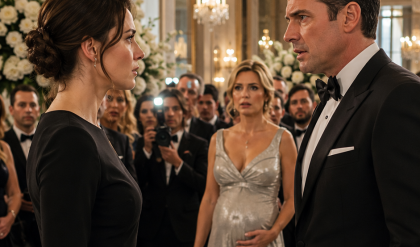
A young woman stepped into the family room with one hand on the small swell beneath her fitted beige dress.
Blonde hair.
Tearful eyes.
Expensive handbag.
The kind of soft, pretty panic that had probably worked on Grant for months.
Paige Monroe.
She looked at Grant first.
Then Madison.
Then the detective.
Her hand dropped from her stomach.
“What is this?” Paige whispered.
Madison looked at her.
For one second, she expected jealousy.
Instead, she felt only exhaustion.
Paige had not cut the brakes.
But she had called.
She had known.
She had waited for money tied to a dead woman’s body.
Pregnancy did not make her innocent.
Fear did not make her clean.
Grant turned to Paige sharply.
“Don’t say anything.”
That was the wrong thing to say in front of Detective Pruitt.
Paige’s eyes filled.
“Grant,” she whispered, “you said she would never know.”
Savannah closed her eyes.
Eileen lowered her head.
Madison watched the rest of Grant’s world crack.
Detective Pruitt stepped toward Paige.
“Ms. Monroe, you should sit down.”
Paige shook her head.
“I didn’t touch the car.”
“No one said you did.”
“I only asked if it was done because—”
She stopped.
Grant hissed, “Paige.”
She looked at him, and maybe for the first time she understood that a man willing to kill his wife would eventually find a reason to erase anyone inconvenient.
Including her.
Including the child she carried.
“My brother owes money,” Paige said, voice shaking. “Grant said he could fix it after the inheritance. He said Madison would never suffer. He said it would be fast.”
Savannah sobbed.
Eileen covered her mouth.
Madison stood very still.
Because now the truth had a second witness.
Grant turned on Paige.
“You stupid—”
Detective Pruitt stepped between them.
“That’s enough.”
Grant laughed once, wild and ugly.
“You all think she’s innocent?” He pointed at Madison. “She handed Savannah the keys.”
The room turned toward her.
Madison felt the weight of it.
There it was again.
The accusation he had saved for last.
She reached into her purse and removed a folded document Elise had given her at dawn.
She placed it on the hospital tray beside the tablet.
“Aunt Celeste’s trust agreement,” Madison said.
Grant’s expression shifted.
Small.
Panicked.
“You killed me for money you never would have touched,” she said.
Elise opened the document.
“The inheritance was held in a separate protected trust. If Madison died within five years of receiving the funds under suspicious circumstances, the full balance would transfer automatically to the Celeste Moreau Women’s Safety Fund pending investigation. No spouse, creditor, or in-law could access it.”
Grant stared at the page.
His plan had not only been evil.
It had been stupid.
Madison looked at him for the last time as a wife.
“You cut my brakes,” she said. “You almost killed your sister. You exposed your mistress. You destroyed your mother. And you did it all for money that was never yours.”
Detective Pruitt took out the handcuffs.
Eileen whispered Grant’s name.
Grant looked around for one person still willing to believe him.
There was no one left.
PART FIVE: THE MONEY HE NEVER TOUCHED
Grant Whitaker was arrested in the hospital family room while his sister watched from a bed he had nearly sent to a morgue.
The official charges came in layers.
Attempted murder.
Conspiracy.
Reckless endangerment.
Evidence tampering.
Insurance fraud investigation pending.
Paige Monroe was taken in for questioning that same afternoon, and her brother’s debt records opened a second trail of threats, payments, and panic.
Savannah gave a statement before the pain medication pulled her under.
She told the detective Grant had encouraged Madison to let her borrow the Range Rover.
She told him Grant had not warned her.
She told him that when she screamed into the phone from the runaway truck ramp, her brother did not answer.
That last part hurt her more than the sling on her arm.
Eileen Whitaker did not speak to Madison for two days.
Then she came to the Franklin house alone, wearing no makeup, no silk robe, no jewelry except a wedding band from a husband long dead and a son newly lost to the truth.
She stood in the kitchen where she had once told Madison to share because family mattered.
Madison let her stand.
“I blamed you,” Eileen said.
“Yes.”
“I blamed you before I understood.”
“No,” Madison said. “You blamed me because blaming me was easier than seeing him.”
Eileen flinched.
Good.
Some truths were supposed to bruise.
“He was my son,” Eileen whispered.
“He was my husband.”
Eileen looked toward the driveway where the Range Rover would never sit again.
It had been towed, photographed, disassembled, and turned from luxury vehicle into evidence.
The pearl-white paint was scratched beyond repair from the runaway ramp gravel, but Madison had asked the mechanic to save one thing.
A small piece of the severed brake line.
Not for revenge.
For memory.
Eileen folded her hands together.
“Savannah wants to speak to you.”
“I’m not stopping her.”
“She’s ashamed.”
“She should be alive first. Ashamed can wait.”
Eileen’s eyes filled.
“I raised him wrong.”
Madison did not comfort her.
That was not cruelty.
That was boundary.
“You raised him to believe women were responsible for cleaning up his consequences,” Madison said. “I won’t do that for either of you.”
Eileen nodded slowly, and for once she did not argue.
Three weeks later, Madison filed for divorce.
Elise handled the petition with the calm precision of a woman slicing silk with a razor.
Grant contested nothing because there was nothing left to contest.
His accounts were frozen.
His office removed his name from the door.
His friends stopped calling him “complicated” and began calling him “under investigation.”
People always changed vocabulary once prosecutors entered the room.
The tabloids wanted Madison’s tears.
She gave them none.
At the preliminary hearing, she walked into the courthouse in a tailored white suit, nude heels, gold hoops, and red lipstick so steady photographers lowered their cameras after the first flash.
Not because she looked fragile.
Because she did not.
Grant sat at the defense table in a gray suit that no longer fit his life.
He looked thinner, older, angrier.
When Madison passed him, he leaned toward his attorney and whispered something.
Madison did not look back.
Paige testified under a cooperation agreement.
She cried often.
She said Grant had promised marriage, money, safety, and a future for their son.
She said she believed him when he claimed Madison was reckless, selfish, undeserving, and cruel.
Madison listened without hatred.
That surprised her.
Hatred required a kind of intimacy she no longer wanted to spend on either of them.
When Paige finally looked at her from the witness stand and whispered, “I’m sorry,” Madison did not answer.
Some apologies arrive only after evidence leaves no other doorway.
Madison had no obligation to decorate Paige’s regret.
Savannah testified last.
She entered in a navy dress with her arm still stiff from injury and her confidence stripped down to something quieter.
She did not look at Grant at first.
She looked at Madison.
“I took the car because I thought I was entitled to it,” Savannah said. “Because my family taught me that Madison’s things were ours if we wanted them badly enough.”
Eileen cried in the second row.
Savannah continued.
“I was wrong. But my brother knew the brakes were cut. He let me drive it anyway because admitting the truth would have exposed him. I survived because Madison called for help before any of us deserved it.”
Grant stared at the table.
Madison closed her eyes.
Not from relief.
From the strange grief of hearing truth spoken by someone who had once helped make lies comfortable.
The judge denied Grant’s bond increase request and expanded the protective order.
Trial would come later.
Prison would likely follow.
For Madison, the legal process became less about waiting for punishment and more about learning how to live in a house where every beautiful thing had once been touched by someone who wanted her dead.
She sold the Franklin home.
Not because she was afraid.
Because she refused to heal inside Grant’s museum.
She bought a smaller estate outside Nashville with wide windows, a private gate, a garden, and a garage with cameras she checked without shame.
Jasper adjusted first, as cats do, by claiming the best chair and pretending the move had been his idea.
Madison kept Aunt Celeste’s portrait in the study.
Beside it, she framed three objects.
A still image from the garage video, blurred except for Grant’s gloved hand.
A certified copy of the trust clause he never read.
And the severed brake line, sealed behind glass.
Visitors sometimes thought it was morbid.
Madison thought it was honest.
The three million dollars remained intact.
Grant had never touched it.
Not one cent.
Six months after his arrest, Madison used part of the interest to launch the Celeste Moreau Safety Fund.
It paid for emergency legal help, vehicle inspections, hotel rooms, transportation, and private security upgrades for women leaving dangerous marriages.
Elise became the fund’s first board chair.
Savannah, after months of therapy and a handwritten apology Madison did not immediately answer, volunteered quietly at the intake desk once a week.
Madison allowed it.
Not because they were friends.
Because Savannah had nearly died inside the same lie.
One afternoon, a young woman came into the fund’s office wearing sunglasses indoors, one hand wrapped around a car key so tightly her knuckles had gone white.
She was shaking, humiliated, and trying to sound practical while asking whether brake inspections were expensive.
Madison stepped out of her office.
She wore a fitted emerald dress, a cream blazer, gold heels, and the kind of calm that came only after surviving the thing other people still feared naming.
Her hair fell smooth over one shoulder, and her red lipstick had become less armor than signature.
The young woman looked embarrassed.
“I’m probably being dramatic.”
Madison held out her hand.
“No,” she said gently. “You’re listening to yourself.”
The woman started crying.
Madison did not rush her.
She had learned that panic often needs permission before it can become a plan.
That evening, Madison drove home alone in a dark green convertible with brand-new brakes, independent inspection records in the glove compartment, and Jasper’s carrier buckled into the passenger seat because he had an appointment with a veterinarian who claimed he was overweight.
The road curved through the Tennessee hills.
For the first time in months, Madison did not imagine the pedal going soft beneath her foot.
She did not imagine Grant’s hands under the car.
She did not imagine a ravine waiting to receive her like a secret.
She drove with the windows down, warm air lifting her hair, music low, both hands steady on the wheel.
At a red light outside Franklin, her phone buzzed.
A message from Savannah.
He pled guilty.
Madison stared at the words.
Then another message appeared.
I’m sorry I only saw him after he almost killed me too.
Madison did not answer immediately.
Forgiveness was not a reflex.
It was not a performance.
It was not something owed because another woman finally arrived late to the truth.
But after the light turned green and the road opened ahead, Madison dictated one line.
Stay alive long enough to become better.
Then she sent it.
Grant had thought three million dollars made Madison valuable enough to kill.
He was wrong.
The money had not made her valuable.
The money had revealed how cheaply he valued everyone else.
His wife.
His sister.
His unborn son.
His mistress.
His mother.
Anyone who stood between him and a fortune that was never his.
At 3:07 a.m., Madison had watched her husband murder her on camera.
By sunrise, she had handed his sister the keys, called for help, saved what she could, and let his own choices drive the truth into daylight.
People later asked why she did not scream that morning.
Why she did not confront him.
Why she smiled when Savannah walked away with the key fob.
Madison always gave the same answer.
“Because some men only confess when they think the wrong woman is about to die.”
And Grant Whitaker had confessed to everyone.
His mother.
His sister.
His mistress.
The police.
The court.
And the wife he had mistaken for easy money.
Madison Whitaker lost a husband, a house, and the illusion that love made people safe.
But she kept her life.
She kept her name.
She kept the fortune Aunt Celeste had protected from beyond the grave.
And every time she opened the doors of the Celeste Moreau Safety Fund, she remembered the truth that saved her before the brakes ever failed.
A woman’s fear is not weakness.
Sometimes, it is evidence arriving early.