I Never Came to Ruin Him — He Built the Ruins Himself and Called Them Mine
## PART ONE: THE FOLDER
The ballroom did not go silent all at once.
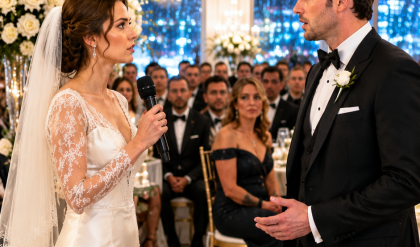
It happened in layers, the way a room reacts when money senses danger before people do. First, the violinist missed a note. Then a senator near the champagne tower turned his head. Then a woman in emerald silk stopped mid-laugh, her smile still open on her face as if someone had pressed pause on her body. Conversations frayed. Camera flashes faltered. The gold light from the chandeliers kept pouring over everything, extravagant and indifferent, while the Plaza’s grand ballroom slowly realized the woman standing in the doorway was not supposed to exist there anymore.
Connor Hail was still on one knee.
That was the image the reporters had come to capture: America’s golden CEO kneeling before Jade Ellison, his pregnant girlfriend, under twelve thousand imported white roses and a banner celebrating Hail Corporation’s global expansion deal. His velvet ring box was open. The diamond inside was large enough to be vulgar and perfect enough to be photographed from across the room. Jade stood above him in a silver gown that clung to her belly and glittered like Manhattan itself had chosen her.
Her hand covered her mouth.
Her eyes had been wet at exactly the correct moment.
Connor had rehearsed this. Of course he had. He rehearsed everything. His smile. His apologies. His public vulnerability. Even his cruelties had timing. Only my entrance had not been in his schedule.
The first person to say my name was a woman from Connor’s board.
“Rowan?”
It left her mouth like a mistake. Then the whisper spread. *Rowan Miller. His ex-wife. The unstable one. The jealous one. The woman who supposedly broke down after the divorce. The woman who could not give him a child. The woman who had vanished from every polished room in Manhattan because Connor Hail had made absence look like proof.*
I stood in the doorway wearing a simple black dress, low heels, and my hair pinned at the nape of my neck. Nothing glittered except the thin silver bracelet around my wrist — the one my mother had given me when I graduated college and told me, *”You don’t have to be loud to be impossible to erase.”*
I had forgotten that for a while.
Tonight, I remembered.
In my right hand was a slim black folder.
That was what changed Connor’s face. Not me. Not grief. Not guilt. The folder. He recognized it before he recognized the woman holding it. The smile fell first from his mouth, then from his eyes. Color drained from his skin in a clean downward motion, as if someone had opened a valve beneath his collar. Jade’s hand dropped from her lips. Her perfect shock dissolved into something less flattering.
Fear does not photograph as well as triumph.
“Rowan,” Connor said. His voice cracked on the second syllable.
I walked forward.
The crowd parted without being asked. Rich people understand power. They do not always understand morality, but they recognize a weapon when it enters a room wrapped in calm. The marble floor shone beneath my feet. The ballroom smelled of roses, champagne, expensive perfume, and the faint electrical heat of television lights. Reporters at the side of the stage shifted their cameras. Investors leaned toward one another. A waiter froze with a tray of untouched flutes.
Marcus Leal stood near the far wall. He did not wave. He did not rescue me. He simply nodded once. A signal. A promise. A witness.
I stopped at the foot of the stage.
Connor rose slowly from one knee, still holding the ring box, still trying to remember which version of himself he needed to become. The loving fiancé? The wronged ex-husband? The untouchable CEO? The innocent man?
He chose CEO.
“What are you doing here?” he asked, his voice low enough to sound controlled to people who did not know him.
“I wasn’t planning to come,” I said. Every microphone in the room seemed to lean forward. “But some truths shouldn’t stay buried.”
Jade gave a small laugh. It trembled at the edges. “This is embarrassing,” she said loudly. “Connor, have security handle it.”
I turned toward her.
For months, I had imagined this woman as a villain drawn in clean lines. Younger. Glossier. Crueler. The woman who sat on Connor’s desk with bare legs crossed while I stood in the doorway holding takeout he had once pretended to want. The woman who let him humiliate me because his praise made her feel chosen.
Tonight, she looked young. Still cruel. Still responsible. But young. And terrified.
“I didn’t come for you, Jade,” I said. Her eyes narrowed. “And I didn’t come for him.”
The whispers rose.
I lifted the folder slightly.
“I came because everyone in this room is celebrating a deal built on false reports, hidden transfers, and signatures Connor tried to bury under my name.”
The ballroom shifted. It was almost physical. A collective step backward without movement.
Connor laughed once. A terrible, hollow sound. “Rowan has been under a lot of stress,” he said, turning toward the crowd. “Many of you know the last few years have been difficult for her.”
There it was. The old knife. Soft voice. Public concern. Private execution.
He had done this to me before. At dinners, in boardrooms, in whispers passed between women with pity in their eyes. He never called me crazy directly when other people were present. He said *tired. Emotional. Overwhelmed. Not herself lately.* A woman does not need to be shouted at to be discredited. She only needs a powerful man to sound worried while he removes her from the room.
I opened the folder.
Connor stopped laughing.
The first page was an internal asset redistribution report marked UNFILED. The word sat across the top like a flare. A man in the front row leaned forward. His name was Andrew Pike, a financier whose fund had committed nearly eighty million dollars to Connor’s expansion. I saw the moment he understood enough to become afraid.
“Is that real?” he asked.
Connor snapped, “No.”
I looked at him. “You should be careful. Your signature is on page three.”
A flash went off. Then another. The room, once Connor’s stage, became evidence.
## PART TWO: BEFORE THE FOLDER
Before Connor Hail destroyed my reputation, I had been a senior data analyst at Sterling Capital.
Not a famous one. Not the kind of woman glossy magazines call “visionary” because she knows how to dress a spreadsheet in charm. I was quiet, methodical, and useful in ways powerful men rarely celebrated publicly because they preferred to treat competence as infrastructure. I found risk before it became scandal. I spotted patterns hidden beneath clean presentations. I saved people money they later credited to instinct. I did not mind. Or I told myself I did not.
I met Connor at a charity technology gala six years before the Plaza. He was not yet America’s golden CEO then. He was a rising executive with a good jawline, a better smile, and a talent for making every person in a room feel briefly selected by history. When he spoke to me that night, he did not look over my shoulder for someone more useful. That was the first thing that disarmed me. I had grown accustomed to conversations with men who spoke to me while scanning the room, their attention like a loan they expected back with interest.
Connor stayed. He asked questions. He listened to the answers.
I know now that he was studying me. But the performance was flawless, and I was hungry for someone who looked directly at me, and that hunger had a cost I would spend years paying.
We married eighteen months later. I remember the morning of the wedding, my mother adjusting the bracelet on my wrist — the thin silver one she’d given me at graduation — and saying quietly, “He talks about himself in the third person, Rowan. Watch that.” I laughed. I thought it was a quirk. I thought I could hold onto who I was inside a marriage to someone like him.
I was wrong. Not because he was loud. Because he was *patient*.
The erosion happened in increments small enough to appear like communication. *You don’t really want to go back to the office after the gala, do you? You’ve seemed so tired lately.* Then, six months later: *The partners say you’ve been distracted. I covered for you but it’s getting harder.* Then, later still: *You’ve always struggled with high-pressure situations. Remember the Henderson account?* I had not struggled with the Henderson account. I had saved it. But by then, I had been told the revisionist version so many times that I checked my own memory for errors.
This is what people misunderstand about how it works. They imagine a woman waking one morning to find herself diminished and wondering how she arrived there. The truth is she does not wonder. She has been given so many explanations for what she sees in the mirror that she stops seeing herself and starts seeing the explanations.
The child question came two years in.
I could not get pregnant. Three rounds of IVF. Two miscarriages so early they registered as data rather than loss — small enough that Connor seemed impatient with my grief, as if I were mourning a hypothesis. “We can try again,” he said, each time, with the inflection of a man troubleshooting software. The tenderness I had mistaken for care turned out to be strategic. He wanted an heir. I was a means toward one. When my body failed to produce what he required, I became a problem he was gracious enough to remain married to, for now.
I did not leave. That is the thing I must say plainly. I did not leave. Not because I was stupid. Not because I was weak. But because I had been so thoroughly renamed — *unstable, fragile, lucky to have him, difficult, prone to misreading situations* — that I had stopped trusting the evidence my own eyes gathered.
There was one night. The only night I came close.
Connor was in London. I found a hotel receipt in his coat pocket — not through snooping, but because he had asked me to dry-clean the coat and left the pocket unemptied, which I came to understand later was a particular kind of cruelty. The receipt was from the Claridge’s suite booked under his assistant’s corporate card. The assistant’s name was Jade Ellison.
I called him. He answered on the third ring with a relaxed voice and said he was with a client and could he call me back. I said I was holding a receipt with Jade’s name on it. There was a pause so brief it almost didn’t exist, and then he said, very gently, that I was doing it again.
“Doing what?” I asked.
“Building a story from nothing,” he said. “Rowan. I’m worried about you.”
I put the receipt in a drawer. I did not leave.
Three months later, Connor filed for divorce.
He had, by that point, already begun removing me. From his professional circle, quietly. From shared friendships, tactfully. From the narrative of his own success, surgically. By the time the papers were served, I was already a footnote in his biography: the first wife, who had not been well. Who had struggled. Who had, regrettably, become an obstacle to his happiness.
The settlement was generous enough to look like guilt and structured enough to function as silence. I signed. My lawyer at the time, a pleasant woman who clearly believed Connor’s public version of events, advised me to move forward. I took the money, the apartment on the east side, and what remained of my professional reputation, which by then fit inside a single paragraph of LinkedIn platitudes.
I moved forward. For almost a year, I moved forward.
Then Marcus Leal came back.
Marcus had been my closest friend at Sterling Capital before I left — before Connor advised me that “perhaps the office politics were affecting your mental health” and I had, in a moment of profound confusion about what I wanted versus what I had been told I wanted, resigned. Marcus had not been surprised when I married Connor. He had been quiet about it in a way that, in retrospect, said everything. He sent flowers to the wedding. He didn’t give a toast.
When he appeared at my door on a Tuesday evening nine months after the divorce, carrying takeout containers and wearing the expression of a man who has been patient for a long time and has decided patience is over, I almost didn’t open it.
“I have something to show you,” he said.
“I’m not—”
“I know you’re not ready. Open the door, Rowan.”
I stepped back and let him in.
He spread the documents on my kitchen table while I stood with my arms crossed and my dinner going cold. He had been at Sterling Capital long enough to notice what I had missed because I had been too close to it: the pattern in Connor’s financial filings beginning three years into our marriage. Asset movements that looked like tax optimization from the outside and looked, from the inside of the data, like something else entirely.
“I don’t know enough to be certain,” Marcus said. “But I know enough to know someone who does.”
“This isn’t my problem anymore,” I said.
Marcus looked at me for a long moment. “Your signature is on the authorization documents for the first transfer.”
I felt the floor.
“He forged it,” I said.
“Probably. Or he had you sign something that looked routine and made it look extraordinary after the fact.” He paused. “Which means if this ever comes out, it comes out with your name on it.”
I sat down.
The room was very quiet. Outside, the city made its constant indifferent noise. I looked at my hands on the table, the thin silver bracelet catching the kitchen light, and felt something I had not felt in two years. Not anger. Not grief. Something colder and quieter and far more useful.
“Tell me what we need,” I said.
Marcus exhaled slowly. “Time. Access to the original filings. Someone at the SEC who owes me a phone call. And you,” he said, “being who you were before he convinced you that you weren’t.”
—
The work took seven months.
I will not lie and say it was clean. There were weeks when I was afraid — not of Connor, but of myself. Of finding out I had agreed to something and simply forgotten. Of discovering that the woman he had described, the one who misread situations, who could not be trusted with her own perceptions, was actually real.
I found the opposite.
Every document I pulled confirmed the same story. The transfers were real. The misattributions were deliberate. My signature had been used four times, each on a document I had no memory of signing — because I had never signed them. I had been the perfect cover: a wife with analytical credentials, a wife who had now been publicly established as unreliable, a wife who had disappeared quietly and taken the settlement money and agreed not to speak about the marriage.
In month five, I found the burned file.
Not literally burned. But there is a kind of document deletion that is meant to look like routine archiving and looks, to someone who knows what she is looking at, like erasure. Connor had moved the original version of the expansion deal through seven subsidiary accounts before landing it on the publicly filed version, which was clean. The original was not clean. The original had the names of three regulatory officials who had been paid consulting fees that had not been reported.
I had my answer.
I called Marcus.
“We have enough,” I said.
“Are you sure?”
I looked at the bracelet on my wrist. My mother’s voice: *you don’t have to be loud to be impossible to erase.*
“I’ve been sure for seven months,” I said. “I was just afraid of knowing.”
—
## PART THREE: THE NIGHT OF THE PLAZA
The decision to go to the Plaza was not planned.
I had already passed the documentation to the appropriate people. Marcus had worked with a securities attorney he trusted. The information was moving through channels that did not require me to be present. I was supposed to stay home. I had promised Marcus I would stay home.
Then I saw the live coverage at eleven o’clock in the evening and there was Connor, kneeling in a ballroom full of investors and cameras and roses, and Jade’s hand was over her mouth, and Manhattan was applauding him.
Applauding *him.*
I put on the black dress.
I called Marcus from the car.
“Don’t do anything rash,” he said immediately.
“I’m not. I’m going to walk into a room and stand there.”
“Rowan—”
“He told everyone I wasn’t well,” I said. “He told everyone I couldn’t be trusted. He did it quietly, for years, and now he’s in a ballroom getting engaged while his investors celebrate a deal I know is fraudulent, and there are cameras everywhere.” I paused. “I’m not going to say anything they don’t already have in writing. I’m just going to be *present.*”
A long pause.
“I’ll be there in twenty minutes,” Marcus said.
“You don’t have to—”
“I know,” he said. “But someone should be there who remembers who you were before all of this. Just in case you forget again.”
That was the moment I almost cried. Not in the ballroom, later. In the back of a cab on Fifth Avenue with the city sliding past the windows, because Marcus Leal had just said, in his understated way, the thing no one had said to me in years: *I remember you.*
I held the folder on my lap.
I did not cry.
—
In the ballroom, after I opened the folder, Connor did three things in rapid succession that told me exactly what kind of man he still was.
First, he reached for Jade’s arm.
Not to comfort her. To position her. To use the visual of the pregnant woman as a shield. She let him — reflexively, the way a person moves toward the thing that has always been their source of direction — and then she caught herself. I saw it. A small stiffening. A recognition that he was managing the image rather than managing the crisis, and that she was furniture in that management.
Second, he tried to take the folder from me.
He moved toward me with his hand extended, his voice dropping to the private register he used when he wanted to remind me that there was a version of this conversation only we needed to hear. “Rowan, stop,” he said. “You don’t know what you’re doing.”
I held the folder slightly to the side, out of his reach. “I know exactly what I’m doing,” I said. “That’s the difference between tonight and every night I spent confused in this marriage.”
He stopped moving.
Third — and this was the moment I had not anticipated, the moment that cost me more than I expected — he told the truth.
Not about the documents. Not about Jade. About me.
“You were brilliant,” he said quietly, so quietly the cameras probably couldn’t pick it up, but I could, and it landed like a closed door. “You were the most analytically gifted person I’ve ever worked with. And I knew if I let you stay who you were, you would eventually figure out everything I was doing. So I made it so you couldn’t trust yourself.” He looked at the folder. “I didn’t think you’d get it back.”
The room was very quiet.
I had expected denial. I had expected performance. I had not expected the truth, delivered flatly and without apology, the way one reports weather.
“That’s almost a compliment,” I said.
“It’s an explanation,” he said. “Not an apology.”
“I know,” I said. “You don’t do apologies.”
I looked at Andrew Pike. “Page three,” I said again. “And the SEC received the full documentation package at eight o’clock this evening.”
Pike stood up. He was already reaching for his phone.
The room did not collapse. Rooms never collapse in the moment. They begin a slow structural failure that takes weeks and produces headlines. Connor watched Pike, then watched the second investor reach for his phone, then watched his PR executive — the man he paid to prevent moments exactly like this one — pressing her way through the crowd with the expression of someone calculating losses in real time.
Connor’s face did something I had never seen it do. It went still. Not controlled. Not performing control. Actually still. The face of a man confronting a consequence he had run the numbers on and found that the numbers were correct.
Jade stepped down from the stage.
She walked past Connor without touching him. She walked past me without looking at me. She walked toward the side exit where the coat room was, moving carefully, her hand pressed to her lower back, and she did not look back.
I felt something for her that I had not expected to feel. Not sympathy, exactly. Recognition. I knew what it was to have organized your entire existence around a man who was managing you, and to walk away from the center of a room while a crowd watched. The walk itself was its own kind of dignity.
I looked at Connor for the last time.
“You should call your lawyers,” I said.
He said nothing.
I closed the folder. I turned around. Marcus was waiting near the door, holding my coat.
The cameras followed me out.
—
## PART FOUR: AFTER
The story broke the next morning with the kind of speed that only happens when documentation is airtight. The SEC confirmed an investigation. Andrew Pike’s fund issued a statement distancing itself from the expansion deal. Three board members resigned before noon.
Connor’s lawyers called my lawyers twice before ten a.m.
My lawyer — a new one, a woman named Diane Torres who had looked at the case for forty-five minutes and said, “This is extraordinary, and you should have come to me three years ago” — told them to send anything in writing.
I sat in Diane’s office on the forty-second floor and watched Manhattan through the window and felt the particular exhaustion of having done the one hard thing you’ve been circling for years. Not relief. Not triumph. Something quieter. Like a sound that has been playing at the edge of your hearing for so long you stopped noticing it, and then it stops, and the silence takes a moment to identify.
Marcus came at noon with sandwiches and the afternoon editions. He spread the papers on Diane’s conference table without comment. There was my name in three of the headlines. *Rowan Miller* — and next to it, no longer *ex-wife* or *estranged* or *troubled* but *former analyst* and *whistleblower* and, in one tabloid that was going for something more dramatic, *the woman with the folder.*
“How do you feel?” Marcus asked.
I considered this.
“Like I’m very hungry,” I said.
He laughed. Really laughed, in the way he used to before I married Connor and the laughter became careful. I had forgotten the sound. It filled the conference room and I found, to my own surprise, that I was laughing too — not at anything specific, but at the sheer absurdity of the last three years, the waste of it, the fact that I had spent so long doubting my own eyes that I had nearly missed the evidence sitting directly in front of them.
Diane watched us with the measured warmth of someone who has seen people come through the other side of long, grinding fights and understands that laughter is sometimes the only honest response.
“We have four months of work ahead,” she said, not unkindly.
“I know,” I said.
“You’ll need to be available for depositions. The SEC will want to speak with you. There will be press requests, and I’m advising you to decline most of them, at least initially.”
“I know.”
“And there’s the matter of the forged signatures. We’ll be pursuing that aggressively.”
“I know,” I said again. I looked at the sandwich Marcus had brought. Roast beef on sourdough, the same thing he used to bring when we worked late at Sterling. He had remembered without being asked. “Diane,” I said, “can I ask you something?”
“Of course.”
“Do you think he actually believed I wouldn’t figure it out?”
She considered the question seriously. “Men like Connor Hail tend to believe their narrative management is permanent,” she said. “He had convinced your entire social circle, a number of professional colleagues, and frankly a significant portion of the press that you were unreliable. From inside that system, you removing yourself from the board probably felt like confirmation.”
“He said I was the most analytically gifted person he’d ever worked with,” I said.
Diane raised her eyebrows.
“He said it to explain why he needed to undermine me.”
“Well,” she said, “at least he was accurate about one thing.”
—
I went home to the east side apartment that evening and sat in the kitchen and did not cook dinner. I ordered delivery from a place three blocks away and ate at the table alone, which I had done hundreds of times in the last year, but which felt different tonight in a way I was still learning to name.
The apartment was small. I had chosen it specifically for that — after years of Connor’s penthouse with its twelve-foot ceilings and the particular loneliness of spaces that exist to impress rather than hold you, I had wanted something that fit. Four rooms. A kitchen where you could reach the counter from the stove without moving. A window in the bedroom that faced east rather than the skyline, which meant I woke up to light that was actually morning-colored rather than the blue-white glow of glass towers performing themselves all night.
I had been told, quietly, by mutual acquaintances relaying Connor’s version, that the apartment was a step down.
I had decided it was a step back toward myself.
My phone had thirty-seven missed calls. I turned it face-down and ate my dinner. I thought about Jade.
She had left the ballroom carefully. She was carrying a child who was, in whatever complicated math of this situation, blameless. She had made choices — choices I was not going to pretend were not real or consequential — but she was also twenty-six years old and Connor Hail had targeted her the same way he targeted everything useful: precisely, from a position of practiced warmth, in the particular window of someone’s life when they most wanted to be chosen.
I knew the feeling.
I did not forgive her. Not yet. Maybe not for a long time. Forgiveness was not something I planned to organize into my schedule like a business goal. But I stopped, that night, imagining her as a clean villain, because clean villains only exist in stories where the narrator is lying to herself about the complexity.
I was done lying to myself.
I picked up my phone and called my mother.
She answered before the second ring. She always answered before the second ring. She had been following the news, she said — her neighbor’s daughter had sent her a link — and she just wanted to know I was all right.
“I’m tired,” I said. “I’m very tired. And I’m all right.”
“Are you eating?”
“I’m eating right now.”
“Good.” A pause, filled with the particular warmth of a mother who has watched her daughter lose herself and said nothing because there was nothing to say that would be heard. “I’ve been wanting to call you all day. I kept picking up the phone and then thinking, give her the day.”
“You could have called,” I said.
“I know.” Another pause. “I’m proud of you,” she said. Simple. Unperformed. “I’ve been proud of you for a long time. I was proud of you when you were miserable in that marriage and keeping it together out of sheer stubbornness. I want you to know that.”
I looked down at the bracelet on my wrist.
“Mom,” I said. “When you gave me this bracelet — the day I graduated — you told me I didn’t have to be loud to be impossible to erase.”
“I remember.”
“I forgot that for a while.”
“I know you did,” she said. “But you’re the one who put it back on.”
—
Jade called me on a Thursday, three weeks after the Plaza.
I almost didn’t answer. I sat looking at the name on the screen for four full rings — she had gotten my number from somewhere, I didn’t ask from where later — and then I answered because I thought: *whatever she is about to say, I would rather know than not know.*
“I’m not calling to apologize,” she said immediately.
“All right.”
“I know what you’re expecting and that isn’t what this is.”
“What is it?” I asked.
A long pause. “I left him,” she said. “Three days ago. I have a lawyer. I’m not—” her voice moved in an unfamiliar way, the careful glossiness cracking at a seam — “I’m not asking for anything from you. I just thought you should know, because you are probably the only other person who understands what *left him* actually cost.”
I sat with that for a moment.
“How much of it did you know?” I said. Not *when did you know,* because I understood that the when was probably irrelevant, but *how much.*
“Not the financial piece,” she said. “Not until the ballroom. But the other things — the way he talked about you when you weren’t there — I knew those things weren’t true.” Her voice steadied into something harder and less comfortable. “I let him say them anyway. Because being the one he’d chosen felt better than being the one he was talking about.”
I did not say *I understand.* I did not say *it’s okay.* Neither of those things was my job to give her.
What I said was: “Get a good lawyer. A better one than you think you need.”
A short silence.
“I have,” she said. “I got Diane Torres.”
Despite everything, I almost smiled. “Good,” I said.
She hung up. I sat looking at the phone for a while. Then I put it down and went back to the work I had been doing, which was, in the small and unremarkable way that rebuilding always is, rebuilding.
—
## PART FIVE: WHAT ACTUALLY HAPPENED
The investigation took eleven months.
Connor Hail was formally charged in the spring with securities fraud, falsification of financial documents, and three counts of filing materially false reports with the SEC. The forged signatures were confirmed by forensic document analysis. Three regulatory officials were separately investigated. The expansion deal was unwound.
His lawyers entered a not-guilty plea.
I was not in the courtroom when they entered it. I was in a conference room two floors above Diane’s office, presenting an analysis of the subsidiary account structure to a regulatory team who had been professional and thorough and slightly awed by the documentation’s completeness, which I chose not to take personally in either direction.
I had been hired six months earlier as a senior risk consultant by a financial firm whose founding partner had, apparently, watched the Plaza coverage and then called Diane’s office the following morning. Her name was Beverly Kim. She was sixty-three and had the kind of quiet, specific power that comes from forty years of being the most prepared person in any room. She had said, at our first meeting: “I don’t need to know the full story. I need to know if you can still see clearly.”
“I can see more clearly than I could before,” I said.
“Good.” She extended her hand. “Then I think we’ll get along.”
I worked. I worked in the way I had always worked before the marriage, before the erosion — methodically, early, with the peculiar satisfaction of finding the thing that is hidden and holding it up to the light. I made mistakes, occasionally. I took two cases in the first four months where I trusted the surface too quickly and had to revise my analysis, and Beverly said nothing critical but left a note on my desk that said simply: *Patience is a risk management tool.* I kept it.
Marcus and I had dinner on Thursdays when our schedules allowed. We talked about work and sometimes about Connor’s case and sometimes about nothing in particular. He had a girlfriend now, a woman named Saoirse who was an architect and who had, at our first introduction, said to me: “Marcus talks about you like you’re a fixed point.” I didn’t know what to do with that. I wrote it down later, at home, in the small notebook I kept on my kitchen table, and looked at it for a while.
A fixed point. Something that does not move even when the map around it changes.
I had not known I could be that.
I had been told, for years, that I was the unstable element. The variable. The thing that introduced error into an otherwise functional system.
I put the notebook away and went to bed and slept well, which was something I had not done reliably for three years and was still, every morning, mildly surprised to find had happened.
—
The night before Connor’s verdict, I could not sleep.
Not from anxiety. From something stranger. A restlessness I recognized from the hours before the Plaza — the feeling of standing at the threshold of a door and knowing that what was on the other side would not undo anything that had been done, but would close something. Complete a shape I had been living inside without being able to see its edges.
I went to the kitchen at two in the morning and made tea and sat at the table where I had once spread Marcus’s documents, and I thought about a question I had been circling for eleven months: *What do I do with the version of myself he made?*
Not the true version. I had found her again — she was here, in this kitchen, slightly older and considerably less trusting of presentations that looked too clean, but essentially recognizable. I meant the version he had constructed. The unreliable one. The one who couldn’t be trusted. The ghost he had built from the bones of my own doubt and then sent out into the world wearing my name.
I didn’t know. I thought, sitting there at two a.m. with the city humming outside, that maybe the answer was not to dismantle her but to let the record do its work. The documents existed. The analysis existed. The forensics existed. The record would correct itself, slowly, in the way that records do — not perfectly, not completely, not in the memory of every person who had looked at me with pity at dinners and thought *Connor seemed to think she was having a hard time* — but sufficiently. Enough to move forward with.
I looked at the bracelet.
I thought about my mother’s voice: *you don’t have to be loud to be impossible to erase.*
I thought about what Connor had said in the ballroom — *you were brilliant, and if I let you stay who you were, you would figure out everything* — and I felt, for the first time, the full weight of it. Not as an insult. Not as a wound. As a strange and terrible kind of evidence. The proof that I had always been exactly who I thought I was, housed in the mouth of the man who had spent four years telling me otherwise.
He had been afraid of me.
Not the version he’d made. The real one.
That was something.
I finished my tea and went back to bed and slept.
—
The verdict came at eleven forty-three in the morning.
Guilty on all counts.
Diane called before the headlines finished forming. She was concise and professional and then, at the end, said: “For what it’s worth — and I know this is your job to assess, not mine — I haven’t seen documentation this complete in twenty years of practice.”
“It helps,” I said, “when you’ve been inside the system.”
“It helps when you’re very good,” she said.
I thanked her and hung up.
Marcus texted a single line: *Fixed point.*
I sat at my desk and looked at my hands for a moment. The silver bracelet caught the afternoon light. Outside the window, the city performed its indifferent, continuous motion — taxis and pedestrians and the particular choreography of a place that does not pause for individual reckoning, which was, I had come to understand, one of its great mercies. Manhattan did not mark your lowest moments. It simply continued, and you continued inside it, and eventually the distance between you and the floor accumulated into something that looked like recovery.
I picked up the Henderson account file on my desk — a new client, a clean account, a set of numbers waiting for someone who knew how to look at them — and went back to work.
—
Jade’s daughter was born in October.
I knew this because Marcus mentioned it, carefully, with his eyes on the table, testing whether it was something I needed to know or something that would cost me. I told him it was fine. He told me Jade had given the girl a name that meant *light entering a space that had been closed.*
I said that was a very good name.
She had, apparently, returned to the project management work she’d been doing before Connor, for a smaller firm, without the penthouse or the silver gown or the version of herself that had existed under his definition. I did not follow this closely. It was not mine to follow. But I found I did not wish her badly, which was its own kind of progress.
The last thing I need to tell you is small.
At the five-year celebration gala for Beverly Kim’s firm — a smaller event than the Plaza, quieter, the kind of party that costs less and means more — Beverly gave a toast in which she said something that moved through the room like the thing people in rooms say *yes, exactly* to when they had not known they needed a word for something.
She said: “The most important thing I have learned in forty years of risk management is that the most dangerous asset any organization has is the one it has convinced itself is a liability.”
She looked at me when she said it.
It was not subtle.
I raised my glass.
The room applauded. The city went on outside the windows. And I sat with the bracelet on my wrist and the clean sound of a room full of people laughing freely, and I thought about the question Connor had put in my head years ago — *what are you doing here?* — and I knew now, finally, and without ambiguity, the answer.
I was here because I had decided to be.
Because nobody had rescued me and I had stopped waiting for rescue.
Because a woman does not need to be loud to be impossible to erase.
Because some truths should not stay buried.
And because the folder was real, and the signature was forged, and the numbers were the numbers, and I knew how to read them.
I always had.
—
*End*