The pen hit the floor before my marriage did.
My husband smiled while his mistress laughed into the microphone.
They thought I was walking out poor, humiliated, and powerless, but I had been holding the keys to his kingdom the entire time.
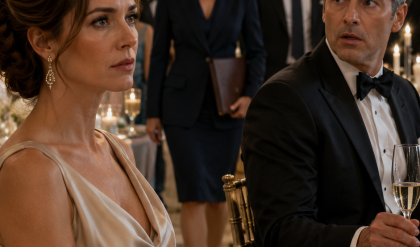
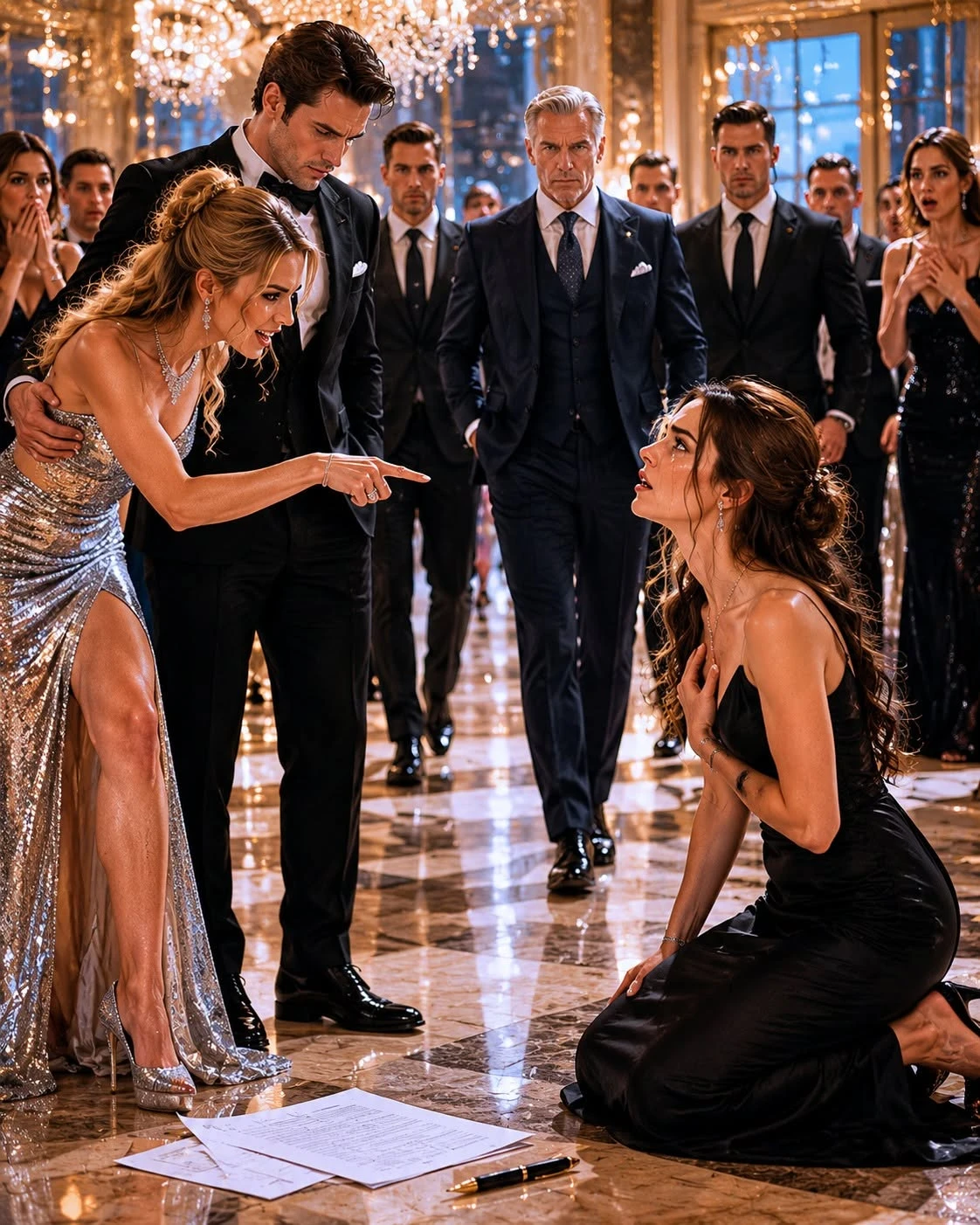
The gold Montblanc pen rolled across the polished stage and stopped beside my shoe like a tiny insult dressed in luxury. For a moment, the entire Plaza ballroom seemed to hold its breath. Three hundred guests stood beneath crystal chandeliers and gold-leaf ceilings, their champagne glasses suspended halfway to their mouths, their jeweled wrists and tailored cuffs frozen in the light.
The floral arrangements I had chosen myself—white orchids, winter roses, and eucalyptus—gave off a clean, expensive fragrance that suddenly smelled like a funeral.
My funeral, apparently.
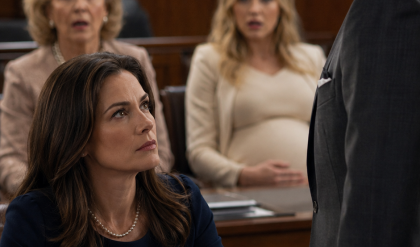
Ethan Caldwell stood above me with divorce papers in one hand and my humiliation in the other.
He was wearing the black tuxedo I had picked up from the tailor that morning. I had asked the tailor to press the lapels twice because Ethan hated a soft crease in photographs. I had checked the cufflinks, steamed the shirt, reminded his driver of the schedule, and reviewed every detail of the anniversary gala he claimed was meant to celebrate both our marriage and the coming public offering of Caldwell Technologies.
Now he stood under the stage lights, grinning like a man who had mistaken cruelty for power.
“Sign them, Olivia,” he said into the microphone, his voice ringing across the ballroom with terrifying clarity. “Sign them and stop embarrassing yourself.”
Beside him, Miranda Chun lifted one manicured hand to her mouth, pretending to hide her laughter.
The diamond necklace at her throat caught the light and scattered it across the stage in bright, hard sparks.
I recognized that necklace.
Cartier.
Sixty thousand dollars.
The invoice had passed through a vendor account marked strategic consulting expense. At the time, I had not confronted him. I had simply copied the file, dated it, and sent it to a secure drive.
Ethan thought I had not noticed.
Men like Ethan always believed silence meant ignorance.
Miranda stepped closer to the microphone. She was twenty-four, polished, hungry, and so breathtakingly confident in her own cruelty that I almost admired the purity of it. She had the look of a woman who had been told by a powerful man that she was special and had decided that meant she was untouchable.
“Don’t make this harder for him,” she said sweetly. “You’ve already taken enough from him.”
A murmur moved through the room.
Not outrage.
Not yet.
People were still trying to understand where the performance ended and the scandal began.
I looked down at the papers in my hand.
Petition for divorce.
Waiver of support.
Voluntary relinquishment of marital claims.
A laughable little trap wrapped in legal language. He had expected me to be too shocked to read, too humiliated to resist, too desperate to understand that nothing in those papers could stand once real lawyers touched them.
But Ethan had never respected what I knew.
He had liked me most when I was quiet at dinner, when I sat beside him while investors praised his vision, when I let him tell stories about building Caldwell Technologies from nothing. He never mentioned the bridge loan that saved him from bankruptcy. He never mentioned the anonymous investment group that rescued his servers, cleared vendor debt, and allowed him to hire the engineering team that later made him famous.
He never asked why the investment terms had favored him so generously.
He never wondered why doors opened when I made a single quiet introduction.
He wanted a wife who made him look stable.
So I became one.
For three years, I wore the simple dresses. I smiled when his executives mispronounced my name. I listened when he called my family “small town people” from Ohio, even though my father owned half the buildings those executives worked in.
I hid my degrees, my inheritance, my board seats, my private name.
I used my mother’s surname, Evans, because I wanted one thing my money could not buy.
I wanted to be loved without it.
That had been my mistake.
“Look at her,” Ethan said, spreading one arm toward the crowd. “This is what dead weight looks like. I carried her for years. I fed her, clothed her, gave her access to rooms she never deserved. And how does she repay me? By making herself a burden while my company is finally ready to go public.”
His voice thickened with alcohol and self-importance. I could smell the scotch on him from three feet away. I could also smell Miranda’s perfume, a heavy white floral scent that had clung to his shirts for months.
Someone in the front row shifted uncomfortably.
A woman near the aisle lowered her glass.
My eyes moved across the crowd and found faces I knew well enough to read.
Some were disgusted.
Some were entertained.
Most were waiting to see who would win before deciding what they thought.
That was how rooms like this worked.
Power first.
Morality after.
Ethan stepped closer and forced the papers against my chest.
“You couldn’t even give me a child.”
That sentence cut deeper than the others.
Not because it was new.
Because he knew exactly where to aim.
The first miscarriage had happened in late winter. There had been snow melting against the hospital windows and blood on a white tile floor. Ethan had held my hand for the first hour, then spent the second in the hallway on a business call.
The second miscarriage had come six months later.
After that, he stopped touching me with tenderness.
He began treating my body like a failed investment.
Too much cost.
No return.
Miranda tilted her head, her expression false with pity.
“Just take the settlement, Olivia. Five thousand dollars is generous considering you contributed nothing.”
The laughter from a cluster of junior executives was small, nervous, and eager.
I bent down and picked up the pen.
The room watched me.
Ethan watched me.
Miranda watched me.
Three hundred people watched the poor discarded wife reach for the symbol of her own erasure.
The metal was cool against my palm.
Something inside me went quiet.
Not numb.
Quiet.
There is a kind of peace that arrives only after pain has gone too far. It is not forgiveness. It is not surrender. It is the stillness of a blade being drawn from a sheath.
“All right,” I said.
Ethan blinked. “What?”
I straightened, smoothing the front of my black dress with one hand.
“I said all right. I’ll sign.”
His smile returned, wide and vulgar with triumph. He turned to the room as if accepting applause.
“See? Even she knows when she’s beaten.”
I placed the papers on the small signing table near the podium.
I read just enough to make the moment last.
Then I signed the first page.
Olivia Evans Caldwell.
Second page.
Third.
Fourth.
The pen moved with perfect control.
No shaking.
No tears.
No dramatic pause.
Just ink and intention.
When I finished, I capped the pen and placed it gently on top of the papers.
“There,” I said. “We’re done.”
Ethan snatched the documents and barely looked at them. He was already turning back toward Miranda, already dismissing me from the stage, from his life, from the narrative he thought he had written.
“Security will escort you out.”
Two men in dark suits appeared near the staircase.
Miranda leaned toward me as I passed her.
“Try not to cry in the service hallway,” she whispered. “It makes the staff uncomfortable.”
I stopped for half a second.
Not long enough for the room to notice.
Long enough for her to see my eyes.
Her smile flickered.
Then I walked down the stairs.
The applause did not come.
That was the first thing Ethan failed to understand.
He had expected the room to reward him for cruelty because cruelty, when wrapped in enough money, often looked like strength. He had expected polite laughter, champagne raised in agreement, investors exchanging knowing glances as if discarding a wife were no different from trimming a weak department before an IPO.
Instead, the ballroom remained suspended in that strange, stunned silence.
I could feel every stare on my back as I crossed the floor.
The marble was cold beneath my heels.
My skin felt too tight.
I heard Miranda laugh again, softer this time, as if trying to restart the room with sheer confidence.
“Poor thing,” she said into the microphone.
Then, louder, because she had tasted attention and wanted more.
“A broke parasite always screams when the host finally pulls away.”
That did it.
A few people gasped.
Somebody said, “Jesus.”
Ethan laughed, but it came out uneven.
And I kept walking.
Not because her words did not hurt.
They did.
They landed in places I thought had already been destroyed. They found the girl I had once been at twenty-six, standing in a courthouse bathroom after my wedding, staring at my reflection and wondering whether Ethan loved me or the version of me I had carefully built for him.
Small.
Grateful.
Manageable.
They found the woman who had sat alone in a fertility clinic while he missed another appointment.
They found the wife who had watched him come home late smelling like perfume and lies, then quietly washed his shirts because part of her still hoped decency might return if she remained decent long enough.
But pain was not the same as defeat.
I reached the ballroom doors.
The two men Ethan had sent moved toward me.
They were hotel security, not his private guards. One looked embarrassed. The other looked tired. Neither wanted to drag a humiliated woman out of a gala in front of Manhattan’s wealthy elite.
“Mrs. Caldwell,” the older one said under his breath, “we were told to escort you—”
“You don’t need to touch me,” I said.
He swallowed.
“No, ma’am.”
Behind me, Ethan’s voice rose again.
“Now,” he said, too brightly, “shall we get back to why we’re really here? Caldwell Technologies is entering a new era. Tonight is about vision. Discipline. Removing liabilities.”
Liabilities.
That was what I was now.
The ballroom doors opened before my hand touched them.
At first, I thought a late guest had arrived.
Then the air changed.
It happened so quickly and so completely that even before I saw them, I knew they were not guests.
A line of men and women in charcoal suits entered with the kind of controlled silence that made sound feel disrespectful. They did not hurry. They did not hesitate. Their shoes moved across the marble in perfect rhythm.
No badges flashed.
No weapons showed.
They did not need either.
Authority came off them like winter air.
At the center walked Marcus Vale.
My father’s head of security.
Sixty years old. Silver hair. Broad shoulders. A face carved from patience and war. He had guarded presidents, oil heirs, kidnapped children, and my mother during the last two years of her illness. When I was seventeen and drunk boys at a charity regatta cornered me behind a boathouse, Marcus had appeared out of nowhere and said only one sentence.
“Miss Vale is going home now.”
No one had argued then.
No one argued now.
He stopped in front of me.
For the first time that night, my knees almost gave.
Not because I was afraid.
Because I had not called him.
I had not called anyone.
“Miss Vale,” Marcus said.
The old name cut through the ballroom louder than the microphone.
Behind me, something shattered.
A glass.
Maybe a plate.
Maybe Ethan’s certainty.
I looked at Marcus, and for one dangerous second, I was a child again, standing barefoot in the great marble foyer of my father’s house after my mother’s funeral, refusing to cry because crying would make the silence real.
“Marcus,” I whispered.
His eyes moved over my face.
He saw everything.
The stage lights.
The papers.
The men near the door.
The way I was holding myself together with invisible wire.
His jaw tightened once.
Then he turned his head slightly.
“Secure the exits,” he said.
The team moved.
Not fast.
Not dramatically.
Just decisively.
Two went to the main doors. Two to the side corridors. One approached the audiovisual booth. Another spoke quietly to the hotel manager, whose face went pale the instant he recognized the crest on Marcus’s lapel pin.
A black rook beneath a silver laurel.
Vale Global.
The most discreet private security firm in the Western world, owned by the Vale family and used only when ordinary power was insufficient.
The room noticed.
Of course it noticed.
Money recognized money.
But real power recognized infrastructure.
Ethan stopped speaking mid-sentence.
The microphone caught the wet sound of his breath.
“Olivia?” he said.
I turned.
He was still on the stage, divorce papers in one hand, Miranda at his side. Her smirk was gone. She was staring at Marcus like a woman who had just realized the floor beneath her was painted glass.
Ethan looked from the security team to me.
“What is this?”
Marcus answered before I could.
“Mr. Caldwell, step away from Ms. Vale.”
The sound that moved through the ballroom was not a gasp this time.
It was a collapse.
A hundred whispers falling into each other.
Vale?
Did he say Vale?
As in Gabriel Vale?
No.
Impossible.
Ethan laughed once.
It was a terrible sound.
“Ms. what?”
I looked at him.
For three years, I had imagined this moment in flashes.
Sometimes in anger.
Sometimes in grief.
Sometimes in the shower at two in the morning, after finding another receipt, another lie, another little cruelty I had pretended not to see.
In those imagined moments, I was colder.
Sharper.
I said something devastating. Something perfect. Something that made the whole room understand.
But real heartbreak is less elegant than fantasy.
When I finally spoke, my voice was quiet.
“My full name is Olivia Margaret Vale Evans Caldwell.”
The microphone picked it up because Ethan was still holding his.
Every syllable traveled.
Every guest heard it.
Every investor understood it faster than he did.
Ethan stared.
“No,” he said.
It was almost tender, that denial.
As if the universe had made a bookkeeping error.
Miranda stepped back from the microphone.
“Ethan,” she whispered. “What does she mean?”
He did not look at her.
He was looking at me with the expression of a man watching a locked door open from the inside.
“You told me your father ran a logistics company in Ohio,” he said.
“He does.”
Marcus’s voice was flat.
“Among other things.”
There were nervous laughs from the back of the room. They died quickly.
Ethan descended one step from the stage.
“You lied to me.”
That almost made me smile.
Almost.
“No,” I said. “I gave you the chance to love someone you believed had nothing to offer you.”
His face changed.
A flicker of memory passed across it.
Our first dinner.
The cheap Thai restaurant in Queens where he had been so charming, so hungry, so full of plans. He had worn a navy suit too tight at the shoulders and talked with his hands about building software that would help hospitals manage critical supply chains. Back then, his ambition had not looked ugly. It had looked alive.
I had loved that aliveness.
I had loved the way he said my name before he knew what it could buy.
At least, I thought I had.
“You tested me?” he said.
“I trusted you.”
The difference landed harder than I expected.
Even on me.
Miranda suddenly found her courage again.
“This is ridiculous,” she snapped, reaching for the microphone. “Anyone can hire bodyguards and invent a name. She’s desperate. She’s been living off Ethan for years.”
Marcus lifted one hand.
The ballroom screens behind the stage flickered.
For a second, there was only blue light.
Then the Caldwell Technologies gala logo vanished.
In its place appeared a corporate ownership chart.
At the top sat a name no one in the room could ignore.
ORCHID VENTURES HOLDING TRUST.
Beneath it, in clean black lines, were percentages, subsidiaries, voting rights, convertible notes, board appointments, and emergency covenants.
I watched Ethan’s eyes move over the screen.
Watched him recognize pieces of his own company he had never bothered to understand because understanding paperwork was for lawyers and wives.
The bridge loan from year one.
The emergency server financing.
The vendor debt purchase.
The convertible notes he had celebrated as a miracle.
The silent board seat he had ignored because it belonged to an entity, not a person.
Miranda’s lips parted.
One of Ethan’s board members stood from his chair.
“Olivia,” he said slowly. “You’re Orchid?”
I looked at him.
“I control Orchid.”
A low sound rolled through the room.
Not applause.
Not anger.
Recognition.
The ugly birth of a new social order.
Ethan’s hand tightened around the divorce papers.
His knuckles went white.
“That’s impossible,” he said. “Orchid saved us before I married you.”
“Yes.”
“You weren’t—”
“I was twenty-seven,” I said. “Not helpless.”
His mouth opened.
Closed.
On the screen, another document appeared.
A term sheet.
Then another.
Then emails.
Then invoices.
I did not look at them.
I knew what they showed.
Personal expenses disguised as consulting fees.
Company funds routed through sham vendors.
Miranda’s necklace.
Her apartment.
Two first-class tickets to Santorini purchased the weekend after my second miscarriage.
A private gynecology consultation billed under an executive wellness budget.
That one made Miranda go still.
Very still.
Ethan turned on her.
“What is that?”
Her face drained.
I had wondered when he would discover she had not been as faithful to him as he had expected me to be to humiliation.
But that was not my concern anymore.
“You used investor funds,” I said, “to maintain an affair while preparing a public offering.”
“I can explain.”
“No,” said a voice from the front row.
Cassandra Holt, Caldwell’s chief financial officer, stood slowly.
She had always been careful around me. Not kind, exactly, but not cruel. She was the only executive who thanked me by name after events. The only one who had once found me in the kitchen of our home during a company dinner and said, “You know more than he gives you credit for.”
Now she looked at Ethan with something like exhaustion.
“No, Ethan,” Cassandra said. “You can’t.”
His head snapped toward her.
“Sit down.”
She did not.
The room held its breath again.
Cassandra lifted her tablet.
“I was contacted by counsel for Orchid Ventures six weeks ago,” she said. “I cooperated.”
Ethan stared at her as if betrayal were something only other people committed.
“You what?”
“I cooperated,” she repeated. “Because I’m not going to prison for your ego.”
Somewhere near the back, someone whispered, “Oh my God.”
Marcus looked at me.
I knew that look.
He was asking permission.
Not as a guard.
As a man who had known me since I wore braces and ballet slippers, who had seen me break my arm falling from a horse and refuse painkillers because my father was in a board meeting and I didn’t want to bother him.
He was asking whether to stop.
Whether I wanted mercy.
That was the strange thing about power.
The people who never have it often imagine it as loud.
A slam.
A shout.
A punishment.
But real power is usually a pause.
A hand waiting above a lever.
A choice no one else knows you are making.
I looked at Ethan.
And for one breath, I saw the man I married.
Not the monster on the stage.
The man before the rot fully showed.
The man who had once fallen asleep on our apartment floor with acquisition documents spread across his chest, one hand still holding mine.
The man who kissed my temple in a grocery store because I remembered his favorite cereal.
The man who cried for exactly nine seconds after our first miscarriage before deciding grief was inefficient.
I had loved him.
That was the most humiliating truth of all.
Not that he fooled me.
That I had stayed after I knew better.
“Olivia,” Ethan said, and now my name sounded different in his mouth.
Not softer.
More careful.
“Liv. We can talk.”
The nickname scraped against my heart.
Miranda looked between us in panic.
“Ethan?”
He ignored her.
Of course he did.
Women like Miranda always thought being chosen by a disloyal man meant winning.
They never understood the prize was temporary by nature.
Ethan came down another step.
“I didn’t know,” he said. “You have to understand, I didn’t know who you were.”
The words were so honest that the room seemed to flinch.
I let them hang there.
Then I said, “That was the point.”
His face twisted.
“No, I mean—”
“I know what you mean.”
And I did.
He would have loved me differently if he had known.
That was the tragedy.
Not because it meant he loved me.
Because it meant he understood how to behave when wealth was watching.
Miranda suddenly grabbed the microphone.
“She tricked him!” she cried. “She manipulated him! She hid her identity like some kind of sick game and now she’s trying to ruin a man who gave her everything.”
Marcus took one step forward.
She stepped back at once.
I turned to her.
The ballroom lights made her necklace flare.
My necklace, really.
Bought with money stolen from a company my trust had kept alive.
“You called me a broke parasite,” I said.
Her mouth opened.
No sound came.
“I want you to remember that sentence,” I continued. “Not because it hurt me. Because one day, when no one will answer your calls, when every door you thought was open suddenly requires references you don’t have, when the women you laughed at become the women deciding whether you enter the room at all, I want you to understand that your cruelty was not confidence.”
I stepped closer.
“It was borrowed power.”
Miranda’s eyes filled with tears.
Real ones, this time.
I felt no pleasure.
That surprised me.
For months, I had imagined exposing her. I had imagined watching that perfect face crack. I had imagined satisfaction so clean it might wash away the smell of her perfume on my husband’s collar.
But revenge did not feel clean.
It felt like standing in the ashes of a house I had once begged God to save.
Marcus spoke again.
“Mr. Caldwell, the board has convened an emergency session pursuant to Section Nine of the Orchid Ventures financing agreement. Effective immediately, your executive authority is suspended pending investigation.”
Ethan’s eyes bulged.
“You can’t do that.”
“I can,” I said.
He shook his head.
“No. No, you can’t. This is my company.”
The screen changed.
A video appeared.
My father.
The room went silent so suddenly that I heard Miranda’s breath catch.
Gabriel Vale was not a man who looked fragile.
Even at seventy-one, he carried himself with an old-world severity that made billionaires straighten their jackets and senators check their facts. In public photographs, he appeared carved from dark wood and winter. Thick silver hair. Deep-set eyes. Shoulders that made expensive suits look structural.
But on the screen, he was in a hospital bed.
The lighting was soft.
Too soft.
His face was thinner than I remembered from our last lunch.
An oxygen line rested beneath his nose.
Machines blinked behind him.
My chest tightened.
I had not seen this recording.
“Good evening,” my father said, his voice rough but unmistakable. “My name is Gabriel Marcus Vale. For those in this room who pretend not to know me, I appreciate your commitment to theater.”
A few shocked laughs broke through the tension.
I could barely breathe.
Marcus’s face had gone still beside me.
My father continued.
“Three years ago, my daughter asked me not to interfere in her marriage. She wanted privacy. She wanted ordinary love. Against every instinct I possess, I honored that request.”
His eyes shifted slightly, as if looking not at the camera, but through it.
At me.
“I will not pretend I enjoyed watching her shrink herself to fit inside a man’s insecurity. I will not pretend I respected her husband. I did not. But I respected her right to choose.”
Ethan’s face had turned gray.
My father coughed once.
The sound tore through me.
“However,” he said, “there is a difference between privacy and abandonment. There is a difference between a marriage failing and a woman being publicly stripped of dignity by a man who owes his fortune to her mercy.”
I pressed my hand against my stomach.
The room blurred at the edges.
My father’s recorded voice filled the ballroom.
“If this message is being played, then Mr. Caldwell has crossed a line my daughter asked me to let her define. The documents now shown to you have been reviewed by counsel. The authority being exercised tonight belongs not to me, but to Olivia. I am not rescuing her.”
He paused.
His tired eyes sharpened.
“I am reminding all of you that she never needed rescuing.”
Something inside me cracked.
Not loudly.
Not visibly.
But deeply enough that I knew I would feel it forever.
On the stage, Ethan sank into the nearest chair.
The divorce papers slid from his hand and scattered across the floor like dead birds.
My father looked older in the recording than he had sounded on the phone the night before. He had called me at 11:38 p.m. I had let it ring because I was in the hotel ballroom finalizing seating cards and pretending not to notice Ethan texting under the table.
He had left a voicemail.
I had not listened.
I told myself I would call him after the gala.
After the speeches.
After I survived one more evening as Mrs. Ethan Caldwell.
On the screen, he took a slow breath.
“To the investors in this room: you may decide tomorrow what your appetite for scandal is. To the board: you have your fiduciary obligations. To Mr. Caldwell: you will learn that humiliation is not a strategy. To my daughter…”
His voice changed.
It became private.
Too private for the ballroom.
“My Olivia. You were never small. You were only standing beside someone who needed you to bend. Stand up now.”
My hand flew to my mouth.
I hated that I cried then.
Not when Ethan insulted me.
Not when Miranda called me barren.
Not when three hundred people watched my marriage bleed across a stage.
I cried when my father called me his.
The screen went dark.
For several seconds, no one moved.
Then Cassandra began clapping.
One clap.
Clean.
Sharp.
Brave.
Another followed.
Then another.
Not the wild applause of celebration.
Not the cheap thunder of entertainment.
Something slower.
Heavier.
A room of powerful people recalculating not only money, but shame.
Ethan looked up at me through the sound.
“Olivia,” he whispered.
I went back up the stairs.
Every step felt unreal.
Miranda moved away from me as if I were fire.
I picked up the divorce papers from the floor.
My signature was there, neat and calm on every page.
Ethan watched my hands.
“You signed,” he said, seizing on it like a drowning man finding wood. “You signed them. Everyone saw.”
“Yes.”
“Then you waived—”
“I signed the acknowledgment copy.”
His face emptied.
“The legal originals were never on that table.”
Marcus held up a second folder.
Cream paper.
Red tabs.
Actual signatures.
Actual seals.
Actual consequence.
My attorney, Evelyn Price, appeared at the side of the stage like she had materialized from expensive smoke. She was small, severe, and terrifying in a white pantsuit that made every man near her look underdressed.
“Mr. Caldwell,” she said, “you attempted to coerce a signature under public duress in front of witnesses, while intoxicated, using fraudulent financial disclosures. Thank you.”
Ethan stared at her.
“For what?”
“For making my work easier.”
Someone in the room made a strangled sound that might have been a laugh.
Evelyn turned to me.
“Mrs. Caldwell?”
The name hurt.
Not because I wanted it.
Because I had wanted it once.
Because there had been a morning after our wedding when Ethan traced those letters on my bare shoulder and said, “Mine,” and I mistook possession for devotion.
I looked at him now.
His bow tie had gone crooked.
His mouth trembled.
All the polish was leaving him.
Without power, he looked ordinary.
Worse.
He looked afraid.
“You called me dead weight,” I said.
He flinched.
“You called me a burden.”
“Liv, I was angry.”
“You told three hundred people I couldn’t give you a child.”
His eyes dropped.
That was the first time he looked ashamed.
Or perhaps just aware that shame was useful.
“I shouldn’t have said that.”
“No,” I said. “You shouldn’t have thought it.”
The sentence broke something open in me.
The years rushed forward.
The hospital smell.
The white tile.
The ultrasound screen with no heartbeat.
The way he stopped saying “our baby” and started saying “the pregnancy.”
The way Miranda had once touched her stomach in a restaurant when she saw me watching them, smiling like she knew exactly where to cut.
I placed the false divorce papers against Ethan’s chest.
“Keep these,” I said. “They’re the only version of our marriage where you leave with anything.”
His hands closed around them automatically.
“Olivia, please.”
There it was.
Please.
The word every cruel person discovers when cruelty stops working.
I turned to Evelyn.
“File everything.”
She nodded.
“With pleasure.”
Miranda suddenly rushed toward Ethan.
“Tell them she’s lying,” she demanded. “Tell them you love me. Ethan, tell them.”
He looked at her as if remembering she existed.
For a moment, I almost pitied her.
Almost.
Because she was learning in public what I had learned slowly in private.
Ethan Caldwell loved whatever protected Ethan Caldwell.
Nothing else.
No wife.
No mistress.
No unborn child.
No promise.
No woman had ever been the center of his life.
Only the mirror.
“Miranda,” he said weakly, “not now.”
Her face collapsed.
The necklace at her throat trembled.
She lifted her hand to it as if diamonds could steady her pulse.
Cassandra stepped onto the stage with two board members behind her.
“Ethan,” she said, “we need your company laptop and phone.”
He laughed in disbelief.
“You can’t be serious.”
One of the board members, an older man who had toasted Ethan twenty minutes earlier, would not meet his eyes.
“It’s over,” he said.
That was when Ethan looked at me with pure hatred.
Not grief.
Not regret.
Hatred.
The mask fell completely, and there he was.
The man beneath the tuxedo.
“You think this makes you better than me?” he spat.
“No.”
“You think your father’s money makes you untouchable?”
“No.”
“You’re still the same sad woman who couldn’t make her husband stay.”
The room went still again.
But this time, the silence was not against me.
It gathered behind me.
I felt it.
The difference.
Power first.
Morality after.
Now power had moved.
And morality, obedient as ever, followed.
I stepped close enough that only he could hear the first part.
“You didn’t leave me, Ethan.”
His eyes burned.
“You auditioned for a life you were never qualified to enter.”
Then louder, for the microphone still catching every word, I said, “And you failed.”
I walked away before he could answer.
That was the last mercy I gave him.
The aftermath did not explode.
It unfolded.
That was worse.
Explosions end quickly.
Unfolding gives everyone time to watch.
Caldwell Technologies’ general counsel arrived with a face like wet cement. Two investors left through the side exit, already on their phones. Miranda tried to leave with Ethan’s driver, but Marcus’s team stopped her long enough for hotel security to document the jewelry, the corporate card in her purse, and the fact that she had been wearing a company-funded mistake around her neck.
She cried then.
Not beautifully.
Not delicately.
She cried with her mouth open, mascara slipping into the corners of her lips, one hand gripping Ethan’s sleeve while he tried to pull away.
“Don’t let them do this to me,” she sobbed.
Ethan looked at the cameras.
The guests.
The board.
Me.
And then he removed her hand from his arm.
Just like that.
Miranda stared at him.
The sound she made was small enough that I almost wished I had not heard it.
Because beneath all the cruelty, all the vanity, all the greed, there had still been a foolish young woman who thought being chosen by him meant she was safe.
No one was safe near Ethan Caldwell.
Not even the women who helped him hurt other women.
I stepped off the stage and entered the side corridor with Marcus beside me.
The noise of the ballroom faded behind heavy doors.
For the first time in an hour, I was away from the chandeliers, the cameras, the flowers, the spectacle of my own undoing.
The hallway smelled like lemon polish and cold air.
My heels sank slightly into the runner carpet.
And then I folded.
Not dramatically.
My body simply stopped pretending.
Marcus caught me before I hit the wall.
“Miss Olivia.”
His voice broke on my name.
That undid me more than anything.
I gripped his sleeve and sobbed once.
Only once.
A hard, ugly sound I could not swallow.
“I didn’t call you,” I said.
“I know.”
“How did you know?”
He did not answer.
That was when fear entered the room.
Not the sharp fear of scandal.
Something older.
Colder.
“Marcus.”
He looked toward the end of the corridor.
A black car waited beyond the service entrance, engine running, rear door open.
“Your father sent us,” he said.
I pulled back.
“When?”
His silence was too careful.
My heartbeat changed.
It no longer felt like a rhythm.
It felt like a knock.
“Marcus,” I said again.
His eyes shone.
Not with tears.
Marcus Vale did not cry.
But with something worse.
A grief already disciplined into duty.
“Your father was admitted to Mount Sinai this afternoon.”
The corridor tilted.
“No.”
“He instructed us not to tell you until after the gala unless—”
“No.”
“—unless Mr. Caldwell attempted public coercion or physical removal.”
The words came from far away.
This afternoon.
Hospital.
Not tell you.
After the gala.
My hand went to my phone.
I had silenced it during dinner.
There were missed calls.
Eleven from my father’s private number.
Four from his physician.
Three from Marcus.
One voicemail from last night still unopened.
My throat closed.
“I need to go.”
“The car is ready.”
I moved.
Then stopped.
Behind the ballroom doors, I could hear Ethan shouting now.
His voice rose and cracked.
A man losing everything always sounded shocked, as if consequences were a foreign language spoken only to other people.
I looked back once.
Not because I loved him.
Because a life does not become meaningless simply because it was built on lies.
Three years of marriage still had weight.
The dinners.
The mornings.
The lost babies.
The hope.
The humiliation.
The quiet.
All of it stood behind those doors with him, collapsing.
Then Marcus touched my shoulder.
“Olivia.”
And I ran.
New York blurred outside the car windows.
The city was all wet pavement and red brake lights, glass towers streaked with rain, strangers under umbrellas stepping around puddles without knowing my world had split in two.
Marcus sat beside me.
No one spoke.
My phone lay in my lap like evidence.
I stared at my father’s missed calls until the numbers became meaningless.
I had been angry with him for years.
Quietly.
Politely.
In the elegant, educated way children of powerful men learn to be angry.
He had missed school plays for mergers. Left birthday dinners for flights to Zurich. Sent jewelry after arguments instead of apologies. When my mother died, he had stood beside the grave without removing his sunglasses, and I had hated him for looking like a statue when I needed him to look broken.
Later, I understood people grieve according to the architecture available inside them.
My father’s architecture had been built for survival, not softness.
But he had loved me.
Awkwardly.
Fiercely.
Imperfectly.
He had loved me through trust structures and security protocols, through driver rotations and medical specialists, through background checks I found suffocating and contingency plans I called paranoid.
He had loved me by preparing for every disaster except the one where his daughter stopped answering the phone.
I tapped the voicemail.
His voice filled the back seat.
“Liv.”
One word.
That was all it took.
I bent forward as if struck.
He sounded tired.
Not weak, exactly.
Just far away.
“I know you’re busy tonight,” he said. “You always did inherit my unfortunate talent for pretending work is armor.”
There was a pause.
A faint mechanical beep in the background.
“I wanted to tell you something before your gala. Not because I think something will happen. Marcus thinks something will happen. Marcus always thinks something will happen.”
A soft breath.
Almost a laugh.
“I wanted to tell you that I’m proud of you. Not of the money. Not Orchid. Not the board seats you think I don’t know you manage better than half the men on Wall Street. I am proud of the fact that you tried to be loved honestly.”
My vision blurred.
“That is not foolish,” he said. “Do you hear me? It is not foolish to want someone to love you without the name, without the money, without the walls we build because we are afraid people only come close to steal heat.”
The car passed beneath white hospital lights.
His voice continued.
“If Ethan is the man you believe he can be, bring him to dinner Sunday. I will behave for ninety minutes. Possibly eighty.”
I made a sound between a laugh and a sob.
“If he is not,” my father said, and now his voice hardened, “then come home. Not to the house. To yourself. Come home to yourself, Olivia.”
The voicemail ended.
No dramatic goodbye.
No final wisdom.
Just a click.
The cruel ordinary ending of a message he thought I would hear in time.
We reached the hospital at 10:42 p.m.
Marcus did not make me go through the lobby.
He took me through a private entrance, past a nurse who recognized him and stepped aside with wet eyes.
That was when I knew.
Not fully.
Not in language.
But my body knew before my mind allowed it.
The hallway to the private wing was too quiet.
Hospitals at night have a sound unlike any other place on earth. Soft shoes. Distant wheels. Machines breathing for people who cannot. The murmur of families trying not to collapse where strangers can see.
My heels sounded obscene against the floor.
Too alive.
Too late.
A doctor met us outside the room.
She was small, with gray at her temples and kindness arranged carefully on her face.
I hated her at once.
Not personally.
I hated what her face had been trained to deliver.
“Ms. Vale,” she said.
“No,” I said.
She stopped.
Her eyes softened further.
That made it worse.
“I’m sorry.”
Two words.
The whole world reduced to two words.
I walked past her.
Marcus said my name, but I kept going.
The room was dim.
Machines stood silent now.
Someone had drawn the curtains halfway, leaving the city lights beyond the glass scattered like fallen stars.
My father lay in the bed.
Still.
Too still.
Without the force of his attention, his face looked unfamiliar. Smaller. Human in a way he had spent his life refusing to be.
I stood in the doorway and waited for rage.
For screaming.
For denial.
Nothing came.
Only a child’s thought.
A stupid, broken, impossible thought.
Daddy, wake up.
I went to him.
His hand was outside the blanket.
The same hand that had signed billion-dollar acquisitions, buttoned my coat when I was five, held my mother’s fingers during chemotherapy, gripped mine too hard at her funeral because he did not know how to ask me to stay.
I touched it.
Cold.
Not icy.
Not like movies.
Just absent.
That was worse.
The body remains, but the person has stepped out of the room forever.
On the bedside table sat a black leather folder.
My name was written across it in my father’s handwriting.
Olivia.
I did not open it at first.
I sat beside him.
I do not know how long.
Marcus stood outside the door.
The city kept shining.
Somewhere downtown, Ethan Caldwell was being removed from his own company.
Miranda Chun was probably calling people who would not answer.
Investors were rewriting statements.
Lawyers were sharpening knives.
The world was rearranging itself around power, money, scandal, consequence.
And I sat beside my father’s body thinking about a voicemail I had not answered because I was busy arranging flowers for a man who hated me.
Eventually, I opened the folder.
Inside were documents.
Of course there were.
My father had never trusted emotion to travel without paperwork.
There was a letter on top.
My hands shook so badly I had to place the paper flat against my lap.
My Olivia,
If you are reading this, Marcus has either frightened someone, disappointed someone, or obeyed me precisely. Perhaps all three.
I hope I am alive when you read it. If I am not, I apologize for leaving you with another mess to manage. You have always been better at cleaning up after powerful men than any daughter should have to be.
I stopped.
Pressed the paper to my mouth.
Then kept reading.
I built walls because I thought they would protect you. Your mother spent twenty-eight years trying to teach me that walls also keep love out. She was right, as usual.
When you married Ethan under your mother’s name, I was angry. Not because you hid from the Vale name, but because I knew how badly you wanted to be chosen for yourself. People like us are not allowed simple tests. Money contaminates every room before we enter it. You wanted one uncontaminated room.
I understand now.
And I am sorry that I did not tell you sooner.
The Orchid Trust was never my gift to Ethan. It was my gift to you. You saved that company. You saw value where I saw an arrogant young man with expensive shoes and insufficient humility. I let the papers hide your hand because you asked me to.
But Olivia, hear me now.
Love that requires your disappearance is not love.
Marriage that feeds on your silence is not loyalty.
And a man who only recognizes your worth after learning your price never loved you. He merely discovered he had undervalued an asset.
I laughed then.
Once.
Brokenly.
Because even dying, my father could not resist making grief sound like a hostile acquisition.
The final paragraph was shorter.
Come home to yourself.
Use everything.
Apologize less.
Trust Marcus.
And when you are ready, forgive me only as much as I earned.
I love you more clumsily than you deserved, but more deeply than I ever knew how to say.
Dad.
I folded over the letter.
My body shook.
This time, I did not stop it.
I cried with my face against the edge of his blanket, not elegantly, not quietly, not like a woman trained for ballrooms and boardrooms and public collapse.
I cried like a daughter.
By dawn, the city had already decided what the story was.
Billionaire heiress exposed husband at IPO gala.
Tech founder removed after humiliating secret wife.
Mistress meltdown caught on camera.
Vale daughter was anonymous investor behind Caldwell Technologies.
The headlines were sharp.
Delicious.
Incomplete.
They made me sound powerful.
They did not mention the hospital.
They did not mention my father’s cold hand.
They did not mention the voicemail.
They did not mention that victory and devastation can arrive in the same car, sit on either side of you, and never speak.
Three days later, I returned to the penthouse I had shared with Ethan.
Not alone.
Marcus came with me.
So did Evelyn.
The locks had already been changed by court order. Ethan was staying at a hotel under a name no one believed. Miranda had vanished from social media, though not from subpoena lists.
The apartment looked exactly as I had left it.
That offended me.
The white sofa. The glass table. The orchids by the window. Ethan’s architecture books arranged by color because he liked guests to think he read more than he did.
On the kitchen counter sat a mug I had washed the morning of the gala.
His mug.
Black ceramic.
World’s Best Founder, a gag gift from an employee he later fired.
I picked it up.
For a moment, I considered throwing it.
Instead, I placed it gently in the trash.
That felt better.
In the bedroom, Evelyn reviewed documents while Marcus checked rooms as if betrayal might be hiding in a closet.
I opened Ethan’s side of the wardrobe.
Rows of suits.
Italian wool.
Handmade shirts.
Shoes polished so perfectly they reflected the ceiling light.
I remembered kneeling once to help him pack for San Francisco, wrapping each shoe in tissue paper so they would not scuff. He had been on a call the whole time, snapping his fingers when he wanted another tie.
I had called it partnership then.
I had been very committed to misnaming my own loneliness.
At the back of the wardrobe, behind a garment bag, I found a small box.
Not hidden well.
Ethan had always underestimated drawers, passwords, women, and consequences.
Inside was a baby blanket.
Cream-colored.
Still folded in tissue.
My breath stopped.
It was from the first pregnancy.
I had bought it before twelve weeks, before caution could catch joy. Ethan had laughed when he saw it, lifted it to his cheek, and said, “Too soft. This kid is going to be spoiled.”
I had forgotten that version of him.
Or buried him.
Maybe both.
There was a photograph beneath the blanket.
Me asleep on the couch, one hand resting on my barely rounded stomach.
Ethan had taken it.
I knew because the angle was from his favorite chair.
On the back, in his handwriting, were four words.
Don’t mess this up.
I sat on the edge of the bed.
For one wild second, grief tried to rewrite him.
It offered me a softer story.
Maybe he had loved me once.
Maybe fear ruined him.
Maybe ambition infected what tenderness had been there.
Maybe.
But a match is still fire even if it began as warmth.
Evelyn found me holding the blanket.
Her expression changed.
“Olivia.”
“I’m fine.”
“No, you’re not.”
That was why I liked her.
She had no talent for polite lies.
I looked down at the blanket.
“I keep wondering where he went.”
“Who?”
“The man who took this picture.”
Evelyn was quiet for a long moment.
Then she said, “Maybe he was real. That doesn’t make the other one less real.”
I closed my eyes.
That was the thing no one tells you about leaving someone cruel.
You want them to have been cruel from the beginning.
It makes the story cleaner.
It makes you less ashamed.
But sometimes there were beautiful days.
Sometimes there was soup when you were sick.
Sometimes there were hands around your waist in a dark kitchen.
Sometimes the same mouth that later destroyed you once kissed your forehead like a promise.
And you have to survive the fact that both versions existed.
I took the blanket home with me.
Not to the penthouse.
Not to the mansion where I grew up.
To my father’s townhouse on East Seventy-Third, the one he used when he wanted to pretend he was a normal old man who liked walking to the same bakery every morning.
For weeks, I lived there quietly.
The world roared outside.
Ethan fought his suspension and lost.
Regulators opened inquiries.
Caldwell Technologies postponed the IPO indefinitely.
Miranda’s lawyers claimed she had been manipulated by a powerful CEO. Ethan’s lawyers claimed he had been deceived by a secret heiress. Everyone discovered victimhood once invoices became evidence.
I signed documents.
I attended calls.
I gave one statement, written by Evelyn but edited by me.
It said only this:
Caldwell Technologies was built by many people, not one man. My priority is protecting its employees, investors, and customers while accountability proceeds through proper channels.
Ethan sent letters.
Then emails.
Then flowers.
Then nothing for nine days.
On the tenth day, he came to the townhouse.
It was raining.
Of course it was.
Men like Ethan always returned in weather dramatic enough to flatter their regret.
Marcus saw him first on the cameras.
“You don’t have to see him,” he said.
“I know.”
But I did.
Not because he deserved it.
Because some doors must be closed by hand.
I met Ethan in the foyer.
He looked thinner.
Unshaven.
His expensive coat was soaked at the shoulders. Without assistants, without photographers, without Miranda, without a stage, he seemed almost young.
That made me angrier than if he had looked monstrous.
“Olivia,” he said.
“No.”
He stopped.
“You don’t know what I was going to say.”
“Yes, I do.”
His mouth trembled.
“I loved you.”
There it was.
The final insult.
Not because it was false.
Because it might have been partially true, and he still believed that mattered more than what he had done.
I looked at him across my father’s marble foyer.
The same foyer where Marcus had carried me upstairs after my mother’s funeral because I fell asleep crying on the bottom step.
“You loved being forgiven,” I said. “You loved being believed in. You loved coming home to a woman who made your life easier. You loved the reflection of yourself in my patience.”
His eyes filled.
“I made mistakes.”
“No, Ethan. You made choices.”
He swallowed.
“I didn’t know about your father.”
“I know.”
“If I had known—”
“You would have treated me better.”
He flinched.
“That’s not—”
“It is.”
The rain tapped against the windows like small impatient fingers.
For a second, neither of us spoke.
Then Ethan reached into his coat and pulled out something wrapped in tissue.
The baby blanket.
My heart lurched.
“You left this,” he said.
“No. I took mine.”
He looked confused.
Then I understood.
There had been two.
One I bought.
One he bought.
He held it out.
“I couldn’t throw it away.”
I stared at the blanket.
Tiny cream stars stitched along the edge.
A stupid, soft little thing meant for a life that never arrived.
The cruelty of it nearly brought me to my knees.
“I don’t know when I became what I became,” he whispered.
I believed him.
That was the hardest part.
“I do,” I said.
He looked up.
“It was every time you chose not to stop.”
His face crumpled.
I took the blanket.
Not for him.
For the child we lost.
For the woman I had been.
For the man he might have been in another life and was not strong enough to remain.
“Goodbye, Ethan.”
He nodded, crying silently now.
Then he did something I did not expect.
He looked past me to Marcus.
“Take care of her,” he said.
Marcus did not blink.
“I always have.”
Ethan left.
I watched through the window as he stepped into the rain and disappeared into a city that no longer opened for him.
I did not feel free immediately.
People lie about that.
Freedom is not always a door bursting open.
Sometimes it is a room after someone leaves, and the silence does not hurt as much as you expected.
Sometimes it is sleeping six hours without checking a phone.
Sometimes it is eating toast over the sink because no one is there to criticize crumbs.
Sometimes it is crying at noon and laughing at three and realizing no one will punish you for either.
Spring came slowly.
My father’s townhouse filled with light.
I replaced the white orchids with wildflowers from a corner shop. They were messy and bright and dropped petals all over the table. My father would have hated them.
So I bought more.
Caldwell Technologies became CT Medical Systems under interim leadership.
Cassandra became CEO.
The employees stayed.
The product survived.
Ethan did not go to prison, though for a while it looked possible. In the end, he took a settlement, resigned all claims, surrendered his shares, and became a cautionary tale whispered over investor dinners.
Miranda wrote me one letter.
Three pages.
Apology, explanation, self-defense, collapse.
I read it once.
Then I put it in a drawer.
I did not forgive her.
But I stopped carrying her.
That was enough.
On the first anniversary of my father’s death, Marcus drove me to the cemetery.
The sky was blue in that merciless way early autumn can be, beautiful without asking permission. I wore a simple navy dress and carried no flowers.
My father had never cared for flowers.
I brought a black coffee from his favorite bakery and placed it beside his grave.
“Still bitter,” I said. “Like you.”
The wind moved through the trees.
Marcus stood several yards away, pretending not to listen.
I sat on the grass.
For a long time, I said nothing.
Then I told my father everything.
I told him Cassandra was better at running the company than Ethan had ever been.
I told him I had moved into the townhouse permanently.
I told him I had finally opened the last room on the third floor and found my mother’s paintings wrapped in linen.
I told him I was angry.
Still.
At Ethan.
At myself.
At him.
At timing.
At the voicemail.
At the fact that love could be real and insufficient, protective and clumsy, present and too late.
The cemetery was quiet.
A leaf landed on the stone between us.
“I’m trying,” I said.
That was all.
Not I’m healed.
Not I forgive you.
Not I’m fine.
Just the truth.
I’m trying.
When I stood to leave, Marcus approached with an envelope.
I frowned.
“What is that?”
He looked uncomfortable.
Which, for Marcus, was like watching a mountain apologize.
“Your father instructed me to give this to you one year after his passing.”
“Of course he did.”
I took the envelope.
Inside was one photograph.
Old.
Slightly faded.
My mother sat on the back steps of our Ohio house, laughing at something beyond the camera. I was a baby in her arms, fat-cheeked and furious, one fist tangled in her necklace.
Beside her sat my father.
Not the Gabriel Vale of magazine covers.
Not the billionaire.
Not the strategist.
Just a young man in shirtsleeves, looking at his wife and child like the world had finally given him something he did not know how to deserve.
On the back, in my mother’s handwriting, were the words:
He is softer than he knows. Help him remember.
Behind the photo was a smaller note from my father.
I tried, my Olivia.
I pressed the photograph to my chest.
And that was when the happy ending broke open.
Not into sadness exactly.
Into something larger.
Because the twist was not that my father had been powerful.
I had always known that.
It was not that Ethan had been weak.
I had known that too, even when I refused to name it.
The twist was that while I had spent years hiding my name to find love, my father had spent those same years hiding his fear so I could have the chance.
He had not failed to come for me.
He had waited at the edge of my choice, aching, furious, obedient, until the one night I needed him most.
And by the time his security team walked in, he was already gone.
I turned the photograph over again.
My mother laughing.
My father watching her.
Me held safely between them.
For the first time in a year, I understood that I had not been abandoned in that ballroom.
I had been loved from a distance so disciplined it looked like silence.
Marcus helped me into the car.
The city moved past the window in gold and shadow.
In my lap, my father’s last photograph trembled gently with the motion of the road, and beneath my thumb, his handwritten words began to blur where my tears touched the ink.
On the white margin, all that remained clear was my mother’s laughing face, my father’s lowered eyes, and a baby who had no idea how many kinds of love would one day break her heart.