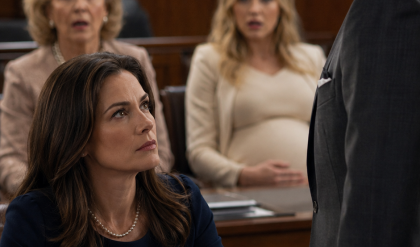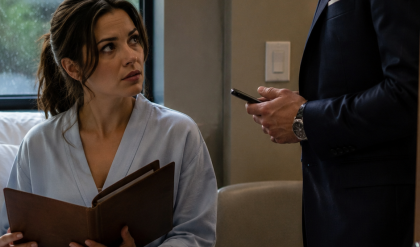
My husband forgot to log out of his company account on my computer.
Five minutes later, I found hundreds of messages between him and his young secretary.
By midnight, I understood he was not just cheating on me. He was trying to erase me from the company I had built with my own hands.
The morning everything changed began like every other Tuesday, which is probably why I remember it with such cruelty.
Nothing warned me.
No storm cracked open the sky. No glass slipped from my hand. No phone call came in the dark with a voice telling me to sit down before I heard the truth. It was simply a quiet October morning in the Chicago suburbs, the kind of morning that makes betrayal feel even more obscene because the world has the nerve to keep looking normal.
I woke at 6:30, slipped out of bed carefully so I would not disturb Daniel, and padded downstairs in gray slippers with one soft seam coming loose near the toe. The house was still dark, though a pale blue light had started gathering beyond the kitchen windows. Our neighborhood sat beneath a thin autumn fog. Maple leaves clung wetly to driveways. The lawns looked silver with dew. Somewhere down the block, a garage door opened with a mechanical groan and a car engine coughed itself awake.
I started coffee.
The machine clicked, hissed, and filled the kitchen with the smell of dark roast. For a few peaceful minutes, I stood at the island with both hands wrapped around my mug, watching warm light reflect in the black glass of the windows. The kitchen looked expensive and calm. White cabinets. Brushed brass handles. A marble island Daniel had insisted was “good for resale,” though he never cleaned it. A vase of dried hydrangeas near the sink. A stack of mail I had sorted the night before. A life arranged neatly enough to fool anyone passing through.
Including me, apparently.
Daniel came downstairs twenty minutes later already dressed in a navy suit, his tie loose around his neck, his phone in one hand and half a bagel in the other. He had always been good-looking in a polished, careless way. At forty-six, he still had thick brown hair with only a little gray at the temples, the kind men called distinguished and women called exhausting when they had lived long enough to know what kind of labor made a man appear effortless.
“Morning,” I said.
He barely looked up.
“Morning, Ev.”
Ev.
Once, I loved that nickname. He had first called me that when we were twenty-five and broke, sitting on the floor of a freezing garage behind our first rental house, eating takeout noodles from paper containers while debugging software that would eventually become the backbone of our company. Back then, his voice softened when he said it.
Now it came out like an automatic reply.
That should have hurt more than it did.
Seventeen years of marriage can turn little disappointments into background noise. You stop reacting to every missed glance, every distracted answer, every dinner where he checks his phone before asking about your day, because reacting to all of it would require admitting how lonely you have become inside a life other people admire.
Daniel poured coffee into a travel mug and scrolled through messages.
“Big meeting today?” I asked.
“With the Denver investors.” He took a bite of bagel, chewed too quickly, and checked his watch. “Boardroom at nine. If this goes well, we’re opening three new distribution hubs next year.”
“That’s wonderful.”
“It should be.”
He said it the way men say things when they believe success is less a possibility than a tribute the world owes them.
I looked at him across the island. “Do you need me to review the final projections?”
“No, it’s handled.”
That tiny sentence sat between us.
It’s handled.
For years, handled had meant I had done the quiet work before he entered the room. I had checked assumptions, corrected numbers, challenged legal language, softened investor concerns, protected timelines. Handled was a bridge I built under him before he reached the gap.
But recently, handled had begun meaning something else.
It meant excluded.
Daniel glanced at his watch again and cursed softly.
“I’ve got to go.”
Within seconds, he was grabbing his briefcase, collecting his keys, and moving toward the garage with the brisk urgency of a man who assumed the house would reset itself after he left.
“Love you,” he called over his shoulder.
“Love you too.”
The garage door opened.
Then closed.
The house became quiet.
I stood in the kitchen longer than necessary, holding my coffee and listening to the silence settle into the rooms. At forty-two, I had become more familiar with silence than I wanted to admit. Our daughter Sophie was away at Northwestern University, sending cheerful texts about midterms and dorm laundry and a philosophy professor who wore the same brown jacket every day. Daniel spent most of his time at the office, at conferences, at dinners, at meetings that stretched late into the evening.
And I spent my days managing investments, overseeing charitable projects, reviewing old estate obligations, sitting on foundation committees, and pretending I did not notice how completely my husband had stopped seeing me.
We had not always been this way.
There had been a time when Daniel could not wait to come home. A time when he brought me gas station coffee at midnight because we were both too stubborn to stop working. A time when he looked at me the way a man looks at someone who knows the cost of his dreams because she paid half of it.
Back when we were young.
Back when we were broke.
Back when the company was not yet named Carter Logistics Systems, not yet headquartered downtown, not yet admired in business magazines for “transforming supply chain intelligence across the Midwest.”
Back when it was just us in a cold garage with two folding tables, a space heater that made sparks if you kicked it wrong, and a software platform I wrote because I believed we were building something that belonged to both of us.
I carried my coffee upstairs to my home office.

The room overlooked the backyard. Morning light had begun spreading over the grass, touching the yellowing leaves of the maple tree near the fence. My desktop computer was already on because Daniel had borrowed it the night before. His laptop had been updating, and he said he needed quick access to investor documents stored in the company portal.
I remembered him sitting at my desk, tapping impatiently at the keyboard while I stood in the doorway wearing pajamas.
“Do you need help finding the files?” I had asked.
“No, I’ve got it.”
“You sure?”
He had smiled without looking at me. “Evelyn, I run the company.”
I had walked away then because I was tired, because arguing over tone at ten-thirty at night felt beneath the energy I had left, because wives in long marriages sometimes learn to save their objections for things that seem large enough to matter.
That morning, I sat down and moved the mouse.
The screen woke.
Immediately, a notification appeared in the corner.
Then another.
Then another.
Company messages.
At first, I thought nothing of it. Daniel had forgotten to log out. I was about to close the window when a name caught my attention.
Madison Reed.
Daniel’s executive assistant.
Twenty-eight years old. Smart. Pretty. Ambitious. The kind of woman people described as “sharp” with a little too much approval when they really meant she knew exactly how to make important men feel important. She had been with the company less than two years, yet somehow she was always near Daniel in photographs from conferences, business dinners, and corporate retreats.
I told myself not to be ridiculous.
Then a new message appeared.
Madison: Last night was amazing.
The cursor blinked.
The coffee in my hand turned heavy.
For a second, my brain refused to process the sentence. It hovered there on the screen, plain and impossible, while the house remained disgustingly calm around me. The HVAC system hummed. A crow called from the maple tree outside. Somewhere downstairs, the coffee machine clicked as it shut itself off.
I set the mug down so hard coffee spilled over the rim and onto a stack of sticky notes.
Then I clicked.
The conversation opened.
My world did not explode.
That would have been kinder.
Instead, it rearranged itself one line at a time.
Hundreds of messages. Maybe thousands. Some from the last week. Some months old. Threads nested inside threads. Private jokes. Hotel reservations. Flight details. Photos I closed immediately because my body understood before my pride did. Messages sent at midnight while I slept upstairs. Messages sent during board meetings. Messages sent from business trips Daniel had described with bored irritation, as if he had been lonely in hotel rooms when really he had been building a second life inside them.
The affair had been going on for more than a year.
My chest tightened.
For a few moments, I could not take a full breath. The room seemed smaller, the window too bright, the chair beneath me suddenly unfamiliar. I could hear my heartbeat in my ears, an ugly, rapid sound. I wanted to stop reading. I should have stopped reading.
But I couldn’t.
People imagine betrayal arrives as one dramatic revelation. A lipstick mark. A confession. A door opening at the wrong time. Sometimes it does. But often, betrayal is uglier than drama. It arrives in sentences. One casual lie after another. One joke at your expense. One hotel confirmation. One message timestamped while you were making dinner for someone who had already left you emotionally but still wanted clean shirts and a stable home.
Madison: Does she ever suspect anything?
Daniel: Not a chance.
I stared at that for a long time.
Not a chance.
Three words. That was how well he thought he knew me. That was how small he believed I had become. Predictable. Trusting. Busy with charitable lunches and daughter updates. Too accustomed to silence to question it. Too invested in the life we had built to imagine anyone would dare rewrite my place in it.
Another message.
Madison: She looks so tired in that gala photo.
Daniel: She always looks tired.
Madison: Maybe because she’s old.
Daniel: Careful. That’s still my wife.
Madison: For now.
Daniel: For now.
I leaned back slowly.
The affair itself was not the worst part. That surprised me. Painful, yes. Humiliating, yes. But not the worst. The worst was the contempt. The casual cruelty. The way two people had used my existence as a private joke while I continued living honestly inside a house where my husband kissed my forehead and called me Ev out of habit.
I kept scrolling.
Then the conversation shifted.
Not romance.
Business.
At first, my mind almost missed the turn because I was still caught in the shock of the affair. But then I saw phrases that did not belong in pillow talk.
Equity restructuring.
Voting rights.
Founder shares.
Board timing.
Transfer window.
My body went still.
Madison: What happens when Evelyn finds out?
Daniel: By then, it won’t matter.
A few messages later:
Madison: Are you sure she can’t block it?
Daniel: Once the transfer is complete, she won’t even know what happened.
The room sharpened.
Transfer.
What transfer?
I sat forward, the grief evaporating under a colder instinct.
I opened the thread fully and began searching. My hands shook so badly I had to press my wrists against the edge of the desk to steady them. Daniel had written about company structure. Future ownership. Executive incentives. Madison’s promotion. A “cleaner cap table.” Reducing “legacy complications.” My name appeared again and again, not as a wife, not even as a founder, but as a problem.
A complication.
A legacy issue.
A voting obstacle.
I found a message from Daniel sent three weeks earlier.
Daniel: Evelyn never reads amendments unless I ask her to.
Madison: Isn’t she supposed to sign?
Daniel: I know how to handle Evelyn.
There are sentences that end marriages.
That was one.
I know how to handle Evelyn.
I opened a blank document and started recording everything.
Timestamp. Screenshot. Save.
Timestamp. Screenshot. Save.
The shaking in my hands eventually stopped.
The tears never came.
Instead, something else arrived.
Clarity.
For more than three hours, I worked methodically. I captured messages, downloaded attachments, copied dates, cross-referenced names, saved files to an encrypted drive, then to a cloud folder under a name Daniel would never think to check. I took screenshots of the affair, yes, but more importantly, I took screenshots of the plan.
Because Daniel had forgotten something important.
I was not just his wife.
I was not some decorative woman sitting at home arranging floral centerpieces for hospital fundraisers while men did the real work.
I had helped build that company before Daniel knew how to speak investor language.
I had written the original software architecture that made our product valuable. I had balanced books at midnight when we could not afford an accountant. I had mortgaged my inheritance to keep payroll alive during the first recession year. I had negotiated the first supplier contracts when Daniel was still practicing pitches in the bathroom mirror.
Before reporters called him a visionary, I was the one making the vision function.
And unlike Daniel, I understood ownership.
By noon, I had saved hundreds of screenshots.
By one, I had called a forensic accountant recommended years earlier by a friend who had survived an ugly business split.
By three, I had scheduled a consultation with one of the best divorce and corporate asset attorneys in Illinois.
By sunset, I knew with absolute certainty that this would not end with screaming.
It would not end with broken dishes.
It would not even end with me exposing an affair.
Because what I had uncovered was much larger than infidelity.
Someone was trying to take what belonged to me.
That evening, Daniel came home smiling.
I heard the garage door rise, then his footsteps in the mudroom, the soft thud of his briefcase against the bench. He walked into the kitchen with the glow of a man who believed the day had gone exactly according to plan.
“Hey,” he said. “You eat?”
“Not yet.”
He kissed my cheek. His mouth touched my skin lightly, carelessly, as if the body he had betrayed was still available to reassure him.
I smiled.
“How was the investor meeting?”
“Excellent.” He loosened his tie and opened the refrigerator. “They’re interested. Very interested. If we structure this right, next year could change everything.”
“I’m glad.”
He looked at me, perhaps hearing something in my voice, perhaps not.
“You okay?”
“Yes.”
“You seem quiet.”
“Just tired.”
That was believable. I had been tired for years.
Over dinner, he talked about expansion plans, distribution hubs, investor expectations, board alignment. He spoke in the confident rhythm he used when he wanted to hear himself become important. I nodded at the right places. Asked one or two questions. Refilled his water. Played my role so perfectly he never noticed the woman across from him had become dangerous in a way he had never bothered to imagine.
For the first time in seventeen years, I lied to my husband without feeling guilty.
Later, Daniel fell asleep within minutes.
I lay beside him in the dark, staring at the ceiling while his breathing settled into a slow, peaceful rhythm. Moonlight cut pale lines across the bedroom wall. The house was quiet. Our life looked intact from the outside.
At 1:12 a.m., I slipped out of bed.
Downstairs, I stood in the kitchen with my phone in my hand and called Margaret Sullivan.
She answered on the second ring.
“Mrs. Carter?”
“Yes.”
“How can I help you?”
I looked toward the staircase where my husband slept inside the life he thought he controlled.
Then I said, “I believe my husband has been stealing from the wrong woman.”
The next morning, I woke after less than three hours of sleep.
Somehow, I felt more awake than I had in years.
Fear would come later. Grief would come later. That hollow ache that appears when the body finally understands loss would come in waves when I least expected it. But that morning, standing in the kitchen while coffee brewed and October light spread across the backyard, I felt sharpened.
Daniel was in the shower upstairs.
Water ran through the pipes. His electric razor buzzed briefly, then stopped. Normal sounds. Marriage sounds. Sounds from the life that had been quietly rotting under its polished surface.
I poured coffee and stood by the window. The maple trees were turning copper at the edges. A cool wind pushed leaves across the lawn. Normally, autumn was my favorite season. That morning, I noticed it only as evidence that time still moved, with or without my permission.
Daniel came downstairs relaxed and confident.
“Morning.”
“Morning.”
He poured cereal into a bowl and ate standing up, scrolling through his phone.
“You okay?” he asked.
“Why?”
“You seem quiet.”
I gave him a small smile. “Just thinking about Sophie.”
That was not entirely a lie.
Our daughter was twenty, studying political science at Northwestern, living in a dorm room decorated with thrift-store lamps and photographs of friends I only half knew. She had Daniel’s dark hair and my stubbornness, which had already saved her from several bad relationships and one terrible internship. Sophie deserved truth. She did not deserve chaos.
Daniel nodded. “Tell her I’ll call this weekend.”
I almost asked whether he planned to call before or after texting Madison.
Instead, I said, “I will.”
That morning, after Daniel left, I drove downtown.
Margaret Sullivan’s office occupied the twenty-third floor of a glass tower overlooking the Chicago River. The lobby smelled like stone, coffee, and expensive perfume. Men in suits moved through security gates with the certainty of people who believed buildings like that had been made for them. I walked past them in a black wool coat, carrying a leather folder filled with copies of documents that could burn my marriage to the ground.
Margaret’s receptionist greeted me with professional warmth.
A few minutes later, I was sitting across from the woman herself.
Margaret Sullivan was in her late fifties, sharp-eyed, composed, and so still she made other people seem messy by comparison. Her hair was silver-blond, cut just below her jaw. She wore a charcoal suit, no unnecessary jewelry, and the expression of someone who had watched many powerful men learn too late that confidence was not evidence.
She listened without interrupting while I told her the story.
The account left open.
The messages.
Madison.
The transfer.
The ownership comments.
The company.
My history.
When I finished, Margaret folded her hands on the desk.
“First question,” she said. “Do you want revenge or protection?”
I blinked.
“I thought they were the same thing.”
“They are not.”
She leaned forward slightly.
“Revenge is emotional. Protection is strategic. Revenge wants him to hurt. Protection wants you intact. If you confuse them, you may enjoy one dramatic moment and lose a great deal afterward.”
I absorbed that.
“Protection,” I said finally.
A small smile touched her face.
“Good. Strategic women usually win.”
For the next two hours, we worked through the architecture of my life.
Marriage records.
Corporate formation documents.
Shareholder agreements.
Old partnership contracts.
Investment histories.
Trust accounts.
Board amendments.
Tax records.
Margaret asked questions quickly, precisely, and without drama.
When was the company formed?
Who contributed initial capital?
Who created original code?
Were intellectual property assignments executed?
Were amendments signed in person or electronically?
Who had access to your estate funds?
Were voting rights changed after Series B?
Did you attend the meeting where this clause was adopted?
That clause.
She turned a printed document toward me and tapped one section with a red pen.
“Did you approve this?”
I read it twice.
“No.”
“Are you certain?”
“Yes.”
She marked it.
Then another.
“This one?”
“No.”
Another.
“This?”
My stomach tightened.
“I’ve never seen that before.”
Margaret’s expression darkened, not dramatically, but enough.
“Interesting.”
There are few words more frightening from a lawyer than interesting.
By the end of the meeting, she had already contacted a forensic accountant named Nathan Voss, a former federal financial investigator who now specialized in corporate fraud, shareholder disputes, and wealthy people lying badly behind polished paperwork.
“He will move quickly,” Margaret said. “You will not confront Daniel. You will not warn Madison. You will not discuss this with friends. You will preserve everything. If Daniel asks why you seem distracted, you are tired, concerned about Sophie, busy with foundation work. Choose simple explanations. Liars often distrust complicated stories because they know how they’re built.”
“What about the divorce?”
“We prepare. We do not file until timing serves you.”
“And the company?”
Her eyes held mine.
“We find out what he has done before we decide how to stop it.”
As I left her office, the Chicago River below looked dark green beneath the bridges. Traffic moved slowly along Wacker Drive. People hurried through the morning with paper cups and laptop bags, unaware that my life had become a legal strategy between one elevator ride and the next.
In the car, I did not cry.
That worried me briefly.
Then I realized grief had stepped aside because competence had entered the room.
Competence was an old friend.
Over the next several days, I lived two lives.
In one, I was Evelyn Carter, wife of Daniel Carter, polished, pleasant, predictable. I answered Sophie’s calls. I attended a foundation lunch for pediatric cancer research. I smiled at a neighbor who asked whether Daniel and I were going to the country club harvest dinner. I sat across from my husband at night while he talked about expansion plans and pretended not to notice when his phone lit up with Madison’s name.
In the other life, I became the woman Daniel had forgotten.
The founder.
The coder.
The investor.
The co-owner.
The woman who understood systems because she had built them before Daniel learned how to sell them.
Nathan Voss called me three days after Margaret hired him.
His voice was calm and direct.
“Mrs. Carter, I’ve completed an initial scan. There are irregularities.”
I sat down immediately.
“What kind?”
“Corporate funds used for personal expenses. Some direct. Some disguised. Some routed through questionable consulting agreements.”
My hand tightened around the phone.
“How much?”
“Preliminary total is in the hundreds of thousands.”
The room tilted slightly.
Not because the money surprised me. By then, very little surprised me.
Because numbers make betrayal solid.
Messages are ugly. Money is proof.
Nathan continued. “Luxury travel. Designer purchases. Apartment payments. Restaurant bills. Jewelry. Several expenses appear connected directly or indirectly to Madison Reed.”
“Apartment payments?”
“Yes.”
I closed my eyes.
Daniel had not just taken Madison to hotels. He had built her a lifestyle with resources connected to the company, to investors, to employees, to the business we started in a garage while wearing coats indoors because we couldn’t afford proper heat.
“There is more,” Nathan said.
Of course there was.
“We found consulting agreements.”
“With whom?”
“Three entities. Two appear inactive. One barely exists. No documented services provided. Payments flow through one entity and appear to benefit Ms. Reed.”
Fake contracts.
False business expenses.
Hidden compensation.
The affair had metastasized into fraud-adjacent misconduct, the kind of thing executives dressed up in clean words until auditors arrived and stripped the language away.
“How long?”
“At least fourteen months. Possibly longer.”
Fourteen months.
I thought of holidays. Board dinners. Sophie’s birthday call from school. Daniel standing beside me at a hospital gala with his hand on the small of my back while Madison, somewhere nearby, knew exactly what that hand no longer meant.
The next week, Margaret called me into her office again.
This time, the conference table was covered in documents. Nathan was there, along with a corporate attorney named Julian Park, a quiet man with black-framed glasses and a gift for making complex ownership structures sound like weather reports.
Margaret did not waste time.
“This is what Daniel appears to be planning.”
She turned a binder toward me.
Equity restructuring.
A new class of voting shares.
Executive incentive grants.
A proposed advisory transition plan.
Language designed to dilute “inactive legacy holders” over time.
Inactive.
Legacy.
Holders.
I read until the words blurred.
The objective was simple beneath the legal complexity. Reduce my voting power. Limit my influence. Reframe my ownership as historical rather than active. Give Daniel greater control ahead of the expansion. Create an eventual path for Madison to rise formally inside the company under the language of “strategic leadership development.”
My skin went cold.
Daniel was not planning a future without me.
He was planning a future built on erasing me.
Everything I had sacrificed. Everything I had contributed. Everything I had designed, funded, protected, and carried. Slowly reassigned. Quietly rewritten. Legally enough to confuse people. Aggressively enough to remove me before I understood the shape of the knife.
Margaret watched my face.
“He underestimated you.”
A bitter laugh escaped me.
“No.”
Both lawyers looked at me.
I looked down at the binder, at the company history Daniel had begun editing before I had even left the room.
“He forgot who I used to be.”
Julian cleared his throat gently.
“That may be his largest mistake.”
I looked at him.
He slid another folder forward.
“I reviewed the original intellectual property records.”
My heart began beating harder.
The original IP. The software architecture. The first logistics optimization engine I had designed before we had employees, before we had investors, before Daniel had ever stood on a stage and said the word innovation into a microphone.
Julian continued. “The assignment documents are incomplete.”
Margaret looked at him sharply though she clearly already knew.
I did not speak.
“The company has broad usage rights,” Julian said. “But ownership of certain underlying architecture and derivative control rights remained tied to your original agreements. Those rights were never fully transferred in the way later investor summaries suggest.”
I heard the words.
It took a moment to understand them.
“Meaning?”
Julian’s expression remained measured, but something like satisfaction moved behind his eyes.
“Meaning Daniel has been operating under a version of company history that is not legally accurate.”
Margaret added, “And if the proposed restructuring relies on an inaccurate representation of asset ownership, that becomes a serious problem.”
I sat back slowly.
For the first time since opening the messages, I felt something close to hope.
Not happiness.
Not triumph.
Hope.
Because facts still mattered.
Because paperwork remembered what people forgot.
Because the woman Daniel thought he had made irrelevant still had her name embedded in the foundation.
That evening, I returned home to find Daniel in the living room on speakerphone, pacing near the fireplace while discussing the annual logistics conference.
The conference was six weeks away and would be held at one of Chicago’s premier hotels overlooking the river. More than four hundred attendees were expected. Investors, board members, industry executives, journalists, strategic partners. Daniel planned to announce the company’s largest expansion since its founding.
He sounded exhilarated.
“National footprint,” he said into the phone. “That’s the message. Not regional growth. National dominance.”
I stood in the doorway watching him.
National dominance.
He hung up and turned, smiling.
“There you are.”
“Here I am.”
“Big day?”
“Foundation meeting.”
He walked over and kissed my cheek. “You do too much.”
The words might have sounded affectionate to someone who did not know him.
To me, they sounded like camouflage.
“Good news?” I asked.
“The board loves the expansion proposal.” He poured himself a drink from the bar cart. “We’re getting close.”
“Close to what?”
“Something big.”
The irony was almost unbearable.
We were both preparing for something big.
Just not the same thing.
His phone buzzed.
Madison’s name flashed across the screen.
Daniel turned it over instantly.
Too fast.
Too practiced.
I looked at him.
“Work?”
“Yeah.”
The lie came easily.
I nodded.
The truth had become easier to carry because every lie created another inch of distance between us, and distance was freeing me.
Over the next month, preparations accelerated.
Margaret drafted divorce filings but did not submit them. Nathan completed a forensic report with supporting exhibits. Julian built a legal memo around my intellectual property rights and the risks of misrepresentation. My financial adviser reviewed personal exposure. A tax attorney mapped potential consequences. Every step was documented. Every move was legal. Every decision was deliberate.
I did not hide money.
I did not sabotage operations.
I did not leak to gossip channels or journalists.
I did something far more dangerous to Daniel.
I stopped supporting the illusion.
Some investor relationships existed because of me, not him. Certain early financing arrangements relied on my credibility. Several strategic partners trusted the company because I had negotiated the original terms and maintained the quiet relationship afterward. Daniel had collected applause for stability he did not maintain.
One by one, I began stepping back.
No announcements.
No drama.
Just absence.
An investor named Howard Feld, who had known us since year four, called after I failed to respond to a routine pre-conference briefing request.
“Evelyn,” he said, “everything okay?”
“Why do you ask?”
“You’ve been unusually quiet.”
“I’m evaluating my future involvement.”
Silence.
Then he said, carefully, “That is concerning.”
“Why?”
“Because you’re one of the few people over there I fully trust.”
After we hung up, I sat alone in my office for a long time.
One of the few people I trust.
Daniel had influence.
I had trust.
He had mistaken the first for the second, which is a common mistake among men who are used to being applauded.
By early November, the conference was two weeks away.
Daniel could barely contain himself. Every dinner became a rehearsal. He talked through slides, partnership announcements, revenue projections. He described the applause he expected without naming it as applause. He spoke about interviews already scheduled with trade journalists. He stood at the kitchen island one night, making sweeping gestures with a wineglass, and said, “This is the moment people finally understand what I’ve built.”
I looked at him.
“What you’ve built?”
He paused.
For one brief second, maybe some instinct warned him.
Then he smiled.
“What we’ve built, of course.”
Of course.
The correction arrived too late to be honest.
One rainy Friday evening, after Daniel fell asleep, I walked downstairs and sat alone in the dark living room. Rain tapped softly against the windows. The house smelled faintly of cedar from the candle I had blown out hours earlier. Across the mantel stood framed photographs: our wedding, Sophie at age five missing both front teeth, Daniel and me in front of our first real office sign, the three of us at Lake Geneva.
For a moment, I wished things had been different.
I wished the young man from the garage had survived success.
I wished he had come to me honestly and said he felt restless or vain or afraid of aging or seduced by his own image. I wished he had admitted he wanted more admiration than one life could provide. I wished he had remembered my hands on that first keyboard, my inheritance keeping payroll alive, my name in the code, my belief in him before belief became a commodity he sold.
But wishes are soft things.
Documentation is harder.
I opened my phone and read Margaret’s final message again.
Conference delivery plan confirmed. No media. Board, counsel, investors, compliance. Evidence only.
Evidence only.
That became the rule that kept me human.
The morning of the conference arrived cold and clear.
Chicago’s skyline glowed beneath a pale November sky. From our bedroom window, the city seemed almost metallic in the distance, hard-edged and bright. Daniel stood before the mirror adjusting his tie with the concentration of a man preparing for history. His suit was charcoal. His shoes were polished. His confidence filled the room like expensive cologne.
“You should come,” he said.
I sat in the armchair with coffee in my hand.
“To the conference?”
“Yeah.” He smiled. “Big moment.”
A strange ache passed through me.
Seventeen years together, and he still had no idea what kind of moment it would become.
“I think I’ll pass.”
“You sure?”
“Positive.”
He shrugged.
“Your loss.”
Then he kissed my cheek and went downstairs.
A few minutes later, the garage door opened.
Then closed.
Then silence.
I stood motionless in the kitchen after he left.
The house felt different that morning. Lighter. Not happy. Not healed. But as though something heavy had already begun to lift because the truth had found a schedule.
At 8:30, Margaret texted.
Everything is ready.
I typed back: Understood.
No speeches.
No declarations.
Just one word.
At ten, while Daniel greeted guests at the hotel, the deliveries began.
Not to tabloids. Not to social media. Not to random employees.
To the people whose responsibility was governance.
Board members.
Corporate attorneys.
Lead investors.
Independent compliance officers.
Each received a prepared packet from professionals whose credibility Daniel could not dismiss as jealousy. Financial reports. Legal analyses. Ownership documentation. Message records relevant to business misconduct. Contract irregularities. IP review. Every claim supported. Every allegation documented. No exaggeration. No speculation.
The most dangerous thing in the world is not an accusation.
It is a documented truth.
At noon, I sat in my home office monitoring updates from Margaret.
Several board members have opened the financial report.
Ten minutes later:
Questions are being raised.
Twenty minutes after that:
Emergency discussions have started.
I leaned back in my chair.
Outside, wind shook bare branches against the pale sky. Inside, my pulse stayed steady. Waiting was harder than planning. For two months, I had moved toward this day with discipline. Now events were unfolding beyond my control.
That felt right.
Accountability should not belong to one angry spouse. It should belong to the systems designed to protect companies from men who confuse power with permission.
At 1:30, Margaret called.
“How bad?” I asked.
“Worse than expected.”
My stomach tightened.
“What happened?”
“The financial misconduct got their attention. The ownership issue changed the room.”
I closed my eyes.
Julian’s IP memo had been delivered shortly before noon.
For years, Daniel had operated as if control belonged entirely to him. Now board members and investors were discovering that the company’s most valuable platform had a history he had conveniently simplified.
“Several investors were under the impression that key software assets belonged exclusively to the company,” Margaret said.
“But they don’t.”
“No.”
The silence carried enormous weight.
The software platform was not a minor asset. It was the engine of the business. The product that attracted the first major client. The foundation of the expansion Daniel planned to announce. And that foundation traced back to me legally, documentably, unquestionably.
For the first time in years, people were seeing the complete picture.
Not Daniel’s version.
The actual one.
At the hotel, Daniel stepped onto the stage at two.
I know because Margaret later obtained the event recording, and because multiple people described the moment in painful detail. He walked out to applause beneath huge screens displaying growth metrics, revenue projections, expansion maps, and the phrase SCALING THE FUTURE in bold blue letters.
He smiled like a man standing at the center of a story he believed he owned.
He began with gratitude. Vision. Market opportunity. Strategic expansion. Leadership. The usual language, polished until almost meaningless.
Then he noticed the first board member leave the room.
Then another.
At first, he kept going.
Daniel was good on stage. I will give him that. He knew how to hold posture, how to modulate his voice, how to make uncertainty look like charisma. But within minutes, the departures became impossible to ignore. People checked phones. Whispered. Exchanged documents. Investors leaned toward legal counsel. A journalist in the third row stopped typing and looked around.
The room’s energy changed.
Confidence gave way to confusion.
Confusion gave way to tension.
Daniel pushed through the presentation.
By the end, the applause was polite and thin.
Several key investors canceled scheduled meetings.
Two journalists requested comment on “ownership questions.”
The board chair asked Daniel to join an emergency session immediately.
At 4:30, my phone rang.
Daniel.
For a moment, I considered letting it go.
Then I answered.
“Hello.”
His voice sounded strained.
“Evelyn.”
“Yes?”
A pause.
Long enough for fear to show.
“Something’s happening.”
I almost laughed.
Something had been happening for months.
“You sound upset.”
“The board called an emergency session.”
“I see.”
“They’re reviewing financial records.”
I said nothing.
“They’re asking questions.”
Still nothing.
His breath grew sharper.
“They somehow got access to confidential information.”
I stood and walked toward the window. The afternoon sky had darkened over the backyard. Chicago’s first winter clouds were gathering.
“Maybe they should have had that information all along.”
Silence.
Heavy.
Then he asked the question I had been expecting since morning.
“Do you know anything about this?”
I looked at the maple tree where Sophie had once fallen off her bicycle and refused to cry because she said crying would make the sidewalk think it had won.
“Yes,” I said.
The silence that followed felt endless.
When Daniel spoke again, his voice was smaller.
“What did you do?”
“No, Daniel.”
My tone remained calm.
“I think the better question is, what did you do?”
He did not respond.
Because for the first time, he understood.
Not everything. Not yet. But enough.
Enough to realize the future he had imagined was disappearing.
Enough to realize the woman he thought he had outsmarted was no longer protecting him.
Enough to realize consequences had finally arrived.
And this was only the beginning.
I did not see Daniel until nearly ten that night.
The house had been dark for hours. I ate soup alone at the kitchen island, answered a call from Sophie, and spent most of the evening sitting in the living room with a book open in my lap, absorbing none of it. The emergency board meeting had stretched through the afternoon and into evening. Attorneys were involved. Investors were demanding explanations. Madison, according to one carefully worded update from Margaret, had been placed on administrative leave pending review.
When the front door finally opened, I looked up.
Daniel stepped inside slowly.
For a moment, I barely recognized him.
That morning, he had looked like a man standing at the peak of his career. Now his tie hung loose, his hair was disordered, and his shoulders sagged beneath the weight of a day he had not controlled. The confidence that had carried him through years of rooms had drained away.
Neither of us spoke.
He set his briefcase on the floor.
“You knew.”
It was not a question.
I closed the book.
“Yes.”
“How long?”
“Since the morning you forgot to log out of your account.”
The color left his face.
For several seconds, he simply stood there.
Then he sat heavily in the chair across from me.
“My God.”
I said nothing.
Truth had already said enough.
He rubbed both hands over his face.
“You saw the messages?”
“All of them.”
Pain flashed across his expression. Not because he had been caught in the affair. Because he had been forced to see himself through the record he created, and the reflection was not flattering.
“I never wanted you to find out like that.”
That almost made me laugh.
Not because it was funny. Because it was absurd.
“I imagine you preferred I never found out at all.”
His silence confirmed it.
For a while, neither of us spoke.
Then he asked the question that mattered.
“Are you divorcing me?”
“Yes.”
He nodded slowly, as if part of him had known before asking.
The strange thing was that I felt no satisfaction. Not in that moment. Looking at him, I felt something closer to acceptance. The marriage had ended before either of us admitted it. We were only acknowledging reality in a room where lies had finally run out of oxygen.
The weeks that followed moved quickly.
The board investigation expanded. Outside auditors reviewed financial records. Legal counsel interviewed executives. Nathan’s findings became part of a broader inquiry. Madison resigned before termination proceedings could complete, which surprised no one. Daniel called it abandonment. Margaret called it self-preservation.
Three weeks after the conference, the board voted to remove Daniel as CEO.
The decision was not unanimous, but it was not close.
Investors who once praised him as visionary now described him as a governance liability. Partners paused negotiations. Speaking invitations disappeared. People who had competed for his attention suddenly had full calendars. Power, I learned, can vanish with astonishing speed when it depends more on reputation than character.
The affair remained mostly private.
The misconduct did not.
That mattered. Not because I wanted Daniel publicly humiliated, but because the business deserved truth. Employees deserved stability. Investors deserved accurate information. The company deserved a future not held hostage by one man’s ego.
Madison left the state within two months.
No dramatic goodbye. No loyal stand. No sacrifice for love. She accepted a position at a smaller firm in Texas and disappeared from our daily lives with the efficiency of someone who had always understood opportunity better than devotion.
One afternoon, Daniel came to the house to collect belongings. We were already separated by then. He carried a box down from the bedroom and set it near the front door. For a few minutes, neither of us spoke.
Then he said, “She left.”
I looked up.
“Madison.”
I waited.
A bitter laugh escaped him.
“All those promises.”
I said nothing.
“Turns out she loved the lifestyle.”
The sadness in his voice sounded genuine.
So did the lesson.
People who betray others often assume loyalty will be waiting for them on the other side. Sometimes it is not. Sometimes the fantasy collapses the moment reality arrives.
Daniel sat on the edge of the sofa, exhausted.
“I thought she loved me.”
I considered my response.
“Maybe she loved the version of you that existed when everything was going well.”
He looked down.
The words landed harder than I intended, but they were true. And by then, truth had become the only language I was willing to speak with him.
The divorce process was less hostile than I expected, mostly because the facts left little room for performance. Margaret moved with surgical precision. Assets were valued. Ownership rights were confirmed. The IP issues were resolved in a way that protected both my interests and the company’s operational continuity. Daniel retained enough to begin again, but not enough to pretend nothing had happened.
Sophie took the news hard.
That was the part no strategy could soften.
I told her in person, in a small cafe near campus where students moved around us with backpacks and winter coats and lives still expanding. She listened quietly as I explained the divorce first, then the company situation in careful language. I did not tell her every cruel detail. Children, even grown ones, do not need every blade.
But I told her enough.
Her eyes filled.
“Was he cheating?”
I closed my hands around my coffee cup.
“Yes.”
She looked toward the window.
“With Madison?”
I inhaled slowly.
“Yes.”
A tear slipped down her cheek.
“I knew something was wrong.”
That sentence broke me more than almost anything Daniel had done.
Of course she knew.
Children grow up, but they remain weather vanes inside family systems. They feel pressure changes before anyone announces the storm.
“I’m sorry,” I whispered.
Sophie shook her head.
“You don’t have to apologize for him.”
I cried then.
Not loudly. Not theatrically. Just quietly, across from my daughter, who was young enough to deserve a cleaner world and old enough to understand she would not get one.
Healing did not begin as joy.
It began as space.
Daniel moved into a condominium downtown. I stayed in the house temporarily, though every room carried history. The kitchen where he said handled. The office where I found the messages. The bedroom where he slept peacefully after planning to reduce me into a footnote.
At first, I thought I would sell immediately.
Then one morning, I stood in the home office and watched snow fall across the backyard. The computer was off. The desk was clean. A framed photo of Sophie sat near the window. This room had held pain, yes. But it had also held my return to myself.
I decided not to let Daniel take that too.
I repainted it.
Deep blue walls. White shelves. A new desk positioned toward the window. I framed the original system architecture sketch I had drawn at twenty-six, coffee stained and uneven, and hung it where I could see it.
Not as nostalgia.
As evidence.
The company faced a leadership crisis after Daniel’s removal. The board hired an interim CEO, but several investors asked me to serve as strategic adviser through the transition. At first, I resisted. Too many memories. Too much disappointment. Too much risk of being pulled back into a structure that had minimized me for years.
Then Marianne Ellis, who had quietly emerged as one of my strongest allies on the board, called.
“You spent years building this place,” she said. “Why should you be the one who walks away from it?”
I said nothing.
She continued. “He betrayed the company. You did not.”
That changed something.
A month later, I accepted the advisory role.
Not because I wanted revenge.
Because I wanted stewardship.
There is a difference.
Employees responded cautiously at first, then warmly. Many did not know the full history of my contributions. Some did. Priya from finance told me she still used a workflow model I had built ten years earlier. Miguel in product remembered me reviewing early user testing data when he was a junior engineer. Howard Feld sent a note saying simply, “Good to see the actual adult back in the room.”
I laughed for the first time in weeks.
By January, the company had stabilized. Controls were stronger. Investors regained confidence. Clients stayed. Employees kept their jobs. The organization Daniel nearly damaged ended up healthier because truth had forced a correction.
That truth became part of my healing.
Not because he lost.
Because I did not disappear.
One week after New Year’s Day, Daniel called.
“I’d like to see you,” he said.
I was standing in the kitchen, watching steam rise from a mug of tea.
“Why?”
A long pause.
“Because I owe you an apology.”
For several days, I debated whether to meet him. Part of me saw no point. The marriage was over. The divorce was nearly finalized. The damage had been done. What exactly could words repair?
But another part of me understood that closure is not always for the person asking forgiveness.
Sometimes it is for the person who survived.
We met the following Saturday at a small coffee shop near Lake Michigan. Snow covered the sidewalks. Inside, warm light reflected off exposed brick walls and wooden tables. People read newspapers, typed on laptops, spoke softly over cappuccinos. The world allowed us privacy by not caring who we were.
I arrived first.
Daniel came in ten minutes later.
For a moment, I barely recognized him. Not because he looked physically different, though he looked older. He carried himself differently. The arrogance was gone. The invisible armor had cracked. He looked like a man who had spent months alone with his own choices and found no flattering angle.
He sat across from me.
“Thank you for coming.”
I nodded.
Neither of us spoke for a few seconds.
Then Daniel took a slow breath.
“I practiced this conversation a hundred times.”
“Did you?”
“Maybe more.”
A sad smile touched his face and disappeared.
“I’m sorry.”
The words hung between us.
Simple words.
Words I had wanted months earlier, before the screenshots, before the auditors, before the board, before Sophie’s face in that cafe.
Still, they mattered.
Not because they fixed anything.
Because they were finally true.
“I don’t mean I’m sorry I got caught,” Daniel said.
I remained silent.
“I mean I’m sorry for what I became.”
For the first time that morning, I believed him.
Not completely. Not in a way that restored anything. But enough to respect the sentence.
“When we started the company,” he said, looking down at his coffee, “I used to tell people I was the luckiest man alive.”
I remembered.
The garage. The space heater. The noodles. The old folding chairs. The first client check we held like a miracle.
“Somewhere along the way,” he continued, “I started believing my own publicity.”
He swallowed.
“I convinced myself I built everything. And after a while, I actually believed it.”
That, I thought, was probably true.
The most dangerous lies are not always the ones people tell others. Sometimes they are the ones they repeat to themselves until entire lives are rearranged around them.
Daniel looked at me.
“You invested your inheritance. You wrote the original software. You kept us alive more times than I can count.” His eyes glistened. “And then I treated you like you were lucky to be there.”
I did not rescue him from the shame.
That was no longer my job.
After a long silence, he asked, “Do you think you’ll ever forgive me?”
I considered the question carefully.
Age teaches you that honest answers are kinder than comforting ones.
“Yes,” I said.
His head lifted slightly.
“But forgiveness is not reconciliation.”
The hope in his eyes faded.
It had to.
Some bridges can be repaired. Others become landmarks for where you stopped crossing.
“I don’t hate you,” I said.
That surprised even me, but it was true.
Hate requires energy, and I no longer wanted to spend energy carrying Daniel inside my body.
“But trust is different,” I continued. “Trust doesn’t return because someone regrets losing it.”
He nodded slowly.
Maybe he had expected that answer.
Maybe he finally deserved to hear it.
We talked for another hour. About Sophie. About the company. About aging. About success. About how easily people mistake applause for love and control for safety. By the time we stood to leave, nothing had been fixed, exactly. But something had closed.
Outside, snow continued falling.
Daniel pulled on his gloves.
“You were always the best part of my life,” he said.
I smiled sadly.
“Then you should have treated me that way.”
He nodded.
There was nothing left to say.
We walked in opposite directions, and neither of us looked back.
The months that followed became some of the most meaningful of my life.
I expanded my advisory role at the company, then transitioned into a formal board position focused on governance, ethics, and founder rights. Not because I wanted power, but because I had learned what happens when power operates without memory.
I launched a mentorship program for women entrepreneurs in Chicago. At first, it was small: eight women around a conference table once a month, drinking burnt coffee and talking honestly about contracts, equity, intellectual property, marriage, money, and the dangerous romance of trusting verbal promises.
Then it grew.
Founders came. Designers. Engineers. Wives who had built bookkeeping systems for husbands’ businesses without contracts. Women who had coded early products, written pitch decks, negotiated leases, managed payroll, sacrificed salaries, and then been told later they had “helped out.”
Ownership became our central topic.
Not empowerment slogans.
Ownership.
Documents.
Signatures.
Equity.
IP assignments.
Board minutes.
Voting rights.
Access.
Proof.
Too many women had been told love made documentation unnecessary. Too many had learned too late that undocumented sacrifice is easy for others to rename.
Whenever I shared my story, I did it without bitterness.
Bitterness would have made people focus on Daniel.
I wanted them to focus on themselves.
“Protect your work,” I told them. “If you build it, document it. If you fund it, record it. If you own it, understand exactly how. Love is not a substitute for legal clarity.”
Every time I said it, I felt another piece of my life return.
Not the old life.
A better one.
Sophie and I grew closer after the divorce. Not immediately. First there was awkwardness, sadness, a few careful conversations where both of us tried not to hurt each other with the truth. But then came dinners, long walks near campus, a weekend trip to Door County, phone calls that lasted longer than either of us expected.
One evening, months later, she called while I was making pasta.
“Mom?”
“Yeah?”
“I’m proud of you.”
I turned off the burner because my hands had suddenly become useless.
“For what?”
“For not letting him erase you.”
I leaned against the counter and closed my eyes.
After everything—Margaret’s strategy, Nathan’s reports, Julian’s legal memo, the board vote, the divorce decree—those words meant the most.
Because children notice what survives.
Looking back now, people sometimes ask whether I got revenge.
The answer depends on what they mean.
If revenge means destroying Daniel, no. That was never my goal. Daniel damaged his own career through his choices. He lost trust through his choices. He broke our marriage through his choices. I did not create the evidence. I preserved it.
If revenge means reclaiming truth, then perhaps yes.
Because in the end, nobody erased me.
Nobody reduced my work to a footnote.
Nobody rewrote the company’s origin story without challenge.
Nobody got to pretend I had simply been standing near greatness when I had helped build the foundation beneath it.
The greatest mistake Daniel ever made was not the affair.
It was not Madison.
It was not even the fake contracts or the attempted restructuring.
His greatest mistake was believing the woman beside him had stopped being the woman who helped create everything he stood on.
He mistook quiet for empty.
He mistook loyalty for dependence.
He mistook my willingness to protect our life for inability to protect myself.
By the time he understood the difference, the evidence had already been saved, the lawyers had already been called, the board had already read the truth, and the foundation beneath him had already begun to crack.
The old life ended on a Tuesday morning because Daniel forgot to log out.
But my real life began later, in quieter moments.
In the blue office I repainted for myself.
In the first mentorship meeting where a young founder asked if she really needed an operating agreement with her boyfriend and every woman in the room said yes at once.
In Sophie’s voice telling me she was proud.
In the first winter morning I woke without checking whether Daniel had come home.
In the realization that peace does not always arrive with joy. Sometimes it arrives as a clean desk, a locked account, a signed document, a name restored to the record.
Years after the conference, I visited the old garage behind our first house. The new owners had turned it into a woodworking space. Through the open door, I saw shelves, tools, sawdust, a heater much better than the one we used to kick back into life with frozen toes.
I stood on the sidewalk for a while and remembered the two young people who had once worked there.
I did not hate them.
Not even Daniel.
They were young. Hungry. Hopeful. Human.
But I loved the young woman most.
The one with cold hands on a keyboard.
The one who thought partnership meant both people would remember.
The one who had no idea that one day she would have to prove what she had built.
I wanted to tell her she would.
I wanted to tell her the proof would hold.
I wanted to tell her that a woman’s work does not vanish just because someone stops saying her name.
Then I went home.
My home.
I made coffee in the kitchen, carried it upstairs, and sat in my blue office as morning light crossed the floor.
On the wall hung the framed architecture sketch from the beginning. Coffee stains. Crooked lines. Notes in my handwriting.
Evidence.
Memory.
Ownership.
I looked at it and smiled.
Daniel once thought he could erase me from the company we built together.
He forgot that foundations remember the hands that laid them.
And when the truth finally surfaced, it did not scream.
It stood there quietly.
With timestamps.
With signatures.
With receipts.
With my name still written where it had always belonged.