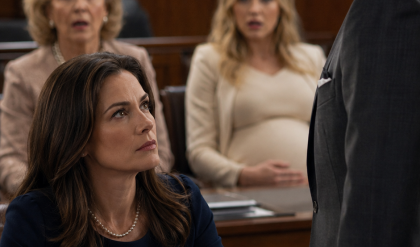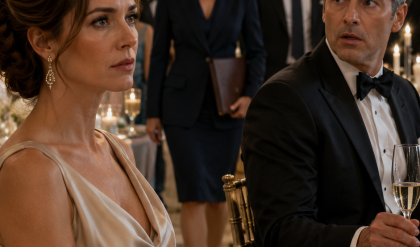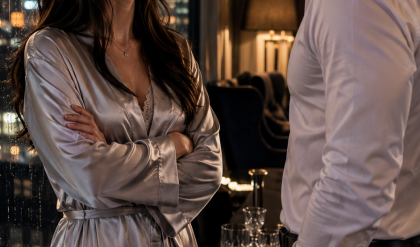
THE KNIFE, NOT THE PEACE TREATY
A Story of Adriana Moretti
PART ONE: THE WRONG VOWS
“Someone is bleeding on the marble floor, and the man holding the knife is supposed to be my husband.”
Except he isn’t.
I know it before the blood reaches the grout lines. Before Vincent DeLuca adjusts his cufflinks with the calm of a man who has done this a hundred times and will do it a hundred more. I know it the same way I knew it at the altar — the way you know when a dress doesn’t fit even before you look in the mirror. Something pulls wrong. Something sits where it shouldn’t.
The man on the floor — the man who said my vows, who slid the ring onto my finger hard enough to leave a bruise — groans once and goes still.
The room smells like candles and whiskey and blood.
Vincent DeLuca finally looks at me.
Twelve hours earlier, I was standing in a cathedral bathroom stall in my wedding dress, hiding a flash drive inside the seam of my bodice with a sewing needle and a prayer.
My hands did not shake. I had practiced that, the not-shaking. My mother used to say that Moretti women were built for grief and ceremony in equal measure, that we knew how to hold still when everything inside us was screaming. She died before she could tell me what to do when the grief and the ceremony happened on the same day.
The flash drive was smaller than my thumbnail. It held the kind of information that got people killed — not because it was illegal, but because it was true. My father had built his entire legacy on a specific lie, and the lie was this: that Vincent DeLuca had started the war.
My mother’s ledger said otherwise.
I smoothed the dress over the hidden drive, checked the small blade strapped to my thigh, and walked out to marry a stranger.
The cathedral was full. Five hundred people who knew exactly what this wedding was and called it beautiful anyway. Flowers banked the pews in white and ivory. Candles burned in wrought iron stands that probably cost more than my college education. My cousins cried in the front row. My uncle Carmine sat rigid in his suit, watching the crowd the way bodyguards watch crowds — not with wonder, but with threat assessment.
My father waited at the end of the aisle.
Carlo Moretti was sixty-one years old, silver-haired, handsome in the way of men who had never been told no by anyone who mattered. He smiled when he saw me. His pride was real. That was the worst part — it was completely, genuinely real. He loved me the way men like him loved things they had shaped into usefulness.
He took my arm, and I did not pull away.
“You look like your mother,” he said quietly as we started walking.
I said nothing. That was the only response he deserved.
At the altar, the groom stood with his back to us. Silver mask. Broad shoulders. Black suit. The DeLuca family tradition — powerful bloodlines never reveal everything at once. Everyone in the cathedral had accepted this without question, because everyone in that cathedral understood that some questions were not safe to ask.
My father released my arm. The groom turned.
The mask covered half his face. Below it, a jaw that was slightly too soft. Eyes that were slightly too eager. A mouth that curved when he looked at me the way men look at acquisitions.
I had studied every available photograph of Vincent DeLuca. Grainy surveillance photos, newspaper shots from a distance, a blurred image from a parking garage camera that someone had forwarded to my father’s security team three years ago. In every single one, Vincent DeLuca’s jaw was sharp. His posture was precise. He stood the way men stand when they have never once doubted that the room belonged to them.
This man leaned. Slightly, imperceptibly, but he leaned. Like he was trying to take up space he hadn’t earned yet.
The priest began to speak.
I looked at my father.
He did not look back.
That was when I understood that I was not meant to notice.
The groom — I would learn his name was Lorenzo DeLuca, Vincent’s cousin, forty-three years old and hungry for everything he had not been given — held my hand through the vows like he was afraid I would run. He wasn’t wrong. He said his vows too fast, the words sliding over each other with a kind of greedy momentum that had nothing to do with solemnity.
I said mine clearly. I had decided that if I was going to do this, I was going to do it with my spine straight.
When the ring went on my finger, he pressed down. I thought, at the time, that he was nervous. Later I would understand he was establishing something.
“You may kiss the bride.”
Lorenzo lifted the lower edge of the mask and kissed me on the mouth. His lips were dry. He tasted like whiskey and ambition.
I did not move. I had learned, somewhere between fifteen and now, how to be perfectly still while something happened to me that I hadn’t chosen. It was not a skill I was proud of. It was a skill I intended to make obsolete.
The cathedral applauded.
The DeLuca estate sat above the Hudson River like a stone fist. The car took me through three security checkpoints before the main gate, and each one featured men with earpieces and carefully blank expressions. The grounds were lit in amber. The house itself was the kind of old money architecture that communicates one thing very clearly: we have been powerful for so long that we no longer need to perform it.
Inside, I was taken to the bridal suite.
It was beautiful. White roses, candlelight, a four-poster bed with silk curtains, a marble bathroom visible through French doors. A tray of food I wouldn’t touch and a bottle of champagne I was definitely going to need.
A woman brought a robe and left without speaking. A man stationed himself outside the door and pretended not to exist.
I sat in the chair by the window and looked at the river below.
The flash drive pressed against my ribs.
My mother’s name was Elena Moretti, born Elena Russo, and she had kept a ledger for the last four years of her life. Not a physical book — she was smarter than that. She had kept it in encrypted files on a server she rented under a name that was not hers, paid for in cash, accessed only from public locations. She had also kept a small, handwritten note in the lining of her winter coat, folded so small it would survive casual searches.
The note said: If your father marries you into peace, it means he has run out of places to hide the war. Find the ledger. Burn his name or bury yours.
She died of a stroke eighteen months ago. I found the note six months after that, when I finally let myself go through her things. The server credentials were written on the inside of a locket she’d given me at my quinceañera, hidden in the engraving.
I had spent twelve months reading what she’d gathered.
The Saint Bartholomew hit — the night Vincent DeLuca’s younger brother Matteo was murdered after a peace meeting with my father — had not been authorized by Vincent. It had not been a DeLuca retaliation, a power move, or a miscommunication between rival factions.
It had been commissioned by two men: Carlo Moretti and Santino DeLuca.
Vincent’s own uncle. My father. Together.
They had profited from the contracts that opened up when the peace collapsed — dock rights, import routes, police precinct arrangements in three boroughs. They had used grief as a smokescreen and family loyalty as a weapon. They had watched the men beneath them bleed for five years while they split the proceeds.
This marriage was not about peace.
It was about access. The Morettis needed DeLuca infrastructure. The DeLucas needed Moretti capital. Santino and my father needed the alliance sealed before anyone started asking the right questions.
I was the seal.
The flash drive held all of it: the ledger, the wire transfers, the encrypted communications, a recorded phone call from three years ago where Santino DeLuca told my father that the grief was “good for business, keep it running.”
I had sent an anonymous message to Vincent DeLuca three weeks before the wedding. Burner phone, public WiFi, six blocks from my apartment: Ask Carlo Moretti who profited from the Saint Bartholomew hit.
I hadn’t known if he’d received it. I hadn’t known if it would matter.
The bedroom door opened.
Lorenzo walked in.
He poured whiskey without looking at me. Drank half the glass. Set it down with the satisfaction of a man who had already decided how this night was going to go.
Then he turned and looked me over the way you appraise a painting you’ve just bought — not with appreciation, but with inventory.
“Take off the dress,” he said.
I stood up. “I’m your wife. Not your property.”
He smiled. The smile had nothing kind in it. “Tonight,” he said, “you’re both.” He took a step toward me. Cheap cologne under expensive fabric. Whiskey and entitlement and the specific aggression of a man who had been told no too many times and decided to stop tolerating it.
His hand reached for my shoulder.
The bedroom doors hit the walls.
The impact was so sudden, so total, that Lorenzo froze mid-step. I froze too, because the sound was not a knock or even a shove. It was a controlled demolition. The kind of entry that communicates: I did not need permission before, and I do not need it now.
The man who stepped inside was tall, and he wore no mask.
His jaw was sharp. The scar along it was exactly where the photographs suggested. His eyes were dark and still, the kind of stillness that isn’t peace but precision — the stillness of a man who has already processed every variable in the room and is simply waiting for the moment to act.
He looked from me to Lorenzo. His expression did not change.
“What,” Vincent DeLuca said softly, “are you doing with my wife?”
The word wife hit the room differently when he said it. Not a claim. Not a threat. Just a fact, stated with the calm of someone who intended to deal with the consequences of that fact immediately.
Lorenzo ripped off the mask. His voice came out wrong — too fast, too high. “I was only — welcoming her to the family, cousin. You were delayed, and I thought —”
“I know what you thought.”
Three seconds of silence.
Then Vincent moved, and it happened so fast that I only caught pieces: a hand at Lorenzo’s throat, the specific angle of a controlled slam, marble meeting skull with a sound that would stay with me. Lorenzo slid down the fireplace and crumpled at its base. A red mark bloomed across the white stone.
Vincent straightened. Adjusted his cufflinks. The blood on the marble did not appear to concern him.
Two men appeared in the doorway. Vincent said, “Take him downstairs. Wake him up when Santino calls.” The men disappeared with Lorenzo like stage managers clearing a prop.
The room went quiet.
Vincent turned to face me for the first time.
I had prepared for many things tonight. A cold and distant husband. A cruel one. A transactional man who would treat me as the asset I was intended to be. I had prepared for threats and for the specific performance of power that dangerous men often felt compelled to stage.
I had not prepared for the way he looked at me — not through me, not at the dress or the dove or the daughter of Carlo Moretti. He looked at me, with the focused attention of someone solving a problem they hadn’t expected to find interesting.
“You should have hidden the flash drive somewhere less obvious than your wedding dress, Adriana.”
My lungs stopped.
He hadn’t touched me. He hadn’t searched the room, hadn’t called for someone to restrain me, hadn’t even raised his voice. He simply walked to the side table, poured a glass of water, set it close to where I was standing, and stepped back.
I stared at the water. Men like him were not supposed to understand distance. Men like him were supposed to take up all available space and require others to navigate around them. The glass of water was the most disorienting thing he had done yet.
“You can deny it,” he said. “But we both know the anonymous message came from someone who’d read my brother’s file. The kind of file that doesn’t leave the Moretti house.”
I found my voice somewhere below the panic. “If you already knew, why did you let the wedding happen?”
“Because I needed to see who else knew.” He sat down, which somehow made the room feel larger rather than smaller. “Lorenzo was not my choice. He was placed there by my uncle while I was being prevented from arriving. The car explosion on Canal Street this afternoon killed my driver. It was meant to kill me. By the time I rerouted and understood what Lorenzo had done, you were already saying vows to the wrong man.” A pause. “I’m sorry for that.”
I hadn’t expected the apology. I didn’t know what to do with it.
“The flash drive,” I said carefully, “is the only thing keeping me alive. My father knows I took something from him. He doesn’t know exactly what yet, but when he figures it out —”
“He’s at the front gate.” Vincent said it without inflection, like reporting weather. “Twenty men. He’s asking to retrieve his daughter.”
The trap. The whole shape of it, suddenly visible: Lorenzo installed as groom, my father positioned outside for extraction, the explosion meant to remove Vincent entirely. If it had worked, Lorenzo would have been managing the DeLuca estate by morning. My father would have had his inside man. Santino would have had his hold on both families. And I would have been somewhere in the middle of it, evidence and all, completely alone.
Someone had planned this very carefully.
Vincent was watching me think. I got the sense he did this often — waited for people to catch up, then watched where they landed.
“The flash drive has proof,” I said. “Not just of the Saint Bartholomew hit. Of your uncle and my father planning the war together. Wire transfers. Communications. A phone call.” I held his gaze. “It could end both of them.”
“I know.”
“You know?”
“I’ve been building the same case for two years.” He said it without satisfaction, which was somehow worse than if he’d said it with triumph. “Your mother’s ledger is more complete than mine. She was closer to Carlo for longer. I suspected she was gathering something, before she died.” His jaw moved slightly. “I didn’t know you had continued it.”
I stood with the blood still cooling on the marble floor and tried to make sense of this. My mother, who I had thought was a grieving, fading woman in her last years, had been doing what I was doing. Building a case. Gathering proof. And she had done it from inside the marriage, which meant she had understood the architecture of the trap from the inside.
She had been preparing an exit for me long before I knew I needed one.
“What do you want?” I asked Vincent.
He stood. He was taller than I’d calculated, which I noted only because I had calculated everything else about this night in advance. “The same thing you want. The men responsible to face what they’ve done. The war to actually end, instead of being managed for profit.” He looked at me steadily. “But I can’t do it alone. Your father’s outside with twenty men who will call this a rescue. My uncle will call Lorenzo’s actions a misunderstanding. Tonight becomes a story about family confusion, and by morning we’re both in worse positions than before.”
He crossed to the window. Below, the headlights of my father’s convoy swept the drive.
“I’m going to ask you something,” Vincent said. “And I want you to understand that either answer is acceptable. You can keep the flash drive and use it however you think best. I won’t stop you. I won’t take it. Whatever protection I can offer tonight is yours regardless.” He paused. “Or you can stay. Let your father believe the rescue failed. Let Santino believe Lorenzo’s situation is being handled. Give us time to coordinate.”
“And then?”
“And then we burn them both.”
The fire crackled behind us. Lorenzo’s blood dried on the marble. My father’s headlights moved below like something alive and hunting.
I thought about my mother in the last years of her life, keeping a secret so large it required a rented server and a coat lining and a locket. I thought about the way she had looked at me sometimes — not with love exactly, but with something more specific. A kind of aching readiness, like she was waiting for me to become something she already knew I was.
I thought about being the knife instead of the peace treaty.
“All right,” I said. “Tell my father the marriage was consummated and his daughter is unavailable.”
Vincent’s expression didn’t change. But something shifted in the room, some atmospheric thing I couldn’t name. He moved to the door and spoke to the guard outside in a low voice. Then he came back in, closed the door, and stood with his back to it.
We looked at each other across the bridal suite, two people bound by vows neither of us had truly chosen, with a dead man’s evidence between us and two living men below who had engineered everything.
“I should tell you something,” he said.
“You already know about the message I sent,” I said. “What else?”
“Your father didn’t only sell you to this marriage for access and alliance.” His voice stayed even, but the words came out like something he’d been carrying and set down carefully. “There’s a debt. The kind that doesn’t go on paper. Carlo owes Santino for the Saint Bartholomew arrangement — the initial payment was in real estate, but there was a secondary agreement. You were it. Not as a wife. As a guarantee. A living insurance policy inside the DeLuca house. If Santino ever needed leverage over your father, you were supposed to be there.”
I sat down.
The chair was very solid. I was grateful for it.
“My father sold me twice,” I said. Not a question.
“Yes.”
I sat with that for a while. The fire kept burning. The roses on the table were perfectly white.
“Then we really do need to burn them both,” I said.
And for the first time, Vincent DeLuca almost smiled.
PART TWO: THE WAR INSIDE THE WALLS
The woman named Isabella arrived at six in the morning with coffee, a satellite phone, and the kind of calm that only comes from having survived multiple crises before breakfast.
She was DeLuca security — Vincent’s, specifically, not the family’s, a distinction she made clear without ever saying it directly. She set the coffee on the table between us, looked at me with dark intelligent eyes that were doing math I couldn’t see, and said, “Lorenzo is awake. He’s asking for Santino. Which means Santino already knows something went wrong.”
“How long before he moves?” Vincent asked.
“Depends on whether he thinks Lorenzo handled it quietly or not. My best guess, four hours.” She glanced at me. “Your father’s convoy left at three a.m. after your message. Twelve men stayed behind on the road.” To Vincent: “He didn’t leave. He parked.”
I wrapped my hands around the coffee cup. “He’s waiting to see what I do.”
“He’s waiting to see what we do,” Vincent corrected. “He doesn’t know how much you’ve told me. He doesn’t know if you’re a captive or a cooperator. That uncertainty is useful, and it has about a four-hour shelf life.”
Isabella spread a map on the table. Not a digital map — paper, the kind that didn’t leave traces on servers. The Hudson Valley, the city below, docks marked in red. “The wire transfers on the drive — I need to know what institution. If it’s the same bank I’ve been tracking for two years, we can move to freeze the accounts before Santino realizes his documentation is compromised.”
I had read the ledger a hundred times. I pulled the flash drive from the seam of my dress — carefully, with the needle I had kept, and the thread I had restitched — and handed it to her.
Isabella took it without ceremony. No surprise, no comment. She plugged it into a device that looked like a small gray brick and said, “I’ll need two hours.”
She left.
Vincent and I sat with the map between us.
“You trust her completely,” I said.
“She was my brother’s childhood friend,” he said. “She was the one who told me Matteo didn’t go to that meeting voluntarily. My father’s council said he went to negotiate. Isabella said he called her twenty minutes before and asked her to remember his middle name.” He looked at the map. “She’s been working toward this longer than either of us.”
The grief in that was quiet, well-managed, old. But it was there. I recognized the shape of it.
“I’m sorry about Matteo,” I said.
He looked at me. Not the assessment he’d given me last night — something more direct, more uncertain. As if the condolence had come from somewhere he hadn’t expected it to reach.
“He was twenty-two,” Vincent said. “He wanted to study architecture.”
We didn’t say anything else for a while.
By nine a.m., the estate was running two parallel realities.
The official reality: Vincent DeLuca had married Adriana Moretti. The wedding had been slightly disrupted by a cousin’s inappropriate behavior, which was being handled privately. The bride was resting. The groom was managing business matters. Everything was fine.
The real reality: Isabella had confirmed that six of the fourteen wire transfers in my mother’s ledger matched an account she had been tracing for two years. Santino DeLuca had been moving money through a shipping company in Red Hook, splitting the proceeds with a holding corporation registered in Cayman — a corporation that, buried under three layers of subsidiaries, had Carlo Moretti’s attorney listed as registered agent.
The phone call recording was better than we’d hoped. My mother had caught Santino mid-sentence, apparently without his knowledge: —grief is good for business, keep it running. Carlo understands. The moment this peace holds, our arrangement becomes visible. We need another eighteen months at minimum.
“This is enough,” Isabella said flatly. “This is a federal case. This is five years minimum for both of them, more with the right prosecutor.”
“We can’t use federal channels,” Vincent said. “Not yet. Half the prosecutors in the southern district have been managed by one side or the other.”
“Then what?” I asked.
“We use the other half.” He looked at me. “Your mother didn’t just gather evidence, Adriana. She built a contact. There’s a name at the bottom of one of those files — a federal investigator who approached her eighteen months before she died. She refused him at the time. But the file is there.”
I looked at the drive. My mother had reached out and left a handhold in the direction of the only door she hadn’t been able to open herself.
“She knew she was running out of time,” I said.
“Yes.”
“And she left it for me.”
Vincent nodded, once.
I had cried for my mother the way you cry for the version of someone you thought you knew — the quiet, elegant woman who made perfect espresso and died before she could tell me what she was really doing. Now I was crying for the woman she actually was. The woman who had kept a rented server and a locket with a code and a note in a coat lining, because she had decided that her daughter was going to have a way out even if she didn’t.
I did not let the tears get far. There wasn’t time.
“We need the investigator before Santino moves,” I said. “And we need Lorenzo contained. If he tells Santino about last night before we can—”
“Lorenzo doesn’t know about the flash drive,” Vincent said. “He knows he was caught. He knows I’m angry. He doesn’t know why I haven’t retaliated yet, which he’ll interpret as calculation, because he reads everything through the lens of calculation.” A pause. “He will not tell Santino the full truth because he doesn’t know the full truth. What he’ll tell Santino is that the situation is delicate and he needs guidance. That buys us time.”
“How much time?”
“Until Santino decides to come see for himself.”
Isabella looked up from her screen. “Three hours. Maybe two.”
The federal investigator’s name was Marcus Webb. He had been with the organized crime unit for eleven years and had the kind of resume that suggested he’d gotten close enough to the Moretti-DeLuca war to know exactly how close he couldn’t get.
Getting him a message was a problem. His direct line was in the file my mother had kept, but calling from the estate was a paper trail neither of us could afford. Calling from outside meant exposure. Email was out.
Isabella looked at both of us. “There’s a restaurant on the West Side that serves as neutral ground for both families. It’s been that way for fifteen years. The owner is connected to neither side by blood or business — he just makes good food and doesn’t ask questions. He has a landline.”
“He’ll call it in,” Vincent said.
“He’ll call it in if it’s a threat. This isn’t a threat.” She shrugged. “It’s a lunch reservation.”
I looked at Vincent. “I need to be the one to go.”
He shook his head, automatic, immediate.
“My father is watching the estate. If you leave, it’s a provocation. If I leave—” I let him finish the thought.
He didn’t like it. I could see exactly how much he didn’t like it, which was interesting, because we had known each other for approximately twelve hours and had spent most of them discussing evidence and conspiracy rather than anything resembling personal feeling.
“You have twelve men of mine at the perimeter,” he said.
“I know.”
“If your father’s people approach—”
“I’ll be in a restaurant on the West Side. In my wedding dress, because I don’t have a change of clothes. I’ll be very visible and very obviously not running.” I looked at him steadily. “I know how to handle my father’s people, Vincent. I’ve been doing it my whole life.”
He held my gaze for a long moment.
Then: “Isabella goes with you.”
“Agreed.”
He crossed to a wardrobe and took out a jacket — his jacket, black, too large for me. He put it around my shoulders without speaking. It was not a romantic gesture. It was a practical one: the dress was ivory and conspicuous and had blood on the hem from where I’d stood too close to the fireplace. The jacket covered it.
But his hands stayed at the collar for one moment longer than necessary.
Neither of us mentioned it.
The restaurant was called Ferro’s. It was the kind of place where the tables were close and the food was real and the owner, a short Sicilian man named Enzo who had been in New York for forty years, knew exactly who walked through his door and pretended otherwise as a matter of professional ethics.
He saw me in the black jacket and the wedding dress and ivory heels and he said nothing. Just seated us at a corner table with his back to the room, a habit of the area.
I called Marcus Webb from the landline in the back hall.
He picked up on the second ring.
“My name is Adriana Moretti,” I said. “My mother was Elena. She kept a file with your contact information. I have what she was building, and I have approximately ninety minutes before the men she was building it against realize what’s happening. I need to know if you’re still interested.”
Silence. Then: “Where are you?”
“West Side. Neutral ground.”
Another pause. “I know the place.” His voice was careful, neither cold nor warm — the voice of a man assessing a situation rapidly. “The file she kept. Does it include the Red Hook transfers?”
“Yes.”
“And the recording?”
My hand tightened on the phone. “You knew about the recording.”
“Your mother sent me a partial transcript eighteen months before she died. Said she needed more time before she could hand it over. Then she—” He stopped. “I’m sorry for your loss. She was extraordinary.”
My throat tightened. I pressed through it.
“She was,” I said. “I have the complete recording. I have the full ledger. I have forensic documentation of the wire transfers. I also have this morning’s cooperation from Vincent DeLuca.” A beat. “I understand that’s complicated.”
“That’s… one word for it.” But I heard him shifting, heard the click of what I assumed was a keyboard. “You understand that if this comes to us through a DeLuca, the defense will spend two years making it about the DeLucas.”
“Which is why Vincent’s name isn’t on anything in the ledger,” I said. “The case is built around two men: Carlo Moretti and Santino DeLuca. The evidence was gathered by Elena Moretti, validated by her daughter, and supported by a secondary investigation I can document independently.”
Webb was quiet for a long moment.
“Can you get me the drive today?”
“If you can guarantee containment until indictment, yes.”
“Define containment.”
“My father cannot know you have the drive before he’s in custody. Santino DeLuca cannot know. No leaks. No pre-arrest press. When they’re taken in, it happens simultaneously and without warning.” I paused. “And I need protection for two people on the DeLuca estate.”
“Yourself and?”
“Vincent DeLuca. And Isabella Torres, if she’ll accept it.”
A longer pause. “Give me an hour. Don’t go back to the estate yet. Order lunch.”
He hung up.
I walked back to the table. Isabella looked at me. I nodded once.
She refilled her water glass and glanced toward the door. “Your father’s man has been standing outside for about ten minutes.”
I followed her gaze. Through the window, on the sidewalk: a man in a gray suit I recognized. Franco. My father’s second shadow, loyal the way blunt instruments are loyal.
He wasn’t moving toward the door. He was just standing, watching, communicating a message without entering: I see you, daughter. I’m giving you a chance to come home.
“Is he armed?” Isabella asked, in the same tone one might ask about the wine list.
“Always. But he won’t come in.” I sat down and picked up the menu without looking at it. “My father sent him to remind me that leaving quietly is still an option. If he wanted to extract me, he’d have sent six.”
“You’re very calm about this.”
“I’m not calm. I just know how to look it.” I set the menu down. “It’s a skill my mother taught me.”
Enzo brought bread without being asked. Isabella tore off a piece and ate it with the focus of someone fueling before a run.
“Can I ask you something?” I said.
“Yes.”
“How long have you been doing this? The investigation.”
She chewed, swallowed, considered. “Five years. Since Matteo. I was the one who drove him to that meeting. I was supposed to wait outside.” She looked at her water glass. “I waited outside.”
The weight in that sentence was very specific. Not guilt exactly — she’d processed it too long for raw guilt. Something more like a permanent reckoning. A debt she’d structured her life around paying.
“You couldn’t have known,” I said.
“No. But I was there, and I lived, and he didn’t. That’s its own kind of knowing.” She looked up. “Vincent spent two years trying to find out who gave the order. I spent two years trying to find out who coordinated it. We had pieces of the same picture and didn’t trust each other enough to put them together until—”
She stopped.
“Until?” I said.
“Until you sent that message.” She met my eyes. “The anonymous tip broke something loose. Vincent had been circling your father for months without getting close enough. The message told him someone inside the Moretti house knew the real origin point. He suspected you within a week.”
“And you?”
“I suspected you from the day the marriage was announced. Your father didn’t have to agree to this alliance. He chose it. And he chose it fast, which meant he needed something inside the DeLuca house that he didn’t already have.” She paused. “But I also noticed that the marriage announcement came three days after you’d been alone in your father’s office for forty minutes with no staff present.”
I stared at her.
“You copied the ledger while he was at church,” she said. “Sunday, nine weeks ago.”
“How do you know that?”
“Because someone ran a very careful mirror backup of a specific server at 11:47 a.m. on a Sunday using credentials that hadn’t been accessed in two years. Your mother’s credentials.” She almost smiled. “I’d been watching that server since I found it eighteen months ago. I didn’t know what was on it until the backup attempt, and by then I could only confirm it happened, not what it contained.” A pause. “I told Vincent someone inside the Moretti network had found Elena’s records. He accelerated the timeline.”
I thought about the ledger. My mother’s careful, systematic documentation. The months she must have spent, gathering, confirming, verifying — all of it pointed at two men who were supposed to be her family.
“She didn’t tell you,” I said. “She could have. You were close enough to her — you were watching that server. But she didn’t reach out.”
Isabella was quiet for a moment. “She knew I worked for Vincent. And she didn’t know, at the time, whether Vincent was involved.”
“And now?”
“Now I know he wasn’t. And so do you, I think.”
I thought about the glass of water, set carefully within my reach. The jacket placed around my shoulders. The way he’d said I’m sorry for that about the vows.
“Yes,” I said.
Franco shifted on the sidewalk outside. Then he took out his phone, made a brief call, and walked away.
My father had just been told I wasn’t coming out voluntarily.
The next move was his.
PART THREE: THE RECKONING
Santino DeLuca arrived at the estate at noon in a black Mercedes with four cars behind him. He was sixty-four, silver-haired like my father but differently — where Carlo Moretti’s silver was cultivated, Santino’s was aggressive, worn like a crown. He moved through the entry with the surety of a man walking into property he considered his own, which technically, as the family’s elder, he did.
Vincent met him in the main hall.
Isabella had briefed me via earpiece from a car two blocks away. I was listening as Marcus Webb’s team positioned themselves in three locations around the estate and two others near my father’s current location in Midtown.
I had forty minutes, Webb had said. Possibly less.
“The situation last night was unfortunate,” Santino said. His voice came through Isabella’s relay clearly — she’d placed a device in the hall’s decorative clock before we’d left for Ferro’s. “Lorenzo acted impulsively. It won’t happen again.”
“No,” Vincent said. “It won’t.”
“The girl — your wife. She’s settled?”
“She’s resting.”
“She hasn’t communicated with her father?”
A brief pause. “Not directly.”
The hesitation was calculated, I knew. Vincent was doing what good interrogators do — giving half-truths that pushed the subject toward revealing what he already knew. Santino’s next question would tell us how much Lorenzo had shared.
“Has she shown you anything?” Santino asked. “Given you anything. Documents, perhaps. Files.”
There it was.
“Lorenzo told you,” Vincent said.
“Lorenzo told me he found her hiding something in the dress during the ceremony.” Santino’s voice took on a paternal quality, the kind that preceded threats. “He was smart enough not to take it himself. He knew she’d been placed by her father to observe the household. Whatever she’s carrying could compromise both families.”
A perfect inversion of the truth. Lorenzo hadn’t seen anything — he’d been focused on other things. Santino was feeding Vincent a version of events that positioned me as a Moretti spy and the flash drive as a Moretti weapon, without ever revealing that he knew what was actually on it.
Which meant Santino didn’t know. He was guessing. He knew Carlo had given me something, or that I might have taken something, but he didn’t know my mother’s ledger existed.
My father had been keeping the ledger from Santino.
I filed that away.
“Whatever she’s carrying,” Vincent said, “is between my wife and me.”
“Vincent.” A shift in Santino’s tone — less patient, more pressure. “This marriage is fragile. One wrong move from the Moretti girl and five years of effort collapses. Whatever she has, it needs to come to me.”
“Why to you?”
Silence.
“Why,” Vincent said again, quieter, “would anything in my household go to you before it went to my father’s council? Before it went to me?”
More silence. The kind that had texture.
“Because,” Santino said finally, “some matters require experience.”
“My brother required experience,” Vincent said. “He got a bullet in a parking garage instead.” A pause so precise it was almost surgical. “Who do you think arranged that meeting, uncle?”
The silence that followed was not the silence of shock. It was the silence of a man recalculating.
“You’ve been talking to her,” Santino said.
“I’ve been talking to my wife.”
“She’s lying to you. She’s a Moretti asset placed inside this house to—”
“She sent me a message three weeks ago,” Vincent said. “Anonymous, from a burner phone. It asked me who profited from the Saint Bartholomew hit.” Another pause. “I’ve been trying to answer that question for two years. Last night, the answer walked down the aisle in an ivory gown.”
Isabella’s voice in my ear: “Federal units are moving. Eight minutes.”
I was already out of the car.
The estate’s east entrance was less monitored than the front. I knew this because Isabella had mapped every camera angle and guard rotation before we’d left that morning. I came in through the garden, across the stone terrace, and through a service door that had been left unlocked by one of the three estate staff members Isabella had quietly confirmed were loyal to Vincent rather than to the family.
The main hall was sixty feet from the service entrance. I could hear voices.
“—this ends tonight,” Santino was saying. “The girl goes back to her father. We negotiate a new arrangement, one that doesn’t compromise—”
“No.”
The word was very simple. Vincent said it the way he said everything — without raising his voice, without performing certainty, because the certainty was simply already there.
“She’s a security risk—”
“She’s my wife, and what she knows, I know, and what I know ends your arrangement.” Vincent let that settle. “Both of them. Yours and Carlo’s.”
“You don’t have proof—”
“The Red Hook transfers. The Saint Bartholomew logistics. The phone call where you told Carlo to keep the grief running for eighteen months.” A beat. “How many of those do you want me to continue naming?”
I stepped into the hall.
Santino saw me immediately. He was a man accustomed to assessing threats, and whatever he saw when he looked at me — I was in the black jacket, still in the wedding dress, with the flash drive visible in my hand — his expression shifted from controlled to something more jagged.
“Adriana.” He said my name like it was a mistake someone had made. “You have no idea what you’re carrying.”
“I have an excellent idea,” I said. “My mother built it.”
Something moved across his face. Not guilt — I didn’t think men like Santino were capable of guilt in any pure form. But recognition. The recognition of something he had calculated wrongly.
“Elena,” he said, almost to himself.
“She suspected you for four years. She was more careful than you gave her credit for.” I kept my voice even. “She was more careful than you gave most people credit for.”
He looked at Vincent. “This is what you’ve chosen. This girl. Against your own blood.”
“You used my brother’s blood,” Vincent said. “To keep a business arrangement running.” For the first time, something showed through the precision — not rage, but the banked version of it, the kind that had been kept carefully controlled for years and was now being directed. “Don’t talk to me about blood.”
Santino moved. Not toward me — toward the door. The instinct of a man used to situations where physical exit was still an option.
“Federal agents are on the property,” I said. “They’ve been briefed. The accounts are being frozen. My father is being taken into custody in Midtown.” I held up the flash drive. “This has already been copied and transmitted. You can take it if you want. It won’t change anything.”
He stopped.
In the silence, I heard the sound of cars on the drive outside. Doors opening. The crisp efficiency of people who knew exactly what they were doing.
Santino turned to look at me. The calculation in his eyes was still running, but the options were visibly narrowing. His gaze moved to the drive, to Vincent, to the door, back to me.
“Your mother was a fool,” he said. “She could have stayed out of it.”
“She was protecting her daughter,” I said. “That’s not foolishness. That’s just love.” I paused. “You wouldn’t know the difference.”
Marcus Webb came through the front door with four agents and documentation that Santino’s attorneys would spend years contesting and ultimately fail to break.
Vincent stood with his hands at his sides and watched his uncle be read his rights.
He didn’t look satisfied. He looked like a man who had reached the end of a very long road and found that the destination looked different than he’d expected. Smaller. Quieter.
I went to stand beside him.
We didn’t touch. We just stood in the same space, which felt, in its own way, like enough.
PART FOUR: WHAT REMAINS
Lorenzo was processed through federal custody at three that afternoon, carrying six separate charges that would keep his attorneys occupied for the better part of a decade. He had, apparently, been significantly more involved in Santino’s arrangements than anyone outside that inner circle had known — the estate, the docks, a series of shell companies. The eagerness that had come through in his vows was the eagerness of a man who thought he was finally getting his share.
My father was arrested at 12:47 p.m. outside the Pierre Hotel in Midtown. His attorney arrived within twenty minutes and spent the next hour explaining that his client had no statement to make. According to Webb, my father had looked at the documents laid before him — the wire transfers, the phone call transcript, the ledger summary — and said nothing for a very long time.
Then he’d asked, quietly, if Elena had built this herself.
The agent had said yes.
My father had nodded slowly, like a man hearing the answer to a question he’d been afraid to ask for years.
I didn’t know what to do with that. I set it aside.
There were things to manage in the hours that followed: statements, documentation, phone calls to family members on both sides who would need to be told a version of events carefully calibrated between truth and operational security. Isabella handled most of it with the efficiency of someone who had been planning for this specific afternoon for years.
I sat in the study that Vincent used as a workspace — books on three walls, a desk that was actually used rather than staged, a window that looked out over the river — and wrote a statement for Webb’s file. My own account, in my own words, of what my mother had gathered and what I had done with it.
When I was done, Vincent came in with coffee and set it near me without speaking. The same gesture as the water the night before. The same precise, undemonstrative care.
“You’re doing it again,” I said.
He raised an eyebrow.
“Setting things near me instead of handing them to me directly.” I looked at him. “You’re giving me the choice to take it or not.”
He sat down across from me. Seemed to consider this. “I suppose I am.”
“Why?”
A long pause. “Because you’ve been in situations where the choice wasn’t given to you. And those situations are hard to stop seeing, once you start.”
I looked at the coffee. Took it.
“My father is going to request a meeting,” I said. “Through channels. Eventually. He’ll want to explain himself.”
“Will you see him?”
I sat with that question honestly. “I don’t know yet.”
Vincent nodded. He didn’t push.
“Your uncle,” I said. “When you confronted him. When you named the proof.” I looked across the desk at him. “You said it to his face. You didn’t wait for the agents. You could have.”
“Yes.”
“Why?”
He was quiet for a moment. “Because Matteo deserved someone who said his name to the person responsible. Not through a court document. Not through a legal proceeding.” His jaw tightened briefly. “To his face.”
I understood that completely.
“He wanted to study architecture,” I said quietly.
“He was very good at it.” A beat. “He would have redesigned this whole house. He thought the east wing was structurally pretentious.”
I almost laughed. It surprised me, the almost.
“He was right,” I said. “It is.”
Vincent looked at me with the focused attention I was starting to recognize — not suspicious, not strategic, just genuinely interested, as though he wasn’t quite used to being surprised by people and was noticing that he was.
“What will you do now?” he said.
“I have no idea.” It was the truest thing I had said in longer than I could measure. “My entire plan was the flash drive. Everything after that was improvised.”
“You’re good at improvising.”
“Don’t tell my father. He spent twenty years trying to make me predictable.”
“He failed.”
“Comprehensively.” I looked out at the river. “I need to find a place to live that isn’t my father’s house or…” I gestured vaguely at the manor around us.
“You could stay,” he said. It was offered carefully, without weight or pressure. The same way you might point out a door someone hadn’t noticed. “There’s no obligation in the suggestion. The marriage is legally yours to dissolve whenever you choose. But there’s space here, and right now, dissolving anything draws the kind of attention neither of us needs while the cases are being built.”
“Pragmatic reasoning.”
“Entirely,” he agreed.
The word sat between us with a small amount of irony that I thought we both heard.
I thought about the twelve hours in which I had come to know him — or the outline of him, anyway. The glass of water. The jacket. The way he’d said I’m sorry without making it about himself. The way his jaw had moved when he talked about Matteo. The way he’d confronted Santino with facts rather than anger, using truth as the weapon it actually was instead of the blunt instrument most people mistook it for.
My mother’s locket was still around my neck. The code was memorized now — I didn’t need it. But I hadn’t taken it off.
“All right,” I said. “Pragmatically.”
He nodded, once, and stood to leave.
“Vincent.”
He stopped.
“The message I sent you three weeks ago,” I said. “When you traced it to someone inside the Moretti house — what made you suspect me specifically? You could have suspected any of a dozen people.”
He turned. The light from the window caught the scar along his jaw.
“Because the message used the phrase who profited,” he said. “Not who ordered, not who gave the command, not who pulled the trigger. The question of profit is the question someone asks when they already know the mechanics and want to understand the motive.” He paused. “Only someone who had read the full picture would know to ask that way. And the only person in the Moretti house who would have had access to the full picture without being complicit in it—” He met my eyes. “Was someone Elena Moretti had specifically prepared.”
I held his gaze.
“She told you about me,” I said.
“No. She left a note in the file she partially transmitted to Webb. He told me about it last month, when I made contact through different channels.” He let that settle. “The note said: If this reaches you after I’m gone, it will be because my daughter found it first. She doesn’t know she’s looking for it yet. But she will.”
My throat closed.
“She knew you’d find the server,” Vincent said. “She designed the trail for someone with your specific knowledge of the house, the locket, the coat. She designed it for you, eighteen months before she died.” A pause. “She trusted you to figure it out.”
I looked at the river. The Hudson, silver-gray in the afternoon light, moving without urgency in the direction of everywhere.
My mother had kept her biggest secret until the end. Not from weakness — I understood now that everything she had done came from a specific, enormous strength. But because some secrets are only safe in the hands of someone who hasn’t yet given the people who would use them a reason to look.
She had waited for me to be ready.
She had made sure I would be.
EPILOGUE: WHAT WE CHOOSE
Four months later, I stood in a federal courtroom in lower Manhattan and gave testimony for three hours.
I was composed. I had practiced the not-shaking for twenty-four years, and now I used it for something that was entirely mine. I answered questions clearly, cited documents by number, described my mother’s methodology with the precision of someone who had spent four months studying it in preparation for exactly this moment.
My father sat at the defense table and looked at me once, at the beginning. I did not look away. He did, eventually.
Santino DeLuca did not look at me at all. He sat with the stillness of a man who had decided that dignity was all he had left and was protecting it with both hands.
The trial would run for seven weeks. I would testify twice more. The verdicts, when they came, would be unambiguous: conspiracy, racketeering, murder for hire, and in my father’s case, an additional charge of witness tampering that his attorney spent three futile days trying to have dismissed.
Lorenzo DeLuca, who had cooperated in exchange for a reduced charge, cried on the stand. I didn’t feel sorry for him. I didn’t feel much about him at all.
Afterwards, Webb met me in the courthouse lobby.
“Your mother would have been proud,” he said.
“I know,” I said. It wasn’t arrogance. It was just true.
Outside, it was October, and the city had gone amber and cool. I stood on the courthouse steps in a coat that was not ivory and not borrowed — my own, navy, chosen because I had wanted it. Below me, the city moved in its ordinary way, unaware and unconcerned, the way cities always are with whatever matters most to the people inside them.
Isabella was leaning against a black car at the curb, reading something on her phone with the efficient focus she applied to everything. She looked up when she heard me on the steps.
“Done?” she asked.
“Done.”
She pushed off from the car. “Vincent’s at the architect’s office. He’s been looking at the east wing.”
I stopped. “He’s actually doing it?”
“He said it seemed like time.” She paused, and something moved briefly across her composed face — something warm and complicated and not fully expressible. “He said Matteo would have wanted someone to.”
I stood with that for a moment.
The locket was still around my neck. I had taken to wearing it differently now — not hidden under clothing but visible, a small oval of gold against the navy wool. My mother’s code, etched in the engraving. The first door she had opened for me.
I had not forgiven my father. That was too large and too specific a thing to manufacture from the outside, and I had stopped pretending otherwise. What I had done was understand him — the architecture of his choices, the specific ways that fear and greed and pride had shaped a man who was capable of love and also capable of this. Both things were true. Neither erased the other.
I was not my father’s peace treaty anymore.
I had been a knife, briefly, in the hands of justice.
Now I was trying to figure out what I was when no one was using me for anything.
It turned out that was the most interesting question I’d ever tried to answer.
“Tell him I’ll meet him there,” I said to Isabella.
She sent the message. I walked down the courthouse steps into October, into a city that didn’t know my name or care about my story, which was, I was discovering, exactly what freedom looked like.
Not perfect. Not resolved.
But chosen.
Every single step of it, from here: chosen.
Later, in the east wing of the DeLuca estate — now three months into a renovation that would take a year and had already produced seventeen architectural disagreements and one genuine argument about load-bearing walls — Vincent handed me a blueprint.
“Your thoughts?” he said.
I looked at the design. The east wing opened outward in the new plan, glass replacing stone where the views of the river were best. Less fortress. More house.
“He was right,” I said. “It was pretentious.”
“He would have been insufferable about it,” Vincent said, “if he’d lived to see it corrected.”
It was the most personal thing he had said about his brother since the night we’d met, and he said it the way grief sometimes comes — sideways, unexpectedly, in the middle of something practical. I didn’t reach for him. I just stayed beside him in the space the comment had opened, which was what he’d done for me, in the beginning.
After a moment, he took the blueprint back and studied it with the focused attention he brought to everything.
“Thank you,” he said quietly. Not to the room, not to the air. To me.
I had been handed a dress and told it was armor. I had been sold as a treaty and chosen to be a knife. I had been prepared by a woman who kept secrets in coat linings because she loved me precisely enough to trust me with the truth.
I was twenty-four years old. I didn’t know yet who I was when I wasn’t fighting something.
But I was starting to find out.
The river moved outside the glass-and-stone windows, silver and unhurried, in the direction of everywhere.
We stayed beside it.
The End