I Never Loved You, Quentin — I Survived You
Part 1:
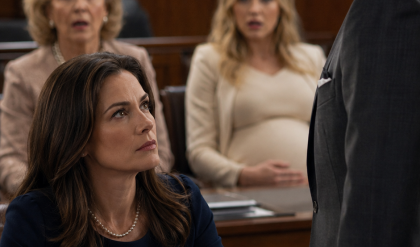
“Your Honor, she lives in a cramped, run-down apartment and works twelve-hour overnight shifts.”
The attorney’s voice carried through the courtroom the way cold water fills a drowning lung — measured, patient, designed to finish you slowly. I did not look at him. I kept my eyes on the seal above the judge’s head, the eagle with its wings spread like it was daring gravity to try something.
Beneath my borrowed blazer, my left sleeve pressed against a damp patch I’d discovered in the car. I’d sat for a moment in the parking garage with my hand against my chest, feeling the warmth spreading through fabric, and thought: not now, body. Not today. I’d layered a folded paper towel against the fabric. It was already failing.
“—no savings, no family support, and no stable environment for an infant—”
No family support. I almost laughed. My mother’s locket was cold against my collarbone, the only warmth that had once come from another human being who loved me without an agenda.
“—My client, however, can provide a private estate, full-time nurses, and every advantage this child could ever need. We are requesting immediate sole custody.”
The attorney turned just enough — just forty-five degrees, a practiced actor’s pivot — so the gallery could see the expression on his face. Not triumphant. Sympathetic. That was the cruelest part. He looked at me like I was a stray he wished could be helped.
I had been in this room for two hours. I had filled out forms, answered questions, watched Quentin’s team present charts of apartment square footage and income brackets and neighborhood crime statistics like they were building a scientific case against love. Quentin himself sat across the aisle in a charcoal suit that probably cost more than four months of my rent. He had a slight tan from a recent trip somewhere warm. He looked rested. Reasonable. Like a man who simply wanted what was best.
He caught my eye and smiled.
That smile. I had spent four years learning its meanings. This particular one — small, slow, tilting slightly left — meant you’re already done and you don’t know it yet.
My hands were shaking. I pressed them flat against the wooden table, feeling the grain beneath my palms, trying to find something real to hold onto.
Willow was four months old. She was with Mrs. Okonkwo down the hall, who had three grandchildren and charged me twelve dollars an hour and always slipped an extra banana into my grocery bag when she thought I wasn’t looking. Willow would be waking from her morning nap in about forty minutes. She would look for me. She always knew.
She always knows.
“That is not true.”
The chair scraped. I was standing before I’d decided to stand, my voice out ahead of my body, already moving.
“She lives in a cramped apartment because apartments cost money, and money comes from work, and I work those shifts because I am feeding my daughter. He does not want Willow because he loves her.” My voice was shaking, but it was not breaking. There is a difference. I had spent years learning that difference in a bathroom with the fan running so the sound would be covered. “He wants her because taking her is the only way he can still hurt me.”
Quentin leaned back in his chair.
He didn’t flinch. He didn’t defend himself. He just leaned back, like a man watching a predictable scene play out exactly as he’d staged it, and let the silence after my words do the work. His attorney lifted one eyebrow toward the judge. A small gesture. You see, Your Honor. Emotional. Unstable. This is what we’ve been telling you.
The judge’s face had been a wall since we’d entered. He was somewhere in his sixties, with reading glasses that made him look studious rather than wise, and he had looked at me exactly once during the opening statements — a brief, vertical sweep that started at my shoes and ended somewhere around my left ear. Now he looked at me the same way.
Then he looked at Quentin’s watch.
It was a small motion. Maybe nothing. But I felt the blood leave my face so fast I gripped the table.
Sometimes the truth looks poor, and a lie arrives wearing Italian leather.
I had not known I knew that until this moment. I had been forming the sentence for four years.
“Enough.” The judge’s voice cracked through the room like a door slamming. The gallery went still. “The difference in living conditions is apparent and documented. This court must consider the best interests of the child, not emotional accusations.” His hand moved — just rested, for a moment, near the gavel beside him.
The gavel.
A small block of wood. I had thought about it all morning. I had stood in my bathroom at five a.m. with Willow balanced against my shoulder, one hand under her warm heavy head, staring at my own face in the mirror and talking myself through it. You are going to walk in there. You are going to sit down. You are going to be calm. They will see. They will understand. The truth is enough.
The truth is enough.
I had believed that. This morning, at five a.m., I had believed it.
I closed my eyes, and I saw her — not as she was now but as she’d been in the first minutes of her life, red and furious and fighting, her fingers curling around mine like she was telling me not to let go. The night she’d spiked a fever and I’d sat in the emergency room for six hours pressing my lips to her forehead, measuring her temperature by the heat against my mouth. The morning she’d smiled for the first time — a real smile, deliberate, aimed at my face — and I had cried so hard I couldn’t breathe, because she knew me, she chose me, she reached for me from inside a life I’d been so afraid to build.
If that gavel comes down —
The courtroom doors exploded open. “The everything you asked for.”
The sound was wrong for the room. Too large. Too percussive. The kind of sound that belongs to emergency, not procedure, and every body in the gallery swung toward it on instinct.
Six attorneys walked in first. They moved in a formation that wasn’t quite military and wasn’t quite ceremonial but was somehow both — three on each side of the aisle, dark suits, files beneath arms, shoes making no sound on the old tile floor. The silence of them was louder than the door had been.
Then he came through.
I had never met Jameson King in a professional setting. I had met him in a hospital chapel when I was twenty-three and my mother had just stopped breathing in the room down the hall. I had met him in a rainy street when I was eight months pregnant and bleeding and running in slippers. In both instances he had looked like a man who had stepped out of somewhere that ran by different rules than the rest of the world — and in this courtroom, that impression did not just hold. It sharpened.
He walked down the center aisle with his hands loose at his sides and his eyes moving through the room in a single sweep that seemed to catalog everything and decide which of it mattered. Forty, maybe forty-one. The kind of face that had never been called handsome by people who were being careful — it was something stronger than handsome. He wore a suit the color of winter sky, no tie, and he walked as though he had been walking into rooms people assumed were closed to him his entire life and had simply never stopped.
Quentin’s attorney dropped his pen.
The clatter was humiliating — the sound of composure physically failing — and the man scrambled to his feet, papers scattering from the table’s edge. His face had gone gray the way faces go when what they feared most has just become real. “Mr. King?” His voice came out wrong, too high, too thin. “Why would you be — what business do you have in this —”
Jameson did not look at him.
He looked at me.
Across the full length of that courtroom, over the heads of shocked gallery watchers and the stiff back of the court reporter, past the judge’s bench and through the stale official air — his eyes found mine, and something happened in them that I had not expected and was not ready for. The flatness cracked. Not much. Not in a way that would look like anything to anyone watching. But I had once sat with this man in a hospital chapel at two in the morning and learned what his silence sounded like when he was actually afraid, and I knew.
He walked straight to my table.
He put one hand on my shoulder — a single steady point of pressure that my body registered the way a shipwreck registers a lighthouse — and leaned down in front of the judge, in front of Quentin, in front of every shocked stranger in that room. He bent down and pressed his lips to my forehead, the way you protect something you cannot afford to lose. The way you stake a claim you are not ashamed of.
The gallery made a sound. I don’t have a better word for it — not a gasp, not a murmur, something caught between the two, like a room full of people hitting the same unexpected note.
Quentin’s face had gone completely still.
Jameson straightened. He reached into the folder beneath his arm, removed a single sheet of paper, and laid it with great care on the judge’s bench.
“Your Honor.” His voice was even. It was also the kind of even that means someone has decided to stop performing composure and simply be immovable. “Before this court makes the worst mistake of its life, it needs to know who Willow’s father really is.”
I had not told him.
That was the thing I needed to say — to someone, to anyone, to the version of myself standing frozen at that table while the room erupted around me. I had not told him. I had not called him with the results of a test. I had not, in any of the hundreds of careful phone calls and careful messages over the past four months, ever said the words aloud. Because I had been afraid of what it would mean. Because I had been afraid of what he would become in my life if I said them. Because Willow was mine, fully mine, and I had been surviving on the terrifying freedom of that fact.
There is a math problem at the center of certain lives: the things you need most are the things you are most afraid to ask for.
I had kept his number in my phone under the name “Legal — K” for four months and called it only when the first custody notice arrived and my hands stopped working right.
The judge picked up the document.
Quentin’s attorney moved to object — a half-rising from his chair, a hand lifted — and one of Jameson’s associates stepped smoothly into his sightline without a word, without touching him, simply establishing a geometry that made the objection difficult to complete.
I watched the judge read.
His reading glasses caught the fluorescent light. His expression moved through something I couldn’t name — confusion, and then a settling, the way a face looks when information it did not expect becomes information it cannot refute. He looked up at Jameson.
“This is a notarized DNA—”
“Yes, Your Honor.”
“—establishing paternity of—”
“Yes.”
The judge set the paper down with the careful, deliberate motion of a man handling something that has just changed the weight of everything in the room. He looked at me. Really looked, for the first time, and I made myself hold it — the borrowed blazer, the damp sleeve, the shoes I’d resoled twice, and whatever was in my face right now that I had no ability to predict or manage.
Then he looked at Quentin.
And Quentin — who had smiled at me across a courtroom like my pain was his closing argument — was not smiling anymore.
Part Two: Eleven Years of a Card
I had not always known what loneliness felt like from the inside.
When I was a child, my mother worked two jobs and loved me loudly in the minutes between them. She left notes tucked inside my lunch in her careful, slanted handwriting — you are braver than you know, little bug — and she sang off-key in the kitchen on Sunday mornings when she thought I couldn’t hear, and her hands smelled like the lavender lotion she kept on the bathroom sink. We had very little. I didn’t know we had very little. We had her, and that was a complete world.
She died when I was twenty-three, on a Tuesday in March, in a hospital bed with her locket in my hand because the clasp was broken and she’d been afraid she’d lose it. I had been sitting with her when it happened — I was there, I did not miss it — but somehow I still spent years afterward feeling like I had looked away for one moment and lost everything.
The hospital chapel was small and had bad lighting and contained, that night, exactly two people: me, collapsed against a wooden pew, holding a locket I couldn’t stop turning over in my hands — and a young man in a loosened tie who had clearly come to think, not to witness someone else’s grief, and who had the grace to pretend he had come for exactly this purpose.
He bought tea from the machine down the hall. He brought back two cups without asking, which I later thought was either presumptuous or the kindest thing a stranger had ever done for me, and I was never quite able to decide which. He sat at a distance that was close enough to be present and far enough not to demand anything.
“I’m sorry,” he said. Simply. Not I’m sorry for your loss with the full, careful blankness of official condolence, just I’m sorry, the way you say it when you mean this should not have happened to you.
I told him about the lavender lotion. I don’t know why. I told him about the Sunday morning singing. I told him about the notes in my lunch. He listened to all of it without trying to resolve it into something more comfortable.
Before he left, he pressed a business card into my hand. Jameson King, it read, and below that, the name of a small firm I didn’t recognize — he was junior then, just beginning. He said: “Sometimes life gets complicated in ways that require someone who will believe you before you can prove anything. If that day comes, call me.”
I had put the card in a keepsake box with my mother’s other things. I did not know why I kept it. I kept it with the same instinct that makes you keep a photograph of somewhere you have never been — a feeling that the world is wider than you have yet lived, and you will need the evidence later.
Quentin Vale came into my life five years after that chapel.
I want to be precise about what I knew and when. That seems important now, in the way that honesty becomes urgent once the truth is finally occupying the room where the lies used to live. I want to be precise because I was not stupid. I was not naive in the simple, forgettable way that fiction uses to excuse women who love badly. I was lonely and I was tired and I was twenty-eight years old with no one in the world who was mine, and Quentin offered me something that felt like rescue.
The first time he raised his voice at me — we’d been together three months, and I had disagreed with him about something small, a restaurant, a decision about where to spend a Saturday — I saw something move behind his eyes. Not anger. Something older than anger. A kind of cold assessment. You are testing the boundary. Let me show you where it is.
I told myself it was stress. I told myself he was under pressure.
The first time he grabbed my wrist — under a dining table, his mother across from us, a tablecloth between his hand and the world — I felt the small bones compress and thought: this is the moment. This is the moment where I leave.
I did not leave. I smiled. The dinner continued.
I cannot explain that to people who have not been inside it. I can only say that the distance between knowing and doing is not made of cowardice. It is made of calculation, and the calculation gets complicated when your options are limited and the person hurting you has made themselves central to the infrastructure of your life.
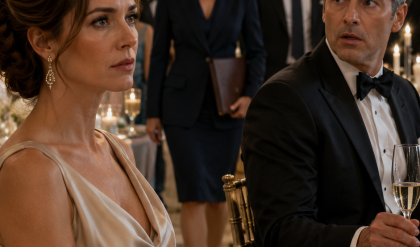
He controlled the bank account after we married. He drove me to my classes — which he then suggested I drop, because, he explained with such gentle reasonableness, I didn’t need to burden myself while he could provide everything. He managed our social calendar, our invitations, the way our life presented itself to others, until I looked up one day and found that I had no life in which he did not appear.
The nurse he hired when I became pregnant was named Carla. She had kind eyes and she brought me ginger tea and she reported back to Quentin every conversation I had on the phone.
I found out the night he showed me her notes. He held them up like a teacher presenting evidence of cheating and explained that he wasn’t angry — he understood I was hormonal, he was patient — but I needed to understand that he always knew. He always knew. Whatever I thought was mine — my thoughts, my words, my brief and careful phone calls to the outside world — he had already seen.
That night in the nursery, folding tiny shirts with hands that had started to shake as a chronic condition rather than a temporary state — when he came home and struck the wall beside my head and his eyes dropped to my stomach — something shifted below conscious thought. Some animal part of me reached a conclusion that my rational mind had been refusing for three years.
He will not stop. There is nothing you can do that will make him stop except leave.
Leave now while you still can.
I called the number at 2 a.m. I had not planned to. I was already outside, already in the rain, already almost a mile from the gate, before I accepted that I was not going to make it anywhere on my own, and I looked down at my phone and there it was in my contacts — Legal — K — from years ago when I’d finally put the card in my phone because the box had gotten water damaged in the apartment before Quentin’s. I had transferred it the way you transfer a keepsake. I had not expected to use it.
He answered on the second ring.
I don’t know what he was doing at 2 a.m. He didn’t tell me. He was simply there, in the immediate and absolute way that I have since come to understand is simply how Jameson King operates in situations that require it — he does not ease into urgency. He meets it.
When the car window came down and I saw his face, I started crying, and I could not explain why except that I had been so braced for it to be a stranger, or worse, and it was him, and it turned out I had been holding myself together for so long that even a face I barely knew could break that tension if it was the right face.
“Get in,” he said.
No questions. No what happened or how did you get here or any of the conversational obligations that would have required me to explain myself in the rain at eight months pregnant in slippers. Just: get in. As if my being here was already sufficient information.
Willow was born nineteen days later in a private clinic Jameson arranged, three weeks early and apparently furious about it — she came out screaming with an intensity that made the nurse laugh, a tiny face compressed in outrage at the cold and the light and the rearrangement of everything comfortable. They placed her against my chest and she went immediately, completely silent, turned her face toward my heartbeat like she recognized it.
I sobbed. Not gently. I am not going to say I sobbed gently or prettily or in any of the ways fiction allows women to cry when crying is meant to be beautiful. I sobbed with my whole body, my daughter on my chest and my face completely undone, and the nurse pretended not to see and I did not care.
Jameson was there because I had no one else. This is a fact I return to when I’m tempted to revise the narrative into something cleaner. He was there because I called him. He came because — I did not fully understand this yet — it was not in his nature not to.
He stood at the window for a long time after Willow was cleaned and wrapped and returned to me, and he looked at her with an expression I did not have a name for. I was too exhausted to search for one. I said something — half-conscious, probably unwise — something about her having his eyes, or his mouth, or some small and precise feature I had noticed in the earliest minutes of her face. I was not tracking what I was saying. I was running on something below language.
His face changed.
Before he could speak, the nurse came in. When the nurse left, I was almost asleep. When I fully woke, he was gone, and on the table beside me was a number for a family law attorney, a number for a security service, and a folded note in his handwriting:
There are things about Quentin you don’t know. When you’re ready, I’ll tell you. You’re not alone.
I spent four months not being ready.
Then the custody notice arrived, and I had twenty-four hours to respond, and I called him.
Part Three: What Quentin Knew
In the days after the courtroom — after the DNA document and Jameson’s entrance and the particular silence of a room that has just watched a story rewrite itself — Quentin’s attorney petitioned for a continuance. The judge denied it.
What I did not know, sitting at that table with my hand against my still-damp sleeve, was the full scope of what Jameson had brought in that folder. The paternity document was the surface. Beneath it was two hundred pages.
Two hundred pages that Jameson’s team had assembled over eighteen months — because, he told me later, with a directness that I was still learning to receive without flinching, he had started building the file the night I called from the road. Not because he assumed I would need it in court. Because he knew Quentin.
They had been in a room together once, three years before I met Jameson in the chapel. A corporate dispute, an arbitration, a matter that had resolved without litigation. Jameson had sat across a table from Quentin Vale for eleven hours and watched the way he operated — how he smiled when he was winning, how he smiled when he was losing, and how those two smiles were indistinguishable from the outside. He had noted it the way you note a weather pattern. Filed it away.
When I called him from a rainy road at 2 a.m., the file had a name on it within the hour.
The two hundred pages contained financial records showing three accounts Quentin had established in trusts structured specifically to exclude any future marital claims — accounts opened six months into our marriage, around the time I first pushed back on dropping my classes. The accounts existed because Quentin had already begun preparing for a version of our future in which I eventually tried to leave.
He had not built the cage in a moment of anger. He had built it patiently, with paperwork, because he was above all else a man who believed in infrastructure.
The pages also contained testimony from Carla, the nurse. It turned out that Carla had a sister, and the sister had a son, and the son worked in a building that shared a floor with a satellite office of Jameson’s firm, and the son had come in one afternoon six months ago wanting to talk to an attorney about whether someone could be compelled to retract testimony given under duress. It had taken two months and a great deal of care, but eventually Carla had told Jameson’s paralegal everything she’d told Quentin.
And she had told Quentin everything. Every phone call I’d tried to have with a social worker during the first trimester. Every time I’d asked the grocery delivery driver if there were shelters nearby. Every night I’d cried in the bathroom with the fan running.
He had known I was afraid of him. He had used Carla to confirm it. And he had done nothing except watch, and wait, and hold the information like a collector holds a debt.
The third section of the file — the part that made Quentin’s attorney go silent for eleven seconds in the conference room where the case was ultimately settled, a silence I was later told was the longest any attorney at that table had witnessed in a professional context — was a record of three prior relationships. Not ex-wives, not public record. Three women, two years each, who had left Quentin under various circumstances over the previous decade. One had signed an NDA. One had moved to another state. The third had filed a police report in 2019 that had gone nowhere because Quentin’s attorney had moved quickly and the woman had eventually dropped the matter.
Jameson’s team had found all three. Two had agreed to submit written statements.
The judge read everything over a forty-eight-hour continuance that Jameson’s presence made functionally unavoidable. At the end of it, the judge declined to grant Quentin any form of custody — not sole, not partial, not supervised visitation pending further review. He cited the financial deception, the surveillance via the nurse, and the pattern of prior conduct as grounds for a protective order.
He also noted, in his written ruling, that the emotional statement made by the respondent in open court — the one where I stood up with my hands shaking and my voice not breaking and said he wants her because taking her is the only way he can still hurt me — was, in his assessment, the most accurate and legally relevant testimony offered in the proceeding.
Emotional, he had called it at the time. In the written ruling, he called it precise.
Quentin, to his credit — and this is a strange thing to say, but precision requires I say it — did not rage. He did not make a scene. He was escorted out of the courthouse by his team with his face arranged into its default configuration of composed displeasure, and he did not look back at me.
That restraint frightened me more than rage would have.
His attorney, packing files into a case on the courthouse steps, paused when I passed him with Jameson’s team. He looked at me with something that was not sympathy but that occupied the same neighborhood.
“You know this isn’t finished,” he said. It was not a threat. It was almost an observation.
Jameson’s hand rested for a moment at the small of my back — not possessive, nothing like that, simply present — and I answered the attorney myself.
“No,” I said. “But now he has to play a different game.”
The attorney looked at me for a moment longer, and something moved behind his eyes. Not admiration, not quite. Reassessment, maybe. The small recalibration of a man who had looked at me this morning and seen a woman already defeated.
He picked up his case and walked to the car.
Part Four: The Things That Were True
There is a conversation I have had three times in my head for every time I have had it in real life, and this is one I had in both places, so the math gets complicated.
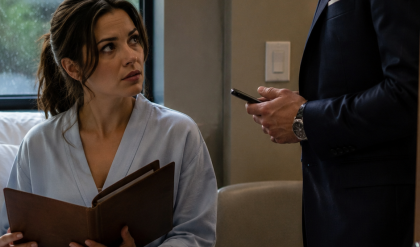
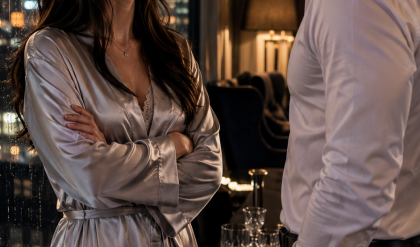
Jameson’s office was on the thirty-fourth floor. It had the kind of windows that make a city look like a problem that has been solved, all grid and light and manageable distance. I had been there twice before — once to review documents with his paralegal, once because he’d called me in to explain the next steps in the case — but I had not been alone with him since the rainy night in the car, because I had been carefully constructing a version of our situation in which I did not have to think about what it meant that he had kissed my forehead in front of a courtroom.
I was still in the borrowed blazer. I’d finally removed the paper towel from inside it.
He poured water into a glass and set it in front of me and sat across the conference table with his hands folded, and I thought: he does this. He puts distance between himself and things that require it. I had noticed that. He was extremely good at proximity — he could read a room from the doorway, read a person across a courtroom — and he was also extremely good at choosing distance when the situation called for management.
“You should have told me,” I said.
He was quiet for a moment in the way he was quiet when he was not avoiding something but processing it. “Yes.”
“You did the test without telling me.”
“I had the test done when you were eight weeks along, when you gave me the prenatal records to review for the legal proceedings. I needed to know.” A pause. “I should have told you what I knew and let you decide what to do with it. I didn’t.”
“Why?”
His eyes moved to the window. Then back. “Because you were trying to leave a dangerous man and build a life for a child who wasn’t born yet, and I thought adding one more complicated thing to that equation would—” He stopped. Started again. “I told myself I was protecting you from a complication. The truth is I didn’t know what to do with it, so I filed it and monitored the situation and waited.”
He didn’t know what to do with it. This man, who had walked into a courtroom like he owned the floor, who had assembled two hundred pages of documentation and orchestrated an entrance designed to stop a proceeding in its tracks — he had not known what to do with the information that he had a daughter.
I turned the water glass in my hands.
“She has your mouth,” I said.
Something moved in his face. Not a crack this time — more like the moment before a crack, the instant where pressure meets material and one of them is about to yield.
“I know,” he said.
“She smiles the same way you do when you’re actually amused instead of performing amusement. On the left first.” I watched him. “I noticed it when she was three weeks old.”
He was completely still.
“I was angry,” I said. “I need to tell you that. When I realized — when I worked it out properly — I was angry that you’d done this quietly and I didn’t know, and I was angry that I couldn’t even be fully angry because you’d just walked into a courtroom and saved my daughter’s life, and those two things don’t fit in the same emotional space.”
“They don’t have to fit.”
“I know. But I want you to understand what this is.” I set the glass down. “I am not going to be someone’s situation again. I was Quentin’s situation for four years. I arranged myself around his life and called it love and then one day found out his nurses were filing reports on my phone calls. I cannot do that again. Not for myself. Not for Willow.”
“I know.”
“So I need you to tell me what this is. What you think this is. What you want.” I looked at him steadily. “Because I am very good now at reading the space between what someone says and what they mean, and I would rather have an uncomfortable truth from you than a comfortable silence.”
He looked at me for a long time. The kind of looking that doesn’t move over your face but settles into it, like he was trying to read something underneath.
“I have been,” he said finally, slowly, “in love with you for eleven years.”
The room was very quiet.
“In the chapel,” he said. “Before that — the moment before, in the hallway, when I saw you through the window sitting with her and holding that locket. I don’t have a better explanation. I’m not offering it as an excuse for poor judgment. It’s just the thing that is true.” His voice didn’t change, didn’t warm or waver, but his hands, flat on the table, pressed slightly harder. “I have been careful. Maybe too careful. I told myself you needed stability, and legal help, and someone who wouldn’t make your life more complicated. I told myself it wasn’t appropriate. I told myself a hundred different versions of not now, not this. And then I watched a judge reach for a gavel that was going to take Willow away from you, and every version of not now just — stopped.”
I thought about the borrowed blazer. The paper towel. The twelve-dollar hourly rate. The banana slipped into my grocery bag.
I thought about Willow’s fingers around mine.
“If you’re going to be in our lives,” I said, “it has to be because you choose it. Not because she’s yours biologically and you feel obligated. Not because you pity what I’m carrying. It has to be because you look at this life — the actual life, with the overnight shifts and the cramped apartment and all the parts that are hard — and you want to be in it.”
“I’ve been in it,” he said quietly, “for four months. I haven’t wanted to be anywhere else.”
I looked at him.
“I’m going to need time,” I said.
“I know.”
“I’m going to need you to understand that I do not move fast anymore. I learned what moving fast toward someone feels like, and I am not interested in that lesson again.”
“I understand.”
“And Willow comes first. In every decision, in every room, in everything.”
His face did something then that I had never seen it do in any context — it went soft in a way that had nothing to do with calculation or strategy or the careful management of a professional situation. It just opened. The way a window opens when someone finally decides the room needs air.
“That,” he said, “is not going to be a problem.”
Part Five: The Life After
Six weeks later, I moved to a different apartment. Not into his life — I want to be precise about that. My own apartment, one with two bedrooms and light that came through the east window in the morning and fell across the floor in a way that I found, the first morning, so unexpectedly beautiful that I had to sit down on the kitchen floor and simply look at it for a while, Willow on my lap doing the concentrated, investigative looking that she did with everything new.
It was the first apartment I had chosen alone, for myself, for us.
I went back to my classes — online now, two evenings a week, while Willow slept. I was studying social work, which surprised me when I wrote it on the enrollment form and then did not surprise me at all.
Mrs. Okonkwo cried when I told her I was moving. She hugged me so tightly that Willow, squished between us, made an indignant sound. I slipped three months of her going rate into an envelope and left it on her counter, and she called me later and told me I was ridiculous, and I could hear her smiling.
Jameson came on Saturdays. This was deliberate — he proposed it, I accepted it, and we had both agreed that a specific day was less complicated than whenever, just let me know. He came on Saturday mornings and sometimes stayed until evening, and on those days we ordered food and let Willow conduct her investigations of him, which were increasingly detailed and frequently resulted in his suit jacket being used as a surface of scientific interest. He was remarkably calm about this. I noticed that he had stopped wearing a tie on Saturdays.
One Saturday he brought a small stuffed bear. Brown, soft, button-eyed, nothing remarkable. He set it on the blanket beside Willow without comment, and she grabbed it with both hands with the focused aggression she applied to all new objects.
“You didn’t have to—” I started.
“I know,” he said.
She carried it everywhere after that. We called it Bear because Willow, at four months, did not yet weigh in on naming conventions but seemed to have fixed opinions about the necessity of the object itself.
The protective order held. Quentin did not file an appeal. His attorney, the one from the courthouse steps who had told me this isn’t finished, sent a single letter in the third week, tersely professional, closing the representation. I had the sense that Quentin had gone to ground the way men with resources go to ground — not defeated, not reformed, but recalculated. Biding. This frightened me, and I did not pretend it didn’t, and I told Jameson, and he said, in the direct way that I was still learning not to flinch from: “I know. We’re watching.”
We. This word, in his mouth, was doing new work.
There is a thing that happens when you have spent years inside someone else’s version of who you are. You carry that version like a weight you don’t notice until you set it down. You expect, reflexively, to be controlled — to feel the ground shift when you do something without permission, to wait for correction, to find the edge of what is tolerated and stand carefully within it. You have been trained, systematically and effectively, to make yourself smaller, quieter, easier.
The relearning is slow. It happens in small rooms, in ordinary moments. It happens when you disagree about a restaurant and wait, muscles braced, for the shift behind the eyes — and it does not come. When you change your mind about something and say so and the response is simply okay, tell me what you’d prefer. When you say I’m angry and the person across from you says you’re right to be and does not leave.
I was not fixed. I want to be clear about that. I still checked the lock twice. I still had certain phone calls I could only make while walking, because moving felt safer than standing still. I still sometimes woke at 3 a.m. convinced that Willow’s breathing had changed, my body running the calculation before my mind was fully awake. These things were real, and they were not resolved by a courtroom or an apartment with east-facing windows or even by someone who showed up on Saturdays and stopped wearing ties.
But they were getting quieter. Slowly. In increments I could sometimes measure.
The last Saturday in October, Jameson arrived with a thermos of coffee because the building’s machine was broken and I had mentioned this the previous week. He remembered small things with a consistency that still occasionally caught me off guard, like stepping onto ground you’ve tested for weakness and finding it solid.
We were on the floor — Willow between us, practicing the project of sitting upright that currently occupied most of her intellectual and physical resources — when I took the locket from the table where I’d set it and held it in my palm.
“This was my mother’s,” I said. “The clasp is still broken. I’ve had it repaired twice and it keeps breaking again.”
He looked at it. “May I?”
I gave it to him. He turned it over in his hands, examined the clasp, turned it back. Opened it, carefully, the way you open something that belongs to someone else.
Inside was a photograph, small and slightly faded: my mother at maybe twenty-five, laughing at something outside the frame, her hair loose and her face so open and unguarded that even now, even after everything, looking at it made my chest do something complicated.
He looked at it for a moment. Then at me. Then back.
“She looks like someone who meant it,” he said.
I didn’t answer right away. Willow grabbed my finger and redirected her investigation.
“She used to leave notes in my lunch,” I said. “Even in high school, when I pretended to be embarrassed by it.”
“What did they say?”
“Different things. You are braver than you know. That was the one she used most.” I took the locket back. Folded my hand around it. “I used to think it was something mothers said because they were supposed to. Now I think she was telling me something specific. About her. About what it cost her to mean it.”
He was quiet for a moment.
“You’re braver than you know,” he said.
“Don’t do that.”
“I’m not doing anything. I’m agreeing with her.” He was looking at Willow, who had abandoned my finger in favor of the thermos lid. “She knew you before you knew yourself. Parents sometimes do.”
I looked at Willow. Her face was creased with effort, the thermos lid demanding a level of dexterity she was currently developing but had not yet perfected. She made a sound of profound frustration.
“She has your stubbornness,” I said.
“My persistence,” he said.
“That’s what I said.”
He looked at me then, and he almost smiled — left side first, just the way Willow did — and I thought: eleven years. The card in the chapel. The tea from the machine. Sometimes life gets complicated in ways that require someone who will believe you before you can prove anything.
I had spent eleven years not knowing what to do with that sentence. Now I was learning.
“What do you want?” he asked, on that same Saturday, later, when Willow was asleep and the apartment had gone quiet around us and we were sitting with the particular care of two people who have been through a great deal and are no longer pretending otherwise.
It was a real question. The kind that doesn’t have a polished answer ready-made, because it requires you to look inward at something you’ve been protecting for so long you’ve almost forgotten what it actually is.
I thought about it honestly, for a long moment, with the east window dark now and the city beyond it and my daughter breathing in the next room.
“I want,” I said, “to finish my degree. I want to sleep through the night at some point this decade. I want Willow to grow up knowing she can disagree with people and still be safe. I want—” I paused. “I want to learn how to let someone stay. I don’t know how to do that yet. I want to learn.”
He nodded. Just that.
“What do you want?” I asked.
He looked at the window for a moment, and then back, and his face had none of its professional architecture in it — none of the courtroom stillness, none of the careful distance. It was just a person, sitting with another person, in an apartment chosen by someone who’d finally learned that the choosing was the point.
“The same thing,” he said. “To learn how to stay in a way that you trust.”
We sat with that. Willow’s breathing moved through the monitor on the table between us, steady and real.
“Saturday,” I said eventually.
“Saturday,” he said.
Outside, the city held its light. The locket was on the table beside the monitor, its broken clasp finally given to a jeweler who’d promised it repaired by Tuesday. On the blanket in the corner was Bear, one button eye tilted slightly upward, a small brown shape anchoring the corner of this life that was ordinary and complicated and chosen.
Chosen.
That was the word that fit inside the rest of them, smaller than survival and larger than rescue. I had survived Quentin. I had survived the courtroom. I was surviving the 3 a.m. wakings and the online coursework and the deliberate, effortful, daily work of becoming the version of myself that wrote her own notes.
But this — the apartment, the Saturday, the man sitting across from me learning how to be still enough that I didn’t need to brace — this was not survival.
This was a woman who had been braver than she knew, finally deciding to find out what brave looked like in a life she didn’t have to escape.
You’re right, Mom, I thought. You were telling me something specific.
The coffee cooled. Willow breathed. The city kept its light.
I let myself stay.
End.