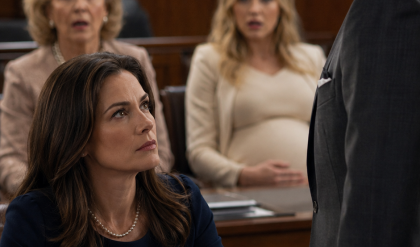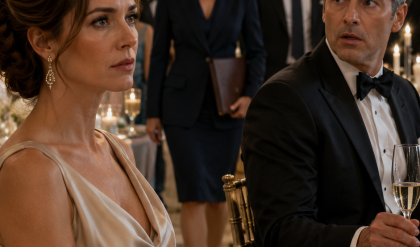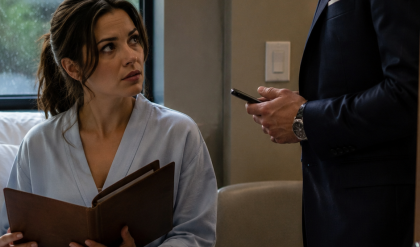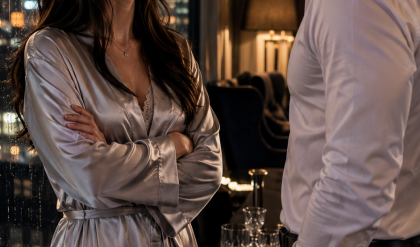
The rain slammed against the towering windows of St. Agnes Medical Center as if the sky had finally lost patience with Philadelphia.
It came down in sheets, silver and violent, washing the city into blurred streaks of headlights and black pavement thirteen floors below. Thunder rolled so hard the glass trembled in its frame. Every flash of lightning turned the labor room bone-white for one terrible second, then dropped us back under the cold hospital lights.
I had imagined this moment a thousand times.
Michael beside me.
His hand wrapped around mine.
His voice near my ear, whispering, You’re safe, Cat. I’m here.
Instead, I was alone in a hospital bed with sweat dampening my hairline, my knees shaking beneath the sheet, and my phone lying facedown beside me like something dead.
Another contraction rose.
It started low, deep in my spine, then tore forward with a force so brutal I thought my body was splitting open.
I clutched the mattress.
“Breathe, Catherine,” the nurse said gently. “In through your nose. Out through your mouth.”
I tried.
I really did.
But pain swallowed the rhythm. It swallowed the room. It swallowed the part of me that had spent nine months believing this night would be hard, yes, terrifying even, but never humiliating.
Never this.
My sister Rachel stood near the window, her arms folded tightly across her chest. She was still wearing her work blouse under a raincoat, mascara smudged beneath one eye from rushing through the storm. She had driven twenty-six blocks through flooded streets because I had called her crying from the back of an ambulance.
Michael had not answered.
Not the first time.
Not the tenth.
Not the thirty-seventh.
“Try him again,” I whispered when the contraction finally loosened its teeth.
Rachel turned sharply. “Cat.”
“Please.”
Her face changed. Anger flickered there, hot and protective, but she picked up the phone anyway.
The screen lit up.
Michael Harrison.
My husband of eleven years.
The man who had kissed my stomach every morning and called our daughter “little moon.” The man who painted the nursery pale yellow because he said pink was too predictable. The man who told me, two weeks ago, that no meeting, no client, no emergency could keep him from being there when our baby came.
Rachel pressed call.
The line rang.
Once.
Twice.
Five times.
Voicemail.
Again.
Voicemail.
Again.
Nothing.
At 3:07 a.m., the call connected.
For one staggering heartbeat, relief rushed through me so fast I almost sobbed.
Then a woman answered.
“Catherine,” she said, irritated, breathy, with music and laughter behind her, “you really need to stop calling tonight.”
The room went still.
Even the monitors seemed to quiet.
I knew that voice.
Amber Collins.
Michael’s executive assistant.
The woman who bought his birthday gifts because he was “too busy.” The woman who sent me polished little emails about company dinners and travel changes. The woman who once hugged me at a charity gala and said, “You are so lucky. He talks about you all the time.”
My hand tightened around the bedrail.
“Where is my husband?” I asked.
A soft laugh rustled through the speaker.
“Michael is with me right now.” She paused, as if savoring the shape of the words. “And honestly? Your dramatic labor situation isn’t his responsibility tonight.”
The sentence did not hit me like a slap. It hit me like a door closing from the other side of my life.
Rachel’s mouth fell open.
The nurse beside me froze with one hand on my shoulder.
I stared at the phone.
For a moment, I was not in labor anymore. I was standing in our kitchen six months earlier, watching Michael turn his screen facedown when I walked in. I was at dinner, listening to him explain why Amber had to come on the Aspen trip because “contracts don’t sign themselves.” I was in bed, awake at midnight, hearing him laugh softly in the bathroom with the shower running.
All the small pieces I had refused to name suddenly arranged themselves into a picture.
Amber wasn’t hiding.
That was the worst part.
She spoke like a woman who knew exactly where she stood.
“You should try going one night without making everything about yourself,” she added. “Michael deserves some peace for once.”
Then she hung up.
The phone screen went black.
Rain battered the windows.
A thunderclap cracked over the city.
And I made a sound I did not recognize.
Not a scream.
Not a sob.
Something smaller.
Something crushed.
Rachel snatched the phone from my hand. “I am going to kill him.”
“No,” I whispered.
“Cat—”
“No.”
Another contraction slammed through me, and this one was worse because it carried everything with it. The betrayal. The humiliation. The fact that every nurse in that room had heard another woman reduce the birth of my child to an inconvenience.
I curled forward, gasping.
“I can’t,” I choked. “I can’t do this.”
The young nurse looked toward the door. “Where is Dr. Patel?”
“Stuck in surgery,” another nurse said. “They’re calling backup.”
Backup.
That word floated above me like a bad joke.
My husband was with another woman.
My doctor was unavailable.
The storm had swallowed the city.
And my daughter was coming anyway.
The doors opened.
A man stepped inside wearing dark blue surgical scrubs beneath a black coat soaked through at the shoulders. Rainwater dripped from his hair onto his collar. He looked exhausted, like someone who had run too far and slept too little, but when his eyes moved across the room, everything inside it seemed to settle.
The nurses straightened.
Rachel stopped pacing.
He removed his coat and handed it to someone without looking away from me.
“I’m Dr. Daniel Brooks,” he said. “Dr. Patel was pulled into an emergency. I’m taking over.”
His voice was calm.
Not soft.
Calm.
There is a difference.
Soft voices can break under pressure. Calm ones give you something to lean against.
I turned my face toward the wall. “I don’t trust anyone anymore.”
A silence passed.
Then he came closer.
He did not tell me I was emotional. He did not tell me to be brave. He did not give me the useless little smile people give women when they are in pain and inconvenient.
He said, “Then don’t trust people.”
I looked at him.
His eyes were gray. Tired. Strangely kind.
“Trust the next breath,” he said. “Then the next push. One moment at a time.”
Something in my chest loosened.
Not much.
Just enough to breathe.
He washed his hands, checked the monitors, spoke to the nurses in short, precise sentences, then returned to my side.
“What’s her name?” he asked.
“My daughter?”
He nodded.
I swallowed. “Lily.”
A flicker crossed his face.
So fast I might have imagined it.
“Beautiful name,” he said.
For the next forty minutes, the world narrowed to pain and thunder.
Daniel Brooks stayed with me through all of it.
When I shook, he steadied my shoulder. When I panicked, he lowered his voice. When I screamed that I couldn’t do it, he looked me straight in the eyes and said, “Catherine, you already are.”
Rachel stood at my left side, crying openly now, whispering, “I’m here, baby. I’m here.”
But it was Daniel’s voice that kept cutting through the storm.
“Good. Again.”
“Stay with me.”
“That’s it.”
“She’s almost here.”
At 4:12 a.m., lightning filled the room.
My daughter entered the world on a cry fierce enough to shame the thunder.
Six pounds, four ounces.
Dark curls pasted to her tiny head.
Her mouth wide open.
Her fists clenched like she had arrived ready to fight.
The moment they placed Lily on my chest, something inside me broke and began healing at the exact same time.
I touched her cheek with one trembling finger.
She was warm.
Real.
Mine.
I sobbed so hard my whole body shook.
Not pretty tears. Not cinematic tears. The ugly kind. The animal kind. Tears from a place so deep even betrayal couldn’t reach it.
Rachel kissed my forehead again and again.
“She’s perfect,” she whispered. “God, Cat, she’s perfect.”
Daniel stood at the foot of the bed, watching the nurses clean and check and record.
For a moment, his face looked unguarded.
Devastated, almost.
Then he blinked, and the doctor returned.
“You did beautifully,” he said.
I laughed through tears. “I felt like I died.”
“You didn’t.”
His gaze moved to Lily.
“You brought someone home.”
Home.
The word landed strangely.
Because I already knew I could not go back to mine.
Not the way it was.
By dawn, the storm had weakened into a gray, exhausted rain.
The city below looked bruised. Ambulance lights flashed on wet pavement. Somewhere down the hall, another newborn cried, thin and furious.
Michael finally called at 6:18 a.m.
I watched his name appear on the screen.
For eleven years, that name had been safety.
Now it looked like a stranger’s.
Rachel reached for the phone.
I stopped her.
“No,” I said.
My voice sounded scraped raw, but steady.
“I’ll answer.”
I put it on speaker.
“Cat?” Michael said.
He sounded panicked.
Good.
“Where are you?” I asked.
There was a pause.
“I—there was a situation. My phone—Amber shouldn’t have answered. She was upset.”
Rachel made a sharp noise beside me.
I stared down at Lily sleeping against my chest.
“She said my labor wasn’t your responsibility.”
“That’s not what she meant.”
“What did she mean?”
Silence.
I heard him breathing.
I had listened to that breathing beside me for more than a decade. In hotel rooms. On Sunday mornings. During flights. After arguments. I knew every version of it.
This was the version he used when searching for a lie.
“I made a mistake,” he said finally.
“No, Michael. You made a choice.”
“Cat, please. I’m coming now.”
“No.”
The word surprised both of us.
It came out quiet.
Clean.
“No?” he repeated.
“You don’t get to come here and hold her like nothing happened.”
“She’s my daughter.”
Something cold moved through me.
I looked at Lily’s mouth, the tiny curve of it, the soft crease beneath her lower lip.
“Is she?” I asked.
The silence that followed was different.
Not confused.
Afraid.
Rachel’s head turned slowly toward me.
Daniel, who had been checking Lily’s chart near the door, went still.
Michael exhaled. “What is that supposed to mean?”
I did not know why I said it.
Maybe because pain loosens truths you planned to keep buried.
Maybe because Amber’s cruelty had stripped away my last instinct to protect him.
Maybe because the moment Lily was placed on my chest, every lie I had lived inside suddenly felt too filthy to carry near her.
“It means,” I said, “there are things we need to talk about.”
Michael’s voice hardened. “Catherine.”
There he was.
The man beneath the charm.
The man who won boardrooms by turning warmth into a weapon.
“Don’t start this now.”
I almost laughed.
Now.
As if betrayal had office hours.
“As of this morning,” I said, “all communication goes through my lawyer.”
“You’re emotional.”
“I’m a mother.”
“Cat—”
I ended the call.
My hand shook afterward.
Rachel stared at me. “What did you mean, is she his?”
I closed my eyes.
The room seemed suddenly too bright.
“I need a minute.”
But Daniel did not leave.
He stood by the door with Lily’s chart in his hand, and there was something in his expression I could not read.
Recognition.
Fear.
Hope.
I looked away first.
The next two days passed in a strange, tender haze.
Michael came to the hospital three times.
I refused to see him.
The first time, he arrived with roses and a security badge clipped to his coat, as if money could authorize forgiveness. Rachel met him in the hallway. I heard her voice through the door, low and lethal.
“You abandoned my sister while she was delivering your child.”
“I had no idea it was that advanced.”
“She called you forty-two times.”
“I made a mistake.”
“No. You made a memory.”
After that, his voice dropped too low for me to hear, but Rachel’s answer rang clear.
“If you try to intimidate her, I will make sure every woman in Philadelphia knows exactly where you were at 3:07 a.m.”
He left.
The second time, he brought his mother.
Eleanor Harrison had pearls, perfect posture, and the emotional warmth of a marble staircase. She told Rachel this was a “private marital matter” and that children needed their fathers.
Rachel told her children also needed mothers who weren’t destroyed by them.
They left too.
The third time, Michael did not knock.
Daniel was in the room when he entered.
I was sitting up, Lily against my shoulder, breathing in the milky warmth of her skin.
Michael stopped just inside the door.
He looked terrible.
Unshaven. Pale. Expensive suit wrinkled. Eyes red in a way that might have been sleeplessness or guilt.
For one stupid second, my heart hurt for him.
That was the cruelty of loving someone for years.
Even after they break you, some small faithful part of you still recognizes their face.
“Cat,” he whispered.
Daniel stepped forward. “She requested no visitors.”
Michael’s eyes flicked to him. “And you are?”
“Her doctor.”
“Then act like it.”
The room sharpened.
Rachel stood from the chair.
“Michael,” I said.
He looked back at me.
His eyes moved to Lily.
Something like awe broke across his face.
“She’s beautiful.”
I held her tighter.
“Don’t come closer.”
He flinched.
“I’m sorry,” he said. “I know I failed you. I know what Amber said was unforgivable.”
“Did you love her?”
His mouth opened.
Closed.
That was answer enough.
Rachel cursed under her breath.
“How long?” I asked.
Michael stared at the floor.
“How long?”
“Two years,” he whispered.
The number sliced cleanly through the room.
Two years.
Two birthdays.
Two anniversaries.
Two Christmas mornings.
The baby shower where he held my hand while Amber smiled across the room.
Grief does not always arrive as crying. Sometimes it arrives as math.
I nodded.
“Leave.”
“Cat, please. We can work through this.”
“No.”
His eyes hardened again.
“You don’t get to take my daughter from me.”
Daniel’s voice came quietly from beside the bed.
“Mr. Harrison, you need to leave.”
Michael turned on him. “This has nothing to do with you.”
For the first time since I met him, Daniel looked shaken.
Not afraid of Michael.
Afraid of himself.
Then Lily stirred against my chest.
A small, sleepy sound.
Daniel’s gaze dropped to her.
His face changed.
Michael saw it.
So did I.
The room seemed to tilt again, just as it had at 3:07 a.m.
Michael looked from Daniel to Lily.
Then to me.
“What is this?” he asked.
No one spoke.
His voice became very soft.
“Catherine. What is this?”
I closed my eyes.
And the past opened.
Twelve months earlier.
A hotel ballroom in Boston.
A medical charity gala I had attended alone because Michael had canceled at the last minute for “an acquisition crisis.” I had worn a navy dress and too much lipstick and smiled until my cheeks hurt.
Daniel Brooks had been the keynote speaker.
Back then, he was not Daniel to me.
He was Dr. Brooks, a pediatric trauma surgeon who spoke about children surviving impossible nights. His voice had cracked once when he mentioned a girl named Lily who died before help could reach her.
After the speech, I found him on a balcony, standing in the cold.
I told him his words mattered.
He told me he wasn’t sure they did.
We talked for twenty-three minutes.
About grief.
Marriage.
Loneliness.
The strange embarrassment of needing kindness from strangers.
Nothing happened that night.
Not the kind of nothing people lie about.
But something began.
A month later, I ran into him again at a hospital fundraiser in New York. Michael was supposed to come. He didn’t. Amber did. She touched his sleeve too often. I drank too much champagne. Daniel walked me outside and bought me coffee from a cart because he said I looked like someone trying not to disappear.
We did not kiss then either.
But I wanted to.
God help me, I wanted to.
The kiss came three weeks later, after I found Amber’s bracelet in Michael’s car and he told me I was paranoid. I drove aimlessly for two hours, ended up outside St. Agnes without knowing why, and called the only person who had ever looked at my loneliness without trying to fix it.
Daniel came down in scrubs.
We sat in his car while rain tapped lightly against the windshield.
I said, “I think my husband is in love with someone else.”
He said, “And who is taking care of you?”
No one had ever asked me that.
Not like that.
I kissed him first.
It lasted six seconds.
Then I cried so hard he didn’t touch me again except to hold my hand.
But six weeks later, after Michael forgot our anniversary and sent flowers with Amber’s handwriting on the card, I went back.
One night.
One terrible, tender, impossible night.
Afterward, Daniel told me he would walk away if that was what I needed.
I said it was.
He did.
Then the pregnancy test turned positive.
Michael cried when I told him.
Cried.
He lifted me off the ground in our kitchen and spun me once, laughing into my hair.
And I made the coward’s choice.
I let him believe.
Because the dates were close.
Because I was terrified.
Because I thought maybe a baby would bring us back to each other.
Because I thought the right lie, held lovingly enough, could become almost true.
It never did.
Now Daniel stood in my hospital room, looking at Lily with the face of a man seeing both heaven and punishment.
Michael understood.
Not all of it.
Enough.
His voice cracked. “She isn’t mine.”
I opened my eyes.
“I don’t know.”
But I did.
Deep down, I had known from the moment Lily opened her eyes.
They were gray.
Daniel’s gray.
Michael stepped back as if the floor had vanished beneath him.
Rachel whispered, “Cat…”
I could not look at her.
Michael laughed once. A broken, ugly sound.
“You let me believe I was a father.”
“You let me believe I was a wife.”
“That is not the same thing.”
“No,” I said, tears sliding down my face. “It isn’t.”
The truth sat among us, breathing.
Not clean.
Not heroic.
Human.
Messy.
Unforgivable in places.
Tender in others.
Michael looked at Lily again. His face collapsed.
And that was the part I had not expected.
I had prepared for rage.
For threats.
For disgust.
I had not prepared for grief.
“I painted her room,” he whispered.
The sentence destroyed me.
For one second, all I saw was Michael barefoot in the nursery, yellow paint on his cheek, grinning while he argued that clouds on the ceiling were “too much.”
He had betrayed me.
And I had betrayed him.
Both things were true.
That was the cruelty.
Daniel moved closer to the door. “I should go.”
“No,” I said.
Everyone looked at me.
My voice shook.
“No more leaving rooms because the truth is uncomfortable.”
Daniel stopped.
Michael wiped his face with one hand.
“Did you know?” he asked Daniel.
Daniel’s jaw tightened. “No.”
“Would you have come tonight if you did?”
Daniel looked at Lily.
Then at me.
“Yes.”
The word was quiet.
It ruined everything.
It saved nothing.
Michael nodded slowly, like a man receiving a diagnosis.
Then he looked at me one final time.
“I deserved to lose you,” he said. “I don’t know if I deserved to lose her.”
He walked out.
The door clicked shut.
For a long moment, nobody moved.
The rain had stopped.
Outside the windows, the first weak strip of morning light touched the tops of the buildings.
Lily opened her eyes.
Gray.
Clear.
Watching nothing and everything.
Rachel sat down hard in the chair and covered her mouth.
Daniel stood frozen.
I looked at my daughter and understood something that should have terrified me but didn’t.
Love had not made me innocent.
Pain had not made me pure.
Motherhood had not erased what I had done.
But Lily was here.
Warm against my chest.
Breathing.
And whatever came next, it would have to begin with the truth.
Daniel approached slowly, stopping beside the bed as if permission mattered more than longing.
“Catherine,” he said, voice rough, “I need to ask you something, and if you tell me to leave, I will.”
I looked up.
His eyes were wet.
“Is she mine?”
The room held its breath.
Rachel looked at me.
The monitors blinked softly.
Somewhere far below, traffic began moving through the wet city.
I looked at Lily’s tiny hand curled against my hospital gown.
Then I looked at Daniel, the stranger who had walked into my storm without knowing he was walking toward his own child.
“Yes,” I whispered.
Daniel’s face broke.
Not dramatically.
Not beautifully.
His mouth trembled once. His shoulders folded inward. He covered his eyes with one hand, and a sound escaped him that was almost a laugh and almost a sob.
Rachel began crying again.
I did too.
Daniel did not touch Lily.
Not yet.
He waited.
That waiting undid me more than anything.
I shifted her carefully and held her toward him.
His hands shook as he took her.
The doctor who had delivered her disappeared.
In his place stood a man holding his daughter for the first time.
He lowered his forehead to hers.
“Hi, Lily,” he whispered. “I’m so sorry I’m late.”
And there it was.
The twist no one in that room could celebrate without bleeding from it.
Michael had abandoned me during labor.
Amber had answered his phone like she had already won.
A stranger had walked into my hospital room and changed my life forever.
Except he had never really been a stranger.
He was the one person I had tried to forget.
The one truth my daughter refused to let stay buried.
Six months later, the nursery was still yellow.
Michael never asked me to repaint it.
He came once a week at first, not as a father, not legally, not by blood, but as a man learning how to grieve a child who had been almost his. Some visits lasted ten minutes. Some ended in silence. Once, he brought a small wooden moon he had carved himself and left it on Lily’s shelf without saying a word.
Amber disappeared from his company before Christmas.
Rachel said that was the least interesting punishment.
Daniel did not move in.
We did not become some shiny, easy ending.
There were lawyers.
There were tears.
There were nights I hated myself so deeply I could barely hold my own reflection.
There were mornings when Daniel arrived with coffee and formula and said nothing because he understood that some forgiveness has to grow without being watched.
But every night, when Lily fell asleep, I sat beside her crib and looked at that yellow room.
At the painted clouds Michael had made.
At the wooden moon he had left.
At Daniel’s gray-eyed daughter breathing beneath both men’s ghosts.
And I learned that sometimes a child is not born into a family.
Sometimes she is born into the wreckage of one.
And sometimes, if everyone tells the truth before it is too late, the wreckage becomes a place where something honest can finally live.
On Lily’s first birthday, rain tapped softly against the windows.
Not a storm this time.
Just rain.
Daniel stood behind me with his hand resting lightly between my shoulder blades. Rachel was in the kitchen arguing with the cake. Michael stood by the nursery door, holding a wrapped book and looking uncertain, older, gentler.
Lily crawled across the rug toward the wooden moon.
She slapped one tiny hand against it and laughed.
All three of us turned toward the sound.
And for one fragile second, no one owned the pain.
No one won.
No one lost.
We simply stood there, watching the child who had survived all our lies reach for the moon Michael had made before he knew she was not his.
And the moon, hanging above her yellow crib, kept shining anyway.