Part 1:
“Don’t make this difficult, Emilia.”
He said it quietly. He always did the worst things quietly.
But his lapel microphone was still on, and three hundred people heard every word.
Grant Sinclair extended the cream envelope toward me across the dessert table — past the sugared roses, past the gold-dusted macarons, past the six-tier cake wrapped in blush fondant and edible pearls — as if divorce papers at his mistress’s baby shower were a reasonable transaction between two adults.
Above us, in rose-gold script: WELCOME, BABY SINCLAIR.
I took the envelope.
No one breathed.
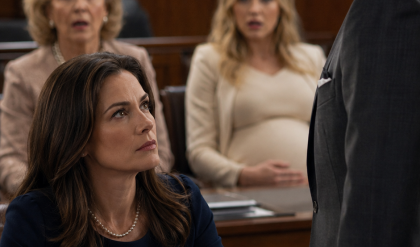
Then Vanessa Bell placed one hand over her swollen stomach, tilted her head, and sighed the theatrical sigh of a woman who had rehearsed sympathy and landed somewhere closer to performance. “It’s better this way,” she said. “The baby deserves a peaceful family.”
I looked at her hand on her stomach. I looked at my husband.
I did not cry.
I did not ask why.
I opened the envelope, removed the papers, and read the first page slowly enough for every camera in the room to catch what calm looks like when it has already finished grieving in private.
Grant’s jaw tightened. He had expected tears. Begging. A scene dramatic enough to discredit me before witnesses.
Men like Grant never understood the danger of a woman who had already done her crying.
I took the pen from his jacket pocket. Signed my name. Placed the papers back in his hand.
Then I reached into my clutch and withdrew a sealed medical report.
The ballroom went so quiet I could hear champagne bubbles dying in glass.
Margaret Sinclair, my mother-in-law, read it first. Her diamonds trembled at her throat.
“The baby isn’t his,” she whispered.
The whisper should not have carried.
But humiliation had sharpened the room. Everyone had leaned too close, hungry for spectacle. So those five words moved through the Kensington Royale’s grand ballroom like a blade through silk.
The baby isn’t his.
Vanessa’s smile collapsed.
Grant looked at his mother, then at the white envelope I had placed against the cake stand, then at me — in that order — which told me everything I needed to know about his priorities.
“What is that?” he asked.
“A report,” I said.
Vanessa laughed too quickly. “A fake one, obviously. Emilia has been unstable for months.”
There it was.
The word they had been rehearsing.
Unstable.
It was the word Grant had used when I asked why his shirts smelled like another woman’s perfume. The word Margaret had deployed when I stopped attending Sunday dinners where she catalogued my empty womb as a family disappointment. The word Vanessa had written to her friends in messages she believed I would never see.
Poor Emilia. She’s becoming embarrassing.
Grant extended his hand. “Give it to me.”
Margaret did not move.
My mother-in-law had spent seven years being a woman built from pearls and punishment. I had never seen her without lipstick, without judgment, without the specific brand of control that announced itself as love. She had corrected how I stood. How I spoke. How I hosted. How I mourned the three pregnancies I had lost. She had told me, while I was still bleeding from the last miscarriage, that “strong women don’t turn grief into theater.”
But now her perfectly manicured fingers were shaking.
Because the report was not a gossip printout.
It was from Whitmore Private Diagnostics — the most discreet medical lab in Manhattan. The kind of place Sinclair women used when they wanted results hidden, expedited, and impossible to dispute.
Grant snatched it from his mother’s hands.
I watched his eyes move across the page.
First confusion. Then denial. Then the particular panic of a man realizing the floor has been gone for some time and he has only now looked down.
Vanessa stepped toward him. “Grant. Don’t listen to her. She’s lying.”
“I didn’t write the report,” I said. “You did.”
Vanessa froze.
That was when the first phones rose.
Grant’s cousin Dahlia whispered oh my God into her champagne. Paige, Grant’s younger sister, lifted her phone higher. A senator’s daughter near the window pressed her hand over her mouth.
“This is private,” Grant said.
“Was it private when you handed me divorce papers in front of everyone?” I asked.
My voice was soft. That made it worse for him.
He took a step forward. “Emilia—”
“No,” I said.
One word.
Not loud. Not trembling.
Just final.
The conclusion on the report was simple and clinical. Based on the genetic markers provided, Grant Alexander Sinclair is excluded as the biological father.
Excluded.
A clean word.
A word that destroyed a nursery, a trust amendment, a press release, and an entire family’s public performance in four syllables.
Grant stared at Vanessa. “Tell me it’s not true.”
She opened her mouth.
No sound.
The silence answered for her.
Grant flinched as if she had slapped him.
I let the moment breathe.
That was the luxury of power. Not shouting. Not rushing. Letting the guilty fill silence with their own ruin.
Then I picked up my clutch.
“Congratulations on your peaceful family,” I said.
And I walked out of the ballroom.
No one stopped me.
The pink balloons bobbed overhead as if nothing had happened. Behind me, the cake stood untouched, the champagne warmed, and three hundred guests began the story that would destroy Grant Sinclair before dinner.
In the corridor of the Kensington Royale, white orchids lined the walls between gold mirrors. I saw myself in one as I passed.
Black silk dress. No tears. Red lipstick. Wedding ring still on my finger — for another seven minutes.
For seven years, they had mistaken my softness for weakness. They had confused my silence for ignorance. They had believed that because I loved quietly, I would lose quietly.
At the elevator, a man stepped from the shadows in a charcoal suit.
Adrian Vale.
The last person I wanted to owe.
The only person who had known what I was about to do.
He was tall and dark-haired and dangerous in the specific way men become dangerous after they stop needing anyone’s approval. Grant called him a vulture. The newspapers called him a corporate butcher. I had called him worse once, across a boardroom table, when he had tried to acquire something that belonged to me.
His eyes moved over my face with the careful attention of a man who charged for his attention.
“Are you all right?” he asked.
“No.”
His expression softened by exactly half an inch. It was the most tenderness I had ever seen from Adrian Vale, and it lasted approximately two seconds.
“Good,” he said. “All right is overrated after betrayal.”
The elevator doors opened.
I stepped inside. Adrian followed.
As the doors closed on the ballroom and the ashes of my marriage, he handed me a second envelope.
“The board meeting is in forty-eight hours,” he said. “Your husband has no idea what else you own.”
I looked at the envelope.
Then at him.
For the first time all day, I smiled.
“Then let’s make sure he finds out in public.”
PART 2:
People love to say betrayal begins with a kiss.
It doesn’t.
Betrayal begins with a shift so small you almost forgive yourself for noticing. A phone placed face down on a table. A shower taken too quickly. A new password. A business trip with no photographs. A husband who stops asking how your day was but remembers to ask whether you’ve signed the tax documents.
Grant and I had not always been cruel to each other.
In the beginning, we had been golden.
He was the heir to Sinclair Global Capital — a financial empire stretching across New York, London, Palm Beach, and Dubai. I was Emilia Hart, a quiet consultant with a talent for numbers and a last name that meant nothing to people who only respected names engraved on museum wings.
That was what Grant believed.
I let him believe it.
When we met at a charity auction, he bid eighty thousand dollars on a painting he hated because I said I loved the color blue. He sent lilies to my office, then learned I preferred white roses. He took me to Paris in February and kissed me beneath rain that turned the sidewalks silver. He asked me to marry him on the terrace of his family’s Newport mansion.
His mother smiled like I had stolen something.
“You’re very fortunate,” Margaret told me the night of our engagement party. “Men like Grant rarely choose women without pedigree.”
I looked at Grant, waiting for him to say something.
He only squeezed my hand under the table.
That should have been enough warning.
But love is a generous liar.
I told myself he was tired. I told myself he would speak up next time. I told myself marriage would make us a team instead of a performance.
Instead, marriage made me a project.
Margaret replaced my wardrobe with pale colors because “Sinclair wives should look timeless, not interesting.” Paige mocked my degree because “consulting is just PowerPoint with heels.” Grant’s friends called me “Cinderella” after too much champagne, as if marrying money were the only possible plot for a woman like me.
I smiled. I hosted. I learned who wanted bourbon and who wanted sparkling water with lime. I memorized seating charts. I turned cold mansions into warm rooms. I sent birthday gifts to women who forgot mine. I became the wife Grant needed when investors visited and the woman his family blamed when anything went wrong.
Then came the pregnancies.
Three pink lines over four years.
Three losses.
Three times Margaret sent flowers with cards that read Rest and recover, as if grief were a minor flu requiring only hydration and quiet.
The third time, Grant stopped touching me for two months.
When he finally came back to bed, he kissed my forehead and said, “Maybe we should stop trying so hard.”
I thought he meant he could not bear to see me suffer.
Later, I learned he meant Vanessa was already pregnant.
Vanessa Bell had entered our life as a public relations consultant for the Sinclair Foundation. Twenty-eight, blonde, polished, with the particular gift of making cruelty look like concern. She called me “sweetheart” in front of staff. She corrected my floral arrangements. She told donors I was “taking a step back for health reasons” on nights Grant wanted her seated beside him.
The bullying was never loud. It was luxury bullying — sharp enough to cut but wrapped in cashmere.
At the country club, she spilled champagne on my ivory dress and gasped, “Oh no, that color washes you out anyway.”
At a hospital fundraiser, she introduced me as “Grant’s first wife” and laughed like it was a joke.
At Margaret’s Christmas dinner, she placed a baby-themed ornament at my setting. A tiny silver rattle.
Everyone saw it.
No one defended me.
I went upstairs, locked myself in a guest bathroom, and gripped the marble sink until my hands stopped shaking. Then I fixed my lipstick and returned before dessert.
That was the night Adrian Vale found me on the balcony.
He had arrived uninvited but tolerated — because half the men in the room owed him money. Adrian had built Vale House from bankrupt hotels, distressed assets, and enemies who had underestimated him exactly once. He had tried to buy my family’s old hotel portfolio years earlier, and I had blocked him through a trust he did not know I controlled.
He recognized me anyway.
“You’re better at hiding knives than your husband is,” he said.
I looked at him over my champagne. “And you’re worse at pretending not to enjoy blood.”
He smiled. “Only when it’s deserved.”
“I’ve heard you think all blood is deserved.”
“I’ve heard you’re merely Mrs. Sinclair.”
That made me laugh.
His eyes sharpened. Adrian Vale noticed everything. It was his most irritating quality and, I would discover later, his most honest one.
“Does Grant know?” he asked.
“Know what?”
“That his wife is the majority beneficiary of the Hart-Meridian Trust.”
I held his gaze.
Most people in New York knew of Hart-Meridian. Old hotels. Private holdings. Land beneath three of Manhattan’s most profitable towers. A controlling interest in Kensington Hospitality Group hidden through layers of trusts and shell companies.
Very few people knew I was the Hart.
My mother had built her fortune quietly after leaving a man who thought her ambition was unattractive. When she died, she left me money with instructions written in her slanted, elegant hand:
Never let a man measure your worth before you know the size of his hunger.
So I had entered marriage with protections.
A prenuptial agreement Grant barely read because his lawyers assumed I had nothing. Separate assets. Voting rights. A quiet team of attorneys. And one rule for myself: never use power to win love.
For seven years, I kept that rule.
Grant mistook restraint for poverty.
The affair did not end my marriage. What ended my marriage was finding out through a billing error at one of my private clinics — a clinic Vanessa had used, under Grant’s insurance, for a prenatal paternity test. She had not known the clinic was mine.
The first report excluded Grant as the father.
The second confirmed it.
My investigator found hotel footage, wire transfers, hidden debt, a draft trust amendment naming Vanessa’s unborn child as a Sinclair heir — and a recording of Vanessa laughing with a voice that was not Grant’s.
It belonged to Bennett Sinclair.
Grant’s half-brother. The family disappointment. The gambler Margaret refused to seat at the main table.
Vanessa had not been in love with Grant. She had been in partnership with Bennett. The baby was his. If Grant publicly acknowledged the child, it could force a renegotiation of the family trust — returning Bennett to power he had squandered twice.
Grant thought he had a new family.
Vanessa thought she had a fortune.
Bennett thought he had found a way back into the empire.
I stood in my bathroom at three in the morning holding the proof, realizing my marriage had not collapsed.
It had been converted into a crime scene.
I called Adrian.
“Why me?” he asked when we met at midnight in my hotel’s closed restaurant.
“Because you hate Grant.”
“Yes.”
“And you hate messy deals.”
“I hate stupid messy deals. There’s a difference.”
“I need someone who can pressure Sinclair Global without looking like he’s helping me.”
Adrian leaned back, studying me with the focused attention he usually reserved for balance sheets. “And what do I get?”
There was the vulture.
I slid a folder across the table. “First right of refusal on three distressed properties in Chicago. At fair market value.”
His mouth curved. “You negotiate like a woman who has been underestimated for sport.”
“You flirt like a man who thinks charm is a weapon.”
“It is.”
“Not on me.”
His smile deepened.
That was the beginning of our alliance.
Not friendship. Not romance. A blade placed beside another blade.
Adrian helped me trace Grant’s leverage. I found the signatures. He uncovered Bennett’s gambling debts. I found the wire transfers from Vanessa’s consulting firm. My attorneys froze the right accounts, prepared the right filings, and waited.
“Why not expose him immediately?” Adrian asked one night.
We stood in the empty Kensington ballroom while staff installed pink drapery for Vanessa’s shower. I watched a worker tie silk ribbons around chairs where Grant’s family would sit and judge me.
“Because Grant wants witnesses,” I said.
Adrian looked at me.
I looked at the pink balloons floating above the stage.
“So I’ll give him witnesses.”
Part Three: The Revenge Dress
The baby shower ended everything.
For Grant, it was only the first wound.
By midnight, the videos were everywhere. The internet did what it does best: slowed the footage down, circled Vanessa’s face, zoomed in on Grant’s hands, lip-read Margaret’s whisper, and turned my calm into a legend by breakfast.
Women stitched the clip with their own stories. Men argued in comment sections and lost. Lifestyle accounts identified my black silk dress within hours. It sold out by noon.
Strangers were calling it the funeral dress.
They had no idea I had something better waiting.
Grant called me thirty-seven times. I answered none.
He texted: Mila, we need to talk. This has gone too far. You embarrassed my family. Please call me.
Then, finally: I made a mistake.
I stared at that message for a long time.
A mistake is forgetting an anniversary. A mistake is burning toast. A mistake is not constructing a stage for your wife’s public humiliation, filling it with your mistress’s pink balloons, and expecting her gratitude.
My attorney replied for me: All communication through counsel.
The Sinclair Foundation Gala was held two nights later — at the Kensington Royale, because rich people love pretending that business and charity are separate things.
Grant did not know that the Kensington Royale was mine.
I arrived at nine. Late enough to be noticed. Early enough to ruin dinner.
The revenge dress was not black.
Black would have been obvious.
It was deep red silk, cut simply, falling off one shoulder and skimming my body like a secret. No sequins. No desperation. Just fabric so perfect it looked poured. My hair was swept back. Around my throat was my mother’s diamond collar — the one Margaret had once called “surprisingly tasteful” before asking if it was rented.
It was not rented.
Neither was the ballroom.
A hush moved through the lobby when I entered.
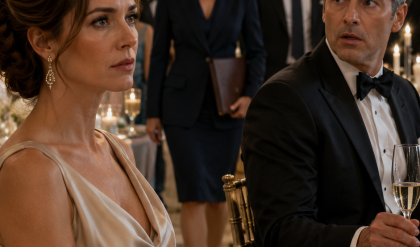
Adrian waited near the marble staircase in a midnight tuxedo, looking like the villain in a film who had quietly bought the studio.
His gaze moved over the dress, then my face. “Careful,” he said. “Half this room just fell in love with you.”
“Only half?”
“The other half is afraid of you.”
“Better.”
He offered his arm.
I looked at it.
“We’re not friends, Vale.”
“No. We’re worse. We’re effective.”
I took his arm.
Flashbulbs ignited.
By the time we entered the ballroom, Grant had already seen us. He stood near the stage with Margaret, Paige, and three board members. Vanessa was nowhere in sight — the baby shower princess had vanished from public life faster than a bad investment.
Grant’s face changed when he saw my dress.
Not because it was beautiful.
Because I was. That was the transformation no stylist could manufacture. I had stopped dressing to soften myself for people committed to cutting me. I had stopped shrinking beside a man who needed my smallness to feel tall.
Every step I took sounded expensive.
Margaret recovered first. “Emilia,” she said, smiling for the room. “How brave of you to attend.”
“Margaret.” I smiled back. “How brave of you to host.”
Paige’s mouth tightened. “Are you here to make another scene?”
I looked at the chandeliers, the centerpieces, the donors pretending not to listen.
“I’ve never made a scene in my life,” I said. “I simply stopped cleaning up your son’s.”
Grant stepped forward. “Mila, please.” He reached for my elbow.
Adrian’s hand moved first. Not dramatically. Just enough to remind Grant that some men were not accustomed to being touched without permission.
Grant’s eyes hardened. “This is between me and my wife.”
“Ex-wife in progress,” I said.
A hotel manager approached, pale with nerves. “Mrs. Sinclair,” he said to Margaret, “there’s a matter with the event authorization.”
Margaret frowned. “Not now.”
“I’m afraid it’s urgent. The owner must approve continuation.”
“Call the owner.”
The manager turned to me.
“Ms. Hart?”
The sound that moved through the room was small and collective and utterly delicious.
Grant stared at me. “What did he call you?”
“Ms. Hart. My name before you made it smaller.”
Margaret looked from the manager to me to the document I was removing from my clutch. “That’s absurd.”
“No,” I said. “It was private. There’s a difference.”
I owned the Kensington Royale. Technically, Hart-Meridian owned it. I controlled Hart-Meridian.
The board members began whispering. Margaret’s diamonds trembled against her collarbone. The event coordinator appeared with a tablet: “Ms. Hart, would you like us to continue service?”
Every guest understood the question.
Every Sinclair understood it better.
Their gala. Their donors. Their reputation.
My permission.
“Yes,” I said. “Dinner should not suffer because the hosts lack manners.”
Someone coughed to hide a laugh.
Grant stepped closer, voice low. “What are you doing?”
“What you taught me,” I said. “Making private pain efficient in public.”
Before he could answer, the screens behind the stage flickered. The Sinclair Foundation logo disappeared.
A legal notice appeared in its place.
Paige gasped.
“My receipts,” I said.
The first slide: invoices from Vanessa Bell’s consulting firm billed to the foundation for services never performed.
The second: wire transfers from Bennett Sinclair.
The third: hotel footage of Bennett entering Vanessa’s suite at the Four Seasons on nights Grant was in London.
The fourth: Grant’s signature on an amendment proposing Vanessa’s unborn child be recognized for purposes of the family trust.
The fifth: Grant moving marital assets into a shell company two days after asking me whether I wanted to “try counseling.”
No one ate. No one spoke.
The ballroom had become a courtroom with better lighting.
Grant looked at the screen as if facts were vulgar things that had wandered in uninvited. “You hacked me,” he said.
“No. You used my hotel, my clinic, my foundation contacts, and my accountants. You left footprints on floors I owned.”
Adrian’s voice beside me was smooth. “Sloppy, really.”
Grant glared at him. “You.”
Adrian smiled pleasantly. “Me.”
That was when Grant understood the second trap.
Vale House had quietly acquired enough Sinclair debt to trigger emergency review. Hart-Meridian held enough voting rights through old partnership agreements to demand board intervention. My attorneys had filed for asset preservation that morning. Grant’s attempt to divorce me quickly and hide money had activated every clause he had ignored in our prenuptial agreement.
He had thought he was cutting me loose.
He had cut the wire holding up his own empire.
The board chairman, Thomas Greer, stood slowly. “Grant,” he said, voice grim, “is this accurate?”
Grant did not answer.
He looked at me.
And there it was.
Too late, he understood. Not just that Vanessa had lied. Not just that the baby was not his. Not just that his mother had publicly humiliated the wrong woman.
He understood too late that I had owned the room, the money, the evidence, and the ending.
“Mila,” he said, barely audible. “I loved you.”
I believed him.
That was the cruelest part. Grant had loved me in the shallow way selfish men love: sincerely, but only when it cost him nothing.
“I know,” I said. “That’s why I stayed too long.”
Then I walked onto the stage.
The microphone waited.
The cameras waited.
The room waited.
I looked out at every person who had watched me be bullied, pitied, dismissed, and publicly discarded.
“My name is Emilia Hart,” I said. “For seven years, I was proud to be Grant Sinclair’s wife. Tonight, I am relieved to be something else.”
The silence was absolute.
“The Sinclair Foundation’s accounts have been placed under independent audit. Any stolen funds will be returned. Any donor wishing to redirect their pledge may do so through Hart-Meridian Charitable Trust. The hospital wing promised under this year’s campaign will be built. It simply will not be built under a lie.”
A woman near the front began to clap.
Then another.
Then the whole room — not wild applause, not messy, but elegant, damning, and final.
Grant stood below the stage, surrounded by people who were already stepping away from him.
Margaret sat down as if her bones had turned to dust.
When I stepped down, Adrian leaned close. “You could have destroyed them harder.”
“I know.”
“Why didn’t you?”
I looked at Grant. He had covered his face with one hand. For the first time in our entire marriage, he looked young. Not innocent — never innocent. Just broken enough to understand that brokenness did not make him special.
“Because I’m not trying to become them,” I said.
Adrian was quiet for a moment.
Then: “That may be the most ruthless thing about you.”
Part Four: The Billionaire’s Apology
The divorce took four months.
The tabloids expected drama. They received paperwork.
Grant tried once to come to my apartment. He arrived with white roses and no appointment. The doorman did not let him past the lobby — because unlike my husband, my doorman understood the concept of boundaries.
He sent a handwritten letter instead.
Eight pages.
He apologized for Vanessa. For the baby shower. For allowing Margaret to mistreat me. For blaming me after the miscarriages. For the affairs he described as “emotional confusion” — a phrase so weak it nearly made me laugh. He also wrote that losing me felt like waking up in a house after the fire had already consumed all the exits.
That line stayed with me longer than I wanted.
Not because I wanted him back.
Because grief is not a switch. Betrayal does not erase every morning you made coffee together, every stupid joke, every hand held in a hospital waiting room. I mourned the man I had believed in and punished the man he had chosen to become. Both were honest. Both were mine to carry and put down.
Vanessa disappeared to Miami until Bennett’s creditors found her. The paternity results became court record after the Sinclair trust dispute exploded. Bennett admitted through counsel that he and Vanessa had planned to use Grant’s public acknowledgment of the child to pressure Margaret into releasing restricted family funds.
Margaret — who had once treated me like an intruder in her bloodline — now sat through depositions while my attorney asked whether she had encouraged Grant to serve divorce papers at a baby shower.
Her answer was no.
The video suggested otherwise.
Paige deleted her social media for two weeks, then returned with a post about “healing from family trauma.” The internet was merciless. She had chosen the wrong audience to perform wounds for.
Grant resigned from Sinclair Global Capital before the board could remove him. That was the official story. The unofficial story was that I had given him forty-eight hours to choose dignity or discovery. He chose dignity. Barely.
Adrian Vale remained the most complicated part of my new life.
We worked together to stabilize Sinclair’s debt, protect the foundation, and prevent thousands of employees from suffering because rich men had treated companies like casinos. Adrian wanted to carve the empire apart. I wanted to save the pieces that employed real people.
We fought constantly.
In conference rooms. Over contracts. Across late dinners neither of us called dates but both of us prepared for.
“You’re sentimental,” he said one night in my office, tossing a restructuring proposal onto my desk.
“You’re predatory,” I replied.
“I’m accurate.”
“You’re lonely.”
That shut him up.
Adrian Vale did not like being seen unless he had chosen the lighting.
He stood by the window, Manhattan glittering behind him. “Careful, Emilia.”
“Or what?”
“Or you’ll discover I’m worse than your husband.”
“No,” I said. “Grant lied because he was weak. You tell the truth because you think it excuses cruelty.”
He turned then.
Something in his face opened and closed like a door in wind.
“You think I’m cruel?”
“I think you learned cruelty young and turned it into a business model.”
The silence between us changed.
I learned later about his father — a hotel worker who died after a private equity group stripped benefits from the company that employed him. A mother who cleaned rooms in buildings owned by men who never knew her name. Adrian had built Vale House by becoming the kind of man who could never be ignored again.
It did not excuse him.
It explained the wound.
Soft redemption does not arrive with violins. Sometimes it arrives as a revised contract.
Two days after our argument, Adrian withdrew a clause that would have allowed Vale House to profit from mass layoffs at a Sinclair subsidiary.
I found the revision at midnight.
I called him.
“You gave up eighty million dollars,” I said.
“I rounded down.”
“Why?”
A pause. Then, quietly: “Because you would have hated me.”
I closed my eyes.
“Adrian.”
“I’m not asking for absolution.”
“Good.”
“I’m asking for dinner.”
I said no.
Three times.
The fourth time, he sent no flowers, no jewelry, no performance. Just a reservation card for a small Italian restaurant in Brooklyn and a note:
No photographers. No leverage. No deals. Just pasta.
I went.
We argued about wine, ordered too much food, and laughed for the first time without using laughter as armor. He told me he had once stolen a hotel bathrobe at nineteen because he wanted to know what rich comfort felt like. I told him I had once hidden in a linen closet during a Newport party because Margaret was teaching guests how to properly pronounce my maiden name.
Adrian’s expression darkened.
“I wish I’d known you then,” he said.
“So you could rescue me?”
“No,” he said. “So I could hand you a match.”
That was the problem with Adrian Vale.
He never offered to save me.
He kept offering me fire.
The divorce was finalized on a rain-washed Thursday morning.
Grant wore navy. I wore cream — not bridal cream, but beginning cream, clean-page cream, the kind that does not require an occasion.
He looked thinner. Older. Human.
When the judge signed the decree, Grant exhaled like a man who had held his breath for months and only now realized it had not kept him alive.
Outside the courtroom, he stopped me.
Adrian waited near the elevators, far enough away to be decent.
Grant noticed him, then looked away.
“I don’t deserve a conversation,” he said.
“No.”
He nodded. “I know.”
No performance. No Sinclair polish. Just a man standing in the wreckage of his own choices.
“I blamed you,” he said. “For the miscarriages. For my unhappiness. For my cowardice. It was easier than looking at myself.”
I said nothing.
“I’m sorry, Emilia.”
The apology was late. It was insufficient. It was also real.
I let it land without letting it enter.
“Be better for someone who never has to forgive you,” I said.
His eyes filled.
I walked away before the tears fell.
Outside, rain silvered the courthouse steps. Reporters waited behind barricades, calling my name — asking if I felt vindicated, if I was dating Adrian, if I had a statement for Vanessa, for Grant, for the women watching across America who had seen themselves in the pink ballroom.
I paused beneath a black umbrella.
“To anyone who has been humiliated by someone who counted on your silence,” I said into the cameras, “do not confuse grace with surrender. Some women cry. Some women leave. Some women gather evidence. All of them deserve to be believed before they are broken.”
That quote was on mugs and sweatshirts by evening.
Margaret Sinclair watched it from her townhouse and sent me a message. Not an apology. Not exactly.
You were stronger than I understood.
I stared at it.
Then typed back: No. I was stronger than you allowed.
She did not reply.
That was fine.
Some endings do not require applause. Some only need a closed door.
Part Five: The Room She Owned
One year after the pink ballroom, the Kensington Royale’s grand hall reopened under a new name.
The Hart Hall for Women’s Health and Legal Advocacy.
The renovation was magnificent — white marble floors restored by Italian craftsmen, chandeliers cleaned until they caught light like captured stars, walls repainted in warm ivory. The old stage expanded for speakers, performances, and charity auctions. But my favorite part was hidden behind the east corridor.
A private suite for women leaving dangerous marriages.
Legal consultations. Medical referrals. Emergency funds. Childcare. A closet filled with interview clothes, winter coats, and dresses for women who needed to remember their bodies belonged to them.
Margaret Sinclair donated anonymously.
I knew because the check arrived from a foundation lawyer who still used her preferred stationery. I accepted it. Pride is useful until it starts stealing help from people who need it.
The opening gala sold out in six minutes.
No pink balloons this time.
No cruel jokes.
No mistress at the cake.
I wore gold.
Not loud gold. Not trophy gold. Soft gold, like morning light finding a room that had been dark for a very long time.
Adrian arrived late — because even redeemed billionaires needed at least one remaining flaw.
He found me near the dessert table, where a new cake stood beneath white roses.
“No medical reports tonight?” he asked.
“Check under the macarons.”
His laugh was low and surprised.
I loved that sound.
I had not told him that yet.
We had spent a year becoming something neither of us could acquire, negotiate, or control. He had learned patience like a foreign language, stumbling over it, sometimes getting the pronunciation wrong, trying again. I had learned that wanting someone again did not make me foolish. Love after betrayal is not innocence. It is courage with better architecture — same open doors, stronger walls.
Across the room, women talked and laughed and embraced. A young mother cried as she accepted a scholarship. A nurse from the new hospital wing thanked donors in a voice that shook with something warmer than gratitude. My legal director announced that the fund had already helped sixty-three women secure counsel.
For the first time in years, I stood in a ballroom and did not feel watched.
I felt witnessed.
There is a difference.
Near the end of the night, I stepped onto the stage.
The applause was warm, not hungry.
I looked out at allies where there had once been judges. Friends where there had once been spectators. My own reflection in the far mirror — no longer a woman trying to disappear gracefully from someone else’s story.
“Last year,” I said, “many of you saw a very different event in this room.”
Soft laughter moved through the audience.
“I thought that day was the end of my life as I knew it. I was right. But I was wrong to think every ending is a loss.”
Adrian stood near the back, watching me with the expression that still made my chest ache in ways I had stopped pretending were merely professional.
“Sometimes an ending is a locked door opening from the inside. Sometimes humiliation becomes evidence. Sometimes the room where you were broken becomes the room where you build something no one can take from you.”
I paused.
“And sometimes the woman everyone underestimated was never empty. She was simply done giving herself away.”
The applause rose slowly, then fully.
Afterward, I slipped out to the balcony.
New York glittered below, restless and bright and utterly indifferent to my history with it.
A minute later, Adrian appeared.
“You disappeared,” he said.
“I own the building. I’m allowed.”
He smiled. “You were brilliant in there.”
“I know.”
His smile softened. “Good.”
For a while, we stood without speaking. In the early days of our alliance, silences between us had been tactical. Now they were just silence.
He reached into his jacket.
My eyebrows lifted. “If that is a ring, I’m pushing you over this balcony.”
“It’s not a ring.”
“Wise.”
He placed a small velvet box in my hand.
Inside: a key.
Old brass. Heavy. Familiar.
My breath caught. “This is from the Meridian on Fifth.”
The Meridian had been my mother’s first hotel — the one Adrian had tried to buy, the one I had refused to sell, the one that had sat closed for three years while contractors argued over a disputed lien.
“I bought the debt attached to the lien,” he said. “Then cleared it.”
I looked at him sharply.
“No ownership claim. No hidden clause. No angle.” He held up both hands. “I signed everything over to Hart-Meridian this afternoon.”
“Why?”
He was quiet for a moment.
“The first time I met you, I wanted to own what you protected.” His voice lowered. “Now I want to protect what you love.”
That was the closest Adrian Vale had ever come to kneeling.
It was better that he didn’t.
I did not want worship. I had spent seven years being placed on a pedestal that was really just a cage at a flattering height. I wanted a man who could stand beside me without needing me smaller.
The balcony doors opened.
For one strange moment, I saw Grant.
He had been invited by the hospital board, not by me. He stood just inside the doorway in a dark suit, looking at the room — the crowd, the stage, the man beside me.
Our eyes met.
There was pain in his face. But no claim. No performance.
He nodded once.
An apology. A goodbye. A man arriving too late to his own better self and being decent enough to acknowledge it.
Then he turned and left.
Adrian followed my gaze. “Are you all right?”
I thought about it seriously this time.
The pink balloons. The divorce papers. The medical report beside the cake. The room gasping. The woman I had been, walking into an elevator with a shattered heart and a second envelope.
Then I thought about the hall behind me, full of women laughing under chandeliers I owned.
“Yes,” I said.
And meant it.
Adrian’s hand brushed mine.
Not taking. Asking.
I laced my fingers through his.
Below us, the city moved on.
So did I.
Not because the betrayal stopped hurting — some things leave marks that simply become part of your skin. But because I stopped building a home inside the hurt. Because I learned, finally, that surviving something is not the same as letting it define you.
Grant had wanted a new family and used my humiliation as the announcement.
Vanessa had wanted a fortune and used a baby as the key.
Margaret had wanted a dynasty and forgot that dynasties fall when they mistake cruelty for class.
Bennett had wanted relevance and found only a courtroom.
And me?
I brought the truth.
Then I built something warmer from the wreckage.
Epilogue
Years later, people still told the story wrong.
They said I ruined my husband at his mistress’s baby shower. They said I exposed a fake heir, took control of a company, wore the perfect revenge dress, and walked away with a billionaire on my arm.
Those parts were true.
But they were not the whole story.
The real revenge was not the medical report beside the pink cake. It was not the gala, or the legal slides on the foundation’s own screens, or the way Grant Sinclair’s face changed when he understood too late that the woman he had publicly discarded owned the room.
The real revenge was peace.
It was waking up in a sunlit apartment with no lies charging the air. It was signing checks that helped women who had been told they had nothing. It was laughing across a breakfast table with a man who had once been my enemy, and who had learned — slowly, imperfectly, because good things take time and bad habits take effort to unlearn — to be gentle without becoming weak.
It was passing the Kensington ballroom and no longer seeing pink balloons.
Only light.
Only music.
Only the proof that a woman can be publicly humiliated in front of three hundred witnesses and still become the most powerful person in the story.
My mother’s brass key from the Meridian on Fifth still hung on a hook beside my door.
Some mornings, I touched it on the way out.
Not for luck.
Just to remember where I came from — and to confirm, with my own hand, that I had never actually left.
He wanted a new family.
She brought the truth.
Then she built something he could never have imagined for himself.