The Last Thing He Stole — Was the Scent She Was Buried In
PART ONE: THE NIGHT HE CALLED ME SWEETHEART
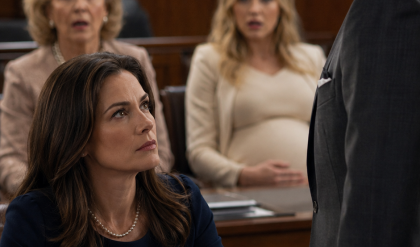
“That perfume,” my mother said, and her voice came out quiet enough to stop a room.
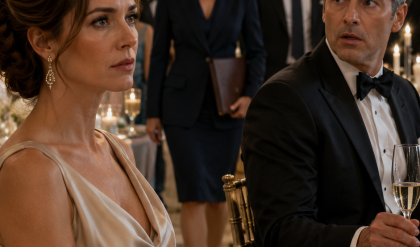
She didn’t finish the sentence. She didn’t need to. We were standing at the edge of the Beaumont Hotel’s grand ballroom — chandeliers throwing fractured light across six hundred people who had come to smile at each other — and across the marble floor, a woman in white silk was walking toward my husband with her arms already open.
Sloane Mercer. Twenty-nine years old. The kind of beautiful that costs money to maintain and comes with receipts I had found in a safe I was not supposed to know existed. She walked like she had already won something. And from the way Grayson smiled when he saw her — that particular smile, the one that reached his eyes in a way his smiles almost never did anymore — I understood that she believed she had.
She wrapped her arms around his neck.
The scent hit me before she even touched him. Warm amber and white peony and something underneath — something I had worn on the morning I became his wife.
I watched my mother’s face change. I watched her go from polished matriarch to something older and colder in the space of a single breath. She looked at Sloane. Then at Grayson. Then at the bottle she was already cataloguing from fifteen feet away — because Vivienne Hart had given me that perfume personally, had watched it being made in a workshop in Grasse, had held the three finished bottles in her hands and said this one is yours, this one is mine, and this one goes with your grandmother.
My grandmother had been buried with hers.
Grayson put his hand on Sloane’s back and laughed at something she said. He was still laughing when he turned and saw me watching. His expression didn’t break — that was the thing about Grayson, the thing that had taken me almost three years of marriage to fully understand. He could look directly at you and feel nothing.
“Sweetheart,” he said, and crossed the floor to stand beside me. His hand found the small of my back. Familiar. Possessive. A hand that had learned exactly where to sit to look like love from across a room.
I smiled. My mother had taught me something important about men who underestimate women: never interrupt one while he is ruining himself.
I had known about Sloane for eight months.
Not suspected. Known. There is a difference, and the difference matters, because suspicion makes you frantic and knowledge makes you strategic. I had found the shell company payments in February, when I was looking for the household insurance renewal and opened the wrong folder on his desktop. Bellamy Interiors. One hundred and forty thousand dollars, billed as “renovation consulting.” We had not renovated anything.
I had kept looking. I am my mother’s daughter, and my mother does not stop when she finds one thing. She stops when she has found everything.
By March I had the hotel charges. By April, the townhouse paperwork — a two-bedroom in Charleston, South Carolina, in a name I didn’t recognize that turned out to be a trust registered to an address that looped back to Grayson’s personal attorney. By May, I had the name. Sloane Mercer. Lifestyle content creator. Two hundred thousand followers. A grid full of beautiful rooms and beautiful clothes and a style that had been, in the past year, quietly shifting toward mine.
That was the part that unsettled me most. Not the money. Not even the affair. I had already decided what I would do about those things. It was the mimicry. The way her apartment started resembling mine. The way her color palette shifted from the warm neutrals she’d favored before to the cool greens and creams of every room I’d ever put on social media. The way she posted a photo of herself reading the same obscure French novel I’d mentioned in an interview, held at the same angle, beside a very similar cup of tea.
She wasn’t just sleeping with my husband. She was auditing my life.
I found the perfume by accident in May, when I was scrolling her grid looking for anything else I might recognize. She’d posted a mirror selfie — white bathroom, good lighting, the kind of studied nonchalance that takes twenty minutes to achieve. She was reaching for something on the shelf, and behind her, barely in frame, was a small amber bottle with a gold stopper and an engraved label.
I zoomed in until my hands went cold.
The engraving read E.H.B. — my initials. Evelyn Hart Beauchamp. The custom label my mother had arranged in France. The bottle that was supposed to be in the ground with my grandmother.
I set my phone face-down on the kitchen counter. I made dinner. I asked Grayson if he wanted more wine while he told me about a meeting he had fabricated. When he went to shower, I went to his office, opened the safe behind the painting — the one he thought I didn’t know about — and photographed every document with my phone while the water ran.
Then I put everything back and went to bed, and when he reached for me in the dark I said I was tired and he said of course, sweetheart and turned away, and I lay there in the silence and thought: not yet. Not yet.
The next morning, I drove to my mother’s house.
I laid everything on her kitchen table. Photographs of the documents. Screenshots. A printed timeline I had compiled over four months in a notebook I kept at the back of my closet behind a box of winter sweaters. She read through all of it without a word while I sat across from her and drank the coffee she had poured me without being asked.
When she finished, she did not say are you sure. That was how I knew how well she knew me.
She said: “Did he touch the trust?”
“The Alderton account, yes. About sixty thousand from the principal.”
She nodded once, slowly, the way she nodded when she was calculating. Then she picked up her phone and called Franklin Hess, who had been the Hart family’s forensic accountant for twenty years. Then she called Diana Lowell, who was the kind of divorce attorney that made opposing counsel quietly reconsider their career choices. Then she called the family’s private banker and said six words that I would not understand until later: Remove Grayson from everything discretionary.
She did all of this before noon.
Then she set the phone down and looked at me. “The gala is in six weeks. Are you going to hold together until then?”
“I’ve been holding together for eight months.”
“That’s my girl,” she said, and for a moment — just a moment — something moved behind her eyes that wasn’t strategy at all
Grayson, during those six weeks, believed he was about to be rewarded.
That was the cruelest part to watch. He was charming at dinner. Attentive in the way he got when he felt guilty and hadn’t yet decided whether guilt required action. He brought me flowers twice. He booked a table at Eloise, which was my favorite restaurant, and sat across from me and talked about the Hart Foundation’s expansion plans and said things like your family’s legacy is something I take seriously, you know that, Evelyn and I listened and nodded and thought about the folder in my mother’s satin handbag.
He had told Sloane, according to the texts I’d found and photographed, that the gala would be a turning point. He had told her to come.
He had actually told her to come.
I think about that sometimes. The audacity of that decision. Whether it was arrogance or recklessness or whether those two things, in a man like Grayson, had simply become indistinguishable. He believed that I was fragile. He believed that I would not cause a scene in front of four hundred donors. He believed that my dignity was something he could use as a leash, and that I would choose the appearance of a happy marriage over the reality of what he’d done because the appearance had always been worth more to women like me.
He had eight months to learn otherwise and had not paid attention.
My wedding ring, that night, was platinum and diamond, simple and expensive. I had worn it without thinking for three years. I took it off before I left the house and put it in my evening bag. Then I put it back on, because I wanted to take it off in front of him. I wanted that to be a choice I made in the moment, not a decision I’d made in private. Some gestures only mean something if they happen in front of a witness.
The Beaumont Hotel’s ballroom was everything Grayson loved. Height, gold, the kind of accumulated glamour that implies you belong here by virtue of simply being here. The Hart Foundation gala was an annual event, and my mother had run it for thirty years with the kind of precision that other nonprofits studied in case studies. Six hundred people. A chamber orchestra. Champagne that cost more per bottle than most people’s grocery budgets.
Grayson wore a tuxedo that fit him perfectly, because he understood appearances, and he kept his hand on the small of my back all evening, steering me toward the people he wanted to impress and away from the ones he was afraid of. He called me sweetheart four times in an hour. I counted.
Helena Price arrived at seven-fifteen and went immediately to stand near the east wall, where the lighting was lower and the crowd was thinner. She was wearing charcoal, not the black she usually favored at evening events, and she had a sealed envelope in the inner pocket of her jacket. She did not look at me. We had agreed she would not look at me.
At seven forty-two, the ballroom doors opened and Sloane Mercer walked in.
She had done everything right, from the angle of pure theater. White silk that was not quite a wedding gown but wanted you to think about one. Hair that had been professionally styled to look effortless. The bracelet on her wrist — a Van Cleef pavé piece I recognized from a receipt I’d photographed — caught the chandelier light. She was beautiful in the way that was designed to be noticed, and she was noticed.
She walked across the marble floor without hesitation. Not looking for him. Already knowing where he was.
She put her arms around my husband’s neck, and she smiled at him, and the amber-and-peony scent of the perfume that was supposed to be mine — that was mine, that had my initials cut into its glass — expanded into the air between us.
My mother was standing at my left shoulder.
I heard her exhale.
And I thought: now.
PART TWO: THE WEIGHT OF THE FOLDER
“That was my gift to my daughter.”
My mother did not say it loudly. Vivienne Hart had spent sixty-three years understanding that volume is what you use when you don’t have authority, and she had authority in this room in the way that the building’s foundation did — invisible, structural, and not going anywhere.
Sloane heard her. Her smile adjusted — a microexpression, a recalibration — and she turned to look at my mother with an expression of perfect, practiced confusion. Who, me? What have I done?
Grayson laughed.
It was the laugh he used when he thought someone was overreacting, the same laugh he’d used when I’d mentioned once that his assistant called at eleven p.m. too frequently, the laugh that said you are embarrassing yourself and I am too generous to say so directly.
“Vivienne,” he said, “don’t be dramatic.”
The string quartet kept playing. A Brahms intermezzo. I remember because the irony lodged itself somewhere in my chest — the gentlest possible music for the moment the room started to understand what it was witnessing.
My mother opened her black satin handbag.
She removed a cream folder tied with a gold ribbon, the kind you use for documents you want to look like a gift until the moment they don’t. She held it in both hands, level, easy, as though it weighed nothing. Grayson’s smile was still on his face, but his eyes had changed. That was the tell with him — the eyes always changed before anything else, and his eyes, right now, were calculating.
He saw the folder and knew it wasn’t a coincidence. He saw my face and knew I wasn’t surprised. And in the three seconds it took for all of that to land, I watched him decide he could still manage this.
He was wrong, but I understood the instinct.
“I won’t be dramatic,” my mother said. “I’ll be accurate.”
She untied the ribbon. She did not open the folder yet — she held it the way a judge holds a document before reading from it, for the weight of the pause. Around us, the nearest tables had gone quiet. Not the whole ballroom — not yet — but enough. The geography of gossip at an event like this is efficient. Silence in one corner becomes audible thirty feet away in under two minutes.
Sloane placed a hand on her chest. I don’t understand what’s happening. It was a good performance. She had clearly rehearsed for some version of a scene, though perhaps not this specific one. She looked around the room — looking for sympathy, or for an exit, or for someone to confirm that she was the wronged party here, which was a narrative she had clearly built for herself in the months she’d spent wearing my perfume and sleeping in a bed my inheritance had paid for.
My mother opened the folder.
“Bellamy Interiors,” she said. “A limited liability company incorporated in Delaware in January of last year, with no physical office and no employees. Consulting payments totaling one hundred and forty-three thousand dollars.”
Grayson’s jaw was working. “Vivienne, this is not—”
“Marigold Trust.” She turned a page. “A charitable trust registered in South Carolina to an address belonging to the law firm of—” she read the name, slowly, letting it settle “—which is, as everyone here probably knows, the firm that represents Beauchamp Capital. Your firm, Grayson. Your trust. Your address.”
“This is a private—”
“You brought your mistress here,” my mother said, “wearing my daughter’s perfume. You chose the audience.”
The word mistress moved through the room the way a match moves through a room when there’s already gas in the air.
I had thought, in the weeks of planning, about this moment. I had thought about what I would feel. Vindication, maybe. Or the clean exhaustion of something that had been held too long finally being set down. What I actually felt was stranger and quieter than either of those things. I felt the particular freedom of a woman who has already made her decision and is now simply watching it happen.
Grayson turned away from my mother and turned to me.
“Evelyn.” He said it the way he always said my name when he wanted something — not soft, not hard, but exact, like a key fitted to a specific lock. “Evelyn, say something.”
He believed, even then, that I would help him.
That is the most honest thing I can say about Grayson Beauchamp: he genuinely believed that I would look at everything he had done — the money, the townhouse, the woman wearing my grandmother’s scent — and I would choose the appearance of our marriage over the reality of his character, because I had always done that before, because women like me were supposed to.
He had married a performance and was shocked to discover there was a person inside it.
I looked at my wedding ring.
I thought about the morning we got married — not the ceremony, but before it, when I had stood in my mother’s bathroom and she had placed that small amber bottle in my hands and said this is the only thing you can never replace, so be careful with what you give your scent to. I had not understood then. I thought she meant the perfume.
I worked the ring off my finger.
I held it for a moment — platinum and diamond, three years of a life I had been performing — and then I dropped it into my champagne glass.
The sound was very small. Crystal against gold, the way two things are when they have nothing to say to each other. The champagne fizzed briefly around it. The ring settled.
Everyone near us heard it.
Grayson stared at the glass. For the first time all evening, his face did something unplanned. Some muscle let go. Some version of the man underneath the tuxedo surfaced briefly — not a better version, just a more honest one — and that version was frightened.
Good.
“I have nothing to add,” I said. “My attorney will.”
Helena stepped forward from the east wall.
She moved through the crowd the way good lawyers move through any contested space — purposefully, without apology, reading the room as she crossed it. She had the sealed envelope in her hand. Grayson’s full name was on the front, written in the dense, formal font of official documents, which it was.
She stopped in front of him and held it out.
He didn’t take it immediately. He stood there with his hand at his side, looking at the envelope, and then at Helena, and then at my mother, and then at me, working through the stages of a man who has run out of moves but hasn’t yet accepted it. The envelope held the divorce filing, the fraud claim referencing the Alderton trust, and a temporary restraining order preventing the transfer or disposition of any joint assets.
Sloane, behind him, had stopped pretending she didn’t understand what was happening. She was still wearing my perfume. She would wear it all the way out of this building, and that seemed right to me — that she would carry the scent of something that had never belonged to her.
“You planned this,” Grayson said. He was still looking at the envelope. “All of it. The whole night.”
I considered telling him: No, you planned it. I just prepared.
He had planned for me to fall apart. He had brought her here because he wanted a scene — because a hysterical wife and a sympathetic mistress was a story that could be managed, a story that cast him as a man trapped between two women, which was the story men like Grayson told themselves so they wouldn’t have to use the word thief.
What he had not planned for was my mother’s handbag. What he had not planned for was a forensic accountant and four months of documented evidence and a woman who had learned, from the woman who raised her, that the most dangerous thing you can do in a room full of powerful people is refuse to perform for them.
He took the envelope.
Sloane left first. She walked across the marble floor the way she had entered, but the geometry of the room had changed and she felt it — the slight angling away, the turning of shoulders, the strategic study of champagne glasses that meant we are not looking at you, which is worse than looking. She had come in as a woman making an entrance. She left as a woman being watched leave.
Grayson followed ten minutes later, after a whispered and pointless conversation with his own attorney — a man who had arrived at the gala as a guest and was now, visibly, doing rapid mental math about what he was obligated to tell his client versus what he was professionally compelled to withhold until morning.
The ballroom did not stop. That was the Hart Foundation: sixty years of discipline. The orchestra played. The dinner was served. My mother gave her annual address in front of four hundred donors and was interrupted four times by applause. She thanked the board members by name. She outlined the expansion plans. She made two jokes that landed perfectly.
She did not mention Grayson Beauchamp once.
I sat at the head table and ate the salmon and talked to the woman beside me — a cardiologist who had just returned from a medical mission in Mozambique — and listened to her describe a surgery she’d performed in a tent with two residents and a flashlight, and I thought: this is what courage actually looks like. Doing something because it has to be done, in the conditions you’re actually in, not the conditions you wished you had.
My left hand, ringless, felt lighter than it had in years.
PART THREE: WHAT WAS IN THE SAFE
I should tell you about the perfume.
Not the one Sloane wore. The one I wore that night — which was not the custom Paris scent, because I had given that bottle to Diana Lowell six weeks ago to be preserved as evidence. What I wore was a department store amber, something warm and unmemorable, because I had understood from the beginning that the point of the evening was not for Sloane to be surprised. She was irrelevant. The point was for Grayson to see that every move he thought he had made in secret had been witnessed, documented, and returned to him in front of the people whose opinion he cared about most.
The perfume was the setup. It had been the setup since February, when I first zoomed in on that mirror selfie and felt the floor shift beneath me. I had spent four months after that asking myself: what does it mean that she has it?
There were two answers.
The first answer was that Grayson had taken it from somewhere. The most likely somewhere was his study — the bottom-right drawer of his desk, where I kept a small collection of scents I rarely used, including the custom bottle, which I had placed there in the first weeks of our marriage without telling him its significance. Men like Grayson learn what they’re given. I had never told him that bottle was irreplaceable, so he had not understood that giving it away was an act of violence.
The second answer was worse. The second answer was that my grandmother’s bottle might not be buried.
I didn’t want to sit with that answer, so I filed it away and kept moving.
After the gala — after Grayson left, and Sloane left, and the evening wound itself into the warm and particular exhaustion of aftermath — I sat with my mother in the back of her car while her driver took us home, and I finally asked the question.
“The third bottle.”
She looked out the window. “Yes.”
“Tell me.”
She was quiet for a moment. Not the strategic pause she’d used all evening, but something that had more grief in it.
“Your grandmother didn’t want to be buried with it,” she said. “She told me the week before she died. She said she’d lived long enough to know that the dead don’t get to keep things, and she’d rather the perfume stayed in the living world.” She paused. “I put it in my safe. I didn’t tell you because I thought — I thought it would make you sad, and you’d just lost her.”
“You kept it for eight years.”
“I kept it for you for eight years. I was waiting for the right moment.” She looked at me. In the dark of the car, my mother looked exactly like my grandmother — the same quality of attention, the same refusal to soften a truth just because it was inconvenient. “I was going to give it to you tonight, after everything. But Grayson got to it first. He went through my safe during your grandmother’s wake. The security footage—” she stopped.
“You have security footage.”
“I have had security footage in this family’s home for twenty years, Evelyn. Your grandmother installed it.”
I laughed. I surprised myself. It came out sudden and genuine and a little helpless, and my mother looked at me for a moment and then she started laughing too, and we sat in the back of that car in our evening gowns and laughed until I felt something release in my chest that I hadn’t even known was clenched.
“He stole from our grandmother’s wake,” I said.
“He stole from a dead woman to give something to his mistress.” She shook her head. “Grayson Beauchamp is going to spend the rest of his life being defined by that sentence.”
The divorce took fourteen months.
That is the part the story always glosses over — the machinery of untangling a life. The apartment divided, the accounts separated, the public narrative managed with the precision my mother brought to everything. Grayson’s attorney made three attempts at aggressive counter-filings. Diana Lowell answered each one with documentation so thorough that, by the fourth month, opposing counsel began requesting extensions before they’d even read what she’d sent.
The fraud case was referred to the state attorney’s office. I am not supposed to discuss the specifics.
Sloane Mercer quietly discontinued her lifestyle account in the month after the gala, resurfacing four months later with a different aesthetic and a different city. I watched this without feeling much. She had not been my problem, not really. She had been a symptom. The disease had a different name.
What I want to tell you about is the morning in October — eight months after the gala, six months into the divorce proceedings — when a small package arrived at my apartment.
It was from my mother’s attorney. Inside, wrapped in cream tissue paper: the third bottle of perfume. Amber glass, gold stopper, the engraving intact. E.H.B. — which were also my grandmother’s initials. Eleanor Hart Beauchamp.
My grandmother had had the bottles engraved with her own initials, which were also mine, which had been my mother’s design all along — making sure there would always be a piece of Eleanor Hart in whatever name I carried into whatever life I built.
The note inside said, in my mother’s handwriting: It survived Grayson. So did you.
I held the bottle and thought about what it was worth to me now, which was different from what it had been worth when I’d had it the first time. The first time, it was a wedding gift — something marking a beginning, which had turned out to be the wrong story. Now it was something else. Something that had been taken and recovered. Something that had passed through the hands of grief and theft and a gala ballroom and still arrived intact.
I uncapped it.
I put a drop on my wrist.
Amber, peony, something green underneath. My grandmother. My mother. My own skin making it different than it had ever been before.
PART FOUR: WHAT YOU KEEP
There is a question I have been asked since — by friends, by a journalist who interviewed my mother for a piece about the Hart Foundation, by a therapist I started seeing three months after the gala — and the question is some version of: how did you stay calm?
The short answer is that I had something to do.
The longer answer is this: I had watched my mother manage grief and betrayal and loss and public life for thirty years, and what I had learned from watching her was that the alternative to action is not peace — it is powerlessness. Powerlessness does not keep you calm. It makes you frantic and afraid and dependent on the behavior of people who have already demonstrated they cannot be trusted. Action is not the opposite of emotion. It is what you do with the emotion so it doesn’t eat you alive.
But I also want to say something true about the nights.
The nights, for those eight months, were not strategic. I did not lie awake calculating. I lay awake thinking about all the ordinary moments in which I had been kind to a man who was already planning to take things from me. The dinners I cooked. The events I attended in dresses I chose because he liked them. The compromises I made because I had been taught that marriage requires compromise, without anyone explaining that compromise is only a virtue between two people who are both honest about what they want.
I had loved Grayson. Not the man at the gala, or the man who went through my grandmother’s safe, or the man who told Sloane to come and stand inside the life he was trying to steal. But the man I had thought he was — the version I had assembled from early conversations and certain gestures and the careful persona he had constructed for exactly this purpose. I had loved that man, and mourning him while simultaneously documenting the evidence of his crimes was one of the stranger experiences of my life.
Grief does not pause for strategy. It runs parallel to it.
The Hart Foundation expansion opened its second regional office in late spring of the following year. I was on the board by then — a position I had been invited into six months before the gala, which Grayson had actively discouraged on the grounds that I was too “emotionally close to the family legacy” to be objective. I understand now that what he had meant was: if you are on the board, you will know things I cannot afford you to know.
I accepted the board seat the week after the gala. I drove to the new office on its opening day and stood in the building my grandmother’s foundation had built and put my hand on the wall — just briefly, the way you touch something to make sure it’s real.
My mother was beside me.
“She would have liked this,” I said. Not a question.
“She liked anything that lasted,” my mother said. She looked at me — really looked, the way she looked at things she was deciding the true value of. “So do you.”
I thought about the perfume. I had been wearing it that morning. I wore it most mornings now, not every day, but on the days when I needed to remember the difference between what had been taken and what had been kept.
What had been kept: this building. My mother’s hand on my arm. My grandmother’s initials on an amber bottle. The knowledge — paid for at considerable cost, but mine now, really mine — that I could hold something that mattered without losing myself in the holding.
What had been taken: three years. A hundred thousand dollars from a trust. A marriage that had been a performance with a bad actor in the lead role.
The arithmetic of that is not clean. It is not supposed to be. Anyone who tells you that surviving betrayal produces a balanced ledger is lying to comfort you, and I have run out of patience for comfortable lies.
What I have instead is this: a seat at a table in a building that will outlast the man who thought he could control me by controlling what I had access to. A mother who did not ask me if I was sure, which is the most precise form of love I have ever received. A bottle of amber perfume that smells like grief and inheritance and the particular strength of women who decide, when everything is taken from them, to build the account back larger than before.
Helena Price sent me a note after the gala proceedings were concluded. She had been my mother’s attorney for twelve years, and she had delivered that envelope to Grayson with the composure of someone setting down a cup of tea, and she wrote to me in the careful, practical prose of a woman who had spent her career watching marriages dissolve and believed that clarity was a form of kindness.
The note said: You did not look like a woman being divorced. You looked like a woman making a decision. There is a significant difference, and most people never get there.
I have thought about that. The difference between things that happen to you and decisions you make inside the things that happen to you. The difference between a scene and a strategy. Between the image of a humiliated wife and the reality of a woman who had been preparing for fourteen months while the man across the dinner table told her about meetings that didn’t exist.
Grayson had expected a scene. He had built for a scene. He had imported his mistress wearing my grandmother’s perfume into my mother’s gala because he believed that my dignity — the thing I had been raised to protect most — would become a cage the moment he put pressure on it. That if he could make me choose between my pride and my pain in front of four hundred people, I would choose pride, and that choice would look enough like acquiescence to buy him time.
He did not understand that I had stopped performing for him months before he walked into that ballroom.
He did not understand that my mother had not built a foundation for sixty years by waiting for men to finish being wrong before she moved.
He did not understand — and this is the part I want to leave you with — that the most powerful thing I did on the night of the gala was nothing. I did not scream. I did not throw anything. I did not give the crowd the instability he had scripted for me. I stood with a champagne glass and I waited and I let the evidence do what evidence does when you have enough of it: it speaks in a voice that doesn’t need to raise itself to be heard.
My mother has a saying she has never, to my knowledge, applied to herself.
She says: A woman who knows something and says nothing is not patient. She is precise.
I put the third perfume bottle on my bedroom dresser, where I can see it in the morning. Some days I wear it. Some days I don’t need to.
I don’t need the scent to remember what it cost.
I don’t need to remember what it cost to know it was worth it.
But I keep the bottle because it is mine — it was always mine, it has my initials cut into it, it survived a theft and a wake and a marriage and a gala and a fourteen-month legal proceeding — and keeping it is not nostalgia.
It is evidence.
It is proof that some things, if you are precise enough, and patient enough, and honest enough about what they are worth, cannot be taken from you permanently.
They can be moved. They can be displaced. They can be carried by the wrong hands through the wrong rooms for a season.
But they come back.
At the end of the fiscal year, the Hart Foundation reported its highest single-year fundraising total in its history. My mother attributed it to what she called “renewed public confidence in the leadership.” When the journalist pressed for specifics, she smiled — the particular smile she had worn at the gala, calm and absolute — and said:
“People give to organizations they trust. We’ve always been trustworthy. Sometimes it just takes an audience.”
END