The Quiet Wife — She Forged My Name on a Building I Owned
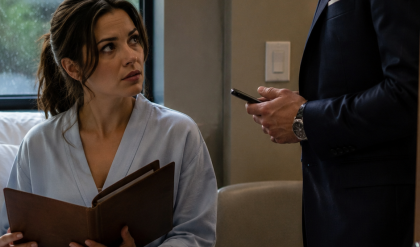
“The Aurelia called this morning,” Evelyn said. “Liv, someone used your signature to rent a penthouse.”
I was barefoot in my kitchen. The rain had been going since Tuesday. My coffee was still hot, which meant the call came early, which meant Evelyn had been sitting on this since before most people’s alarms.
“Say that again,” I said.
She said it again.
I put the coffee down very carefully, the way you put something down when your hands have started making decisions your mind hasn’t caught up to yet.
PART ONE: THE DOCUMENT
The leasing office at The Aurelia sent the email at 9:47 a.m.
I was still in the kitchen. The rain had thickened against the window. I opened the attachment on my phone, then walked to my laptop because a screen that size deserved a larger stage.
The lease was eleven pages. I read all eleven.
Unit 4702. One-year term, beginning the first of the month. Leaseholder: Savannah Vale. Payment account: Hartwell, G. — a personal account, not the foundation, not yet, that detail would come later and it would be worse. Guarantor: Olivia Hartwell.
My name. His money. Her penthouse.
I looked at the signature on page nine for a long time. It was good. She had practiced, or someone had practiced for her, and they had gotten the loop of the O right and the way my H leans slightly backward, like it’s bracing for something. What they had not gotten was the pressure point at the end of the l in Hartwell, where I always lift the pen a half-second too early. A forensic examiner would find it in twenty minutes. Evelyn would find someone in ten.
I did not scream.
I did not call Savannah’s number, which I had found on Grant’s second phone four months ago and written in my own handwriting in the back of my calendar, under a grocery list, because sometimes the most important information needs to live somewhere boring.
I downloaded the lease. I saved the email. I checked the metadata — the document had been created on a Tuesday, which was the Tuesday Grant told me he was in Cincinnati for a pipeline deal, and I had nodded and asked him if he wanted me to pack his gray suit, and he had said yes, and I had packed it, and we had been in the middle of a marriage that looked like a marriage and felt like a building whose load-bearing walls had already been removed.
I forwarded everything to Evelyn.
By noon, Evelyn called back. I was in the pantry by then, standing among the glass jars I organized by height every autumn — a habit I’d inherited from my mother, who believed that an organized pantry meant a life under control. I had not reorganized them yet this year. I had not had time, or I had not wanted to, or I had known somehow that something was coming and there was no point in ordering things that were about to be disordered.
“Liv,” Evelyn said, “this is worse than a forged lease.”
I looked at a jar of preserved lemons my housekeeper Marta had made in September. “Tell me.”
She told me. The first month’s rent, the security deposit, the administrative fees — seventy-two thousand dollars, drawn from the Hartwell Foundation’s operating account.
I said nothing for a moment.
The Hartwell Foundation funded pediatric hospital wings. It funded scholarships for nursing students in counties where the nearest hospital was an hour away. Last year it had renovated a school library in a town that Grant had never visited, in a district he couldn’t have found on a map, because I had found the grant proposal and pushed it through myself. The foundation had my name on it too, as a board member, which meant the seventy-two thousand dollars had my name on it twice now — once forged, once real, and both of them attached to a penthouse Grant had given his girlfriend.
“There’s more,” Evelyn said.
I waited.
“The Aurelia is owned by Bellweather Residential. Bellweather is a subsidiary of Chamberlain Property Group. Chamberlain is held inside the Ellison Trust.”
The Ellison Trust was mine. It had been my grandmother’s, then my mother’s, then mine. Grant had never asked much about the mechanics of it because Grant was the kind of man who assumed that anything that belonged to his wife had, by a kind of marital osmosis, become his.
Savannah Vale had forged my name to lease an apartment in a building I controlled.
I looked at the signature on page nine again in my memory — the O, the backward H, the lifted l — and felt something happen inside me that I did not have a clean word for. Not anger. Not grief. Something older and quieter, like the moment before a very long exhale.
“Evelyn,” I said, “I want the apartment held. I want the foundation transfer traced and documented. I want the signature sent to a forensic analyst tonight. And I want the security footage from The Aurelia’s lobby preserved — every camera, every entrance, the past thirty days.”
“Done. What else?”
“I want Grant to believe, for one more day, that I am embarrassed.”
A pause. Evelyn had been my attorney for eleven years. She understood the architecture of what I was saying.
“The gala is tomorrow,” she said.
“Yes,” I said.
“Olivia.” Her voice changed register, the way it did when she was about to say something she considered both necessary and difficult. “Are you sure you want to do this in public?”
I picked up the jar of preserved lemons. Marta had written the date on the lid in black marker: September 14th. The same week Grant had come home from a business trip with a new habit of leaving his phone face-down on the counter, a small and ordinary tell that I had filed away without saying anything, because I had been building a file for longer than I’d admitted to myself.
“He brought her into our foundation,” I said. “He brought her into our building. He brought her into our marriage and then he forged my name to make it official.”
“Yes.”
“Then he can watch me respond in our ballroom.”
Evelyn was quiet for two seconds. Then she said, “I’ll have everything ready by morning.”
I did not sleep well, but I slept. That surprised me. I had expected the night to be long and ragged, to lie awake assembling evidence in my mind like a prosecutor rehearsing for a trial she couldn’t afford to lose. Instead I fell asleep at eleven and woke at six with the specific, brittle clarity that comes when the worst thing has already happened and what remains is only the response to it.
I did not eat breakfast, but I made coffee and sat with it at the kitchen island where I had been standing the morning before, when the leasing office called, when the world was still technically intact. The rain had stopped. The light coming through the windows was the pale, thin light of late autumn, the kind that makes everything look slightly more honest than usual.
Grant came downstairs at seven-fifteen. He was in his workout clothes, heading to the gym on the building’s second floor, moving through his morning with the ease of a man who had not yet been told that his morning was the last one of its kind.
He stopped when he saw me.
“You’re up early,” he said.
“I couldn’t sleep,” I said, which was true, in the way that the most useful lies are always rooted in something true.
He looked at me for a moment with an expression I had been watching reconfigure itself over the past year — the expression that was trying to decide whether I knew something or whether I was simply being the version of myself that made him slightly uncomfortable, the version that was too quiet, too composed, too difficult to read. Grant preferred women he could read. He had told me that once, early in our marriage, as a compliment.
“Big night tonight,” he said.
“Yes,” I said.
He poured himself a glass of water, drank half of it, and went to the gym.
I sat with my coffee and thought about the signature on page nine.
I arrived twelve minutes late.
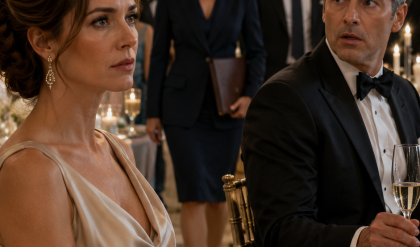
This was calculated. The venue — the Grand Meridian ballroom, which the foundation had used for seven consecutive years, which I had chosen and renegotiated the contract for every single time — would be at peak attention by the time I walked through the doors. Donors would have their first drinks in hand. The lighting would have settled into the warm gold that made everyone look slightly more generous than they felt. Grant would be positioned near the entrance in his tuxedo, which I had not packed for him this time, which he had packed himself, and which I had let him do without comment.
I wore black. Not mourning black, not dramatic black — a column gown in matte crepe that I had bought six months ago for a different occasion and never worn, because the occasion had been a dinner that Grant had canceled at the last minute, a dinner that had been, I now understood, canceled because Savannah had been in town.
I wore no jewelry except my watch.
I wore no wedding ring.
Grant noticed the ring first. He was smiling at a federal judge when I came through the doors, and he turned toward me with the automatic, practiced warmth of a man at a charitable event, and then his eyes dropped to my left hand and the smile stayed on his face but something behind it went very still.
He crossed the room toward me. The judge watched him go with an expression of polite curiosity.
“You look beautiful,” Grant said, reaching for my cheek.
I turned my face a quarter-inch. His mouth touched air. Several people saw it. I watched his eyes calculate the damage.
“I need to talk to you,” he said, low enough that the nearest cluster of guests would hear the tone but not the words.
“Later,” I said. “People are watching.”
His jaw tightened. I recognized the tightening — it was what his face did when he wanted to say something that the room wouldn’t let him say. In the early years of our marriage, I had felt something sad about that tightening, a sympathy for the gap between what he wanted and what the situation allowed. I did not feel sympathy tonight. I felt, instead, the strange calm of a woman who has stopped being afraid of her own husband’s silences.
I moved away from him toward the bar.
I had a glass of water. I talked to a cardiologist I liked, a woman who ran a clinic the foundation had helped fund, who had the energy of someone who had spent twenty years in rooms where everything mattered and had learned to carry that weight without letting it crush her posture. She told me about a patient. I listened. I was genuinely listening.
Across the room, Grant watched me.
Savannah arrived at nine.
I knew she would come because Grant had invited her. I had found the email — not the one I was supposed to find, not the kind of careless trail a frightened man leaves when he’s trying to cover himself, but the earlier email, the one from three weeks ago, before the leasing office called, before any of this had hardened into the shape it now had. In that email, Grant had written: The gala is Thursday. I want you there. And Savannah had written back: Are you sure? And Grant had written: You’re not the secret. She is.
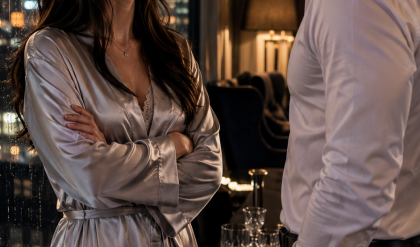
She arrived in silver satin. The fabric caught the chandelier light in a way that suggested someone had thought carefully about the chandelier light when choosing it. She was twenty-nine years old, and she was wearing my Cartier bracelet — the thin gold one with the small sapphire clasp that Grant had given me on our fifth anniversary, that I had not worn since the spring, that I had left in the dish on my dressing table when I stopped wearing it without quite deciding to stop, the way you sometimes stop doing things before you understand why.
She came toward me directly. I gave her credit for that.
“Olivia,” she said, and her voice had the careful brightness of someone who has rehearsed a scene and believes she knows the blocking. “I hope this isn’t awkward. Grant said you never wore it.”
She lifted her wrist. The bracelet caught the light.
I looked at it for one second. One full second, not the fractional glance of someone too threatened to look, but the considered gaze of someone deciding what something is worth.
“Savannah,” I said.
Then I said nothing else.
She waited. She needed me to cry, or to go cold and brittle, or to say something that would give her the upper hand, something that would let her tell the story later as: The wife fell apart. The wife caused a scene. I was the calm one, the dignified one, the one who kept her head. She needed noise from me, because noise from me would be the sound of a woman losing.
I gave her silence instead.
She smiled again, smaller this time, and touched her stomach. The touch was deliberate. She had done it in a mirror, I thought — practiced the angle, practiced the timing, practiced the expression that went with it, the soft and certain expression of a woman who had decided to make an announcement in a room full of witnesses.
The room changed before she even spoke. Rooms always know. The air in a ballroom can shift in a fraction of a second when something real is about to happen, and every donor and judge and surgeon in that room had spent enough time in rooms like this to feel the change.
Grant went pale. I watched it happen from fifteen feet away, the color draining from his face with the speed and totality of a man who has just realized that the thing he set in motion is no longer under his control.
“Grant and I didn’t want rumors controlling the story,” Savannah said, pitching her voice at the volume of an intimate announcement in a large room, which is a very specific and effective volume. “We’re in love.” She looked at Grant with a warmth that was real, I thought. That was the part that might have hurt me once. “And we’re starting a family.”
Every glass seemed to freeze.
Grant reached for my elbow. I stepped away.
I picked up a champagne flute from a passing tray. The server was a young man who had been looking at the floor but looked up when I took the glass, and his eyes were wide, and I gave him a small nod that I hoped communicated: You’re fine. This is not about you.
I looked at Savannah. I looked at Grant. I smiled at them both — not a performance, not a cruelty, but the smile of a woman who has already made her decisions and is now simply living inside them.
“To new beginnings,” I said.
The silence around us lasted three seconds, which is a very long time in a ballroom. Then sound resumed, the cautious, recalibrated sound of a room that is pretending not to have seen what it has just seen.
Savannah had waited for tears. She had not gotten them, and I watched her recalculate.
I opened my clutch and touched the folded paper inside with two fingers.
Grant saw the gesture. He knew that gesture — I had made it before, in board meetings, when I was about to produce a document that would change the direction of a conversation. He had seen me do it many times and had, I think, never understood what it meant until this moment.
He leaned close. “Olivia,” he said, very quiet. “What are you doing?”
I did not answer him. I looked at the stage, where the foundation’s logo was printed on a banner beside his name. Grant Hartwell, Executive Director. Hartwell Foundation: Building a Better Tomorrow.
He followed my eyes to the banner. I watched him understand, in real time, that I was not there to survive the gala. I was there to change the ownership of the story.
“Don’t,” he whispered. The shine had left his voice entirely. What remained was the flat, stripped sound of a man who was afraid.
I turned to look at him. I kept my smile small and honest. “You brought her here,” I said. “I brought paperwork.”
His face tightened when I said that word. Paperwork. It sounds harmless until it has your name on it — or, in this case, until it has your name on it twice, once forged and once legitimate, and both of those names are about to be read aloud in a room full of people who fund hospitals.
I took the folded lease from my clutch. A copy, not the original — the original was with Evelyn, because desperate people do foolish things with originals, and I had not been desperate in a long time.
Savannah saw the document. Her hand fell away from her stomach. For the first time all evening, the calculation left her face and something rawer came through — not guilt exactly, but the specific shock of a woman who had been told she was entering a story and had just realized she had been told the wrong story.
“Is that what I think it is?” Grant asked.
“The Aurelia lease,” I said. My voice was even. “Unit 4702. Savannah Vale as leaseholder. Your personal account as payment source.” I paused. “And my forged signature as guarantor.”
Savannah’s mouth opened.
“Liv—” Grant started.
“The first month’s rent, the security deposit, and the administrative fees,” I continued. “Seventy-two thousand dollars. Drawn from the Hartwell Foundation’s operating account.”
A woman near us — a federal appellate judge whose name I knew, who had received a foundation grant three years ago to fund a legal clinic — turned slightly toward us. She did not make a show of listening. She simply stopped pretending not to.
Grant stepped closer, dropping his voice further. “That was just—”
“A crime,” I said.
He flinched.
“But that’s not the part you forgot,” I said. “The part you forgot—” I looked at Savannah, who was very still now, the silver satin holding her upright the way the armor holds a soldier long after the soldier has decided to stop fighting. “The Aurelia is owned by Bellweather Residential. Bellweather is a subsidiary of Chamberlain Property Group.”
I paused.
“Chamberlain is held inside the Ellison Trust.”
Savannah blinked. Grant froze.
“You let her forge my name,” I said quietly, “to rent an apartment in a building I control.”
The chandelier light was very steady. Someone across the room laughed at something, and the laugh sounded very far away, from another country, from a different kind of evening.
Grant’s mouth moved. No sound came out.
“I’ve been patient,” I said. “I’ve been organized. I’ve had four months and a very good attorney and a forensic document examiner named Dr. Reyes who will testify that the signature on page nine of that lease was made by someone who had studied my handwriting but couldn’t replicate the pressure point at the end of the first l in Hartwell.” I looked at Savannah. “Did you know that? About the pressure point?”
She said nothing.
“It’s a very specific thing,” I said. “I don’t even notice I do it.”
The lights dimmed. A staff member stepped onto the stage and announced, pleasantly and professionally, that the program would begin in five minutes, that donors were invited to find their seats, that the bar would remain open throughout.
Grant grabbed my wrist.
I looked down at his hand. Not at his face — at his hand, at the grip, at the specific pressure of fingers that had held me differently at different points in our marriage. I had a clear memory of him holding my hand in an emergency room seven years ago, when I had miscarried our first pregnancy, and he had been very still and very present in a way that I had believed, at the time, was the truest version of him.
He let go.
My phone buzzed inside my clutch.
I opened it. Evelyn’s message was three words and an attachment.
DNA results attached.
PART THREE: THE COST OF BEING CERTAIN
I had suspected for six weeks.
Not about the child — about everything. The suspicion about Savannah had started earlier, in the spring, when Grant began leaving his phone face-down and coming home from trips that ran two days longer than scheduled and telling me about meetings in cities where I happened to know, because I had kept a casual and private awareness of his calendar, that no meetings had been scheduled.
But the DNA suspicion was newer. It had started with a conversation Grant had with someone on his phone in the kitchen while I was coming downstairs, a conversation he ended the moment he heard me on the steps — not ending it guiltily, ending it with the flat efficiency of a man erasing a line. And something in that efficiency had made me think.
I had not confronted him. I had called a private medical investigator and told her what I needed and given her six weeks to get it.
She had needed five.
The attachment opened to a summary page. I read the relevant line. I read it twice to make sure I was reading it correctly.
I put my phone back in my clutch.
Savannah was watching me. She had been watching me since the lights dimmed, since the staff member’s announcement, since the room began its careful migration toward the dinner tables. She was watching me the way a person watches someone who has information they don’t, which is to say with the specific, terrible attention of someone who knows they are about to hear something they cannot un-hear.
Grant was watching me too, but differently. He was watching me with the calculus of a man who was still, even now, trying to find the version of events in which he came out ahead. I had been watching that calculus for years. It was what had allowed me to stay in the marriage as long as I had — not because the calculus was appealing, but because I had been waiting, without quite admitting it to myself, for the moment when it would fail.
I walked to the stage.
Grant followed. Savannah followed. The room watched with the focused stillness of a crowd that has understood it is witnessing something real.
The foundation’s event coordinator, a woman named Diane who had worked with me for six years and who was currently standing at the side of the stage with a look of controlled alarm on her face, caught my eye. I gave her a small nod. She hesitated for a fraction of a second, then stepped aside.
I took the microphone.
The room went quiet.
“I want to thank you all for being here,” I said. “The Hartwell Foundation has done extraordinary work, and that work belongs to every person in this room who believed in it and funded it.”
Grant had reached the edge of the stage. He was deciding whether to come up after me. I watched him decide, and I watched him conclude that coming up after me would be worse than letting me speak, and I watched him conclude too late that letting me speak was also going to be worse than he had estimated.
“This foundation was built on the premise that the people who have the most have a responsibility to the people who have the least,” I said. “That’s not a complicated idea. Most of us learned it young. What’s complicated is what happens when someone in a position of trust decides that the foundation exists for their own convenience.”
A pause.
“The foundation’s operating account was used to fund a private residential lease,” I said. “Seventy-two thousand dollars. The leaseholder is not a scholarship recipient. The leaseholder is not a hospital. The leaseholder is a personal acquaintance of the executive director whose name appears on that banner.”
I looked at Grant. He had gone very still.
“I have the lease. I have the transfer records. I have the signature analysis. And I have the security footage from The Aurelia’s lobby for the past thirty days.” I looked at the federal judge, who was watching me with the specific, careful attention of a person who had spent thirty years evaluating testimony and knew what it sounded like when someone was telling the truth. “The foundation’s board will receive a full accounting by Monday morning. Our legal team has already been notified. Any donor who wishes to speak with me directly may do so.”
The room was very quiet.
“I love this foundation,” I said. “I love what it was built to do. And I intend to make sure it continues to do it.”
I handed the microphone back to the stage manager.
I walked off the stage on the opposite side from Grant.
Savannah found me in the hallway outside the ballroom, near the coat check, seven minutes later.
I was standing with Evelyn, who had arrived during my remarks with a tablet and an expression that suggested she had been preparing for this moment with the same thoroughness I had.
Savannah’s silver dress looked different in the hallway light — less curated, more exposed. The Cartier bracelet was still on her wrist.
“That wasn’t necessary,” she said.
I looked at her.
“You could have filed the papers,” she said. “You could have done it quietly. You didn’t have to—” She stopped. She was doing the thing people do when the script runs out, which is reaching for words that will restore the version of events in which they were justified.
“Savannah,” I said. “You wore my bracelet to my gala.”
She lifted her chin. “Grant gave it to me.”
“Grant doesn’t own it.” I held her gaze. “Grant has never owned anything in this marriage that I didn’t allow him to steward. I allowed it because I believed in the partnership. I allowed it because I trusted that the things I built and the things I funded and the things I signed would be treated with the respect they deserved.”
She looked at me with something that was trying to be defiance and landing closer to grief. “You don’t know what we have.”
“I know what you have,” I said. “You have a penthouse in a building I own, funded by a foundation I built, signed with a name that isn’t yours to use.” I paused. “You also have a document from a laboratory that you should know about before you make any more announcements in front of federal judges.”
She went still.
I opened my clutch and removed my phone. I turned it toward her so she could read the summary line of the DNA report.
She read it.
She read it again.
“That’s—” she started.
“Accurate,” Evelyn said, pleasantly.
I watched Savannah process it. I watched her process it the way you watch someone realize they have been standing in a story that was never theirs — not the villain’s story, not the protagonist’s, but the story of a person who was told one set of truths and handed a completely different set of consequences.
Grant had told her the wife was fragile. Grant had told her the building was his. Grant had told her the foundation would accommodate whatever he needed, because Grant had spent twelve years believing that the things that ran smoothly around him ran smoothly because of him.
He had been wrong about all of it.
“The bracelet,” I said.
She unclasped it and held it out.
I took it. It was lighter than I remembered.
PART FOUR: WHAT REMAINS
Grant signed the divorce papers in February.
He signed them in Evelyn’s office, across a table from me, in a room that had good lighting and no sentiment. He was wearing the gray suit I had packed for him in October, for a trip to Cincinnati, for a meeting that had not happened. He looked like a man who had spent four months being slowly, thoroughly informed of the exact dimensions of what he had miscalculated.
The foundation board had met in November. They had voted to remove him as executive director and install an interim director while the full accounting was completed. The board also voted to fund an independent audit going back three years. Grant had not contested either vote, because Grant’s attorneys had made it very clear to him that contesting the votes would require him to contest the evidence, and the evidence was very thorough.
The Aurelia lease was voided. The forensic analysis of the signature had taken six days. Dr. Reyes had filed a report that was, in Evelyn’s words, “the most useful eleven pages I’ve read all year.”
The foundation recovered the seventy-two thousand dollars. It funded a pediatric oncology wing in a hospital in the county where my grandmother had been born, in a town where Grant had never been and would never go, and where a small plaque now read Ellison Wing in letters that had no one else’s name on them.
Savannah moved out of Unit 4702 in December. She moved back to the city where she was from, according to the forwarding address she filed, which Evelyn noted with clinical interest, was not a city where Grant had any assets.
The silver satin dress was probably still in a closet somewhere. I did not think about it much.
The morning after the gala, I went back to the pantry and reorganized the jars.
I did it by height, the way my mother had, the way her mother had, and I did not pretend it was a metaphor for anything except the simple satisfaction of putting things in the order they were meant to be in. Some of the jars needed to be thrown away. The preserved lemons from September were still good. I kept them.
Marta came in at nine and found me standing on a step stool, rearranging the top shelf.
“You’re up early,” she said.
“I slept well,” I said.
She looked at the organized jars, then at me, then at the ring that was not on my left hand.
She put the kettle on without saying anything, which was exactly what I needed her to do.
I kept the Cartier bracelet in a drawer for three months.
Not because I wanted to keep it — because I was deciding what kind of person I was going to be once this was finished. Whether I was going to be the person who kept the bracelet as a symbol of what I had reclaimed, or whether I was going to be the person who understood that some objects outlive the stories they were given in.
In March, I had the bracelet repaired — the clasp had been slightly bent, from how Savannah had worn it — and gave it to Diane, the event coordinator, because her twentieth anniversary was the following week and she had once, years ago, mentioned that her wife loved sapphires.
Diane cried a little, which surprised me. Then she said, “You didn’t have to do this.”
“I know,” I said.
She wore it to the spring gala. I noticed it on her wrist during the opening remarks, when the new executive director — a woman named Dr. Farah Osei, who ran a mobile health clinic in three counties and had the particular kind of authority that comes from having actually done the work — began speaking about what the foundation was and what it was going to become.
I was in the third row, which was not where I usually sat. I usually stood near the back, where I could see the room and the stage at the same time. But I had decided, for this gala, to sit close enough to hear clearly.
Dr. Osei was talking about accountability. She was talking about it the way someone talks about a word they’ve actually lived in, not a word they’re performing.
“The foundation’s resources exist because people trusted us with them,” she said. “Trust is not a document. It’s a practice. And when it’s broken, the only way back is through the breaking.”
I looked at the bracelet on Diane’s wrist, the small sapphire catching the light, and thought: Yes. That’s exactly right.
The pantry jars stood in order.
The preserved lemons lasted through spring.
The building was still mine.
The trust was still mine.
The story — the one about who built what, who held what, what had my name on it and what had always been mine to direct — that story had always been mine too.
I had simply stopped being quiet about it.
On the night of the gala, twelve minutes after I handed the microphone back to the stage manager, a reporter from a financial weekly who had been covering the foundation for three years came to find me in the hallway outside the ballroom.
She said, “Off the record, Mrs. Hartwell — what was your name doing on that lease?”
I said, “Off the record? Someone wrote it there without asking me.”
She said, “And on the record?”
I said, “On the record, the building was mine. The signature was forged. And the foundation is going to be fine.”
She asked me one more question, the one they always ask: “Did you know? Before the leasing office called — did you know it was coming to this?”
I thought about the grocery list in the back of my calendar. I thought about the metadata on the lease. I thought about four months of being very organized in a very quiet way.
“I knew something was coming,” I said. “I just didn’t know yet what shape it was going to take.”
She looked at me for a moment.
“That must have been hard,” she said. “The waiting.”
I thought about the kitchen. The pantry. The rain on a Wednesday morning. The preserved lemons on the shelf.
“The waiting wasn’t the hard part,” I said. “The hard part was deciding what I was waiting for.”
She wrote it down.
I went back into the ballroom.
END