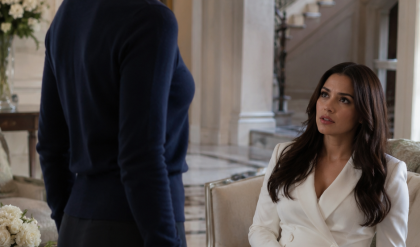
## PART ONE: THE FOLDER
“You’re not coming.”
It wasn’t a question. Liam said it the way he said everything in the last eight months of our marriage — like a conclusion he’d already reached alone, in a room I hadn’t been invited to.
I was sitting at the dining table with three campaign decks spread across it, a cold cup of coffee beside my elbow, and a highlighter I’d been clicking for the past hour without marking a single page.
“I built half the relationships in that ballroom,” I said.
“You built them *for* me.” He adjusted his cufflinks without looking up. “That’s different.”
He was right that it was different. He was wrong about what that difference meant.
Liam Hayes learned how to enter a room from me. Not the posture — that came from a personal trainer he hired after the Series B. Not the suit — that came from a stylist I found after the Series C. But the *way* he entered. The two-second pause at the threshold. The quarter turn toward the most powerful person in the space. The smile that arrived half a beat late, the way expensive things always do.
I taught him that.
For six years, I had been the woman behind the voice of Hayes Vision. Not the wife. Not the quiet supporter in the background, though I played that role with enough skill that most people believed it. I was the architect of every word his company ever said to the world — every campaign, every speech, every line that made powerful men decide he was worth trusting.
Then he decided he had outgrown me.
He said it almost gently, which was somehow worse than cruelty. He said the company had evolved. He said they needed a different kind of presence. He said that Sienna — and here his voice changed in the way voices change when someone is performing casualness — that Sienna understood the modern market.
Sienna was twenty-five. She had 4.2 million Instagram followers and a smile that photographed like daylight.
What she didn’t have was the agreement Liam had signed six years ago in a coffee shop in Queens, on a Tuesday, when his company was worth nothing and my brain was the only asset either of us owned.
I had never mentioned that agreement since I signed it.
I mentioned it the night of the Hayes Vision Annual Gala, in front of every camera in New York.
The leather folder had been sitting on my desk for three weeks before the gala.
I kept moving it. From the desk to the bookshelf. From the bookshelf to the closet. Then back to the desk because I needed to see it there, needed to feel the weight of what I was deciding every time I sat down.
My lawyer, a sharp-faced woman named Denise who had once told me I had a “dangerous tendency toward fairness,” had assembled the packet herself.
“You could do this quietly,” she said during our last meeting. “File through proper channels. No spectacle.”
“He made the end of our marriage a spectacle,” I said. “He gave an interview to *Forbes*. He called it a mutual evolution.”
Denise said nothing.
“Did you read it?” I asked.
“I read it.”
“He said he needed a partner who matched his current chapter.” I kept my voice even. “He didn’t mention that his current chapter was narrated in my words.”
Denise put the folder on the table between us. “The gala is in three weeks. The merger announcement is scheduled for that night. Board approval is contingent on the valuation, and the valuation includes every asset listed in this agreement.”
She didn’t say anything else.
She didn’t need to.
I found out I was pregnant eleven days after Liam handed me a settlement check and a storage company’s contact number for the furniture I’d been allowed to keep.
The doctor used the word *twins* and I sat in the paper-covered examination chair for a long time after she left the room, listening to the building’s ventilation system hum, thinking about a coffee maker in Queens that had leaked every morning for two years. Liam used to joke that it had more ambition than most VCs he’d met — it kept trying despite being structurally unsound.
I hadn’t thought about that coffee maker in years.
I thought about it a lot, sitting in that examination room.
I called Denise from the parking lot.
“Everything changes,” she said.
“I know.”
“The settlement. The agreement. What you were planning.”
“I know.”
A long pause. Then: “What do you want to do?”
I watched a sparrow land on a parking meter and immediately fly away, as if it had arrived at the wrong address.
“I want to finish what I started,” I said. “But I want to do it right.”
My mother called it revenge. My best friend called it justice. Denise called it strategy.
None of them were entirely wrong.
But the thing I couldn’t explain to any of them — the thing I hadn’t admitted even to myself until the night I stood in front of my full-length mirror in the white silk gown, seven months pregnant, hands flat against the curve of my stomach — was that I wasn’t going to the gala to destroy Liam.
I was going because I was tired of letting the story belong to him.
For six years, I had given him my words. My ideas. My vision of what his company could become and how it could speak to the world. And when he left, I had sat quietly with my settlement check and my cardboard boxes and let him write the ending.
*Mutual evolution.*
*He needed to grow.*
*She understood.*
I was tired of understanding.
The babies moved under my palms — two small kicks, synchronized in that eerie way they had developed in the past month, as if they were already communicating.
“I know,” I said to them. “I know.”
The Plaza ballroom held three hundred people.
I had attended this gala for six consecutive years as Liam’s wife. I knew where the string quartet stood, which corner the board members gathered in, which journalists he liked and which ones he feared. I knew that he always positioned himself near the east archway with a champagne flute in his right hand, because a photographer had once told him that the lighting from the east was more flattering.
He was standing there when I walked in.
He had a champagne flute in his right hand.
He was looking toward the entrance because he always looked toward the entrance — it was another thing I had taught him, the importance of knowing who arrived and when.
Our eyes met across three hundred people and a string quartet playing Vivaldi, and for one extraordinary second, nothing moved.
Then his champagne glass fell.
It happened slowly enough that I saw his fingers loosen before the glass dropped. I saw the exact moment his face broke open — not with guilt, not yet, but with something rawer than guilt. Something closer to the expression of a man who has just understood, with complete certainty, that the thing he threw away was not the thing he believed he was throwing away.
Crystal shattered. Champagne spread across marble.
The string quartet kept playing.
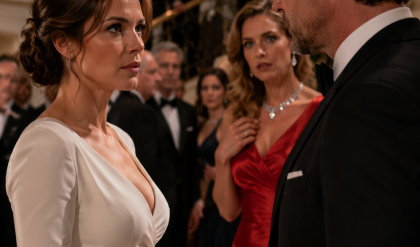
Sienna Monroe stood at his side in a champagne gown — the irony of the color was either her stylist’s mistake or her stylist’s genius — and looked between me and the broken glass with the particular expression of a woman who has just realized she’s been handed a role in someone else’s story.
I had not come to hurt Sienna. I had not come to shame her. She was twenty-five, and she had fallen for a man who presented himself beautifully, and she would spend the next few years learning what I had spent six years learning.
I pitied her that education.
But I had not come to spare her from it, either.
—
I walked to the center of the room because that was where the light was best.
I had learned that from Liam’s photographer too.
The cameras followed me the way cameras always follow a woman who walks as if she has already won. I had practiced this walk every evening for two weeks in my apartment — the pace, the posture, the way to carry seven months of pregnancy in a white silk gown so that every line of it read as intention rather than circumstance.
The leather folder was under my arm.
Liam was moving toward me before I stopped walking.
“Evelyn.”
He said my name the way he had said it on our second date, in a Thai restaurant in Midtown where we split a dish we couldn’t afford and argued about whether conviction or preparation mattered more in a pitch. He had said *Evelyn* like it was an answer he’d been working toward.
Tonight it sounded like a question he was terrified of.
Sienna’s hand tightened on his arm.
“Adrian, do something,” she said quietly.
I almost smiled at that. Not because I found it amusing, but because I recognized it — the reflex of someone who had been trained to believe that the right man with enough resources could manage any situation. I had once believed that too.
“Evelyn.” Liam stepped closer, dropping his voice. “This isn’t the place.”
“You announced our divorce at this gala,” I said. “You told Marcus Reeves from the *Journal* that the split was mutual and that you were embracing a new chapter. Marcus wrote four hundred words about how you’d evolved.” I tilted my head slightly. “This seems exactly like the place.”
His jaw tightened.
He was calculating. I could see it — the rapid inventory behind his eyes, assessing options, measuring exits, looking for the version of this moment he could still control.
He looked at my stomach.
The calculation stopped.
“Is it—” He swallowed. “Are they—”
“Yes.”
One word. The crowd around us had gone quiet in that specific way crowds go quiet when they sense history being made — not loudly, not with drama, but with the soft, terrible certainty of a thing that cannot be undone.
Cameras erupted.
Sienna’s smile disappeared.
Liam’s phone began to vibrate.
I opened the folder.
—
## PART TWO: THE AGREEMENT
The document that drained the color from Liam’s face was two pages long.
It was not the paternity petition, though that was in the folder. It was not the twin ultrasound photographs, though those were there too, printed cleanly on medical letterhead.
It was page three.
The original agreement, dated six years ago, signed in blue ink on a coffee shop receipt — because we hadn’t had printer paper and the receipt was the cleanest surface available — and later transcribed onto proper legal documents by a lawyer who had charged us three hundred dollars and asked twice if we understood what we were signing.
Liam had understood.
He had been the one to suggest it.
*”You should have protection,”* he’d said, back in the Queens apartment, when Hayes Vision was still a folder on a laptop and the coffee maker leaked every morning and I had stayed up until 2 a.m. rewriting his investor deck for the fourth time. *”If anything goes wrong with the company. If we hit problems. Your work should be yours.”*
He had meant it to protect me then.
He had not anticipated needing protection from it himself.
—
“I know what this is,” he said.
His voice was steady. I gave him credit for that — Liam Hayes had always been able to hold his voice steady while his face betrayed him. It was a skill I had helped him develop for presentations. It worked less effectively in ballrooms.
“Then you understand what happens if the merger proceeds,” I said.
“You can’t do this.”
“I didn’t create the terms.” I kept my voice quiet, the way he had once taught me to speak in rooms where everyone was listening — *people trust what they have to strain to hear*. “You helped write them.”
“That was different. That was—”
“Six years ago. When the company had nothing.” I closed the folder. “You were protecting me. That’s what you said.”
He opened his mouth. Closed it.
Sienna was looking between us with the expression of someone watching a film she had arrived halfway through, trying to follow a plot that had started without her.
“What does it mean?” she asked. Not unkindly. Just lost.
Liam didn’t answer her.
He was looking at me with an expression I hadn’t seen from him in years — the specific, stripped-down look of a man who has been reduced to his actual self, without the performance, without the positioning, without the careful management of perception.
It was the look he’d had in the Thai restaurant, arguing about conviction versus preparation.
It had been one of the things I loved most about him.
Now it mostly made me tired.
—
His phone rang again. And again. A board member named Richard Sloane pushed through the crowd with the focused urgency of a man who has just received a call that makes the room around him irrelevant.
Liam saw him coming.
“We need five minutes,” he said to me, low and desperate. “Evelyn, please. Five minutes.”
“You had six years,” I said.
Richard Sloane arrived at Liam’s shoulder. He looked at me, at the folder, at Liam’s face, and did the math in approximately four seconds.
“Liam.” His voice was very controlled. “The board has called an emergency vote.”
Seven words. The ballroom absorbed them with the particular silence of a crowd that does not yet know what it’s witnessing but knows it is witnessing something.
Sienna’s hand fell from Liam’s arm.
A photographer’s flash exploded across Liam’s face.
Then another.
I turned toward the side exit.
“Evelyn.” His voice cracked. “Evelyn, wait.”
I stopped with my hand on the door handle.
The babies shifted under my palm — two small movements, different rhythms, one after the other, like a question and its answer.
I had promised myself I would not turn around.
I turned around.
—
He looked, in that moment, like the man I had married.
Not the billionaire. Not the cover-story founder with the *Forbes* profile and the penthouse and the model on his arm. He looked like Liam, who had stood in a Queens apartment at midnight watching me rework his investor deck and said, *I don’t know how you do this. I don’t know what any of this would be without you.*
He had meant it then.
He had meant it the way people mean things before they forget why the meaning mattered.
“I’m sorry,” he said.
The cameras caught it. Every photographer in the room caught it — the posture, the broken voice, the image of a man who had dropped his champagne glass and not yet picked himself back up.
I looked at him for a long moment.
“I know,” I said.
Then I walked out.
—
## PART THREE: THE COST
Denise met me in the car.
She had been waiting in the parking structure because she had known, with the certainty of a woman who had prepared a hundred cases, that I would need somewhere to land after I stopped performing.
She handed me a bottle of water and did not immediately speak.
I drank half of it.
“How do you feel?” she asked finally.
The question surprised me. Denise did not typically ask about feelings — she asked about outcomes and strategies and next steps. I had always appreciated her for it.
“I don’t know yet,” I said honestly.
She nodded as if this was an acceptable answer.
“The board will file for injunctive relief within forty-eight hours,” she said, returning to familiar ground. “The merger is suspended. Liam will need to either negotiate a transfer agreement with you or prove the work originated outside the scope of the original contract.”
“He can’t prove that.”
“No. He can’t.”
Outside, New York moved past the window — headlights, storefronts, a woman walking two dogs who had wrapped their leashes around each other and were sorting themselves out with cheerful confusion.
“The twins,” I said. “The custody arrangement.”
“That begins a separate process.”
“Will he fight it?”
Denise considered this with the careful honesty I paid her for. “He’ll have lawyers who want him to. Whether *he* fights it is a different question.”
—
He called at 11:47 p.m.
I looked at his name on the screen for a long time.
Then I answered.
“I’m not going to fight you on the twins,” he said. No preamble. No performance.
“I know,” I said, which wasn’t quite true — I had hoped, but hoping and knowing were different things.
“I want—” He stopped. Started again. “I want to be part of their lives. However you’ll allow.”
“That’s their choice to make eventually,” I said. “Not mine.”
Silence.
“I’m going to lose the merger,” he said.
“Yes.”
“The company might—” He didn’t finish.
“I know.”
Another silence. Longer.
“You had every right,” he said finally. “I know that. I’m not — I’m not saying you didn’t.”
“I know you’re not.”
“I just need you to know that I know it. I need—” His voice broke, just slightly, just enough that I could hear the place where the performance ended and Liam began. “I need you to know that I understand now what I didn’t understand then.”
I looked at the ultrasound photograph that Denise had clipped to the dashboard when she handed me the water. Two small shadows on gray film. Curved and close together, already sharing space, already learning to coexist.
“What do you understand?” I asked. Not to be cruel. Because I genuinely wanted to know.
A long pause.
“That growing doesn’t mean leaving,” he said. “I thought — I told myself it was growth. That I was evolving. That you belonged to an earlier version of me.” A breath. “But I just left. And I called it growth so I wouldn’t have to call it what it was.”
I didn’t say anything.
“What was it?” I asked finally.
“Fear,” he said. “You got better every year. The campaigns, the work, the — you just kept getting better. And the company needed you and I started to feel like I was — like I was the one riding on your vision and not the other way around.” He paused. “So I replaced you. Because it was easier than becoming someone worthy of you.”
This was the most honest thing Liam Hayes had said to me in three years.
It was also too late to do anything useful with.
“I appreciate that,” I said. “Genuinely.”
“But?”
“But I’m not the woman you left anymore,” I said. “And I’m not the woman you would have kept, either. I’m the woman who’s going to raise two children and run a communications consultancy and probably get unreasonably attached to her daughters’ sleep schedules.” I paused. “There isn’t a version of this that goes back.”
Quiet.
“I know,” he said.
“Okay.”
“Can I—” He stopped. “When they’re born. Can I be there?”
I thought about the Queens apartment. The coffee maker. The investor deck, the keynote I rewrote, the six years of labor that had been simultaneously the best work of my professional life and the invisible scaffolding of someone else’s empire.
I thought about the gala, and the way his champagne glass fell.
I thought about what it would cost to say yes, and what it would cost to say no, and whether cost was even the right frame for a decision about the people who would share my body for the next two months and then my life for the rest of it.
“Yes,” I said. “You can be there.”
He exhaled — the full, deflated exhale of a man who had been holding his breath without knowing it.
“Thank you,” he said.
—
## PART FOUR: WHAT REMAINS
Richard Sloane called the following morning.
He was the kind of man who had the patience to wait twelve hours before beginning to negotiate, which was either admirable or terrifying depending on which side of the table you occupied.
“We’d like to discuss a licensing arrangement,” he said.
“I’d like to discuss a full partnership stake,” I said.
A pause. “That’s a significant ask.”
“I built the communication infrastructure for a company currently valued at nine hundred million dollars,” I said. “The assets listed in the original agreement represent the strategic foundation of every client relationship Hayes Vision has. I’m not asking to run the company. I’m asking for ownership of what I created.”
Another pause. Longer.
“We’ll send a term sheet,” he said.
“I look forward to it.”
I hung up the phone and sat for a moment in my kitchen, where the coffee maker — a new one, nothing like the leaking one from Queens — was producing a clean, efficient cup of coffee with absolutely no ambition or personality whatsoever.
I missed the old one, suddenly and absurdly.
—
Denise sent the counter-proposal three days later.
Sienna posted a statement to Instagram four days after that. It was gracious and measured — I suspected she’d had professional help writing it — and it ended with something close to dignity: *Some relationships teach you what you think you want. Others teach you what you actually need. I wish everyone in this situation peace.*
I saved the statement. Not to use against her. Just because it was, unexpectedly, good writing.
—
The twins arrived on a Tuesday.
Liam was in the waiting room when they pulled Clara out first and then, fourteen minutes later, June. He saw them through the NICU window, two small faces, red and creased and furious with the indignity of existence outside warmth, and when the nurse finally let him hold Clara he stood with her in both hands for a long time without speaking.
I watched him from the bed.
He looked terrified. He looked like a man who had just understood, with cellular certainty, that the world now contained two people more important than anything he had previously cared about.
I understood that feeling.
I had understood it for seven months.
“They’re small,” he said.
“They’ll get bigger.”
“They look like—” He looked up. “They look like you.”
“Good,” I said.
He almost smiled.
—
The partnership stake was finalized eight weeks after the girls were born.
I was nursing June in my home office when Denise called with the final terms, and I shifted June to one arm and held the phone against my shoulder and listened to numbers that would have sounded fictional six months ago, and I thought about the investor deck I had rewritten four times at midnight in a Queens apartment for a company that hadn’t been worth anything yet.
*Your work should be yours.*
He’d meant it as protection.
It had become, eventually, exactly that.
—
My mother came to visit in October and immediately began rearranging my kitchen in the way mothers do — the way that is equal parts love and a deeply held belief that you have been organizing spices incorrectly your entire adult life.
She paused at the coffee maker.
“This one works perfectly,” she said. Almost accusatory.
“It does.”
“You should get one that’s a little broken,” she said. “The ones that work too well have nothing to prove.”
I looked at her.
“What?”
“Nothing.” She went back to the spices. “Just something your father used to say.”
I looked at the coffee maker for a long moment.
Then I picked up Clara, who had just woken up in her bassinet and was engaging in the full-body protest she launched every morning upon discovering that sleep had ended, and I walked to the window and stood with her in the October light while she gradually accepted the reality of consciousness.
“I know,” I told her. “I know.”
—
Liam came on Sundays.
He was punctual. He brought good coffee from a place in the East Village, which was his way of acknowledging that my coffee was adequate and he wanted to contribute something. He held both girls with the slightly desperate competence of a man learning a skill he should have started years ago, and he asked careful questions about their sleep schedules and eating habits and whether Clara’s tendency to yell at the mobile above her bassinet was normal or a cause for concern.
“It’s normal,” I said. “She has opinions.”
“Where did she get those from.”
“Unclear,” I said.
He almost smiled again. He smiled more easily now, more genuinely — the performance version of his smile had been stripped away with the rest of it, and what remained was smaller and more real and considerably less impressive at a distance.
I preferred it.
We did not talk about going back. Neither of us raised it as a possibility, which was its own kind of answer. What we built instead was something that did not have a clean name — a shared calendar, an agreed-upon language for the girls, a Sunday routine that Clara had already begun to anticipate with a specific expression of cautious hope that she wore every time she heard the buzzer.
It was not forgiveness exactly. Or rather, it was forgiveness in the way that real things are forgiven — incompletely, with residue, with the full knowledge that healing and trust were different processes operating on different timelines.
It was honest, at least.
—
The *Forbes* profile ran in November.
It was about me.
The reporter was a woman in her thirties who had done her research — she had found the original Queens apartment, had talked to Marcus Reeves from the *Journal* who had, apparently, some regret about the *mutual evolution* piece and was performing penance through scrupulous fairness. She had obtained a copy of the partnership agreement. She had spoken to three Hayes Vision clients who described, on background, the specific quality of the strategic communication work that had made them choose the company.
The piece was titled: *The Voice Behind the Empire: How Evelyn Marsh Built Hayes Vision — and What Happened When She Left.*
I read it in my home office while June slept on my chest and Clara communicated her feelings about the situation via focused staring from her bassinet.
The last line was a quote from me that I had almost not given them.
*I didn’t go to the gala to take anything back. I went because I was tired of letting someone else tell the end of my story. The work was always mine. I just finally said so out loud.*
I read it twice.
Then I set the magazine down and looked at Clara, who had, apparently, decided the bassinet was now acceptable and was staring at the ceiling with the expression of a philosopher encountering a particularly interesting problem.
“What do you think?” I asked her.
She considered it.
Then she grabbed her own foot with both hands, which was her current preferred response to most situations.
“Fair point,” I said.
—
The coffee maker leaked for the first time in February.
I stood in the kitchen looking at the small puddle spreading across the counter and thought about a Tuesday in Queens, a receipt instead of paper, a man who wanted to protect the work I was doing before either of us knew what it would become.
I got a dish towel.
I cleaned it up.
Then I left the coffee maker as it was — dripping, imperfect, still producing a decent cup despite its structural flaws — and went to get my daughters, who were awake and had opinions about the morning.
The empire could sort itself out.
I had work to do.
—
*She had built his voice from silence.*
*When she finally used her own,*
*the room learned to listen.*