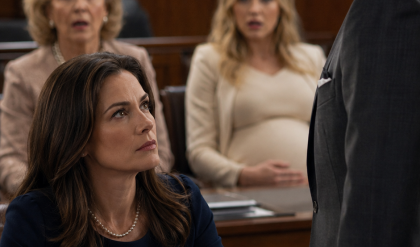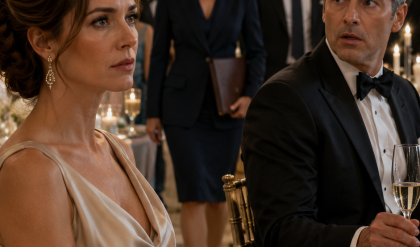
I walked into that wedding carrying two babies, a two-year-old secret, and the full weight of what it means to love a man who never learned how to stay — and I want you to understand something before I tell you what happened next: I did not go there to destroy him. I went there because Miles had his father’s eyes, and Alina had his stubborn frown, and I was so tired of lying to myself about what that meant.
Part 1
The morning of Ethan Walker’s wedding, I told myself I was not going.
I had said that the night before too, standing in my bathroom at two in the morning while Miles slept against my shoulder and Alina fussed in the portable crib beside the sink. I had told myself I was not going while I ironed my deep blue dress. I told myself again while I pinned my curls back with the pearl clip my mother gave me for my twenty-fifth birthday, the one she said a woman should wear when she needed to feel like herself.
I still put on the dress.
I still pinned my hair.
Because the truth was this: I had not been to Manhattan in eight months. I had not seen anyone from that world — Grayson’s world, the one I had been quietly erased from — since I packed two suitcases and moved to Brooklyn on a gray Tuesday in April, two years ago. And Ethan Walker had been my friend long before he was Grayson’s. Claire Davenport had called me herself, three weeks before the wedding, voice careful and kind in the way people are when they know something delicate lives between the words.
“I’d love you to be there,” she’d said. “I know it’s complicated. But we want you there, Samara. You.”
Not Grayson’s ex. Not the woman who disappeared. Me.
So I went. I told myself it was for Claire. I told myself the cathedral was large enough that I would not have to see him. I told myself a great many things that morning, the way mothers of eleven-month-old twins tell themselves five minutes of quiet is coming any second now.
Miles was in his tiny navy suit. He looked like a senator. He always looked like a senator, serious and deliberate, studying everything with those enormous gray eyes that made my chest hurt every single time. I had loved Grayson Holt with my whole heart once. I had also hated him. And then I had stopped having the luxury of either, because I had two infants and a studio apartment and a freelance copywriting career I was rebuilding from scratch, and feelings about Grayson Holt were a category of expense I simply could not afford.
Alina kept pulling at the satin bow on her dress. She did not like fuss. She also had her father’s exact expression when something displeased her — a small, dignified furrow between the brows, as if the universe owed her an explanation.
“Stop,” I told her, adjusting the bow for the fourth time.
She looked at me. The furrow deepened.
God, she looked like him.
They both did, and I had made my peace with that, mostly, in the way you make peace with a bruise that never quite fades. You stop poking it. You stop cataloguing the exact shade. You just live alongside it and try not to press too hard.
The cathedral was everything Ethan had ever dreamed. St. Adrian’s on Fifth Avenue, all carved stone and soaring light, white roses wound through every archway like some kind of fever dream about love. The string quartet played something that made the woman next to me cry before the doors had even opened. I found a seat near the back, away from the front pews, away from the people who might recognize me and look at my babies with questions on their faces.
I was doing fine.
I was genuinely, honestly doing fine.
Until I saw the back of his head.
Grayson sat in the front pew, broad-shouldered in a black suit that probably cost more than my monthly rent, and I knew him so completely — the exact line of his jaw, the particular way he held himself when he was performing composure rather than feeling it — that something in my chest went quiet and terrible all at once.
I had loved that man.
Not the idea of him. Not the money or the towers or the terrifying force of his attention when it was aimed at you. I had loved the version of him that existed at three in the morning when the defenses were down — the one who talked about his mother with something close to grief, who made coffee badly on purpose because he liked watching me correct him, who looked at me sometimes like I was the only fixed point in a room full of spinning things.
I had loved that man.
And then he had been cruel to me in the specific way that only men who love you can be — with precision, with language designed to land, with the particular coldness of someone who knows exactly where you are soft and aims there anyway.
I left two days later.
I did not know I was pregnant.
By the time I knew — six weeks later, sitting on the cold tile of my new bathroom with two pink lines and a silence so complete I could hear my own heartbeat — everything had calcified between us. I called. Three times over the course of a week, and three times the calls went to voicemail. I did not leave a message the first two times, because what do you say? The third time, I started to say it. I said, “Grayson, I need to talk to you, it’s important —” and his assistant called me back forty minutes later.
His assistant.
Who informed me, very professionally, that Mr. Holt was in the middle of a sensitive acquisition period and was not taking personal calls, but that he wished me well in my future endeavors.
My future endeavors.
I sat with that for a long time.
And then I made a decision. Not a perfect decision. Not one I was always sure about, especially in the middle of the nights when Miles wouldn’t sleep and Alina was teething and I was so exhausted I cried into a dish towel while burping a baby and thought, he should be here, this is wrong, this is not how this was supposed to go. But a decision I stood by: I would not beg. I would not chase a man who had already decided that the closing of an acquisition mattered more than answering my call. I would build something for myself and for these children that did not depend on Grayson Holt or his gray and his towers and his money and his love that came with conditions I had only learned in the breaking.
I was doing that. Slowly, imperfectly, stubbornly. I was doing it.
And then the reception.
The ceremony ended and the guests moved to the Langford Hotel, and I had almost made it through. I had survived seeing him from across the cathedral, had survived the toast — which I heard because I was near the back of the ballroom, half-hidden behind a pillar, holding both babies because the nursery assistant I had arranged hadn’t arrived yet, bouncing Miles gently while he grabbed at my necklace with his whole fist. I heard Grayson’s toast, charming and controlled and masterfully empty, and I thought, there he is. There is the man who sends assistants to answer his calls.
I was already thinking about leaving.
And then Miles chose that exact moment to let out a sound — not crying, just a loud, decisive baby announcement of existence — and several heads turned, and someone laughed, and the ripple of attention found me before I could slip toward the door.
I saw the moment Grayson turned.
I watched his face go through something I had only seen twice before in all the years I knew him: genuine, unmanaged shock. The kind that strips a person down to something before the money and the architecture and the armor. He stood very still. His glass fell.
His eyes went to Miles.
Then to Alina.
Then to me.
And I thought, with a clarity that almost made me laugh: well. This is happening now.
I had imagined this moment. Of course I had. In a hundred different versions, at a hundred different times, usually in the dark after the twins finally slept. I had imagined being composed, cool, perfectly in control. I had imagined saying the right thing in the right order with just enough dignity to make him understand the weight of what his absence had cost.
What actually happened was that he came through the crowd like a man walking through water, and the room split around him, and my fingers tightened on both my babies, and I felt suddenly, devastatingly young — the same girl who stood in his penthouse with her heart in her throat, before everything broke.
“Samara.”
My name in his mouth. Still the same. Still the only word in any language that landed in my chest the way his voice did when he said it like that.
“Grayson.”
I kept my voice even. I held my children.
He looked at Miles. He looked at Alina. He looked at me. And I watched him do the math that had been available to him all along, the math he would have done two years ago if he had answered his own phone.
“Whose children are they?” he asked.
I almost said something I would have regretted.
“Not here,” I said instead.
His jaw tightened. I knew that jaw. I had kissed that jaw. “Not here? You walk into a room carrying two babies who look like me, and you want to say not here?”
“Lower your voice.”
“Are they mine?”
Alina’s lip trembled.
I watched Grayson see it. I watched something shift in him — the sharp intake of breath, the way his eyes went immediately to her face and then went soft for one unguarded second, the way a man does when he suddenly understands he is looking at himself in miniature.
He lowered his voice.
I led him to the side hallway. The dim one with old photographs of New York on the walls, a velvet bench under a brass lamp.
And I said the word I had been carrying for eleven months.
“Yes.”
Part 2
“They’re yours,” I said. “His name is Miles. Her name is Alina.”
I watched the names land on him. The way his face went through something complicated and unreadable, the way a man looks when handed something irreversible.
Then came the anger.
I expected it. I had braced for it the way you brace for weather you’ve been watching come in all day. But knowing a storm is coming and standing in it are two different things.
“You had my children and didn’t tell me?”
“I tried.”
His laugh was bitter. “You tried?”
And here is where something in me went very still. Because I had spent eleven months — through pregnancy and birth and sleep deprivation and every single midnight feeding and every morning I dressed two tiny humans alone and every evening I sat across an empty dinner table — I had spent all of that time being careful with my anger. Folding it down. Telling myself that anger was a luxury, that I needed my hands free for more practical things.
I unfolded it now.
“I called you three times,” I said. My voice was quiet. Quieter than his. “Three calls, Grayson. And do you know who called me back? Your assistant. Who told me you were in an acquisition period and wished me well in my future endeavors.”
He stared at me.
“I was six weeks pregnant,” I said. “And you sent your assistant.”
Silence.
Miles had fallen asleep against my shoulder. Alina was watching Grayson with the focused expression she used on strangers, that particular brand of infant assessment that looked unsettlingly like judgment. I shifted her weight and held his gaze.
“You could have come to the office,” Grayson said finally, but even as he said it, something in his voice had changed. Less certain. More careful.
“I shouldn’t have had to come to the office to tell you I was pregnant with your children. That’s not — that’s not how this should have worked. I should have been able to call the man I spent two years with and tell him something important, and he should have answered.”
“You left.”
“You made it impossible to stay.”
That landed. I saw it land. He looked away briefly, jaw working, and I recognized the gesture — it was the one he made when he was right on the edge of saying something true.
“What did I say?” he asked. “Specifically. That was so impossible.”
I almost laughed. I had replayed his exact words often enough that I could have recited them perfectly, with inflection, at two in the morning. “You told me I was a convenience. That I had confused proximity for love on both our parts. That you didn’t have room in the kind of life you were building for someone who needed as much —” I paused, because even now the word stung “— maintenance as I did.”
Another silence.
“Maintenance,” he repeated, very low.
“Your word.”
He closed his eyes. Just for a moment. “Samara —”
“I’m not here for an apology right now,” I said. “I want you to understand that I did try. I wasn’t running from you. I was protecting myself and my children from a man who had made it very clear what his priorities were.”
Alina reached out suddenly and grabbed the lapel of his suit jacket.
Both of us looked down.
She had his face completely in her hands — two small fists full of expensive fabric — and was studying him with an expression of absolute concentration, like a scientist who has finally located the variable she has been looking for.
Grayson’s expression did something that cracked my composure just slightly.
He didn’t pull back. He didn’t stiffen. He just looked at her — this small fierce person who had his eyebrows and my stubbornness — and something in his face went entirely undefended.
“She does that to everyone,” I said, softer than I intended.
“Does she.” Not a question. He was still looking at her.
“She grabbed the mayor’s pocket square at the hospital fundraiser last month. Someone photographed it. It was on Instagram.”
His mouth did something that was not quite a smile. “Of course it was.”
Miles stirred. He lifted his head, blinking, and looked directly at Grayson with that grave, measuring gaze.
“He has your eyes,” I said. I had never said that out loud to anyone except my mother, and saying it here, to him, felt like opening a door I had kept locked.
“I know.” His voice was rough.
“You’ve been sitting here doing the math since the ballroom.”
“Since the ballroom,” he confirmed.
We stood in the hallway for a moment that stretched beyond its natural length, both of us aware that whatever came next would be permanent. You cannot unknow a thing like this. You cannot have an almost-conversation about two children and then put the lid back down.
“What do you want?” I asked.
He looked at me. “What do I want?”
“From here. From this. From —” I gestured between him and the twins. “What do you want?”
“To know them.” No hesitation. Whatever else Grayson Holt was, whatever damage lived in him, the answer came without calculation. “I want to know my children.”
Something eased in my chest. Not trust — not yet, not even close — but the particular relief of a woman who has been tensed for the worst and found something slightly better.
“That’s going to take time,” I said. “And structure. And it is going to require you to be consistent in a way that you have never had to be before, because they cannot absorb the kind of unpredictability that you and I managed to weather. They’re babies, Grayson. They need boring dependability. They need someone who shows up the same way every single time.”
“I can do that.”
“You’ve never had to.”
“Then I’ll learn.”
I looked at him for a long time. Alina was still holding his lapel. Miles had fallen back asleep against my shoulder with the boneless trust of a child who has never been dropped.
“We start slow,” I said. “Supervised. In neutral spaces. No grand gestures, no lawyers firing at each other, no Holt Holdings PR strategy about wholesome family values. Just time. Consistent, boring, ordinary time.”
He nodded.
“And Grayson.” I waited until his eyes came back to my face. “This is not about us. What happened between us is a separate conversation that I am not ready to have in a hotel hallway at your best friend’s wedding reception.”
Something moved across his expression — something I catalogued and then deliberately set aside, because I could not afford to read it yet.
“Understood,” he said.
From the ballroom, the DJ had finally succeeded in restarting the music. Ethan and Claire were probably back on the dance floor. The world was proceeding without us, as it tended to do.
I shifted Alina to my hip. She released his lapel reluctantly, leaving two small wrinkles in the expensive fabric that I found, privately, enormously satisfying.
“I should go back,” I said. “Claire deserves the rest of this evening.”
“I’ll find you before you leave,” Grayson said. “If that’s — if that’s all right.”
I looked at him. At the controlled tension in his body, at the effort behind the asking, at the way he was watching my face with an attention that had once made me feel like the most important person in any room.
“That’s all right,” I said.
And I walked back into the light.
Part 3
He found me forty minutes later, near the tall windows at the edge of the ballroom.
Miles was awake and making very serious observations about the crystal chandelier above us. Alina had accepted a piece of wedding cake from a kind-faced guest and was consuming it with aggressive joy. I was watching the city outside, the way Manhattan looked at night from a high floor — all light and movement, a thing that never stopped for anything.
Grayson came to stand beside me, a few feet of deliberate distance between us.
Neither of us spoke for a moment. Below us, the taxis moved. The music played. Somewhere in the room, Claire laughed at something Ethan said, the full-body laugh of a woman who has chosen correctly.
“I’ve been thinking about what you said,” Grayson said. “The three calls.”
I kept my eyes on the window.
“My assistant should never have — I didn’t know she’d handled it that way. I had blocked incoming contact from —” He stopped. Exhaled. “It doesn’t matter what the protocol was. You called and I wasn’t there. I wasn’t there for all of it.”
“No.”
“I’m sorry.”
The words were quiet and unhurried, without the defensive architecture he usually built around apologies. I had heard him apologize before — to business partners, to journalists, occasionally to me, but always with an asterisk attached, always with a small structural argument for why the harm had been incomplete. This was different. This sounded like a man standing in a hallway alone with the weight of what he had missed.
I looked at him.
He was watching Miles, who had now transferred his attention from the chandelier to Grayson’s watch.
“He wants everything shiny,” I said.
“Genetic,” Grayson said, and I surprised myself by almost laughing.
“That’s a very self-aware thing to admit.”
“I’ve had about forty-five minutes to reconsider my entire life history. Self-awareness accelerates.”
Miles reached for the watch with both hands. Grayson, without ceremony, unclasped it and held it out. Miles took it and immediately put it in his mouth. Grayson watched this with an expression that was equal parts horror and helplessness.
“He’ll be fine,” I said. “It’s a phase.”
“That’s a five-thousand-dollar watch.”
“He doesn’t know that.”
“He’ll probably scratch the bezel.”
“Almost certainly.”
Grayson said nothing. He did not take the watch back.
I noted that. Filed it carefully in the place where I kept the evidence I was still gathering about who this man was now, versus who he had been, versus who he might become.
We stood there a while longer. Ethan appeared at Grayson’s shoulder at some point, looked between us, looked at the twins, and had the extraordinary self-control not to say a single word — just squeezed Grayson’s arm once and disappeared back to his wife. Claire caught my eye from across the room and gave me a small nod that contained, in the way women sometimes communicate, an entire conversation: I see you. You’re doing fine. This is yours to handle and I’m here.
When I finally moved to gather my things, Grayson walked with us to the elevator without asking permission and without making it a declaration. He held the door. He stood on Miles’s side so that when Miles reached out and grabbed a handful of his suit jacket — just as Alina had done earlier, and I was beginning to think this was a coordinated twin strategy — Grayson didn’t stumble.
In the lobby, we stood under the marble archway while my car came round.
“I’d like to call,” Grayson said. “This week. If that’s all right.”
“I’ll give you my number.” I looked at him squarely. “And Grayson. When I call you — if I call you — you answer. You don’t have an acquisition period that excuses you from your children.”
“Understood.”
“I mean it.”
“I know you do.”
The car appeared at the curb. The doorman stepped forward. I maneuvered both twins toward the door with the practiced efficiency of a woman who had been doing this alone for the better part of a year, and I was nearly outside when Grayson said my name.
“Samara.”
I turned.
He was standing in the amber light of the lobby, watch still missing from his wrist, a small smear of wedding cake frosting on the lapel where Alina had pressed her face in farewell.
“I should have answered,” he said.
Three words that held inside them, somewhere, everything else — the cruelty of his last night, the assistant, the silence, the two years of absence, the mornings I could have used a second pair of hands and the nights I cried because I was doing something enormous entirely alone.
I should have answered.
It was not enough. I want to be clear about that. An apology in a hotel lobby does not undo eleven months or two years or the specific loneliness of raising two people by yourself because the man who helped make them had decided his feelings about endings were more important than his responsibility to pick up the phone.
But it was something.
And I was tired of standing at the edge of something and turning away.
“Next Saturday,” I said. “Two in the afternoon. I’ll text you the address. One hour, neutral ground, and you bring nothing — no gifts, no gestures, just yourself.”
I watched him absorb this.
“One hour,” he said.
“We’ll see how you do.”
I got into the car.
Miles pressed his face to the window as we pulled away, watching the city with that solemn intensity, and Alina fell asleep with the immediate confidence of a child who trusts that the world will still be there when she wakes up.
I sat between them in the backseat of a car moving through Manhattan, and I did something I had not done in a long time.
I let myself feel all of it at once — the exhaustion and the love and the particular grief of a thing that broke before it finished becoming what it should have been. The careful, stubborn hope of someone who has rebuilt herself from the inside out and is not willing to risk that work for anything less than honest. The precise complexity of sharing two children with a man you once loved completely, which is not the same as loving him now, and is not the same as never loving him again, and exists in its own impossible category between those things.
Alina sighed in her sleep. Miles was still watching the city go by.
“I know,” I told him, which is what I always said when he made his observations about the world. He looked at me with his father’s gray eyes and seemed satisfied with that.
The lights of the city streamed past the window.
Next Saturday was one week away.
An hour is not very long. It is also not very short. It is enough time for a child to decide whether someone is safe. It is enough time for a man to either be present or reveal that he cannot be. It is enough time for a woman who has been alone in a hard, beautiful thing for eleven months to begin the slow work of deciding what, if anything, she is willing to risk again.
I was not there yet. I want to be clear about that too.
But I had put down my phone for six months after he went silent, and then I had spent a year putting one foot in front of the other, and I knew something about what it meant to choose the difficult thing not because it was safe but because it was necessary.
Maybe Grayson Holt would show up on Saturday and be exactly who he had always been — brilliant and controlled and unable to survive the ordinary requirements of a life shared with other people.
Maybe he would surprise me.
I had been surprised before, in both directions.
What I knew — what I held onto as the car crossed the bridge and Manhattan fell behind us and Brooklyn gathered itself up in lights ahead — was that Miles and Alina deserved to find out. They deserved the chance to know their father, and I loved them too much to let my own broken heart make that decision for them.
That was the thing about becoming a mother that no one had warned me about, the thing I had learned in the specific school of keeping two people alive on insufficient sleep and insufficient help: love like this is not about you. It never was. It asks you to be bigger than your hurt, more spacious than your history, more willing than your fear.
So. Next Saturday. Two o’clock. One hour.
We would see.
Miles finally turned from the window and looked at me. He reached out and placed his small hand flat against my cheek with the absolute matter-of-fact tenderness that babies have — giving comfort the way they need it themselves, simply and without condition.
I held his hand there.
“We’re okay,” I told him. “We’re okay, baby.”
The city lights faded. The car moved on.
Somewhere behind us, Grayson Holt was standing in a hotel lobby with a scratch on his five-thousand-dollar watch and wedding cake on his jacket, and I did not know what he was going to do with the thing he had been handed tonight. I did not know if he was capable of the particular, unglamorous work that loving children required — the showing up, the consistency, the willingness to be boring in the service of something larger than yourself.
But I knew what I was capable of.
I was capable of eleven months alone with two babies and a freelance career and no one to hold the other child when one of them cried. I was capable of rebuilding. I was capable of walking into a room full of people who knew his name and standing in the light with his children on my hips and not flinching.
I was capable of one hour on a Saturday.
And if he showed up and was present and tried, genuinely tried, the way a man who has been handed the most important reckoning of his life ought to try —
Well.
One hour could become two.
Two could become a Saturday afternoon.
An afternoon could become a routine.
And routines, given enough time and enough willingness, have a way of becoming something you cannot imagine having lived without.
I knew that better than anyone.
After all — I was the woman who had walked into his wedding carrying his secret twins, not because I wanted to cause a scene, and not because I wanted him back, and not because I had rehearsed what to say.
I went because Claire asked me. Because Ethan was my friend. Because I had lived two years in the margins of a world that had once been mine too, and I was done making myself small.
And because somewhere, under all the careful practical architecture I had built to survive, under the exhaustion and the pride and the entirely justified anger — somewhere in there, a door was still standing.
I hadn’t opened it.
But I hadn’t locked it either.
And that, I had learned, was how every difficult, necessary, complicated thing begins: not with certainty, and not with forgiveness already accomplished, and not with the ending already written.
Just with a door. Still standing. Still there.
Next Saturday.
Two o’clock.
One hour.
We’ll see.
— End —