PART TWO: Six Weeks Building a War Room
Let me tell you what those six weeks before that night looked like.
I didn’t discover Tiffany through a strange phone call or lipstick on a collar — those details are too cinematic. I discovered her because I was bored enough one afternoon to open the “architectural surveys” folder on the shared tablet while waiting for ultrasound results, searching for something to read. I found dozens of photographs saved under file names that were meaningless strings of numbers.
She was eight years younger than me. Beautiful in the way people describe as “easy to look at” — nothing sharp, nothing that challenged you, but nothing forgettable either. I stared at those photographs and did not feel jealous. That surprised me. What I felt was tired. Tired of having been right. Tired of having spent so long persuading myself that I was wrong.
I had suspected before the pregnancy.
But I had not wanted to be right.
That night, I sat on the bathroom floor — cold marble beneath me, my belly already heavy, hands trembling faintly — and I allowed myself to cry for exactly one hour. I set a timer. Not because grief has a limit, but because I knew that if I let it pour out unchecked, I would lose what I needed most in that moment: clarity.
When the timer went off, I washed my face, drank a glass of water, and called Evelyn Reed.
Evelyn was the lawyer whose number I had kept in my phone for seven years without ever using. An old friend from the gallery had given it to me once and said: “Just in case.” At the time I thought that was pessimistic. Now I understood it was wisdom.
Evelyn listened to me for fifteen minutes without interruption. When I went quiet, she asked: “What do you want?”
Not how do you feel. Not are you sure. But what do you want.
“I want to leave with my child protected,” I said. “I want what belongs to me returned. And I want no one to be able to say I destroyed him — only that he destroyed himself.”
“All right,” Evelyn said. “Then that is exactly what we do.”
The following six weeks were the most demanding of my life.
Not because of the divorce — that hadn’t formally begun. But because I was building two things simultaneously: a legal case and a new life. Every morning I woke up, drank ginger tea to quiet the nausea, and sat at the writing desk in our bedroom — the bedroom Richard rarely came to anymore — and worked.
Evelyn walked me through every document. Joint accounts. Separate assets. Unexplained transfers. Her forensic accounting team found Sterling Horizons LLC in the third week — a Delaware shell company with eighteen months of transactions that Richard believed were buried well enough. When Evelyn placed the report in front of me and explained what they’d found, I was not surprised.
Only sad.
Not sad because I’d lost. Sad because he had built his escape tunnel right beside me, and I had been living in that house without knowing I was standing on hollow ground.
He had been planning to leave me before our son was born.
That, more than Tiffany, was what cut deepest.
But grief is also fuel, if you know how to direct it properly.
Parallel to the legal work, I reached out to Dominic for the second time — this time not by accident. I called him, explained that I was preparing to leave, and asked whether the idea we’d discussed briefly about an art advisory firm was still something he found worth pursuing.
Dominic was quiet for a moment.
Then he asked: “Are you certain this is the right time?”
“No,” I said honestly. “But I can no longer afford to wait for the right time.”
We met three times during those six weeks. Each time in a discreet office, each time with his legal and financial teams present, each time I brought everything I had built: a business plan, market analysis, a client list I had spent fifteen years in this industry accumulating. None of it belonged to Richard. It was mine — my knowledge, my relationships, my eye.
I was bringing the one thing I had quietly kept hold of across seven years: myself.
Dominic never asked about the marriage. He offered no personal advice. He did not look at me as someone who needed rescuing. He looked at me as a business partner — one he was evaluating with exactly the seriousness he brought to any investment decision.
That was what I needed more than any sympathy.
The night before we signed, I sat alone in the apartment and wrote a letter to Alexander. Not one he would read for many years — he hadn’t yet been born. But one I needed to write for myself, addressed to the person who would one day need to understand it.
“My love, I want you to know that you were not the reason I stayed, and you are not the reason I am leaving. You are the reason I am doing this right. I want you to grow up in a home where no one pretends that love means ownership. I want you to see that the women in your life — whether it is me, or someone you love later on — are whole people, not accessories to anyone’s story.”
I folded the letter and placed it in my personal documents box.
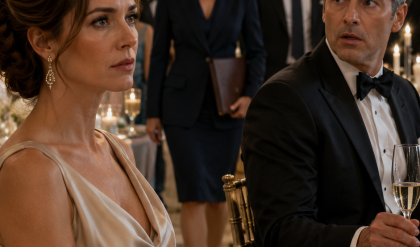
Then I put on the navy dress and walked into Ethelgard.
When Richard leaned over Table Nine and said the things he said — you’re pregnant, what the hell are you doing here with him — the first thing I noticed was that he had addressed me by condition rather than by name. Not Catherine. Not wife. But pregnant — as though the curve of my belly were the sum total of what I still was in his eyes.
The second thing I noticed: he was not asking what are you doing here because he cared about my wellbeing. He was asking because he wanted to know who was occupying his territory.
That was when I told him about Sterling Horizons. About the Pendry suite. About the roses sent to the West Twenty-Third apartment. About the folder of photographs named “architectural surveys.”
Tiffany’s face went pale.
Richard stood very still.
And Dominic — Dominic said nothing until Richard reached toward me.
PART THREE: Building From the Wreckage
The morning after Ethelgard, I woke in a room at the Lowell Hotel.
Pale light filtered through cream curtains. The city hummed below — that familiar pre-dawn breath of New York that never fully quiets. In one disoriented second before consciousness fully assembled itself, I reached out for something familiar: Richard shaving, the coffee machine, his assistant calling about a morning meeting, all the small choreography of his importance.
Then I remembered.
None of those sounds existed anymore.
What rose in me was not grief. It was relief — a relief so large that I lay still for a moment and let it settle, because I wasn’t accustomed to the sensation. Relief at not needing to read someone’s mood before breakfast. Relief at not calibrating my expression to fit the temperature of the room. Relief that this room — smaller, rented, without the expensive curated art — belonged entirely to me.
Evelyn called at eight.
“The accounts begin freezing at noon,” she said. “We file for divorce, custody protections, and forensic discovery simultaneously. He’ll know by lunch.”
“Good.”
“Catherine.” She paused. “He will call you.”
“I know.”
“He’ll say things that are hard to hear.”
“I know that too.”
A brief silence. “Are you all right?”
“I will be,” I said. “That’s not the same thing, but it’s enough.”
I met Evelyn at her office at nine. The conference room looked out over Manhattan through wide glass — the city Richard had once told me “devours the sentimental.” I sat down and looked at the documents stacked neatly across the table, and I thought of the first time I came to New York at twenty-two, with a suitcase and the groundless confidence of someone who hasn’t learned yet what they don’t know. I had known nothing about this city. But I had learned. I had built a career at the Vandermeer Gallery from entry-level to the curator that the wealthiest collectors in the city sought out when they wanted to be told the truth about a painting.
Then I had met Richard.
And I had let him persuade me that standing beside him was more important than standing alone.
Not because I was naive. Because I loved him, and when you love someone, you want to believe what they say about you — even when they are saying it to make you smaller.
I spent three hours with Evelyn moving through each page of the forensic report. By noon, as she had predicted, my phone began to ring.
Richard.
I placed it face down and continued reading.
By afternoon, Sterling Properties stock had begun to slide. By evening, the Wall Street Journal had the story. I read the article once and did not return to it.
Not because I didn’t want to know. But because I had realized that his story was no longer mine. I did not need to monitor his unraveling to know that my leaving had been right.
That night, Richard called thirty-seven times.
I listened to every voicemail — not alone, but with a cup of tea and both hands resting on my belly. I heard the progression: fury, then threats, then bargaining, then finally the voice of someone I had known eight years before — the voice he used the night my father died, the voice he used the first time we talked about the future, the voice of a man who was genuinely afraid.
“Katie, I’m sorry. I think I got lost somewhere. Please don’t do this.”
I played that one twice.
Then I deleted it.
Not because I doubted that he meant it in that moment. Perhaps he did — at midnight, in the dark, with everything he had built collapsing around him. But another person’s remorse is not my responsibility to carry. I had carried enough.
The months that followed were the legal war Evelyn had prepared me for. Richard attacked every front: he called me unstable, claimed I was being manipulated by Dominic, insisted I was acting out of revenge rather than reason. His lawyers deployed every delay tactic. He attempted to hide assets behind layers of corporate fog.
Evelyn’s team found all of it.
Tiffany gave a deposition — not out of any loyalty, but out of self-preservation. Her answers were messy, defensive, sometimes contradicted themselves. But they were useful in the ways that mattered. Yes, Richard had told her he planned to leave after the baby arrived. Yes, he had represented the marriage as functionally over. Yes, he used corporate accounts for personal gifts. Yes, he had promised to “set everything up properly” once Sterling Horizons was fully funded.
The expression on Richard’s face in the deposition recording looked as though it had been carved from humiliation.
I watched only the portions Evelyn required me to watch.
I did not enjoy it.
That mattered to me. I did not want to become a person who feeds on someone else’s destruction. I wanted safety. Justice. Independence. A future in which my son would not learn to understand love as ownership or power as concealment.
Alexander was born in February, during a blizzard.
Not a soft snowfall. A hard, wind-driven storm that turned Manhattan white by midnight and blurred the hospital windows with moving light. I labored for fourteen hours with Evelyn in the waiting room managing an emergency call, my mother holding ice chips, and Dominic waiting outside — because I had asked him to wait there unless I called. His presence at that moment was not what the room needed. What the room needed was my mother’s hand, and mine.
When they placed my son on my chest — red-faced and furious at the world that had suddenly appeared around him — I laughed through tears.
“Hello, Alexander,” I whispered. “You have terrible timing.”
He stopped crying for half a second, considered me, then began again louder.
My mother wept openly.
I held him and felt something move through me that was larger than victory, larger than vindication. I had protected him before he had a name. I had stood in restaurants and courtrooms and empty lofts and attorneys’ offices because I refused to allow the first architecture of his life to be built from deception.
Richard met Alexander two weeks later, under supervised temporary custody.
He looked older.
Not ruined — wealthy men rarely become poor quickly enough for morality to feel satisfied. But diminished. The ease had gone out of him. His suit was still fine. His shoes still polished. But something behind the eyes had been revised. He held the baby awkwardly, with wonder and grief moving across his face in ways he couldn’t contain.
I watched from across the room.
For a moment, I saw the father he might have become had ego not eventually consumed the man.
Then Alexander fussed, and Richard said quietly, “He wants you.”
The words were soft. Already resigned.
Catherine took her son back.
“Yes,” I said. “He does.”
The divorce finalized eighteen months after Ethelgard.
I received a substantial settlement, protection of Alexander’s trusts, and the majority of what Richard had tried to conceal. He retained enough to live well — but not enough to feel unpunished. The board at Sterling Properties voted formally for his removal not long after. I heard the news from Evelyn over the phone while sitting in my new Chelsea office, Alexander asleep in his pram beside my desk.
“They escorted him from the building,” Evelyn said.
“I heard.”
“Don’t you want the details?”
I looked at Alexander. “No.”
Sterling Thorne Art Advisory opened six months after Alexander was born.
I leased a raw loft in Chelsea — exposed brick, industrial windows, afternoon light spreading across poured concrete like a promise kept late. Nothing in that space spoke of luxury in the way Richard understood the word: no chandeliers, no bespoke furniture, nothing chosen to impress.
Everything in it was chosen because I loved it.
I built a team from people I had known across fifteen years of working in this field: scholars, analysts, curators, market strategists. People with real eyes, not eyes trained to agree. I created a program for collectors who wanted to understand art rather than merely acquire it. I created another for women returning to arts careers after years spent in caregiving or marriages that had slowly sidelined them.
The first time an intern thanked me for making ambition feel possible again, I had to excuse myself and stand alone in the research library until the feeling passed.
Not sadness.
Recognition.
Recognition that what I had lost — the years at the gallery, the years of working as myself — had not been lost permanently. It had been held somewhere inside me, waiting for a space wide enough to open into.
I had found that space.
Or more precisely: I had built it.
My relationship with Dominic developed in ways I neither anticipated nor forced. He was my business partner first — the only person, at that particular moment in my life, who had looked at me and seen an executive rather than a betrayed wife in need of rescue. That had mattered more than anything else he could have offered.
After the divorce was final, after Alexander learned to walk, after the company stood firmly enough that Richard’s name no longer needed to appear in any conversation about what I was building — something slow and deliberate grew between us. Not a rescue. Not a replacement. A partnership that took its time, because we both understood what haste costs.
The first time he kissed me, it was in the gallery after a rainstorm, with the lights low and the city shining wet beyond the windows.
He asked permission first.
“May I?”
That is why I said yes.
Not because I was running from anything. Because for the first time in a very long time, I was choosing.
Five years after the night at Ethelgard, I returned to the restaurant alone.
Not to haunt myself. Not to revisit old wounds. But to complete the circle — to sit inside that same room and feel nothing beyond calm and the ordinary pleasure of a good meal.
The maître d’ recognized me at once and offered Table Nine.
I smiled and shook my head.
“Somewhere near the window.”
I ordered scallops and dessert — during my marriage I had often skipped dessert because Richard had a habit of making observations about appearances that were dressed up as concern. I sat watching rain collect on the glass, thinking about the woman I had once been at that other table across the room: pregnant, betrayed, quietly terrified beneath the composure, holding herself together with strategy because grief alone would have pulled her under.
I wanted to tell that woman something.
Not that revenge would heal her. It would not.
Not that success would erase the betrayal. It would not.
But that one day she would sit in this same room and feel nothing except hunger, dry amusement, and the unremarkable satisfaction of paying her own bill.
My phone buzzed.
A message from Dominic: How is enemy territory?
I replied: Mine now.
A moment later: Naturally.
I laughed — a real laugh, the kind Richard had once heard carrying across a dining room and mistaken for betrayal, because he could not imagine joy existing outside the boundaries of his ownership.
When the check arrived, I placed my own black card on the tray.
My name. My account. My company.
Simple things.
Hard-won things.
Outside, the night was cool and clean. I stood for a moment beneath the discreet crest above Ethelgard’s door and let the city move around me — taxis hissing through puddles, pedestrians beneath umbrellas, towers glowing overhead like proof that ambition can be both beautiful and brutal depending entirely on who holds it.
I pressed one hand briefly against my coat, in the place where five years earlier Alexander had kicked beneath my ribs while I faced Richard down at Table Nine.
And then I walked.
Not looking back.
Not because the past was unimportant — it had shaped me in ways I was still uncovering. But because I had learned this: a woman is not a line item in anyone’s portfolio. She is not an asset to be displayed, leveraged, neglected, or quietly written down while her holder invests elsewhere.
She is the one reading the books when he stops paying attention.
And sometimes, if he is arrogant enough to mistake her silence for surrender, she becomes the one who buys the debt, calls the meeting, freezes the accounts, takes the table, and builds something so luminous that his name survives only as the shadow she walked out of.
But that is not the real ending.
The real ending is quieter, and for that reason more valuable:
An ordinary morning in Chelsea. Alexander trying to eat a page from a museum catalog. Dominic walking in with coffee and a new file. Sunlight falling through industrial windows onto concrete floors.
And me, working.
Not as a reaction to anything.
As a creation.