The Lie I Kept to Keep Them Safe — And the Photograph That Undid Everything
PART ONE: THE FLIGHT
“You have got to be kidding me,” Blake said, loud enough for three rows to hear.
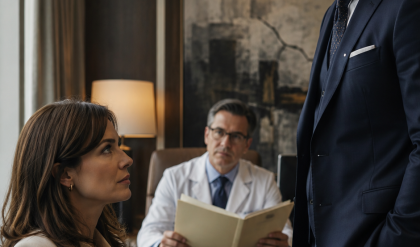
Emma Vale did not look up. She turned the page of her paperback with deliberate slowness, the way she had learned to do everything in the five years since Blake Harrington had made her a woman who chose her reactions like weapons. The words blurred. She hadn’t been reading anyway.
His shadow fell across her lap, and she felt the cold of it before she registered the source. That was the thing no one warned you about after a marriage ended badly — your body remembered what your mind had spent years trying to unlearn. Her pulse kicked hard against her wrist. Her fingers pressed flat against the open page. Don’t tremble. He’ll mistake it for weakness when it’s only grief.
“Trust me, Blake.” She closed the book with a soft, deliberate snap. “If I had known you were on this flight, I would have walked to Chicago.”
A few passengers turned. A flight attendant glanced up from her checklist, then glanced away. Blake did not move toward the six empty first-class seats stretching behind him like a row of absolutions. He put his briefcase in the overhead bin above her head — above her head, as if he were planting a flag — and lowered himself into the seat beside her with the particular, practiced ease of a man who had never once in his life made himself smaller for anyone.
“You’re really going to do this?” Emma asked.
“I already did,” he said, and buckled his seatbelt with a smile that had no warmth and a great deal of intention.
She turned toward the window. Chicago was still three hours and twenty minutes away. Outside, the tarmac shimmered in late October light, and the ground crew moved around the wing with the focused indifference of people who had no idea what was happening in seat 2A. Emma pressed her knuckles against the cold plastic of the armrest and concentrated on her breathing. In. Out. He is just a man. He is just a man sitting beside you, and in three hours and twenty minutes, you will never have to see him again.
The plane began to push back. Blake ordered a Scotch without looking at the flight attendant. Emma asked for water, her voice completely steady, and she was proud of that steadiness in the way you are proud of something that cost you enormously.
“Five years of silence,” he said, as the city tilted away beneath them, “and now we get six hours together.” He swirled the glass. “Isn’t life generous?”
“You always did mistake cruelty for power,” Emma said, still looking at the window.
A beat. Then: “And you always mistook secrets for innocence.”
Her fingers tightened on the paperback before she could stop them. She felt him notice. He had always been exceptionally good at noticing the things she didn’t want him to see, and entirely blind to the things she needed him to understand. That was the central tragedy of their marriage in a single sentence, and she had spent five years arranging that sentence into something she could carry without bleeding.
The accusation was five years old and still razor-sharp: secrets for innocence. The three messages he had found on her personal phone, the ones he had read like a verdict before she’d had the chance to become a defense. Can’t wait to see you tomorrow. This has to stay between us for now. I know he’ll be shocked when he finds out. Three lines. Eleven seconds of reading. Five years of consequence.
She remembered standing barefoot on their penthouse marble at midnight, the Manhattan skyline burning behind him like a witness gallery. She remembered the way his voice had gone very quiet, which was worse than if he’d shouted. Who is he, Emma?
And she had wanted to tell him. God, she had wanted to explain. But the truth she was carrying then was too new, too fragile, too entirely dependent on timing she hadn’t yet secured — and Blake’s face in that moment had already hardened into a shape she didn’t recognize, and she had made a decision in the space of one wrong breath that she had been paying for ever since.
She had said: Blake, please. Let me explain.
He had stepped back from her touch as if she’d offered him something contaminated.
By morning, lawyers. By afternoon, packed suitcases. By night, the man who once said he couldn’t sleep without her hand in his had signed her out of his life with the efficient misery of someone closing a loss position.
He never asked why she was crying into the sleeve of his old university shirt. He never saw what she carried when she walked out.
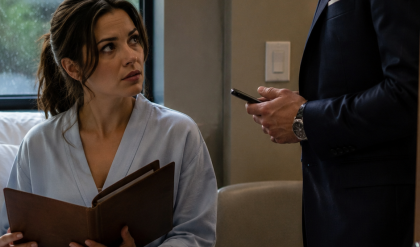
“You look well,” Blake said now, glancing at her blouse, her simple silver watch, her bare left hand. His gaze moved to her paperback — Environmental Law and the New Frontier, dog-eared at page 212 — as if even that offended him. “Quieter than before. Less ambitious.”
Emma looked at him then, and she made herself look at him completely, all of him — the silver threading at his temples that hadn’t been there before, the slight tension around his mouth that she suspected had become permanent, the way his hands wrapped his glass with a grip a fraction too tight for someone who claimed to be entirely at peace. He was fifty-one now. Still handsome in the way of men who have been told so often they’ve stopped noticing it. Still armored in that particular Blake way, where the armor was so well-fitted you might mistake it for skin.
She said: “No, Blake. I just learned that some people don’t deserve the truth.”
His jaw tightened. The old anger — the one she knew as intimately as a weather pattern — flashed behind his polished control, just for a second, and then the control reasserted itself like a tide coming back in.
“Is that what you tell yourself?” he asked.
“It’s what I know,” she said, and returned to her book. …FULL STORY IN THE COMMENT 👇👇👇
He didn’t leave her alone. She hadn’t expected him to. Blake had never been able to let a silence stand when he could fill it with something cutting, and the cutting was never fully about the present moment — it was always about the moment five years ago that he had decided, once and finally, how the story went. She was the one who had kept secrets. She was the one who had lied. She was the guilty party, sentenced and filed away, and the occasional reminder of that sentence was simply maintenance.
He mentioned the divorce like a victory he occasionally revisited for the pleasure of it. He mentioned Harrington Global — clean energy, three continents, a New York Times profile last spring calling him “the man who might actually save the world” — in the way people mention a subject they believe you envy, which is to say he mentioned it constantly. He asked whether she still “hid behind research” when the truth got inconvenient, and she thought about the three boys waiting for her in Chicago and said nothing, because nothing was the kindest answer she had for him.
At some point over Ohio, he said: “I read your paper on deep-sea methane migration. The one in Nature last year.”
She looked up.
“It was good,” he said, and something in his voice had shifted, barely perceptibly, into something that was not quite an attack. “Better than good. You always were the most rigorous scientist in any room you walked into.”
Emma held very still. This was the other thing about Blake — the thing that had made her fall in love with him in the first place and that made him, even now, more dangerous than his cruelty. He was capable of turning the weapon off without warning and offering you something genuine, and the genuine thing was always harder to survive than the assault.
“Thank you,” she said, carefully.
“The methane sequestration model your team built is the one we licensed for the Pacific platform,” he said. He wasn’t looking at her. He was looking at the seat back ahead of him, as if the information was simply factual, uncolored by anything. “I didn’t know it was yours until after the contract was signed. Renata flagged it.”
Renata Voss. His CFO and, if the industry gossip Emma occasionally heard was accurate, his companion for the last two years. Emma filed this away with the neutrality she had practiced into muscle memory.
“I’m glad the work is being used,” Emma said.
“Of course you are. It was always about the work for you.” He said it without particular heat, and that was worse somehow. “That was never the problem.”
“What was the problem, then?” She heard herself ask it and immediately wished she hadn’t, because it was not a question she needed answered — she knew the answer, had been living the answer for five years — but something about thirty thousand feet and the unrelenting nearness of him made the old words rise up before she could swallow them.
Blake looked at her. Really looked at her, the way he hadn’t since she’d sat down. “You trusted someone else with something that should have been mine,” he said. “That’s what it comes down to. Whatever the reason was — and I’ve spent five years trying to imagine reasons — you made a choice to keep me out and let someone else in.”
The plane hummed around them. A child somewhere in coach laughed at something. Emma felt the weight of what she was holding, the thing she had been holding for five years, shift slightly in her chest, as if it had been readjusting its grip on her ribs.
“What if the reason,” she said, very quietly, “was that I was trying to protect you?”
His expression closed. “From what?”
“From your father.”
The silence that followed was different from the silences before it. This one had edges.
Blake set down his glass. His voice, when it came, was flat and precise: “My father died four years ago, Emma.”
“I know.” She looked at her book. “And I didn’t say anything then either. Because it was over and because saying it would have only made more pain for people who were already in pain.” She paused. “I’m not saying it now for any reason except that you said you made a choice to keep me out, and I want you to understand that the choice I made five years ago was not the choice you thought it was.”
“Then what was it?”
She looked at him. She thought about Chicago. She thought about three small boys in navy coats and the way Oliver had looked at her this morning at breakfast with Blake’s exact expression when he was working something out — that focused, still-water look — and had said, Mom, why do you seem like you’re getting ready for something hard?
She had kissed his forehead and said, Because I love you, sweetheart. Getting ready is how I show it.
“I’ll tell you,” Emma said to Blake, thirty thousand feet above Ohio, “when we land.”
He stared at her. “You’ll tell me.”
“Yes.”
“Five years, and you’ll—” He stopped. His hand on the armrest between them was very still. “Emma.”
“When we land,” she said again, and opened her book to page 212.
She didn’t read a single word.
PART TWO: THE PHOTOGRAPH
The airport doors opened, and Chicago’s winter air hit Emma like a decision she had already made.
She pulled her coat tighter and walked with the particular walk she had developed since the boys were born — straight-backed, sure-footed, the walk of a woman who had no one to catch her if she stumbled and had made peace with that. She could hear Blake behind her, his measured footsteps keeping pace at a distance that was exactly close enough to be deliberate. She did not hurry. She had stopped hurrying for Blake Harrington when she was twenty-nine years old and standing barefoot on marble, and she had not started again.
The Bentley was already at the curb. Arthur — sixty-four, silver-haired, with the grave, careful face of a man who had spent decades knowing more than he said — stepped out of the driver’s seat and opened the rear door with the quiet efficiency that had made him indispensable first to Evelyn Harrington, then to Emma, and finally to the three children who called him Uncle Art and had no idea what he was really keeping.
“Dr. Vale,” Arthur said, warmly.
Then the back door of the Bentley burst open and the boys came out.
They came out the way they always did when they’d been waiting too long — in a single unstoppable mass of navy wool and cold-flushed cheeks and competing voices, all three of them crashing into Emma at once with the enthusiastic violence of people who had been saving up their need for her since morning. She went to her knees on the icy curb without thinking, holding all three of them, breathing them in — the smell of the particular soap she bought, and cold air, and something sweet that meant they’d had cookies in the car, which Arthur had absolutely promised he would not allow.
“You were supposed to text me when you landed,” Oliver said into her shoulder, his voice slightly muffled by her coat collar. Oliver, at nine, was the one who worried. He had been worrying since he was three, with a focused seriousness that occasionally made Emma’s heart ache for him and simultaneously made her fiercely, quietly proud.
“My phone died,” Emma said.
“You’re supposed to keep a portable charger—”
“I know, Ollie.”
Henry was already pulling back to look at her face with the rapid, clinical assessment he applied to everything. Henry was eight, and he catalogued the world in details: the small scar on Emma’s right hand from a lab accident, the particular way she tucked her hair behind her ear when she was nervous, the shade of blue her eyes went when she was sad versus when she was tired. “You don’t look like the flight was good,” he announced.
“It was fine.”
“You’re doing the voice,” Henry said. “The it was fine voice.”
“Henry.”
“Just saying.”
Samuel, the youngest at seven, was still pressed against her side and hadn’t said anything yet. Samuel spoke less than the other two and thought more, which was something Emma had noticed at eighteen months and had spent the years since both respecting and worrying about. He had Blake’s coloring most obviously — the deep blue eyes, the near-black hair — and he had a habit of noticing the exact thing no one wanted noticed and then asking about it with the blunt sincerity of someone who didn’t yet know there were questions adults preferred left alone.
It was Samuel who looked past Emma’s shoulder, and went still.
Oliver followed his brother’s gaze.
Then Henry.
Emma felt the precise moment all three of them saw Blake. She felt it in the way they stilled against her, one by one, the way water stills when something large moves beneath it.
Oliver’s voice dropped to a whisper. “Mom. Why does that man look exactly like us?”
Emma stood. She placed one hand on Samuel’s shoulder and one on Henry’s and she looked at Blake, who had stopped moving entirely, who had gone the particular shade of pale that she associated in him with a certain kind of shock — not fear, not anger, but the shock of a man whose internal model of the world has just been presented with contradicting data that it cannot immediately integrate.
He was looking at her sons. He was looking at their eyes, their chins, the particular angle of their shoulders. He was doing the math she had known for five years he would eventually do.
“Not here,” Emma said.
“Emma—” His voice broke on her name, just slightly. It was the first uncontrolled thing he had done in six hours.
“Not here, Blake. Not in front of—”
“Are they—”
“Not here.”
Henry looked between Emma and Blake with the expression he wore when he was cataloguing something new. “Mom, who is he?”
“Someone I used to know,” Emma said, which was the truest incomplete thing she had ever said.
“He has our face,” Henry said, with the flat certainty of someone delivering a finding.
“Whoa,” said Samuel, softly, more to himself than anyone. Then: “Is he famous?”
Blake made a sound that was not quite a laugh. Emma tightened her hand on Samuel’s shoulder. Stay here, sweetheart. Stay right here with me.
But Samuel was already reaching into his coat pocket with the unconscious, trusting gesture of a child retrieving something he’d been asked to keep safe and was now, in the particular illogic of childhood, deciding this was the right moment to produce.
“Mommy,” Samuel said, “is this why Grandpa Arthur told me to keep the picture safe?”
“Sammy—” Emma’s voice changed. The steadiness cracked, just once, at the edge. “Sammy, not now.”
But it was already too late, because Samuel had unfolded the photograph, and Blake had already reached for it with hands that were not entirely steady.
The photograph was worn at the fold lines in the way of something that had been opened and closed many times. Emma had seen it only once herself — had not, in fact, known it still existed until this moment, until Samuel’s small hand produced it from his coat pocket with the oblivious significance of a child doing what a trusted adult had asked. She had not known Arthur had given it to him. She did not know, yet, why.
Blake held the photograph.
In it, Emma lay in a hospital bed in the aftermath of labor — exhausted in the way she remembered from the inside, the way that felt like having been turned inside out and left to find your own way back. She was holding three infants against her chest, swaddled in the yellow-striped hospital blankets she still had in a box in her closet, and she was crying the way she had cried in those first hours, not from pain but from the overwhelming, impossible weight of loving something so completely that you couldn’t quite believe it was real and outside of you and needed you to breathe.
Beside the hospital bed, standing and smiling down at the babies with an expression Emma had never once seen on his face in all the years she had known him: Blake’s father.
Martin Harrington.
And beside Martin, her hand resting lightly on Emma’s forearm: Evelyn Harrington. Blake’s mother. Three years dead. Looking at her grandchildren with a joy so pure it was almost grief.
Blake turned the photograph over with the movements of a man performing tasks he didn’t yet understand. On the back, in Evelyn’s careful, slanted handwriting:
Blake must never know. Not until Martin is dead.
The silence around the Bentley lasted approximately four seconds. It felt much longer.
“My mother knew,” Blake said. It was not a question. His voice had gone very quiet in the way that Emma recognized — the quiet before the storm — and yet this was different from the midnight quiet of the penthouse. This was not the quiet of a man constructing an accusation. This was the quiet of a man whose foundations had just shifted beneath him and who was standing very still because moving might make it worse.
“Yes,” Emma said.
He looked up from the photograph. His eyes went to the boys — to Oliver, still watching him with that careful, serious face; to Henry, who had taken a half-step closer to Emma; to Samuel, who was looking up at Blake with the open curiosity of a child who has not yet learned to perform indifference. “She knew I had sons.”
“Yes.”
“And she never—” He stopped. He looked at Arthur for the first time. “Do I know you?”
Arthur’s voice was even, unhurried, carrying the kind of calm that comes from having prepared for a moment for a very long time. “No, Mr. Harrington. But I knew your father.”
The boys felt the weight of it. Emma could see them feeling it — Oliver’s jaw tightening, Henry going quiet, Samuel pressing closer to her side. They were old enough to understand that something large was happening. They were not old enough to know what it was.
“Come to my house tomorrow morning,” Emma said. “Nine o’clock. Alone.”
Blake was still looking at the photograph. His thumb moved across the image of his mother’s face with a gesture so small she almost didn’t see it. Then he looked up at the boys again, and this time when he looked at Oliver, Oliver didn’t look away. They held each other’s gaze for a moment — the father and the son who had never been in the same room before today, wearing the same eyes, the same stillness — and Oliver’s expression did something complicated and brave.
“Do they know,” Blake said, very quietly, “who I am?”
Emma looked at her eldest son. At the way he was already carrying this, already adjusting to its weight, already deciding who he was going to be inside it. She felt the familiar fierce, aching love that had been her entire world for nine years, and she felt, underneath it, something she had not expected: the first faint loosening of the thing she had been holding alone.
“They’re beginning to,” she said.
PART THREE: THE MORNING
The house was a Victorian on Maple Street in Lincoln Square, the kind of house that had been modest once and been made into something warm and specific by the person living in it. Blake sat in the car outside it at 8:47 in the morning and did not immediately go in.
He had not slept. He had gone to his hotel and sat in the dark at the window for four hours and then lain on the bed with his eyes open and tried to dismantle the last twenty-four hours into something that could be processed, and found that it couldn’t be. It was the kind of information that reorganized everything around it, that didn’t fit into the existing architecture of what you believed to be true — it required a different structure entirely, and that structure took time that he didn’t have.
He had three sons.
His mother had stood in a hospital room with those sons and held their mother’s hand and written on the back of a photograph: not until Martin is dead.
His father had been there.
Martin Harrington, who had died fourteen months after Emma left, of a stroke that the doctors said was sudden and Blake had believed, until this moment, was simply age. Martin Harrington, who had built the first version of what became Harrington Global on a set of government contracts that Blake had, at twenty-eight, been too young and too trusting to scrutinize. Martin Harrington, about whom Blake had, in the years since his death, discovered a number of things he wished he didn’t know — quiet things, the kind of things that were buried in old correspondence and legal settlements and the careful avoidance of former colleagues — and had chosen, largely, not to look at directly.
I was trying to protect you.
He had thought, on the plane, that this was another version of the old excuse — the one women used when they meant I didn’t trust you. He had catalogued it with the rest of Emma’s impossible calm and turned it over for the rest of the flight, and he had not been able to find the lie in it, which disturbed him deeply. Emma Vale had been a great many things in their marriage, but she had never been dishonest about her feelings. Even her silences had been honest. Even when she was not telling him something, she had never pretended she was.
He thought about the man in the messages. Can’t wait to see you tomorrow. This has to stay between us for now. I know he’ll be shocked when he finds out.
He had been so certain. The certainty had felt like clarity, and he had mistaken it for evidence.
He got out of the car at 8:53 and walked to the front door.
Emma opened it before he could knock. She was in a gray sweater and dark jeans, her hair down, and she looked — he noticed this with something that was not quite pain and not quite relief — like herself. Not the polished version she had performed in their marriage, the one he had sometimes suspected was armor. This was the version without the armor, which he had occasionally glimpsed late at night in their penthouse in the minutes before she was fully asleep, and which he had never, he understood now, taken seriously enough.
“The boys are at school,” she said. “Coffee’s on.”
He followed her through the hallway. The house was full of them — not loudly, not in a way that announced itself, but in every detail. Three small pairs of shoes by the door, arranged with varying degrees of care. A framed drawing on the wall labeled VOLCANO in large unsteady letters, signed by all three with different handwriting. A bookshelf crammed with the chaos of three growing people’s reading lives. A height chart on the doorframe of the kitchen, three columns of pencil marks with dates beside them, and he could not look at it long because looking at it did something to his chest he wasn’t ready for.
Arthur was at the kitchen table. He rose when Blake entered but didn’t extend his hand.
“Sit down,” Emma said, and poured three cups without asking preferences because she knew Blake’s and Arthur clearly didn’t need to be asked. This small competence — the coffee without ceremony — was more disarming than anything she could have done deliberately.
Blake sat. He put the photograph on the table between them.
“Tell me,” he said.
Arthur told him most of it.
Emma had met Arthur through Evelyn — his mother had employed him for twenty years as a kind of personal assistant, the role that involved the management of things that were not strictly professional. Blake had not known this. He had known Arthur existed only as a name occasionally mentioned by his mother in the context of Arthur handled it or I had Arthur look into it, and he had assumed, as sons sometimes assume about their mothers’ professional arrangements, that Arthur was simply an efficient assistant with no particular narrative of his own.
Arthur was, in fact, the person who had first told Emma Vale that she was in danger.
It had begun, as these things often do, with a document. Emma had been running a research partnership between her lab at Columbia and Harrington Global’s Pacific operations, tracking methane emissions in deep-water drilling zones. She had found an anomaly — not in the drilling data, but in the emissions reporting. Numbers that had been adjusted. Not drastically, not in a way that would be obvious to anyone not specifically looking at the source models, but adjusted. Consistently, over eighteen months, in a way that underreported Harrington Global’s methane output by approximately twelve percent.
Twelve percent was not nothing. Twelve percent was the difference between Harrington Global’s operations meeting the international clean-energy standards that justified their government contracts and funding, and failing to meet them.
Emma had gone to Blake. Or she had tried to.
“I tried three times,” she said. She was holding her coffee cup with both hands, looking at the table. “Two weeks before you found the messages. I tried to make an appointment with your assistant, but you were in Singapore, and then Seoul, and then back and immediately in board meetings, and I—” She stopped. “I kept thinking there was time. I kept thinking I had time to do it right, to come to you with everything sorted out and explained, rather than showing up with half a picture and a mess of implications.”
Blake was very still. “You were going to tell me my father was falsifying data.”
“I was going to tell you someone at Harrington Global was falsifying data and that I suspected it went higher than the operations level. I didn’t know yet how high.” She looked up. “Arthur knew. Arthur had known for two years.”
Blake looked at Arthur. “How?”
Arthur folded his hands on the table. He had the manner of a man who had made his peace with a difficult story and was now simply in the business of telling it accurately. “Your father was not a careful man about certain things. He believed the people closest to him were loyal absolutely, and loyalty, in his understanding, meant silence.” A pause. “I was not, by the end, certain that my silence was the right kind of loyalty.”
“You went to Emma.”
“I went to Emma because she had found the numbers on her own, and because she was the only person I believed was both capable of proving it and — forgive me — genuinely uncertain what to do about it.” Arthur looked at him steadily. “She loved you, Mr. Harrington. She was trying very hard to find a way to give you the information without destroying everything you had built.”
The messages. Can’t wait to see you tomorrow. This has to stay between us for now. I know he’ll be shocked when he finds out.
Blake heard them differently now. They rearranged themselves in his mind like a key turning in a lock, and the door they opened led somewhere entirely other than where he had spent five years believing.
“The man in the messages,” he said.
“Was me,” Arthur said simply. “We were preparing the documentation. The meeting the following day was to review what we had before Emma came to you.”
Blake put his hands on the table, flat, and looked at them. He had made a habit, in certain difficult board meetings, of placing his hands flat on the table to anchor himself to what was real and present. He did it now without thinking.
“She never told me,” he said. “When I confronted her. She never said it was Arthur.”
“No,” Emma said.
“Why?” The word came out harder than he meant it. “Emma, why? One sentence. It was Arthur, we were documenting something about your father. One sentence and none of this—”
“Because your father was standing outside our bedroom door.” Her voice was quiet and steady and it cut him completely off. “He’d come over that night. He was in the apartment when you confronted me. I could see him through the crack in the door, Blake. And I knew — I knew the second I said Arthur’s name and explained what we were documenting, your father would have destroyed everything we had before morning. The documentation. Arthur.” She looked at her hands. “I was three months pregnant. I didn’t know yet that it was three. I thought it was one. And your father was standing thirty feet away, and I made a decision in less than ten seconds that I have questioned every day since.”
The silence in the kitchen was not like the silences on the plane. This silence was working.
Blake thought about his father. About the man he had been publicly — the patriarch, the founder, the man who had built something from nothing and never let you forget it. He thought about the man he had been privately, in the ways Blake had suspected and not looked at, and he thought about the particular quality of Martin’s voice when he spoke about Emma, the faint, consistent note of disapproval that Blake had dismissed as his father’s general conservatism about women in professional roles.
He had not considered, until this moment, that his father’s disapproval of Emma might have been specific. Strategic.
“He knew what she had found,” Blake said.
“I believe he suspected,” Arthur said. “Which is why he was there that night.”
“And when you left—” Blake looked at Emma. “The documentation. What happened to it?”
“I gave it to a journalist at the Times,” Emma said. “Three months after the divorce. After your father had done what he needed to do to the internal records and I had run out of ways to prove it from the outside.” She paused. “Nothing came of it. The journalist said the numbers weren’t enough without a source inside the company willing to go on record. Your father died a year later, and the operations were restructured, and the data discrepancies were absorbed into the restructuring.” A beat. “The current methane reporting is accurate, by the way. I checked. Whoever took over the operations accounting is doing it correctly.”
Blake looked at her. He looked at her for a long time. He thought about the night five years ago with brutal, specific precision — the midnight confrontation, the sleeping city, the absolute certainty he had felt — and he examined that certainty for the first time from the outside, as a thing that had been his and had cost him everything.
He had been so certain.
He had been certain the way people are certain when they are afraid, when the story that frightens them the most feels the most true because the fear makes it feel real. He had been afraid, for years before that night, of being the kind of man whose wife did not fully choose him — and when the messages appeared, his fear had reached for them like they were proof of something it had always suspected.
He had been so certain, and he had never once considered what his certainty was made of.
“I’m sorry,” Blake said.
The words came out without the speech he had half-prepared in the car — the controlled, careful acknowledgment he had been composing, the one that preserved his dignity while conceding the essential point. They came out simply, without architecture, the way the true things sometimes did.
Emma looked at him. She looked at him for a moment that lasted long enough for him to understand that she was not deciding whether to believe him — she was deciding what to do with a true thing that had arrived five years too late.
“I know,” she said.
“That’s not enough,” he said. “I know it’s not enough.”
“No.” She set down her coffee cup. “It’s not.”
PART FOUR: WHAT CANNOT BE UNDONE
The hardest conversation was not with Emma.
It was with Oliver.
Blake came back to the house three days later, on the evening Emma had said the boys would be home and ready, and ready was, he understood, a relative term — the kind of readiness that came from a mother who had spent three days explaining something enormous in the specific language of children without lying about any of it. Emma had texted him: Ollie knows the most. Henry wants facts, all of them, in order. Sam will tell you about his snail collection and see how you react to the snail collection, and that will be his test.
Blake had stood in his hotel room and read that text three times and felt something crack open in him that he suspected had been sealed for a very long time.
He brought nothing. He had been about to bring something — a gift for each of them, expensive, the way he handled situations he didn’t know how to navigate — and then he stood in the store with three packages in his hands and thought about what Emma had said on the plane. I just learned that some people don’t deserve the truth. Not a cruelty. A statement of educational fact. She had learned it from him, from the way he had responded to something he didn’t understand by reaching for the most punishing interpretation available.
He put the packages down and went empty-handed.
Henry opened the door. He looked at Blake with the cataloguing attention Emma had described — taking inventory of his face, his hands, the absence of gifts — and then stepped back to let him in with the air of a scientist admitting a variable into a controlled environment.
“Mom says you’re our biological father,” Henry said, walking back to the kitchen as if this were a resumption of an earlier conversation.
“That’s correct,” Blake said.
“What’s your type O or type A or what?”
“B positive.”
Henry wrote something in a small notebook. Blake did not ask about the notebook. He was beginning to understand that asking about the notebook would be incorrect.
Samuel was on the kitchen floor with a shallow plastic tray, conducting what appeared to be a snail census. He looked up at Blake and said, “This is Gerald. He only moves when he thinks no one is watching.” A pause. “Do you like snails?”
“I’ve never thought about it,” Blake said honestly.
Samuel considered this. “That’s okay,” he decided. “Most people haven’t.”
Oliver was at the kitchen table with a book, and he was not reading it. He was performing reading while in fact watching Blake over the top of it, and the performance was not convincing and was not meant to be — it was the gesture of a nine-year-old who wanted to observe without appearing to care, and the caring was visible in every careful, controlled line of him. He looked, Blake thought, with a grief that was also something like wonder, like a child who had learned early to hold himself together and who was not entirely sure this moment was safe enough to stop holding.
They were introduced. There was pasta, because Emma had apparently decided that the easiest container for an impossible evening was a regular dinner, and she was right, in the way she was often right about things Blake had spent five years failing to acknowledge. Henry asked seven questions about Blake’s company, all of them specific and research-based, and Blake answered all of them and then Henry made another note. Samuel fed Gerald a piece of lettuce and provided a running commentary. Emma moved between the stove and the table with the competence of someone who had been running this household alone and had made a good life of it, and Blake watched her and felt the specific weight of what it meant that she had.
After dinner, Oliver said, “Can we talk? Like, just you and me for a minute?”
They went to the small backyard. October had turned cold for real now, and the garden was in late-season disarray, a few stubborn mums still going in the raised beds Emma had built. Oliver stood with his hands in his sweatshirt pocket and looked at the ground.
“Mom explained everything,” Oliver said. “She always explains everything. She thinks it’s better to know things even when they’re hard.”
“She’s right,” Blake said.
“She told us about Grandpa Martin. About the stuff he did to the environmental data.” Oliver looked up. “She said he was afraid of losing money, and that fear makes people make bad choices.”
Blake felt this land without deflecting it. “Yes.”
“She made a bad choice too,” Oliver said. “She says so. She says she should have found another way to tell you, even if it was risky. She says she made the choice she could make in the time she had, but that doesn’t mean it was the best one.”
“That’s honest.”
“She’s always honest.” Oliver’s voice held a note of something — not quite pride, not quite the simpler thing. Something more complicated, the love of a child who has understood that the person they love most in the world is fallible and has decided to love them anyway. “Are you honest?”
Blake looked at his son. At the nine years of face he hadn’t been there for, at the precision and the wariness and the way the boy held himself as if he had learned to be his own ballast. He thought about what it cost, to give a true answer to this question, and he gave it.
“Not always,” he said. “I’ve been better at being certain than at being honest. They’re different things, and I confused them for a long time.”
Oliver looked at him for a moment. Then he nodded, very slightly, the way Emma nodded when she was filing something accurate under things she would return to.
“Mom says you’re going to want to be in our lives,” Oliver said. “She said she’s leaving it up to us.”
“That sounds right.”
“What do you want?” Oliver asked. The question was direct, and it was not the question of a child. It was the question of someone who had spent nine years watching adults navigate want and disappointment and had decided to go to the source.
Blake thought about the right way to say this and then thought about what he had told Oliver five minutes ago, and chose honestly over correctly. “I want to know you,” he said. “All three of you. I know I don’t have a right to that, and I know it’s going to take time, and I know that whatever happens has to work for you and your brothers and your mother — not for me.” He paused. “But yes. I want it.”
Oliver looked at the mums. He reached out and touched one of the flower heads with one finger, gently, the gesture of a person testing something’s reality. “Okay,” he said. “I’m going to think about it.”
“That’s fair,” Blake said.
“Samuel already decided,” Oliver said. “He decided when you said you’d never thought about snails. He said anyone who’s honest about not caring about snails instead of pretending is probably okay.” A pause. “Henry needs three more data points.”
Despite everything — despite the weight of the evening, the weight of five years, the particular crushing weight of standing in a backyard in Chicago in October with the son he hadn’t known he had — Blake almost smiled. “What counts as a data point?”
“You’ll know when he gives you the tests,” Oliver said, and went back inside.
PART FIVE: WHAT STAYS AND WHAT BREAKS
The hearing was six weeks later.
Emma had filed the original data-discrepancy documentation with the EPA a year after the divorce, a version of it — incomplete, insufficient, rebuffed. The Times journalist she had approached had moved on. The story had gone nowhere.
But Arthur had kept everything. Arthur had kept everything for thirty years with the methodical care of a man who believed that the truth had a timeline and that his job was simply to keep it alive until the timeline arrived. He had three copies of Martin Harrington’s internal communications directing the adjustments to the emissions data. He had the original unaltered emissions models from Emma’s research. He had, most damningly, a series of communications between Martin and two members of the federal contracting board that established that the government contracts Harrington Global had built its early infrastructure on had been awarded, in part, on the basis of falsified environmental compliance data.
Blake had taken it to his own lawyers first. Then to the EPA. Then, because the EPA’s response suggested that the contracting board communications fell outside their jurisdiction, to the Department of Justice.
He did this without consulting the board of Harrington Global. He did this knowing what it would do to the company’s stock price, to the contracts currently under review, to the expansion into Southeast Asia that Renata had spent eighteen months negotiating. He did this because he had spent six weeks thinking about what it cost to be certain instead of honest, and because his mother had known, and had not told him, and he suspected she had not told him because she had not believed he would do the right thing — and he wanted, with a ferocity that surprised him, to be wrong about that.
The stock dropped fourteen percent in one day. Renata resigned. Three board members called for a special review.
Blake sent Emma a text that said: The filing is done. Thought you should know.
She replied: I know. I saw it in the news. How are you?
He stared at that question for a long time. Then he replied: Uncertain. Which I think might be an improvement.
A pause. Then: It is.
The morning he drove to Lincoln Square to pick up Oliver for their second Saturday together — Henry having granted him data point number three after Blake had correctly identified the specific species of beetle Henry had photographed and sent him as a pop quiz; Samuel having introduced him to every member of the snail collection by name and been reassured by Blake’s sincere effort to keep them straight — Emma met him at the door with two coffees and said, “I need to tell you something.”
She had been thinking about it for a month, she said. She had almost told him that first morning at the kitchen table with Arthur, and then had decided it wasn’t the right moment, and then there hadn’t been a right moment, and she had eventually understood that she was waiting for a right moment because she was afraid there wouldn’t be one after she said it.
“The night you found the messages,” Emma said. “I was going to tell you. Not just about Arthur and the data. I was going to tell you I was pregnant.” She held her coffee cup. “That’s what the messages were really about. I was working up to it. I wanted everything in order because I was scared — you’d said you needed more time, that you weren’t ready, and I—” She stopped. “I thought if I came to you with everything settled, with the documentation sorted and the timeline clear and the pregnancy certain, that it would be—” The word she chose was careful. “—manageable. That you could take it all in at once.”
Blake thought about thirty-one-year-old Emma, three months pregnant, alone in their Manhattan penthouse at midnight, standing barefoot on marble with her husband’s face closed against her. He thought about what it would have meant to her to tell him in that moment, under those conditions, with his father thirty feet away and the documentation unfinished and his face already certain and closed.
He thought about what it had cost her not to.
“I would have stayed,” he said. “If you’d told me about the baby, I would have stayed.”
“I know that now,” Emma said. “I didn’t know it then.” She looked at him with the straight, honest look he had spent five years remembering incorrectly — he had remembered it as cold, but it wasn’t cold, had never been cold. It was simply unarmored. “I think I didn’t trust that you’d choose me over the certainty you’d already reached. And I think that’s a thing that happened between us long before that night.”
This was the part he had been turning over for six weeks, in the hotel room, in the car, in the small hours of the mornings when the filing was done and the lawyers were settled and there was nothing left to do but sit with what remained. Emma had made a choice he still thought was wrong. She had made it from fear, and the fear had been earned partly from his own behavior, and the behavior had come from the same wound that had made him so certain at midnight five years ago — the fear, deep and old and very carefully concealed, that the people he loved were always on the verge of choosing something else.
“I know,” he said.
“I’m not telling you this to—” She paused. “I’m not trying to reopen anything, Blake. I want to be clear about that. I’ve built a life. The boys are good. What we’re doing now — what you’re building with them — is enough. More than enough.”
“I know,” he said again. And then, because he had been practicing honesty: “I’m glad it’s enough. I want it to be enough.” He looked at the height chart on the kitchen doorframe — nine years of pencil marks, nine years of dates, nine years of ordinary mornings. “I missed nine years. I can’t—” He stopped. “I’m not going to try to compress nine years into the next year. That’s not fair to them.”
Emma looked at him with an expression that was not soft and was not hard and was something more difficult than either. “No,” she said. “It’s not.”
Oliver appeared at the top of the stairs in his coat, backpack over one shoulder, looking down at both of them with the assessment he applied to everything. He had Blake’s eyes. He had Emma’s directness. He was going to be fine, Blake thought, with the particular ache of someone who was only now beginning to understand what fine cost.
“Ready?” Blake asked.
“Brought my history book,” Oliver said, coming down the stairs. “I want to show you this thing about the 1970s environmental movement. For context.” He glanced at Emma. “Mom said you don’t need to learn everything immediately.”
“She’s right,” Blake said.
“But also,” Oliver said, opening the front door, “you should know that Henry and Sam are going to quiz you about what we talked about today. So if you want, you can just tell me what you’re going to say to them now and I’ll let you know if it’s going to pass.”
Blake looked at Emma over Oliver’s head. Something moved in her face — not the smile he remembered from their marriage, the polished, performative one — but the real one, the one he had occasionally glimpsed before he understood its value, small and brief and entirely genuine.
He followed his son out into the cold.
EPILOGUE
Six months later, Oliver found the paperback.
It was on Emma’s nightstand, the one she’d been holding on the plane — Environmental Law and the New Frontier, still dog-eared at page 212. He picked it up while he was looking for her phone charger, which he was borrowing without asking on the grounds that she had borrowed his without asking the previous Tuesday and they had an agreement.
He looked at the page 212 dog-ear. Then he flipped to the back cover and read the description, which was about methane sequestration policy frameworks, and then he set it back on the nightstand.
Downstairs, Emma was making dinner. Henry was at the table explaining to Blake, who was sitting across from him with the expression of a man trying to follow a complex lecture and mostly managing, that the beetle Blake had identified six months ago during the pop quiz was technically a subspecies and did he want to know the subspecies classification or just the genus. Samuel was on the floor beside Gerald’s new and significantly upgraded habitat — a large glass terrarium Blake had brought three months ago, not as a gift but as a practical solution to Gerald’s chronic escape problem, and therefore acceptable — narrating Gerald’s Sunday movements in a low, even voice.
Oliver stood at the bottom of the stairs and looked at all of them.
He thought about what it felt like to be a family — not the simple version, the one in the books they’d read in second grade with the clean houses and the neat endings, but the actual version, the one that had all this history in it, all this complicated love and old fear and the ongoing project of choosing each other across the difficulty of it. His mother moved around the kitchen with her particular sureness, and his father was learning Henry’s taxonomic system with visible effort and no visible impatience, and Samuel was talking to a snail, and it was — not perfect. It was not the family Oliver had imagined in the abstract when he was small, the simple uncomplicated version.
It was this. And this was real.
He went in and sat down at the table, next to Blake, and said to Henry: “Tell me the subspecies.”
Henry looked at him with the expression of someone whose audience had just doubled and began to talk.
Emma set a bowl on the table and her hand rested briefly on Oliver’s shoulder — the touch that meant I see you, I know you, you’re mine — and then she went back to the stove.
Outside, the first real snow of March was starting to fall, light and uncertain, the kind that might stay and might not. Gerald moved one inch across his terrarium and Samuel gasped with delight.
Blake caught Emma’s eye across the kitchen, across all of it — across nine years and six hours and six months and all the wrong certainties and the things that cost what they cost.
She looked back at him, steady and unarmored, and did not look away.
“Dad,” said Henry, which was the first time, “are you paying attention?”
“Yes,” Blake said. “I’m paying attention.”
End