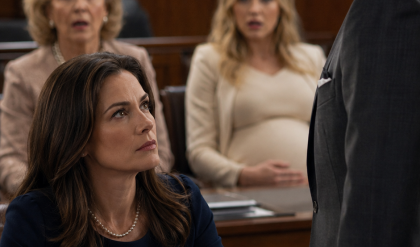
Amara Whitlock arrived at her own anniversary party carrying a suitcase, and everyone in the room thought it was the funniest thing they had ever seen.
By midnight, not one of them would be laughing.
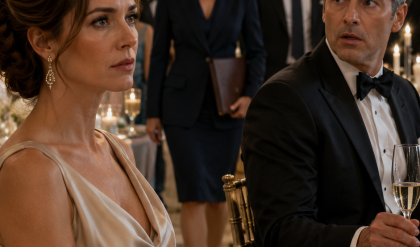
Whitlock House blazed under the moonlight like a palace built for betrayal. White roses climbed the golden pillars. Crystal chandeliers spilled light over three hundred guests dressed in silk, diamonds, and old money. A string quartet played beside the marble staircase, soft enough to sound tasteful, expensive enough to remind everyone who owned the room.
At the entrance stood Amara, calm and graceful in a simple pale blue dress, one hand resting on the handle of a small brown suitcase.
She had worn no diamonds.
She had brought no entourage.
Only the suitcase.
The whispers began before she took her third step inside.
“Is she leaving him tonight?”
“Look at that case. How dramatic.”
“Poor thing. She still thinks anyone cares.”
Amara heard all of it. She had spent three years hearing things no one thought she was brave enough to answer. Three years of swallowed insults. Three years of sitting at polished tables where every smile had a blade beneath it.
Across the ballroom, her husband, Adrian Whitlock, stood beneath the grand chandelier with Selene Marlow pressed against his side. Selene glittered in silver silk, her blonde hair pinned like a crown, her diamonds sharp enough to wound. Adrian did not move away from her when he saw his wife.
He smiled instead.
Not with guilt.
With relief.
As if Amara’s humiliation had finally arrived on schedule.
Then Cornelia Whitlock swept forward.
Adrian’s mother had ruled Whitlock House longer than any queen had ruled a kingdom. Her white hair was smooth as porcelain, her emerald gown flawless, her diamonds trembling at her throat as she looked down at Amara’s suitcase.
“What is this?” Cornelia asked loudly.
Amara’s voice was gentle. “Something I brought with me.”
Cornelia’s smile widened. “Then let us see what a woman like you considers precious.”

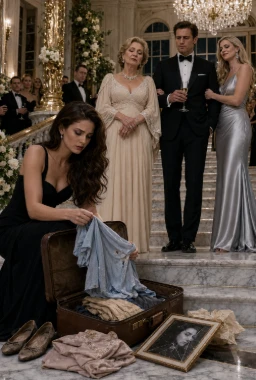
Before anyone could stop her, Cornelia seized the suitcase, dragged it toward the staircase, and threw it open.
A pale blue blouse slid across the marble.
Two folded dresses tumbled out.
A pair of worn flats landed near the door.
Then a framed photograph, carefully wrapped in tissue paper, struck the stone edge of a step and cracked.
For one heartbeat, Amara’s eyes moved to the broken frame.
Only for one heartbeat.
Then she looked back at Cornelia.
The ballroom held its breath, delighted and horrified.
Cornelia lifted the blouse between two fingers as if it were something dirty. “Take your rags and leave,” she announced. “You never understood this family. You never belonged here.”
A few guests laughed.
Selene smiled into her champagne.
Adrian sighed, the way a man sighs before performing something rehearsed.
“Since my mother has made the evening honest,” he said, raising his glass, “I might as well finish what should have been done long ago.”
The quartet stopped playing.
Adrian turned slowly, making sure every important person in the room could see him.
“I have filed for divorce,” he said. “Amara will leave this house tonight. Once the legal process is complete, Selene and I will make our relationship official.”
A fork clattered near the fireplace.
Someone whispered, “Good Lord.”
Amara did not cry.
That was the first thing that frightened them.
Adrian had expected tears. Cornelia had expected pleading. Selene had expected a broken little scene that would make her victory look graceful.
Instead, Amara laughed.
Softly.
Calmly.
Cold enough to silence every crystal glass in the room.
Adrian’s smile tightened. “Is something funny?”
Amara looked at him, then at Cornelia, then at the shattered photograph near the stairs.
“Yes,” she said. “The timing.”
Cornelia’s face hardened. “Do not try to be clever. You were tolerated here.”
Amara remembered every insult hidden behind perfect manners. The dinners where Cornelia changed the dress code and never told her. The charity lunch where she introduced Amara as Adrian’s “little rescue project.” The morning Cornelia made her polish silver with the staff because, as she said, “A woman without breeding should learn service.”
Three years of smiling.
Three years of silence.
Three years of being underestimated by people too arrogant to understand that silence could be a weapon.
Adrian stepped closer. “You may keep whatever you brought into this marriage.”
Cornelia clapped lightly. “Which should fit easily into that suitcase.”
This time more people laughed.
Near the doorway, a young waiter bent down and carefully folded Amara’s blue blouse. He brushed dust from the sleeve with a tenderness that made her throat tighten. Amara gave him a small nod.
Then she turned back to her husband.
“Actually,” she said, her voice clear in the frozen ballroom, “I brought more into this marriage than any of you can afford to lose.”
Selene’s fingers tightened around Adrian’s sleeve.
Adrian forced a laugh, but fear had begun crawling into his eyes.
At that exact moment, the ballroom doors opened with a clean brass click.
Three people entered.
A tall silver-haired man in a black suit carried a leather folder. A woman beside him held a tablet. Behind them came another man with a slim metal case handcuffed to his wrist.
The crowd parted before understanding why.
Adrian frowned. “This is a private event.”
The silver-haired man stopped beside Amara and bowed.
“Miss Vale.”
The name moved through the ballroom like fire through silk.
“Vale Meridian?” someone whispered.
“Theodore Vale’s granddaughter?”
Cornelia went pale so quickly her diamonds seemed brighter than her skin.
Selene’s smile vanished.
Adrian stared at his wife as if a stranger had stepped out of her body.
“Who are you?” he asked.
Amara lifted her chin.
“My name is Amara Vale.”
The room erupted.
Guests leaned into each other, whispering. Investors went rigid. Board members exchanged looks of panic. Vale Meridian was not simply wealth. It was power. It owned shipping lines, hotels, banks, technology patents, private estates, and quiet influence in rooms where governments listened.
Adrian’s voice cracked. “That is impossible.”
“No,” Amara said. “What is impossible is that you married me, betrayed me, robbed from me, mocked me, and still never learned my name.”
Cornelia gripped the railing. “You lying little—”
The silver-haired man opened his folder. “I am Marcus Ellery, chief counsel of Vale Meridian Trust. I can confirm that Amara Vale is the sole surviving heir of Theodore Vale and the controlling owner of Vale Meridian Holdings.”
A sound like thunder passed through the ballroom.
Adrian looked suddenly sick.
Selene whispered, “Adrian?”
Amara smiled faintly. “He did not know either.”
Marcus continued, “Three years ago, Vale Meridian quietly purchased the debt secured against Whitlock House, Whitlock Manufacturing, and six subsidiary properties. Those debts were restructured through a private marital trust controlled by Miss Vale.”
Cornelia’s mouth opened, but no sound came out.
Adrian shook his head. “No. My company recovered because I negotiated emergency financing.”
“You signed whatever your lawyers placed in front of you,” Amara said. “You never asked where the money came from because you believed rich men deserved rescue and poor wives deserved gratitude.”
Her eyes moved to the cracked photograph.
“My grandfather warned me about this family. He said Whitlocks smiled beautifully while picking bones clean. But I was young, and I believed love could make cruel people gentle.”
For the first time, her voice trembled.
Only slightly.
“I loved you, Adrian. I loved this house. I tried to love your mother. I gave you loyalty when your company was collapsing. I gave you dignity when creditors were circling. I gave you silence when every woman in this room knew about Selene before I did.”
Selene’s face flushed.
Adrian stepped forward. “Amara, we can discuss this privately.”
“No,” Amara said. “You chose the audience.”
The woman with the tablet tapped the screen. Behind Amara, the ballroom’s grand projection wall—prepared for a sentimental anniversary slideshow—flickered to life.
Instead of wedding photographs, documents appeared.
Bank transfers.
Shell companies.
Forged signatures.
Private messages between Adrian and Selene.
A hush fell so deep it seemed the house itself had stopped breathing.
Selene stared at the screen, horrified.
Adrian lunged toward the tablet. The man with the metal case blocked him.
“Careful,” Marcus said. “The federal auditors are already outside.”
Cornelia whispered, “Federal?”
Amara looked at her mother-in-law.
“Yes, Cornelia. Federal.”
Then the next document appeared.
A twenty-seven-year-old police report.
A fire.
A burned warehouse.
Two dead passengers in a black car found beside the river.
Cornelia staggered backward.
Adrian turned toward his mother. “What is that?”
Amara’s calm finally cracked, and beneath it was something terrible.
“My parents,” she said. “Elena Vale and Julian Vale. They died when I was six months old.”
Cornelia shook her head. “No.”
“Oh, yes.”
The cracked photograph was placed into Amara’s hand by the young waiter. Its glass was broken, but the image remained clear: a laughing young couple holding a baby wrapped in a white blanket. In the corner, half hidden by shadow, stood a younger Cornelia Whitlock wearing the same diamond necklace at her throat.
Amara held it up.
“My grandfather kept this picture because it was the last taken before my parents died. For years, he believed their deaths were an accident. Then, two months before he passed, he found something hidden inside Whitlock accounts.”
Marcus nodded to the woman with the tablet.
A recording began.
Cornelia’s younger voice filled the ballroom.
“If Theodore finds out we moved the patents through Whitlock Manufacturing, he will destroy us. Julian is asking questions. Handle it before he talks.”
The room froze.
Cornelia’s hand flew to her mouth.
Adrian whispered, “Mother?”
Amara’s eyes were wet now, but her voice was merciless.
“You called me a stain on your family legacy,” she said. “But your legacy was built on my parents’ blood.”
Cornelia collapsed into a chair as if her bones had vanished.
“I did not kill them,” she whispered. “I only wanted the documents delayed. I did not know Malcolm would—”
“Malcolm Whitlock,” Amara said. “Your late husband. Adrian’s father.”
Adrian stumbled back.
Every face turned toward him.
He looked from his mother to Amara. “I did not know.”
“No,” Amara said softly. “You did not. But you knew about the offshore accounts. You knew you were laundering money through Selene’s charity. You knew you signed my name to transfer trust shares you thought belonged to a woman too stupid to read legal papers.”
Selene gasped. “You said those documents were harmless!”
Adrian rounded on her. “Shut up.”
That single command finished him.
Every investor in the room heard it.
Every guest saw the truth in Selene’s face.
Then the young waiter stepped forward and removed his white gloves.
Adrian snapped, “Who are you?”
The waiter looked at Amara first.
She nodded.
He turned to the ballroom.
“My name is Luca Vale.”
The whispers exploded.
Amara continued, “My cousin. The child everyone believed died in the same fire as my parents.”
Cornelia made a strangled sound.
Luca’s eyes fixed on her. “I was pulled from the car before it burned. A Whitlock driver hid me, raised me, and died last year with enough guilt to leave a confession.”
Marcus opened another document.
“That confession, combined with tonight’s recorded admissions, has been submitted to authorities.”
Blue and red lights flashed suddenly against the terrace windows.
A woman screamed.
Cornelia tried to stand, but her legs failed.
Adrian stared at Amara, his face no longer handsome, no longer controlled, only hollow.
“You planned this,” he whispered.
Amara looked around the ballroom—the roses, the chandeliers, the marble staircase, the guests who had laughed at her suitcase.
“No,” she said. “You planned it. I only accepted the invitation.”
The doors opened again.
This time, police entered.
Cornelia was the first to be taken. Her diamonds trembled as cuffs closed around her wrists. She looked at Amara, not with rage now, but terror.
“Please,” Cornelia whispered. “Do not let them take everything.”
Amara stepped close enough that only Cornelia and a few nearby guests could hear.
“You threw my mother’s blouse down the stairs,” she said. “You broke the last photograph I had of my parents. You called my life rags.”
Cornelia’s lips shook.
Amara’s voice dropped.
“So yes, Cornelia. I am taking everything.”
Adrian was next.
He did not resist at first. He looked at Amara as if some part of him still believed charm could save him.
“Amara,” he said. “I loved you once.”
She looked at him for a long moment.
“No,” she replied. “You loved being forgiven.”
Selene began crying before they reached her. “I didn’t know about the deaths. I swear I didn’t.”
Amara studied her.
“I believe you,” she said.
Selene sagged with relief.
Then Amara added, “But you knew I existed. That was enough.”
By midnight, Whitlock House was nearly empty.
The guests had fled in clusters, whispering into phones, desperate to be first to tell the scandal and last to be associated with it. The roses still climbed the pillars. The champagne still bubbled in untouched glasses. But the palace no longer belonged to the people who had ruled it.
Amara stood alone at the foot of the staircase, staring at her suitcase.
Luca came beside her. “You really carried it in yourself.”
She smiled sadly. “They needed to believe it was all I had.”
He looked at the broken photograph in her hand. “Grandfather would have been proud.”
Amara’s fingers tightened around the frame.
Then Marcus approached with one final envelope.
“There is one more matter,” he said.
Amara frowned. “What matter?”
Marcus looked at Luca, then back at her.
“Theodore Vale amended his will three days before he died. The final clause was sealed until after the Whitlock investigation concluded.”
Amara opened the envelope.
Her eyes moved across the page.
Then stopped.
For the first time that night, she looked truly shocked.
Luca leaned closer. “Amara?”
She read the line again.
Her grandfather had left Vale Meridian not to her.
Not to Luca.
But to the person who proved, after losing everything, that they could still show kindness to someone with nothing.
Attached was a name.
Not Amara Vale.
Not Luca Vale.
The estate, the company, the house, and every recovered Whitlock asset were to pass into a charitable foundation directed by the young waiter who had folded Amara’s blouse before he knew anyone was watching.
Luca blinked. “That’s me?”
Amara looked at him, then at the suitcase, then at the empty ballroom where cruelty had destroyed itself.
Slowly, she began to laugh.
Not coldly this time.
Freely.
Because Theodore Vale’s final lesson had not been about revenge.
It had been about character.
And the richest person in Whitlock House that night had not been the woman with the secret name, the man with the stolen empire, or the family with diamonds at their throats.
It had been the only one who bent down to protect what everyone else had thrown away.
Amara handed Luca the envelope.
Then she picked up her suitcase.
“Where will you go?” he asked.
She looked back once at the house that had tried to bury her.
Then she smiled.
“Anywhere,” she said. “For the first time in my life, I am not leaving with nothing.”
She stepped through the open doors into the moonlight.
Behind her, Whitlock House no longer sounded like a palace.
It sounded like a lock finally opening.