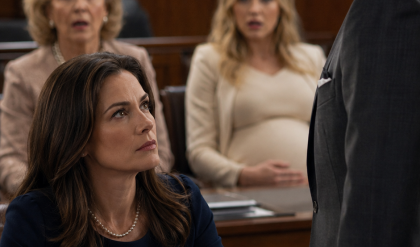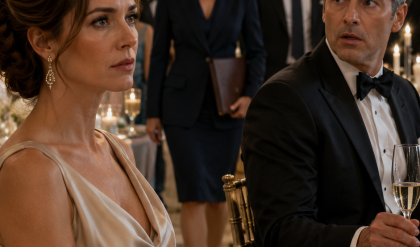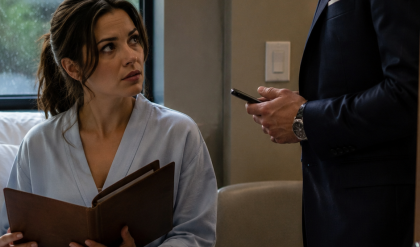
He called his wife boring and brought a model to the gala — but by midnight, every camera in New York was chasing the woman he left behind
“Grant didn’t fall in love with you, Evelyn. He was sent to marry you.”
Margaret Vale said those eight words to a window full of rain, and Evelyn Whitaker sat very still in a cream-colored armchair and did not cry. She had spent eight years learning not to cry in front of people. She had spent eight years learning not to cry alone, either. She had learned, eventually, not to cry at all — because crying had always felt like surrender, and surrender had never fixed a single thing inside that penthouse.
She took the envelope from the coffee table.
She stood.
She drove back to Manhattan.
She put on the gown.
PART ONE: THE NIGHT EVERYTHING STOPPED
The first person to stand when Evelyn Whitaker walked into the Grand Astoria ballroom was not her husband.
It was the man her husband hated most.
She had not planned for that. She had planned for many things during the forty-minute drive back from Margaret’s brick house — the whispers, the cameras, the precise angle of Grant’s jaw when he saw her — but she had not planned for Nathan Cross to be watching the elevator doors as though he had been expecting her for years.
For three full seconds, the ballroom seemed to forget how to breathe.
Every conversation collapsed mid-sentence. Champagne glasses paused halfway to glossy lips. The ambient noise of senators and heiresses and imported string quartets simply stopped, as though someone had placed a hand over the city’s throat. Every camera that had spent the evening worshiping billionaires and actresses and the women hanging from their arms turned, slowly, toward the elevator doors.
Evelyn stood there alone.
No escort. No announcement. No nervous smile manufactured from years of practice. No husband’s hand resting at her back in the careful, proprietary way that announced this one is mine without ever meaning I love her.
Just a midnight blue silk gown that moved like water when she breathed. Dark hair swept into an elegant knot, a few strands loose at her neck — not by accident, but because she had learned, finally, that the things that looked effortless cost the most. And the diamond necklace. Grant had given her that necklace four years ago after a weekend she had never allowed herself to name properly. He had clasped it around her throat himself, his fingers cold and practiced, and said: There. Now stop looking like that.
She had stopped wearing it six months ago.
He had never noticed.
She wore it tonight because she had decided to stop pretending he had never hurt her.
Across the marble floor, beneath twelve thousand dollars worth of crystal chandeliers, Grant Whitaker stopped walking.
She saw it happen. She had always been able to see things in him that required patience — the stillness before anger, the tightening around his eyes before a lie, the particular quality of silence that meant he had made a decision he knew she would hate. Eight years of studying a man who treated her like furniture taught a woman to read the grain of the wood.
He stopped walking, and his fingers went very still around his champagne glass.
Beside him, Lila Monroe followed his gaze.
Lila Monroe was twenty-six, blonde in a way that looked expensive even in bad lighting, and famous in that specific New York way where everyone recognized her face and no one could explain exactly what she did to deserve it. She wore silver couture that had been photographed twelve times before the gala even started. She was beautiful the way a weapon is beautiful — designed to go in clean and come out clean and leave the damage somewhere behind her.
Her smile tightened at the edges. Not much. Just enough.
“Who is that?” she asked.
Grant did not look at her.
“My wife.”
He said it the way a man says the name of a city he once lived in and left without explanation. Not with love. Not with hate. With that particular strain of recognition that lives inside guilt and refuses to become remorse.
Evelyn watched him say it, though she could not hear the words. She had learned to read his lips, too, because he had spent eight years talking about her to other people in rooms she was supposed to be too far away from to notice.
She had noticed everything.
She just hadn’t known what to do with any of it until today.
Now she turned away from him.
That was the first thing that unsettled everyone. Not the gown. Not the necklace. Not the fact that the woman the national press had spent forty-eight hours calling the invisible wife had materialized in the most photographed room in New York looking like something that had been hidden from the world on purpose.
What unsettled everyone was that she turned away from her husband and did not look back.
She crossed the marble floor with the deliberate grace of a woman who had finally decided that she was not going to move around anyone else again. And Nathan Cross stepped forward from the center table, because he had been the only person in the room already standing, and he took her hand with both of his.
He was taller than Grant. Darker. Less handsome in the conventional way that magazine covers demanded, but more something — more present, in the way that a room feels when a fire is lit versus when a lamp is on. He was fifty-one years old and he wore it the way certain men wore expensive watches, without apology, without performance.
He bent and kissed her knuckles.
The ballroom erupted in whispers.
Grant set his champagne glass down on the nearest surface so carefully that it made no sound at all.
“You look,” Nathan said quietly, only loud enough for Evelyn, “exactly like yourself.”
“Is that a compliment?” she asked.
“It’s the highest one I know how to give.”
She allowed herself a small smile. Not for the cameras, though she knew they were watching. Not for Grant, though she knew he was watching harder than any camera. The smile was for Margaret Vale, sitting alone in her brick house outside Boston right now, with her cream cardigan and her trembling hands and the thirty-year secret she had finally put down.
He was sent to marry you.
Evelyn accepted a champagne flute from a passing server, turned her back on the elevator doors, and let Nathan Cross walk her into the room her husband had told America she couldn’t handle. (I know you’re all very curious about the next part, so if you want to read more, please leave a “HAYA” comment below!) 👇
PART 2:
Six hours earlier, Evelyn had almost stayed home.
She had sat on the edge of the bed in the master suite of Grant’s Manhattan penthouse — she still thought of it as his, had never entirely stopped thinking of it as his, even with her own books stacked on the nightstand and her own coffee mug left in the kitchen sink — and she had stared at the blue gown hanging in the open closet like a dare she hadn’t accepted.
The car had come for Grant at four-thirty.
She had heard Lila’s voice in the foyer. Bright, practiced, shaped to fill expensive spaces. She had heard Grant’s response — two syllables, clipped, comfortable. The voice he used when he was satisfied with an arrangement.
Through the bedroom door, she had heard him take a call.
“No,” he said to whoever was on the other end. “She won’t come. She never does.”
Then Blake, his younger brother, had laughed from somewhere near the wet bar. Blake was thirty-three, handsome in Grant’s mold but looser, less careful, like a copy of a copy where something essential had degraded in reproduction.
“She’ll stay home and cry into herbal tea,” Blake said.
Grant had not defended her.
He said: “Probably.”
The word fell through the bedroom door like a stone through water and sank straight to the bottom of eight years.
Evelyn had known Grant was cold. She had known he was ambitious and controlling and capable of extraordinary cruelty in the specific, intimate way that never left marks visible to outsiders. She had explained all of it to herself, over and over, in the exhausted arithmetic of a woman who loves a man who doesn’t love her back and knows it but can’t quite calculate the exit. His distance was pressure. His absences were the price of building an empire. The women in photographs were business necessities, the rumors were the cost of public life, and her loneliness was — was something. She had always managed to make her loneliness into something coherent.
Probably had no coherence inside it.
It was not stress. It was not a bad day. It was not the Grant who showed up unexpectedly with her favorite flowers after a terrible month, the Grant she had built the whole architecture of the marriage around, proof that somewhere inside the coldness there was something worth excavating.
Probably was belief.
He believed she would disappear because she had always disappeared. He believed she would absorb whatever he did and convert it into something she could live with, and then she would make him tea and fold herself small enough not to take up space, and tomorrow would come and the whole quiet machine would run again.
She had spent eight years becoming the person he expected.
She stood from the edge of the bed.
She pulled the gown from the hanger.
And she drove herself to Boston, because Margaret Vale had called that morning with four words that had no room for argument.
Come before the gala.
Margaret’s house smelled of old paper and the particular sadness of rooms that had held too many funerals. She was seventy-eight, small now in her cardigan, smaller than Evelyn remembered from childhood visits when she had seemed enormous — enormous with opinions, with authority, with the kind of certainty that comes from having survived things. She was James Holloway’s oldest friend. Evelyn’s father’s person.
She poured tea she didn’t need and set it on the coffee table.
She put the envelope beside it.
“I should have given this to you years ago,” she said. “Before the wedding, certainly. But James asked me to wait. He thought he could handle it himself.”
Evelyn looked at the envelope.
“What is it?”
Margaret’s hands trembled around her teacup. “Everything your father knew about Grant Whitaker before you met him.”
The room tilted.
Evelyn opened the envelope with hands that did not shake, because she had made a decision somewhere between Blake’s laughter and the bedroom door, and the decision was that she was done performing steadiness for people who weren’t watching. She could shake later. She could fall apart at whatever appointed hour seemed appropriate. Right now she needed to see.
Inside: legal papers, crisp and formal, from a firm she didn’t recognize. Bank records, older, from accounts she’d never known existed. Correspondence between Grant’s father — Harold Whitaker, eight years dead — and a man whose name Evelyn recognized as her father’s business partner. A transfer of debt. A conversation between powerful men about a woman who hadn’t been told she was part of the transaction.
And one photograph.
Grant, perhaps thirty years old, standing outside a private office with James Holloway. Her father looked uncomfortable in the photograph, his shoulders up, his eyes angled away from the camera, the body language of a man in a room he knows he shouldn’t be in.
On the back, in James Holloway’s handwriting, six words:
Do not let him near Evelyn.
Evelyn set the photograph face-down on the coffee table.
For a long moment she didn’t speak.
“Why didn’t you tell me?” she said finally.
Margaret closed her eyes. “Because James made me promise. He was convinced he could stop the marriage before it happened. He had evidence that the Whitaker family had been systematically acquiring debt from Holloway Properties for years — quietly, through intermediaries. When the debt reached a certain level, the Whitakers would have controlling interest in everything James had built. James found out too late.” She paused. “He came to Grant. They had one meeting alone. I don’t know exactly what was said. But after that meeting, your engagement was announced.”
Evelyn’s voice came out very level. “Dad agreed.”
“He didn’t see another way.” Margaret opened her eyes. “Grant made him understand that the debt would be called immediately if James refused. The company, the employees, your mother’s accounts — all of it. Grant was very specific about what would happen.” She reached out and covered Evelyn’s hand with hers. “Your father thought he could protect you from inside the arrangement. He thought if he stayed close to you both, he could find another way out.”
“He died fourteen months after the wedding.”
“Yes.”
“Accident,” Evelyn said. Not a question. She had spent eight years filing her suspicions under unbearable, do not open. Now she opened it.
Margaret’s silence lasted three seconds too long.
“There was an investigation,” she said carefully. “It was ruled an accident.”
Evelyn folded the photograph and put it in the envelope with everything else.
“Grant knows I’ve never had access to my father’s accounts,” she said. “He oversaw the estate settlement himself. He said it was to protect me from the complexity.” She stopped. “He made sure I had nothing that wasn’t given to me by him.”
Margaret nodded.
Evelyn picked up the envelope.
“What does he actually get?” she asked. “From the marriage. What did he want that required all of this.”
Margaret hesitated. “Your grandfather’s land trust. The Holloway land in Connecticut — forty-three acres on the shoreline. It passed to your father outside the company structure, which meant Grant couldn’t touch it through the debt. The trust specified it could only transfer to a direct blood heir of James Holloway, or a spouse.”
Evelyn went very still.
“He needed a Holloway spouse.”
“Yes.”
“He needed me specifically.”
“Yes.”
She stood.
She smoothed the envelope flat.
She drove back to Manhattan.
She put on the gown.
PART THREE: WHAT THEY KNEW AND WHAT THEY SAID
Nathan Cross had known James Holloway for fifteen years before James died.
He told Evelyn this at the small table near the terrace, where they had retreated after her entrance had generated enough whispers to power the room for the rest of the evening without their active participation. The string quartet was playing something with enough gravity to suggest someone had briefed them. Outside the glass, Manhattan burned quietly with its own importance.
“He came to me once,” Nathan said. “About six months before he died. He wanted to know if I could move certain assets into a trust structure outside the reach of existing creditors.” He paused. “He was very careful about how he asked. He never named Grant directly.”
“But you knew.”
“I knew Grant’s family had been doing it for years. Acquiring debt through proxies, waiting, calling it when the leverage was right. It’s an old game. Harold Whitaker was very good at it.” He looked at his glass. “James wasn’t. He was a builder. He trusted people because he genuinely didn’t understand that some people aren’t building anything — they’re only acquiring.”
Evelyn looked at the room. Grant was across it, at the main table, very composed. He had installed Lila Monroe on his left and Blake on his right, and he was performing ease with the particular intensity of a man who is working very hard to look as though he isn’t working at all.
“He’s trying to decide,” Evelyn said.
“Whether to come over here.”
“Whether to make a scene or absorb one.” She turned her glass slowly in her hands. “He’ll absorb. He’s very good at absorbing things in public and destroying them in private.”
Nathan was quiet for a moment. “The envelope Margaret gave you.”
She looked at him.
“She told me she was going to do it,” he said simply. “I’ve been waiting three years for her to be ready.”
“You could have told me yourself.”
“Yes.” He didn’t look away. “I chose not to, because evidence given by an enemy of your husband would have been easier for you to dismiss than evidence given by your father’s oldest friend.” He paused. “Was I wrong?”
She thought about it honestly.
“No,” she said.
“Evelyn.” He set his glass down. “I need to tell you something now that I should have found a way to tell you years ago. I own the note on your father’s debt.”
She went still.
“I bought it from the Whitaker family eight months after James died,” Nathan said. “The price Grant named was designed to humiliate — he wanted to sell it publicly, to anyone, let the market handle it. I made sure the market was me.” He looked at his hands. “I’ve been holding it for four years. I’ve never called it. I never intended to call it.”
“Why?”
“Because calling it was always going to hurt you before it hurt Grant.” He looked at her steadily. “And because it didn’t feel like mine to use as a weapon.”
The string quartet shifted into something slower, sadder, the kind of music that doesn’t announce itself as meaningful but becomes meaningful by the time it’s over.
“There’s more,” he said.
“There usually is.”
“The land trust. The Connecticut acreage your grandfather set aside.” He picked up his glass again, didn’t drink from it. “There’s a clause your father’s lawyers found after his death. The trust can be dissolved by the original grantor’s direct heir acting independently — not through a spouse. If you petition, as James Holloway’s daughter and the named beneficiary, the trust reverts to you alone. Grant’s marriage claim becomes irrelevant.” He paused. “I have the documentation. I’ve had it for four years.”
Evelyn looked at him for a long time.
“Why didn’t you give it to me?”
“Because,” Nathan said, “you had to be ready to want it. Giving a woman her freedom before she’s decided she wants to be free is a different kind of taking.”
She didn’t speak for several seconds.
“That’s a very careful distinction,” she said finally.
“I’ve had four years to make it.”
Across the room, Grant moved. Not toward the exit — toward them.
PART FOUR: THE CONVERSATION THAT COST EVERYTHING
He came alone. He had left Lila at the table without a word, which was the kind of thing Grant did — moved through the world as though other people were furniture that arranged itself at his convenience and expected nothing in return.
He was still handsome. She noted it the way she noted weather — as information, not as feeling.
“Evelyn.” He sat in the chair across from her without being invited, because Grant Whitaker had never in his adult life waited for an invitation. “You look extraordinary.”
“Thank you,” she said.
“This is a surprise.”
“I imagine so.”
He looked at Nathan. The look lasted exactly as long as it needed to to communicate everything — ownership claimed, territory marked, warning issued — without requiring any of it to be said aloud. Grant was very efficient that way.
Nathan looked back at him with the comfortable neutrality of a man who has already won and is simply waiting for the paperwork.
“Could I have a moment alone with my wife?” Grant asked.
“That’s up to her,” Nathan said.
Grant turned to Evelyn with a different kind of patience — the kind that wasn’t patience at all, just very controlled impatience with better manners on top. “Evelyn.”
She looked at him.
She thought about the photograph. Her father’s handwriting. Six words in blue pen on the back of a picture taken in a private office where a deal had been made using her life as currency.
“You know about the envelope,” she said.
Something shifted in his face. Just barely. Just the fraction of adjustment that a man makes when he has been prepared for multiple scenarios and a new one has arrived.
“Margaret Vale,” he said. His voice carried a version of affection the way a trap carries bait. “She’s been trying to hurt this marriage for years.”
“She gave me legal documents, Grant. My father’s correspondence. Bank records.” Evelyn kept her voice level, the way she had kept it level in the car and in Margaret’s living room and in the elevator on the way into this room. “And a photograph of you with my father in an office two years before I met you.”
“Business,” he said immediately. “Our families had interests that overlapped. That’s not unusual.”
“You told me you’d never met him before our first date.”
A pause. Three seconds. In three seconds, Grant Whitaker assembled a new version of the truth.
“I didn’t think it was relevant,” he said. “It was one meeting. Years earlier. I didn’t want you to feel like our relationship was anything other than—”
“Natural?” she offered.
“Yes.”
“Real?”
He stopped.
“I loved you,” he said. And the terrible thing — the thing that had cost her eight years — was that she still couldn’t entirely tell whether it was a lie. She thought about this a lot in the years afterward. She thought it was possible to love someone and also have been sent to acquire them. She thought it was possible for both things to be true and for neither one to be enough.
“Maybe you did,” she said. “But you married me to get the land trust.”
He let the silence run for a moment.
Then he said: “And you stayed married to me for eight years, Evelyn. You think it was only me choosing this?”
There it was.
The thing that was nearly true. The thing a person could almost agree with if they weren’t careful, the thing that contained enough accuracy to make the rest of it harder to stand against. She had stayed. She had stayed and explained and accommodated and reduced herself to fit, and she had done it while telling herself it was love, and wasn’t that also a kind of transaction?
She held the thought steadily, looked at it directly, the way you look at a scar you’ve had so long you’ve stopped seeing it.
“You’re right,” she said. “I chose to stay inside something I didn’t fully understand. I should have asked harder questions earlier.” She looked at him steadily. “That’s on me. I own it.” She paused. “But the lie is on you. You knew what the marriage was from the first day. I didn’t know until today. That’s not the same kind of staying.”
Grant leaned forward slightly.
“You have no access to any of those assets without me,” he said quietly, and his voice had changed — not louder, not crueler, just stripped of the layer that made it sound like something else. “The trust, the accounts, the estate. You walked away from everything your father built the day you signed those papers. I made sure of it.”
“I know,” she said.
“Margaret Vale is a sick old woman who has hated my family since before you were born.”
“The documents are real, Grant.”
His jaw tightened. “You have nothing without me.”
“I have the land trust,” she said. “As a direct heir, acting independently, I can petition to dissolve the spousal claim. My grandfather’s lawyers wrote that clause specifically. Your marriage claim becomes irrelevant.” She tilted her head slightly. “I have the documentation.”
He looked at Nathan.
Nathan looked back at him with the same comfortable neutrality.
“You’ve been planning this,” Grant said. Not to her — to Nathan. “You’ve been building this for years.”
“James Holloway was my friend,” Nathan said. “I take care of the things he left behind.”
The string quartet finished their piece. In the silence that followed, the ballroom recalibrated — conversations restarting, glasses lifted, the professional machinery of a charity event resuming operation. Only at this small table did the air remain unmoved.
“Walk away from this,” Grant said to Evelyn, and his voice had one more layer stripped away now, down to something that might have been warning or might have been fear or might have been both at once. “You don’t know what you’re doing.”
She looked at the man she had spent eight years trying to understand.
She thought about probably.
“I know exactly what I’m doing,” she said. “For the first time in eight years, I know exactly what I’m doing.”
She stood.
She picked up her champagne glass.
And she walked away from him without looking back — which was, she realized, the second time she had done it tonight, and the first time in her life it had felt like a beginning rather than an escape.
PART FIVE: MIDNIGHT AND AFTER
By eleven-thirty, the Harrington Children’s Foundation had raised fourteen million dollars.
By eleven forty-five, three separate news organizations had filed requests for comment on the video that had circulated on social media since approximately ten p.m. — Evelyn Whitaker’s entrance, Nathan Cross standing, the deliberate arc of her crossing the room, the kiss to her hand. By midnight, the clip had four million views. By one a.m., it would have twelve.
Evelyn was aware of none of this in any way she cared about.
She was in the terrace corridor outside the ballroom, sitting on a stone bench with her shoes beside her and her champagne glass empty, watching the lights of the city arrange themselves below. Manhattan at midnight was the same as Manhattan at noon except that all the pretenses got tired and sat down too.
Nathan came out twenty minutes later.
He didn’t say anything immediately. He sat beside her on the bench, not close, the careful distance of a man who is very aware of exactly how much space he takes up.
“He’s left,” he said.
“With Lila?”
“Without her, actually.”
Evelyn absorbed this.
“She looked confused,” he added.
“She probably is.” Evelyn looked at the city. “He’s very good at making people feel chosen until he’s done choosing them.”
A pause.
“What happens now?” she asked.
“Practically speaking,” Nathan said, “you file the petition through your grandfather’s trust attorneys. I’ll give you the documentation tonight — I had it brought from my office this afternoon. Grant’s lawyers will contest it. There will be a period that is unpleasant.” He paused. “But the clause is clear. James Holloway’s lawyers wrote it specifically because he knew, by the end, that he needed to protect you from something he hadn’t been able to prevent.”
“My father protected me with paperwork,” she said. There was no bitterness in it. Only something that would take a long time to know what to call.
“He did what he could with what he had.” Nathan looked at her. “He called me the night before he died. I’ve wondered for four years whether I should tell you that.”
She went very still.
“He said he’d made a mistake he didn’t know how to undo,” Nathan said quietly. “He said the worst thing wasn’t the debt or the land or the money. The worst thing was that he had put you in a room with a man who would never see you.” He paused. “He asked me to watch out for you.”
Evelyn sat with this for a long time.
The city breathed below them. A taxi blared. A siren rose and fell. The ordinary persistent noise of a place that doesn’t stop for grief, which is either brutal or merciful depending on the day.
“I need to ask you something,” she said.
“Yes.”
“Did you come to the gala tonight for the documents? For the evidence? For the land trust?” She looked at him. “Or for some other reason.”
Nathan Cross was quiet for three seconds.
“I’ve been in rooms with you four times,” he said. “Fundraiser in Tribeca in twenty-nineteen. Your husband’s company anniversary dinner. A gallery opening in Chelsea. And tonight.” He paused. “Each time, I watched you make yourself smaller. Not because you are small — the opposite. Because you had learned to do it so well that you thought it was who you were.” He looked at the city. “I didn’t come tonight for the documents.”
She exhaled slowly.
“That’s a complicated answer to give a married woman.”
“You’ll be a good deal less married by next week,” he said. “And it’s a complicated situation.”
She almost laughed. It surprised her — the almost of it, the feeling just at the edge of laughter that she hadn’t felt in so long she’d forgotten what it lived next to.
“I’m not ready,” she said. “For whatever that was a sentence about.”
“I know.”
“I have a petition to file. A marriage to end. A conversation to have with myself about eight years of choices.”
“I know.”
“And I don’t actually know who I am when I’m not trying to make someone else comfortable.”
“That,” Nathan said, “is the most interesting question I’ve heard anyone ask about themselves in years.”
She looked at him.
“You’re going to be insufferable about this,” she said.
“Almost certainly.”
This time she did laugh.
It was small, and it was real, and the city below them received it without comment, the way cities receive the things people finally allow themselves to feel on terraces at midnight when no one important is watching.
PART SIX: THE AFTER
The petition took six weeks.
Grant contested it through four different law firms, which was two more than his lead attorney recommended and two fewer than his pride demanded. He filed a counter-claim, which was thrown out. He called Evelyn twice. She let both calls go to voicemail. He left no messages, because Grant Whitaker was not the kind of man who left messages — he was the kind of man who assumed that silence communicated authority, that a ringing phone was an argument he was winning.
He was wrong about that, as it turned out.
By the end of February, the Connecticut land trust had been dissolved and reconstituted in Evelyn’s name alone, as James Holloway’s sole living heir. Forty-three acres on the shoreline. Old-growth trees, a farmhouse that needed everything, a boathouse with a broken window that had been broken since Evelyn was nine years old and her father had rowed her out past the dock and told her she could be anything she wanted as long as she was honest about what she wanted.
She had not been honest with herself in a very long time.
She drove to Connecticut in March, alone, on a Tuesday afternoon when the light had that specific quality of early spring — thin and tentative and trying, the way hope looks before it’s earned.
She parked in the gravel drive and stood looking at the farmhouse for a while. Then she went around to the boathouse and stood looking at that. The broken window had been like this so long it felt personal. She took a photograph of it on her phone and sent it to a contractor.
She went inside. The farmhouse smelled of cold and closed-up years and the specific dry sweetness of wood that hasn’t heard a fire in too long. She walked through every room. She looked at everything her grandfather had built and her father had kept and Grant had tried to take.
She sat down at the kitchen table.
She cried.
Not performance, not processing, not the polite contained kind of crying she had allowed herself in private for years. Real crying, the kind that empties something out, the kind that takes a while and doesn’t apologize for it.
When she was done, she felt lighter in the way she had sometimes felt as a child after a summer thunderstorm — the world the same but cleaner, something relieved from the air.
She made a list.
On the list: a lawyer for the divorce. A therapist she had actually chosen herself, not the one Grant’s assistant had scheduled and Grant had approved. A call to her mother, who lived in Lisbon now and had been asking for three years when Evelyn was going to stop making excuses for a man who didn’t see her. A contractor for the farmhouse. A conversation with Nathan Cross that she was not ready for yet but had begun to feel she might be ready for eventually, which was different from before.
She drove back to Manhattan.
She returned the diamond necklace to the box it came in.
She did not return it to Grant. She put it in the kitchen drawer beside the takeout menus and the spare key to the apartment she had rented herself for the first time, in a building without a doorman, on a street that flooded when it rained. She put it there because it cost something to apologize for damaging a person, and the necklace was the only apology he had ever offered that had a dollar value she could look up, and she thought it was worth keeping as a record of exactly what he believed an apology cost.
Margaret Vale came to the apartment in April.
She was smaller than ever, moving carefully in the way of a woman who has lived long enough to understand exactly what her body is doing, and she brought a box of her own father’s papers — correspondence between the Holloways and the Vales going back sixty years, photographs, recipe cards in her mother’s handwriting, the accumulated material of two families who had been friends long enough for the friendship to become its own kind of inheritance.
They had tea.
They talked for four hours.
“He would be so proud of you,” Margaret said, when the light had shifted to late afternoon gold and the takeout menus drawer was still closed and the necklace was still in it.
“He’d be disappointed I didn’t figure it out sooner,” Evelyn said.
“He’d be proud that you figured it out at all.” Margaret looked at her with the particular directness of someone who has earned the right to say hard things kindly. “Most people don’t. They just keep getting smaller until they disappear.”
Evelyn thought about this.
“He said I could be anything I wanted,” she said. “As long as I was honest about what I wanted.”
“He said that to everyone he loved.”
“I don’t know what I want yet.”
“You’re sitting in an apartment you chose yourself,” Margaret said. “You just dissolved a land trust that a very powerful man spent a decade trying to steal. You’re drinking tea with a very old woman who should have done better by you and you haven’t made her feel terrible about it.” She paused. “I think you’re doing fine.”
The contractor called in May about the farmhouse. The boathouse window would need a full replacement. The farmhouse needed a new roof and a new floor in the kitchen and about six months of work before anything could be called livable.
“Do it,” Evelyn said.
Nathan called in June.
She had known he would. He was the kind of patient that understood itself as patience rather than performing patience, and she appreciated that about him in a way she had not appreciated things about people in a very long time.
“The farmhouse,” she said, when she answered.
“Hello to you too,” he said.
“The kitchen floor is going to be reclaimed oak. I wanted someone to know who might appreciate it.”
“I do appreciate it,” he said. “I also wanted to ask if you’d had dinner.”
“I’m making dinner right now.”
“Tonight?”
“I’m making pasta. It’s Tuesday.”
“Is Tuesday a pasta day?”
“I’m choosing it to be a pasta day. I’m allowed to choose things now.”
“You always were,” he said.
She stirred the sauce.
“You could come for dinner,” she said, with the particular careful casualness of a woman who knows exactly what she’s saying and is saying it anyway. “It’s not ready for another forty minutes. There’s enough for two.”
A brief silence.
“I’m twenty blocks away,” he said.
“That’s efficient.”
“I might have been hoping for this exact call.”
“I know,” she said. “I’m choosing to find that charming rather than presumptuous.”
“I appreciate the distinction.”
She set a second bowl on the counter. It sat there while the sauce reduced and the pasta water came to boil and the city outside her window did what cities did, indifferent and continuous. She looked at the bowl. She looked at it the way she had once looked at one bowl going cold on the stove in Grant’s penthouse kitchen — and found that the feeling was different. Not absent. She had learned too much about loneliness for it to be absent. But different. The second bowl was a choice. The second bowl was something she had put there herself.
When the knock came at the door she smoothed her apron, which she had chosen herself from a kitchen shop downtown on a Tuesday in March when the light was thin and the world was trying, and she crossed the apartment she had chosen, in the building without a doorman, on the street that flooded when it rained.
She opened the door.
She did not perform steadiness.
She was simply steady.
“The kitchen floor,” Nathan said.
“Reclaimed oak,” she confirmed.
“I brought wine.”
“Good.”
She let him in.
Outside Boston, Margaret Vale fell asleep in her cream cardigan with a framed photograph of James Holloway on the table beside her, and did not feel guilty for the first time in four years.
In Connecticut, the farmhouse waited with its broken window fixed and its new floor not yet laid, the shoreline doing what shorelines do in early summer — changing everything slowly, insisting on nothing, arriving.
In Manhattan, in a building without a doorman, on a street that flooded when it rained, Evelyn Holloway Whitaker stirred pasta in a kitchen she had chosen and talked about reclaimed oak floors with a man who had spent four years keeping a promise to her father, and found — not happiness, exactly, nothing so tidy or so final, but something that lived beside it.
Something she had put there herself.
Something chosen.
The diamond necklace was still in the drawer.
She would decide what to do with it later.
Later, for the first time in eight years, was hers.
END