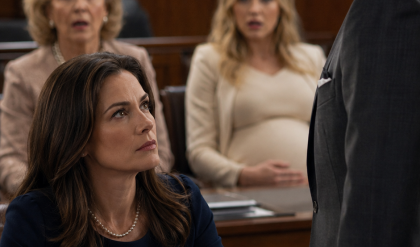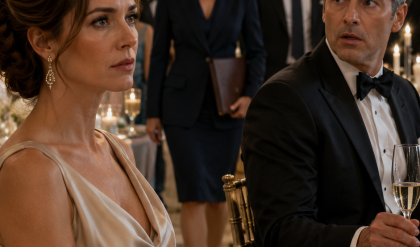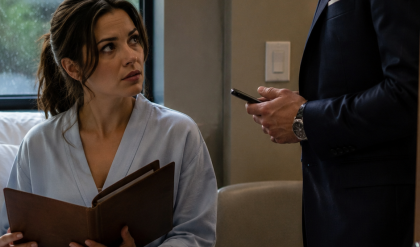
My father is on his knees in my kitchen, and my husband is watching like it’s weather.
I Never Raised My Voice — So They Never Heard Me Loading the Gun
PART ONE: THE FLOOR
“My father is on his knees in my kitchen, and my husband is watching like it’s weather.”
She said it to no one. Standing in the hallway with her suitcase still in her hand, coat still on, the words left her mouth before she understood they were a eulogy.
For two and a half years of marriage, Elena Vásquez-Reyes had believed that love was enough to make a house a home. She had believed this the way people believe in maps before they’ve driven the route — with confidence that had never been tested by the actual road.
The road, it turned out, had been a cliff.
She heard Beatriz’s laughter first. High and bright and satisfied, the laugh of a woman who had been waiting a long time for a particular pleasure. Then the wet scrape of a rag on marble. Then her father’s breathing — shallow and effortful, the breathing of a man whose pride was costing him more than his body could afford.
Elena did not drop her suitcase. She did not make a sound. She stood in the hallway of the home she had bought before she’d ever met Andrés, the home she’d put in her father’s name through a trust no one had thought to examine because no one had thought to suspect her, and she watched through the kitchen archway as Don Manuel Vásquez, seventy-two years old, gray-haired and trembling, scrubbed soup off her floor on his knees.
Above him stood Beatriz Reyes — silk blouse, wine glass, the posture of a woman who had never once questioned whether her comfort came at someone else’s cost.
“Scrub harder,” Beatriz said. “This house still smells like a ranch.”
Don Manuel looked up.
He saw his daughter.
Shame reached his face before relief could, and that — that sequence, shame before relief — was what broke something loose in Elena’s chest. Not anger. Not grief. Something colder and more precise than either.
He is ashamed that I am seeing this. Not angry. Not asking for help. Ashamed, because he had decided somewhere in his seventy-two years that men who needed their daughters were a burden, and that being a burden was the worst thing a person could be.
They taught him that, Elena thought. While I was at work paying their bills.
Beatriz turned slowly, with the unhurried confidence of someone who had never been interrupted before.
“You’re back early,” she said. Her smile sharpened at the edges.
“My meeting ended.” Elena’s voice was quiet. It had always been quiet. People had mistaken this for softness for as long as she could remember.
Andrés was leaning against the counter. He had that look he got when he was annoyed but didn’t want to show it — jaw set, hands loose at his sides, eyes slightly unfocused in the way of a man who was thinking about something other than the present moment. He did not look surprised. He looked like a man waiting for an inconvenience to pass.
“You should have called,” he said.
Elena looked at him. Really looked, the way you look at something you’ve been carrying for a long time when you finally set it down and see the shape of it.
“My father is on the floor,” she said.
Andrés made a sound — somewhere between a sigh and an exhale, the sound of a man dismissing a complaint he’d heard too many times. “He spilled soup. My mother asked him to clean it.”
“He is seventy-two years old.”
“He insisted on visiting while you were away.” Beatriz’s tone was gentle in the way that a blade is gentle before it enters. “Someone had to teach him manners.”
Don Manuel had been pushing himself up from the floor. His knees — bad knees, ranch knees, forty years of kneeling in soil and hauling wire fences — gave out. He went back down. Elena crossed the hallway in four steps and caught him by the arms, steadying him, pulling him upright.
“I’m fine, mija,” he said immediately. “Don’t fight.”
Those three words — don’t fight — landed harder than anything Beatriz had said.
He had spent a lifetime not wanting to be the reason she had to fight. He had learned, somewhere deep and early, that his need for dignity would cost her something she couldn’t afford. And he was still, even now, on the floor of her kitchen, worrying more about her peace than his own.
They have been doing this to him for months, Elena understood. And he never told me because he didn’t want to be a burden.
She helped her father stand. His boots — old ranch boots, worn at the heels, the same boots he’d worn to her college graduation — were sitting by the door. Removed. As if they were evidence of something shameful.
Elena turned to look at the small black dot above the kitchen archway.
The security camera blinked steadily.
Beatriz followed her gaze. For one second — just one — fear moved across her face. The face of a woman who had not considered, until this precise moment, that someone might be watching.
Elena smiled.
Not warmth. Not triumph. The smile of a woman who had just confirmed something she’d suspected but hadn’t yet proven.
“Good,” she said.
Andrés frowned. “Good what?”
Elena picked up her suitcase with one hand and kept her other arm through her father’s.
“Good that everyone behaved exactly like themselves.”
Beatriz laughed — too loud, too fast, the laugh of someone filling silence because silence had become dangerous.
“You think you can threaten us?”
Elena set the suitcase down, opened her phone, tapped twice, and placed it face-up on the kitchen counter.
A recorded voice filled the room.
This house still smells like a ranch.
Beatriz’s own voice, bright and satisfied, played back to her in her daughter-in-law’s kitchen while her wine glass trembled slightly in her hand.
Elena watched the color leave both of their faces — Andrés going pale from the hairline down, Beatriz going white and then immediately, reflexively, furious.
“Delete that,” Beatriz said.
“No.”
“Elena.” Andrés stepped forward. “This is a family matter. You’re being —”
“I’m going to take my father home.” Elena picked up her phone and her suitcase. “When I come back, we’ll discuss who this house really belongs to.”
She said it quietly, the way she said everything. But something had shifted in the architecture of the sentence — the way a door sounds different when it’s locked from the inside.
PART 2:
In the driveway, Andrés followed her in a low, urgent whisper, the whisper of a man who was aware of the neighbors’ windows.
“Delete the recording.” He stopped himself from grabbing her arm. She noticed. “Elena. Listen to me. You’re angry and you’re making this dramatic.”
Elena buckled her father into the passenger seat. Don Manuel sat very still with his hands in his lap, looking at the dashboard, performing the invisible act of not being there.
“Delete it and we’ll talk,” Andrés said. “Reasonably. Like adults.”
Elena closed the passenger door gently.
Then she turned to face her husband. He was close enough that she could see the pulse at his throat. He’d been nervous, she realized. Before she’d even walked in. The way he’d been standing — that loose, performatively casual posture — that was a man who’d been waiting for something.
He knew, she thought. He knew this was happening. Maybe he planned it. Maybe Beatriz told him. Maybe he just let it happen and told himself it wasn’t his fault.
“You let her humiliate my father,” Elena said.
“He humiliated himself.” Andrés’s voice dropped lower, sharper. “Coming here like some poor relative when we have guests scheduled this weekend. Arriving without calling, tracking in mud —”
“He is my father.”
“And she is my mother.” His jaw tightened. “You want me to tell my mother to apologize to a —”
He stopped.
Elena waited. Watched the word he hadn’t said hang between them.
“To a what?” she asked.
He looked away.
“You should rest tonight,” Elena said. Her tone hadn’t changed. Still quiet. Still even. “You’ll need energy tomorrow.”
She got in the car and drove.
In the passenger seat, Don Manuel looked out the window and did not speak until they were on the highway, until the neighborhood was behind them and the flat open land was spreading out ahead, and the sky was doing what the sky over the valley always did at dusk — going copper and violet in horizontal bands that looked like they’d been painted by someone who had never once been rushed.
“I didn’t want to trouble you,” Don Manuel said.
“You didn’t.”
“They said —” He paused. “They said I owed them respect. Because they gave you status.”
Elena laughed once. It was not a warm sound. It was the laugh of a woman seeing a con clearly for the first time, even though she’d been in it for years.
“They gave me nothing, Papá.”
Don Manuel was quiet for a while. Then: “What will you do?”
Elena watched the road.
“I’m going to finish what they started,” she said. “Only I’m going to do it correctly.”
PART TWO: THE LEDGER
Her father’s kitchen table was small and wooden and had held her homework at eight years old, her college applications at seventeen, and the first financial model she’d ever built at twenty-two on the night before she’d presented it to a room full of men who were about to lose thirty million dollars to fraud if she didn’t stop them.
The table had been there for all of it.
Elena set her laptop on it at ten-thirty that night, poured herself one glass of water, and began.
She started with the security footage. The full archive — six months of footage from the camera system she’d installed herself, the summer before the wedding, after a neighbor’s break-in. She’d been thorough. She’d put cameras at every entrance, the kitchen, the living room, the study. She’d mentioned this to Andrés once. He’d nodded and forgotten, the way he forgot anything that didn’t require him to do something.
Beatriz had not forgotten. She’d found two of the cameras six months ago and had them removed — Elena had noticed the gaps and replaced them with smaller models, slightly different angles. The kitchen camera was new. Beatriz hadn’t found it yet.
Elena copied the full archive to three separate drives, two cloud backups, and her lawyer’s secure server. Then she pulled the footage from the last six months and began to watch.
She had trained herself, fifteen years ago, to watch numbers the way other people watched faces. To notice when something was slightly off. A digit transposed, a date inconsistent, a signature that wavered in a particular way. Numbers didn’t lie, but people who worked with numbers always left fingerprints.
What she found in the footage was worse than she’d expected. Better, from a legal standpoint. Worse, from the standpoint of having once loved someone.
Andrés and Beatriz in the study, three months ago, while Elena was in Monterrey. Andrés at her desk, on her computer — the one she’d never thought to lock because it had never occurred to her that her home was a place she needed to defend. His mother standing behind him, reading over his shoulder.
“The consulting company is the cleanest route,” Beatriz said on the footage. “Her signature’s already in the system from last year’s contracts.”
“She’ll notice.”
“Not if you’re careful. She trusts you.”
A pause. Then Andrés said: “She does.”
The way he said it — with a kind of tired contempt, the contempt of someone who’d grown bored with being trusted — was the sound Elena would remember for a long time. Not the betrayal. She’d lived with betrayal before. The contempt. The weariness of being loved by someone who’d decided your love was an inconvenience.
She moved from the footage to the financials.
Elena had built her career on forensic accounting — specifically on fraud cases, specifically on the kind of sophisticated financial manipulation that required understanding not just numbers but psychology. She understood how people who thought they were clever were always, in the end, predictable. They used familiar patterns. They cut corners they thought no one would check. They left small, arrogant mistakes because they had convinced themselves that the person they were stealing from wouldn’t look.
Andrés and Beatriz had been stealing from her for eight months.
The mechanism was simple: her consulting company, Elena Vásquez LLC, had approved three vendor invoices totaling $340,000. The invoices were from companies that didn’t exist — shell entities Andrés had created using her digital signature, obtained through her unlocked computer during those months she’d trusted him. The money had gone through two intermediary accounts and landed in a private investment fund Andrés controlled.
The plan, as far as Elena could reconstruct it from the messages on the backup account she’d found (Andrés used his high school email for anything he didn’t want her to see, which told her something about how he thought about her intelligence), was this: drain the consulting company, undermine her financially, then present her with a property dispute using fabricated documentation suggesting she’d signed a post-nuptial agreement ceding half the house.
The house.
Elena’s mouth curved.
The house was held in a property trust. Trustor: Don Manuel Vásquez. Trustee: Elena Vásquez-Reyes. The prenuptial agreement — which Andrés’s own lawyer had drafted, which Andrés himself had signed — explicitly acknowledged no marital claim to any property in the trust.
Andrés had signed that document three years ago in an Italian restaurant while Beatriz waited outside in the car because Elena had said, very quietly, that she would not marry anyone who hadn’t read and understood the financial arrangements, and that she preferred to have these conversations without her future mother-in-law present.
Andrés had laughed then. He’d found it charming, he’d said. You’re so organized, he’d said. I love that about you.
He had not connected organized with forensic accountant who has spent fifteen years catching people exactly like you.
By four in the morning, Elena had everything.
She sent her lawyer an encrypted file at 4:17 AM with the subject line: Ready when you are.
Her lawyer — Sofía Guerrero, fifty-one years old, who had been Elena’s attorney since Elena’s first major case and who had stood in a parking garage at midnight once and told Elena you are the most dangerous client I have ever had, and I mean that as a compliment — replied at 4:21 AM.
I’ve been waiting for this. Conference room, 9 AM. I’m bringing friends.
Elena closed her laptop.
Don Manuel was asleep in his bedroom, boots on the floor beside the bed, the same way he’d slept since she was a child — boots where he could reach them, ready to work at any hour. The house smelled like coffee and wood and the dry-grass smell of the valley, the smell she’d grown up breathing, the smell Beatriz had called a ranch.
Elena stood in the doorway and looked at her sleeping father for a long moment.
They thought the ranch was an embarrassment, she thought. They didn’t know.
The ranch was the first property in a land portfolio now worth $4.2 million. Her father had bought it when she was three years old with the savings from twelve years of farm labor. He had never sold it. He had added to it, piece by piece, over the decades — small parcels, modest prices, patient accumulation — because he’d understood something about land that people who’d always had money didn’t understand: it waits for you.
He’d put everything in Elena’s name when she turned twenty-five. He’d done it without ceremony, sitting at this same kitchen table, sliding a folder across to her and saying yours now, mija, you’ll know what to do with it. She hadn’t asked why. She’d understood. He’d been preparing her for this her whole life — not for the fraud, not for the betrayal, but for the moment when she would need to stand on ground that belonged to her.
She went to her old bedroom and slept for four hours.
PART THREE: THE RECKONING
They arrived at the conference room at 9:04 AM, Andrés and Beatriz, dressed in the particular way of people who have convinced themselves they are about to win. Andrés in the gray suit Elena had bought him for a gala last spring. Beatriz in emerald silk, pearls, the posture of a woman who had decided that offense was the best defense and had decided to be extremely offensive.
They stopped in the doorway.
Elena was already seated at the head of the table. Sofía sat to her right. Two men Elena had introduced to the bank’s fraud team sat to her left — quiet men in dark suits who had the particular stillness of people accustomed to watching others realize very specific things about the choices they’d made.
“What is this?” Andrés asked. His voice was carefully controlled. He was performing confidence. Elena had gotten very good at reading performances.
“A courtesy meeting.” Elena slid a manila folder to the center of the table. “I wanted to give you the opportunity to see what I’ve found before I submit everything formally.”
Beatriz scoffed. The sound of a woman who had decided scoffing was power. “You brought strangers to a family issue.”
“I brought witnesses to a financial crime,” Elena said. “Those are different things.”
Andrés crossed to the table and opened the folder. He was trained in business — his MBA from a university whose name Beatriz had dropped at every dinner party for six years — and Elena watched the moment his training ran out. It happened at the third page. His face went very still.
“These are from the company account,” he said.
“Yes.”
Beatriz snatched the folder from him, flipping pages. “Where did you get these? These are private —”
“They’re from my company,” Elena said. “I have full access to my company’s accounts.”
“You can’t use these in —”
“Yes, she can,” Sofía said pleasantly. “They’re hers.”
Andrés set the folder down. Something was happening behind his face — Elena watched it the way she watched numbers, looking for the moment the pattern broke. He was recalibrating. Deciding how to play this.
“All right,” he said. “I can explain the transfers. There were consulting fees that —”
“Andrés.” Elena’s voice was still quiet. It had always been quiet. “I built my career finding what you tried to hide. You used my digital signature on fake invoices to funnel money out of my consulting company. Your mother convinced you to use shell entities she thought I wouldn’t trace. You planned to leverage the financial instability against me in a manufactured property dispute.” She paused. “I found all of it.”
Silence.
Beatriz recovered first — she always recovered first, Elena had observed; she was a woman of extraordinary emotional resilience when it served her. “This is because of pride,” she said. “Because we said what everyone in that neighborhood has always thought. You people.” She raised her chin. “You never know your place.”
Elena looked at her.
Not with anger — she had moved past the part where anger was useful. She looked at Beatriz the way you look at a structural problem in a building you’re about to demolish: with clarity about what needs to come down and in what order.
“My place,” Elena said, “is on the deed. On the trust documents. On the bank accounts you attempted to empty. On the contracts you didn’t read carefully enough.” She stood. “My place is wherever I decide to stand.”
The door opened.
A man Elena had never met but whose name appeared on official documents entered and handed Andrés an envelope.
Process server. Divorce papers.
Beatriz received her envelope seventeen seconds later. A civil complaint, fraud and conspiracy, co-signed by the bank.
Andrés looked up from the papers. He had gone past pale — he looked the way people looked when the story they’d been telling themselves ran out of pages.
“You won’t actually file charges,” he said. His voice was quiet now too. “Elena. You know me. We’ve been —”
“Tell me something,” Elena said. “What would you have done? If it had worked?”
He didn’t answer.
“You planned to drain my company and put me in debt,” she continued. “You were going to use fabricated documents to claim half the house. You were going to leave me with nothing so that I would be, as your mother put it, properly grateful.” She tilted her head. “What was I supposed to be grateful for?”
Andrés’s mouth moved. Nothing came out.
“I loved the man you pretended to be,” Elena said. “I’m sorry he never existed. I think he would have been someone worth knowing.”
The words were not cruel. That was the worst part, Andrés would think later — not the charges, not the footage, not the financial exposure. The words. Said quietly, with something that was almost, almost grief. The way you speak about someone who is already gone.
Beatriz slammed her hand on the table.
“You have nothing without our name,” she said. “You’ve always had nothing. A ranch girl in expensive clothes trying to buy her way into —”
“My lawyer will be in touch,” Elena said. She nodded to Sofía, who began gathering documents. “You have until noon to vacate the property.”
“We are not leaving our —”
“Sofía.”
Sofía placed a second document on the table. The property trust, full documentation, the prenuptial agreement with Andrés’s signature, and a restraining order obtained that morning.
Beatriz read it.
For the first time in the two and a half years Elena had known her, Beatriz Reyes did not have a word for what she was looking at.
PART FOUR: THE HOUSE
At noon, Elena was standing in the center of her living room when the front door opened.
Andrés came in first, Beatriz behind him. They had the faces of people who had spent three hours on the phone with their lawyer and been told, with various degrees of professional sympathy, that there was nothing to be done.
A locksmith stood near the door. Two movers waited in the hallway with boxes already packed and labeled — Elena had done this before she left for the conference room, calm and methodical, boxing only what was his, leaving everything she’d purchased clearly identified with small adhesive tags she’d found in the utility drawer. The tags were yellow. She’d used them to label spice jars. It had seemed appropriate to use them for this.
“You can’t —” Beatriz started.
“The locksmith is here to change the locks,” Elena said. “The movers have everything belonging to you and Andrés. Sofía has the inventory list. If you believe anything has been incorrectly included or excluded, you can raise it through your attorneys.”
Andrés moved toward the boxes, then stopped. He looked like a man searching for a lever that no longer existed.
“Elena,” he said. Just her name.
She turned to look at him.
There was something genuine in his face at last — she could tell the difference now, between his performances and his unguarded moments, the way you learn to tell the difference between recorded music and live music. He was genuinely frightened. Genuinely diminished. And somewhere beneath that, genuinely surprised — by her, by this, by the fact that the woman he’d thought he understood had turned out to be someone else entirely.
She wondered if he’d loved her at all. She thought maybe he had, in the beginning, in some partial way — loved the competence, loved the stability, loved the quiet. Loved what she gave him without asking for much in return. But loving someone the way you love a tool you rely on isn’t the same as loving the person.
She’d known the difference her whole life. She’d grown up watching her father love her mother — the real way, the hard way, the I will be on my knees for you if I have to way — and she’d spent two and a half years telling herself that Andrés’s version was just different, not lesser.
“Please,” he said. “The charges. Think about what you’re doing.”
“I have thought about it,” Elena said. “For approximately six hours, which is longer than you thought about forging my signature.”
He looked away.
“We have a history,” he tried.
“We have documentation,” she said. “That’s what we have.”
Beatriz had been circling the room while they talked, the way she always did when she was looking for an advantage — eyes moving over surfaces, calculating. She stopped near the television.
Elena reached into her pocket and pressed play.
The screen filled with footage.
Don Manuel on his knees. The soup-soaked rag. The trembling in his hands. And Beatriz above him, wine glass raised, laughing.
This house still smells like a ranch.
Clear audio. Bright screen. The marble floor gleaming.
Beatriz turned from the screen and looked at Elena and for the first time — the very first time — Elena saw her without the armor. An old woman who had built an entire identity out of having been born above a certain line and who had never once questioned whether that line was real or whether anything on either side of it meant what she’d decided it meant.
“You won’t release that,” Beatriz said. Her voice was different. Lower. “You know what it would do —”
“I released it this morning,” Elena said. “My lawyer cleared it. It’s been public for three hours.”
The silence that followed was the kind that lands like weight.
Beatriz’s phone buzzed. She looked at it. Looked again. Her hand tightened.
“My charity board,” she said, very quietly.
“I imagine they’ve seen it by now.” Elena’s voice was not unkind. She had not done this for cruelty. She had done it because some things needed to be seen. “Your investors too, Andrés. The bank filed its report an hour ago.”
Andrés’s phone had started buzzing on the side table. Neither of them moved to answer it.
“You could have come to me,” Elena said. “Whatever you needed — money, help with the business, anything. You could have just asked.”
“And admitted we needed a woman from a ranch to bail us out?” Beatriz’s voice cracked on the last word. Cracked, and then something behind it broke open — not remorse, not quite. But something closer to the truth. “You don’t understand. Our name —”
“Your name,” Elena said carefully, “is not worth more than my father’s knees.”
She nodded to the locksmith.
The old locks came out of the door with a sound like something final.
PART FIVE: THE GROUND
The renovations took eight weeks.
Elena had the marble torn out. She’d always hated marble — cold and white and performatively expensive, chosen by Beatriz before the wedding when she’d appointed herself the house’s decorator on the basis that Elena, she’d said gently, didn’t quite have the eye for these things. Elena had let it happen. She’d been at work. She’d been tired. She’d been telling herself it didn’t matter.
Now she put in wide-plank wood floors the color of the tierra in the valley at harvest, warm and imperfect and real. She had the kitchen repainted the color of the inside of a clay pot. She had the camera system updated — better cameras, no longer just for security but because she intended to see clearly from now on, and she thought there was something honest about that intention being visible.
Her father came every Sunday.
He came with his boots on, mud from the ranch dried on the soles, and he sat at the kitchen table that was now wood instead of marble and drank coffee from the clay mug she’d found at a market and put in the cabinet specifically for him. He brought vegetables from the ranch garden — tomatoes, chiles, squash — in a paper bag that he set by the sink without asking. He asked how work was going. She told him. He listened the way he’d always listened, with the full weight of his attention, the attention of a man who had spent a lifetime watching things grow and who understood that watching was not passive.
In the third week, he said: “You should eat more.”
In the fifth week, he said: “The floors are good. They sound like floors.”
In the eighth week, when the last of the work was done and the house smelled like wood and fresh paint and the dry-earth warmth coming through the open windows from the valley, he stood in the kitchen doorway and looked at the room for a long moment.
“It looks like yours now,” he said.
Elena looked around the room. At the wooden floors. At the clay-pot color on the walls. At the small framed photo she’d put on the counter — herself at six years old, sitting on Don Manuel’s shoulders at the ranch, squinting into the sun, laughing at something neither of them could now remember.
“It always was,” she said.
Andrés was three months into fraud charges and living in a rented room behind his cousin’s tire shop in the valley. His lawyer had called Elena’s lawyer twice with settlement proposals. The proposals had been declined politely. The charges were proceeding.
Beatriz had sold her jewelry — the estate pieces, the ones she’d described at every dinner party as irreplaceable, darling, you wouldn’t understand the provenance — to pay attorney fees for lawyers who had, over the past six weeks, stopped returning her calls.
Elena received the message on a Thursday afternoon, while she was reviewing a new fraud case — a hotel group in Guadalajara, similar signature to the Reyes scheme, similar arrogance, similar assumption that no one was looking closely.
The message came from Beatriz’s personal account.
You ruined us.
Three words. No punctuation at the end, which meant it had been sent quickly, the way you send something when you’ve finally run out of reasons not to.
Elena read it twice. Then she walked to the kitchen where her father was cutting tomatoes at the counter, boot heels on the wood floor, the small sounds of a kitchen being used the way a kitchen was supposed to be used.
“Papá.”
He wiped his hands and took the phone. Read it slowly, the way he read everything — not slowly because he was slow but because he’d learned that reading too quickly meant missing what a thing was actually saying.
He handed the phone back.
“What will you answer?” he asked.
Elena looked at the kitchen. At the floors. At the clay mug on the counter, at the paper bag of tomatoes, at the photo on the counter, at the windows open to the valley.
She typed four words.
No. You cleaned yourselves.
She blocked the number.
Poured her father more coffee.
Opened the windows wider.
The air that came in was warm and dry and smelled like it always had — like earth, like open sky, like the valley stretching out in every direction, patient and indifferent and still there, the same land that had been there before any name was put on it.
Like the ranch.
Like home.
Like something that had always been hers and had simply been waiting for her to stop apologizing for it.
Don Manuel stood beside her at the window, coffee in hand, looking out at the valley in the last light.
“You were always going to be fine,” he said. “I should have remembered that.”
Elena leaned against her father’s shoulder.
“I learned it from you,” she said.
They stood there for a while, the two of them, in the house that had always been hers, watching the valley do what the valley had always done — hold the light a little longer than it had any right to, turning copper and violet in horizontal bands along the horizon, and then, slowly, letting the dark come in.
The house was quiet.
But it wasn’t the guilty kind.