My husband whispered at our son’s wedding that my red dress made me look desperate.
He smiled while he said it, because he knew people could hear.
By midnight, every guest knew the buildings he called his legacy had been drawn by my hand.
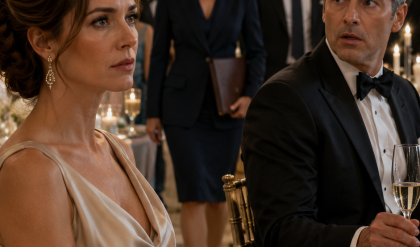
The insult arrived beneath four thousand white lights, in a courtyard that smelled of roses, lavender, expensive wine, and the first cool breath of evening settling over the Napa hills.
I had spent two hours convincing myself I was brave enough to wear red. Not bright red. Not a shouting red. It was deep satin, nearly the color of old wine held up to candlelight, elegant at the collarbone, fitted at the waist, falling softly enough that I could still tell myself I looked like the mother of the groom and not like a woman trying to become visible after twenty-seven years of beige.
Richard hated it the moment he saw me.
He did not say so at first. He was too skilled for that. My husband had built an empire out of timing, stolen language, and the ability to wound privately while smiling publicly. He waited until guests were close enough to hear but too polite to respond. He lifted his champagne flute. He leaned toward my ear. His cufflinks caught the lantern light.
“Clare,” he murmured, “that dress makes you look like a desperate old woman begging strangers to remember she used to be beautiful.”
A woman beside us stopped adjusting her pearl earring.
A business partner’s wife looked down at her shoes.
A cousin I had hosted for Christmas three times suddenly found the vineyard fascinating.
No one laughed.
That almost made it worse.
Humiliation is not always loud. Sometimes it is a room deciding, silently, that your pain would be inconvenient. Sometimes it is the three seconds after cruelty when everyone around you pretends the music is too pretty to have heard it. Sometimes it is your husband standing beside you at your only son’s wedding, smiling like a king, while the woman he has made small for decades decides whether this is the night she finally stops shrinking.
I did not look down.
Richard noticed.
His smile remained, but his eyes sharpened.
For twenty-seven years, he had trained my body to obey shame. I knew the movements by heart: chin lowering, shoulders softening, fingers smoothing my skirt, mouth closing before truth could make him angry. He had called me too sensitive until I doubted my hearing. Too dramatic until I softened my grief. Too emotional until I learned to speak about my own pain as if describing weather in another state.
But that night, Ethan was no longer a child upstairs with his bedroom door cracked open, pretending not to hear his father cutting me into pieces in the kitchen.
That night, my son was a married man.
Across the courtyard, Ethan stood with Grace, his bride, under a wooden arch wrapped in pale roses. Grace’s silk dress moved gently in the breeze, and her dark hair was pinned with tiny white flowers. She had cried during the vows, not theatrically, not prettily, but honestly. Ethan had wiped her tears with his thumb like the trembling of the woman he loved was something sacred, not embarrassing.
Watching them had loosened something inside me.
For years, I told myself silence was motherhood. I told myself I had stayed quiet to keep peace, to protect Ethan, to preserve the house around his childhood even when the rooms inside it were full of fear. I signed holiday cards. Hosted investors. Smiled through charity dinners. Covered bruises that never appeared on skin. I taught him that love could be gentle, even if the marriage he lived inside was not.
My silence had once protected a child.
Now it protected only Richard.
“Did that hurt your feelings?” Richard asked under his breath, still smiling at a couple approaching from the bar. “Don’t start, Clare. At our age, elegance means knowing when not to demand attention.”
I touched the silver brooch near my left shoulder.
Grace had given it to me that morning in the bridal suite. I had been standing in front of the mirror, already hearing Richard’s voice in my head, already preparing to apologize for fabric, color, age, womanhood, existence. Grace came behind me and fastened the brooch to my dress.
“It belonged to my grandmother Eleanor,” she said. “She was one of the first women architects in her county. For years, she had to submit drawings under a man’s name.”
My throat closed.
Grace looked at me in the mirror.
“She used to say women who open doors should never stand in corners.”
I almost cried then.
Not because of the brooch.
Because Grace had seen me.
Richard never had.
To Richard, I was the tasteful wife in background photographs. The woman who chose flowers, remembered birthdays, arranged seating charts, calmed angry clients, wrote condolence notes, and made our home feel warm enough for investors to forget they were being sold a version of my husband that did not exist without me.
According to the official story, Richard Hayes founded Hayes Development from nothing.
He was the visionary.
The man who turned empty lots into luxury residences, abandoned warehouses into restaurants, and raw land into communities with courtyards, walking trails, fountains, and light.
He was the genius who understood how buildings made people feel.
That story was a lie.
The first building was mine.
I drew it when we were twenty-five, in a one-bedroom apartment in Sacramento with a leaking ceiling and a refrigerator that hummed like a tired lawn mower. I was a licensed architect with student loans, cheap pencils, and more ambition than sleep. Richard sold commercial lots back then. He had charm. He had hunger. He could shake a banker’s hand and make debt sound like destiny.
He found the investors.
I designed the building.
It was only a modest mixed-use project, apartments above storefronts, but I treated it like a cathedral. I designed the interior courtyard so families could step into shared light instead of blank hallways. I planned cross-ventilation before anyone in that investor room used the word sustainable without smirking. I added shaded walkways, flexible units, deeper windows, and small balconies where people could drink coffee without feeling stacked inside profit.
The night before the investor meeting, Richard kissed my forehead.
“Let me present it,” he said. “These men will listen better if it comes from me.”
I was young.
I loved him.
I believed he meant one meeting.
It was never one meeting.
One project became three. Three became ten. My sketches became his vision. My all-nighters became his work ethic. My design notes became his philosophy. My drawings hung in conference rooms with brass plaques below them bearing his name.
When I asked for credit, he said I was being insecure.
When I asked to attend meetings, he said I did not understand business.
When I demanded respect, he said I was trying to embarrass him in front of men who could make or break us.
So I did what women like me are trained to do.
I adapted.
Then I documented.
For more than twenty years, I kept copies. Original drafts. Redline plans. Technical notes. Email chains. Early contracts. Investor memos. Old partnership documents from before Richard buried my role under shell companies, temporary restructuring, and language so dull even lawyers forgot to fear it.
I had a storage unit he did not know about.
I had a fireproof box inside my closet behind winter blankets he never touched because domestic things offended him unless they were arranged for magazines.
I did not know when I would need those files.
I only knew a woman should not leave her life’s work entirely inside the hands of a man who called her emotional every time she remembered she existed.
Five days before Ethan’s wedding, Richard brought me papers to sign at breakfast.
He slid the folder beside my coffee while reading the Wall Street Journal on his tablet.
“Bank compliance,” he said. “Just formalities.”
For years, that sentence had been his favorite leash.
Formalities.
Sign here, Clare.
Don’t complicate this, Clare.
You trust me, don’t you?
I picked up the pen.
Then I noticed the second page.
My name appeared as primary equity partner.
Not spouse.
Not beneficiary.
Not decorative witness.
Primary equity partner.
I had not seen that phrase on a company document in years.
My stomach went cold, but my face stayed still. Richard was texting with one hand while pretending to read market news with the other. He had always underestimated how fast I could read when danger had a signature line.
A major transfer had been blocked because it required my authorization.
When I asked why the bank needed my signature for a routine matter, he laughed.
“Because banks hire idiots,” he said. “Sign it, Clare.”
I did not.
I told him I had to dress for a final fitting with Grace. He rolled his eyes, muttered something about women turning weddings into military operations, and left the folder on the table.
That was his mistake.
I photographed every page.
Then I called Lydia Park.
Lydia was a corporate attorney I had met six years earlier at a women-in-design luncheon where I had pretended to be interested only in charity committees. She gave me her card after saying, “Women who say they are just helping their husbands usually have more power than they have been allowed to understand.”
I had kept the card behind my driver’s license.
Lydia reviewed the photographs and called me back the same afternoon.
“Clare,” she said carefully, “do you understand what this means?”
“I think Richard is trying to move money without me.”
“He is trying to move money, restructure voting control, and remove you from practical decision-making. But the old formation documents he never fully cleaned up may give you more leverage than he realizes.”
My legs went weak.
I sat on the edge of the guest room bed, the room where I slept whenever Richard came home angry and made the master bedroom feel like occupied territory.
“How much leverage?” I asked.
“Enough that he should have been much nicer to you.”
Lydia’s voice was calm.
That calmed me.
Over the next five days, we prepared quietly.
Marlene, my best friend since architecture school, retrieved the first box from storage and cried when she opened it.
“You kept everything,” she said.
“I didn’t know how not to.”
Samuel Reed, one of Hayes Development’s original investors, agreed to attend the wedding with his memory intact and his conscience late but willing. Professor Harold Benton, my old mentor, flew in with his cane, his old lecture notes, and the exact fury of a man realizing one of his brightest students had been erased in plain sight.
Catherine Doyle, Richard’s most loyal board ally, received copies the afternoon of the wedding.
I had disliked Catherine for years. She had praised Richard in interviews, defended his temper as genius, and once told me at a fundraiser that greatness often looked unreasonable from the outside. But Lydia insisted she was legally careful, not stupid.
“Send her the documents,” Lydia said. “Let her decide whether loyalty is worth fiduciary exposure.”
I did not intend to use any of it that night.
I wanted Ethan and Grace to have joy.
I wanted one celebration in our family untouched by Richard’s hunger for dominance.
Then Richard insulted me.
Then he danced with me for less than two minutes, stiffened his hand at my waist like touching me required discipline, whispered, “Don’t look so proud. It ages you,” and left me in the middle of the dance floor to walk straight to Khloe Whitaker.
Khloe was thirty-one, his executive assistant, and beautiful in pale gold silk. She laughed up at him with her whole throat exposed, trusting the power beside her. Richard placed his hand on her lower back in front of everyone.
Not friendly.
Not accidental.
Possessive.
A ripple moved through the courtyard.
Grace saw it from the head table. Her face changed.
Marlene reached under the table and gripped my hand.
“Please tell me you’re done,” she whispered.
I looked at Richard spinning Khloe under the same lanterns I had chosen for my son’s wedding.
Then my phone buzzed.
Lydia.
Everything is ready for Monday. Witnesses confirmed. If he pushes you tonight, you are legally protected.
I read the message twice.
The band lowered.
The wedding coordinator tapped the microphone.
“Ladies and gentlemen, we’re going to begin family toasts.”
Richard released Khloe slowly, like he wanted me to see that he could. He straightened his jacket, took the microphone, and stepped onto the small stage beside the floral arch.
That was when I understood something with perfect clarity.
This wedding would not end with Richard’s version of the truth.
He stood beneath the arch with the confidence of a man who believed every room was property once he entered it.
“My son,” he began, “has chosen a beautiful woman and a strong future. Tonight, I give him the greatest blessing a father can offer: an example of what it means to build something that lasts.”
A few people clapped softly.
Ethan smiled because he was a good son.
But I saw his jaw tighten.
Richard continued, “When I started Hayes Development, I had no safety net. Just vision. Just grit. I looked at empty lots and saw homes. I looked at old buildings and saw futures. I built this company with my own hands. I hope Ethan brings that same discipline, that same courage, into his marriage.”
My stomach did not twist.
Something inside me had gone still.
There are moments when rage burns hot.
Then there are moments when rage becomes architecture.
Calm.
Exact.
Load-bearing.
Richard turned toward Ethan and Grace.
“Grace, welcome to the Hayes family. You are marrying into a legacy. Protect it. Respect it. And remember that strong families are built when women understand the value of supporting their husbands’ dreams.”
The courtyard went quiet.
Not polite quiet.
Uneasy quiet.
Grace’s fingers tightened around Ethan’s hand.
Richard lifted his glass.
“And of course, I thank my wife, Clare, for giving me a fine son, for keeping our home beautiful, and for standing beside me all these years.”
There it was.
A son.
A home.
A shadow.
My twenty-seven-year obituary delivered at my son’s wedding while the woman my husband was sleeping with sat twelve feet away glowing with borrowed importance.
Richard lowered the microphone and began to step down.
I stood.
Marlene inhaled sharply beside me.
Richard saw me and frowned.
“What are you doing?” he whispered.
“I would like to give a toast.”
His smile froze.
“That’s not on the schedule.”
“Neither was dancing with your assistant like I was already dead.”
The microphone caught enough of it.
A collective breath moved through the crowd. The wedding coordinator looked terrified. The band stopped mid-note. Khloe set her champagne glass down with a tiny click that somehow sounded louder than music.
I took the microphone from Richard’s hand.
For one second, he did not release it.
His fingers tightened around the handle, and his eyes warned me with the same private language that had ruled our marriage for decades.
Sit down.
Behave.
Do not embarrass me.
Do not make me punish you later.
But there would be no later like before.
I pulled gently.
He let go.
I turned toward the guests.
“Thank you all for being here to celebrate Ethan and Grace,” I said. “They deserve a marriage built on respect, honesty, and the kind of love that does not require one person to disappear so the other can shine.”
Ethan’s face changed.
He knew.
Maybe he had always known more than I wanted him to.
Richard stepped closer.
“Clare.”
I did not look at him.
“For twenty-seven years, I have listened to my husband speak about his empire, his buildings, his vision, and his genius. Many of you have repeated those words. Some of you invested because of them. Some of you made fortunes because of them.”
Faces turned toward the front tables where Richard’s partners sat stiff in black suits.
“But that story is incomplete.”
Richard laughed once.
Sharp.
Fake.
Ugly.
“My wife is emotional tonight,” he said loudly. “Weddings do that.”
I smiled.
Not because anything was funny.
Because the old trap no longer worked.
“I am emotional,” I said. “That does not make me wrong.”
Marlene stood from her table.
In her hands was the leather portfolio.
Richard saw it, and for the first time all night, true fear crossed his face.
I had not told him Marlene was holding the first set of documents. I had not told him Lydia had arranged for copies to be delivered to three separate people at the wedding in case Richard tried to take my phone, my purse, or my nerve.
Marlene walked to the stage and handed the portfolio to Samuel Reed.
Samuel opened it slowly.
I faced the crowd.
“The first ten major projects of Hayes Development were designed by me,” I said. “The Courtyard Lofts. Meridian House. Eastbank Residences. Aurora Tower. Franklin Market. All of them began on my drafting table.”
The courtyard erupted in murmurs.
Richard’s face darkened.
“That is enough.”
“No,” I said. “It became enough years ago. I just kept surviving it.”
Samuel stood.
His voice was not loud, but it carried.
“I saw Clare’s original plans for the Courtyard Lofts before I ever heard Richard pitch the project. I invested because of her design.”
Someone near the center tables whispered, “Oh my God.”
Professor Benton stood next, leaning on his cane.
“I recognized the hand,” he said. “I reviewed Clare’s early studies. The courtyard system, the passive cooling structure, the modular family units—those were hers. I wondered for years why she stopped submitting work.”
I looked down at my hands.
I had not stopped.
I had just stopped being named.
Richard moved toward me, his voice dropping low.
“Get off that stage before you destroy yourself.”
The microphone caught him again.
This time, everyone heard.
I turned toward him.
“No, Richard. I am not destroying myself. I am correcting the record you built over my body.”
Grace stood so fast her chair scraped against stone.
Ethan rose beside her.
“Mom,” he said.
There was pain in his voice.
Not disbelief.
Pain.
I held his gaze.
“I did not want your wedding to carry this,” I said. “I wanted tonight to be yours. But your father chose to humiliate me here. He chose to erase me again here. I will not let your marriage begin with the same lie that poisoned mine.”
Ethan stepped away from the head table and walked toward the stage.
Richard pointed at him.
“Sit down.”
For one terrible second, I saw the boy he used to be, frozen between us.
Then Grace walked with him.
That was the first twist Richard did not expect.
He had always believed love made people obedient.
He had never understood that real love makes people brave.
Ethan climbed the stage and took my hand.
“I used to fall asleep to the sound of your pencil,” he said into the microphone.
My breath broke.
He looked at the guests.
“When I was a kid, I thought all fathers sold buildings their wives designed. I thought that was just how our family worked.”
Richard’s mouth opened.
No sound came.
Ethan reached inside his jacket and pulled out a small flash drive.
“I found old home videos last month when I was making a wedding slideshow. In one of them, I’m eight or nine. Dad is filming me with a toy plane, and Mom is in the background explaining the Aurora Tower model while he tells her to slow down because he needs to memorize it for an investor lunch.”
The room went silent in a new way.
A devastating way.
Richard stared at Ethan as if his own son had become a stranger.
“You kept that?”
Ethan’s voice shook, but he did not back down.
“I didn’t know what it meant until I was older. Then I did.” He turned to me. “I’m sorry, Mom. I should have said something sooner.”
I cupped his face for one second, forgetting the microphone, the crowd, the years.
“You were a little boy.”
He shook his head.
“I’m not now.”
Khloe stood abruptly.
Her chair tipped behind her, hitting the stone.
“I need some air.”
But Lydia was already at the edge of the courtyard.
She wore a navy suit, no jewelry except small gold hoops, and looked like the kind of woman who could set a building on fire with a pen.
“Miss Whitaker,” Lydia said. “I would not leave just yet.”
Richard snapped, “Who the hell invited you?”
“I did,” I said.
A murmur spread.
Lydia handed one sealed envelope to Samuel, another to Catherine Doyle, and another to a bank representative seated near the front.
I looked at Richard.
“The bank transfer you tried to force through last week was blocked because you still need my authorization as primary equity partner. On Monday morning, I will file a formal authorship claim, a financial audit request, and a petition for divorce.”
The word divorce landed harder than anything else.
Richard’s eyes narrowed.
“You ungrateful little—”
Ethan stepped between us.
“Do not finish that sentence.”
Richard stared at him.
“You’re choosing her over your family.”
Ethan’s voice went cold.
“She is my family.”
Grace took my other hand.
“And mine.”
The second twist came from someone no one was watching.
Catherine Doyle stood slowly from the front table.
She looked at Richard, then at Khloe.
“I received the documents this afternoon,” Catherine said. “I hoped there was an explanation.”
Richard’s expression sharpened.
“Catherine, not here.”
“Especially here,” she said, “because you stood in front of your son and told him to build a marriage on a lie.”
Khloe backed up one step.
Catherine continued, “The offshore account attached to the blocked transfer is linked to a consulting entity incorporated eleven months ago. That entity is also tied to Miss Whitaker. Richard made me sign a preliminary vendor approval for it under false pretenses. I will cooperate fully with any audit.”
That was not in my documents.
I looked at Lydia.
Her face gave nothing away, but I saw the smallest flicker in her eyes.
She had known there might be more.
She had let the room reveal itself.
Richard leaned close enough that only I should have heard him.
“I will ruin you.”
The microphone was still in my hand.
The entire courtyard heard.
I looked at him and smiled with the coldest part of myself.
“You cannot ruin what you stole without admitting it was never yours.”
For the first time in twenty-seven years, Richard Hayes had no room left to perform in.
The wedding did not become the kind of scandal people could dismiss as hysteria.
No one threw wine. No one screamed across the dance floor. No bridesmaid cried for attention. No uncle started a fight near the bar.
That would have helped Richard.
He could have blamed champagne, menopause, jealousy, stress, anything but the truth.
Instead, the truth sat down at every table like an uninvited guest and refused to leave.
I stepped off the stage holding Ethan’s hand on one side and Grace’s on the other. People moved aside for us, not because I was fragile, but because they were finally seeing the woman who had been standing there the whole time.
Outside the courtyard, the vineyard air was cool and sharp.
Richard caught up halfway down the stone path.
“Clare.”
I kept walking.
“This is not how adults handle private matters,” he said.
That made me stop.
I turned around beneath a lantern wrapped in white roses.
“In private, you stole twenty-seven years from me. In public, I returned seven minutes.”
His nostrils flared.
“I made your drawings worth millions.”
“My drawings made you look like a genius.”
“You would have been nothing without me.”
There it was.
The sentence behind every year of our marriage.
The rotten beam inside the walls.
I stepped closer.
“I was something before you. You just convinced me it was safer to forget.”
Ethan stood behind me, breathing hard.
Richard looked at him with naked contempt.
“You too? After everything I gave you?”
Ethan’s voice shook.
“You gave me a house where Mom learned to apologize for breathing.”
Richard blinked.
That one landed.
Grace held Ethan’s hand like she was keeping him in the present.
“I saw more than you think,” Ethan said. “The slammed doors. The way Mom stopped talking when your car came up the driveway. The way every celebration became about your mood.”
Richard scoffed.
“Children exaggerate.”
“I’m twenty-nine,” Ethan said. “And I’m done being managed.”
I watched him say it and felt a grief I had not expected.
Mothers like me tell ourselves that if the children survive, the silence was worth it. We pretend they were protected because they were fed, educated, driven to practice, kissed good night. We do not want to admit they learned the shape of fear even when we hid the words.
Grace stepped forward.
“A mistake,” she said to Richard, “is thinking a wedding ring makes a woman property.”
Richard looked her up and down with his old contempt.
“You’ve been in this family for two hours.”
“And I already understand it better than you do.”
From the courtyard, music began again.
Someone had made the wise decision to move the reception forward. Not because the scandal was over, but because weddings are living things. They keep breathing even when families crack open beside them.
I looked at Ethan.
“This is still your wedding.”
He shook his head.
“Mom, no.”
“Listen to me. What happened tonight was necessary, but it does not get to steal your first dance, your cake, your pictures, your joy. Your father has taken enough from this family.”
Grace’s eyes filled.
“You’re sure?”
“I am unsure of many things right now,” I said. “But I am sure he does not get to ruin what you built honestly.”
So we went back.
That was the strangest part of the night.
Not the speech.
Not the files.
Not Richard’s face when the word audit entered the air.
The strangest part was returning to the reception and choosing joy in the same place where shame had tried to own me.
The band played again. Guests pretended not to stare and failed completely. Ethan and Grace cut their cake. Marlene brought me water and whispered, “You look like a hurricane in diamonds.”
“I feel like I might throw up.”
“Both can be true.”
At 11:40, Grace asked me to dance.
“Me?”
“Yes, you.”
So I danced with my daughter-in-law under the lights while my son watched with tears in his eyes.
It was not planned.
It was not traditional.
It was better.
Halfway through, Ethan joined us. Then Marlene. Then Grace’s mother. Then a circle of women I barely knew and somehow recognized.
Richard stood at the edge of the courtyard alone.
Khloe was gone.
That was the beginning of his real punishment, though he did not know it yet.
Men like Richard fear lawsuits, bankruptcy, prison, headlines.
But what they fear most is standing in a room where their control no longer works.
Monday arrived with gray skies and no mercy.
At 9:00, I walked into the conference room at Hayes Development headquarters in San Francisco wearing a cream suit and the silver brooch from my red dress.
The office still smelled like cedar, coffee, and Richard’s arrogance. Floor-to-ceiling windows looked over the city, including two buildings I had designed while breastfeeding Ethan and pretending not to mind when Richard called them “my babies” in interviews.
Lydia walked beside me.
Marlene came too, not because she had legal standing, but because I needed one person in the room who knew the sound of my real laugh before marriage made it rare.
Around the table sat Samuel Reed, Catherine Doyle, three board members, a forensic accountant, Professor Benton, and two bank representatives. There were folders at every seat: copies of my work, copies of Richard’s emails, copies of formation documents he had assumed were too old, too buried, too boring to matter.
Richard arrived twelve minutes late.
That was deliberate.
Power had always entered after everyone waited.
But the room did not rise for him.
He noticed.
His jaw tightened.
He wore a charcoal suit, but he looked badly assembled, like a man who had slept in anger. Khloe was not with him. His attorney followed, pale and nervous.
The forensic accountant began.
It is a strange thing, watching your life become evidence.
The first drawing appeared on the screen.
Courtyard Lofts.
Pencil.
Ink.
Coffee stain on the bottom right from a night I remembered with humiliating tenderness. Ethan had been sick with a fever. I was seven months pregnant, balancing tracing paper over my stomach while Richard slept because he had a big pitch the next morning.
My signature sat in the lower corner.
Clare Bennett.
Small, but there.
The next slide showed Richard’s email.
Need you to clean up the courtyard section before lunch. Investors love the light idea, but I need to explain it like it was mine. Don’t overcomplicate it.
No one spoke.
Then came Meridian House. Eastbank. Aurora Tower. Franklin Market.
Ten projects.
Ten sets of drawings.
Ten trails of messages where Richard asked me to revise, explain, simplify, calculate, prepare, hide, wait.
At slide seven, Professor Benton removed his glasses and wiped his eyes.
“I told her she would change residential design,” he said quietly. “I wondered for years why she stopped submitting work.”
I looked down at my hands.
I had not stopped.
I had just stopped being named.
Then the accountant moved to the financial documents.
Richard had not only tried to remove me from voting control. He had attempted to move $4.8 million into a consulting company attached to Khloe Whitaker. The company had no staff, no active contracts, and a registered address at a luxury apartment building in Seattle.
There were draft employment agreements naming Khloe as strategic development director after the restructuring. Internal memos reducing my equity authority. Emails from Richard to his attorney discussing “spousal optics” and “minimizing Clare’s legacy exposure.”
Legacy exposure.
That phrase sliced deeper than mistress, money, or fraud.
To Richard, I was not a person.
I was a risk category.
Lydia folded her hands.
“Without Mrs. Hayes’s authorization, the attempted transfer and restructuring are invalid. Given the authorship documentation, the board also faces fiduciary exposure if it continues representing Mr. Hayes as sole creative founder.”
Richard slapped his palm on the table.
“This company carries my name.”
The room flinched.
I did not.
“And my foundations,” I said.
The words came out before I planned them.
Maybe I had been waiting twenty-seven years to say something that simple.
Samuel nodded once.
Catherine looked at the board.
“I move for internal intervention pending full audit. Richard Hayes is to be suspended from executive authority until the review is complete. Clare Bennett Hayes is to be publicly reinstated as founding design partner and principal architect of the first ten developments.”
Richard’s attorney objected.
The bank representative interrupted.
“The bank supports a temporary freeze on disputed transfers.”
Richard stared at Catherine.
“You owe me.”
Her face hardened.
“No, Richard. I covered for you when I thought you were difficult. I will not cover for theft.”
The vote was not unanimous.
But it passed.
Richard lost control of the room at 10:18 on a Monday morning.
I know because I looked at the clock.
After twenty-seven years of being told I was too sensitive, too dramatic, too dependent, too late, I wanted to remember the exact minute when the walls shifted.
Richard stood so fast his chair rolled back.
“You think this is over? You think a few dusty drawings make you special?”
I stood too.
“No,” I said. “I think they make me documented.”
He leaned across the table.
“I will drag this divorce out until you are exhausted.”
Lydia smiled slightly.
“Mr. Hayes, she has been exhausted for twenty-seven years. I would not rely on that strategy.”
Marlene made a sound that might have been a cough.
I knew it was laughter.
Richard walked out.
No one followed him.
That was maybe the cruelest thing for him.
Power does not disappear all at once. It evaporates when people realize they do not have to chase it.
The story broke six days later.
Not because I called reporters.
Richard did.
He tried to get ahead of the scandal by giving a statement to a business columnist he had golfed with for years. He described me as “a valued supporter during the company’s early creative period” and said our family was “working privately through emotional misunderstandings.”
Lydia sent the columnist twelve pages of documentation and one quote from me.
I do not want revenge. I want my name back.
The article ran on Sunday morning.
By Monday, architecture blogs picked it up.
By Tuesday, national business outlets were calling.
By Wednesday, one headline read:
The Woman Behind Hayes Development Finally Steps Out of the Shadow.
I hated that headline.
Not because it was untrue.
Because shadows do not just happen.
Someone stands in the light and blocks you.
Clients began calling. Some embarrassed. Some calculating. Some wanted to know if their projects would be affected. Others asked quietly if I would consider leading design reviews personally.
One woman, a developer from Portland, said, “I always suspected a woman designed Aurora Tower. The light in that lobby never felt like Richard.”
I laughed for the first time in days.
Then I cried for twenty minutes in my parked car.
Healing is not graceful.
You can win a board vote and still shake while ordering coffee. You can see your name in print and still hear your husband whispering that your dress makes you pathetic. You can be free and still reach for the old cage because it is the only shape your body recognizes.
Ethan and Grace postponed their honeymoon by three days.
I begged them to go.
“Your mother just detonated a twenty-seven-year marriage,” Grace said, sitting on my kitchen counter in sweatpants two days after her wedding. “We can wait until Thursday.”
“You should be somewhere tropical.”
Ethan opened my refrigerator and frowned.
“You have mustard, olives, and nine bottles of sparkling water.”
“I have been busy reclaiming intellectual property.”
“You need soup.”
Grace ordered Thai food.
Ethan made tea.
I sat at the kitchen island in the house Richard and I had shared, looking at the family photographs on the wall. Most of them had been chosen by me because Richard liked photos where we looked expensive: Aspen, Maui, ribbon cuttings, galas. A successful family. A beautiful wife. A proud husband. A son in a navy blazer trying to smile normally between two parents who had turned silence into furniture.
“I’m sorry,” Ethan said suddenly.
I looked at him.
“For what?”
“For knowing some of it and doing nothing.”
I turned my mug in my hands.
“How old were you when you first knew?”
He swallowed.
“Maybe twelve. I didn’t know the words. I just knew Dad got credit and you got tired.”
I closed my eyes.
“Children are not responsible for rescuing their mothers.”
“I’m not a child now.”
“No,” I said. “Now you are a man who stood beside me when it mattered.”
He sat across from me.
“I should have done it before the wedding.”
I smiled sadly.
“So should I.”
Grace reached over and covered my hand.
“Maybe everyone speaks when they finally have air.”
That sentence stayed with me.
For the next four months, my life became lawyers, accountants, interviews, depositions, and boxes.
The divorce moved like a storm system.
Richard fought every inch. He contested valuations, challenged authorship, accused me of manipulating Ethan, accused Lydia of professional misconduct, accused Marlene of poisoning me, accused Grace of being too modern, whatever that meant. He even accused me of having planned to destroy him from the beginning.
In a way, he was right.
Not because I wanted destruction.
Because every copy I kept, every drawing I saved, every email I forwarded to a private address was a tiny act of future survival.
A woman collecting proof is a woman secretly believing she may one day deserve justice.
Khloe disappeared for two weeks.
Then she returned with her own attorney.
That was the twist Richard never saw coming.
She was not in love with him.
She had recorded him.
According to her statement, Richard had promised her a senior position, an apartment, and eventual public legitimacy after he “resolved the Clare issue.” Khloe was not innocent. She had helped set up the consulting company. She had enjoyed proximity to power. She had smiled at me across dinner tables while sleeping with my husband.
But she had also understood Richard would sacrifice her the moment she became inconvenient.
So she saved messages.
Recordings.
Voicemails.
One recording was played in a closed legal meeting on a rainy Thursday afternoon.
Richard’s voice filled the room.
“Clare signs whatever I put in front of her. She always has. Once the board control shifts, she can cry into her charity committees for all I care.”
I did not cry.
Not then.
I stared at the polished table until his voice ended.
Lydia asked if I needed a break.
“No,” I said. “Play the next one.”
The next recording was worse.
Khloe asked, “What if Ethan takes her side?”
Richard laughed.
“Ethan has no spine for conflict. He’ll fold. He always does.”
I thought Ethan might break when he heard it later.
He did not.
He got very quiet, then said, “He mistook peacekeeping for weakness. I learned that from Mom.”
That was the day I stopped worrying that my son had inherited Richard’s shadow.
By winter, the settlement had shape.
Richard kept some shares because law is not a fairy tale and villains do not always leave empty-handed. But he lost executive control. He lost the right to present himself as sole founder. He lost three major clients. He lost the Napa house. He lost the San Francisco office suite he loved because the board voted to rename it Bennett Studio Division during restructuring.
He hated that most.
My maiden name on the glass doors.
Clare Bennett.
Not Mrs. Richard Hayes.
Not supportive spouse.
Not legacy exposure.
Clare Bennett.
Architect.
The first time I saw it installed, I touched the letters with two fingers and sobbed so hard the contractor pretended to check something in the hallway.
Marlene stood beside me.
“You okay?”
“No.”
“Good.”
I laughed through tears.
“Good?”
“You spent twenty-seven years being okay on command. Try something else.”
So I did.
I opened my own studio in a restored brick building in Oakland with tall windows, old hardwood floors, and a courtyard full of lemon trees. The first week, I brought in my drafting table from storage. The legs were scratched. The surface carried ink ghosts from projects Richard had once claimed as his. I ran my palm over it like greeting an old friend I had abandoned in another life.
I hired four young architects.
All women.
Not as a statement, though people called it one. I hired them because they were brilliant.
One of them cried in the interview when she saw my original Aurora sketches on the wall.
“My professor told us your husband designed this.”
“I know,” I said. “Let’s fix that.”
My first independent commission was a community housing project in Sacramento, twelve blocks from the apartment where Richard and I had once lived with the leaking ceiling. It would have interior courtyards, shaded walkways, natural ventilation, and units designed for families who needed beauty without being priced out of dignity.
When the city announced the project, I insisted the press release include every designer on the team.
Names matter.
Men who already have them pretend they do not.
Richard came to my studio eight months after the wedding.
I saw him through the glass before he saw me. He stood on the sidewalk in a dark overcoat, thinner than before, his hair more silver, his posture still trying to remember how to be royal.
For one second, my body reacted the old way.
Shoulders tight.
Breath shallow.
Mind scanning for what I had done wrong.
Then the feeling passed.
He was just a man outside a door.
My receptionist asked if I wanted her to send him away.
“No,” I said. “I’ll speak to him.”
I met him in the courtyard where lemon leaves moved in the afternoon wind.
He looked around like the building insulted him by existing without his permission.
“Nice place,” he said.
“Thank you.”
“I see you kept the courtyard obsession.”
“I kept many things that were mine.”
His jaw shifted.
For a moment, neither of us spoke.
Then he said, “We were a family.”
I looked at him carefully.
“No, Richard. We were a performance.”
His eyes flashed.
“That is cruel.”
“It is accurate.”
“I needed you,” he said, and his voice cracked just enough to reveal something human beneath the ruin.
There was a time when that crack would have undone me. I would have rushed to comfort him, explain him to himself, soften the consequences of his own choices.
Not anymore.
“You did not need me,” I said. “You used me.”
He looked away.
“I made mistakes.”
“You made a career.”
His face hardened, then tired.
The anger could not hold itself up like it used to.
“Twenty-seven years, Clare. You do not throw away twenty-seven years.”
The courtyard seemed to go very still.
I thought of myself at twenty-five, drawing by the yellow light of a rented kitchen. I thought of Ethan at eight, pretending not to listen. I thought of the red dress, the microphone, the word desperate in my husband’s mouth. I thought of all the years I had mistaken endurance for love.
“I did not throw them away,” I said. “I rescued them from your lie.”
His eyes filled with something like fear.
“What do you want me to do?”
I looked at the man who had once filled every room I entered.
Now he seemed smaller than the space between us.
“Breathe alone,” I said.
He flinched because he knew.
Years earlier, after a fight I could barely remember, he told me he stayed married to me because leaving would be messy. Then he added, “One day, when all this is handled, I will finally breathe.”
He had meant without me.
Now I gave him the gift of his own wish.
I walked back inside and closed the glass door softly.
No slam.
No final insult.
Noise is not required to end an old life.
Ethan and Grace returned from their honeymoon with sunburned noses, matching bracelets, and a seriousness beneath their happiness that made me ache. Trauma has a way of joining a family before joy has unpacked its bags.
They came to the studio on a Saturday afternoon.
Grace brought flowers. Ethan brought a framed photograph from the wedding.
At first, I braced myself.
I did not want a picture of the speech, Richard’s face, or me standing beneath that arch with a microphone and twenty-seven years of grief shaking behind my ribs.
But it was not that.
It was the dance.
Grace and I beneath the lights, her wedding dress brushing my red gown, Ethan stepping toward us with one hand over his heart. In the photo, I am laughing and crying at the same time. My head is tilted back. The silver brooch catches the light.
I did not remember looking happy.
Ethan hung it in my office without asking.
I let him.
Then he stood in front of my drafting table, running his fingers over the edge like he had when he was a child.
“Grace and I want to ask you something,” he said.
Grace slipped her hand into his.
“If this is about giving you money,” I said, “I will become dramatic.”
Grace laughed.
“It’s not.”
Ethan took a breath.
“We want you to design our house.”
The words entered me quietly.
Not because it was a large commission. It was not compared to towers, civic projects, headquarters, developments with budgets that required committees and champagne.
But a home for my son.
For the woman who had stood beside me when she had every excuse to stay out of it.
My eyes burned.
“I would be honored.”
Grace smiled.
“We want light. A kitchen big enough for everyone. A courtyard if possible.”
Ethan added, “And a room for you.”
I looked at him.
He shrugged, suddenly shy.
“Not because you need one. Because we want one.”
There are moments when justice feels like victory.
Then there are moments when justice feels like being invited into the future.
That one felt like both.
The public unveiling of my first independent building happened fourteen months after the wedding.
The Sacramento project was not the tallest building I had ever designed. It was not the most expensive. It did not have imported marble or a lobby meant to intimidate visitors into silence.
It had sunlight.
Children ran through the central courtyard before the ribbon cutting. An older woman sat on a bench beneath a young oak tree and said the breeze reminded her of her grandmother’s porch. A father pushed a stroller along the shaded walkway, looking up at the balconies with the stunned relief of someone who had expected affordable housing to feel like punishment and found beauty instead.
My name was on the plaque.
Clare Bennett, Lead Architect.
Below it were eleven more names.
Every designer.
Every engineer.
Every person whose work shaped the building.
I wore red again.
Not the same dress.
Something simpler.
Softer.
Mine.
Ethan stood in the front row with Grace, who was pregnant by then, one hand resting on the small curve of her belly. They had told me three weeks earlier in my studio, using a tiny rolled blueprint with the words Future Room Needed written across it.
I cried so hard Grace cried too.
Ethan kept saying, “This was supposed to be cute,” while handing us napkins.
Richard did not come to the unveiling, but he sent a letter.
It arrived that morning in a cream envelope because even in disgrace, he preferred expensive paper.
I opened it alone in the unfinished community room before the ceremony.
Clare,
I saw the article about the project. It looks like you.
I do not know how to apologize in a way you would believe. Maybe I lost that right. Maybe I never had it. I told myself I was building something for us. Then somewhere along the way, I decided I meant me.
I do not expect forgiveness.
Richard.
I read it twice.
Then I folded it and put it back in the envelope.
I did not cry.
Forgiveness is complicated. People treat it like a beautiful room you enter when you are healed. But sometimes it is just a door you do not open because you finally understand not every visitor deserves your house.
I did not hate him.
That was enough.
When I stepped onto the small platform for the ribbon cutting, the crowd quieted. Reporters lifted cameras. City officials smiled. My team stood behind me, nervous and proud.
I looked at the plaque.
I thought of all the plaques that should have carried my name and did not. All the rooms where I had been thanked for flowers while men praised my ideas in another man’s mouth. All the times I had made myself smaller because I was told love required good lighting and no shadow.
Then I touched Grace’s grandmother’s brooch pinned near my shoulder.
A woman who opens doors should be seen.
I finally understood the sentence fully.
Being seen is not vanity.
It is evidence that you survived the attempt to erase you.
I stepped to the microphone.
For one brief second, the vineyard came back to me: Richard’s whisper, the red dress, the silence, the cruel little smile he wore when he thought shame still belonged to him.
Then the memory changed.
I saw Ethan climbing the stage.
Grace taking my hand.
Marlene with the portfolio.
Lydia in navy.
Catherine standing up.
Khloe turning evidence against the man who thought he owned every woman in his orbit.
I saw my own hand pulling the microphone free.
I smiled.
“Thank you for being here,” I said. “This building is about light, air, dignity, and names. Especially names. Because work without credit is theft dressed as humility, and silence, when demanded for too long, is not peace. It is a cage with flowers painted on the bars.”
No one moved.
“So today, every person who helped create this place is named. Every drawing has an author. Every idea has a source. And every family who lives here deserves a home built on respect, not performance.”
My voice trembled at the end.
I did not hide it.
People clapped.
Not polite clapping.
The kind that rises and rolls because something true has found a room big enough to hold it.
After the ceremony, Ethan hugged me for a long time.
“I’m proud of you,” he said.
I closed my eyes.
“I used to think those were the words children needed from parents.”
“They are,” he said. “But parents need them too.”
Grace kissed my cheek.
“The baby kicked during your speech.”
“Well,” I said, touching her belly gently, “good taste starts early.”
That night, after everyone left, I returned to my studio alone.
The city was quiet. The courtyard smelled like lemon leaves and rain. I turned on the lamp above my drafting table and unrolled the first sketch of Ethan and Grace’s house.
A kitchen facing morning light.
A courtyard with room for a child to run.
A small guest room at the back, not hidden, not decorative, simply welcome.
I picked up my pencil.
For a moment, my hand hovered above the paper.
I thought of the young woman I had been at twenty-five, drawing until three in the morning, believing love meant becoming less so a man could become more. I wished I could reach back through time and sit beside her at that cheap kitchen table. I wished I could tell her to sign bigger, speak earlier, keep every copy, buy the red dress.
But maybe she already knew.
Maybe that was why she saved the drawings.
Maybe some quiet part of me had been waiting all along for the day I would stop asking permission to exist.
People still remember the wedding.
They remember my dress. They remember Richard’s face. They remember the speech, the flash drive, the board member turning against him, the mistress becoming a witness, the son choosing his mother in front of everyone.
I remember something else.
I remember the exact second after Richard insulted me when I did not look down.
That was the moment the old marriage began to die.
Not on the stage.
Not in the boardroom.
Not in court.
There, inside me.
A woman does not always leave when the door opens.
Sometimes she leaves when she finally realizes the lock was made of fear.
And fear can be broken without making a sound.
I am not Richard Hayes’s decorative wife.
I am not the quiet woman in beige standing beside his empire.
I am not legacy exposure.
I am Clare Bennett.
I draw buildings with courtyards because people deserve air.
I put names on plaques because work deserves truth.
And every line I draw now carries mine.