My husband thought the baby monitor was only watching our son sleep. He did not know it was recording him in the nursery, whispering to his mistress about taking custody, making me look unstable, and ending our family. At breakfast, she wore my cashmere cardigan like she already owned my life. What they did not know was that I had already sent the recording to court.
I sat at the dining table the next morning with dry eyes and black coffee. Harrison sat at the head of the table in his perfect suit, looking calm. Sienna sat beside him in my chair, wearing my cream sweater over her silk dress. My mother-in-law, Beatrice, stirred her tea like this was just another family meeting.
Sienna smiled at me like she had won. “I hope you don’t mind that I stayed over,” she said. Her voice was soft, sweet, and fake. I looked at the sweater first, then at her face.
“I mind many things,” I said. “That one is just obvious.” Harrison’s jaw tightened, but I did not raise my voice. I had learned that quiet makes guilty people more nervous than screaming ever could.
Beatrice placed her cup down. “This family values dignity, Evelyn.” I almost laughed. Dignity, in that house, meant staying silent while rich people ruined you politely. It meant smiling while your husband’s mistress sat at your breakfast table.
Then Harrison said the word he should not have touched. “We need to discuss Noah.” My son was still asleep upstairs in the nursery. The same nursery where Harrison had stood at 2:13 in the morning, whispering beside his crib. The same nursery where Sienna had called my baby “my son.”
“No,” I said. Harrison blinked like he had never heard that word from me before. “You need to discuss Noah with your attorney, who will discuss Noah with my attorney. Then someone can explain why whispering custody strategy in a nursery with a baby monitor was a terrible idea.”
For one second, no one moved. Not Harrison. Not Sienna. Not even Beatrice, who always acted like silence belonged to her. I placed my phone face up on the table and pressed play.
Harrison’s voice filled the room. “I can’t wait until this family is over.” Sienna’s face went pale. The recording kept going. “Once the court sees she’s unstable, custody won’t be a problem.”
Beatrice whispered, “Turn that off.” I did not. Then Harrison’s voice came through again, cold and clear. “She should have read the prenup better.”
Harrison stood so fast his chair scraped the floor. “Give me the phone,” he said. I picked it up calmly and held it against my chest. “No,” I said, and for the first time since our wedding, he looked unsure of me.
“My attorney has it,” I told him. “So does the court.” Sienna gripped the cardigan around herself like it could protect her. Harrison stared at me with a rage he could not afford to show in front of witnesses.
“You think one recording saves you?” he said. I looked straight at him. “No,” I said. “I think it gives context.”
Sienna’s voice shook. “Context for what?” That was the first time she sounded afraid. I turned to her, because she had been smiling all morning like she knew the ending. She did not.
“For the paternity test you mentioned,” I said. The color drained from her face. Harrison looked at her so fast it told me everything. Beatrice stopped breathing.
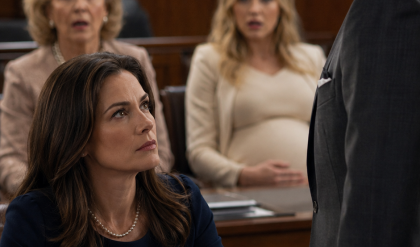
Two hours later, I walked into family court in a black coat and no wedding ring. Harrison arrived behind me with his expensive attorney and wounded-husband face. He tried to look like the stable parent. I looked like a woman who had receipts.
The judge listened to the recording once. Harrison’s voice sounded smaller under fluorescent lights. Smaller, but uglier. When the judge asked if it was his voice, he said yes.
Then she asked if he had been standing in our son’s nursery. He said yes again. His attorney touched his arm, but it was too late. The room had already heard what kind of father whispers betrayal over a sleeping baby.
By the end of the hearing, Harrison was barred from touching my medical records. He could not remove Noah from the house. All messages between him, Sienna, and his attorney had to be preserved. Then the judge looked down at one last document on her desk.
It was a sealed lab envelope.
And the name printed across the top was Sienna Brooks.
I stared at the sealed envelope on the judge’s desk, but I did not reach for it. Harrison did. His hand moved before his attorney could stop him. That small movement told the whole room he was scared.
The judge did not open it yet. She only looked at Harrison and asked why a paternity issue had been discussed in my son’s nursery. He said it was taken out of context. I watched Sienna swallow like the context had just wrapped a hand around her throat.
My attorney, Margaret Vale, stood beside me with her silver hair and cold patience. “Your Honor,” she said, “the recording references a test, custody, and a planned mental health claim against my client.” Her voice stayed flat. That made it worse for him.
Harrison tried to look offended. It did not work. His mother Beatrice sat behind him in navy Chanel, gripping her purse so tightly her knuckles turned white. For the first time, she was not looking at me like I was the problem.
The judge ordered all communications preserved. Every text. Every email. Every message between Harrison, Sienna, and his lawyer about custody, medical claims, paternity, and money. Sienna looked down at the floor like she had just realized rich men can still be subpoenaed.
Outside the courtroom, Harrison caught up to me in the hallway. His face was calm again, but his eyes were not. “You have no idea what you’re doing,” he said. I looked at him and said, “I know exactly what I heard.”
He stepped closer. Margaret moved between us. I did not step back. Harrison lowered his voice and said, “You don’t know what Sienna has.”
That was the wrong thing to say. Because I knew what Sienna wanted. I knew she wanted my house, my place, and access to a family trust she should never have known about.
Three days later, Margaret came to my kitchen with a cream envelope and two coffees. Noah was in his highchair, laughing and hitting a spoon against the marble. The house felt quiet, but not peaceful. It felt like the second before glass breaks.
Margaret opened the envelope with a letter opener shaped like a tiny sword. She read the page once. Then she read it again. I did not ask her to hurry.
Finally, she looked at me. “Harrison is Noah’s biological father,” she said. I breathed out because the truth still mattered, even when I already knew it. Then Margaret turned the second page.
“And Harrison,” she said, “is not the biological father of Sienna Brooks’s unborn child.”
I went still. The spoon fell from Noah’s hand and clattered against the marble. Margaret slid the page across the counter.
There, under biological father, was one name.
Daniel Pierce.
The Last Card
Daniel Pierce.
I said the name slowly in my mind, testing it. Daniel Pierce was Harrison’s business partner. His oldest friend. The man who had stood as best man at our wedding and kissed my cheek at every Christmas dinner for six years.
Margaret watched my face. I did not give her much to read.
“Does Harrison know?” I asked.
“Not yet,” she said. “But he will, the moment his attorney receives their copy.”
I looked at Noah, who had picked up his spoon again and was studying it with the absolute concentration only babies can give to ordinary things. He had his father’s chin. He had my eyes. He was untouched by all of it, and I intended to keep him that way.
The call came that same evening.
Not from Harrison. From Beatrice.
She did not ask how I was. She never had. But her voice was different this time — scraped clean of its usual marble finish. “I did not know,” she said. “About Daniel. About any of it.”
I believed her. Beatrice was many things, but she had always loved Harrison in the fierce, blind way mothers love their firstborn. This would have broken something in her that her pearls and Chanel suits could not hold together.
“I know,” I said.
A long pause. Then, quietly, “What do you need?”
It was the first honest question she had ever asked me.
“Nothing from you,” I said, but without cruelty. “Only from the court.”
The second hearing was smaller but louder in every way that mattered.
Harrison arrived without Sienna. That told me everything about how fast loyalty moves when consequences arrive. His attorney looked tired. Harrison looked like a man who had rehearsed a version of events that no longer existed.
The paternity results were entered into evidence. Margaret did not editorialise. She did not have to. The document spoke in the cold language of biology, and biology does not negotiate.
When the judge read out Daniel Pierce’s name, Harrison’s face did something I had never seen it do in ten years of marriage. It collapsed. Not with grief, but with the specific humiliation of a man who had planned to use betrayal as a weapon and found it pointed back at himself.
His attorney asked for a recess. The judge granted fifteen minutes.
In the hallway, Harrison stood alone near the window. I walked past him. He reached out, not to stop me, just — a gesture. Like a reflex. Like muscle memory from a life we used to share.
“Evelyn,” he said.
I stopped. I did not turn around immediately. I let the air between us say everything that words would only complicate.
Then I turned.
He looked older than he had at breakfast that morning, three weeks ago, when Sienna had worn my sweater and the world had still felt like it was ending. He did not look powerful. He looked like a man standing in the rubble of plans he had built on sand.
“I never wanted it to become this,” he said.
“No,” I said. “You wanted it to become something worse. You wanted me unsteady, discredited, and alone. This is just what happened when it did not go the way you planned.”
He had nothing to say to that, because it was true, and truth has a sound even liars recognise.
I turned and walked back toward Margaret.
The final order came on a Thursday.
Primary custody with me. Harrison with supervised visits until a further review in six months. No removal of Noah from the family home. The prenup, which Harrison had told me would protect him, also protected me — the clause he had clearly not read carefully enough concerned marital misconduct, and the recording had made that particular conversation quite straightforward.
The family trust he had whispered about to Sienna — the one she should never have known existed — was frozen pending a full financial disclosure.
Daniel Pierce resigned from Harrison’s company the following Monday. I heard he moved to another city. Sienna, I did not hear about at all, which I suspected was exactly how she now preferred it.
That evening I sat in the nursery after Noah was asleep.
It was quiet the way rooms are quiet after a storm passes and the air still smells of rain. I looked at the baby monitor on the shelf — small, white, entirely ordinary — and thought about how one decision, made out of sheer exhausted instinct at two in the morning, had changed the shape of everything.
I had not put it there to catch anyone. I had put it there because I was a mother who wanted to hear her son breathe.
That was the thing no one in that courtroom had thought to account for. Not Harrison, not Sienna, not the attorneys with their expensive suits and courthouse confidence. They had planned for a version of me that did not exist anymore — the woman who stayed quiet, who deferred, who valued their version of dignity over her own survival.
They had not planned for a woman who simply paid attention.
Noah shifted in his crib and made the small, complete sound of a child utterly at peace. I pulled the blanket up around his shoulders and turned off the lamp.
Outside, the city was doing what cities do — moving, forgetting, beginning again. And inside that quiet room, so was I.
Not every ending looks like winning. Some of them just look like morning — ordinary, undramatic, and entirely yours.