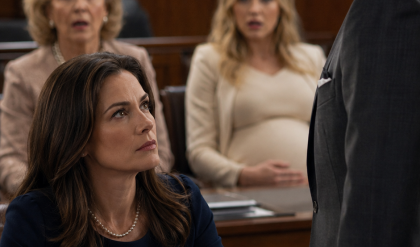
The check was already signed.
Sophia did not touch it.
Then the family learned who really held the keys.
Margaret Blackwood placed a check for one hundred twenty million dollars on the tea table and told me to leave before the twins were born.
No one breathed.
Not because of the money. In the Blackwood family, money had always been discussed with the same boredom other families reserved for weather. Trust distributions, acquisition bonuses, liquidity events, foundation grants, asset shelters. The words passed over porcelain cups and linen napkins as if they were small matters of housekeeping.
The silence came from how gently Margaret said it.
Soft. Polished. Almost sympathetic.
As if she were offering condolences at a funeral instead of buying a living wife out of her own marriage.
The check sat between us on the low glass table in the front sitting room of the townhouse I had restored with my own hands, my own taste, and eight years of misplaced devotion. It was printed neatly, signed already, made payable to Sophia Elise Blackwood. The ink had not even dried all the way. I could smell it beneath the lemon polish, the winter roses, and the faint sharpness of the tea Margaret had not touched.
Across from me, Margaret sat in a pale blue suit with pearls at her throat, silver hair pinned into an elegant twist, one hand resting delicately on her knee. She had the kind of face society photographers adored: composed, timeless, expensive. Tender enough for witnesses. Cold enough for truth.
Beside the fireplace stood Nathaniel.
My husband.
The billionaire heir to Blackwood Atlas Group.
The man who could walk into a hostile acquisition room and make grown men forget their prepared questions. The man who had once put his head in my lap after a board revolt and whispered, “You are the only place I can breathe.” The man who now could not look me in the eye.
Near the window, Clara Voss stood with both hands over her stomach.
She was twenty-six, blonde, fragile in the curated way powerful men found comforting, and visibly pregnant beneath a cream knit dress. The swell of her belly was not dramatic yet, but the room had arranged itself around it like a shrine. Her lashes trembled. Her mouth stayed parted in a performance of frightened innocence. Every few seconds, her fingers moved protectively over the place where Margaret Blackwood’s future heirs were supposedly growing.
Twins.
That was the word Nathaniel had used fifteen minutes earlier after asking me to sit down.
Clara is pregnant.
I had not moved.
With twins.
Margaret had clasped her hands as if receiving a blessing.
Now the check sat between us like a verdict.
“You have always been graceful,” Margaret said. “That is why I believe you will understand what must happen.”
I looked at the check without touching it.
“What must happen?”
Nathaniel shifted beside the fireplace. He wore a charcoal suit, his tie loosened, his handsome face drawn with what someone else might have mistaken for torment.
I had learned the difference between pain and inconvenience.
Margaret leaned forward. “The family needs stability. Clara’s pregnancy changes the future. Two children, Sophia. Two Blackwood heirs. They cannot be born into scandal.”
I looked at Clara.
Then I looked back at Margaret.
“Perhaps their father should have avoided creating one.”
Clara flinched as if I had struck her.
Nathaniel’s jaw tightened.
“Do not attack her.”
There it was.
Three words.
Clean. Instinctive. Revealing.
I smiled faintly. “I said one sentence.”
“She’s pregnant.”
“I heard.”
Margaret lifted one hand. “This is precisely why we are trying to handle matters privately. No public scenes. No lawsuits. No ugly headlines. You accept the settlement, file quietly, and allow Nathaniel to prepare a proper household for his children.”
His children.
Margaret’s expression did not change.
“Yes.”
I looked at my husband. “And you agree?”
Nathaniel finally met my eyes.
His were gray, the same color they had been the morning we got married, when he stood in a stone church full of old money and looked at me as if I were a door out of a room he hated. Back then, I thought loneliness could be cured by being chosen. I did not know men sometimes choose softness the way they choose houses: for comfort, not loyalty.
“I think this is the cleanest way,” he said.
Cleanest.
I repeated the word silently.
Clara looked down at her stomach. A tear slid over one cheek.
“I never wanted to hurt anyone,” she whispered.
I turned toward her. “Then why are you standing in my living room?”
Color rose in her face. Margaret’s voice sharpened beneath its silk.
“Sophia.”
The living room belonged to me as much as anyone, though the Blackwoods rarely remembered that. I had chosen the antique green rug, the linen curtains, the walnut shelves. I had restored the old townhouse after Margaret called it drafty and impractical. I had turned it into a home when Nathaniel still claimed he hated the coldness of his mother’s estate.
Now they had brought his pregnant secretary into that home to watch me be purchased out of it.
Nathaniel stepped closer. “Please, let’s not turn this into cruelty.”
I looked at him.
“You brought your secretary here carrying twins and let your mother offer me a check.”
He closed his eyes briefly. “I know this hurts.”
That almost made me laugh.
Hurt was a stubbed toe, a missed call, a friend forgetting your birthday.
This was architecture.
A betrayal designed with seating arrangements.
I picked up the check.
Margaret’s shoulders relaxed slightly. Clara’s eyes brightened with something she tried to hide. Nathaniel watched my hands, perhaps hoping money would do what affection no longer could.
I studied Margaret’s signature.
“One hundred twenty million,” I said.
“A generous settlement,” Margaret replied. “For eight years of marriage. For discretion. For silence.”
“For dignity,” Margaret corrected.
I looked up.
“Dignity cannot be bought from the person who still has it.”
The room changed.
Margaret’s face cooled. Nathaniel stiffened. Clara’s hand tightened over her stomach.
I placed the check back on the table, aligning it carefully with the glass edge.
“I will not sign anything tonight.”
Nathaniel exhaled. “Sophia—”
“And Clara should sit down,” I continued.
Clara blinked.
“If she is carrying twins, standing through a family negotiation seems unnecessary.”
Confusion crossed her face before shame did. She looked as if kindness had arrived from the wrong direction and she did not know where to put it.
Margaret recovered first. “We expected resistance. I understand pride.”
“No,” I said. “You understand purchase.”
Margaret stood. Her pearls caught the lamplight.
“Be careful. The Blackwood name can protect you, but it can also close every door you think you have.”
I rose too.
I was not as tall as Margaret. Not as theatrical. Not as obviously powerful. I wore a soft gray dress, my dark brown hair tied at the nape of my neck, my wedding rings still on my finger. To the people in that room, I looked like a wife being discarded.
That was their first mistake.
“Margaret,” I said, “you should speak to your lawyers before threatening me.”
Her eyes narrowed. “My lawyers prepared the check.”
“Then speak to better ones.”
Nathaniel stared at me for the first time that evening. Unease crossed his face.
Good.
I turned to Clara. “Congratulations on the twins. You should ask for independent medical care, independent counsel, and a written support agreement before this family starts calling your children assets.”
Clara’s mouth parted.
Nathaniel snapped, “Enough.”
I looked at him, calm as a closed file.
“No,” I said. “Enough was before you turned fatherhood into a merger announcement.”
They left twenty minutes later.
Margaret first, her heels clicking across my marble foyer as if the house had betrayed her by not echoing in her favor. Clara followed, one hand still on her stomach, the other clutching her small white handbag like a witness with nowhere to go. Nathaniel lingered at the door.
For a second, the man I married appeared beneath the heir.
“Sophia,” he said.
Not apology.
Not explanation.
Just my name.
I waited.
He looked past me into the house we had shared. The library where he used to fall asleep over annual reports. The staircase where he kissed me the night his father finally praised him. The dining room where I hosted men who later voted for him because I made him look steadier than he was.
“I didn’t want it to happen like this,” he said.
That was the kind of sentence cowards used when they wanted sympathy for the consequences of their own decisions.
“But you wanted it to happen.”
He flinched.
“Go,” I said.
He did.
I locked the door behind him and stood with my palm against the cool brass knob until the sound of their car faded into the rain. The townhouse settled around me. Not empty. Listening.
On the tea table, the check remained exactly where Margaret had placed it.
One hundred twenty million dollars.
Paper. Ink. A number large enough to impress strangers and small enough to insult me.
I took three photographs.
One close enough to catch the routing number. One wide enough to show the room. One with the time stamp visible on my phone.
Then I carried it to the library, put on gloves, slid it into a clear protective sleeve, and wrote across the label in black ink:
OFFER TO REMOVE LEGAL SPOUSE AFTER DISCLOSURE OF MISTRESS PREGNANCY.
Evidence came first.
Feelings could wait until they learned to behave.
I did not sleep that night.
I did not cry either, though I would have forgiven myself if I had. Instead, I sat in the library with the door locked, a cashmere blanket over my knees, ginger tea cooling beside my elbow, and every major Blackwood Atlas agreement from the last decade open across the long oak table.
The rain tapped the windows softly now, less accusation than witness. The house smelled of old paper, lemon oil, and the faint trace of Nathaniel’s cologne still caught in the leather chair he used to prefer. I hated that smell for surviving him.
At midnight, Nathaniel texted.
We need to talk when you are calmer.
I stared at the words until they lost meaning.
Calmer.
A word men used when a woman stopped being useful.
I did not answer.
At 1:16 a.m., Margaret’s personal assistant sent a message asking whether I wanted the Blackwood family office to coordinate “transition logistics.” I forwarded it to my archive account, took a screenshot, and printed a copy.
At 1:44 a.m., Clara’s name appeared in my old company directory search. Clara Voss. Executive assistant promoted three weeks ago to “strategic liaison.” Salary adjustment. Housing allowance. Medical concierge access. Discretion bonus.
Discretion bonus.
I printed that too.
At 2:03, I opened the Blackwood Family Trust Agreement.
The Blackwoods believed power belonged to blood. They said it at dinners, at board retreats, at weddings where old women in diamonds studied younger women like breeding prospects. Margaret had built her entire life around the idea that the line must continue through sons, heirs, portraits, controlled marriages, and women who understood when to become decorative.
That was why Clara’s twins mattered.
Not because they were children.
Because Margaret thought they were leverage.
I turned to the inheritance provisions.
Section 11.
Any child legally recognized by a Blackwood descendant could inherit. But voting control over Blackwood Atlas Group remained bound to the guardian steward provision until the youngest recognized heir reached twenty-five.
Guardian steward.
I sat very still.
The guardian steward was not automatically the biological parent.
It was the person named in the continuity instrument executed by the previous controlling chairman.
Nathaniel’s late father, Arthur Blackwood, had named me.
Not Nathaniel.
Not Margaret.
Me.
Sophia Elise Blackwood.
Arthur had done it four years earlier after the Dubai crisis, the one no one in the family mentioned because I had made sure it never became public. Nathaniel had signed an unauthorized side commitment tied to a logistics development fund in the UAE. Too much risk. Too little disclosure. A hidden guarantee that could have destabilized the European arm of Blackwood Atlas.
He called it bold.
I called it reckless.
Arthur called me into his study after I unwound it without headlines. He was dying by then, but not weak. Never weak. His body had betrayed him. His judgment had not.
“My son has ambition,” he told me, his voice thin but sharp. “You have judgment. Empires need the second more than the first.”
I had not told Nathaniel about the continuity instrument.
Arthur had advised against it.
“He will either be grateful or humiliated,” Arthur had said, “and I do not trust him to choose gratitude.”
I hated that sentence then.
Now it sat in the room like prophecy.
I opened the shareholder covenant from Blackwood Atlas’s private restructuring and found the second thing Margaret had forgotten.
Ellery Stone.
The financing partner who rescued Blackwood’s European logistics arm five years earlier.
External, according to the board minutes.
Quiet, according to the press.
Essential, according to Nathaniel when he toasted the deal and thanked “family loyalty.”
He never asked whose family.
The beneficial owner of Ellery Stone was my maternal trust.
Like many quiet women born into old money, I had learned young that the safest power was the kind people only noticed after insulting it. My mother taught me that with silver hair, navy dresses, and an accounting degree she never used publicly because men listened better when they thought the numbers were their own idea.
Ellery Stone held convertible debt, board observation rights, and a default trigger if Blackwood Atlas attempted related-party asset transfers, fraudulent settlement activity, or leadership actions that created reputational damage affecting major financing.
A public mistress pregnant with twins did not automatically trigger anything.
A mother-in-law offering one hundred twenty million dollars from a pledged liquidity reserve to force the legal spouse to disappear might.
I took out my phone and called Daniel Rook.
He answered on the third ring, voice rough with sleep.
“Sophia?”
“I need emergency review.”
“Is Nathaniel hurt?”
“No.”
“Are you?”
I looked at the sleeved check beside the trust agreement.
“Not in a way that requires a doctor.”
Daniel’s tone changed. “Tell me.”
So I did.
The check. Clara. The twins. Margaret’s threat. Nathaniel’s silence. The family liquidity language. The directory entry. The guardian steward clause. Ellery Stone.
When I finished, he was fully awake.
“Do not touch the check again,” he said.
“I used gloves.”
There was a pause.
“Of course you did. Photograph everything and send it to me. Preserve all messages. Do not meet Nathaniel alone. Do not speak to Margaret without counsel. Did anyone say where the funds originate?”
“Margaret called it family liquidity.”
“With Margaret, that usually means something she hopes no one audits.”
“I thought so.”
“I’ll pull filings and internal references. Do you want a marital filing prepared?”
I looked toward the dark hallway beyond the library door.
Eight years of marriage lived in that house. Nathaniel laughing barefoot in the kitchen. Nathaniel falling asleep with his head in my lap after hostile board meetings. Nathaniel whispering that I was the only person who saw him without the Blackwood armor.
Memory tried to open a door.
Truth locked it.
“Yes,” I said. “But not filed yet. Strategy first. They tried private humiliation. I want to know what public story they are preparing.”
“That sounds like Margaret.”
“Also verify Arthur’s guardian steward provision.”
Another pause.
“You think they forgot?”
“I think they never knew.”
“Nathaniel didn’t read it?”
“Nathaniel reads summaries written by people who already flatter him.”
Daniel gave one quiet exhale. Professional interest had entered the room.
“If Clara’s twins are recognized and the company faces continuity risk, your authority may increase, not decrease.”
“Exactly.”
“That means Margaret just paid you to leave a room you may legally control.”
I looked again at the check.
For the first time all night, I smiled.
“Yes,” I said. “That is what makes it rude.”
By morning, Nathaniel was convincing himself I would take the money.
I knew that because Nathaniel always expected the convenient truth to arrive if he waited long enough. He had mistaken my steadiness for surrender for years. I could be hurt and still organize dinner. Angry and still proofread a board memo. Exhausted and still pass him a note across a conference table that saved him from his own impatience.
He had mistaken reliability for permanence.
At 9:12 a.m., Daniel’s office sent preservation notices to Blackwood corporate counsel, family counsel, the trust administrators, the family office, and Margaret’s private attorney. They covered communications regarding the check, funding sources, Clara Voss’s pregnancy, proposed divorce terms, settlement pressure, surveillance, removal from residence, governance interests, and any public narrative prepared before or after the meeting at my townhouse.
At 9:26, Nathaniel called.
I did not answer.
At 9:31, he called again.
At 9:34, Daniel answered on my behalf.
I heard the recording later.
“Where is my wife?” Nathaniel demanded.
“Safe,” Daniel said.
“She is not your wife to manage.”
“She is my client to protect.”
“I need to speak to her.”
“You may send a written request through counsel.”
“This is insane.”
“No,” Daniel replied. “Insane was presenting a pregnant employee and a nine-figure check to your legal spouse in her own home and expecting gratitude for discretion.”
Nathaniel went silent.
Daniel continued, “Your next call should be to your attorney.”
At 10:07, Margaret called me from a private number.
I let it ring.
At 10:08, Rebecca Blackwood, Nathaniel’s younger sister, texted.
Are you seriously making this ugly?
I replied with one sentence.
Ugly began before documentation.
Then I took a screenshot.
At noon, the society item appeared.
Blackwood Family Prepares for New Generation Amid Quiet Marital Transition.
Elegant poison.
The article described Nathaniel and me as having “lived increasingly separate lives for years.” It called Clara Voss a “trusted executive aide and close family companion.” It hinted at joyful news expected soon. It praised Margaret’s discretion and mentioned that I, known for my reserved public style, would be treated with extraordinary generosity.
It did not mention twins.
It did not mention the check.
It did not mention Clara standing in my living room while my mother-in-law tried to buy my silence.
By one o’clock, my legal team had drafted a response.
By two, I changed one sentence.
By three, it went out.
Mrs. Sophia Blackwood has not authorized any public characterization of her marriage, residence, medical status, or legal position. Reports suggesting a negotiated departure are false. Mrs. Blackwood has preserved all rights related to marriage, property, trust, governance, and corporate matters. Any attempt to pressure witnesses, beneficiaries, employees, or expectant parents connected to the Blackwood family will be addressed through counsel. Privacy is requested for all unborn children implicated by recent events.
The last sentence changed the story.
All unborn children.
By four, gossip sites were hunting.
By five, Blackwood Atlas shares had slid two percent.
By six, the board requested an emergency governance briefing.
At 6:42, Nathaniel received a security report that proved his family had learned nothing.
I did not know about the report until Daniel forwarded me the legal notice after the fact. Margaret had hired a private security contractor to track my movements. They followed me to a maternal medicine clinic and noted the appointment classification with the dull efficiency of men who think a woman’s body becomes discoverable when enough money is behind the question.
Possible pregnancy-related consultation.
My own pregnancy had been eight weeks along.
A secret so early it still felt more like a held breath than a child.
I had planned to tell Nathaniel privately that weekend, before Clara’s pregnancy was turned into a shrine and my marriage into a disposal problem. That plan belonged to a different life.
Nathaniel called again after the report.
Daniel answered again.
“Is she pregnant?” Nathaniel asked.
“I suggest you put all communications in writing through counsel.”
“Daniel, do not play games with me.”
“You lost the privilege of informal access when your mother hired surveillance.”
“I did not authorize that.”
“Then your family has a governance problem and a privacy problem.”
“Is she pregnant?”
“Ask your attorney what discovery entitles you to and what decency does not.”
Daniel ended the call.
When he told me, I sat in the library with my hand resting against my lower stomach and listened to rain slide down the old windows. The sonogram image lay inside a folder on the desk. Too small to look like anything to a stranger. Large enough to rearrange every breath in my body.
“Are you all right?” Daniel asked.
“No.”
“Do you need a doctor?”
“No.”
“Do you want to release the pregnancy?”
I looked at the check. Then the trust agreement. Then Arthur’s note in the margin of the old board file.
My son has ambition. You have judgment.
“Not yet,” I said. “They used Clara’s pregnancy as leverage before anyone protected Clara. I will not use mine the same way unless the record requires it.”
Daniel was quiet for a moment.
Then he said, “That is very you.”
“I’m not sure that’s a compliment.”
“It is expensive, but it’s a compliment.”
Clara called me three days later.
Not directly. She called from the private medical clinic lobby and asked the receptionist if Mrs. Blackwood had arrived for her appointment. The receptionist, properly trained and poorly prepared for the drama of wealthy women, told my security contact, who told Daniel, who asked whether I wanted to avoid her.
I did not.
The clinic lobby smelled like lavender disinfectant and expensive fear. Soft music played through hidden speakers. Frosted glass separated the reception desk from the waiting area. Clara sat near the window in a camel coat too large for her shoulders, staring at a consent form with both hands trembling.
When she saw me, her face went white.
“Mrs. Blackwood.”
I paused. “Clara.”
She stood too quickly, winced, and pressed one hand to her stomach.
My instinct moved before my anger did.
“Sit.”
She obeyed, embarrassed.
I sat two chairs away, leaving space between us. For a minute, neither of us spoke. Outside, taxis moved through cold rain. Inside, a nurse called another patient’s name in a voice soft enough to be unreal.
“I didn’t know you’d be here,” Clara said. “I can reschedule.”
“You’re pregnant with twins. Keep your appointment.”
She blinked rapidly. “You’re very calm.”
“People keep saying that like an accusation.”
“I mean…” She swallowed. “If I were you, I would hate me.”
I looked at her.
“Do you want me to?”
The question unsettled her more than anger would have. She looked down at the consent form.
“I don’t know what I want.”
It was the first honest thing I had heard from her.
The lobby settled again.
Then Clara whispered, “Margaret wants me to sign something.”
My attention sharpened. “What?”
“A prenatal family protection agreement. That’s what she called it. She said it guarantees support, housing, medical care, trust funds after birth.”
Her fingers tightened around the papers.
“But it also says the children will be raised under Blackwood family supervision if I’m considered unstable.”
I closed my eyes for one brief second.
There it was.
Margaret had moved from buying out the wife to containing the mistress.
“Did you bring it?”
Clara hesitated.
“Clara,” I said, “I am not your friend. But I am not Margaret. If you sign something you do not understand, you will regret it.”
The younger woman reached into her bag and pulled out a folded packet.
I accepted it and read the first page.
Then the second.
Then the fourth.
My jaw tightened.
The agreement was worse than expected. It offered generous financial support, but the conditions allowed the Blackwood Family Trust to seek custodial control if Clara violated moral conduct provisions, discussed family matters publicly, entered relationships deemed harmful to the children, failed to follow approved medical protocols, or ignored “family security recommendations.”
In plain language, Margaret intended to own the babies and manage Clara as a visitor.
I handed it back.
“Do not sign this.”
Her eyes filled. “Nathaniel said it was standard.”
“Nathaniel says standard when he has not read.”
“He would not take my children.”
I looked at her.
“He let his mother offer me money to disappear while you stood in my living room.”
Her face crumpled.
Cruel words are not always false. Sometimes truth does the cutting.
“I loved him,” she whispered.
I looked away.
There were many things I could have said. That love does not justify harm. That wanting to be chosen does not erase another woman. That Clara had enjoyed the replacement fantasy until the contract turned toward her.
Instead, I said, “Get your own attorney.”
“I can’t afford the kind of lawyer they have.”
“There are attorneys who handle high-conflict family and trust matters. I’ll give you three names. They do not work for me.”
She stared. “Why would you help me?”
“I am not helping you win. I am helping prevent two children from becoming collateral.”
Clara touched her stomach with both hands. “You believe they’re Nathaniel’s?”
“Are they?”
Tears slipped down her face. “Yes.”
“Then paternity will confirm it.”
She flinched at the practicality. “I’m not lying.”
“Then verification protects you.”
The nurse appeared at the doorway. “Ms. Voss?”
Clara stood slowly. Before following the nurse, she looked back.
“Mrs. Blackwood?”
“Yes.”
“Margaret said you were barren.”
I did not move.
Clara’s face twisted with shame. “I’m sorry. I believed her.”
For a moment, the lobby became too bright.
Inside the folder in my lap were my own test results, appointment notes, and a sonogram image so early it still looked more like a secret than a child.
I looked at Clara, at the young woman carrying twins and learning too late that being chosen by powerful people often meant being trapped by them.
“Margaret says many things,” I replied.
Clara’s eyes lowered to my folder.
Understanding flickered.
I did not confirm it.
Some truths deserve protection until they are strong enough to stand in daylight.
The emergency board meeting took place two days later by video. I attended from Daniel Rook’s office, wearing a dark green blazer and no jewelry except my wedding ring. My hair was pulled back. My face looked calm on the screen. That was useful. People often mistake calm for emptiness. It makes them careless.
Twelve directors appeared in their little boxes. Nathaniel sat in the Blackwood Atlas boardroom beside corporate counsel. Margaret sat slightly behind him, which was theatrical and unconstitutional in about six ways. Helena Cross, the board chair, opened the meeting with the expression of a woman who had smelled smoke and did not intend to be told it was candlelight.
“We are not here to litigate a marriage,” Helena said. “We are here because potential trust, succession, and financing issues may affect Blackwood Atlas.”
I nodded. “Agreed.”
Margaret spoke before anyone else could. “Then Mrs. Blackwood’s personal filings are irrelevant.”
Daniel leaned into frame. “They are relevant if family actions intersect with corporate liquidity, trust control, or coercive settlement funded by company-adjacent reserves.”
Corporate counsel shifted uncomfortably.
Helena looked at Margaret. “Was the proposed one hundred twenty million dollar payment sourced from personal funds?”
Margaret’s chin lifted. “Family funds.”
“That is not an answer.”
“The Blackwood family office maintains liquidity.”
I spoke calmly. “The check was drawn from a Blackwood Legacy account pledged in part to support executive continuity obligations.”
The room went still.
Nathaniel looked at his mother.
Margaret did not look back.
Helena turned to corporate counsel. “Is that accurate?”
Counsel hesitated. “Preliminarily, the account is connected to family office assets, but it has cross-collateral relevance under certain agreements.”
One director muttered, “Jesus.”
Margaret’s face hardened. “This is being exaggerated.”
“I have no interest in exaggeration,” I said. “The check exists. The meeting occurred. Clara Voss was present. The proposed payment was offered in exchange for my quiet departure after Ms. Voss’s pregnancy with twins was disclosed.”
The word twins entered the boardroom like an alarm.
Helena removed her glasses. “Ms. Voss is pregnant with twins?”
Nathaniel answered, voice low. “Yes.”
Another director asked, “And paternity?”
Nathaniel’s jaw tightened. “I am the father.”
I did not react.
My stillness made the directors look at me more carefully.
Helena said, “Mrs. Blackwood, your public statement referenced unborn children plural beyond Ms. Voss. Are you making a medical disclosure?”
Daniel began, “My client is not required—”
I lifted one hand slightly.
Daniel stopped.
I looked directly at Nathaniel through the screen.
“I am pregnant.”
No one spoke.
Nathaniel closed his eyes.
Margaret’s hand froze around her pen.
I continued. “I had intended to disclose it privately before my husband’s affair, Ms. Voss’s pregnancy, and the proposed buyout were presented to me as a completed family decision.”
Helena’s expression turned severe. “This creates significant continuity concerns.”
Margaret snapped, “Or convenient timing.”
Nathaniel’s head turned. “Mother.”
My face remained composed, but something in me cooled so sharply that even Helena noticed.
Daniel leaned forward. “Mrs. Blackwood has medical documentation and will comply with lawful, appropriate procedures. Any insinuation made for intimidation will be added to our record.”
Margaret sat back, lips pressed thin.
I said, “Let us be clear. I do not intend to use any child as leverage. I am here because others already did.”
The board secretary stopped typing for half a second, then resumed.
Helena nodded slowly. “Then we will commission independent review of the relevant trust provisions, financing triggers, and family office account usage. Until complete, no settlement payment, succession arrangement, or governance modification involving minor heirs will proceed without board notice.”
Margaret’s voice was ice. “The board has no authority over family reproduction.”
“No,” Helena replied. “But it has authority over corporate instability caused by family misconduct.”
For the first time since I had known Margaret Blackwood, she had no immediate answer.
After the meeting, Nathaniel came to the townhouse.
Not inside.
I had changed the locks that morning.
He stood under the portico in the rain, dark coat soaked at the shoulders, looking up at the security camera I had installed above the door. The hallway smelled faintly of fresh metal from the new deadbolt. My hand rested on my stomach as I watched him through the monitor in the library.
He called.
I let it go to voicemail.
He texted.
Please. Five minutes. I need to know you’re safe.
Daniel looked at me across the table. “No.”
“I know.”
But I listened to the voicemail once.
“Sophia,” Nathaniel said, and the way he said my name nearly opened a door I had already locked. “I didn’t know about the surveillance. I didn’t know about the trust. I didn’t know about Clara’s agreement. I didn’t know you were pregnant.”
The silence after that was not empty.
It was an indictment.
“I know that sounds like a defense,” he continued. “It isn’t. It’s worse. I didn’t know because I let other people handle the parts of my life that required courage.”
I closed my eyes.
“Please tell me if you and the baby are medically safe. Through Daniel if you want. Through anyone. I don’t deserve access. I know. But I need to know.”
The message ended.
I opened my eyes.
Daniel watched me carefully.
“Do you want to respond?”
“Yes.”
He picked up his pen.
I dictated.
All future communication regarding me or the pregnancy must go through counsel. Do not contact my doctors. Do not send security. Do not come to the house without written notice. I am changing the locks permanently. Medical updates will be provided when appropriate under legal structure.
Daniel read it back.
I added one more sentence.
“Access is not love.”
Daniel looked at me.
Then he wrote it down.
Clara moved out of the company apartment two days later with her own lawyer and a private security service Nathaniel did not control. She texted me from a temporary number.
I took your advice. Thank you. I hate that I needed it.
I looked at the message for a long time.
Then I replied.
Needing counsel is not failure. Signing blind would have been.
Her answer came after several minutes.
Did you know?
I knew what she was asking.
About your pregnancy?
Yes.
No. Not when you stood in my living room.
I expected her to apologize again.
Instead, she wrote:
Then Margaret tried to erase both of us in different ways.
That was the first time I believed Clara might survive the Blackwoods.
Margaret’s counterattack began at a luncheon.
It was always going to begin at a luncheon.
She invited twelve women to the Blackwood estate: trustees, directors’ wives, two museum patrons, a retired judge, and a columnist who pretended she was only there for charity planning. The table was set with ivory china and winter flowers. Clara was absent. I was not invited. That absence was the point.
Margaret waited until dessert to sigh.
“I only hope the children are protected,” she said.
The retired judge glanced at her. “Children?”
Margaret’s mouth tightened delicately. “I should not speak.”
The columnist leaned in. “Margaret, you know discretion is safe here.”
It was not.
Everyone knew that.
Margaret counted on it.
“There are pregnancies involved,” Margaret said softly. “Real lives. Fragile futures. Unfortunately, certain adults see unborn children as instruments of control.”
One trustee’s wife murmured, “How awful.”
Margaret lowered her eyes. “I blame myself. I welcomed Sophia into the family despite concerns. She is intelligent, of course. Very intelligent. But warmth cannot be taught.”
By evening, the phrase had traveled.
Warmth cannot be taught.
By morning, it appeared in a blind item about a cold society wife using legal maneuvers against an expectant mother of twins.
By noon, Elise Monroe, my communication strategist, had the source chain.
“She’s predictable,” Elise said.
I read the blind item without expression.
Daniel said, “We can ignore it.”
“No,” I said. “Not this one.”
He looked at me.
“She is using Clara and the twins as sympathy while trying to control them privately. Release the prenatal agreement.”
Elise sat straighter. “Redacted?”
“Names protected where necessary. Leave the custody control language visible.”
Daniel nodded slowly. “That shifts the narrative.”
“It tells the truth.”
Within four hours, the public story changed again.
The cold wife became the woman who warned the pregnant secretary not to sign away custody rights.
The benevolent mother-in-law became the matriarch whose agreement allowed family supervision over Clara’s children if she failed moral conduct standards.
Clara’s attorney released one sentence.
Ms. Voss is represented independently and will make decisions regarding her pregnancy and children free from coercion by any family member, employer, or spouse.
The word spouse was not accidental.
Nathaniel saw the statement during a board preparation meeting and went pale.
Margaret saw it at the estate and threw a porcelain cup against the fireplace.
Rebecca called it betrayal.
I called it Tuesday.
That evening, Margaret came to the townhouse.
Without notice.
Which meant she was stopped at the new security desk I had installed in the vestibule.
The guard called upstairs. I looked at the camera feed and saw Margaret standing in a sable coat, face carved from fury. Daniel advised against allowing her in.
I considered.
Then I said, “Let her into the front sitting room. Record everything.”
Margaret entered like a queen forced to use a public entrance.
I waited near the fireplace in a black dress, one hand at my side, the other holding a cup of tea. I did not offer her one.
“You released a private family document,” she said.
“You circulated a public lie.”
“That agreement was meant to protect the twins from instability.”
I set down my cup. “You define instability as any woman you cannot command.”
Margaret stepped closer. “Do not pretend you care about Clara.”
“I care that two children are not born into a contract cage.”
“You care about control.”
“Yes,” I said.
She blinked.
I continued. “Control over my body, my home, my legal rights, my child’s future, and the company Arthur asked me to protect. I care very much about control when the alternative is letting you purchase obedience and call it family.”
Margaret’s face flushed. “Arthur made a mistake naming you.”
“Perhaps. But he made it legally.”
“You think a document makes you a Blackwood?”
I looked around the sitting room at the house I had restored while Margaret criticized the curtains. At the marriage I had protected while Nathaniel drifted toward admiration elsewhere. At the family that wanted me gone until my hidden authority became inconvenient.
“No,” I said. “Your family taught me that being a Blackwood is often nothing to aspire to.”
Margaret lifted her hand.
For one sharp second, I thought she might strike me.
The guard stepped forward from the doorway.
Margaret lowered her hand.
My voice stayed calm. “Do not come here uninvited again.”
Her eyes shone with rage. “This is not over.”
“I know.”
“You will lose something.”
I looked at her.
“Margaret, I already did. That is why you are finding me expensive.”
The formal board hearing took place the following Monday in a room with no flowers.
That detail pleased me.
Blackwood Atlas’s directors gathered around a long glass table beneath recessed lights. No portraits. No family silver. No inherited mythology. Just documents, microphones, and men and women who understood that liability did not care about bloodlines.
I attended in person.
Nathaniel stood when I entered. He looked thinner than he had two weeks earlier, his suit immaculate, his face drawn. For a brief moment, his eyes moved to my stomach. I saw pain there. Longing. Shame.
I did not let any of it decide my next step.
Margaret sat beside family counsel, rigid with contained fury. Clara appeared by video with her attorney, Priya Sen, beside her. She looked nervous but steadier than before.
Helena Cross opened the proceedings.
“We will address four issues: the proposed payment to Mrs. Blackwood, the prenatal agreement offered to Ms. Voss, the guardian steward provision, and the financing exposure related to Ellery Stone.”
Margaret’s attorney began with polished indignation. He described the one hundred twenty million dollar check as a private family settlement. He described Margaret’s actions as protective. He described my legal response as aggressive, premature, and personally motivated.
Daniel Rook responded with dates.
Dates were less dramatic than indignation and far more lethal.
Date of Clara’s pregnancy disclosure to me.
Date and location of the check presentation.
Date Margaret’s office contacted the columnist.
Date surveillance was ordered.
Date the prenatal agreement was delivered to Clara.
Date the board was informed.
The timeline made Margaret’s benevolence look like choreography.
Then Julia Hart, the forensic accountant, presented the funding analysis.
“The check was drawn from Blackwood Legacy liquidity,” Julia said. “While technically family-office controlled, the account is cross-collateralized in internal stability representations. A private settlement of this scale connected to succession and marital removal should have been disclosed before execution.”
One director asked, “Was the check cashable?”
“Yes.”
“So if Mrs. Blackwood had accepted, the account would have lost one hundred twenty million dollars?”
“Correct.”
“Potentially affecting corporate representations?”
“Yes.”
The director looked at Margaret. “Without board notice?”
Margaret’s lips thinned. “It was a family matter.”
Helena said, “It became corporate when you used a pledged liquidity source.”
Next came Clara.
Priya guided her through the prenatal agreement. Clara confirmed Margaret had urged her to sign quickly. She confirmed Nathaniel had described it as standard. She confirmed no independent counsel had been provided before I warned her.
Nathaniel closed his eyes when she said that.
Margaret stared straight ahead.
Then Helena turned to the guardian steward provision.
Mason Vale, the trust litigator, presented Arthur’s instrument, execution history, and legal effect. The directors read in silence.
Finally, Helena asked the question Margaret had dreaded.
“Mrs. Margaret Blackwood, did you know your late husband named Sophia Blackwood as guardian steward?”
Margaret’s face was stone. “No.”
“Mr. Blackwood?” Helena asked Nathaniel.
He swallowed. “No.”
“Mrs. Blackwood,” Helena said to me. “Did you know?”
I met her gaze. “Yes.”
Margaret’s attorney pounced. “And you concealed it.”
I turned to him. “Arthur instructed me not to disclose it unless the triggering conditions became relevant. They became relevant when minor heirs were used as leverage in a governance dispute.”
“Convenient.”
“Legal.”
The attorney flushed.
Nathaniel looked at me. His voice was rough. “Why did my father choose you?”
The question was not on the agenda.
No one stopped it.
I looked at him for a long moment.
“Because after Dubai, he understood that ambition without restraint could endanger the company.”
The room tightened.
Nathaniel went pale.
Margaret whispered, “Sophia.”
But the door had opened.
Helena’s eyes sharpened. “Dubai?”
Daniel placed a sealed file on the table.
“We hoped not to introduce this unless necessary. However, challenges to Arthur’s reasoning make it relevant.”
Nathaniel looked down.
The Dubai file did not need much explanation. An unauthorized side commitment. A hidden guarantee. A potential loss large enough to destabilize a division. My negotiated unwind. Arthur’s subsequent decision to create the guardian steward provision.
When Helena finished reading, her expression had changed.
Not toward me.
Toward Nathaniel.
Margaret’s face looked carved from ash.
The board called a private executive session.
I waited in a side room with Daniel. Through the glass, I could see Nathaniel standing alone near the windows. Margaret did not go to him. Clara’s video feed had ended. Rebecca was not there. For once, Nathaniel had no woman beside him to absorb the consequence.
Daniel said quietly, “Are you all right?”
I looked at my husband.
“No,” I said. “But I am clear.”
The board’s decision arrived at 6:40.
Nathaniel Blackwood would remain interim chief executive for thirty days under restricted authority while a leadership committee reviewed successor options. He lost unilateral control over succession planning, family-office coordination, and major financing representations.
Margaret was removed from any advisory role connected to trust matters, minor heirs, or family-office liquidity tied to corporate stability.
I was confirmed as guardian steward under Arthur’s instrument, pending any court challenge.
Ellery Stone received enhanced observation rights.
Clara’s prenatal agreement was formally disavowed as unauthorized by the company and inappropriate for any corporate-affiliated trust structure.
The decision did not destroy Nathaniel.
It did something worse for a man raised to inherit command.
It supervised him.
When the meeting ended, I walked toward the elevator with Daniel.
Nathaniel followed. “Sophia.”
Daniel stopped.
I said, “It’s fine.”
Daniel stepped aside but remained close enough to be useful.
Nathaniel stood before me, shoulders tense, eyes red around the edges.
“I did not know about the surveillance until after.”
“You still received the report.”
“I know.”
“And opened it.”
He flinched. “Yes.”
The elevator numbers moved slowly above the doors.
Nathaniel lowered his voice. “Are you well? Medically?”
“Yes.”
“And otherwise?”
I looked at him. “You are not entitled to otherwise.”
Pain crossed his face. “I deserve that.”
“Yes.”
He took a breath. “I spoke to Clara. She left the apartment.”
“Good.”
“I am arranging independent support through counsel.”
“Yes. Good.”
He looked down, almost smiling bitterly. “I used to hate when you spoke like that.”
“Like what?”
“Like a verdict.”
I said nothing.
He looked back up. “Now I think I hated it because you were usually right.”
The elevator arrived.
I did not enter.
Nathaniel continued, urgency rising. “I love you.”
There it was.
This time not through Daniel. Not written on a card. Spoken in a hallway after a board reduced his power and exposed his shame.
I felt the words.
I hated that I felt them.
“You loved being safe with me,” I said. “You loved being understood by me. You loved the version of yourself I helped you maintain. But love that needs another woman’s humiliation to feel alive is not love I can live inside.”
His eyes filled. “I was afraid.”
“Of what?”
“That you saw me too clearly.”
The answer was honest enough to hurt.
My voice softened, but only slightly. “I did. Clara did not.”
“No,” he said. “She saw what I showed her.”
He nodded slowly, as if accepting a sentence.
“Can I come to the next appointment?” he asked.
My hand moved to my stomach.
For a moment, I saw the future as it might have been. Nathaniel beside me, nervous and awed. Margaret pretending restraint. A family repaired before breaking. Children born into complicated love, but love nonetheless.
Then I saw Clara in my living room.
The check.
Margaret’s voice.
Nathaniel saying, This is the cleanest way.
“No,” I said.
He closed his eyes.
“Not yet,” I added.
His eyes opened.
I did not offer more.
Not yet was not forgiveness. It was a boundary with a door somewhere beyond it, locked from my side.
I stepped into the elevator with Daniel.
As the doors closed, Nathaniel remained in the hallway, looking for the first time like a man who understood that access was not a right.
Margaret filed the trust challenge three weeks later.
No one was surprised.
She contested Arthur’s guardian steward provision on grounds of undue influence, lack of full family disclosure, and conflict created by my marital dispute. The petition was elegant, aggressive, and personally insulting in the way expensive lawyers learn from clients who want blood but still need plausible deniability.
My response was shorter.
Arthur was competent. The provision was valid. Margaret’s challenge was retaliatory. Discovery should include the Dubai file, family-office communications, the one hundred twenty million dollar check, surveillance orders, and the prenatal agreement.
Margaret withdrew two claims within forty-eight hours.
She did not withdraw all.
The court hearing took place in a private trust courtroom without cameras. Margaret arrived in black. I arrived in ivory. Nathaniel arrived alone. Clara did not attend, but submitted an affidavit confirming Margaret’s pressure.
That affidavit mattered.
Not because Clara had become noble overnight, but because truth often enters the record through frightened people who finally understand silence will not save them.
The judge, a gray-haired woman named Allison Reed, read everything with the expression of someone who had seen too many wealthy families mistake trusts for weapons.
Margaret’s attorney argued first. He described Arthur as vulnerable after illness, me as influential, and the provision as inconsistent with Blackwood family tradition.
Judge Reed interrupted. “Counsel, tradition is not law.”
The attorney recovered poorly.
Daniel argued next. He presented Arthur’s medical clearances, independent counsel notes, correspondence showing Arthur’s concern over governance restraint, and my documented role in resolving Dubai.
He did not dramatize.
He did not need to.
Then Judge Reed asked me to speak.
I stood.
Nathaniel looked at me from across the aisle. Margaret did not.
The judge said, “Mrs. Blackwood, did you ask Arthur Blackwood to name you guardian steward?”
“No.”
“Did you conceal the provision for personal advantage?”
“I followed Arthur’s instruction that it remain inactive unless triggering conditions arose.”
“Do you seek to control the unborn Blackwood children?”
My expression changed for the first time.
“No, Your Honor. I seek to ensure no adult uses them to control each other.”
The judge watched me carefully. “Including your own child?”
“Especially my own child.”
Margaret shifted.
I continued, voice steady. “I have been called cold, calculating, barren, manipulative, and ungrateful. But the record shows that when Clara Voss was asked to sign away rights, I told her to get counsel. When my mother-in-law offered me money to disappear, I preserved the check instead of cashing it. When the board asked about my pregnancy, I disclosed only what was necessary to prevent further lies. I am not asking this court to reward me for being hurt. I am asking it to enforce a document Arthur Blackwood created because he feared exactly this kind of instability.”
The room was silent.
Judge Reed looked at Margaret. “Mrs. Margaret Blackwood, do you wish to address the court?”
Margaret rose slowly.
For once, she seemed older than her pearls.
“My husband should have trusted his family,” she said.
Judge Reed’s voice was neutral. “Perhaps he believed he was.”
The ruling did not come that day.
It arrived one week later.
Arthur’s guardian steward provision was upheld. Margaret’s challenge was denied in substantial part. Discovery into certain family-office actions would proceed separately.
I read the decision in my library with Daniel on the phone and ginger tea beside me. Outside, snow fell lightly over the townhouse steps. The room smelled of paper, firewood, and the bread my housekeeper insisted I keep eating because pregnancy had made my appetite strange and tyrannical.
I placed one hand over my stomach.
“We are safe,” I whispered.
For the first time in weeks, I cried.
Not loudly. Not dramatically.
Just enough to let my body admit it had been carrying more than one life.
Clara gave birth first.
Two boys, six weeks early, small and furious, with strong lungs and Nathaniel’s gray eyes. Their names were Oliver and Theo Voss, not Blackwood.
The choice caused a private earthquake.
Margaret called it an insult.
Rebecca called it manipulation.
Nathaniel, to his credit, did not call it anything in public. He signed the support agreement, accepted paternity, and attended the neonatal unit under Clara’s rules.
I sent flowers.
Not roses.
White tulips.
The card said, Wishing strength and health to you and the boys. Sophia.
Clara texted me a photo of two tiny hands curled near each other.
Thank you. They are perfect.
I looked at the photo for a long time.
I did not feel jealousy.
I felt sorrow that adults had nearly turned those hands into legal instruments before they could hold anything.
Nathaniel visited me one week later with written notice, as required. I received him in the front sitting room. He looked exhausted in a way status could not hide. The twins’ early birth had shaken him. The board restrictions had humbled him. Margaret’s defeat had isolated him. For the first time since I had known him, Nathaniel seemed unsure who he was without someone’s admiration or obedience.
“They’re very small,” he said.
I sat across from him in a soft brown dress. My pregnancy was unmistakable now. “Premature twins often are.”
“Clara is doing well.”
“Good.”
He rubbed his hands together. “She named them Voss.”
“I heard.”
“My mother is furious.”
“Your mother survived the fall of several governments at dinner parties. She will survive surnames.”
A faint smile crossed his face, then disappeared. “I deserve that.”
“It was not an attack.”
“With you, the accurate sentences hurt more.”
I looked down at my tea.
Nathaniel leaned forward. “I am stepping back from day-to-day leadership.”
I looked up.
“The board recommended a professional CEO during review,” he said. “I agreed.”
I studied him. “Why?”
“Because if I fought it, I would be proving everyone right.”
“That has not always stopped you.”
“No.” He looked toward the window. “But I saw Oliver in the incubator. Theo too. They were so small. They were not heirs, Sophia. They were just babies. And I realized my mother was already asking about trust structures while Clara was still bleeding.”
I closed my eyes briefly.
“I am sorry,” he said.
I opened them.
He continued. “For bringing Clara into your home. For letting my mother speak to you that way. For not reading what affected women I claimed to love. For turning children into proof that I had not failed.”
The apology was better than the first one.
It was specific.
That made it more dangerous.
Specific remorse can tempt a wounded person to return to work before the wound closes.
I placed my cup down. “Thank you.”
Hope moved across his face.
I stopped it gently.
“That does not change the separation.”
He nodded, but pain tightened his mouth. “I know.”
“Does Clara have adequate support?”
“Yes. Independent. Court-filed.”
“Good.”
“May I ask about…” His eyes moved to my stomach. “May I know the baby?”
I rested one hand over the curve beneath my dress.
“Eventually,” I said.
His breath caught.
“Under legal structure,” I added. “With consistency. No interference from your mother. No public statements. No using one child to bargain for another.”
“I agree.”
“You agree now. We will put it in writing.”
He gave a sad smile. “Of course.”
They sat in silence.
Not comfortable.
Not hostile.
Something between ending and beginning.
Before he left, Nathaniel paused at the doorway. “Do you know the sex?”
I looked at him for a long moment.
“A girl,” I said.
His face changed completely.
Not triumph.
Not relief.
Wonder, raw and frightened.
“A girl,” he repeated.
“Yes.”
His eyes brightened. “She will be like you.”
My voice softened. “I hope she is like herself.”
My daughter was born in late spring during a thunderstorm.
Labor was long and difficult. My mother, Maryanne, flew in from Boston and held my hand through twelve hours of pain, legal calls muted, all strategy suspended by the ancient work of bringing a child into air. Nathaniel waited outside the hospital suite because I allowed it and because the written agreement said he could.
When the baby cried, I cried too.
I named her Elise Arthur Blackwood.
Arthur for the man who trusted judgment over blood. Elise for myself because I had learned that a daughter could inherit not only names, but repaired courage.
Nathaniel met Elise the next morning.
He washed his hands twice, then sat in the chair beside the bed while the nurse placed the baby in his arms. His face crumpled at once.
“Hello,” he whispered. “Hello, little one.”
I watched carefully.
I did not soften entirely.
I did not forget.
But I allowed myself to see the truth in front of me: a flawed man holding his daughter like a question he was afraid to answer wrongly.
Elise opened one eye and made a tiny offended sound.
Nathaniel laughed through tears.
I looked away for a moment, not because I was unmoved, but because I had learned not every feeling needed to become a decision.
Recovery was quieter than victory.
People think public exposure fixes private damage. It does not. It only turns the lights on. You still have to clean the room.
The townhouse became mine again slowly. First the locks. Then the nursery. Then the library. I returned Margaret’s silver candlesticks and stored Nathaniel’s framed magazine covers in a cedar trunk. I kept some photographs from formal galas, not because I wanted them, but because history should not be edited only by pain.
I opened my own accounts. I restructured Ellery Stone. I reviewed every document related to Arthur’s trust twice, then once more while Elise slept in a bassinet beside my desk. I went to therapy on Thursday mornings and hated how useful it was. I learned that grief could exist beside competence, and that competence did not mean I owed the world a face without cracks.
Some nights I still missed Nathaniel.
That embarrassed me until my therapist said, “Missing is not returning.”
So I missed him sometimes.
And did not return.
The sale of Blackwood Atlas did not happen all at once. It began as a governance review, became a restructuring, then turned into a strategic split that separated healthy operating divisions from family-controlled vanity assets. I did not sell the empire in one dramatic signature. I did something more lasting.
I made it impossible for the family to use the company as a private kingdom.
The logistics arm entered a publicly accountable partnership. The real estate division received independent management. The family office lost informal access to corporate liquidity. The foundation was rebuilt with outside trustees. The Blackwood name remained on buildings but no longer moved money without records.
Margaret called it dismemberment.
Helena Cross called it modernization.
Employees called it overdue.
Nathaniel called it painful and did not try to stop it.
That, more than any apology, told me he might survive himself.
One year later, I stood in the renovated headquarters of the Blackwood Children’s Legal Trust and watched Clara’s twins try to crawl in opposite directions.
Oliver made it under a chair before Clara caught him. Theo slapped both hands on the carpet and shrieked with delight. Elise sat on a blanket near my feet, solemnly chewing a cloth star with the seriousness of a board chair reviewing evidence.
Clara laughed, breathless. “They’re faster every week.”
I lifted Elise before she could lunge toward a stack of brochures. “That sounds like a governance issue.”
Clara smiled.
She looked healthier now. Still young. Still carrying consequences. But no longer arranged as anyone’s ornament. Her hair was shorter, her clothes simpler, her eyes clearer.
The trust we stood inside offered legal support to expectant mothers, employees involved in workplace power abuse, women pressured into private agreements they did not understand, and families tangled in wealth structures built to silence the vulnerable.
It was funded partly by penalties recovered from the Blackwood Legacy account and partly by my own foundation.
Margaret hated it.
That was not why I built it.
It was only a pleasant side effect.
Nathaniel arrived at noon for the children’s first joint family mediation review. He brought no flowers, no gifts too large for the occasion, no entourage. Just a small stuffed rabbit for Elise and two board books for the twins.
Clara watched him carefully as he greeted the boys.
I watched him carefully as he greeted Elise.
Careful was the shape of our family now.
Not warm in the old way. Not whole in the traditional way. But honest enough to keep children from paying for adult vanity.
During the meeting, Nathaniel listened more than he spoke. When Clara corrected him about the twins’ feeding schedule, he wrote it down. When I said Elise became overstimulated after long visits, he asked what helped. When the mediator asked about holidays, Margaret’s name entered the room like a cold draft.
Nathaniel said, “My mother will not have unsupervised access.”
Clara and I both looked at him.
He looked back, tired but steady. “I know what she does with rooms when no one stops her.”
It was not enough to erase the past.
It was enough to protect a weekend.
On Elise’s second birthday, Margaret sent a gift.
It arrived in a white box tied with silver ribbon. Inside was a diamond bracelet, small enough for a child and inappropriate enough for Margaret.
The card read:
For my granddaughter. Blood remembers.
I looked at the bracelet for a long time.
Then I sent it back with a note.
Elise is learning hands before ornaments.
Nathaniel called two hours later, trying and failing not to laugh.
“Mother is furious.”
“That will be familiar for her.”
“She said you insulted the bloodline.”
“I insulted a bracelet.”
“With you, objects often stand trial.”
I smiled despite myself.
There were moments like that now.
Brief. Human. Not enough to rebuild a marriage and not trying to.
We had become co-parents with history.
It was not a romance.
It was not a tragedy either.
It was work.
Three years after Margaret placed the check on my tea table, I returned to the Blackwood estate for Arthur’s memorial dedication. I came because the company had endowed a governance ethics center in Arthur’s name and because Elise was old enough to point at portraits and ask why everyone looked so serious.
Clara came too, with Oliver and Theo in matching navy sweaters. Nathaniel arrived separately carrying Elise’s coat, because she had decided halfway up the steps that coats were unacceptable.
Margaret received us in the grand hall.
She had aged. Not softened exactly. Margaret Blackwood did not soften. But the sharpness had become less theatrical, more contained. She looked at the children first, as if counting blood, then stopped herself with visible effort.
“Sophia,” she said.
“Margaret.”
Clara’s shoulders stiffened.
I noticed.
So did Nathaniel.
“Clara,” Margaret said after a pause. “The boys look well.”
Clara held Theo’s hand. “They are.”
No darling. No future of the family. No ownership language dressed as affection.
Progress sometimes arrived wearing discomfort.
During the dedication, Helena Cross spoke about Arthur’s late-life commitment to governance restraint. Nathaniel spoke briefly and honestly about learning that legacy without accountability becomes entitlement.
I did not speak.
I had been asked.
I declined.
Some victories do not need a microphone.
Afterward, Margaret found me near the winter garden. Elise was with Nathaniel, showing him a leaf she considered important. Oliver and Theo chased each other along the path while Clara pretended not to panic.
Margaret stood beside me in silence for almost a minute.
Then she said, “I was wrong.”
I looked at her.
She kept her eyes on the children. “Not about everything.”
“Of course not.”
“Do not mock me.”
“I am recognizing your limits.”
Margaret’s mouth tightened, but she let it pass.
“I was wrong to offer the check.”
The words were stiff, but they existed.
I waited.
Margaret continued.
“I was wrong to call you barren.”
That sentence cost more.
I felt the old pain move once, then settle.
“Yes,” I said. “You were.”
Margaret looked at me then. “I thought family could be protected by control.”
“It can be preserved by boundaries.”
“You sound like Arthur.”
“He had his moments.”
Margaret almost smiled.
Almost.
“Elise has your eyes,” she said.
I glanced toward my daughter. Elise was now making Nathaniel hold three leaves and one pebble.
“She has her own,” I said.
Margaret nodded faintly, remembering perhaps that she had heard that correction before.
The children ran past laughing. For a moment, the estate did not feel like a kingdom or a battlefield, just an old house filled with small, loud lives that had no idea how hard the adults had fought not to make them inherit the worst of it.
I watched them and felt something unclench.
Not forgiveness exactly.
Not forgetting.
Something steadier.
Proof that a woman could survive being priced, judged, replaced, doubted, and still refuse to pass the wound forward.
Margaret’s final mistake was believing reputation could still be repaired with a ballroom.
Six months after Arthur’s memorial, she hosted the Blackwood Winter Benefit at the Hudson estate. Officially, it raised money for early childhood medical care. Unofficially, it was Margaret’s attempt to reclaim the family image after years of headlines had reduced her from matriarch to cautionary tale.
The invitation was embossed, severe, and personally addressed to me.
I almost declined.
Then Elise found the envelope on the breakfast table, slapped one small hand over the Blackwood crest, and declared it “bird mail.”
I took that as a sign.
Not from fate. I distrusted fate.
From comedy, which I trusted more.
I attended.
Not alone.
I arrived with Clara, Oliver, Theo, Elise, and Nathaniel, all in one car by deliberate agreement. The gossip began before we reached the front steps. Cameras flashed. Guests turned.
Margaret stood at the entrance in dark emerald silk, her expression fixed so firmly into welcome that it almost became pain.
Clara stepped out first, holding Theo’s hand. Oliver clung to Nathaniel’s coat. I lifted Elise from her car seat and settled her against my hip. Elise wore a navy velvet dress and white tights, one shoe already threatening rebellion.
Nathaniel offered me his arm.
I looked at it.
He smiled faintly. “For the steps. Not symbolism.”
“Good,” I said, and took it for exactly eight seconds.
The cameras caught it anyway.
Margaret watched us approach. Her eyes moved over Clara, the twins, Nathaniel, Elise, and me. Once, that arrangement would have horrified her because it could not be controlled into a clean family portrait.
Now it was the only arrangement that did not lie.
“Welcome,” Margaret said.
Clara held Theo a little closer.
I noticed.
So did Margaret.
For one brief second, the older woman looked as if she might say something territorial, something about blood, name, heirs, or family.
Then her gaze shifted to me, and memory did its work.
“The children look lovely,” Margaret said instead.
I nodded. “They dressed themselves emotionally, if not technically.”
Nathaniel coughed to hide a laugh.
Inside, the estate had been transformed into candlelight, white flowers, violin music, and expensive repentance. The donor wall displayed photographs from the Children’s Legal Trust, the neonatal unit, and the new family advocacy clinic. I saw my own foundation listed as a principal sponsor.
I had approved the grant.
I had not known Margaret would place the name so prominently.
Clara saw it too. “She put your foundation first.”
“She put the largest donor first.”
“Still.”
I looked at the sign again.
Still.
The evening was almost peaceful until Rebecca arrived.
Rebecca Blackwood Crane swept into the ballroom in silver satin and resentment. Her husband trailed behind her carrying a drink and the expression of a man who had learned to survive by agreeing with furniture.
Rebecca kissed Margaret’s cheek, ignored Clara, and looked at me with a smile sharp enough to cut ribbon.
“Sophia,” she said. “How moving. The whole modern family on parade.”
Nathaniel’s face tightened. “Rebecca.”
I shifted Elise to my other hip. “Good evening.”
Rebecca glanced at Elise. “She does look like a Blackwood.”
“She looks like herself.”
“You always say that.”
“People keep needing to hear it.”
Clara turned away to guide the twins toward the children’s room, but Rebecca was not finished.
“And Clara,” she said brightly. “How generous of you to come. Some women would find it difficult to attend an event hosted by the family they tried to enter through the side door.”
Clara went still.
Nathaniel stepped forward. “Stop.”
Rebecca lifted her brows. “What? We’re all pretending truth is healing now. I thought honesty was the new family hobby.”
The nearest guests pretended to admire a floral arrangement while listening with their entire bodies.
I handed Elise to Nathaniel.
“Hold her.”
He obeyed immediately.
I walked to Rebecca.
Not quickly.
Not dramatically.
Calmly, which made the movement more frightening to anyone who remembered the old scandals.
“Rebecca,” I said. “Clara did not enter through a side door. Your brother opened it. Your mother furnished the room, and you laughed from the hallway.”
Rebecca flushed. “How dare you?”
“Easily.”
Several guests looked down.
Rebecca’s eyes flashed. “You enjoy humiliating this family.”
I looked around the ballroom.
“No. I enjoy accuracy. Humiliation is what happens when people confuse exposure with invention.”
Margaret appeared behind Rebecca, face pale.
“Enough,” she said.
For once, the word was directed at her daughter.
Rebecca turned. “Mother.”
Margaret’s voice was low. “Enough.”
The two women stared at each other. Something old passed between them. Years of Margaret teaching Rebecca cruelty as a survival tool, then discovering cruelty did not know when to stop.
Rebecca laughed bitterly. “So now Sophia runs the room too.”
I answered before Margaret could.
“No. The room is finally learning consequences.”
Rebecca looked as if she wanted to say more, but her husband touched her elbow, and perhaps for once she read the air correctly. She walked away, silver dress flashing beneath the chandeliers.
Clara had not moved.
I turned to her. “Are you all right?”
She swallowed. “Yes.”
She was lying.
But not completely.
The program began fifteen minutes later.
Margaret stepped onto the small stage. The room quieted. She stood beneath the Blackwood crest, surrounded by flowers, donors, cameras, and every ghost she had spent years arranging into silence.
Her prepared remarks sat on the lectern.
She did not look at them.
“For many years,” Margaret began, “I believed family legacy meant protection of a name.”
The room grew still.
Nathaniel, standing beside me, looked up sharply.
Margaret continued.
“I confused control with protection. I confused silence with dignity. I confused blood with responsibility. Those mistakes harmed people in this room.”
Rebecca, near the side wall, stared at her mother in disbelief.
Margaret’s hands tightened around the lectern.
“This benefit supports legal and medical advocacy for mothers, children, and families navigating power imbalances. It exists because the Blackwood family learned publicly and painfully that money without accountability becomes a threat disguised as care.”
No one breathed loudly.
Margaret looked toward Clara first.
“Miss Voss, I failed to respect your independence as a mother.”
Clara’s eyes widened.
Then Margaret looked at me.
“Sophia, I failed to respect your dignity as a wife, a mother, and a steward of this family when we did not deserve one.”
The apology was not warm.
Margaret was not warm.
But it was public, specific, and spoken without bargaining.
That mattered.
I did not smile.
I nodded once.
Margaret finished the speech in a voice that shook only near the end. Applause followed, uncertain at first, then stronger. Some people applauded courage. Others applauded discomfort ending.
Either way, the room changed.
The Blackwood Children’s Legal Trust opened its second office the following spring. It occupied two floors of a renovated brick building near the courthouse. No marble lobby. No intimidating portraits. No receptionist trained to make frightened women feel underdressed.
The walls were warm white. The chairs were comfortable. The consultation rooms had glass panels in the doors, so no conversation felt like a trap.
I walked through before the ribbon ceremony with Elise on one side and Clara on the other. Oliver and Theo ran ahead under Nathaniel’s supervision, though supervision mostly meant he followed them with the expression of a man negotiating with weather.
“No running,” Nathaniel called.
Theo ran faster.
Oliver shouted, “We are walking quickly.”
Clara covered her mouth to hide a laugh. “They learned that from your legal team.”
I looked at the boys. “Plausible deniability is not a toddler value.”
Elise tugged my hand. “What is deniability?”
Nathaniel looked alarmed. “Please do not answer that yet.”
I smiled. “It means adults making things too complicated.”
Elise considered this, then nodded as if adults had disappointed her expectations.
The ceremony was small by Blackwood standards and large by mine. Judges, social workers, nurses, legal aid attorneys, trustees, former clients, and donors who had learned that I preferred direct questions to flattery.
Margaret attended and sat in the second row, which everyone understood as progress.
Rebecca did not attend, which everyone understood as peace.
Nathaniel spoke briefly on behalf of the family foundation. He did not mention legacy.
He mentioned responsibility.
“This trust exists because children should not be born into contracts designed by fear,” he said. “It exists because parents with power must be held to standards higher than intention. It exists because support means nothing if it comes with invisible chains.”
He looked toward Clara, then me.
“Some lessons are learned too late to prevent harm. The only honorable thing left is to prevent repetition.”
It was a good speech because it did not ask the audience to forgive him.
Clara squeezed Theo’s shoulder.
I held Elise’s hand.
Margaret looked at her son with an expression I had never seen on her before. Not pride exactly. Recognition, perhaps, that humility had finally entered the bloodline and found somewhere to sit.
Then I stepped to the microphone.
I had not planned to speak long. I looked at the front row. Clara with the twins. Nathaniel with Elise’s sweater folded over his arm. Margaret sitting alone but present. Maryanne smiling from the aisle. Daniel Rook holding a folder because he apparently did not know how to attend anything without paper.
“The first office of this trust was built from a crisis,” I began. “This second one is built from a decision.”
The room quieted.
“A crisis can reveal harm. A decision determines whether harm becomes tradition.”
I looked toward the hallway where framed signs listed services in plain language.
Emergency counsel. Prenatal rights review. Coercive contract support. Family-office pressure response. Employee pregnancy protection.
“When people talk about powerful families, they often talk about inheritance as if children receive only money, names, houses, or shares. But children inherit atmosphere too. They inherit the way adults speak when they are angry. They inherit what is forgiven without repair. They inherit which doors are locked, which stories are hidden, and which people are treated as removable.”
Margaret looked down at her hands.
I continued, voice steady.
“There was a night when I was offered a great deal of money to disappear. At the time, that check felt like an ending. It was not. It was a mirror. It showed me what happens when a family protects image more fiercely than people.”
No one moved.
“I kept the check,” I said, “not because I wanted to remember the insult, but because evidence matters. Later, I realized evidence is not only for court. Sometimes evidence is what a woman keeps so she can prove to herself that she did not imagine the moment someone tried to price her dignity.”
Clara’s eyes filled.
Maryanne pressed a tissue into her palm without looking away from me.
“This trust cannot make every family kind. It cannot make every powerful person honest. It cannot save every marriage, and it should not try. What it can do is give people language, counsel, records, and exits. It can tell a frightened mother not to sign before she understands. It can tell a wife that silence is not grace when silence is being purchased. It can tell a father that support is not ownership.”
Nathaniel lowered his eyes.
“Most importantly, it can tell children before they are old enough to understand any of this that the adults around them chose to stop passing harm forward.”
The applause was quiet at first, then full.
Elise clapped because everyone else did.
Oliver and Theo clapped because clapping was loud.
Nathaniel stood.
Clara stood.
Margaret stood last, but she stood.
That night, I returned to the townhouse with Elise asleep in the back seat. The city was soft with rain. Streetlights blurred against the windows. Nathaniel had offered to drive behind us, then accepted when I said security was enough.
He was learning slowly.
Unevenly.
But learning that love for a child did not give him automatic access to the mother.
At home, I carried Elise upstairs, changed her into pajamas without fully waking her, and tucked her beneath a quilt embroidered with tiny moons. On the nursery shelf sat the wooden block she had once offered me like a medal. I had kept it there because motherhood had made me sentimental in ways I no longer mocked.
Downstairs, I made tea and opened the old file box Daniel had returned after the final trust matters closed. Inside lay a copy of the one hundred twenty million dollar check.
Canceled.
Never cashed.
Preserved as evidence.
I held it under the lamp.
Once, that check had been meant to measure my worth, to price my silence, to tell me that a wife without visible power could be removed if the number was large enough and the room cold enough.
Now it looked almost small.
Paper.
Ink.
A signature from a woman who had mistaken money for destiny.
I placed the copy into a new folder labeled HISTORY.
Not pain.
Not proof.
History.
I walked to the window with my tea. The townhouse was quiet around me, the kind of quiet I had once confused with waiting. Now it meant safety. Choice. A life where no one could walk in with a check and mistake my stillness for surrender.
My phone buzzed.
A message from Clara.
The boys are still talking about Elise’s leaf collection. Thank you for today.
I smiled and replied, Tell them Elise has declared herself curator.
Then a message from Nathaniel.
Thank you for letting me be there.
I read it, waited a moment, and answered.
Keep earning it.
His reply came after several minutes.
I will.
I set the phone down.
The rain continued.
Upstairs, Elise slept.
Somewhere across the city, Clara was probably trying to convince twins that bedtime was real. Nathaniel was perhaps sitting alone with the weight of what he had lost and the responsibility of what remained. Margaret was in her estate with her portraits and maybe a little less certainty.
I did not need all of them healed to be whole.
That was the lesson.
For years, the Blackwoods believed I was valuable because I was graceful, useful because I was quiet, replaceable because I had not produced an heir on their schedule.
Then the secretary became pregnant with twins.
The mother-in-law wrote a one hundred twenty million dollar check.
And everyone discovered the woman they tried to buy was the only one who knew how to keep the children, the company, and herself from becoming property.
I lifted my tea and looked at the rain-bright city.
I had not disappeared.
I had become impossible to remove.