The moment the chapel doors opened, everyone stood for the bride, but I was no longer walking toward marriage.
I was walking toward execution.
Not mine.
His.
The string quartet played a song my mother used to hum while arranging flowers in the kitchen. Hundreds of guests turned in their pews, their faces soft with expectation, their eyes shining with the kind of tenderness people offer brides because they believe love is always beautiful when dressed in white.
My veil floated behind me.
My bouquet trembled in one hand.
In the other, hidden against the folds of my gown, I carried the black folder that would end the Hale family’s performance forever.
At the altar, Adrian Hale waited beneath an arch of white roses and candlelight. He looked devastatingly handsome in his tailored tuxedo, tall and golden and calm, with that perfect smile that had once made me believe lonely women could be rescued.
Now I knew better.
Some men do not rescue women.
They study them.
His mother, Vivian Hale, sat in the front pew wearing ivory lace, though every etiquette book in the civilized world would have called it a declaration of war. Diamonds glittered at her throat like frozen teeth. When she saw me walking, her lips curved in triumph.
She thought I had come to give them everything.
My name.
My house.
My lake property.
My father’s shares.
My mother’s charity foundation.
My future.
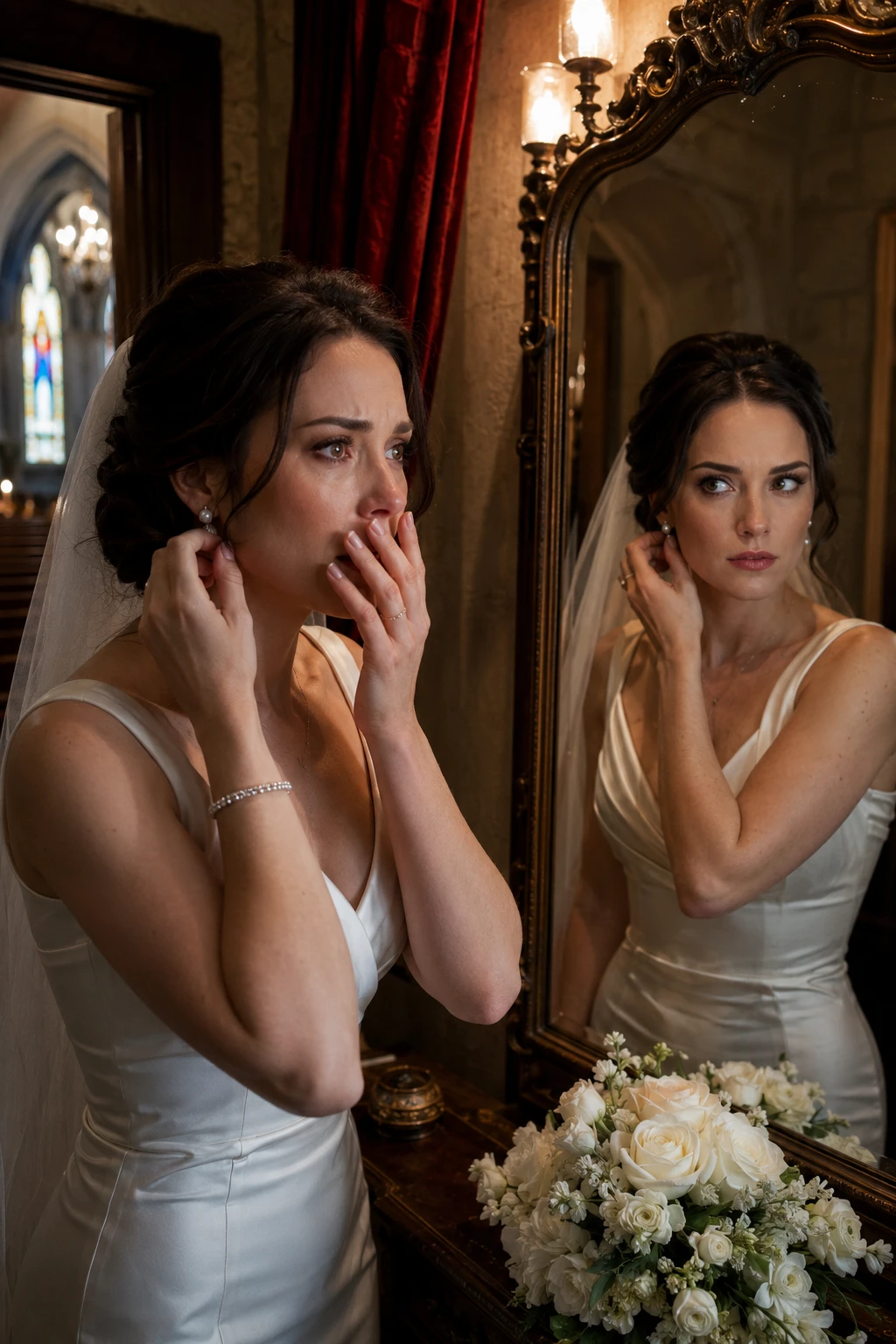
One hour earlier, behind the sanctuary curtain, I had heard Adrian laugh through the chapel wall and say, “I don’t care about her—I only want her money.”
The words had entered me quietly.
No scream. No collapse. No dramatic sobbing in the dressing room.
Just a strange, perfect stillness.
Like the moment before glass shatters.
Now every step down the aisle sounded impossibly loud against the polished stone floor. I noticed ridiculous things: the scent of lilies, the shine on Adrian’s shoes, the pearl earring brushing my neck, the tiny gasp Elise gave from behind me as she adjusted my veil with shaking fingers.
She was the only one who knew.
The only one who had seen me look into the mirror and change from a bride into something colder.
When I reached the altar, Adrian extended his hand.
“My God,” he whispered, smiling. “You look beautiful.”
I let him take my fingers.
His palm was warm.
Mine was ice.
“You look surprised,” I said softly.
His smile flickered. “Only overwhelmed.”
Liar.
The officiant, Father Bell, began with the calm solemnity of a man standing before a sacred promise.
“Dearly beloved, we are gathered here today…”
His voice filled the chapel. Sacred words floated over guests, flowers, candles, and secrets. Adrian stood close enough that I could smell his cologne, the same expensive cedar scent he had worn the night he proposed beneath fairy lights in my garden.
That night, he had knelt with tears in his eyes.
“Mara,” he had said, “you are my miracle.”
I had believed him.
Grief makes belief dangerous.
After my parents died within two years of each other, I had become the last living daughter of the Ellison family. People saw the estate, the lake house, the company shares, the foundation named after my mother, and assumed wealth made loneliness easier.
It did not.
Money can buy marble floors, private doctors, security gates, and lawyers who answer calls at midnight.
But money does not sit beside you when the house is too quiet.
Adrian did.
He appeared at a foundation gala with his open smile and careful sadness. He remembered my coffee order. He walked me to my car in the rain. He never rushed me when I spoke about my mother. He called my father “a giant” and said he wished he had met him.
Now I understood.
He had met my father in every public record, every company filing, every probate notice, every society article that listed me as “sole heir.”
Father Bell continued.
“Marriage is not to be entered into lightly, but reverently, honestly, and with full intention…”
Honestly.
The word almost made me laugh.
Adrian squeezed my hand.
A warning.
A performance.
A reminder that he believed he still controlled the scene.
Vivian leaned forward in the front row, her eyes fixed on the folder now visible against my skirt. She noticed everything, that woman. She had noticed the value of my bracelet the first time we met. She had noticed which trustees deferred to me at foundation dinners. She had noticed where my staff kept guest keys.
But she had not noticed the microphones.
That was the mistake greedy people often made.
They looked so hard at what they wanted that they forgot to see the room.
This chapel belonged to my mother’s foundation. The restoration, the lighting, the audio system, the cameras hidden behind carved oak panels—all of it had been funded and maintained under my authority. Adrian and Vivian had chosen it because it looked romantic.
I had agreed because it listened.
The ceremony moved forward like a dream turning rotten.
Vows.
Promises.
Sacred phrases.
Lies dressed in flowers.
Then Father Bell turned to Adrian.
“Adrian, do you take Mara to be your lawfully wedded wife?”
Adrian looked into my eyes with practiced devotion.
“I do.”
The chapel sighed.
Vivian dabbed the corner of her eye with a lace handkerchief, though not a single tear had appeared.
Then Father Bell turned to me.
“Mara, do you take Adrian to be your lawfully wedded husband?”
Silence fell.
Adrian’s smile widened.
Vivian leaned forward.
I lifted my chin, opened the black folder, and spoke clearly into the microphone.
“No.”
A sound moved through the chapel like wind tearing through trees.
Father Bell froze.
Adrian’s hand tightened around mine. “Mara.”
I pulled my fingers free.
“No,” I repeated, louder this time. “I do not take Adrian Hale to be my husband.”
Vivian stood. “What is the meaning of this?”
I turned toward her, and for the first time that day, I smiled.
“It means, Vivian, that the walls were thin.”
Her face changed.
Only for half a second.
But I saw it.
Adrian went pale beneath his tan. “Mara, whatever you think you heard—”
“I heard you say I was too desperate to walk away.” I looked at the guests. “I heard you say you didn’t care about me. Only my money.”
A collective gasp shattered the room.
Someone whispered, “Oh my God.”
Adrian stepped toward me. “This is emotional. She’s nervous. Everyone, please—”
I raised one page from the folder.
“Then perhaps your own voice will calm everyone down.”
I nodded toward the sound technician near the choir loft.
The chapel speakers crackled.
Then Adrian’s laugh filled the sacred room.
Soft.
Careless.
Familiar.
“She’s too desperate to walk away now.”
The guests went silent in a way silence had never sounded before.
The recording continued.
“I don’t care about her—I only want her money.”
A woman in the third row covered her mouth.
My aunt stood so quickly her purse fell to the floor.
Adrian turned toward the technician. “Turn it off!”
The technician did not move.
Because he worked for me.
Vivian’s voice followed, sharp and hungry.
“Once the marriage certificate is signed, she’ll transfer the lake house?”
Then Adrian again.
“She promised. And the investment account. I’ll handle the rest.”
The chapel exploded.
Gasps. Whispers. Chairs scraping. One of Adrian’s cousins swore under his breath. My father’s old business partner, Mr. Langford, rose slowly from his pew, his face carved in stone.
Adrian reached for me, but Elise stepped between us.
“Don’t touch her,” she said.
He looked around, hunting for sympathy, but sympathy had fled the room.
“Mara,” he said, lowering his voice, “you’re making a mistake.”
“No,” I said. “I almost made one.”
Vivian walked into the aisle, trembling with fury. “You vindictive little thing. You planned this?”
I looked at her ivory dress.
At the diamonds she had worn to my wedding as if she were already the queen of my inheritance.
“You planned to rob me in front of everyone I love,” I said. “I only invited witnesses.”
Her eyes flashed. “You have no idea who you’re humiliating.”
“Oh, I do.”
I turned another page.
“Adrian Hale, for the last four months, you and your mother repeatedly pressured me to transfer property prior to marriage, alter foundation beneficiary structures, and sign a prenuptial agreement prepared by your lawyer.”
Adrian snapped, “That prenup is valid.”
“No,” I said gently. “The first version was a trap. The final version was mine.”
His expression faltered.
“What?”
I held up the signed document.
“You didn’t read the revised clauses, Adrian. You were too busy congratulating yourself.”
The guests were listening now with a hunger that made the room feel electric.
“The final prenuptial agreement includes a fraud inducement clause, a reputation harm clause, and a full forfeiture provision tied to documented attempts to marry for financial exploitation.”
Vivian’s mouth opened.
No sound came out.
I looked at Adrian.
“You signed it.”
His face drained.
“You changed pages.”
“My attorney changed clauses. Your attorney reviewed them. You signed them. Vivian witnessed them.”
The whispers became louder.
Vivian gripped the pew as if the floor had shifted beneath her.
Adrian looked at his mother. “You said it was fine.”
Vivian hissed, “Be quiet.”
But it was too late.
The first real crack between them had appeared.
And I had not even reached the best part.
I opened the folder again.
“Also, since you both repeatedly asked about my inheritance, you should know something. The lake house was never transferable to a spouse. My investment account was never personally accessible. My company shares are held in a family trust requiring independent trustee approval.”
Adrian stared at me.
“But you said—”
“I said I would discuss it after the wedding.” I tilted my head. “You heard what greed wanted to hear.”
Mr. Langford gave a quiet, satisfied laugh from the second row.
Vivian turned on me. “You barren little heiress. You think money makes you powerful?”
The chapel went dead silent.
Adrian closed his eyes.
Even he knew she had gone too far.
The insult struck a bruise no one could see. Vivian knew I had lost a pregnancy two years before I met Adrian. She knew because I had told her one afternoon over tea, believing tenderness offered to a future mother-in-law would be kept sacred.
Instead, she had stored it like a weapon.
For one second, pain rose hot behind my eyes.
Then I remembered my father’s voice.
Never let anyone know how much you see.
I stepped down from the altar and faced her directly.
“No,” I said. “Money does not make me powerful.”
I lifted the black folder.
“Evidence does.”
The chapel doors opened.
Two uniformed officers entered first.
Behind them came a woman in a navy suit, her badge clipped at her belt. Detective Nora Vale, financial crimes division. Calm, sharp-eyed, and utterly unimpressed by Vivian’s diamonds.
Adrian took one step back.
Vivian’s fury became fear.
“Mara,” Adrian whispered. “What did you do?”
“What you taught me to do,” I said. “I protected my future.”
Detective Vale approached the altar. “Adrian Hale. Vivian Hale. We have questions regarding attempted fraud, coercion, and conspiracy involving financial exploitation.”
Adrian shook his head. “This is insane.”
Vivian pointed at me. “She fabricated this.”
The detective looked at Vivian with faint boredom.
“Mrs. Hale, we have audio recordings, emails, drafts of financial transfer instructions, and statements from your former attorney.”
That name moved through the room like a match dropped into gasoline.
Former attorney.
The polished little man with wolf-shaped cufflinks.
Vivian sat down hard.
Adrian stared at his mother again. “What did you do?”
She said nothing.
And in her silence, I heard it.
Something deeper.
Something I had not known.
Detective Vale turned to me. “Ms. Ellison, we may need your statement again later.”
“Of course,” I said.
But before the officers could move, Adrian suddenly laughed.
It was not his charming laugh.
It was ragged.
Broken.
Almost childish.
“You think she’s the victim?” he said, pointing at me. “Ask her about her father.”
Every eye turned toward me.
My heart slowed.
Vivian whispered, “Adrian, stop.”
But he was unraveling now.
“You want truth, Mara?” he spat. “Your precious father ruined my family. He bought our company for nothing after the crash. My father drank himself to death because of your last name.”
The chapel breathed in.
I looked at him carefully.
“Your father was Daniel Hale.”
His eyes narrowed. “You knew?”
“I knew he ran a manufacturing company my father acquired.”
“He stole it.”
“No,” Mr. Langford said sharply from the pew. “Daniel Hale embezzled from employee pensions. Mara’s father bought the company to keep eight hundred workers from losing their jobs.”
Adrian flinched.
Vivian stood again, her face twisted. “Liar.”
Mr. Langford walked into the aisle. “I was there.”
Something cold touched the back of my neck.
Because suddenly, Vivian was not looking at Mr. Langford.
She was looking at me with old hatred.
“You think your father was a saint?” she whispered. “He took my husband’s company. He took our name. He took our future.”
I stared at her.
And then she smiled.
A terrible, victorious smile.
“So I took something from him.”
The chapel fell silent.
Detective Vale’s gaze sharpened.
Vivian seemed to realize she had spoken aloud, but rage had carried her too far.
“What did you take?” I asked.
She looked at me, and for the first time, I saw not a greedy mother-in-law, not a social climber, not a cruel woman in ivory.
I saw a wound that had learned to walk.
“Your mother,” she said.
The world disappeared.
The flowers. The pews. The guests. Adrian. The officers.
Everything narrowed to Vivian’s mouth and the impossible words coming out of it.
“My mother died in a car accident,” I said.
Vivian’s smile shook.
“Accidents are easy when roads are wet and brake lines are old.”
Someone screamed.
I do not remember who.
Maybe Elise.
Maybe me.
Detective Vale moved immediately, but Vivian did not run. She stood there beneath my mother’s chapel lights, wearing ivory to my wedding, confessing to a murder she had hidden for twelve years.
Adrian staggered away from her.
“No,” he whispered. “No, you told me it was just business.”
Vivian turned on him. “Everything was for you.”
“For me?” His voice cracked. “You killed her mother?”
“She owed us!”
“No,” I said.
The word came from somewhere deeper than grief.
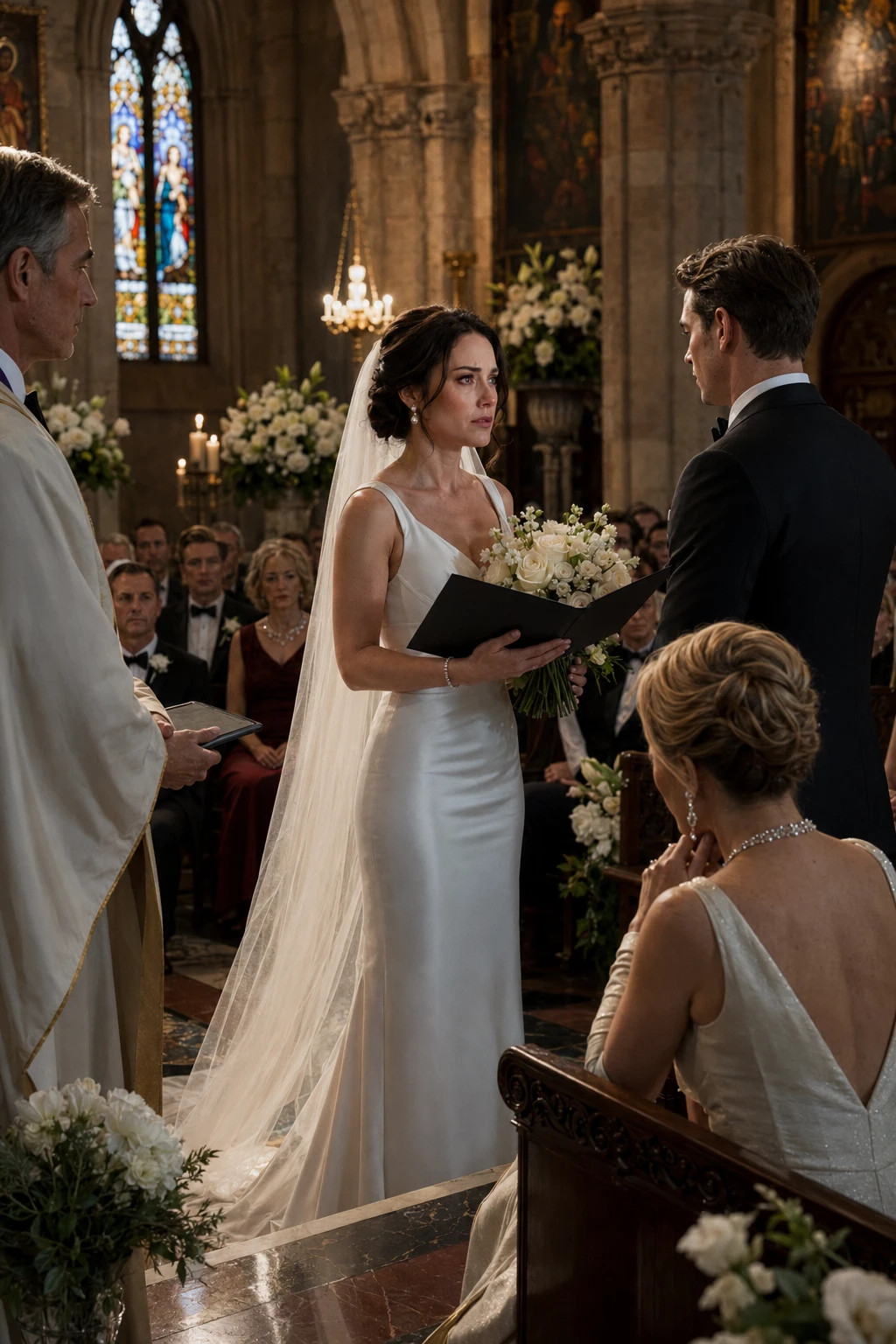
I stepped closer to Vivian, so close I could see powder gathered in the lines around her mouth.
“My mother owed you nothing.”
Vivian’s eyes were wild now. “Your family destroyed mine.”
“And you spent twelve years becoming worse than whatever you hated.”
The officers took her arms.
This time, she fought.
Diamonds flashed. Ivory lace twisted. Her perfect hair came loose as she screamed that my family had stolen everything, that I was supposed to pay, that Adrian was supposed to marry me and take back what belonged to the Hales.
Adrian stood frozen at the altar, all arrogance gone.
Just a boy in a tuxedo watching his mother become a monster in public.
As they dragged Vivian toward the doors, she looked back at me.
“You were never supposed to find out,” she hissed.
I held my bouquet tightly enough to crush the stems.
“I know,” I said. “That is why truth needed a microphone.”
The chapel doors closed behind her.
For a long moment, no one moved.
Then Adrian sank onto the altar step.
“Mara,” he whispered. “I didn’t know.”
I looked at him.
Part of me wanted that to matter.
Part of me wanted to believe there was still one small human thing left inside the man I almost married.
But then I remembered his voice through the wall.
I don’t care about her—I only want her money.
“You knew enough,” I said.
He bowed his head.
The guests began to rise, quietly, uncertainly, like survivors leaving a storm cellar. Elise came to me and wrapped her arms around my shoulders, but I did not cry.
Not then.
Not while everyone watched.
Father Bell approached me slowly.
“Mara,” he said, his old voice trembling, “what would you like done with the flowers?”
I looked around at the white roses, the candles, the ribbons, the altar where I had almost given my life to a lie.
Then I looked up at my mother’s stained-glass window, glowing above the chapel doors. She had built this foundation for widows, children, women starting over, families who needed somewhere safe to stand.
“Donate them,” I said. “All of them. Hospitals. Shelters. Anywhere they can mean something better than this.”
Three months later, Vivian Hale was charged not only with conspiracy and attempted financial fraud, but in connection with my mother’s death. Adrian accepted a plea agreement related to the fraud case and testified against her. I did not attend his hearing.
He wrote me one letter.
I burned it unopened in my mother’s garden.
A year after the wedding that never happened, I returned to the chapel alone.
No guests.
No quartet.
No ivory lace.
Just me, a simple black dress, my mother’s pearl earrings, and sunlight pouring through stained glass onto the stone floor.
Elise had asked if I wanted company.
I told her no.
Some endings need witnesses.
Others need silence.
I stood before the altar and opened the black folder one final time. Inside were the documents, the transcripts, the recordings, the clauses I had rewritten with steady hands while everyone mistook me for fragile.
At the very back, tucked behind the legal papers, was a photograph of my parents dancing at a foundation gala. My father’s hand rested gently at my mother’s waist. My mother was laughing, her head tilted back, alive forever in that captured second.
I touched the photograph.
“I almost married them,” I whispered.
The chapel gave no answer.
But the silence felt warm.
Outside, the garden bells began to ring noon. I closed the folder and placed it on the altar—not as evidence anymore, but as proof.
Proof that my father had taught me to see.
Proof that my mother’s chapel had listened.
Proof that softness had never been weakness.
As I walked toward the doors, sunlight caught my pearls and scattered tiny white sparks across the floor.
One year earlier, I had entered that chapel as a bride.
Today, I left as the woman my parents had raised me to become.
Not desperate.
Not broken.
Not a bank account in a white dress.
A daughter.
A survivor.
And finally, the rightful owner of her own life.