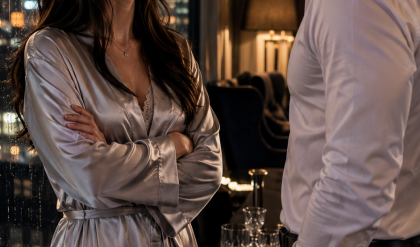
PART 1: THE SIGNATURE THAT ENDED HER NAME
The pen scratched across the divorce papers one final time, and Lena Hart disappeared from Adrian Voss’s world.
That was what he believed.
He believed it because he needed to. Because the mahogany desk between them was wide and polished and expensive enough to make destruction look civilized. Because the lawyer’s office smelled of old leather, expensive cologne, and quiet endings. Because everything about the morning had been arranged to feel like business.

Clean.
Efficient.
Final.
Adrian Voss signed his name with the same controlled hand he used to approve transfers, authorize shipments, and mark certain men as problems to be solved before sunrise. His signature was bold, black, decisive. It cut across the page like a verdict.
Across from him, Lena signed more slowly.
Her handwriting looked smaller beside his. Not weak, exactly. Just careful. As if even her name had learned not to take up too much space.
“Just one more initial here, Mrs. Voss,” the lawyer said.
Lena’s fingers tightened around the pen.
Mrs. Voss.
The name had once made her heart race. Now it felt like a dress she had outgrown and kept wearing because everyone else insisted it still fit.
She initialed.
The lawyer gathered the pages with a professional nod. He had the tired eyes of a man who had watched too many marriages die without ever believing in them.
“That concludes the dissolution agreement,” he said. “Mr. Voss, your assistant has the wire information for the settlement. Ms. Hart, the funds should appear within forty-eight hours.”
Ms. Hart.
Back to the beginning.
Back to the girl who had once worked three jobs, wore thrift-store heels to interviews, and believed rich men only existed in rooms she entered carrying trays.
Fifty thousand dollars.
That was what three years had been worth.
Three years of learning how to smile at women who feared her husband. Three years of dinners where men stopped talking when she entered. Three years of sleeping beside a man whose phone calls always lowered his voice and whose hands sometimes came home scrubbed too clean.
Three years of loving someone who had mistaken her softness for uselessness.
Adrian stood.
His tailored charcoal suit fell perfectly around his frame. He was thirty-four, beautiful in the way weapons were beautiful—precise, cold, made for impact. Dark hair combed back. Sharp jaw. Eyes that rarely asked for permission from anything in the world.
He did not look ruined.
That hurt more than if he had looked cruel.
“I’ll have Marcus drive you wherever you need to go,” he said.
His voice was level. Businesslike.
Lena looked at him.
That was the tone he used with accountants. With junior attorneys. With men whose loyalty he doubted but had not yet decided to punish.
“After that,” Adrian continued, “I don’t want contact. Not directly. Not through mutual acquaintances. Not through my staff.”
Lena felt the words enter her body one by one.
Don’t call.
Don’t write.
Don’t exist where I can see you.
Her hand moved toward her stomach before she stopped it.
Not now.
Not here.
Not in front of him.
“I understand,” she said.
Something flickered across Adrian’s face.
It might have been regret.
It might have been relief.
With Adrian, it was sometimes hard to tell the difference unless you had once loved him enough to study the smallest changes in his silence.
“I’m sorry it didn’t work,” he added.
Polite.
Careful.
Worse than cruelty.
Lena stood and smoothed the front of her plain black dress. She had chosen it because it was forgettable. Not the elegant silk pieces Adrian’s stylist once sent to the penthouse. Not the cheap cotton dresses of her old life. Something between.
A woman leaving a marriage should not look like she was asking to be remembered.
“So am I,” she said.
And she meant it.
Not for the penthouse. Not for the money. Not for the status that had made women at galas smile too brightly and whisper when she passed.
She was sorry for the version of herself who had believed being chosen by Adrian Voss meant being seen.
The elevator ride down fourteen floors felt endless.
Lena stood alone inside the mirrored walls, one hand pressed against her stomach now that no one could see. The baby was still too small to show. Barely a secret beneath her skin. Barely real and already the most dangerous thing in her life.
Pregnant.
She had known for two weeks.
Two weeks of waking before dawn, sitting on the bathroom floor of an apartment Adrian did not know she had rented, staring at two pink lines until her vision blurred.
Part of her had wanted to tell him.
Not because she believed he loved her. She had stopped believing that sometime around the first anniversary he forgot, or the third time he left dinner without explanation, or the night he told her, “You knew what I was when you married me,” as if knowledge made neglect easier to swallow.
But Adrian Voss had a twisted code.
If he knew, he would do what he considered right.
He would cancel the divorce. Install her back into the penthouse. Hire doctors. Assign guards. Put his name on the child, his money around the child, his world over the child.
And one day, when the baby cried too loudly during a meeting or when Lena asked him to come home before midnight or when another war came knocking at his door, she would see the truth in his face.
Obligation.
Resentment.
A cage built from responsibility and called protection.
No.
She could survive being unwanted.
Her child would not be born into it.
In the lobby, Marcus waited beside the black Mercedes.
He was Adrian’s driver and sometimes more than that. Silent. Efficient. Gray at the temples. A man who had seen things and learned not to react.
“Where to, ma’am?” he asked.
Lena gave him the address of the small apartment three neighborhoods away.
Marcus’s eyes flicked once to the building name she gave him, then away.
If he was surprised, he did not show it.
The city moved past the tinted windows in steel, glass, traffic, and winter light. Lena watched Manhattan slide away and remembered the first time she had met Adrian.
She had been serving champagne at a charity gala.
He had looked at her like the room had gone quiet around her.
For a girl who had spent her life invisible, that kind of attention had felt like warmth.
She had not yet learned that fire and warmth looked the same from a distance.
When Marcus stopped in front of her building, he got out and opened her door.
The apartment house was old brick, badly painted, with a cracked step and a buzzer that worked only when it felt like it. It looked like survival.
Lena stepped onto the sidewalk.
“Thank you, Marcus.”
He hesitated.
For the first time in three years, he looked directly at her not as Mrs. Voss, not as an accessory to Adrian’s empire, but as a woman standing alone with one suitcase and a face too calm for what had just happened.
“Take care of yourself,” he said quietly.
The words almost broke her.
Instead, she nodded and walked inside.
Up three flights.
Down a narrow hallway.
Into an apartment with secondhand furniture, thin walls, and windows that rattled when trucks passed below.
She locked the door.
Then she sank onto the couch and finally let her body understand what her face had refused to show.
The sobs came silently at first.
Then harder.
She cried for the marriage. For the girl who had believed attention was love. For the woman who had learned to make herself small enough to fit inside a powerful man’s life.
Then she cried for the child.
When the grief finally emptied enough for thought to enter, Lena stood, washed her face, and looked at herself in the bathroom mirror.
Her eyes were swollen.
Her mouth trembled.
But beneath the ruin, something sharp was forming.
Adrian had signed the papers with relief.
Fine.
Let him feel relieved.
By the time he realized what he had lost, there would be no Lena Hart left to find.
PART 2: HOW TO BECOME A GHOST
Lena spent three days learning how people disappeared.
Not movie disappearance. Not dramatic passports and midnight flights with men in sunglasses.
Real disappearance.
Boring disappearance.
The kind that made records dull, trails cold, names ordinary enough to vanish inside databases no one wanted to search twice.
She searched from library computers. She paid cash. She avoided cameras where she could and wore a baseball cap where she could not. She withdrew Adrian’s settlement in increments from different branches, hands sweating inside her coat pockets while tellers smiled with professional indifference.
Fifty thousand dollars had seemed like an insult in the lawyer’s office.
Now it became oxygen.
She found Sarah in a bar near a bus depot.
Sarah was maybe forty, maybe fifty. Life had carved tired beauty into her face and left suspicion in her eyes. She wore red lipstick badly and carried herself like a woman who had survived enough men to know which questions mattered.
“You running from the law or from a man?” Sarah asked over cheap whiskey.
Lena looked at her.
“Does it matter?”
Sarah smiled without amusement. “Only to the price.”
“I need to become someone else.”
“Everyone says that. Most people mean a haircut and a new city.”
“I mean documents. History. A life that holds up.”
Sarah studied her for a long moment.
Then her eyes dropped briefly to Lena’s stomach.
Not visibly pregnant yet.
But women like Sarah noticed what men missed.
“You got a kid involved?”
Lena did not answer.
Sarah nodded slowly. “Then we don’t do sloppy.”
The name came first.
Mara Clark.
Close enough to remember.
Far enough to survive.
Born in Cedar Rapids, Iowa. No living parents. Temporary administrative jobs. No scandals, no debts worth chasing, no connections worth exploiting. A woman so ordinary she could stand in line anywhere in America and vanish before anyone remembered her face.
“Mara Clark sounds like she pays rent late but never causes problems,” Sarah said.
“Good.”
“She doesn’t wear expensive coats.”
“I don’t have one anymore.”
“She doesn’t speak like she spent three years around rich criminals.”
Lena’s mouth tightened.
Sarah lifted her glass. “There it is. Good. Use that anger. It’ll keep you alive.”
The new identity cost twenty-five thousand dollars.
Birth certificate. Social Security number. Driver’s license. Digital crumbs scattered carefully enough to look accidental.
For another five thousand, Sarah made Lena Hart boring.
Old addresses with forwarding errors. A bank trail that ended in cash. A few vague sightings in cities she would never visit. Enough confusion to slow anyone who searched.
“Won’t stop a powerful man forever,” Sarah warned.
“I don’t need forever.”
“Yes, you do,” Sarah said, looking at her stomach again. “You just haven’t admitted it yet.”
On the ninth day, Lena Hart boarded a bus with one suitcase, twenty thousand dollars in cash, a fake ID, and a hand pressed under her coat against the future.
In a truck stop bathroom somewhere in Ohio, she dyed her light brown hair auburn and cut six inches off with nail scissors. The result was uneven. That helped. Expensive women were polished. Women no one noticed looked tired.
By the time she stepped off the bus in Portland, she was Mara Clark.
Twenty-six. Alone. Recently separated from a boyfriend who had not been worth discussing. Looking for administrative work. Quiet. Reliable. No family. No past that invited questions.
She rented a studio in a building where people minded their own business because everyone had something to hide or something to forget. The windows stuck. The radiator hissed. The neighbor across the hall watched her through a cracked door the first week and said nothing.
Mara found work processing insurance claims.
The job was dull.
Dull felt holy.
Every evening, she returned to the apartment, took prenatal vitamins with tap water, and sat on the floor because the couch smelled faintly of someone else’s cigarettes.
Sometimes she missed the penthouse.
Not Adrian.
Not exactly.
She missed heated floors. Fresh towels. The way groceries appeared before she thought to order them. The illusion that money could protect a person from fear.
Then she remembered the cost.
She remembered Adrian saying, “I don’t want to see you again,” in the same tone he used to close a file.
She would touch her stomach and say, “You will never beg to be seen. Not by him. Not by anyone.”
Back in Manhattan, Adrian Voss tried not to think about her.
At first, it was easy.
There were meetings. Shipments. A conflict with the Varelli crew. A senator who needed reminding that campaign donations were not gifts from heaven. A nightclub owner who thought he could skim from Adrian’s accounts because divorce made men distracted.
Adrian corrected him.
Efficiently.
But absence had habits.
The penthouse was quieter without Lena moving through it.
He noticed the small things first. No chamomile tea in the cabinet. No book left open on the arm of the sofa. No soft music playing in the bedroom when he came home after midnight.
He had once found those things intrusive.
Now the rooms felt too clean.
Two months after the divorce, one of his associates mentioned his daughters at dinner.
“Children change the architecture of a man,” Chen said, smiling at a photo on his phone. “You think money is legacy. Then your little girl learns to walk and suddenly everything else becomes scaffolding.”
Adrian changed the subject.
Later, alone in his car, he thought about children for the first time without immediately dismissing the idea.
Children had always seemed dangerous.
Targets with birthdays.
Weakness with faces.
And yet the thought lingered.
Three months after the divorce, Marcus came into Adrian’s office carrying an expression Adrian disliked immediately.
“What?”
Marcus closed the door.
“I found something.”
“I told you not to look for her.”
“I wasn’t. Not exactly.”
Adrian stared.
Marcus placed a folder on the desk.
“Six weeks before the divorce, Mrs.—Lena saw an OB-GYN. The appointment was coded as prenatal care.”
The room went silent.
Adrian looked at the folder but did not touch it.
“What did you say?”
“She was pregnant,” Marcus said carefully. “Or believed she was.”
Adrian stood slowly.
The city beyond his windows blurred.
Pregnant.
Lena sitting across from him in the lawyer’s office.
Lena signing her name.
Lena walking out with one hand briefly against her stomach.
He had noticed.
He had noticed and not asked.
“Where is she?”
Marcus’s face tightened. “Gone.”
“What does that mean?”
“It means the settlement was withdrawn in cash. Her apartment was emptied. No credit card usage. No trace. She planned it well.”
Adrian felt something cold and unfamiliar open inside his chest.
“She disappeared.”
“Yes.”
“Find her.”
Marcus did not move.
“Sir.”
Adrian looked at him.
“Find. Her.”
The search began that night.
Investigators. Hackers. Private contacts. Men who could pull records from places records were not supposed to leave. Airport cameras. Bus terminals. Hospitals. Clinics. Rental applications.
Nothing.
Lena Hart had been a quiet woman in his life, but she vanished like a professional.
That angered him.
Then it shamed him.
Because she had learned strategy in his house.
She had learned silence from him.
She had learned how dangerous powerful men became when they believed concern gave them rights.
Weeks became months.
The leads died.
Adrian slept less.
He drank more.
He began seeing Lena in fragments: a woman in an auburn coat crossing a street, a laugh behind him in a restaurant, the curve of a pregnant stranger’s hand against her belly.
Every mistake in his marriage replayed differently now.
Not as inconvenience.
As evidence.
The dinner she had waited through while he took calls in another room.
The museum job she had left and he had not noticed.
The night she asked, “Do you ever wonder what kind of life we are building?” and he had answered, “A protected one.”
She had gone quiet after that.
He had called the quiet peace.
It had been surrender.
Six months after the divorce, an investigator called from Oregon.
“I found a woman who might be her.”
Adrian’s grip tightened around the phone.
“Where?”
“Portland. Different name. Different documents. But the face matches enough.”
“Send the address.”
“Mr. Voss, if it’s her, she went to great lengths not to be found.”
Adrian’s voice was quiet.
“I know.”
The flight took three hours.
Adrian spent all of them looking at a photograph of Lena from their wedding day. It was one of the few where she faced the camera directly. She wore white silk, her hair pinned back, her eyes soft with something he had mistaken for shyness.
Now he recognized it.
Hope.
The address in Portland led to a brick building that smelled of old rain, boiled cabbage, and damp carpets. The stairs creaked. The hallway paint peeled near the baseboards.
This was where she had chosen to live instead of returning to him.
Instead of taking his money.
Instead of letting him build a golden prison around her.
Apartment 3C did not answer.
A door across the hall opened a crack.
An elderly woman stared at Adrian with narrowed eyes.
“She’s not home.”
Adrian turned. “Do you know when she’ll return?”
“Who’s asking?”
“An old friend.”
“You don’t look like her kind of friend.”
The woman’s gaze traveled over his suit, his watch, his shoes, and found him guilty.
“She works late Thursdays,” she said finally. “Back around nine.”
Adrian waited three hours in the hallway.
His phone vibrated constantly.
He ignored it.
At 8:47, footsteps sounded on the stairs.
Slow.
Tired.
Then Lena appeared.
No.
Mara appeared.
Auburn hair. Cheap jeans. Canvas jacket. Plastic grocery bags in both hands. Her face was thinner. Shadows lay beneath her eyes. But it was her.
And beneath the loose jacket, her stomach was round.
Unmistakably.
He stood.
The grocery bags fell from her hands.
Oranges rolled across the worn floor.
Her face emptied of color.
“No,” she whispered. “No, you can’t be here.”
“Lena.”
“That’s not my name.”
Her hands moved to her stomach.
Protective.
Against him.
That hurt more than any accusation could have.
“I’m not going to hurt you,” he said.
Her laugh came out broken. “You already did.”
PART 3: THE PROMISE HE COULD NOT BREAK
The hallway smelled of dust and someone’s dinner burning two floors below.
Adrian had imagined this moment a hundred times on the flight.
He had prepared explanations. Apologies. Demands he dressed as rights. Offers he convinced himself were generous.
All of them disappeared when he saw Lena backing against the wall with both hands over their child.
Not because she was ashamed.
Because she was afraid.
Of him.
“You’re pregnant,” he said.
Her face hardened.
“That is none of your business.”
“The hell it isn’t.”
“Lower your voice.”
The command was quiet.
He obeyed before he realized it.
Lena glanced toward the neighbor’s door, then bent slowly to gather the oranges. One rolled toward Adrian’s shoe. He picked it up and held it out.
She hesitated before taking it.
A ridiculous object between them.
Orange skin. Trembling fingers. Years of marriage reduced to a fruit in a hallway.
“When were you going to tell me?” he asked.
“I wasn’t.”
The answer was immediate.
Clean.
Like the signature she had left on the divorce papers.
Adrian felt his jaw tighten. “That is my child.”
“No,” Lena said, voice low and fierce. “This is my child.”
“Our child.”
“The moment you signed those papers with relief on your face, you surrendered the right to that word.”
He flinched.
She saw it.
Good, her expression said.
Let it land.
“I would have provided for you,” he said.
“I know.”
“I would have protected you.”
“I know.”
“I would have—”
“Done the right thing,” Lena finished. “Yes. That is exactly why I didn’t tell you.”
Adrian stared.
She shifted her weight, one hand pressing into her lower back. Pregnancy had changed the way she stood. He noticed the exhaustion in her face, the cheap shoes, the thin coat, the plastic bags filled with discounted groceries.
His instinct rose violently.
Move her.
Feed her.
House her.
Punish whoever let the radiator in this building fail.
Control the variables.
Lena watched the calculation happen in his eyes and stepped back again.
“There,” she whispered. “That is why.”
“What?”
“You don’t love. You manage.”
The hallway went silent.
Adrian had heard men call him cruel. Cold. Brilliant. Dangerous. Unfair. Necessary.
No one had ever said it like that.
Like a diagnosis.
“I made a mistake,” he said.
“Yes.”
“I was wrong.”
“Yes.”
“I’m sorry.”
Lena looked at him for a long moment.
Tears filled her eyes but did not fall.
“Sorry doesn’t make you safe.”
The words were soft.
That made them worse.
“I can change.”
“Can you?” she asked. “Can you walk away from everything you built? From every man who depends on your violence? From every enemy who knows your name? Can you become someone this child could run to without being followed by danger?”
He had no answer.
They both knew it.
Lena nodded once, as if he had spoken.
“That’s what I thought.”
Adrian looked at her stomach again.
“How far along?”
She hesitated.
“Six months.”
A whole season of life.
Gone.
“Boy or girl?”
“I don’t know. I wanted to be surprised.”
He swallowed.
“Are you healthy?”
“Yes.”
“The baby?”
“Yes.”
Relief moved through him so sharply it almost buckled his knees.
“Let me help.”
“No.”
“Money, then.”
“No.”
“Lena—”
“My name is Mara here.”
The correction was another door closing.
“I need you to listen to me,” she said. “Not as Adrian Voss, not as a man who commands rooms, not as someone deciding what happens next. Listen like someone who once owed me kindness.”
He went still.
“I left because I did not want my child raised in fear. I left because I did not want to spend the rest of my life watching you resent us for tying you to something you never chose. I left because being near you meant shrinking until I could fit inside your convenience.”
“That isn’t true.”
“It is,” she said. “You just weren’t looking.”
He looked at her then.
Really looked.
At the woman who had created a new identity, crossed states alone while pregnant, built a life out of little money and hard choices, and still stood between him and the child as if her body were enough of a wall.
He had thought her fragile.
She had been steel in a quiet dress.
“What do you want from me?” he asked.
“Nothing.”
“There must be something.”
“Yes,” Lena said. “Leave.”
The word struck him like a bullet.
“I can’t.”
“You can. You just don’t want to.”
“You’re asking me to walk away from my own child.”
“I’m asking you to do the one thing that might prove you care about more than possession.”
The neighbor’s door opened wider.
The elderly woman looked from Lena to Adrian with hard eyes.
“You need me to call somebody, Mara?”
Lena did not look away from Adrian.
“No, Ruth. Thank you.”
Ruth did not close the door.
Adrian understood the message.
Lena had people here. Not powerful people. Not armed people. But people who saw her.
Perhaps that was more than he had ever given her.
“I need you to promise,” Lena said.
His throat tightened.
“No.”
“Promise me you won’t follow. You won’t send men. You won’t track hospitals. You won’t turn our lives into another problem to solve.”
“Don’t ask me that.”
“I am asking.”
“This is unfair.”
Lena laughed once, and it held nine kinds of pain.
“Fair? You married me because I made you feel human for five minutes. You ignored me because humanity became inconvenient. You divorced me because I no longer fit your image of power. And now you want fairness because the consequences hurt you.”
He looked away.
“Look at me,” she said.
He did.
“I am not punishing you,” she said. “I am protecting the only innocent person in this story.”
The baby moved then.
Lena’s hand tightened over her stomach.
For one second, her face softened with wonder before fear returned.
Adrian saw it.
That private miracle.
One he had no right to touch.
“I promise,” he said, and the words tore something out of him. “I won’t look for you again. I won’t interfere. I’ll let you disappear.”
Relief passed across her face.
Then grief.
Because even when freedom is necessary, it can still hurt.
“Thank you.”
He wanted to ask if the child would know his name.
He wanted to ask if she had ever loved him.
He wanted to say he loved her, but the words felt obscene now, arriving only after loss had made them useful.
So he nodded.
Lena picked up the last orange and opened her apartment door.
“Adrian.”
He looked back.
“For what it’s worth,” she said, “I think part of you did love me. You just loved your world more.”
Then she stepped inside.
The door closed.
This time, Adrian did not knock.
He returned to New York and told Marcus the lead had been wrong.
“No Lena,” he said. “Just someone who looked like her.”
Marcus watched him carefully.
“Understood.”
Adrian closed the investigation.
Publicly.
Privately, he began doing something worse than searching.
He began remembering.
He remembered Lena sitting alone at his dining table with a cold plate in front of her. Lena falling asleep on a sofa waiting for him. Lena asking once, “Do you think there is any version of us that doesn’t end badly?” and him answering without looking up from his phone, “Don’t be dramatic.”
He remembered the relief he felt when she signed.
And for the first time, Adrian Voss understood that some sins did not announce themselves with blood.
Some wore suits.
Some sounded polite.
Some signed documents and called it mercy.
PART 4: THE CHILD WHO LEARNED TO RUN
Isla Grace Clark came into the world three weeks early on a February morning cold enough to frost the inside of Lena’s apartment windows.
She arrived screaming.
Loud. Furious. Offended by light, air, and the entire concept of being handled.
The nurse laughed when she placed the baby on Lena’s chest.
“She has opinions.”
Lena cried so hard she could barely answer.
Isla was small, red-faced, and perfect in the unfinished way newborns are perfect. Not polished. Not beautiful in the easy sense. More like a promise delivered raw and breathing.
She had Lena’s chin.
Adrian’s dark eyes.
That hurt.
Then it healed.
Then it hurt again.
“Hi, baby,” Lena whispered. “I’m your mama.”
Isla stopped crying for half a second, as if considering the arrangement.
Then she screamed again.
Lena laughed through tears.
“Fair enough.”
The hospital released them after two days.
Lena carried Isla home in a secondhand car seat, up three flights of stairs, into an apartment too small for motherhood and fear to coexist comfortably.
The first weeks were brutal.
Isla had colic.
Every evening at six, she began crying with the discipline of a soldier reporting for duty. Lena walked the apartment in circles until her knees ached, bounced, shushed, sang songs she barely remembered from childhood, and cried silently when exhaustion made the walls pulse.
One night, at eleven, someone knocked.
Lena froze.
Then Ruth’s voice came through the door.
“Open up before you drop that baby.”
Lena opened it.
Ruth, the elderly neighbor with suspicious eyes, walked in wearing slippers and a cardigan, arms already extended.
“Give her here.”
“I can handle it.”
“Didn’t ask if you could. Asked you to give her here.”
Lena was too tired to refuse.
Ruth took Isla with the confidence of a woman who had held many crying babies and outlived the men who panicked around them.
“Go shower,” Ruth said.
“I—”
“Hot water. Ten minutes. You smell like fear and formula.”
Lena stood under the shower and shook.
When she came back, Isla was quiet against Ruth’s shoulder.
“How?” Lena whispered.
“Different heartbeat,” Ruth said. “Babies get tired of the same panic.”
After that, Ruth became part of their life in the way lonely people sometimes become family before anyone gives permission.
She watched Isla when Lena returned to work after eight weeks. She brought soup. She corrected Lena’s swaddling with insulting tenderness. She called the baby “little judge” because Isla stared at people as if weighing their souls.
“She gets that from her father,” Lena said once without thinking.
Ruth looked at her.
Lena busied herself with bottles.
Ruth did not ask.
That was why Lena trusted her.
The years began moving in small victories and sudden alarms.
Isla’s first smile.
First fever.
First word, which was “no,” delivered with such authority that Ruth laughed for five minutes.
First steps across the apartment while Lena folded laundry and nearly dropped an entire basket.
When Isla walked, she did not wobble toward Lena uncertainly.
She looked at the distance, measured it, and moved.
“Your father did that too,” Lena whispered.
Then wished she had not.
At eighteen months, Lena moved them to Seattle after seeing a man outside her building who looked too much like one of Adrian’s associates.
At two and a half, Seattle became Denver.
At four, Denver became Phoenix.
Every move had a reason. Some real. Some imagined. All exhausting.
Lena learned to pack an apartment in four hours. She learned which jobs asked too many questions and which landlords accepted cash with a shrug. She learned to keep documents in a waterproof folder and cash hidden in three places. She learned that survival, repeated long enough, could start to look like illness.
Isla adapted because children adapt when they have no power not to.
But adaptation was not the same as peace.
At four, Isla asked, “Why do we move so much?”
Lena was folding clothes into a suitcase.
“Mommy’s jobs change.”
“Other mommies have jobs and don’t change houses all the time.”
Lena stopped folding.
Isla sat on the floor holding a stuffed rabbit with one ear chewed flat from years of anxious comfort. Her dark eyes watched everything.
Too much like Adrian.
“Sometimes moving keeps us safe,” Lena said.
Isla tilted her head.
“Safe from what?”
Lena felt the answer rise and die.
From your father’s enemies.
From your father’s love.
From my fear.
“Just safe,” she said.
Isla looked unsatisfied.
She often did.
By six, Isla knew there was no father in their house and no grandparents in their stories. She knew her mother changed phones too often. She knew they did not take pictures at school events if other parents might post them. She knew not to go with strangers, not to say where they lived, not to give her full name without looking at her mother first.
Lena told herself these were safety rules.
Sometimes, in the dark, she wondered if they were just another kind of cage.
Then Phoenix almost became home.
They stayed two years.
Long enough for Isla to make a best friend named Emily. Long enough for Lena to get a job with benefits at an insurance company. Long enough to paint Isla’s room pale yellow and buy a small bookshelf they did not plan to abandon.
Long enough for hope to become careless.
The call came on a Tuesday.
“This is Detective Sarah Chen with Phoenix Police. I’m calling about an incident at your daughter’s school.”
Lena’s heart stopped.
“Is Isla hurt?”
“She is safe. A man attempted to pick her up claiming he was a family friend. The school followed protocol. He left when questioned.”
Lena was already grabbing her purse.
“What was his name?”
“He gave the name Marcus.”
The office lights seemed to go white.
Marcus.
Adrian’s driver.
Adrian had found them.
At the school, Isla sat in the principal’s office coloring with frightening calm.
“Mommy,” she said when Lena entered, “I didn’t go with him.”
Lena dropped to her knees and held her so tightly Isla squirmed.
“I know, baby. You did exactly right.”
Detective Chen watched Lena from the doorway.
She asked questions in the hall.
Custody dispute?
Restraining order?
Dangerous ex?
Lena answered carefully until careful stopped being useful.
“If I told you her father was a crime lord with enough money to make police reports disappear,” she said quietly, “could you protect us? Or would telling you make us easier to find?”
Detective Chen’s expression changed.
She believed her.
That almost made it worse.
“There are programs,” the detective said.
“Programs have files. Files have names. Names can be found.”
“What will you do?”
“What I’ve always done.”
Lena took Isla home, packed in under an hour, and left Phoenix before sunset.
“Where are we going?” Isla asked from the back seat.
“Somewhere new.”
“I liked Phoenix.”
“I know.”
“Is it because of my daddy?”
Lena’s hands tightened on the wheel.
The desert road stretched ahead, empty and cruelly beautiful.
“What makes you ask that?”
“Because you looked scared when the detective said Marcus. And because you always look sad when I ask about him.”
Lena pulled into a rest stop.
The engine ticked softly after she shut it off.
She turned to face her daughter.
“Your father is not a simple man,” she said.
“Is he bad?”
Lena looked at Isla’s face, searching for how much truth a child could carry.
“He made bad choices. Big ones. Dangerous ones. I left before you were born because I wanted you to have a life away from those choices.”
“Does he know about me?”
“He found out before you were born.”
“Did he not want me?”
The question nearly split Lena in half.
“No,” she said quickly. “That is not true.”
“But he didn’t come.”
“Because I asked him not to.”
Isla went very quiet.
That was worse than tears.
“Why?”
“Because sometimes adults can care and still be unsafe.”
Isla hugged the rabbit tighter.
“I don’t like being safe if it means always leaving.”
Lena had no answer.
So she drove.
And behind them, Phoenix vanished like every almost-home before it.
PART 5: THE DYING MAN AT THE DOOR
Three more years passed.
Running changed Isla.
At nine, she no longer cried when Lena said they had to move.
That should have made things easier.
It made everything worse.
She packed her books first. Then her rabbit. Then the few clothes she liked. She labeled boxes without being asked. She stopped making friends too quickly.
A child should not know how to leave cleanly.
In a small apartment outside St. Louis, Isla finally broke.
“I don’t want another new school.”
Lena stood with packing tape in her hand.
“I know.”
“You always say that.”
“I do know.”
“Then stop doing it.”
The words came out sharp.
Lena flinched.
Isla’s face crumpled, then hardened again, as if softness had embarrassed her.
“I’m tired of being a secret,” she said. “I’m tired of not having grandparents or old pictures or a birthday party with people who knew me last year.”
Lena set down the tape.
“Baby—”
“I’m not a baby.”
No.
She wasn’t.
That night, after Isla fell asleep, Lena sat at the kitchen table with a cup of cold tea and admitted the thing she had avoided for nine years.
She had kept Isla alive.
But she had not given her peace.
A knock came at two in the morning.
Not loud.
Not frantic.
Three measured taps.
Lena opened her eyes on the couch, instantly awake.
She looked through the peephole.
Marcus stood in the hallway.
Older now. Grayer. Still carrying that controlled stillness.
Lena’s blood went cold.
She did not open the door.
“What do you want?”
“To talk.”
“Go away.”
“Ms. Hart.”
Her real name, after nine years, sounded like a ghost pressing its hand against glass.
“I’m alone,” Marcus said. “Unarmed. I’m not here to take you anywhere.”
“Why should I believe you?”
“Because if I meant harm, you wouldn’t have heard me knock.”
The honesty was ugly enough to be true.
Lena opened the door with the chain still on.
Marcus looked exhausted.
Not tired.
Wounded by time.
“What?”
“Mr. Voss is dying.”
The hallway seemed to tilt.
Lena gripped the door.
“What?”
“Cancer. Stage four. He has months. Maybe less.”
Adrian Voss.
Dying.
The man who had been a shadow at the edge of every city, every school, every new name, suddenly reduced to a failing body.
Lena felt nothing at first.
Then too much.
“What does that have to do with me?”
“He wants to meet his daughter.”
“No.”
The word came fast.
Automatic.
Marcus accepted it like he had expected nothing else.
“He knows he has no right to ask.”
“Good.”
“He kept his promise for nine years.”
Lena’s jaw tightened.
“You came to Phoenix.”
“Not to take her. He suspected someone else was looking. He sent me to confirm whether you were exposed. I made a bad judgment. I went too close.”
“You almost destroyed our lives.”
“I know.”
Silence stretched.
Marcus reached into his coat slowly and held out a card.
“Neutral location. Public. Daytime. One hour. No associates. No pressure. If you say no, I leave and he dies with the answer.”
Lena stared at the card like it might explode.
“He doesn’t get to become sympathetic because he is dying.”
“No,” Marcus said. “He doesn’t. But this is not about what he deserves. It is about what Isla may one day wish you had allowed.”
That hit harder than she wanted.
Behind her, a floorboard creaked.
Isla stood in the hallway, hair messy from sleep, rabbit tucked under her arm.
“It’s about my dad, isn’t it?”
Lena closed her eyes.
There would be no more hiding.
Three days later, Isla stood in the kitchen wearing purple socks and an expression too serious for a child.
“I want to meet him.”
Lena gripped the counter.
“Isla.”
“I know you’re scared.”
“That doesn’t mean I’m wrong.”
“I know.” Isla’s voice softened. “But he’s dying. And I don’t even know what he looks like.”
Lena felt her heart tear quietly.
“I can show you pictures.”
“That’s not the same.”
“No.”
“I don’t want to spend my whole life wondering.”
The sentence entered Lena like a key turning in an old lock.
She had spent nine years running from Adrian’s danger.
But she had also run from Isla’s questions.
From the truth.
From grief she could not control.
“Okay,” Lena whispered.
Isla’s eyes widened.
“Okay?”
“One meeting. Public place. My rules. The second I feel anything is wrong, we leave.”
Isla nodded solemnly.
“Okay.”
The park in Richmond was Marcus’s choice.
Bennett Park. North pavilion. Open sight lines. Families far enough away to make it public, close enough to prevent anything too obvious.
Lena arrived fifteen minutes early.
She dressed Isla in jeans and a purple sweater because Isla wanted to choose something herself and Lena could not bear to take that from her.
At exactly two, a black sedan pulled into the lot.
Marcus stepped out first.
Then Adrian.
Lena stopped breathing.
He looked like a man death had already started editing.
The Adrian in her memory was all sharp edges and controlled power. This Adrian was thinner, his suit loose across his shoulders, his hair gray at the temples, his face pale in a way no expensive doctor could disguise.
But his eyes were the same.
Dark.
Focused.
Haunted.
He saw Isla and stopped walking.
Not dramatically.
Completely.
As if his body had forgotten its instructions.
Marcus murmured something.
Adrian nodded and approached slowly.
“Hello, Lena,” he said.
His voice was rougher.
“Adrian.”
His gaze dropped to Isla.
Wonder moved across his face with such naked force that Lena almost looked away.
“You’re Isla.”
Isla studied him.
“You’re my father.”
“I am.”
“Mom says you’re dying.”
Adrian almost smiled.
“She is direct,” he said.
“She gets that from you,” Lena replied before she could stop herself.
Adrian looked at her.
For one second, the old life flickered.
Then it was gone.
They sat at the picnic table.
Isla began with ordinary questions.
Favorite color.
Food.
Books.
Whether he liked dogs.
Adrian answered each one like it mattered, because to Isla, it did.
Gray.
Steak before treatment ruined his taste.
Historical biographies.
No dogs, but only because he had never trusted anyone dependent on him to survive his schedule.
“That’s sad,” Isla said.
“Yes,” Adrian answered. “It was.”
Then she asked the question Lena feared.
“Why did you divorce Mom?”
Adrian looked at Lena for permission.
She gave the smallest nod.
“Because I was foolish,” he said. “Because I did not understand what she was worth while she was standing in front of me. Because I thought ending the marriage cleanly was kinder than admitting I had neglected it until it starved.”
Isla absorbed this.
“Did you love her?”
Lena’s fingers tightened under the table.
Adrian looked at her.
“I thought I didn’t,” he said. “But I think some people only recognize love after they have destroyed the place where it lived.”
Lena looked away.
Nine years too late.
Still, the words found the bruise.
Isla touched the edge of the table.
“Do you love me?”
Adrian’s face changed.
Not with performance.
With pain.
“I don’t know you well enough to claim that word the way you deserve,” he said. “But I know I could have loved you. I know I should have been there. And I know the absence is my fault, not yours.”
Isla nodded like that answer was acceptable.
Then he gave her the ring.
A white gold band in a small velvet box.
Lena’s wedding ring.
Inside, Isla read the engraving aloud.
“Until we meet again.”
Her voice turned soft.
“What does it mean?”
Adrian looked at Lena.
“When I gave it to your mother, I thought it meant love always returns. Now I think it means some people remain part of your story even when they are not allowed to stay.”
Lena’s throat burned.
Isla slipped the ring carefully into her pocket.
“Thank you.”
Adrian’s hand trembled slightly as he reached for a thick envelope.
Lena’s body tightened.
“What is that?”
“The real reason I asked to meet.”
The air changed.
Marcus stepped closer.
Adrian pushed the envelope toward Lena.
“Victor Kozlov found out about Isla six months ago.”
The name meant nothing to Isla.
It meant everything to Lena because Adrian’s face had gone still in the old way.
The dangerous way.
“He has been tracking you,” Adrian said. “Quietly. Smarter than I expected. He waited until I found you because he wanted me to care before he took you.”
Lena’s skin went cold.
“You brought us here knowing we were being hunted?”
“I brought you here to warn you and give you what I should have given you nine years ago.”
Inside the envelope were new identities. Real ones. Clean ones. Passports. Accounts. Instructions. Money in amounts so large Lena’s hands shook.
“Enough to stop running,” Adrian said. “Enough to disappear so completely even I can’t find you.”
“Why should I believe this isn’t another cage?”
“Because I’m dying,” he said simply. “I don’t have time left to own anything. I only have time to pay what I owe.”
Isla’s hand found Lena’s.
Small.
Cold.
Trusting.
“How long do we have?” Lena asked.
“Forty-eight hours, maybe.”
Marcus’s voice was grim. “Less if Kozlov realizes this meeting happened.”
Lena stood so fast the bench scraped.
“We’re leaving.”
Isla moved around the table before Lena could stop her.
She hugged Adrian.
Everyone froze.
Adrian’s hands hovered, then settled carefully on her back.
“I’m sorry you’re dying,” Isla whispered. “I’m sorry I don’t know how to love you yet.”
Adrian closed his eyes.
“That’s all right, sweetheart.”
Lena looked away.
Because grief sometimes became unbearable when it arrived wearing a child’s kindness.
They left minutes later.
In the car, Isla sat silently with the ring in her fist.
Lena drove with the envelope on the passenger seat and fear beating in her throat.
“Do you think he loves us?” Isla asked.
Lena kept her eyes on the road.
“I think he loves what he finally understood,” she said. “And I think sometimes regret is the only form love has left when it arrives too late.”
“That’s sad.”
“Yes,” Lena whispered. “It is.”
They reached the coastal Maine house before dawn two days later.
It was small, white, and quiet, with blue shutters and a view of gray water beyond the trees. The documents said it belonged to Emma Reed and her daughter Sophie.
New names.
New life.
Adrian’s final gift.
“Is this home?” Isla asked.
Lena looked at the house.
At the ocean.
At the daughter who had spent nine years learning how not to hope too much.
“I hope so,” she said.
For six days, it almost was.
On the seventh morning, Lena woke to silence.
Not peace.
Wrongness.
She ran to Isla’s room.
The bed was empty.
The window was open.
The curtains moved gently in the salt-heavy air.
On the pillow lay a single card.
The king of spades.
Kozlov had found them.
PART 6: THE CARD ON THE PILLOW
Lena did not scream.
That terrified her later.
In the moment, there was no sound in her body. Only cold. Clean. Precise.
She checked the bathroom.
The closet.
The hallway.
The kitchen.
She checked places too small for a nine-year-old because panic did not care about logic.
Nothing.
Isla was gone.
Her backpack was gone too, the purple one with patches from cities she had never been allowed to keep.
The rest of the house remained undisturbed. Door locked. No broken glass. No overturned chair.
Whoever had taken her had done it quietly.
Professionally.
Lena picked up the king of spades with two fingers.
The card was thick, expensive, black-and-white, almost elegant.
She hated it more than blood.
The clean phone Marcus had given her was in the kitchen drawer.
One contact.
She pressed call.
He answered on the first ring.
“Ms. Hart?”
“He took her.”
Silence.
Then Marcus’s voice changed.
Not shocked.
Operational.
“When?”
“Sometime after midnight. Window open. Card on the pillow.”
“Are you hurt?”
“No.”
“Do not touch anything else. Do not call police. I’m coming.”
“My daughter is gone.”
“I know.”
“My daughter is gone, Marcus.”
“I know,” he said again, and this time his voice cracked slightly. “Hold together until I get there.”
“I don’t have a choice.”
“No,” Marcus said. “You don’t.”
He arrived in two hours and forty minutes.
Lena counted every one of them.
By then she had walked through every room so many times she could have drawn the house from memory. She had found the camera before Marcus pointed it out—hidden inside a smoke detector in the hallway.
“He was watching,” she said.
Marcus removed it with gloved hands.
“At least three days.”
“How? Adrian said the identities were clean.”
“They were.”
“Then how?”
Marcus did not answer immediately.
That was answer enough.
“He tracked you,” Lena said.
Marcus’s jaw hardened.
“Yes.”
Rage moved through her body like fire finding oxygen.
“You led him to us.”
“I didn’t know.”
“You led him to my child.”
Marcus accepted the accusation without defense.
“Yes.”
For one second, Lena wanted to strike him.
Then she thought of Isla.
Rage later.
Daughter first.
“Where would he take her?”
Marcus opened a laptop on the kitchen table.
“Kozlov has several properties, but for this kind of leverage he would want privacy. Control. Symbolism.”
He pulled up a satellite image.
A compound in the mountains outside Harrisburg.
Remote. Gated. Surrounded by trees.
“This used to be a hunting lodge,” Marcus said. “He converted it. Private guards. Cameras. Limited access roads.”
“We go there.”
“Ms. Hart—”
“We go there.”
“You need to understand who Kozlov is. Adrian built fear like architecture. Kozlov enjoys it like music.”
“I don’t care what he enjoys.”
“He took Isla because she hurts Adrian.”
“She hurts me more.”
Marcus looked at her then.
Maybe for the first time, he understood she was no longer the quiet woman he had driven away from a divorce lawyer’s office.
She was a mother whose child had been stolen.
There are few things in the world more dangerous.
“Then we go,” he said.
His phone rang before they reached the car.
The screen showed an unknown number.
Marcus put it on speaker.
A smooth accented voice filled the room.
“Good morning, Marcus. I trust you found my message.”
Lena’s hands curled.
“Kozlov,” Marcus said.
“Still so grim. Is the mother there?”
Lena stepped closer.
“I’m here.”
“Ah. Lena Hart. Mara Clark. Emma Reed. So many names for one frightened woman.”
“Where is my daughter?”
“Safe. For now.”
“If you hurt her—”
“You will do what? Cry? Run? Change names again?” Kozlov chuckled. “No, Mrs. Voss. You have done enough running. Now Adrian comes to me.”
“He’s dying.”
“Yes. That is what makes this poetic.”
Marcus’s face went hard.
“What do you want?”
“I want Adrian Voss in my study by midnight. Alone. No police. No army. No clever tricks. He comes, the girl leaves alive.”
“And Lena?”
Kozlov’s voice warmed with amusement.
“She may come too. Mothers make excellent witnesses.”
The call ended.
Lena stood motionless.
Then she reached for her coat.
Marcus caught her arm.
“Wait.”
“Let go.”
“We need Adrian.”
“No.”
“We do.”
“He can barely stand.”
“He is the only thing Kozlov wants badly enough to trade for Isla.”
Lena shook her head, but her breath was already breaking.
Adrian had been right.
His world had followed them.
And now the man she had spent years escaping might be the only way to get their daughter back.
Marcus drove to a private hospice outside Manhattan.
Lena barely remembered the trip.
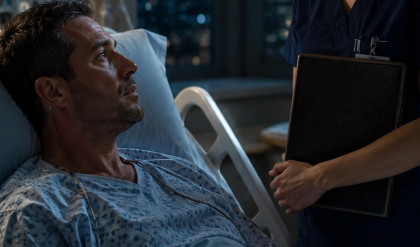
Adrian’s room was quiet, expensive, and too white. Machines hummed softly. Sunlight filtered through sheer curtains. He lay in bed, thinner than he had looked at the park, skin nearly translucent, dark eyes still painfully alert.
He turned his head when Lena entered.
One look at her face and he knew.
“Isla.”
“Kozlov took her.”
Adrian closed his eyes.
Not in weakness.
In grief.
Then he opened them and became, for a moment, the man every enemy had feared.
“Tell me everything.”
Marcus did.
The camera.
The card.
The call.
The compound.
Adrian listened without interrupting. Only his hand betrayed him, gripping the sheet until his knuckles whitened.
When Marcus finished, Adrian reached for his phone.
“Rodriguez,” he said when the call connected. “I need your team. Now. Kozlov’s Harrisburg compound.”
Lena stepped forward.
“You cannot leave this bed.”
Adrian looked at her.
“If trading what’s left of my life gets Isla out, that is the first clean bargain I’ve made in years.”
“No.”
“Yes.”
“You don’t get to die heroically and call it fatherhood.”
Pain crossed his face.
“No. I don’t. But I get to protect her now.”
Lena hated him for being right.
She hated him for being dying.
She hated him for arriving too late and still being necessary.
“I’m going,” she said.
Adrian’s eyes sharpened. “Absolutely not.”
“That is my daughter.”
“And walking into Kozlov’s compound untrained—”
“I spent nine years surviving your world without your help.” Her voice shook, but did not break. “Do not stand there now and tell me what I can’t survive.”
Marcus looked at Adrian.
“She’s coming,” he said.
Adrian exhaled.
Then nodded.
“No improvising,” he said to Lena. “You do exactly what Marcus tells you.”
Lena’s smile was bitter.
“Still giving orders from a deathbed.”
“Old habits.”
“Then break this one.”
He looked at her.
“Please,” he said.
The word silenced the room.
Adrian Voss did not say please.
Not before.
Lena nodded once.
For Isla.
Not for him.
The team assembled within hours.
Men and women with hard eyes and quiet movements filled the hospice conference room. Rodriguez, compact and scarred, spread blueprints across a table.
“Front gate is suicide,” he said. “East service entrance is possible but exposed. Drainage tunnel here gets us inside the perimeter.”
“Cameras?” Marcus asked.
“Everywhere. Chen can loop feeds for ten minutes. Maybe twelve.”
“Isla’s likely location?”
Rodriguez tapped the second floor.
“Kozlov likes theatrical control. Study or private library. Somewhere he can stage the exchange.”
Adrian sat in a wheelchair at the head of the table, an IV hidden beneath his sleeve, his breathing shallow but steady.
He looked like death.
He sounded like command.
“If anything goes wrong,” he said, “you prioritize the child. Not me.”
No one argued.
Lena stared at him.
He did not look away.
At dusk, they drove toward Harrisburg.
Adrian rode in the back beside Lena, a blanket over his legs, his face gray from pain he refused to mention.
For miles, neither of them spoke.
Finally, Lena said, “If she dies—”
“She won’t.”
“You don’t know that.”
“No,” Adrian said. “But if I let myself think anything else, I will be useless.”
She looked out the window.
Trees blurred past in black lines.
“Did you think about her?” she asked.
“Every day.”
“Don’t say that because it sounds good.”
“I thought about a child I had no right to imagine,” he said. “Whether she looked like you. Whether she hated me. Whether she was safer because I stayed away.”
Lena’s throat tightened.
“She asked me once if you didn’t want her.”
Adrian closed his eyes.
The pain on his face was worse than anger.
“What did you say?”
“That it wasn’t true.”
“Thank you.”
“I didn’t do it for you.”
“I know.”
The compound lights appeared in the distance like a warning.
Marcus turned off the headlights.
The final approach happened in darkness.
No one spoke after that.
PART 7: THE STUDY WHERE A FATHER WAS MADE
The drainage tunnel smelled of mud, rust, and old water.
Lena crawled through it on her hands and knees behind Marcus, every breath scraping her throat. Somewhere ahead, men moved with weapons. Somewhere above them, her daughter was alive or not, afraid or not, waiting or not.
She refused every thought that ended in not.
The team breached the basement at 11:42 p.m.
Silent.
Fast.
Brutal.
Two guards went down before they could make a sound. Chen looped the cameras. Rodriguez cleared the service corridor. Marcus kept Lena behind him until she wanted to scream.
Adrian was not with them.
That had been the plan.
He would arrive at the front at midnight in full view, offering himself while the team moved from inside.
Kozlov wanted theater.
Adrian would give him theater.
Lena wanted her daughter.
That was all.
They reached the second floor.
Voices came from behind heavy double doors.
Kozlov’s study.
Marcus held up one hand.
Wait.
Inside, Isla’s voice spoke.
“I’m not scared of you.”
Lena nearly collapsed.
Alive.
Her baby was alive.
Kozlov laughed.
“You should be. Fear is intelligent.”
“My mom says fear is information. Not instructions.”
Adrian’s voice came next, weaker but steady.
“She sounds like her mother.”
Lena pressed a hand over her mouth.
Marcus leaned close.
“Not yet.”
Inside the study, Adrian stood facing Victor Kozlov with Marcus’s absence unnoticed because all eyes were on the dying man who had walked willingly into the room.
Kozlov was elegant in a cream suit, silver hair slicked back, eyes pale and bright with pleasure.
Isla sat in a chair near the fireplace, wrists bound but posture upright.
Adrian looked at her once.
Only once.
If he looked longer, he might break.
“Let her go,” he said.
Kozlov smiled.
“You always were direct.”
“You wanted me. I’m here.”
“And the mother?”
“Not part of this.”
Kozlov laughed softly. “Women and children are always part of this. Men like us pretend otherwise until we need leverage.”
Adrian’s breathing hitched.
Kozlov noticed.
“Cancer has humbled you.”
“No,” Adrian said. “Regret did that first.”
Isla’s eyes filled with tears.
She had never seen him like this. Not as the man from stories. Not as the dangerous father she was unsure how to feel about.
A dying man standing between her and a monster.
Kozlov stepped closer.
“I waited nine years for this. Do you know that? Nine years of watching you build a kingdom while your little secret ran from city to city. I could have taken them sooner, but where is the art in that? No. First you had to find them. First you had to care.”
Adrian’s face hardened.
“You talk too much.”
Kozlov’s smile vanished.
He struck Adrian across the face.
Isla cried out.
Lena heard it through the door and surged forward.
Marcus caught her.
“Not yet,” he hissed.
Adrian straightened slowly.
Blood darkened the corner of his mouth.
Isla’s voice broke.
“Stop.”
Adrian looked at her then.
“It’s all right.”
“No, it’s not.”
“No,” he said softly. “It isn’t.”
Kozlov moved behind Isla and rested a hand on her shoulder.
Adrian’s eyes changed.
“Take your hand off my daughter.”
My daughter.
The words struck everyone differently.
Kozlov smiled.
Isla began to cry silently.
Lena shook in Marcus’s grip.
Adrian had no right to the phrase.
And yet, in that room, he earned it one heartbeat at a time.
“The exchange,” Kozlov said. “You stay. She leaves.”
“Yes.”
“And the mother?”
“She leaves too.”
“You are not in a position to negotiate.”
“I am the only reason you’re enjoying yourself,” Adrian said. “Hurt them, and all you have is a dead man sooner than expected.”
Kozlov studied him.
Then laughed.
“Fine.”
He nodded to a guard.
The guard cut Isla’s wrists free and shoved her toward the door.
Marcus kicked the doors open.
Chaos erupted.
The first shots shattered the lamps. Rodriguez’s team moved from both sides. Lena dropped low as Marcus pulled Isla toward her.
“Mom!”
Lena caught her daughter so hard they both fell.
“I’ve got you. I’ve got you.”
Adrian turned at the sound.
For one second, his face softened.
Then Kozlov grabbed him.
A gun pressed under Adrian’s jaw.
“Everyone stop!”
The room froze.
Kozlov dragged Adrian backward.
“Touch me and he dies.”
Adrian laughed.
It was faint.
Almost peaceful.
“I’m dying anyway, Victor.”
Kozlov’s face twisted.
“You think that makes you brave?”
“No.” Adrian looked at Isla. “It makes me available.”
Lena understood before anyone else did.
“No,” she whispered.
Adrian’s eyes found hers.
There was apology there.
Love too, perhaps.
But not the old kind. Not the wanting kind. Not the owning kind.
The kind that let go.
“Go,” he said.
Kozlov snarled and pulled him toward the private elevator.
Marcus moved to shoot.
Adrian shook his head once.
Don’t.
Kozlov’s men regrouped around the elevator. Too many angles. Too much risk. Isla clung to Lena, sobbing now.
“Daddy!”
The word tore through the room.
Isla had never called him that before.
Adrian’s face broke.
Completely.
“I love you, Isla,” he said. “I’m sorry I wasn’t there. I’m sorry for all of it.”
Kozlov dragged him backward.
“But I’m here now,” Adrian said, voice rough and failing. “And this is what fathers do.”
The elevator doors began closing.
“They protect their children,” he said, “even if it costs everything.”
The doors shut.
For one heartbeat, nobody moved.
Then Marcus grabbed Lena’s arm.
“We go.”
“No!”
“We go now!”
“They’ll kill him!”
Marcus’s eyes were wet, but his voice stayed hard.
“He made his choice. We honor it by living.”
Lena fought him.
Isla screamed.
Rodriguez’s team dragged them through smoke, down the service stairs, out through the east corridor as gunfire erupted behind them.
Outside, cold mountain air hit Lena’s face.
They were shoved into a black SUV.
The engine roared.
The compound vanished behind trees.
Lena held Isla against her chest and tried not to imagine what was happening in that study.
She failed.
Isla sobbed until her body shook.
“It’s my fault.”
“No,” Lena said fiercely.
“If I didn’t exist—”
“Do not finish that sentence.” Lena pulled back and held Isla’s face in both hands. “You are not the reason men did terrible things. You are the reason one man finally did one right thing.”
Isla cried harder.
Lena held her.
The road unspooled into darkness.
Behind them, Adrian Voss died in a place built by violence, paying with the only thing he had left.
His life.
It was not enough to erase the past.
But it was enough to change the ending.
PART 8: THE LETTER HE LEFT BEHIND
Marcus brought them to a safe house three states away.
Rural Pennsylvania.
A place with no name Lena heard spoken twice.
The house was clean, anonymous, and stocked with clothes that fit too well. Marcus had planned for everything except the expression on Isla’s face.
That, no one could prepare for.
Isla did not speak for six hours.
She sat on the edge of the bed holding the white gold ring in her palm.
Lena sat beside her and waited.
Motherhood, she had learned, was often the agony of not filling silence too soon.
Finally, Isla said, “How long did he know me?”
Lena swallowed.
“One afternoon.”
“And he died for me.”
“Yes.”
“That doesn’t make sense.”
“No,” Lena said. “It doesn’t. Not the easy kind.”
Isla looked at her.
“Did he love me?”
Lena thought of Adrian’s face in the study. The way the word daughter had changed the air. The way he had looked at Isla as if seeing the meaning of his life only when it was too late to live it.
“Yes,” Lena said. “In the time he had, he loved you.”
Isla’s mouth trembled.
“I wish he had more time.”
“So do I.”
It was the first honest grief they shared.
Not for the husband Lena lost.
Not for the father Isla never had.
For the man Adrian almost became before death took him.
Three days later, Marcus gave Lena a box.
“He asked me to give this to you only if he didn’t make it.”
Lena stared at it.
“I don’t know if I want it.”
“I know.”
But she took it.
Inside were three letters.
One for Lena.
One for Isla.
One marked For when she is old enough to hate me properly.
Despite herself, Lena almost laughed.
Then cried.
She read hers alone in the kitchen after Isla slept.
Lena,
If you are reading this, then I failed to survive but succeeded at something more important.
I do not know how to apologize for a life. A sentence is too small. A letter is worse.
You were never nothing. You were never invisible. I was blind in ways that served me, and because blindness served me, I called it strength.
I signed the divorce with relief because I thought I was freeing myself from weakness. I did not understand that you were the only good witness to whatever humanity I had left.
You gave Isla life. You gave her safety. You gave her years I could not have given her without making her a target. I know running cost you. I know my world stole peace from both of you even when I was absent.
The accounts Marcus gave you are clean. The properties are beyond my organization’s reach. Marcus has instructions to dissolve what remains that could lead danger to you. He will protect you if you let him, but he will not control you. I made him swear that.
Tell Isla nothing pretty about me unless it is true.
Tell her I was dangerous. Tell her I was proud. Tell her I failed her mother before she was born.
Then tell her, if you can, that at the end I saw her face and understood what my whole empire was worth.
Nothing.
Live, Lena.
Not as Mara. Not as Emma. Not as any name fear gave you.
Live as the woman I was too late to see.
Adrian.
Lena folded the letter with shaking hands.
For a long time, she sat in the kitchen listening to the refrigerator hum and Isla breathing faintly through the baby monitor Marcus had set up even though Isla was nine and insisted she was not a baby.
Then Lena did something she had not done in nine years.
She said Adrian’s name without fear.
“Goodbye.”
The news of Kozlov’s death came a week later.
Not from police.
From Marcus.
“Kozlov’s organization is gone,” he said.
Lena looked at him across the safe house kitchen.
“You mean dead.”
“I mean gone.”
She did not ask details.
She had spent too many years close to darkness to pretend she did not understand what men like Marcus meant when they became careful.
“And Adrian?”
Marcus’s face changed.
“He was found at the compound.”
“Did he suffer?”
Marcus looked away.
“Yes.”
Lena closed her eyes.
She had wanted truth.
Truth was cruel.
“Did he know we got out?”
“Yes,” Marcus said. “Kozlov told him before the end. Thought it would hurt more.”
Lena opened her eyes.
“Did it?”
“No,” Marcus said quietly. “I think it let him go.”
Isla listened to her letter that night.
Lena read it aloud because Isla asked her to.
Adrian’s words to his daughter were shorter.
Isla,
I do not know your favorite song. I do not know how you take your eggs or whether you like storms or whether you sing when you think no one hears you.
I know your favorite color is purple. I know you ask questions directly. I know you are braver than any child should have to be.
I missed your whole life, and that is my fault.
You owe me nothing. Not grief. Not love. Not forgiveness.
But if someday you wonder whether you were wanted, know this: by the time I met you, my life was almost over, and you were still the best thing that had ever happened in it.
Be kind like your mother. Be sharp like yourself. Be free of me.
Your father,
Adrian.
Isla cried into Lena’s lap for a long time.
Then she whispered, “I don’t want to run anymore.”
Lena stroked her hair.
“We won’t.”
“How do you know?”
Because Kozlov was gone.
Because Adrian was gone.
Because fear had become habit, and habits could be broken.
Because her daughter deserved a better inheritance than escape routes.
“I know,” Lena said.
And this time, she chose to believe herself.
PART 9: THE WOMAN WHO STOPPED DISAPPEARING
They did not return to any old name immediately.
That would have been foolish.
Marcus moved them one final time to a coastal town in Maine where the ocean was gray, the people were practical, and nobody cared much who you had been if you paid your bills and shoveled your walkway.
But this time, Lena chose the name.
Not Sarah.
Not Adrian.
Not fear.
She became Lena Hart again quietly, legally, carefully, with Marcus’s help and a judge who owed Adrian nothing but owed justice something.
Isla kept Clark for a while.
Then, at twelve, she asked to become Isla Hart.
“I don’t want Voss,” she said, sitting across from Lena at the kitchen table. “But I want to know where I came from.”
Lena nodded.
“That makes sense.”
“Does it hurt your feelings?”
“No, baby.”
“It’s not because of him exactly.”
“I know.”
Isla traced a finger along the rim of her glass.
“It’s because I’m tired of feeling like a fake person.”
Lena reached across the table and took her hand.
“Me too.”
They built a life slowly.
Not dramatically.
No sudden healing. No perfect new beginning.
Lena worked in medical billing first, then trained for patient administration at a clinic near the harbor. She learned the names of neighbors. She bought furniture she intended to keep. She planted herbs in pots along the kitchen window and cried the first winter when they survived the frost because survival without movement still felt miraculous.
Isla returned to school.
At first, she trusted no one.
She kept her backpack packed. She memorized exits. She asked teachers too many questions about emergency procedures.
Then she made a friend named Nora who talked too much and loved marine biology.
Then another named Sam who taught her chess and lost to her constantly.
At thirteen, Isla joined the debate team.
At fourteen, she stopped flinching when cars slowed near the house.
At fifteen, she asked Lena for the box.
Adrian’s box.
The ring. The letters. A photograph Marcus had added later from Adrian’s private files—Lena on their wedding day, not looking at the camera but laughing at something outside the frame.
Isla sat on Lena’s bedroom floor and went through everything with quiet reverence.
“Were you happy here?” she asked, holding the photo.
“For a moment,” Lena said.
“Do you regret marrying him?”
Lena sat beside her.
The question had once seemed simple.
Now, with time between her and the wound, it was not.
“If I hadn’t married him, I wouldn’t have you.”
“That’s not an answer.”
“It’s the truest one I have.”
Isla accepted that.
Then she slipped the ring onto a chain and put it around her neck.
Lena’s chest tightened.
“You don’t have to wear that.”
“I know.”
“People may ask.”
“I’ll say it belonged to my father.”
Lena’s throat burned.
“And if they ask what he was like?”
Isla touched the ring.
“I’ll say he was complicated.”
Lena smiled sadly.
“That’s generous.”
“No,” Isla said. “It’s accurate.”
Years passed in ordinary ways.
That was the miracle.
Isla got her driver’s license and drove too carefully for the first six months. She went to college on a scholarship and called Lena every Sunday until finals week, when she forgot and then sent three apology texts in a row. She studied criminal psychology, which made Lena uneasy until Isla said, “I’m not studying him. I’m studying how people stop becoming him.”
Marcus visited twice a year.
Always with gifts.
Always awkwardly.
He aged into something gentler, though his eyes remained alert. He and Ruth, who eventually moved to Maine after deciding Portland winters had betrayed her, developed a hostile friendship based on arguing about coffee.
One autumn evening, when Isla was twenty-one, she came home from college and stood with Lena on the beach.
The sky was bruised purple. The Atlantic moved in heavy silver folds.
Isla wore Adrian’s ring around her neck.
“I read his second letter,” she said.
Lena looked at her.
“The one for when I was old enough to hate him properly.”
“And?”
“He was right. I did hate him properly for a while.”
“That’s allowed.”
“I hated him for dying after making me care. I hated him for making you run. I hated him for giving me his eyes.”
Lena waited.
Isla looked toward the water.
“But I don’t anymore.”
“No?”
“No. Hate takes too much room. I need that room for other things.”
Lena smiled.
The wind moved through Isla’s dark hair, and for one painful, beautiful second, Lena saw Adrian in the line of her profile.
Not the danger.
Not the empire.
Just the inheritance no running could erase.
“I think he would have liked you,” Lena said.
Isla glanced over. “I know.”
Lena laughed.
“You sound like him.”
“I know that too.”
They walked until the sun sank.
At the edge of the dunes, Isla stopped.
“Do you still miss him?”
Lena looked at the sea.
Did she?
She missed the man he might have become. She missed the apology arriving earlier. She missed the life where fear had not taught her how to pack quickly. She missed the version of herself who loved without escape plans.
But Adrian himself?
The answer was softer.
“I remember him,” she said.
Isla nodded.
“That’s different.”
“Yes.”
That night, Lena sat alone at the kitchen table after Isla went to bed.
The house was warm. The window herbs had grown wild. Ruth’s casserole cooled on the counter. Marcus had sent a postcard from Chicago with no explanation because he believed postcards were safer than texts, even now.
Lena opened Adrian’s letter one last time.
You were never nothing.
You were never invisible.
For years, those words had hurt because they arrived too late to save the woman who needed them.
Now they felt different.
Not healing.
Witness.
She folded the letter and placed it back in the box.
Then she carried the box upstairs and put it in Isla’s room.
It belonged to her now.
The past did not disappear because you survived it.
It became an object you could choose where to place.
Lena returned to the kitchen and turned off the light.
Outside, the ocean kept moving.
For the first time in more than two decades, she did not check the locks twice.
She checked them once.
Then she went to bed.
Not as a ghost.
Not as a fugitive.
Not as Adrian Voss’s discarded wife.
As Lena Hart.
Mother.
Survivor.
Woman seen too late by the man who lost her, but never again invisible to herself.