PART 1:
“She’s laughing,” the airline agent said. “I’m sorry, ma’am. I thought you should know that part.”
I was standing in the kitchen of our Beacon Hill townhouse when the call came in. The kind of rain that doesn’t announce itself — no thunder, no wind, just a cold, methodical soaking of everything left outside. The copper pots above the island caught the light from the hood lamp and threw it back in dull amber. I had been making tea. The kettle had already gone cold.
The agent’s name was Priya. She had a careful, practiced voice, the kind trained to deliver impossible information without inflecting it with opinion. She told me a woman named Madison Hale had attempted to board an international flight at Logan International Airport using my passport. My name. My photo. Except the face didn’t match, and the agent at the gate had caught it before boarding, and now the airline needed to confirm the document’s status.
I asked only one question.
“Is she with my husband?”
Priya paused. Three seconds, maybe four. Long enough to be its own answer.
“There is a Charles Whitmore listed on the same reservation, yes.”
I thanked her. I asked her to preserve every piece of footage from the gate area, the check-in counter, and the terminal entrance between nine and eleven p.m. I gave her the flight number before she offered it. Then I asked her to file the incident report and hold a copy for Detective Marcus Ortiz, Boston Police, who I would be calling next.
“Of course,” Priya said. There was a small, almost imperceptible shift in her voice. Not pity. Something closer to recognition. “Is there anything else you need tonight?”
“No,” I said. “I have everything I need.”
I set down the phone and stood for a moment with both hands on the counter. The granite was cold. The kettle had a ring of dried water around the base where I’d filled it too full. I looked at that ring for a long time.
My marriage ended in that moment. Not in a scream. Not in tears or the theatrical shatter of something thrown at a wall. It ended in a silence so precise I could feel it in my molars, a small, surgical click of something locking into place.
The locked drawer in my office upstairs held things Charles didn’t know existed. He had told me once, early in our marriage — laughing, affectionate, proud of me — that I was the most self-contained person he had ever met. He meant it as a compliment. I had written it down.
I called Detective Ortiz at 9:14 p.m.
I called the airline’s legal department at 9:31 p.m.
I sent one email to Marjorie Bell, my attorney, at 9:47 p.m. The subject line read: We need to meet. Tomorrow. Early.
Then I sat down on the kitchen floor, my back against the island, my knees pulled up, and I allowed myself exactly eleven minutes to feel what it actually felt like. Not to process, not to plan. To feel.
I had loved Charles Whitmore with the particular, careful love of a woman who knows what love costs. I had loved him through his father’s death and the year he drank too much afterward and the slow, difficult climb back. I had loved him through the years when the business was failing and he came home with that specific set of his jaw that meant he needed me to be steady, so I was steady. I had rearranged my consulting work around his schedule, declined partnerships that required relocation, learned to read the rooms he walked into so I could manage them before he noticed they needed managing.
I had loved him well.
I had also, for the past fourteen months, been quietly documenting what love had blinded me to.
At 10:02 p.m., I stood up, rinsed the cold tea down the drain, and made a fresh cup. Then I went upstairs to wait.
Charles came home at 11:43 p.m.
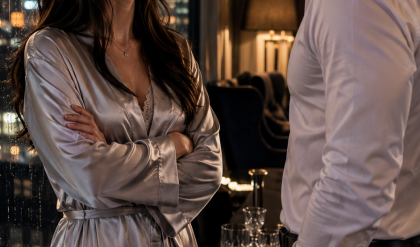
I heard the front door — his particular way of closing it, not quite a slam, the habit of a man who considers himself considerate — and then his footsteps on the stairs. He appeared in the doorway of our bedroom still in his coat. His hair was damp. He had the look of someone who had been rehearsing in the car.
“Vivienne,” he said. “Before you say anything —”
“Sit down, Charles.”
He blinked. Then he sat. Automatically, without argument, the way people sit when the voice they hear is not the one they expected.
“Madison took the wrong document from my briefcase.” He said it steadily, almost gently, like a man delivering a prognosis. “She was nervous, she grabbed it without thinking, and I should have checked before we left. It was a mistake.”
“What a strange accident,” I said.
“I know it looks —”
“My passport,” I said, “was not in your briefcase.”
He stopped.
“It was in the leather document box. In the locked drawer. Of my private office.” I watched him recalibrate behind his eyes — a quick, practiced adjustment, like a man rerouting on the fly. “The only person in this house who has a key to that drawer besides me is you.”
“Vivienne —”
“I’d like you to explain the mechanism of that accident to me.” I kept my voice entirely level. “How she reached into your briefcase and removed a document that was not in your briefcase.”
The silence between us was a different shape than the one earlier. That one had been mine. This one was his — jagged at the edges, looking for a foothold.
“You’re doing this to punish me,” he finally said. “You’ve already called someone.”
“I called several people.”
He stood. He was not a man who processed shock well — it made him aggressive, a defense mechanism so old and ingrained he probably couldn’t see it anymore. He moved to the window, back to me, jaw working. Outside, the rain had not let up.
“She is twenty-six years old,” he said, his voice dropping into something almost reasonable. “She made a stupid mistake and she is terrified right now. I need you to think about what happens if you make this into a police matter.”
“The police matter already has a case number.”
He turned. His face had changed — the practiced gentleness gone, something harder and less attractive taking its place. He had a look I had seen before, though rarely aimed at me. He used it in boardrooms. On contractors who came in over budget. On the landscaper who had planted the wrong hydrangeas two summers ago.
“You have a very comfortable life,” he said.
Three seconds of silence.
“I know you do,” he said. “And I need you to think carefully before you do something you can’t undo.”
I looked at him across the bed — twelve years of a shared bed, our particular arrangements of pillow and blanket, the book on my nightstand I’d been reading for two months because I was always tired, the small ceramic dish where he dropped his watch every night — and I felt the last warm thing in me toward him quietly extinguish.
“Tell me,” I said. “How did she know the drawer existed?”
He did not answer.
“How did she know where my office was? How did she know which key opened which lock?” I tilted my head, genuinely curious, watching him not answer. “You showed her the house, Charles. Didn’t you.”
He looked at me like I had become someone he did not recognize.
Maybe I had. Or maybe he had only ever known the version of me who loved him enough to stay quiet.
I walked past him into the hallway, into my office, and closed the door behind me.…
PART 2:
The office was the only room in the house that still felt entirely mine.
Twelve years ago, when we bought the townhouse, Charles had wanted to turn this room into a media room. I had wanted it as a study. We had negotiated — Charles with his easy confidence, me with my quiet, immovable patience — and I had kept the room. He had gotten the basement bar he wanted instead. At the time he’d laughed it off and called it my “little fortress.”
He was not wrong.
I sat at the desk, opened my laptop, and entered the password he had never known existed. Not the one I used for email, not the one for our shared accounts. The one I had created fourteen months ago, on a Wednesday evening in March, when Charles had taken a call in the garage and I had watched his body language through the kitchen window and known — the way you know, not the way you can prove — that something had changed.
The folder on the screen was titled BLACK SWAN.
I had named it that for two reasons. First: because black swan events are the ones that seem impossible until they happen, and then seem inevitable once they do. Second: because Charles had once told me in our early years that I reminded him of a black swan — something that moved like grace made visible, and was rarer than anyone thought. I had liked that once. Now I wanted it back.
The folder was organized the way I organized everything: by date, by category, by actionability.
Sub-folder one: Financial Anomalies. Bank transfers between December and the present that cleared through an account I’d had to look up. A foundation Charles had mentioned once and never mentioned again. Property documents for a condominium in Charlestown registered jointly between Charles Whitmore and a holding company whose registered agent was one Madison A. Hale.
Sub-folder two: Communications. I had not hacked his phone. I had not violated any privacy I wasn’t legally entitled to. But Charles had, for three years, used our shared tablet to occasionally check his secondary email — a habit he’d developed in the early days of the marriage when he traveled and preferred the larger screen. He had never removed the account. It had simply sat there, syncing quietly, the way things do when you assume no one is looking.
I had not read his emails for fourteen months.
I had screenshotted them and organized them by thread.
Sub-folder three: Logan Airport. This one was the newest. Created tonight, in the seven minutes between my call with Detective Ortiz and my call with the airline’s legal department. It contained one item: a contact name and number for the airline’s security liaison, the case number, and a timestamped note reading footage requested and flagged for preservation.
Sub-folder four: Marjorie Bell. The prenuptial agreement. A document Charles had signed eleven years ago in a moment of what I can only describe, looking back, as spectacular overconfidence. He had laughed through the signing. His own attorney had flagged one particular clause — flagged it, recommended against it, watched Charles wave him off with the breezy certainty of a man who cannot conceive of losing.
The clause was fourteen lines long.
I had read it so many times I could recite it.
Charles knocked on the office door at half past midnight.
“Vivienne.” His voice was different. Softer. The boardroom version had retreated; this was the voice he used when he was genuinely uncertain, the voice I had fallen in love with, actually, because it was the only time he sounded like someone who needed something. “Can we talk? Please?”
I did not open the door. “We can talk through the door.”
A pause. “I don’t want to talk through the door.”
“I know.”
Another pause. Longer. I heard him exhale — a long, carefully controlled breath, the kind that precedes a pivot in strategy.
“I made a mistake,” he said. “A serious mistake. I know that. I’m not trying to minimize —”
“Charles. Stop.” I kept my voice conversational, not unkind. “I’m going to tell you something true, and I need you to hear it rather than looking for the counterargument. Are you listening?”
Silence. Then: “Yes.”
“I know more than you think I know. Not some of it. Most of it. I have known for fourteen months that something had changed, and I spent fourteen months making sure that when this moment came, I would have everything I needed to handle it correctly.” I paused. “The question you should be asking yourself right now is not how to convince me you’re sorry. The question is how much of what I know you are comfortable having presented to a judge.”
The silence on the other side of the door lasted a long time.
“Vivienne,” he said. His voice was different now. Quieter. Something young in it — the way fear sounds in men who are rarely afraid. “What exactly did you —”
“Goodnight, Charles.”
I heard him stand there. I heard him breathe. Then I heard him walk away.
I opened sub-folder four and read the prenuptial clause again, slowly, the way you read something you want to make sure you’ve understood exactly right.
I smiled for the first time in hours.
PART THREE: CHARLESTOWN
Madison Hale was twenty-six years old, and she was, in the particular and legitimate way of the very young and very certain, absolutely convinced she was the protagonist.
I had looked her up — public profiles, the consulting firm where she’d met Charles, a LinkedIn that described her as a “strategic communications specialist” with a headshot in which she looked directly into the camera with the specific confidence of someone who has never had that confidence seriously challenged.
She called me at 7:14 the next morning, while Charles was still asleep in the guest room and I was already dressed, already caffeinated, already in a car to Marjorie Bell’s office.
“Mrs. Whitmore,” she said. She did not say she was sorry. I noted that. “I think we should talk before this goes any further.”
“Good morning, Madison.”
“I — yes. Good morning.” She recalibrated. I could hear her doing it, the small swallow and reset of someone who expected a different opening. “I know last night must have been incredibly upsetting. I want you to know that what Charles and I have — it’s not what you’re imagining. It’s not just —”
“Madison.” I watched the Charles River through the car window, the early light making the water look almost silver. “I’m going to stop you before you say something you can’t unsay. You are already facing a charge of identity document fraud. It’s a federal offense. Anything you say to me without an attorney present is something I am legally permitted to share with Detective Ortiz.”
The line went quiet.
“I don’t suggest we talk further without your attorney present,” I said. “I genuinely mean that as advice, not a threat.”
“You’re not — you seem —” She searched for the word. “You seem very calm.”
“I am.”
“Doesn’t this hurt you?”
I considered the question. Outside, a crew team was on the river, eight oars rising and dipping in perfect unison, the coxswain’s voice too distant to make out but the rhythm of it somehow reaching me through the glass.
“Of course it does,” I said. “But hurt and helpless are two different things.”
I ended the call.
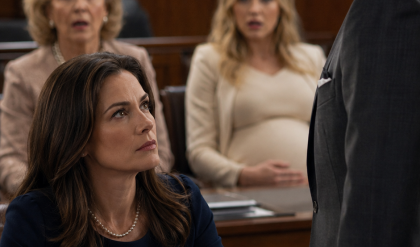
Marjorie Bell had been practicing family law in Boston for thirty-one years. She had the kind of face that had decided somewhere in its forties that it was done performing softness and had settled into something better: absolute attentiveness. She wore reading glasses on a chain and kept a small cactus on the corner of her desk that her assistant called Gerald.
She read everything I’d given her without interruption, which was one of the reasons I trusted her.
When she finished, she took off her glasses, set them on the desk beside Gerald, and looked at me.
“The Charlestown property,” she said.
“Joint registration through the holding company. I have the date of registration — it predates the clause by about two years.”
“The clause states that any financial commitment made to a third party outside the marriage that exceeds fifteen thousand dollars and is established without disclosure —”
“Constitutes a breach,” I said. “Yes.”
Marjorie made a small sound that was not quite a laugh. She slid the prenuptial agreement toward me and tapped the relevant paragraph with one finger. “His attorney flagged this at signing.”
“I know. Charles overruled him.”
“Why?”
I thought about it honestly. “Because he was twenty years into a life where nothing had cost him what he thought it would. He’d learned to discount the fine print.”
Marjorie nodded slowly. She reached for her glasses, thought better of it, left them on the desk. “The footage from Logan.”
“Detective Ortiz has a copy. I have a copy. The airline’s legal team has a copy.”
“What does it show?”
“It shows them arriving together. It shows Madison holding my passport and laughing. It shows Charles leaning in and saying something that makes her laugh harder.” I paused. “It shows them not being confused about what they were doing.”
“Premeditation,” Marjorie said. Not a question.
“The defense will argue she grabbed the wrong document from his briefcase.” I kept my voice level. “That argument requires my passport to have been in his briefcase. My passport was in my locked office drawer. The locksmith I called this morning has confirmed no forced entry to the drawer or the office.”
Marjorie looked at me for a long moment.
“The key,” she said.
“There are two keys. Mine and his.”
She picked up a pen. “Vivienne. I want to ask you something, and I want you to answer honestly.”
“Always.”
“Have you done anything — anything at all — in the past fourteen months that we need to account for? Any access to information you weren’t entitled to? Any—”
“No.” I met her eyes. “I read emails that synced to our shared tablet on an account he never removed. I documented financial information from joint accounts I have legal access to. I took screenshots of what was visible on devices I am authorized to use.” I paused. “I was very careful, Marjorie. I knew this moment would come.”
She wrote something down. “When did you know?”
“That something had changed? Fourteen months ago.” I thought about how to say the next part. “When I knew with certainty — truly knew — last night, when she laughed at my passport. That told me everything I needed to know about how I had been seen.”
Marjorie set down the pen and looked out the window at the river.
“He thought you’d protect him,” she said.
“He thought my comfort came from him,” I said. “He thought his name was the roof over my head.”
“Is it?”
I almost smiled. “When we married, I had a consulting practice with twelve clients, an investment portfolio I’d built since twenty-three, and enough savings to live on for four years without income.” I looked at Gerald the cactus, who had the small, enduring dignity of something that needs very little to survive. “I loved him, Marjorie. That’s the only thing he gave me that I couldn’t have built myself.”
She nodded. She picked up the prenuptial agreement.
“Let’s talk about how we want to proceed,” she said.
PART FOUR: WHAT A COMFORTABLE LIFE LOOKS LIKE
Charles retained an attorney named Harrison Webb, who had the demeanor of a man deeply accustomed to making problems quietly disappear through the application of sufficient pressure and sufficient check-writing.
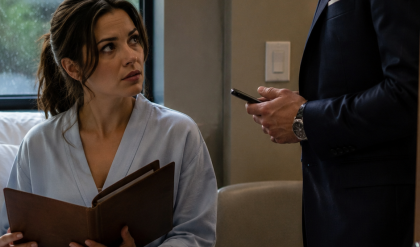
Harrison Webb’s first move was to request an in-person meeting, just the two of us — no attorneys, informal, “to see if there’s a path through this that doesn’t require the courts.” He called it, in an email to Marjorie that I was copied on, “an opportunity for an adult conversation.”
I thought about that phrase for a moment. Adult conversation. As though what Charles had been engaged in for the past fourteen months had been something other than a performance of arrested adolescence.
Marjorie declined on my behalf.
Harrison Webb’s second move was to send a letter suggesting that I had “potentially accessed private communications without authorization” and that this might “complicate the evidentiary picture significantly.”
I read the letter. I noted that it did not deny the Charlestown property, the financial transfers, or the substance of the airport footage. It was a threat dressed as a concern. The tell was in what it didn’t say.
Marjorie’s response was three paragraphs long, the first of which cited the specific statute under which the shared tablet’s email sync was entirely legal given my status as joint account holder on all relevant devices, the second of which laid out the property registration date relative to the prenuptial clause, and the third of which noted that Detective Ortiz had broadened the identity fraud investigation to include questions about how the document had been acquired from a locked private space.
Harrison Webb’s third move was silence.
Charles came to find me on a Thursday afternoon, two weeks after the airport.
I was in the back garden, which sounds peaceful and probably was, in the way that things are peaceful when you’ve stopped waiting for them to be anything other than what they are. The hydrangeas were doing what they always did in October, which was stubbornly refusing to acknowledge that the season was over. I had always admired that about them.
He looked worse than I had expected. Not dramatically worse — Charles was too proud for visible deterioration — but there were new lines around his mouth and he was holding himself differently, the particular posture of a man who has discovered that his confidence was always partly borrowed.
“I want to talk,” he said. “No attorneys.”
“Marjorie has advised —”
“I know what Marjorie has advised.” He stopped at the edge of the stone path, his hands in his coat pockets. “I want to talk to you. Not to your legal representation. To you.” He looked at the hydrangeas instead of at me. “I think I deserve that much.”
I considered it. “Five minutes.”
He sat across from me on the iron bench I had brought from my apartment twelve years ago, the one he had always called too old and too heavy and had never managed to convince me to replace.
“I never thought you would —” He stopped. Started again. “I thought you needed me,” he said. “I thought —” He rubbed the back of his neck. “I know how that sounds.”
“How does it sound?”
“Arrogant.” A pause. “Stupid.”
I waited.
“Madison said —” He caught himself. Made a decision I could see him make, consciously, to not bring her name into this garden. “I told myself it was separate. That it didn’t touch us. That you would never need to know because it was never going to matter.”
“And when she laughed at my passport?”
He was quiet for a long time. Around us, the rain that had followed us all through this was finally, tentatively, considering stopping.
“She didn’t mean it as disrespect,” he said. “She was nervous. When she’s nervous she —”
“Charles.” I said his name quietly, not harshly. “I am not asking about Madison. I am asking about you. I am asking what it was like to stand there and watch her hold my face up like a punchline, and to have done nothing.”
Something moved behind his eyes. Something real — possibly the first real thing I’d seen in this conversation.
“I froze,” he said.
“Yes.”
“I should have —”
“Yes.”
He looked at me. “I don’t know who you’ve become,” he said. “Or if this was always who you were and I just —”
“Didn’t look,” I said.
He nodded once. A small, honest nod.
“I loved you,” I said. “I want you to hear that in the past tense and understand that it’s not a performance. I loved you, and I would have stayed, and I was staying, and what changed was not that I discovered you had been unfaithful.” I held his gaze. “What changed was learning what you thought my silence was worth.”
He opened his mouth.
“My comfortable life,” I said. “That sentence, Charles. That is what this is actually about.”
He looked away. At the hydrangeas, at the old iron bench, at the garden that had been mine long before it was ours.
“What do you want?” he asked. “Tell me what you actually want, and I’ll —”
“I want the Charlestown property listed and the proceeds handled according to the prenuptial clause.” I spoke plainly, without heat. “I want documentation of all financial arrangements with Madison Hale’s holding company. I want us to agree on a settlement that does not require us to be enemies, because I don’t have the energy for enemies and I don’t think you do either.” I paused. “And I want Madison’s attorney to understand that the identity fraud charge stays active as long as I need it to.”
He stared at me. “That’s it? No —” He seemed to be searching for the dramatic gesture he’d prepared for. The retribution he’d steeled himself to absorb. “No rage?”
“I’m not interested in rage,” I said. “I’m interested in accuracy.”
PART FIVE: WHAT’S LEFT
The settlement took four months.
Harrison Webb made three more attempts at creative pressure and one genuine attempt at reasonable negotiation, which was the only one any of us responded to. Madison Hale’s attorney arranged a meeting in which she agreed to a deferred prosecution agreement on the identity fraud charge, which meant the charge remained on record and could be activated if anything she’d agreed to turned out to be untrue. Detective Ortiz, who had the quiet thoroughness of a man who had seen worse and remained undisturbed by it, handled that piece with considerable efficiency.
The Charlestown condominium sold in February. The prenuptial clause was precise and unambiguous and Harrison Webb, to his credit, had ultimately recognized a losing argument when he was facing one. The financial irregularities were documented, disclosed, and accounted for in the settlement terms.
I moved into an apartment in the South End in January, before the sale closed, before the settlement was finalized, because I had learned a long time ago that the body needs to believe in the new beginning before the paperwork catches up.
The apartment had tall ceilings, south-facing windows, and a study with a door that locked from the inside. I put the leather document box — empty now, or nearly — on the shelf above the desk. I kept Gerald the cactus, because Marjorie had offered him to me on a whim and he suited the study, and because something about him — small, self-sufficient, asking very little, growing anyway — appealed to me.
I called Priya, the airline agent, in March. She sounded surprised to hear from me.
“I wanted to tell you the outcome,” I said. “I don’t know if that’s strange.”
“No,” she said. After a beat: “I’m glad you did.”
“You told me she was laughing,” I said. “You didn’t have to tell me that. You could have left it at the facts.”
Priya was quiet for a moment. “I thought you deserved to know how it actually looked,” she said. “Not just what happened. How it looked.”
“It changed what I knew,” I said. “It mattered.”
My consulting practice had gone quiet during the marriage. Not by force — Charles had never forbidden anything, had never been the kind of man who issues prohibitions. It had gone quiet the way things go quiet when you organize your life around someone else’s volume: gradually, accommodatingly, so slowly you don’t notice the room has gotten smaller.
In March, I called two clients I hadn’t spoken to in three years.
In April, I accepted a project I’d have turned down in the marriage because it required six weeks in London.
In May, I went to London.
I worked late and ate at restaurants where I chose the table and the time and the menu without consulting anyone. I walked along the Thames in the mornings before the city properly woke up. I bought myself a new leather document box — smaller than the old one, dove grey — and filled it with nothing but current papers, because the thing about keeping records is that eventually you stop needing all of them.
I did not think about Charles very often. When I did, it was not with bitterness — or it was, sometimes, for a moment, and then it passed. What lingered was not anger but a kind of anthropological curiosity: how had he believed, right up to the end, that the woman he had built a life with had no architecture of her own?
I thought about that sentence more than any other. You have a very comfortable life.
He had meant it as a reminder of what I stood to lose. He had not considered — had genuinely, I think, not been able to conceive — that I had read it as a statement of his own misunderstanding. He thought comfort was his gift to me. He had missed, entirely, that I had been providing most of my own comfort for years, and that his contribution had always been the part I could least quantify, which was love, and which was therefore the only part I actually mourned.
You lose love. That’s real. That’s the thing that costs.
But you do not lose yourself. Not if you’ve been paying attention.
On a Tuesday in late May, I sat in a café near my London hotel with a coffee I had chosen and a notebook I was using to sketch the outline of a new project, and my phone rang.
It was a number I didn’t recognize. I almost didn’t answer.
“Mrs. Whitmore,” a voice said. Then caught itself. “I’m sorry — Ms. —”
“Vivienne is fine,” I said.
“This is Annalise Ortega. I’m a journalist with —” She named the publication. “I’ve been covering the Logan Airport identity fraud case, and I wanted to reach you for comment. We’re running a piece about —”
“About the federal case, or about my marriage?”
A pause. “Both, honestly.”
I looked out the café window. London was doing what London does in May, which is produce a pale, determined sunshine that makes everything look temporary and beautiful.
“Tell me,” I said, “what angle you’re planning to take.”
She told me. It was not the angle I expected — not the scorned wife, not the dramatic exposé. It was something quieter. She was writing about women who choose precision over panic. About the gap between what people expect when a woman discovers betrayal — the collapse, the spectacle, the public grief — and what some women actually do.
“How did you find me?” I asked.
“Detective Ortiz,” she said. “He said —” She paused. “He said you were the most prepared person he’d met in twenty-two years on the job. He said it like it was the highest compliment he knew how to give.”
I thought about that. “It was.”
“Would you be willing to talk? On the record?”
I looked at the notebook in front of me. The outline of the new project. The empty pages waiting.
“Not yet,” I said. “But keep my number.”
The hydrangeas at the Beacon Hill townhouse — which was sold in April, the proceeds divided according to the prenuptial clause, every calculation precise — were probably doing what they always did. Refusing to acknowledge the season. Growing anyway.
I had taken one thing from that garden when I left.
The iron bench was too heavy to move. The hydrangeas were not mine. But tucked against the garden wall, half-buried in the mulch Charles had always complained needed replacing, there was a small terracotta pot with a black-eyed Susan that had self-seeded years ago from nowhere. I had never planted it. It had arrived and stayed.
I had dug it up on my last day in the house and carried it out in a plastic bag, roots and all, slightly absurd, completely deliberate.
It was on the windowsill of my South End apartment now, next to Gerald, looking out at the January cold with the patient stubbornness of something that has survived worse.
I had started talking to it. Just briefly, in the mornings. Nothing dramatic.
Good morning. Still here. Me too.
There is a thing that happens when you have spent a long time being very still and you finally start moving again: you discover that you are faster than you thought. Not faster than before — faster than you have been in years, because all that stillness was the compound interest of restraint, and now it is yours to spend.
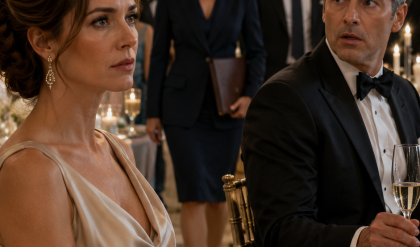
I spent it in London, and then in a partnership I’d been offered in 2019 and declined, and then in a Monday evening in October — exactly one year after the airport, almost to the day — in a dinner party at a friend’s apartment in Cambridge where I laughed at something and didn’t check, reflexively, whether the laugh was too loud or whether I was taking up too much space.
It was a very small thing.
It was enormous.
At the end of the evening, walking home along the river, I stopped for a moment and stood in the October air, which smelled of dead leaves and cold water and something faint and sweet I couldn’t identify, and I looked at the water for a while.
The river doesn’t care who crosses it. It carries everything — the crew teams at dawn, the tourist boats, the rain from a year ago that hit the windows of a townhouse where a woman stood with a cold kettle and made the most important phone call of her life. The river takes it all and moves with it.
I took out my phone, opened a folder, and deleted BLACK SWAN.
Not because I needed to forget. Because I no longer needed it to protect me.
I walked home. I made tea. I drank it while it was still hot.
That, it turned out, was what a comfortable life actually looked like.
“You have a very comfortable life.”
He was right. He just didn’t understand who built it.
END