The Wife He Erased — Who Owned the Floor Beneath His Feet
Part One: The Receipts
“Some men don’t forget what a woman deserves.”
I read it three times. Then I set my phone face-down on the kitchen counter, very carefully, the way you set down a glass you know is cracked.
Outside, the Gulf was doing what it always did at six in the morning — pulling back from the shore in long silver sheets, indifferent and gorgeous. I had imagined watching it from a balcony at The Marlowe. I had imagined the white bougainvillea. I had imagined thirty-five feeling, finally, like something I had chosen.
Instead, I was standing in our Miami kitchen in a robe that cost four hundred dollars and a marriage that had cost considerably more.
I picked the phone back up.
Sloane Paige’s Instagram post was still there. She hadn’t deleted it. Why would she? She didn’t know I existed in any meaningful way — I was the wife, which in Grant’s world was a category, not a person. There she was on my balcony: blonde, champagne-lit, the ocean behind her the exact shade of teal I had described to the concierge when I booked Suite 402 three months ago. White bougainvillea climbed the railing. A silver ice bucket held a bottle I recognized — the Billecart-Salmon rosé, the one I’d noted in the preferences field because it was the bottle we’d had on our honeymoon.
He had used my own honeymoon wine to toast someone else.
I zoomed in on the ring. Cushion-cut, rose gold band. Not my ring. A new ring. And behind her, just visible in the mirror of the plunge pool — Grant’s hand on her white satin waist, his wedding ring turned inward, his Patek Philippe catching the early light.
Some men don’t forget what a woman deserves.
The caption had 847 likes. Three of them were from our mutual friends.
I sat down on the kitchen floor. Not because my legs gave out — I want to be precise about this — but because I needed to be close to something solid. The marble was cold through the robe. I pressed my palm flat against it and breathed.
Then I opened my laptop.
I had always been better at facts than feelings. It was the thing Grant loved about me in the beginning, before he learned to use it as an insult. You’re so clinical, Elena. Do you feel anything?
I felt everything. I simply knew that feelings required a foundation. You couldn’t build a case on grief. You built it on evidence.
By seven a.m., I had the Bellweather Holdings reservation records open on one screen, our household account statements on another, and Sloane Paige’s social media — all of it, going back fourteen months — on a third. I made coffee. I drank it standing up.
The suite had been transferred from my name to Grant’s on the same afternoon he called me from “Atlanta.” The call logs showed he’d been in Florida. Palmetto Key, specifically — forty minutes from The Marlowe’s private boat launch.
He had been on the island while he told me money was tight.
He had been on my balcony while I canceled dinner reservations and rescheduled my own birthday.
I went through the household account line by line. The suite, three nights at the nightly rate I had negotiated as a property owner. Room service, twice a day. The Marlowe spa, a full day, two guests. The boutique charge — Marlowe Boutique, women’s formalwear — was four thousand, two hundred dollars. That would be the white satin dress. The one Sloane had been photographed in the lobby wearing, one hand trailing a garment bag, sunglasses on, smiling the smile of a woman who believes she has won something.
The ring dinner came last. Marlowe Private Dining — celebration menu, 2 guests, champagne service — listed two days before his “Atlanta” trip began.
He had proposed to her while I was his wife.
With my money. In my hotel.
I finished my coffee. I opened a new document. At the top I typed: What Grant Whitaker Does Not Know.
It was a short list, but it was enough.
He did not know that Bellweather Holdings was mine.
Seven years ago, when we married, I had structured it that way deliberately — not out of distrust, but out of hard experience. I had watched my mother’s work absorbed into my father’s name like ink into paper, invisible by the time anyone looked for it. Elena Vasquez had become Elena Vale when I was twenty-two, building LumaLedger in a sublet office with three employees and a business loan I paid back eleven months early. When I married Grant Whitaker, I kept the business structures separate. Bellweather held the real estate portfolio. LumaLedger held the tech investments. Grant knew I “had money.” He did not investigate the source because men like Grant — men who have always been the center of their own story — do not investigate the infrastructure of their comfort. They simply live inside it.
He did not know that I was the silent guarantor on Whitaker Capital’s operating credit line. Three years ago, when his firm hit a liquidity wall, I had arranged the bridge through a Bellweather subsidiary. It was structured as a third-party guarantee. His banker knew. Grant did not — I had been told, gently, that his ego was the primary concern, and I had agreed because I was still operating under the belief that protecting Grant’s ego was the same as protecting our marriage.
He did not know that Patrick Henderson, whose billion-dollar partnership Grant was about to announce at the Devereaux Club gala, had originally been introduced to Grant through my network. Henderson’s family had invested in LumaLedger’s Series B. I had mentioned Grant’s firm offhandedly at a dinner four years ago. Henderson had followed up. Grant had called it his “biggest get.”
He did not know about the Bellweather commitment letter — a document that had crossed my desk two weeks ago, that I had not signed, that bore a signature I recognized as a very competent forgery of my own.
That last item I had discovered at five-thirty in the morning, forty minutes after sitting on the kitchen floor, when I pulled the Henderson deal files from the Bellweather server to see if there was any trail. There was. Grant had been using Bellweather’s name — my name, my maiden name, the company I had built before he ever knew I existed — to back a deal structure I had never seen and never approved.
I stared at the forged signature for a long time.
Then I picked up the phone and called Camille Brooks.
She answered on the second ring. Camille had been my attorney for nine years. She did not say hello. She said, “Tell me everything and don’t editorialize.”
I told her everything and did not editorialize.
When I finished, she was quiet for four seconds — I counted. Then: “The gala is tonight.”
“Yes.”
“Grant will be there with her.”
“That’s my assumption.”
“Elena.” Her voice was very even, the way it got when she was thinking quickly. “I need you to not do anything for the next eight hours that you haven’t cleared with me first.”
“I know.”
“I mean it. Not a text. Not a call. Not a look across a dinner table.”
“Camille. I understand.”
A pause. “How are you?”
I looked at the documents open on my screen. The forged signature. The hotel charges. The transfer of my suite. The ring celebration dinner. The caption: Some men don’t forget what a woman deserves.
“I’m focused,” I said.
Part Two: The Education of Sloane Paige
Grant came home at four in the afternoon. He came in through the garage, which meant he didn’t see my car. He went upstairs, showered, and I heard him on a call — his voice doing the thing it always did when he wanted to sound important, slightly lower, slightly slower, a performance of gravitas I had once found attractive.
I sat at the kitchen table with the folder Camille had messengered over and waited.
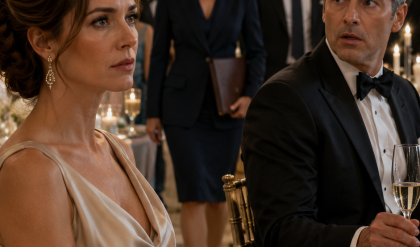
He appeared in the kitchen doorway in his tuxedo. He looked exactly like what he was: handsome, sixty-two, the kind of man who had been told his whole life that the room was his the moment he entered it. He saw me and stopped.
I was wearing the black Valentino. Hair pinned. Earrings that had belonged to my grandmother, who had also built things and been erased.
“You look—” he started.
“We should leave in twenty minutes,” I said. “Traffic on Brickell.”
He watched me for a moment. Something moved behind his eyes, some small animal of suspicion, but Grant Whitaker had spent forty years trusting his own comfort over his instincts. He adjusted his cufflinks. “Right. Sure. I’ll get the car.”
In the car, he spoke about the Henderson deal. He was luminous with anticipation — I could feel it coming off him like heat. He spoke about legacy, about building something that would outlast both of us, about how tonight was the culmination of everything he’d worked toward. He was not lying, technically. He had worked toward this. He had simply used tools he had stolen to do it.
I looked out the window and thought about my mother, who used to say that the hardest thing about loving the wrong person is not the betrayal. It’s the time. The years of expertise you develop in making yourself smaller. The particular genius it takes to disappear inside a life.
“Elena.” He touched my hand, briefly. “You okay?”
“Of course,” I said. “Tonight’s important.”
He smiled. He believed me because he had always believed that my emotional state was his to interpret.
We arrived at the Devereaux Club at eight forty-five.
I saw Sloane before Grant did. She was at the bar in the white satin dress — the four-thousand-dollar dress from my boutique — with a flute of something pale and her phone tilted at the self-aware angle of someone who knows they are being watched. The ring caught the chandelier light every time she moved her hand.
She was twenty-nine, maybe thirty. She was beautiful in the uncomplicated way of someone who had never been told her beauty was provisional. I did not blame her for not knowing. I had not known either, once.
Grant said, “I need to go check on the AV setup. Wait here?”
I waited.
I watched him cross the room toward her. I watched his face change — that private softening, the one I used to think was for me. I watched him touch the small of her back, the gesture of a man who believes that possession is a form of love.
From across the room, she glanced at me. Just once. Assessment, automatic and quick. I held her gaze.
She looked away first.
At nine o’clock, Grant went to the stage for sound check. Sloane was guided to the front by the event coordinator — Grant had put her at Table One, the host table. I found my place card at Table Twelve. Table Twelve was near the kitchen.
A waiter set down a glass of water. My hand was steady. I noticed this and filed it away: my hands are steady.
I took out my phone and texted Camille: On schedule.
Her reply came in eleven seconds: We’re ready. Wait for the screen.
He spoke beautifully. That was the thing about Grant — he had always known how to perform sincerity. He spoke about partnership and vision and the kind of future that required courage to build. He spoke about transparency, which would have been funny if it had not also been a forgery charge and a wire fraud question and the end of everything he thought he had built.
Then he held out his hand to Sloane.
She walked up to the stage in the white satin dress, the ring flashing, and the room did something complicated — some people began to understand, and some people were still deciding what to understand, and some people looked at Table Twelve.
I was already standing.
Every heel strike across the marble sounded like a verdict. I counted them: fourteen steps from Table Twelve to the stage stairs, four steps up, six steps across. Grant saw me when I was ten steps away. The color went from his face in one clean sheet, like a tide going out.
I took the microphone from its silver stand.
The room went very quiet. That particular silence — not the absence of sound but the presence of held breath — is one I will not forget as long as I live.
“My name,” I said, “is Elena Vale.”
I said it again, because he had spent seven years burying it.
“I am the founder of LumaLedger. I am the managing partner of Bellweather Holdings. I am the owner of The Marlowe at Palmetto Key. I am, until this morning, the private guarantor behind Whitaker Capital’s operating credit line.” I paused. “I am also Grant’s wife, though I understand that last one has been renegotiated without my knowledge.”
The screen behind Grant changed.
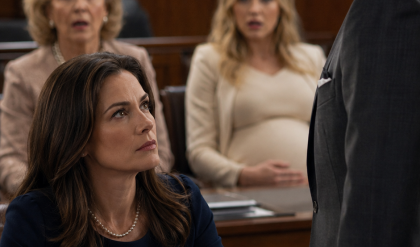
Camille had built the presentation with the precision of a woman who enjoyed the mechanics of consequences. First: Suite 402 at The Marlowe. The balcony. The white bougainvillea. The ocean. Second: the transfer record, my name crossed out, Grant’s name written in. Third: the household account — charge after charge, itemized, dated, annotated. Fourth: the lobby security still, timestamp visible, Sloane in the boutique dress, Grant’s hand on her waist, his ring turned inward.
Fifth: a page I had not seen until Camille sent me a preview at six that evening. It was a Bellweather Holdings commitment letter. It had my signature on it. The signature was excellent. I had never signed it.
The room understood this in sequence, like a fuse burning.
Grant said, very quietly, “Elena. Don’t.”
“You should have learned my name,” I said.
Then I held the envelope out and Patrick Henderson’s face went gray.
Part Three: What Sloane Paige Knew
Camille served the papers below the stage at nine forty-seven p.m. She did Grant’s first, then Sloane’s — the civil suit for fraud, naming Sloane as a co-beneficiary of assets obtained through misrepresentation. Sloane stared at the envelope. The ring caught the chandelier again.
For a moment, looking at her, I felt something I had not prepared for: recognition.
She had believed him. I could see it in the way her face reorganized itself, the same reorganization I had done that morning on the kitchen floor. She had been handed a version of Grant that was tailored for her — generous, romantic, misunderstood by his cold and difficult wife — and she had believed it because she had wanted to, and also because he was very good at what he did.
That did not make her innocent of what she had taken. But it made her something other than a villain.
Henderson was already on his phone. Three of his associates were on theirs. The room had split into people who were watching Grant and people who were watching me and people who were quietly doing the math on what Bellweather’s involvement meant for the Henderson partnership.
The math was not good for Grant.
I left the stage the same way I came up: directly, without looking back.
A woman named Frances Chen, who ran a family office I had done business with for four years, caught my arm at the bottom of the stairs. She was sixty, immaculate, and had the expression of someone reassessing a very long list.
“LumaLedger,” she said. “That was yours.”
“Has been,” I said.
“And Bellweather.”
“Yes.”
She considered this. “I once asked Grant who was behind the Bellweather real estate portfolio. He said it was a private family trust.”
“He was imprecise,” I said.
She laughed — a short, real sound that cut through the ballroom noise. “Elena. Call my office Monday morning.”
I said I would.
At the coat check, a hand closed around my wrist. Grant. His tuxedo had not wrinkled but something else had — the performance had slipped and underneath it was a man who was realizing, for the first time, that the floor he stood on was not his.
“You just destroyed everything,” he said.
“No,” I said, very evenly. “You did that. I just turned on the lights.”
“I was going to—” He stopped. His jaw worked. “We could have handled this privately.”
“You handled it publicly when you put Sloane on that stage and gave our friends a show.” I looked at him steadily. “You made it public when you forged my name on a document and used it to move eight hundred million dollars.”
Something shifted in his face. The anger, briefly, became something else. Almost shame. Almost.
“I never meant for you to find out like this,” he said.
And that was the thing — the truest, worst thing he could have said. Not: I never meant to do this. Not: I’m sorry. But: I never meant for you to find out. The harm was always acceptable to him. Only the discovery was regrettable.
“I know,” I said. “That’s why it had to be exactly like this.”
I got my coat. I walked out alone into the Miami night.
Part Four: The Cost of Being Useful
Three months passed.
The Henderson partnership collapsed within a week of the gala. The forged signature triggered a securities investigation. Grant’s attorney — a good one, expensive — negotiated frantically, but the combination of the fraud civil suit, the credit line default that followed when Bellweather withdrew the guarantee, and the reputational hemorrhage left Whitaker Capital in a position that could best be described as informative about leverage.
Grant settled. The terms were mine to design, within Camille’s careful guardrails.
I do not want to pretend this period was clean. It was not. The divorce proceeding involved thirty-seven separate document requests, two depositions, and one afternoon in a conference room where Grant looked at me across a table and said, with something that might have been genuine bewilching sadness, “I did love you. In the beginning.”
“I know,” I said.
“That doesn’t matter now, does it.”
“It matters,” I said. “It just doesn’t change the outcome.”
He nodded. His attorney touched his arm, guiding him back to the documents. I watched his profile — still handsome, still the face of someone who would always find a room to stand in the center of — and I felt the grief of it, finally, now that the work was done. Seven years. A version of myself I had optimized for his comfort. The particular loneliness of being indispensable and invisible at the same time.
I let myself feel it for exactly as long as it took to sign the final page.
Sloane Paige called me in October.
I almost didn’t answer. I thought about it for four rings, standing in my new apartment — the one I had leased under Elena Vale, in the building I had financed through Bellweather four years ago, on the fourteenth floor with windows that faced south toward the water. I answered.
“I’m not calling to apologize,” she said. Her voice was steadier than I expected. “I mean, I am. But I know an apology doesn’t cover it.”
“No,” I said. “It doesn’t.”
“I didn’t know about the forgery. I want you to know that.”
“I believe you,” I said. And I did — the civil suit had established fairly clearly that the document had been prepared by a third party Grant had hired, that Sloane had not known Bellweather was mine, had not known Grant was still married in any functional sense when they met. She had been misled. That did not make her harmless, but it made her a different kind of problem.
“I want to know—” A pause. I could hear her steadying herself. “How did you know what to do? When you found out. How did you know to look at the records instead of just—” She didn’t finish.
“I didn’t,” I said. “Not at first. At first I sat on the kitchen floor.”
Silence.
“Then I made coffee,” I said, “and I opened the laptop. Because the feelings needed somewhere to go. I pointed them at the evidence.”
Another pause. Then, quietly: “I think I’ve been letting men point my feelings at things that work for them.”
I thought about that for a moment. “Yes,” I said. “Grant is very good at that.”
We did not become friends. That would have been a neater story than the true one. But I referred her to Camille for the civil suit settlement, and Camille later told me Sloane had retained her own representation and negotiated very clearly and had not, at any point, cried in the conference room.
I thought she would probably be fine.
Part Five: What Elena Vale Built
The LumaLedger Series D closed in November. The press coverage was substantial — not because I staged it, but because the gala story had made Elena Vale a name, and the name now had a face that people remembered: a woman in a black dress walking toward a stage with something in her hand and something behind her eyes that looked, one journalist wrote, like the opposite of surrender.
I gave one interview. The journalist was good. She asked careful questions.
“Were you afraid?” she asked. “That night at the Devereaux Club.”
I thought about the heel strikes on the marble. Fourteen. Four. Six. I thought about the silence that came when I took the microphone, that total, glass-breaking quiet.
“No,” I said. “I was clear. Clarity feels like a lot of things that aren’t fear.”
“What do you want people to take from this story?”
I considered the question. Outside the interview room’s window, Miami was doing what Miami does in November — blazing improbably, the sky a shade of blue that seems like a negotiation between the ocean and the light.
“I want them to understand that being useful to someone isn’t the same as being valued by them,” I said. “And that sometimes the most dangerous thing you can do is let someone believe they built something alone.”
The journalist wrote it down.
Frances Chen’s office called on Monday, as promised. By December we had a term sheet for a co-investment structure that would channel Bellweather capital into three of Frances’s portfolio companies. It was the kind of partnership that grew from a long root system — we had orbited each other’s work for years, sharing a world Grant had convinced himself he owned.
“I should have reached out sooner,” Frances said, over lunch at a place she chose, which told me something important about how she operated. “I always assumed you were—” She paused, choosing the word.
“Furniture,” I offered.
She winced. “I was going to say adjacent. But yes. That’s closer.”
“It’s a common assumption,” I said. “Grant cultivated it carefully.”
“Why did you let him?”
It was the question I had been asking myself for three months, the one that lives on the other side of the anger when the anger settles into something cooler and more durable. Why did I let him? Why did I stand beside him at gala after gala and smile when he introduced me as my wife, that category, that piece of furniture, when I could have introduced myself?
“I thought protecting him was the same as protecting us,” I said. “And I think I was also afraid that if I made myself fully visible, I’d be—” I stopped.
“Alone?” Frances said.
“Responsible,” I said. “For everything I am. Fully. Without the cover of being someone’s wife.”
Frances picked up her wine. “And now?”
“Now I’m responsible,” I said. “It turns out I can bear it.”
In January, I went to The Marlowe.
I booked Suite 402. I did not change the reservation, did not choose a different room with a different view. I drove down on a Friday afternoon, checked in under my own name — Elena Vale, which was also the name above the lobby entrance, which I had never changed because I had always liked the sound of it — and went upstairs and stood on the balcony.
The bougainvillea was there. White, extravagant, climbing the railing with the cheerful indifference of things that grow without being asked. The ocean was doing its evening thing, that long blue darkening from turquoise to indigo, the horizon going soft.
I had a glass of the Billecart-Salmon rosé. I had ordered it deliberately. Not as a wound — I was done with that — but because it was good wine that I liked, and no one gets to take a thing you love just by standing in front of it.
I called my sister, Maria, who had been calling me since October and whom I had been managing carefully, answering her questions with the minimum necessary reassurance. Now I let her talk. She talked for thirty-seven minutes about Grant, about our mother, about the particular stubbornness that runs in the Vasquez women that looks from the outside like coldness and is from the inside a form of survival. She cried a little. I did not, but I let her hear that I was close to it.
“Are you happy?” she asked, finally.
I looked at the ocean. The bougainvillea moved in the warm January wind. On the horizon, a boat was a small white comma.
“I’m clear,” I said. “I’m working on happy.”
“Is that enough?”
I thought about the kitchen floor at six in the morning. I thought about fourteen heel strikes on marble. I thought about Elena Vale, said twice into a microphone in a silent room, because the first time felt necessary and the second time felt like a beginning.
“For now,” I said. “It’s actually more than I’ve had in a while.”
Epilogue: The Name Above the Door
The following May, Bellweather Holdings broke ground on a new development at the north end of Palmetto Key. Mixed-use residential and commercial, the kind of project that changes the shape of a neighborhood over a decade. There was a small groundbreaking ceremony, press, the ritual photo with the hard hat and the gold-painted shovel.
Afterward, a reporter asked me what I was proudest of.
I thought about the obvious answers: LumaLedger, the Series D, the Frances Chen partnership, the way the Bellweather portfolio had appreciated while I was busy being invisible inside a marriage. All of it real. All of it earned.
But what I said was: “The name.”
The reporter frowned. “The development name?”
“My name,” I said. “Keeping it. Putting it on things. Making sure, when I walked into a room, people eventually knew whose room it was.”
The reporter wrote it down. Later, someone made it into a pull quote, and it lived for a while on the internet alongside photos of the gala and the court filings and the image of me on the stage at the Devereaux Club, microphone in hand, screen lit up behind me with everything Grant had done.
I did not mind the photos. I had finally understood, I think, what my mother had tried to tell me in the years before she stopped being able to: visibility is not vanity. It is the opposite of disappearing. It is the refusal to be useful without being known.
Grant would spend the next two years in negotiations, restructuring, and the particular exile of powerful men who have been publicly measured and found to have built on borrowed ground. I did not track him. I was not interested in his suffering, only in the perimeter of mine.
Sloane Paige eventually left Miami. I heard she’d moved to Austin. Started something small. I hoped it was hers.
The bougainvillea bloomed every year on the balcony of Suite 402, white and extravagant and entirely indifferent to the history of the people who stood beneath it.
I kept the room in my name.
Every birthday, I went back. I ordered the good wine. I stood on my balcony and looked at my ocean and thought about the specific freedom of being fully, visibly, undeniably the person who built the floor beneath your own feet.
The first time I said my name into that microphone at the Devereaux Club, it was an act of war.
Now it was just my name.
That was the whole story. That was all I had ever been trying to get back to.
Elena Vale, founder of LumaLedger, managing partner of Bellweather Holdings, owner of The Marlowe at Palmetto Key.
And not one thing more than that — because that, it turned out, was already everything.