I Never Came Home — The Night My Father’s Secret Walked Out With My Wife
“Harper isn’t yours.”
Three words on a hospital document, circled in red like a wound that refused to close. I read them standing in my kitchen at seven in the morning, wearing yesterday’s clothes and another woman’s perfume, surrounded by the ruins of a dinner my wife had cooked for a man who never came home.
That was six hours ago.
Now I’m parked outside Emily’s sister’s house in Arcadia, and I don’t know if I’m here to beg or to confess or just to see with my own eyes that she’s still breathing.
The lights are off. It’s barely past one in the afternoon, but the curtains are drawn tight as a closed fist.
I don’t go to the door. I can’t. My father’s lawyer already called this morning—before Patricia Brennan even finished her coffee, I imagine—and warned me that showing up uninvited would guarantee a restraining order by sundown. So I sit here with both hands on the steering wheel and the document folded on the passenger seat and the smell of cold wax still in my lungs from the candles Emily had lit for a celebration I never attended.
Six years. Two plates. One question written in her careful handwriting inside a card I found too late.
Six years ago, I married my best friend. I still love that man. Do you?
I used to know the answer. I’m not sure I’ve known anything for a very long time.
Part One: What the Candles Knew
The dinner had been cold when I found it. That was the thing that broke me first—not the ring, not the letter, not even the empty nursery with its pale shadows where HARPER used to hang. It was the food.
Emily had made prime rib, the cut I’d loved since our first real date, when I’d taken her to Mastro’s and she’d laughed at the prices and said she could make it better herself. She’d spent the next three Sundays in my apartment kitchen until she did. That was Emily: when she made a promise, she followed it past the point of reason and all the way to perfection.
The prime rib sat in its roasting pan under a tent of foil, and it had been beautiful once. I could tell. The browning on the edges, the herbs pressed into the fat, the careful way she’d rested it—she’d cooked it with real attention. The kind of attention you give something when you’re hoping, not just eating.
The candles had burned to nothing. Whatever was left of them had pooled into the candlesticks in small, hardened lakes of wax.
The cake read Happy 6th Anniversary in Emily’s handwriting, white icing on chocolate, the letters done slowly and precisely the way she did everything. She’d probably stood over it for twenty minutes getting each letter right. I know this because I once watched her write my name on a birthday card for ten minutes before she was satisfied.
She had been there. She had been right there, doing all of this for me, and I had been downtown in a four-hundred-dollar-a-night suite telling myself I deserved a night off from my own life.
I threw my phone against the wall at nine in the morning. The screen didn’t crack, which felt unfair.
I drove to my father’s house because I had nowhere else to go and no one else who might know the truth.
That’s a damning sentence to say out loud: my father was the only person I could think to turn to. But that was the shape of my life—I had built it wide and shiny and completely hollow. I had a wife I didn’t come home to, a best friend I hadn’t called in two years because Theodore Carter thought Marcus Webb was a bad influence, and a company full of people who smiled at me the way employees smile at someone who signs their checks.
The hospital document had been tucked behind Emily’s anniversary card like a punch she’d decided not to throw yet.
I’d read the relevant line three times before the language finally translated into something my brain would accept.
Donor identification: T.E. Carter.
My father’s initials. My father’s sample. In my wife’s fertility file.
The primary-colored clarity of it—the obscene, insane simplicity—I’d had to sit down on my kitchen floor like a man who’d been cut off at the knees. Because the logic assembled itself without my permission: Emily and I had tried for almost two years. Dr. Voss at the Pasadena Fertility Center. The consultations, the procedures, the careful optimism of a doctor who was very good at managing disappointment. We’d been told my counts were low, that success was possible but not guaranteed.
Apparently my father had decided to guarantee it himself.
Theodore Carter believed in results. He also believed in the Carter legacy in the same lunatic, unquestioned way that very wealthy men believe in things no one has ever successfully challenged: completely, without footnote.
I had been driving forty miles an hour over the speed limit by the time I hit the 210.
He was waiting in the study. Of course he was.
Theodore in his study was a particular performance: the posture, the Scotch, the window behind him at just the right angle to put him in silhouette when the afternoon light came through. He’d been staging that specific tableau since I was nine years old and he’d decided it was time I learned what disappointment looked like from a powerful man’s face.
I threw the document onto his desk hard enough to scatter the papers he’d arranged there.
“Did you put your sperm in my wife?”
My father looked at the document. Then at me. He didn’t flinch—Theodore Carter genuinely did not flinch, I had watched him receive bad news the way most people receive weather reports—and he picked up the paper with two fingers and set it properly on his desk.
“The clinic was supposed to handle the paperwork more carefully,” he said.
That was it. That was the whole response. The clinic was supposed to handle the paperwork. As if the problem was administrative.
“That’s a yes,” I said. My voice came out strange. Too quiet.
“Jake.” He set down his coffee. “You were struggling. Emily was struggling. Your fertility numbers were—”
“I know what my fertility numbers were. I was there, Theodore. I sat in that office. We both did.”
“Then you know you needed help.”
“Help.”
“You needed an heir. The company needed continuity. I secured that.” He said it the way he said everything—flat, final, factual, as though the world had simply caught up to a conclusion he’d already reached. “Emily is healthy. The child is healthy. A Carter by blood, which is what matters for succession.”
I heard the word succession and something in my chest went cold and very still.
“She doesn’t know,” I said.
“No.”
“You used her body without her knowledge.”
“The procedure was disclosed to her physician. The specific—”
“You used her body. She thinks that baby is mine.”
“The baby is a Carter.”
I crossed the room in about three steps and stopped because if I didn’t stop I wasn’t sure what happened next, and one of us ending up in a police report wasn’t going to help Emily. Theodore held his ground. He always held his ground. It was, I had once thought, a thing to admire.
“She ran,” I said. “She packed up the nursery and she ran and she filed for a protective order, and you think she’s afraid of me.”
Something shifted in his face then. Not shame—Theodore Carter had removed shame from his operating system sometime in his forties—but recalculation. The quiet clicking of a mind that solved problems the way engineers design bridges: without sentiment, entirely in load-bearing terms.
“She doesn’t know,” he said. “She left because of your affair.”
“She’ll find out. She has the document—”
“She has a copy of a file she may not know how to read correctly. And even if she does—” He picked up his Scotch and looked at me over the rim with an expression I recognized from boardrooms. “A custody battle would be difficult for her. Eight months pregnant, emotionally unstable, history of—”
“Don’t.”
“—anxiety disorders, a husband whose infidelity is documented, a woman with no income and no permanent address who ran—”
“Theodore.” The word came out like glass breaking. “Stop talking.”
He stopped. Not because I frightened him—I had never frightened him—but because he was waiting to see which way I would fall. That was how he operated in negotiations. Let the other side show their structure before you decided where to push.
“I’ll help you manage this,” he said, in a voice calibrated to sound reasonable. “Emily is a good woman. She’s emotional right now, understandably so. Once the baby comes, once things settle—”
“You were going to use my drinking,” I said. It wasn’t a question. “Against her in court. You were going to use my affair.”
He didn’t answer.
“You told me to fix the prenup two months ago. You said it was just a formality.” I watched him. “It wasn’t a formality.”
“I was protecting the family’s assets.”
“You were building a case. In case she ran.” I took a step back, because I needed the distance to see the whole picture, and the picture was this: my father had known about Sienna. Had perhaps known before I’d fully admitted it to myself. Had watched me dismantle my marriage from the outside, made quiet legal preparations, and waited. A man who had never in his life left something to chance.
He’d set the table and let me think I was eating my own dinner.
“She is carrying a Carter heir,” Theodore said. “I will not allow that child to be raised outside this family.”
“She’s carrying a baby,” I said. “Her baby. Mine.” The word didn’t taste false when I said it. I hadn’t expected that. “Emily is my wife and that little girl is mine in every way that actually matters, and if you try to use your lawyers to take them—”
“You’ll do what?” He said it gently. The most dangerous tone in his vocabulary. “You have two documented DUI incidents that I’ve managed quietly for six years. You have an ongoing affair that your assistant, your driver, and at least one board member can testify to. You have a history of erratic decision-making and one very messy week that you’re going to be living inside for years.” He paused. “I love you, Jake. But don’t make threats you can’t afford.”
He poured Scotch into the second glass on his desk. The same way he had always poured: two fingers, unhurried, deliberate. An invitation and a test in the same gesture. Every time I’d ever taken that glass, I’d told myself it was just a drink. Just one. Just how men like us dealt with the pressure of being men like us.
I looked at the glass.
I looked at my father.
I left the glass on the desk.
“She took Harper,” I said, and my voice was level in a way that surprised me. “She already took her out of that house and out from under your hands, and every day she’s gone is a day you don’t have what you want.” I picked up the hospital document from his desk. “And now I know what she doesn’t know yet. Which means I can either use that to destroy her, or I can use it to protect her.”
I turned toward the door.
“If you go against this family—”
“I’ll lose everything,” I said. “You’ve told me. I know the whole list. The company, the money, the name, the network.” I stopped at the door with my hand on the frame, not turning around because I didn’t want him to see my face right then. “You know what I keep thinking about?”
He waited.
“There was a card. On the anniversary table. She wrote—” I stopped. Took a breath. “She wrote that she still loved the man she married six years ago. And she asked if I still did.” I exhaled. “I’ve been trying to remember the last time I was that man.”
“Jake—”
“She already took the baby, Theodore.” I stepped through the door into the hallway. “She already chose.”
His voice followed me, low and final: “She will not take that child from this family.”
I stopped. Didn’t turn around.
“She already did,” I said.
And I walked out.
Part Two: What Emily Knew and Didn’t
She had known about Sienna for three months.
That sentence had been sitting at the back of my skull like a stone since I first read the letter, and I kept picking it up, turning it over, trying to understand its weight.
Three months. Twelve weeks of Emily warming dinner. Twelve weeks of Emily asking how my day was, rubbing the back of my neck when I came home stressed, sleeping next to me in the king bed she’d chosen because she said she wanted us to always be close enough to reach each other in the dark.
Twelve weeks of Emily knowing, and twelve weeks of Emily choosing to stay.
Not because she was passive. I understood that now. Emily had stayed because she’d decided to give me a chance to come back on my own. Because she’d believed, maybe longer than was rational, that the man who’d driven to every farmer’s market in the San Gabriel Valley to find the exact kind of chamomile she liked still existed somewhere inside the person I’d become.
She’d waited until our anniversary because it meant something to her—to us, to who we’d been—and she’d given me one last door to walk through.
I hadn’t walked through it. I’d spent the night in a penthouse suite ordering room service.
I found Marcus at his architecture firm in Old Pasadena because Marcus was one of four people who might still speak to me, and of those four, he was the only one whose counsel wouldn’t eventually report back to my father.
He looked at me across his drafting desk with the expression of a man who has rehearsed this conversation and hoped he’d never have to give it.
“How bad?” he asked.
“Comprehensive.”
“The affair.”
“Emily knows. Three months.”
He pushed back in his chair. Outside his window, Colorado Boulevard moved past in the ordinary way of streets that didn’t care about other people’s catastrophes.
“Is that all of it?”
I put the hospital document on his desk.
He read it. Then he read it again. Then he set it down very carefully, the way you set down things that might detonate.
“Your father.”
“My father.”
“Does Emily know?”
“Not yet. Which is—” I stopped. The thing I couldn’t say: which is why she ran away from the man she thought had failed her, not the man who had violated her. She’d packed that nursery with a heartbreak I understood, the clean and awful heartbreak of a woman whose husband chose someone else. She didn’t yet know there was a second floor to this building.
“She’s going to find out,” Marcus said.
“I know.”
“And when she does—” He didn’t finish. He didn’t need to. When Emily found out, the picture would rearrange itself into something far darker than a failed marriage and an unfaithful husband. Someone had made a decision about her body without her knowledge or consent. Had used the most intimate process of her life—the wanting of a child, the years of trying, the hope she’d maintained through all of it—as a vehicle for a plan she’d never been told existed.
She was going to need to understand that before anyone tried to serve her with legal papers.
“I need to get to her before Theodore does,” I said.
“Her lawyer already filed.”
“Her lawyer filed about me. She hasn’t filed about Theodore because she doesn’t know Theodore is in this.” I tapped the document. “I need to bring her this before someone else does. Before he can control the narrative.”
Marcus looked at me for a long moment. “Why?”
“Because—”
“No, Jake.” His voice was quiet but precise. “Why do you need to be the one? Because it’s the right thing? Because it helps your case? Because you feel guilty? The answer matters.”
The answer mattered. I sat with it, which was uncomfortable, because sitting with myself had become uncomfortable over the course of about two years of careful avoidance.
“Because she’s afraid of the wrong thing,” I finally said. “She left to protect Harper from me. She doesn’t know she also needs to protect her from my father. And I—” I stopped. “I put her in that position. I made her vulnerable. The least I can do is make sure she has the right information when she’s deciding how to fight.”
Marcus studied me.
“That’s the first honest thing I’ve heard you say in about three years,” he said.
Emily’s sister Claire had never liked me.
This wasn’t a secret. Claire Nguyen had the specific, watchful dislike of an older sister who’d sat across from her sibling’s husband at a hundred family dinners and quietly logged every missed look, every distracted answer, every time Emily covered for me without knowing Claire was watching her cover. Claire had never said anything to me directly because Emily had asked her not to. Emily was like that: she managed the peace between her world and mine as though keeping everyone comfortable was her personal responsibility.
She wasn’t managing anything right now. She was eight months pregnant, living in her sister’s guest room, and I’d just parked across the street like the exact kind of man the restraining order was designed to address.
I called Marcus on the drive over. He called Emily’s lawyer, who called Claire’s landline.
Forty minutes later, Claire Nguyen opened her front door and looked at me across six feet of concrete path with an expression that said she had opinions she was choosing not to lead with.
“She doesn’t want to see you,” Claire said.
“I know.”
“The protective order—”
“I’m not fighting it.” I held up the hospital document. “I need her to have this. It changes the legal situation and she needs to know before Theodore’s lawyers make contact.” I met Claire’s eyes. “I’m not here to fix anything between us. I’m not here to convince her of anything. She should make whatever choice she wants to make with the full information.”
Claire looked at the document. She didn’t take it.
“What is it?”
“It’s about Harper’s paternity.” I watched something move through Claire’s face—suspicion, then understanding, then a complicated anger that I recognized as the particular fury of someone who had already been bracing for more bad news and found they’d braced correctly. “Emily doesn’t know yet. But Theodore does. And he’s going to use it.”
“Use it how?”
“He wants custody.”
The silence that followed had a specific texture. Claire’s hand had gone to the door frame.
“Of Emily’s daughter.”
“He’ll argue I’m unfit. Which isn’t wrong. But he’ll argue Emily is too—emotional state, no income, running from the marital home—and he’ll use it to get his hands on a child who is—” I stopped. “Who Emily made. Whatever else is true, Harper is Emily’s. Emily built her. And Theodore wants to treat her like a property transfer.”
Claire was quiet for a long moment.
“You know what the worst part is?” she finally said.
I waited.
“Emily was going to leave you two years ago. Did you know that?”
I hadn’t known that.
“She packed a bag. She sat in my kitchen right here and she told me she couldn’t keep doing it—the distance, the drinking, the disappearing. And then your father called her.” Claire’s jaw tightened. “Told her you were under extraordinary pressure. That you needed her. That the Carter family was grateful for her steadiness.” She looked at me. “He told her that leaving would destroy you. And Emily—” She stopped. Pressed her lips together. “She went back.”
The weight of that settled on me like something physical.
“He kept her in the marriage,” I said.
“He kept her available,” Claire said. Flat. Precise. The way you say a thing when you’ve been sitting on it long enough that it’s no longer emotional, just true. “And then he used the marriage to do this.”
I didn’t say anything. There wasn’t anything to say to that.
“Leave the document,” Claire said. “I’ll give it to her. But Jake—” She looked at me with the direct, unsparing attention of someone who had watched this from outside the whole time. “She doesn’t owe you a conversation. She doesn’t owe you forgiveness. She doesn’t owe you anything.”
“I know,” I said.
“Do you?”
“I drove here because she needed the information. Not because she owed me anything.” I set the document on the porch railing. “Tell her—” I stopped. What was there to say. “Tell her I know what I did. All of it. I’m not asking her to factor that into anything. I just need her to know about Theodore before he makes contact.”
I turned back toward my car.
“Jake.”
I turned around.
Claire was holding the document. Her expression had not softened, exactly, but it had changed—become something more complicated than dislike, the way a person’s face changes when they update information.
“She asks about you,” she said. “That’s not—I’m not telling you that to give you hope. I’m telling you because it’s true and I think you should know the kind of person you’re dealing with. Even now, she asks.”
I couldn’t speak for a moment.
“She deserves better than what I gave her,” I said.
“Yes,” said Claire. “She does.” She stepped back inside. “I’ll give her the document.”
Part Three: The Accounting
Theodore moved fast. I had expected that.
His lawyers contacted Emily’s lawyers within eighteen hours of my visit to San Marino, and what they led with was not the paternity document—Theodore was too careful to weaponize that first—but the affair, the drinking, my documented failures as a husband and as a man.
They were building the portrait of an unfit father before Emily’s team could establish anything.
I spent two days in Marcus’s guest room, not sleeping, reading through everything I’d signed in the last year. The prenuptial amendment was as bad as I’d feared: an updated asset protection clause that, combined with my documented infidelity, would complicate Emily’s position considerably. My father had anticipated an affair and written accordingly.
He had anticipated everything except one thing.
I called Patricia Brennan, Emily’s lawyer, from Marcus’s kitchen at six in the morning.
“I’m going to need a deposition,” I said when she picked up.
A pause. “Mr. Carter, I represent your wife—”
“I know. I want to provide testimony about my father’s involvement in the fertility treatment. I want to make it part of the record before Theodore’s team can characterize it.”
Another pause. Longer this time.
“That would constitute testifying against your own legal interests,” she said carefully.
“I’m aware.”
“And against your father’s.”
“I’m aware of that too.”
The silence stretched. Outside Marcus’s window, the morning was doing its impassive thing—garbage trucks, birds, someone’s car alarm cycling off.
“Mr. Carter,” Patricia Brennan said, “are you asking me to help you help my client?”
“I’m asking you to take my testimony before Theodore’s people figure out that I’m willing to give it.”
She asked me to hold. I held for four minutes. When she came back, her voice had changed—not warmer, exactly, but with a different quality of attention.
“Monday at nine,” she said. “My office in Pasadena.”
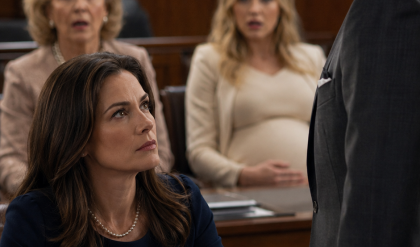
I saw Emily for the first time at the deposition.
She was already seated when I arrived, across the conference table with Patricia Brennan on her left and a second attorney I didn’t recognize on her right. She wore a cream blouse and her hair was pulled back the way she always did it when she was trying to project calm—I knew this because I’d watched her do it before difficult conversations for six years, the particular controlled tidiness she used as armor.
She didn’t look at me when I came in.
I sat down. The court reporter arranged her equipment. Patricia Brennan conferred briefly with her colleague. The morning light came through the blinds in flat, even lines.
Emily looked at the table. I looked at Emily.
Eight months pregnant and still precise in every movement. Still managing the peace, even now, even in this room—keeping her face neutral, her hands still, her presence contained in a way that I knew, from the inside, cost her something.
Under the table, I think, her hands were shaking. I couldn’t see it. I knew it the way I knew all of Emily’s invisible things: because I had spent enough years watching her manage pain quietly that I had learned to read the effort it took.
“Mr. Carter,” Patricia Brennan said, and the deposition began.
I told them about the document. I told them about my conversation with Theodore. I told them what I knew about Dr. Voss and the fertility center and the way my father had quietly redirected a procedure without Emily’s knowledge or mine. I told them about the prenuptial amendment. I told them about the two DUI incidents Theodore had managed to suppress.
I told them I was an alcoholic who had not had a drink in four days and who had spent the previous six months drinking instead of coming home to his pregnant wife.
I told them all of it.
Halfway through, Emily finally looked at me.
I don’t know what I expected. Anger, maybe. I deserved anger. Or worse—the careful absence of expression she used when something hurt too much to react to.
What I saw instead was something I hadn’t anticipated. Not forgiveness—it wasn’t that. It was something earlier than forgiveness. Recognition, maybe. The specific look of someone who has been trying to understand a picture from one angle and suddenly sees it from another, and the new angle doesn’t make anything better but it makes it different, which is its own kind of mercy.
I looked back at the table. Kept talking.
Theodore’s lawyers attempted to characterize my testimony as the desperation of a man trying to rehabilitate his image. That wasn’t entirely wrong. But the document existed regardless of why I disclosed it, and the fertility center’s records existed, and Dr. Voss—faced with the kind of liability that ends medical careers—confirmed the procedure under his own deposition three days later.
Theodore’s custody petition collapsed the following week.
He called me that night. I answered because I knew he would call and I wanted to be done with it.
“You’ve destroyed this family,” he said.
“You did that,” I said. “I’m just the one who said it out loud.”
“Everything I did was for—”
“Don’t say legacy.” I was sitting on Marcus’s back porch in the dark, watching the lights of the valley below. “Don’t say family. Don’t say any of the words you use to make it sound like it wasn’t about control. Emily was a person. She’s still a person. Harper is going to be a person. You don’t get to arrange people.”
He was quiet for a moment.
“You’re throwing away everything.”
“I know.”
“The company—”
“I know, Theodore.”
“For a woman who’s leaving you.”
I looked at the valley lights. Someone down there was having a regular Tuesday. Someone was watching television, making dinner, going to bed.
“I’m not doing it for her,” I said. It was the truest thing I’d said in years. “I’m doing it because I want to be the kind of person who does it.”
He hung up.
I sat in the dark for a long time.
Part Four: Harper, and After
Emily didn’t call me.
I didn’t expect her to.
She went into labor on a Thursday morning—Claire texted Marcus, who texted me—and I drove to Huntington Hospital and sat in the waiting room for six hours with a cup of terrible coffee and the particular stillness of a man who has run out of things to do except wait and hope he hasn’t ruined the only thing that ever mattered.
Claire found me at hour four.
She sat down without saying anything and handed me a bag of chips from the vending machine, which was, I think, the most complex act of partial forgiveness I’ve ever received from another human being.
“She’s doing well,” Claire said. “It’s going normally.”
“Okay.”
“You should know she read the deposition transcript.”
I looked at her.
“Her lawyer gave it to her. After everything was filed.” Claire was looking at the opposite wall. “She called me after. She didn’t say a lot.” She paused. “She said it was the first time she felt like she knew what kind of person you were trying to be.”
I put that in my pocket and kept it there.
Harper Rose Carter was born at 4:47 in the afternoon. Seven pounds, two ounces. Emily was in recovery when a nurse came out to tell me, and the nurse seemed mildly confused about the geometry of my situation—the man in the waiting room, the woman’s sister who had appointed herself intermediary, the careful distance maintained by everyone involved.
“Mom and baby are doing well,” the nurse said. “Are you—?”
“I’m her father,” I said. It came out clean and sure. “I’ll wait.”
Emily let me come in two hours later.
The room was quiet and lit warmly and Harper was asleep in the bassinet next to the bed, wrapped in a white blanket with a small striped hat on her head. She had Emily’s nose. She had Emily’s particular quality of stillness—even at two hours old, she seemed like someone who was paying careful attention to things.
Emily looked exhausted. The real kind, the kind that goes all the way down.
I stood just inside the door. I didn’t know where to put my hands.
“You don’t have to—” Emily started.
“I know,” I said.
She looked at me for a moment. The same way she’d looked at me across the deposition table, that slight recalibration, the new angle.
“Thank you,” she said. “For the deposition.”
“You deserved to have the right information.”
“Jake.” She said my name and I went still. “I know why you did it. And I know it wasn’t—I know it wasn’t nothing.”
I crossed the room and sat in the chair beside the bed, not too close, the right distance for a man who has given up the right to close distances and is trying to respect that.
“She’s beautiful,” I said.
Emily looked at Harper. “She is.”
We sat in the particular silence of two people who have been through something very large and have not yet figured out what they are to each other on the other side.
“I have a therapist,” I said. “I started Tuesday.”
Emily looked at me.
“And I called a treatment program. For the drinking. I’m on the waiting list.” I looked at my hands. “I’m not telling you because—it’s not leverage. I’m not using it. I just want you to know that it’s happening.”
“Okay,” Emily said quietly.
“And the company—Theodore is removing himself from the board. His lawyers advised him it was the only way to manage the liability exposure.” I paused. “I’m probably going to lose the CEO position. The board isn’t thrilled with the last few months of my judgment.”
“Is that—” She stopped. “Are you okay with that?”
The question surprised me. That she would ask. That even now, through everything, her first instinct was to inquire after how I was.
“I think it might be the best thing that could happen to me,” I said honestly.
Harper made a small sound in her bassinet—not waking, just shifting, some unconscious navigation of her new world. Emily and I both looked at her. It was the first time we’d looked at the same thing together in a long time.
“I’m not asking you to forgive me,” I said. “Or to—I’m not asking for anything. You should do whatever makes you and Harper safe and okay. I’ll sign whatever you need, I’ll make whatever agreements, I’ll stay as far away as you want.” I stopped. “I just needed you to know that I’m trying to figure out how to be someone different. Because of her.” I looked at Harper. “And because I want to be him. Not because someone’s watching.”
Emily was quiet for a long time.
“I know,” she said. “I could tell.”
Outside, the California evening was doing its patient thing. The light through the hospital blinds had gone gold.
“I don’t know what we are,” Emily said. “I need—I need time. A lot of it. And I need you to not make promises you can’t keep.”
“I know.”
“And if you drink again—”
“I’ll tell you. I’ll tell you immediately and I’ll get back into treatment.” I met her eyes. “I’m not going to promise you I won’t fail. I’m promising that when I fail, I won’t hide it from you.”
She looked at me for a moment.
“That’s the most honest thing you’ve ever said to me,” she said.
I thought about Claire, telling me the same thing four days ago in different words.
“I’m working on it,” I said.
Epilogue: The Question She Asked
Six weeks later, Emily moved back into the house.
Not into our bedroom—she took the guest suite across the hall, and I moved my things out of the master bathroom, and we arranged a crib in the room between us. Harper slept between us like punctuation in a sentence we were still writing.
It wasn’t forgiveness. It wasn’t reconciliation. Emily’s lawyers and my lawyers were still in regular contact, and the paperwork existed, and the distance between us at the kitchen table was still measured and real.
But she was here. She’d chosen to come back to the house, not to me—to the house, to the kitchen she’d cooked in for six years, to the garden she’d planted, to the nursery she’d rebuilt with new wall letters and a new rocking chair in the same soft yellow.
I came home one evening to find her standing at the kitchen counter with Harper in the crook of one arm, reading something on her phone. The anniversary dinner plates were stacked in the cabinet behind her, back in their regular places after I’d run them through the dishwasher and put them away like a small, wordless act of upkeep.
She looked up when I came in. I was carrying the exact chamomile she liked from a farmer’s market in Monrovia, which I’d driven forty minutes out of my way to find.
I set it on the counter. She looked at it. Some small thing moved through her face.
“How was the drive?” she asked.
“Worth it,” I said.
Harper made a small sound. Emily shifted her in her arm with the unconscious ease of someone who had already learned a new language.
“I’ve been thinking about what you said,” Emily said. “In the hospital.” She looked at the chamomile instead of me. “About trying to be someone different.”
I waited.
“I don’t know if you can,” she said. “I think—I think that’s something you find out, not something you decide.” She looked at me. “But I’d like to see.”
It wasn’t a promise. It wasn’t absolution. It was an open door, held carefully, the way you hold something you’re not ready to put down but aren’t sure you can keep.
“Okay,” I said.
Harper turned her head toward the window, toward the evening light coming through the glass, with the concentrated attention of someone discovering the world for the first time. She had Emily’s nose and Emily’s stillness and, I thought, the beginning of a look that was entirely her own.
On the counter between us: the chamomile, the ordinary kitchen light, and the space we hadn’t yet decided how to fill.
Emily reached out and picked up the chamomile.
“I’ll make tea,” she said.
It wasn’t I forgive you, or I love you still, or we’re going to be okay. It was a woman who had chosen, with full information and clear eyes and the hard-won certainty of someone who had packed a nursery alone at eight months pregnant and come back anyway, to make tea in her own kitchen on a Tuesday evening.
She had asked me once, in careful white icing on a chocolate cake, if I was still the man she’d married.
I wasn’t. That man had been easier and younger and blind to the damage he could do. I was something less finished and more honest, standing in a kitchen that smelled like chamomile and possibility, trying to learn, one ordinary evening at a time, how to be someone worth coming home to.
Harper looked at the light.
Emily made tea.
I stayed.
“Six years ago, I married my best friend. I still love that man. Do you?”
The answer, it turned out, was not something you said. It was something you showed up for—imperfectly, honestly, without promises you couldn’t keep—until the question became the answer.